

Inhibition of Bacterial and Fungal Biofilm Formation by 675 Extracts from Microalgae and Cyanobacteria
Open accessThe DOI matches its Crossref record; 41 of the 42 references it cites were found in a registry or an index, and 1 are not checked yet.
Abstract
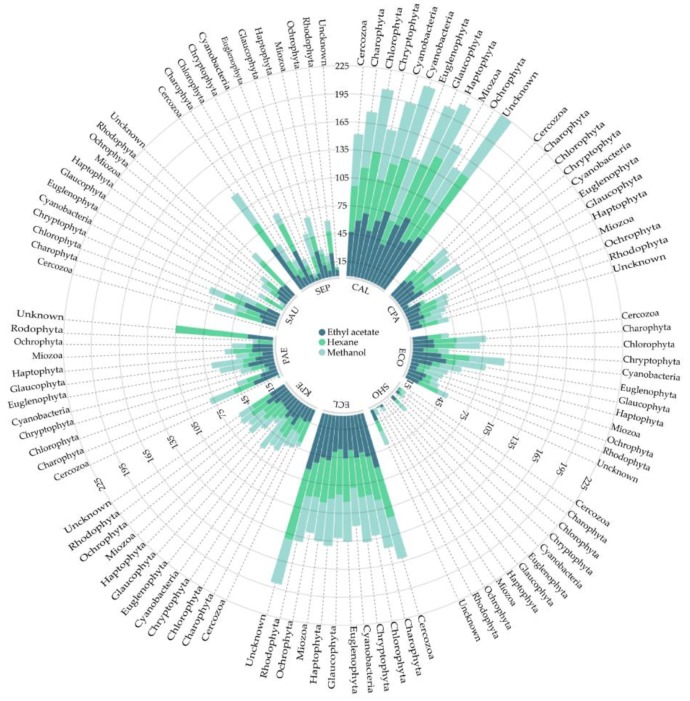
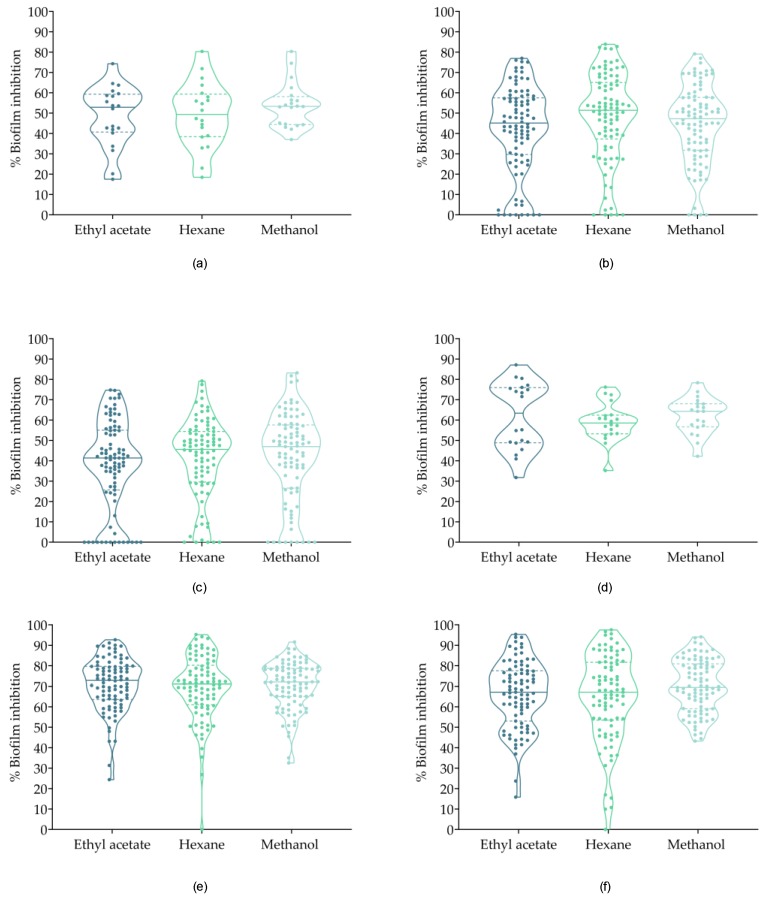
Bacterial biofilms are complex biological systems that are difficult to eradicate at a medical, industrial, or environmental level. Biofilms confer bacteria protection against external factors and antimicrobial treatments. Taking into account that about 80% of human infections are caused by bacterial biofilms, the eradication of these structures is a great priority. Biofilms are resistant to old-generation antibiotics, which has led to the search for new antimicrobials from different sources, including deep oceans/seas. In this study, 675 extracts obtained from 225 cyanobacteria and microalgae species (11 phyla and 6 samples belonging to unknown group) were obtained from different culture collections: The Blue Biotechnology and Ecotoxicology Culture Collection (LEGE-CC), the Coimbra Collection of Algae (ACOI) from Portugal, and the Roscoff Culture Collection (RCC) from France. The largest number of samples was made up of the microalgae phylum Chlorophyta (270) followed by Cyanobacteria (261). To obtain a large range of new bioactive compounds, a method involving three consecutive extractions (hexane, ethyl acetate, and methanol) was used. The antibiofilm activity of extracts was determined against seven different bacterial species and two Candida strains in terms of minimal biofilm inhibitory concentration (MBIC). The highest biofilm inhibition rates (%) were achieved against Candida albicans and Enterobacter cloacae. Charophyta, Chlorophyta, and Cyanobacteria were the most effective against all microorganisms. In particular, extracts of Cercozoa phylum presented the lowest MBIC50 and MBIC90 values for all the strains except C. albicans.
Overview
The claims and statistics of this paper haven’t been checked yet.
Free: it reads the open-access text and checks the first 5 claims that cite a source we can check. Create a free account to check every claim.
Integrity signals
Registry
Cites
Statistics
Figures
Verification
Claims the paper makes
The claims and statistics of this paper haven’t been checked yet.
Free: it reads the open-access text and checks the first 5 claims that cite a source we can check. Create a free account to check every claim.
Claims other papers make about this one
Each is checked against this paper’s own text: does it say what the citing paper says it does?
The cited source says what the claim attributes to it.
In the citing paper
“extracts from a number of species from Charophyta , Chlorophyta, and Cyano bacteria have been shown to inhibit biofilm production in the patho genic yeast Candida albicans and bacterium Enterobacter cloacae (Cepas et al., 2019).”
From Cyanobacteria and microalgae in supporting human habitation on Mars (2022) · cites this paper as Cepas et al., 2019
Self-check
Percentages, sums and reported differences re-computed from the paper’s own numbers.
The self-check needs the paper’s full text.
Citations
Cites
Flemming, H.-C., & Wingender, J. (2010) · Nature Reviews Microbiology · doi:10.1038/nrmicro2415 · Cited by 10,137
Biofilms: Survival Mechanisms of Clinically Relevant Microorganisms
Donlan, R. M., & Costerton, J. W. (2002) · Clinical Microbiology Reviews · doi:10.1128/cmr.15.2.167-193.2002 · Cited by 6,644 · cited 1×
“Biofilms have the capacity to attach to both biotic and abiotic surfaces, increasing the colonization of medical devices such as urinary and intravenous catheters, mechanical heart valves, endotracheal tubes, and prosthesis joints [5].”
BackgroundPrimary production of the biosphere: Integrating terrestrial and oceanic components
Field, C. B., Behrenfeld, M. J., Randerson, J. T., & Falkowski, P. (1998) · Science · doi:10.1126/science.281.5374.237 · Cited by 6,371
Faulkner, D. J. (1990) · Natural Product Reports · doi:10.1039/np9900700269 · Cited by 4,866
Hidden Killers: Human Fungal Infections
Brown, G. D., Denning, D. W., Gow, N. A. R., Levitz, S. M., Netea, M. G., & White, T. C. (2012) · Science Translational Medicine · doi:10.1126/scitranslmed.3004404 · Cited by 4,284
Antibiotic resistance of bacterial biofilms
Høiby, N., Bjarnsholt, T., Givskov, M., Molin, S., & Ciofu, O. (2010) · International Journal of Antimicrobial Agents · doi:10.1016/j.ijantimicag.2009.12.011 · Cited by 3,225
Bacterial adhesion and biofilms on surfaces
Garrett, T. R., Bhakoo, M., & Zhang, Z. (2008) · Progress in Natural Science · doi:10.1016/j.pnsc.2008.04.001 · Cited by 1,129
(2022) · Microbiology Spectrum · doi:10.1128/microbiolspec · Cited by 689
Bioactive compounds from cyanobacteria and microalgae: an overview
Singh, S., Kate, B. N., & Banerjee, U. C. (2005) · Critical Reviews in Biotechnology · doi:10.1080/07388550500248498 · Cited by 619
A Fatty Acid Messenger Is Responsible for Inducing Dispersion in Microbial Biofilms
Davies, D. G., & Marques, C. N. H. (2009) · Journal of Bacteriology · doi:10.1128/jb.01214-08 · Cited by 603
Research works printed but not linked: 1
- Clinical and Laboratory Standards Institute (CLSI) Performance Standards for Antimicrobial Susceptibility Testing 24th Information Supplement, M100-S24, vol. 34, no. 1 Clinical and Laboratory Standards Institute Wayne, PA, USA 2014
Cited by
Biofouling and me: My Stockholm syndrome with biofilms
Flemming, H.-C. (2020) · Water Research · doi:10.1016/j.watres.2020.115576 · Cited by 211
Using inorganic nanoparticles to fight fungal infections in the antimicrobial resistant era
Huang, T., Li, X., Maier, M., O’brien-simpson, N. M., Heath, D. E., & O’Connor, A. J. (2023) · Acta Biomaterialia · doi:10.1016/j.actbio.2023.01.019 · Cited by 123
Cyanobacteria and microalgae in supporting human habitation on Mars
Mapstone, L. J., Leite, M. N., Purton, S., Crawford, I. A., & Dartnell, L. (2022) · Biotechnology Advances · doi:10.1016/j.biotechadv.2022.107946 · Cited by 92
“In addition to possessing anti-cancer and anti-viral potential, extracts from a number of species from Charophyta , Chlorophyta, and Cyano-bacteria have been shown to inhibit biofilm production in the pathogenic yeast Candida albicans and bacterium Enterobacter cloacae (Cepas et al., 2019).”
Bioprospecting for bioactive compounds in microalgae: Antimicrobial compounds
Stirk, W. A., & van Staden, J. (2022) · Biotechnology Advances · doi:10.1016/j.biotechadv.2022.107977 · Cited by 76
Anti-biofilm activity of marine algae-derived bioactive compounds
Behzadnia, A., Moosavi‐Nasab, M., & Oliyaei, N. (2024) · Frontiers in Microbiology · doi:10.3389/fmicb.2024.1270174 · Cited by 87
Cepas, V., Gutiérrez‐del‐Río, I., López, Y., Redondo-Blanco, S., Gabasa, Y., Iglesias, M. J., Soengas, R. G., Fernández-Lorenzo, A., López‐Ibáñez, S., Villar, C. J., et al. (2021) · Marine Drugs · doi:10.3390/md19120675 · Cited by 77
Self-citationSampathkumar, S. J., Srivastava, P., Ramachandran, S., Sivashanmugam, K., & Muthukaliannan, G. K. (2019) · Microbial Pathogenesis · doi:10.1016/j.micpath.2019.103658 · Cited by 61
Recent Advances in Photodynamic Therapy against Fungal Keratitis
Hung, J., Lee, C., Hsu, H., Ng, I., Wu, C., Yu, C., Lee, N., Chang, Y. H., & Wong, T. (2021) · Pharmaceutics · doi:10.3390/pharmaceutics13122011 · Cited by 50
Butassi, E., Svetaz, L. A., Carpinella, M. C., Efferth, T., & Zacchino, S. A. (2021) · Antibiotics · doi:10.3390/antibiotics10091053 · Cited by 43
The Usefulness of Microalgae Compounds for Preventing Biofilm Infections
López, Y., & Soto, S. M. (2019) · Antibiotics · doi:10.3390/antibiotics9010009 · Cited by 72
Self-citationThe origin and evolution of cell-intrinsic antibacterial defenses in eukaryotes
Richter, D. J., & Levin, T. C. (2019) · Current Opinion in Genetics & Development · doi:10.1016/j.gde.2019.09.002 · Cited by 28
Michelon, W., da Silva, M. L. B., Matthiensen, A., da Silva, E. A., Pilau, E. J., Nunes, E. D. O., & Soares, H. M. (2021) · Chemosphere · doi:10.1016/j.chemosphere.2021.131268 · Cited by 27
Ilieva, Y. E., Zaharieva, M. M., Kroumov, A. D., & Najdenski, H. M. (2024) · Fermentation · doi:10.3390/fermentation10070341 · Cited by 26
Gutiérrez‐del‐Río, I., de Fraissinette, N. B., Castelo‐Branco, R., de Oliveira, F. L., Morais, J., Redondo-Blanco, S., Villar, C. J., Iglesias, M. J., Soengas, R. G., Cepas, V., et al. (2020) · Journal of Natural Products · doi:10.1021/acs.jnatprod.0c00072 · Cited by 25
Self-citationAli, S., Waqas, W., Bakky, M. A. H., Zada, S., Saif, U. M., Hasan, M. T., Shafiq, M., Dildar, T., & Hui, W. (2024) · Reviews in Aquaculture · doi:10.1111/raq.12980 · Cited by 25
Innovative Strategies to Overcome Antimicrobial Resistance and Tolerance
Choudhary, M. I., Römling, U., Nadeem, F., Bilal, H. M., Zafar, M., Jahan, H., & Rahman, A. (2022) · Microorganisms · doi:10.3390/microorganisms11010016 · Cited by 24
Ballén, V., Ratia, C., Cepas, V., & Soto, S. M. (2020) · Biofouling · doi:10.1080/08927014.2020.1824272 · Cited by 21
Self-citationVohník, M. (2021) · Biogeosciences · doi:10.5194/bg-18-2777-2021 · Cited by 19
Mushtaq, S., Ahmad, N. M., Nasir, H., Mahmood, A., & Janjua, H. A. (2020) · Advances in Polymer Technology · doi:10.1155/2020/5392074 · Cited by 18
Transposon Insertion in the purL Gene Induces Biofilm Depletion in Escherichia coli ATCC 25922
Cepas, V., Ballén, V., Gabasa, Y., Ramírez, M., López, Y., & Soto, S. M. (2020) · Pathogens · doi:10.3390/pathogens9090774 · Cited by 17
Self-citationBarone, M. E., Murphy, E., Parkes, R., Fleming, G. T. A., Campanile, F., Thomas, O., & Touzet, N. (2021) · International Journal of Molecular Sciences · doi:10.3390/ijms222212196 · Cited by 17
Prospect of nanomaterials as antimicrobial and antiviral regimen
Chakraborty, A. K., Diwan, A. R., & Tatake, J. (2023) · AIMS Microbiology · doi:10.3934/microbiol.2023024 · Cited by 15
Biosensors at the crossroads of food safety and antimicrobial resistance control in Africa
Olaifa, K. W., & Ikusika, E. O. (2025) · Discover Electrochemistry. · doi:10.1007/s44373-025-00061-7 · Cited by 15
Martins, C. B., Ferreira, O., Rosado, T., Gallardo, E., Silvestre, S., & Santos, L. M. A. (2021) · Biotechnology Letters · doi:10.1007/s10529-021-03122-0 · Cited by 13
Self-citationMohamed, H., Marusich, E., Дивашук, М. Г., & Leonov, S. V. (2024) · Frontiers in Cellular and Infection Microbiology · doi:10.3389/fcimb.2024.1408179 · Cited by 11
Antibiofilm and Anti-Candidal Activities of the Extract of the Marine Sponge Agelas dispar
Júnior, A. C. V., Pontes, M. D. C. N. D., Barbosa, J. P., Höfling, J. F., Araújo, R. M., Boniek, D., de Resende, M. A., & Andrade, V. S. (2021) · Mycopathologia · doi:10.1007/s11046-021-00591-9 · Cited by 10
Hanif, N., Miftah, J. A., Yanti, H. D., Oluwabusola, E. T., Zahra, V. A., Salleh, N. F., Kundukad, B., Tan, L. T., de Voogd, N. J., Mubarik, N. R., et al. (2025) · Molecules · doi:10.3390/molecules30061202 · Cited by 9
Horváth, Á. N., Németh, L., Vörös, L., Stirk, W. A., Staden, J. V., & Ördög, V. (2023) · Phytoparasitica · doi:10.1007/s12600-023-01045-2 · Cited by 9
Microalgae and Cyanobacteria, a Promising Source of Antimicrobial Molecules Against Aquatic Pathogen
Torres-Bayona, C., Rojas, J. L., Fernandez, R., Prieto‐Guevara, M. J., Pulido-Rojano, A. D., & Moreno‐Garrido, I. (2022) · Turkish Journal of Fisheries and Aquatic Sciences · doi:10.4194/trjfas21184 · Cited by 8
Antimicrobial activity of Cyanobacteria-derived compounds
Gómez-Espinoza, O., Núñez-Montero, K., & Barrientos, L. (2022) · Elsevier eBooks · doi:10.1016/b978-0-12-821491-6.00006-5 · Cited by 6
Abdel-Rahman, S., Ghareeb, M. A., Mohsen, E., Hamed, A. A., & El‐Hawary, S. S. (2023) · Journal of Applied Pharmaceutical Science · doi:10.7324/japs.2023.128836 · Cited by 5
Al-Ogaidi, D. A. H., Karaçam, S., Gurbanov, R., & Vardar-Yel, N. (2024) · Current Pharmaceutical Biotechnology · doi:10.2174/0113892010291960240223054911 · Cited by 4
Ikhane, A. O., Osunsanmi, F. O., Mosa, R. A., & Opoku, A. R. (2025) · Microorganisms · doi:10.3390/microorganisms13010211 · Cited by 3
Tsamo, A. T., Wouamba, S. C. N., Ngoumfo, A. B. M., MAWOUMA, I. J. P., Famuyide, I. M., Njouonkou, A.-L., Ouahouo, B. M. W., Mkounga, P., Dzoyem, J. P., McGaw, L. J., et al. (2025) · South African Journal of Botany · doi:10.1016/j.sajb.2025.11.049 · Cited by 2
Kumari, A., Das, S., Mishra, S., & Rao, K. V. B. (2026) · Chemistry Africa · doi:10.1007/s42250-026-01618-8 · Cited by 2
Iglesias, M. J., Soengas, R. G., Ortiz, F. L., Biondi, N., Tredici, M. R., Gutiérrez‐del‐Río, I., López‐Ibáñez, S., Villar, C. J., Lombó, F., López, Y., et al. (2023) · Journal of Phycology · doi:10.1111/jpy.13316 · Cited by 3
Self-citationUse of Nanomaterials as an Antimicrobial and Antiviral Regimen
Chakraborty, A. K., Diwan, A. R., & Tatake, J. (2023) · Springer eBooks · doi:10.1007/978-3-031-49933-3_3 · Cited by 1
Evidence of use of microalgae as antimicrobial agents
Stirk, W. A., & Staden, J. V. (2025) · Elsevier eBooks · doi:10.1016/b978-0-443-22080-7.00034-x · Cited by 1
Domracheva, L. I., Скугорева, С. Г., Fokina, A. I., Zagoskin, М. A., & Ashikhmina, T. Y. (2021) · South of Russia ecology development · doi:10.18470/1992-1098-2021-1-53-60 · Cited by 1
Investigation of Photodynamic and Rhamnolipid Inhibition on the Dermatophyte Biofilm
Askari, R., Zaboli, F., Pordeli, H., & Kaboosi, H. (2024) · Indian Journal of Microbiology · doi:10.1007/s12088-023-01139-9 · Cited by 1
(2021) · Biogeosciences · doi:10.5194/bg-2020-452-rc2
(2021) · Biogeosciences · doi:10.5194/bg-2020-452-rc1
Fighting the resistance: algae as key organisms against antibacterial resistance;
Monteiro, P. (2021) · Portuguese National Funding Agency for Science, Research and Technology (RCAAP Project by FCT)
Vohník, M. (2021) · Biogeosciences · doi:10.5194/bg-2020-452-ac1
Vohník, M. (2021) · Biogeosciences · doi:10.5194/bg-2020-452-ac2
Gutiérrez‐del‐Río, I., de Fraissinette, N. B., Castelo‐Branco, R., Oliveira, F., Morais, J., Redondo-Blanco, S., Villar, C. J., Iglesias, M. J., Soengas, R. G., Cepas, V., et al. (2020) · ChemRxiv · doi:10.26434/chemrxiv.11619873
Self-citationTherapeutic potential of microalgae and their prospects in targeted delivery in cancer management
Gupta, D., Gadi, V., & Kumar, M. S. (2024) · Elsevier eBooks · doi:10.1016/b978-0-323-95114-2.00021-2
Potential anti-biofilm agents from marine microbes
Taj, Z., & Chattopadhyay, I. (2025) · Elsevier eBooks · doi:10.1016/b978-0-443-26771-0.00014-x
Margalit, A. (2019) · Maynooth University ePrints and eTheses Archive (Maynooth University)
ELECTROANALYSIS OF MICROBIAL BIOFILMS AND ANTIBIOFILM DRUG TESTING
Olaifa, K. W. (2022) · Nazarbayev University Repository (Nazarbayev University)
ALÇİ, G., Keçeli, S., & Dündar, D. (2026) · The Journal of Infection in Developing Countries · doi:10.3855/jidc.23048
Metadata
- Authors
- Cepas, V., López, Y., Gabasa, Y., Martins, C. B., Ferreira, J. D., Correia, M. J., Santos, L. M. A., Oliveira, F., Ramos, V., Reis, M., Castelo-Branco, R., Morais, J., Vasconcelos, V., Probert, I., Guilloud, E., Mehiri, M., & Soto, S. M.
- Affiliations
- Barcelona Institute for Global Health (ES)
- University of Coimbra (PT)
- Centro Interdisciplinar de Investigação Marinha e Ambiental (PT)
- Interdisciplinary Centre of Marine and Environmental Research (CIIMAR), 4450-208 Porto, Portugal
- Universidade do Porto (PT)
- Centre National de la Recherche Scientifique (FR)
- Corresponding author
- Soto, Sara M.
- ORCID
- Venue
- Antibiotics
- Publisher
- MDPI AG
- Published
- 2019-06-12
- Volume
- 8
- Issue
- 2
- Pages
- 77
- ISSN
- 2079-6382 (ISSN-L)
- PMC
- PMC6628188
- OpenAlex
- W2951996946
- Cited by
- 48
- References
- 41
- Citations by year
- 2026: 1 · 2025: 6 · 2024: 7 · 2023: 6 · 2022: 5 · 2021: 13 · 2020: 6 · 2019: 3
- FWCI
- 2.23
- Type
- journal article
- Language
- en
- Open access
- gold
- dx.doi.org
- Licence
- Locations
- Antibiotics (publishedVersion, cc-by)
- PubMed Central (publishedVersion, cc-by)
- PubMed (publishedVersion)
- RECERCAT (Consorci de Serveis Universitaris de Catalunya) (publishedVersion, other-oa)
- HAL (submittedVersion)
- Dipòsit Digital de la Universitat de Barcelona (Universitat de Barcelona) (submittedVersion, cc-by)
- DOAJ (DOAJ: Directory of Open Access Journals) (submittedVersion, cc-by-sa)
- Portuguese National Funding Agency for Science, Research and Technology (RCAAP Project by FCT) (submittedVersion, cc-by)
- Portuguese National Funding Agency for Science, Research and Technology (RCAAP Project by FCT) (submittedVersion, other-oa)
- Funders
- Horizon 2020 Framework Programme (634588)
- Topics
- Life Sciences › Biochemistry, Genetics and Molecular Biology › Molecular Biology › Bacterial biofilms and quorum sensing
- Physical Sciences › Engineering › Ocean Engineering › Marine Biology and Environmental Chemistry
- Life Sciences › Agricultural and Biological Sciences › Aquatic Science › Seaweed-derived Bioactive Compounds
- Keywords
- antibiofilm activity, bacterial biofilms, fungal biofilms, microalgae extracts, Candida albicans, Enterobacter cloacae, Chlorophyta, Cercozoa, charophytes, marine algae, bioactive compounds, culture collection
About these checks
Registry, retraction, Cites and statistics results are computed, not judged, with one exception: a printed reference that no index lists is read once by a model before it counts as a citation error. Claims are extracted by a model and kept only when their quote appears verbatim in the text; each cited source is then checked, with a model’s help, for whether it says what the claim relies on. Those verdicts can be wrong — read the claim’s quote and the cited source before relying on one.
Statistics and arithmetic are recomputed, not judged.
Confidence bands are shown only for fields calibrated on our annotated test set. None is calibrated yet, so no band is shown.
What counts as a claim ›How we measure confidence ›How we check this ›
Are you an author, or do you see a problem with this page? Request a review
Data sources
Bibliographic data: Semantic Scholar, OpenAlex, Crossref.
Contains information from the Semantic Scholar Academic Graph Datasets, made available under the ODC Attribution License (ODC-BY 1.0).
Semantic Scholar’s data is described in: Kinney, R., et al. (2023). The Semantic Scholar Open Data Platform. arXiv:2301.10140.
