

The DOI matches its Crossref record.
Extraction Optimization of Quercus cerris L. Wood Chips: A Comparative Study between Full Factorial Design (FFD) and Artificial Neural Network (ANN)
Open accessAbstract
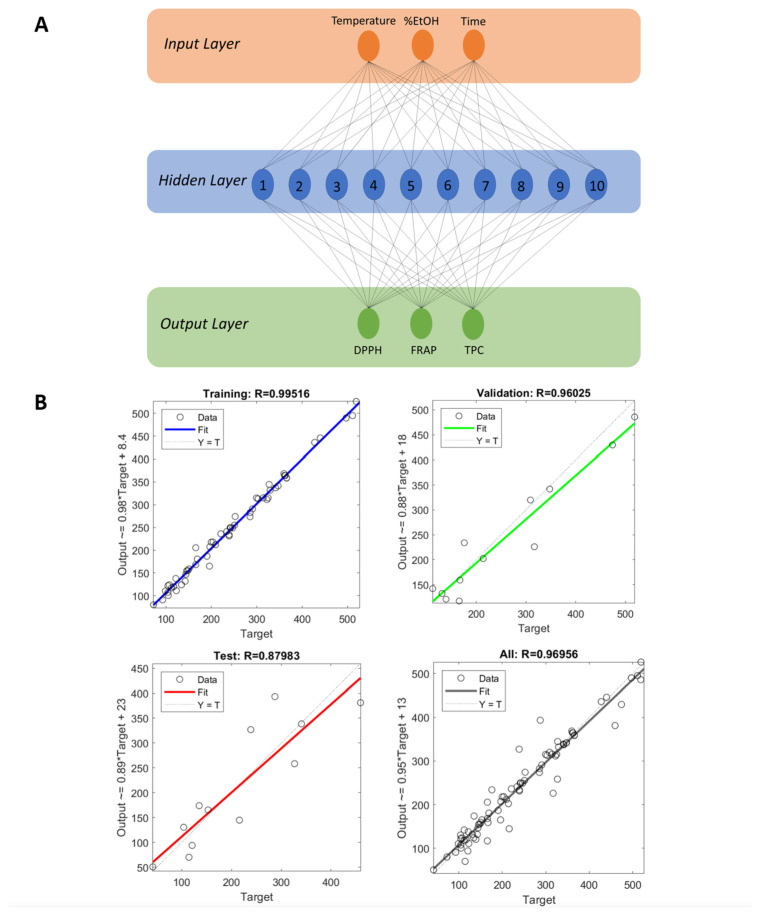
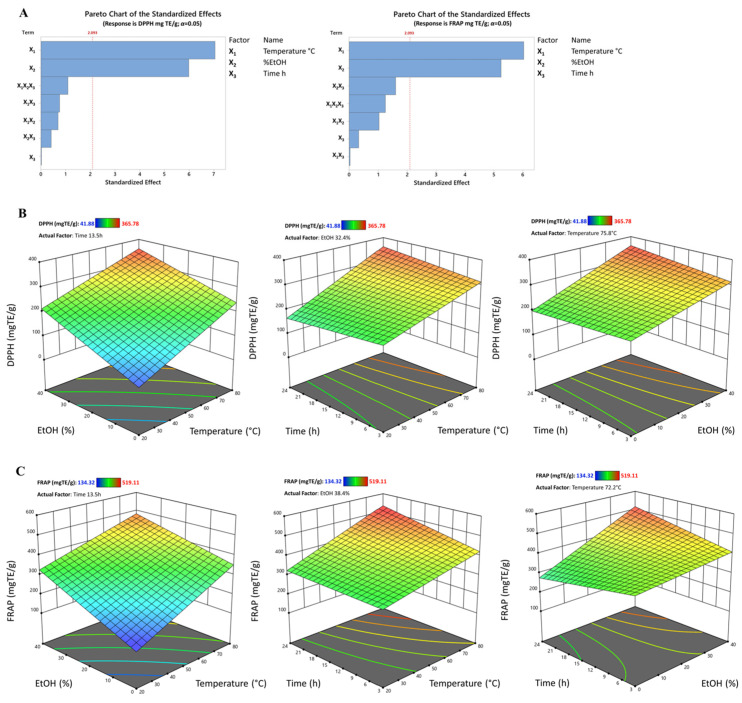
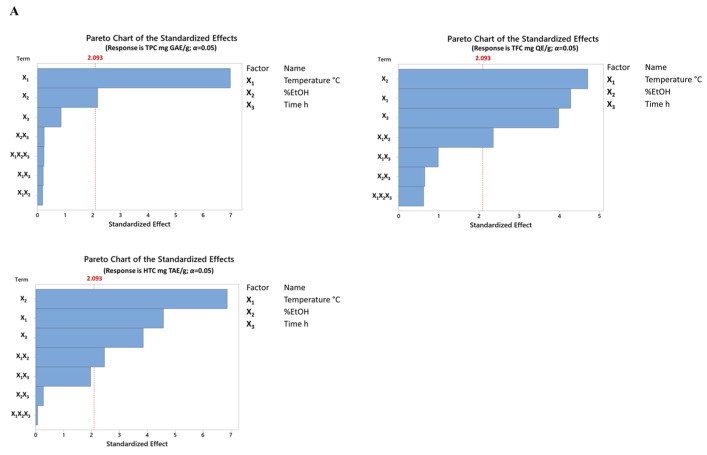
From a circular bio-economy perspective, biomass valorization requires the implementation of increasingly efficient extraction techniques to ensure the environmental and economic sustainability of biorefining processes. This research focuses on optimizing the specialized metabolite extraction of Turkey oak chips from Quercus cerris L. by applying a 3 levels Full Factorial Design (FFD). The goal is to obtain an extract with the highest antioxidant activity [evaluated by 1,1-diphenyl-2-picryl hydrazyl (DPPH) scavenging activity and ferric reducing antioxidant power (FRAP) assays] and specialized metabolites content [measured as total phenolic content (TPC), total flavonoid content (TFC), condensed tannin content (CTC), and hydrolysable tannins content (THC)]. With this objective, three different variables were investigated and compared: temperature (20 °C, 50 °C, 80 °C), solvents EtOH/H2O (0%, 20%, 40%), and time (3 h, 6 h, 24 h), resulting in 27 different extracts. Following the FFD analysis, the optimal extractive conditions were determined to be 80 °C, 40% EtOH/H2O, and 19.8 h. Finally, the prediction ability of FFD was compared with that of artificial neural network (ANN) for DPPH scavenging activity, FRAP, and TPC data based on the coefficient of determination (R2), mean absolute error (MAE), and root mean square error (RMSE). The results indicated that ANN predictions were more precise than FFD ones; however, both methods were useful in optimizing the extraction process as they returned comparable optimized extraction parameters.
Overview
The claims and statistics of this paper haven’t been checked yet.
Run the check — free, no account needed. It reads the open-access text and checks the sources it cites.
Integrity signals
Registry
Cites
Statistics
Figures
Verification
Claims the paper makes
The claims and statistics of this paper haven’t been checked yet.
Run the check — free, no account needed. It reads the open-access text and checks the sources it cites.
Self-check
Percentages, sums and reported differences re-computed from the paper’s own numbers.
The self-check needs the paper’s full text.
Citations
Cites
No references could be resolved yet.
Research works printed but not linked: 30
- Braghiroli, 2020, Valorization of biomass residues from forest operations and wood manufacturing presents a wide range of sustainable and innovative possibilities, Curr. For. Rep., 6, 172, 10.1007/s40725-020-00112-9 · DOI
- Bergamasco, S., Zikeli, F., Vinciguerra, V., Sobolev, A.P., Scarnati, L., Tofani, G., Scarascia Mugnozza, G., and Romagnoli, M. (2023). Extraction and Characterization of Acidolysis Lignin from Turkey Oak (Quercus cerris L.) and Eucalypt (Eucalyptus camaldulensis Dehnh.) Wood from Population Stands in Italy. Polymers, 15. · DOI
- Ianni, F., Segoloni, E., Blasi, F., and Di Maria, F. (2020). Low-Molecular-Weight Phenols Recovery by Eco-Friendly Extraction from Quercus Spp. Wastes: An Analytical and Biomass-Sustainability Evaluation. Processes, 8. · DOI
- Lavisci, 1991, Quality of turkey oak (Quercus cerris L.) wood. II. Analysis of some physico-chemical parameters related to its gluability, J. Holzforsch., 45, 415, 10.1515/hfsg.1991.45.6.415 · DOI
- Bernetti, 1998, Il mercato delle biomasse forestali per scopi energetici: Un modello di offerta, Riv. Di Econ. Agrar., 53, 1
- Bernetti, I., Fagarazzi, C., and Romano, S. (September, January 31). Biomass production as an energy source in coppices of the province of Florence, Italy. Proceedings of the Atti della Sixth Joint Conference on Food, Agriculture and the Environment, Minneapolis, MN, USA.
- Hofmann, 2017, Seasonal changes of natural antioxidant content in the leaves of Hungarian forest trees, Ind. Crops Prod., 98, 53, 10.1016/j.indcrop.2017.01.011 · DOI
- Cetera, 2019, Thermo-treatment affects Quercus cerris L. wood properties and the antioxidant activity and chemical composition of its by-product extracts, Ind. Crops Prod., 130, 380, 10.1016/j.indcrop.2018.12.099 · DOI
- Yang, 2008, Bioavailability issues in studying the health effects of plant polyphenolic compounds, Mol. Nutr. Food Res., 52, S139
- Nisca, A., Ștefănescu, R., Moldovan, C., Mocan, A., Mare, A.D., Ciurea, C.N., Man, A., Muntean, D.-L., and Tanase, C. (2022). Optimization of Microwave Assisted Extraction Conditions to Improve Phenolic Content and In Vitro Antioxidant and Anti-Microbial Activity in Quercus cerris Bark Extracts. Plants, 11. · DOI
- Jadranin, 2007, Influence of thermal treatment on phenolic compounds and antioxidant properties of oak acorns from Serbia, Food Chem., 104, 830, 10.1016/j.foodchem.2007.01.025 · DOI
- Şen, U., Viegas, C., Duarte, M.P., Maurício, E.M., Nobre, C., Correia, R., Pereira, H., and Gonçalves, M. (2023). Maceration of Waste Cork in Binary Hydrophilic Solvents for the Production of Functional Extracts. Environments, 10. · DOI
- Gil, 2012, Ailanthus altissima (Miller) Swingle: A source of bioactive compounds with antioxidant activity, BioResources, 7, 2105
- Anastas, 2010, Green chemistry: Principles and practice, Chem. Soc. Rev., 39, 301, 10.1039/B918763B · DOI · Paper page
- 2019, Optimization of the extraction process of minerals from Salvia officinalis L. using factorial design methodology, Microchem. J., 145, 1224, 10.1016/j.microc.2018.12.047 · DOI
- Faraone, I., Rai, D.K., Chiummiento, L., Fernandez, E., Choudhary, A., Prinzo, F., and Milella, L. (2018). Antioxidant Activity and Phytochemical Characterization of Senecio clivicolus Wedd. Molecules, 23. · DOI
- Libutti, A., Russo, D., Lela, L., Ponticelli, M., Milella, L., and Rivelli, A.R. (2023). Enhancement of Yield, Phytochemical Content and Biological Activity of a Leafy Vegetable (Beta vulgaris L. var. cycla) by Using Organic Amendments as an Alternative to Chemical Fertilizer. Plants, 12. · DOI
- Ahajji, 2009, Influence of heat treatment on antioxidant properties and colour stability of beech and spruce wood and their extractives, Wood Sci. Technol., 43, 69, 10.1007/s00226-008-0208-3 · DOI
- Gironi, 2011, Temperature and solvent effects on polyphenol extraction process from chestnut tree wood, Chem. Eng. Res. Des., 89, 857, 10.1016/j.cherd.2010.11.003 · DOI
- Gortzi, 2013, Effect of artificial ageing using different wood chips on the antioxidant activity, resveratrol and catechin concentration, sensory properties and colour of two Greek red wines, Food Chem., 141, 2887, 10.1016/j.foodchem.2013.05.051 · DOI
- Sen, 2020, Chemical characterization, bioactive and fuel properties of waste cork and phloem fractions from Quercus cerris L. bark, Ind. Crops Prod., 157, 112909, 10.1016/j.indcrop.2020.112909 · DOI
- Yang, 2009, Optimum extraction process of polyphenols from the bark of Phyllanthus emblica L. based on the response surface methodology, J. Sep. Sci., 32, 1437, 10.1002/jssc.200800744 · DOI
- Ștefănescu, R., Ciurea, C.N., Mare, A.D., Man, A., Nisca, A., Nicolescu, A., Mocan, A., Babotă, M., Coman, N.-A., and Tanase, C. (2022). Quercus Robur Older Bark—A Source of Polyphenolic Extracts with Biological Activities. Appl. Sci., 12. · DOI
- Ferreira, 2020, In Vitro Screening for Acetylcholinesterase Inhibition and Antioxidant Activity of Quercus suber Cork and Corkback Extracts, Evid.-Based Complement. Altern. Med., 2020, 3825629, 10.1155/2020/3825629 · DOI
- Bajraktari, 2018, Chemical characterization, hardness and termite resistance of Quercus cerris heartwood from Kosovo, Maderas. Cienc. Y Tecnol., 20, 305
- Todaro, 2017, Effects of thermo-vacuum treatment on secondary metabolite content and antioxidant activity of poplar (Populus nigra L.) wood extracts, Ind. Crops Prod., 109, 384, 10.1016/j.indcrop.2017.08.052 · DOI
- Khanbabaee, 2001, Tannins: Classification and definition, Nat. Prod. Rep., 18, 641, 10.1039/b101061l · DOI
- Shahidi, 2015, Measurement of antioxidant activity, J. Funct. Foods, 18, 757, 10.1016/j.jff.2015.01.047 · DOI
- Gammoudi, 2021, Modeling and optimization of capsaicin extraction from Capsicum annuum L. using response surface methodology (RSM), artificial neural network (ANN), and Simulink simulation, Ind. Crops Prod., 171, 113869, 10.1016/j.indcrop.2021.113869 · DOI
- Youssefi, 2009, Comparison of artificial neural network (ANN) and response surface methodology (RSM) in the prediction of quality parameters of spray-dried pomegranate juice, Dry. Technol., 27, 910, 10.1080/07373930902988247 · DOI
Cited by
Sorted by citations
Allolinggi, G. S., & Setyani, W. (2025) · Natural Sciences Engineering and Technology Journal · doi:10.37275/nasetjournal.v5i1.64 · Cited by 2
Metadata
- Authors
- Ponticelli, M., Carlucci, V., Mecca, M., Todaro, L., Milella, L., & Russo, D.
- Affiliations
- University of Basilicata (IT)
- Centro di Riferimento Oncologico della Basilicata (IT)
- Corresponding author
- Milella, Luigi
- Venue
- Antioxidants
- Publisher
- MDPI AG
- Published
- 2024-09-14
- Volume
- 13
- Issue
- 9
- Pages
- 1115
- ISSN
- 2076-3921 (ISSN-L)
- PMC
- PMC11428725
- OpenAlex
- W4402820253
- Cited by
- 11
- References
- 0
- Citations by year
- 2026: 4 · 2025: 5 · 2024: 1
- FWCI
- 2.12
- Type
- journal article
- Language
- en
- Open access
- gold
- doi.org
- Licence
- Locations
- Antioxidants (publishedVersion, cc-by)
- PubMed Central (publishedVersion, cc-by)
- PubMed (publishedVersion)
- CINECA IRIS Institutional Research Information System (University of Basilicata) (submittedVersion, cc-by)
- DOAJ (DOAJ: Directory of Open Access Journals) (submittedVersion, cc-by-sa)
- CINECA IRIS Institutial Research Information System (University of Genoa) (submittedVersion, other-oa)
- Funders
- Regione Basilicata (CUP: G49J19001350004, 527/2019)
- DGR (CUP: G49J19001350004, 527/2019)
- Topics
- Health Sciences › Medicine › Biochemistry (medical) › Phytochemicals and Antioxidant Activities
- Life Sciences › Agricultural and Biological Sciences › Food Science › Agricultural and Biological Research
- Life Sciences › Agricultural and Biological Sciences › Forestry › Wood Residue Utilization and Solid Biofuels
- Keywords
- Quercus cerris, extraction optimization, full factorial design, artificial neural networks, antioxidant activity, total phenolic content, total flavonoid content, proanthocyanidins, hydrolysable tannins, ethanol-water solvent, extraction temperature, extraction time, secondary metabolites, biomass valorization, biorefining
About these checks
Registry, retraction, Cites and statistics results are computed, not judged, with one exception: a printed reference that no index lists is read once by a model before it counts as a citation error. Claims are extracted by a model and kept only when their quote appears verbatim in the text; each cited source is then checked, with a model’s help, for whether it says what the claim relies on. Those verdicts can be wrong — read the claim’s quote and the cited source before relying on one.
Statistics and arithmetic are recomputed, not judged.
Confidence bands are shown only for fields calibrated on our annotated test set. None is calibrated yet, so no band is shown.
What counts as a claim ›How we measure confidence ›How we check this ›
Are you an author, or do you see a problem with this page? Request a review
