

The DOI matches its Crossref record; 63 of the 65 references it cites were found in a registry or an index.
The Effects of Allicin, a Reactive Sulfur Species from Garlic, on a Selection of Mammalian Cell Lines
Open accessAbstract
Garlic (Allium sativum L.) has been used as a spice and medicinal plant since ancient times. Garlic produces the thiol-reactive defence substance, allicin, upon wounding. The effects of allicin on human lung epithelium carcinoma (A549), mouse fibroblast (3T3), human umbilical vein endothelial cell (HUVEC), human colon carcinoma (HT29) and human breast cancer (MCF7) cell lines were tested. To estimate toxic effects of allicin, we used a standard MTT-test (methylthiazoltetrazolium) for cell viability and 3H-thymidine incorporation for cell proliferation. The glutathione pool was measured using monobromobimane and the formation of reactive species was identified using 2′,7′-dichlorofluoresceine-diacetate. The YO-PRO-1 iodide staining procedure was used to estimate apoptosis. Allicin reduced cell viability and cell proliferation in a concentration dependent manner. In the bimane test, it was observed that cells treated with allicin showed reduced fluorescence, suggesting glutathione oxidation. The cell lines tested differed in sensitivity to allicin in regard to viability, cell proliferation and glutathione oxidation. The 3T3 and MCF-7 cells showed a higher proportion of apoptosis compared to the other cell types. These data show that mammalian cell lines differ in their sensitivity and responses to allicin.
Overview
The claims and statistics of this paper haven’t been checked yet.
Run the check — free, no account needed. It reads the open-access text and checks the sources it cites.
Integrity signals
Registry
Cites
Statistics
Figures
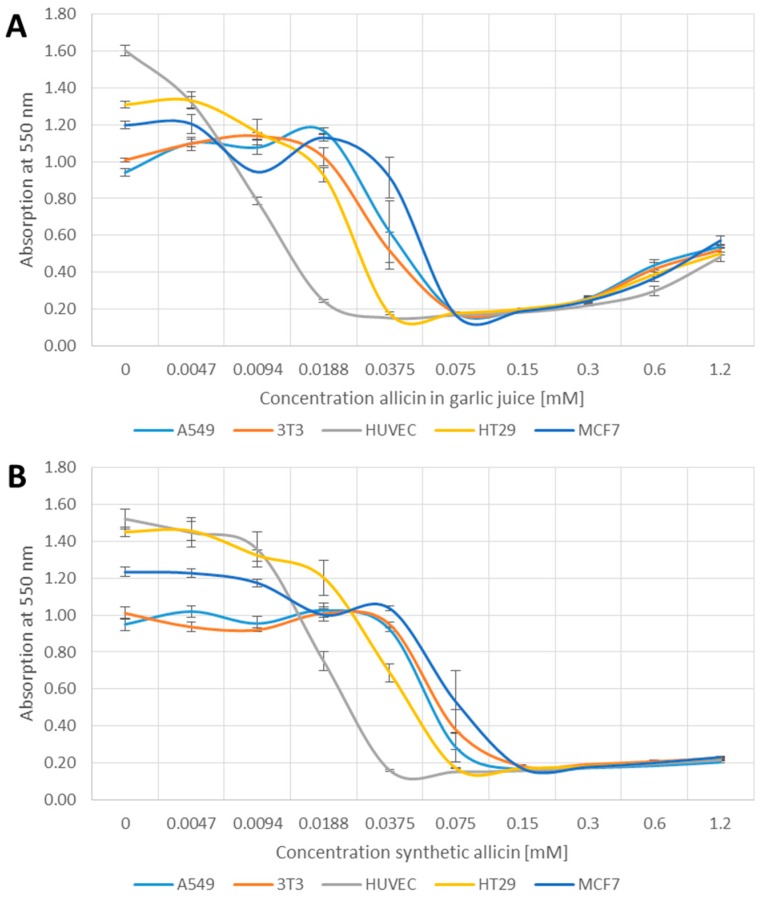
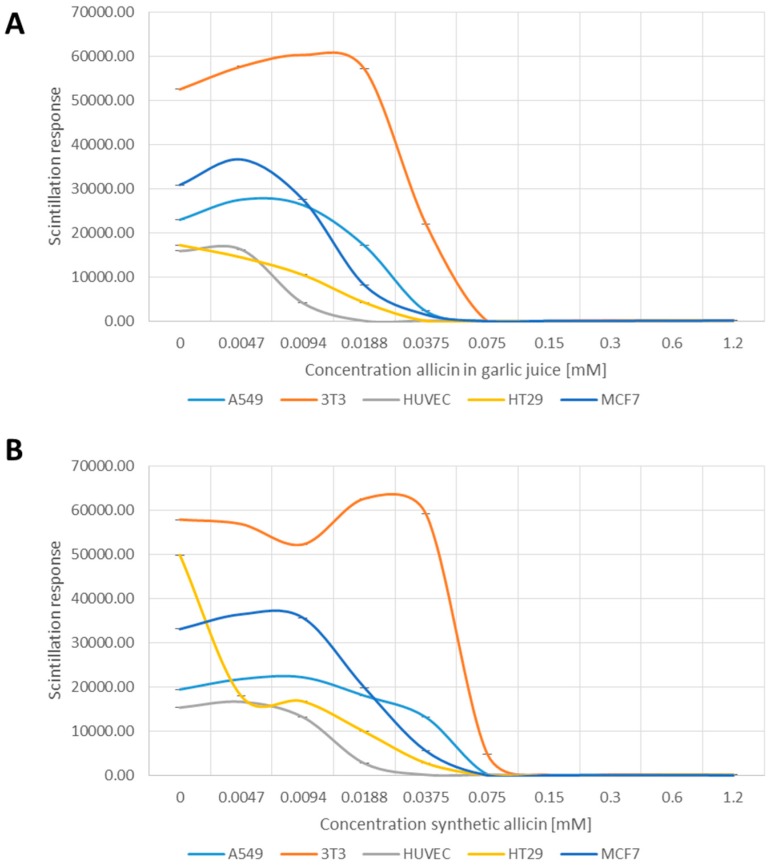
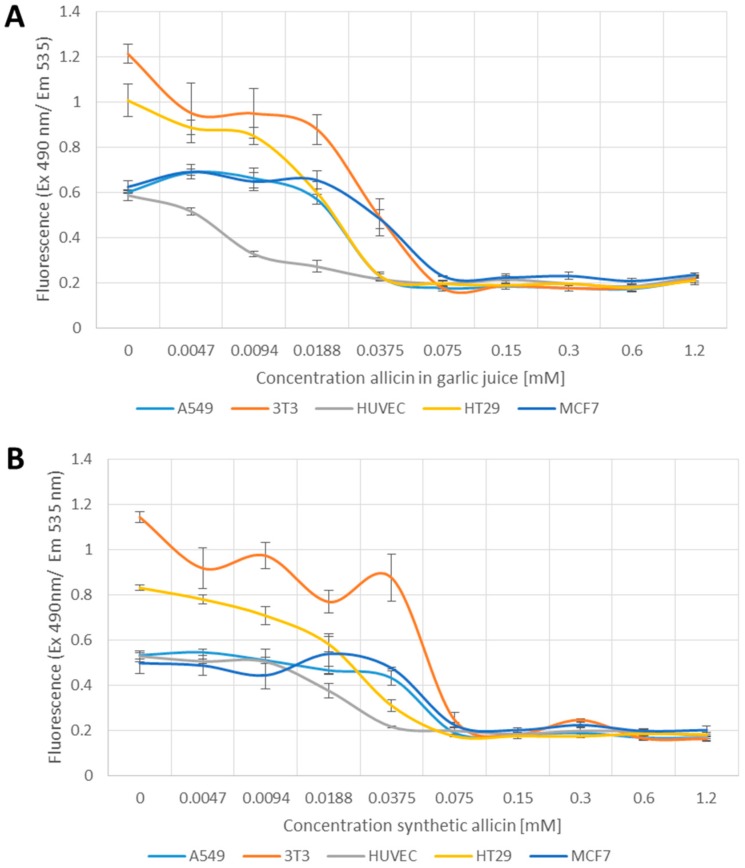
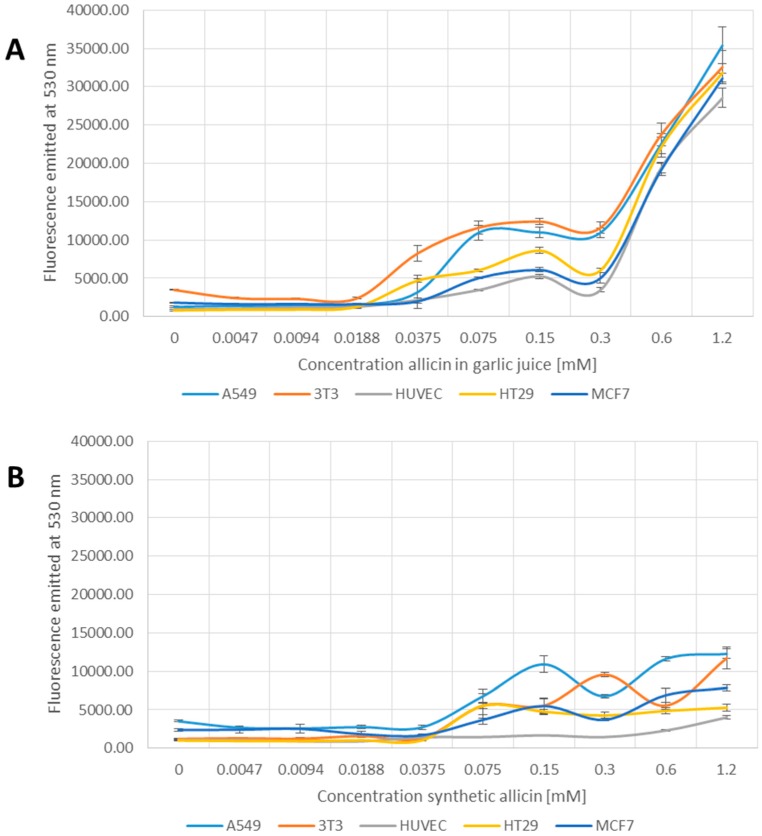
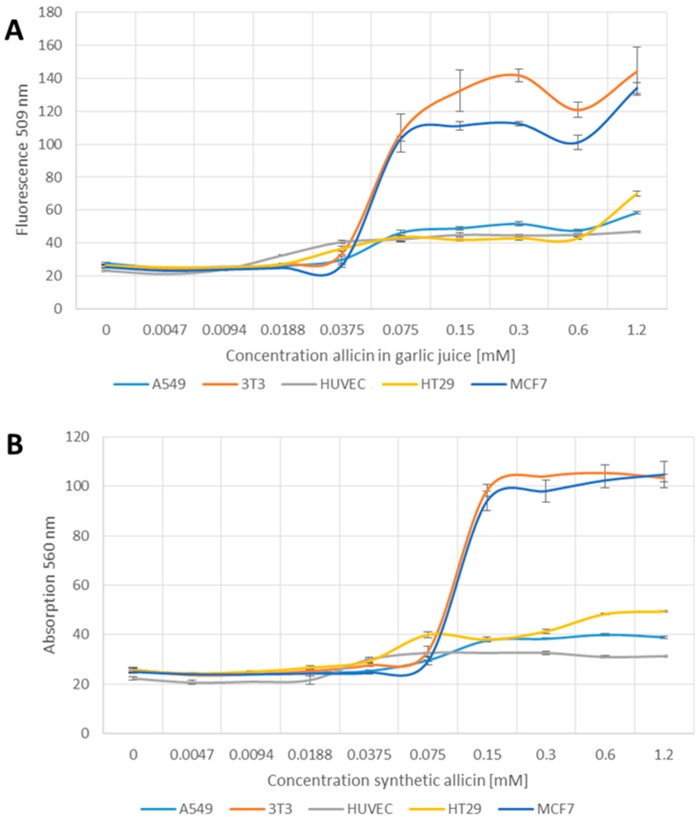
Verification
Claims the paper makes
The claims and statistics of this paper haven’t been checked yet.
Run the check — free, no account needed. It reads the open-access text and checks the sources it cites.
Claims other papers make about this one
Each is checked against this paper’s own text: does it say what the citing paper says it does?
The cited source says what the claim attributes to it.
In the citing paper
“Allicin is a membrane-permeable compound that can enter cells easily and interact with cellular thiols such as glutathione or cysteine residues in proteins [37,89,90] as well as enzymes containing reactive cysteine and this may be the potential interpretation of allicin’s toxicity [63].”
From Chemical Constituents and Pharmacological Activities of Garlic (Allium sativum L.): A Review (2020) · cites this paper as [63]
In the citing paper
“Interestingly, in 1960, tumor cells were reported to be killed when incubated in an allicin solution [63].”
From Chemical Constituents and Pharmacological Activities of Garlic (Allium sativum L.): A Review (2020) · cites this paper as [63]
Self-check
Percentages, sums and reported differences re-computed from the paper’s own numbers.
The self-check needs the paper’s full text.
Citations
Cites
Schafer, F. Q., & Buettner, G. R. (2001) · Free Radical Biology and Medicine · doi:10.1016/s0891-5849(01)00480-4 · Cited by 4,587
Wang, H., & Joseph, J. A. (1999) · Free Radical Biology and Medicine · doi:10.1016/s0891-5849(99)00107-0 · Cited by 2,355
Health-promoting properties of common herbs
Craig, W. J. (1999) · American Journal of Clinical Nutrition · doi:10.1093/ajcn/70.3.491s · Cited by 1,103
Allicin: Chemistry and biological properties
Borlinghaus, J., Albrecht, F., Gruhlke, M., Nwachukwu, I., & Slusarenko, A. (2014) · Molecules · doi:10.3390/molecules190812591 · Cited by 893
Self-citationCavallito, C. J., & Bailey, J. H. (1944) · Journal of the American Chemical Society · doi:10.1021/ja01239a048 · Cited by 770
Surh, Y., Kundu, J. K., & Na, H. (2008) · Planta Medica · doi:10.1055/s-0028-1088302 · Cited by 758
Myhre, O., Andersen, J. M., Aarnes, H., & Fonnum, F. (2003) · Biochemical Pharmacology · doi:10.1016/s0006-2952(03)00083-2 · Cited by 624
Phenolics as antioxidants in garlic (Allium sativum L., Alliaceae)
Božin, B. N., Mimica–Dukić, N., Samojlik, I., Goran, A., & Igić, R. (2008) · Food Chemistry · doi:10.1016/j.foodchem.2008.04.071 · Cited by 453
Garlic as an antioxidant: the good, the bad and the ugly
Banerjee, S., Mukherjee, P. K., & Maulik, S. (2003) · Phytotherapy Research · doi:10.1002/ptr.1281 · Cited by 424
Effect of Garlic on Total Serum Cholesterol
Warshafsky, S., Kamer, R. S., & Sivak, S. L. (1993) · Annals of Internal Medicine · doi:10.7326/0003-4819-119-7_part_1-199310010-00009 · Cited by 372
Cited by
Sorted by citations
Chemical Constituents and Pharmacological Activities of Garlic (Allium sativum L.): A Review
El-Saber Batiha, G., Magdy Beshbishy, A., G. Wasef, L., Elewa, Y. H. A., A. Al-Sagan, A., Abd El-Hack, M. E., Taha, A. E., M. Abd-Elhakim, Y., & Prasad Devkota, H. (2020) · Nutrients · doi:10.3390/nu12030872 · Cited by 931
Antioxidant, Antimicrobial and Antiviral Properties of Herbal Materials
Parham, S., Kharazi, A. Z., Bakhsheshi‐Rad, H. R., Nur, H., Ismail, A. F., Sharif, S., Ramakrishna, S., & Berto, F. (2020) · Antioxidants · doi:10.3390/antiox9121309 · Cited by 535
Allicin and health: A comprehensive review
Salehi, B., Zucca, P., Orhan, İ. E., Azzini, E., Adetunji, C. O., Mohammed, S. A., Banerjee, S., Sharopov, F. S., Rigano, D., Sharifi‐Rad, J., et al. (2019) · Trends in Food Science & Technology · doi:10.1016/j.tifs.2019.03.003 · Cited by 260
Biological, nutritional, and therapeutic significance of Moringa oleifera Lam
Dhakad, A. K., Ikram, M., Sharma, S., Khan, S., Pandey, V. V., & Singh, A. (2019) · Phytotherapy Research · doi:10.1002/ptr.6475 · Cited by 240
A Comparison of the Antibacterial and Antifungal Activities of Thiosulfinate Analogues of Allicin
Leontiev, R., Hohaus, N., Jacob, C., Gruhlke, M. C. H., & Slusarenko, A. J. (2018) · Scientific Reports · doi:10.1038/s41598-018-25154-9 · Cited by 217
Self-citation
Metadata
- Authors
- Gruhlke, M., Nicco, C., Batteux, F., & Slusarenko, A.
- Affiliations
- RWTH Aachen University (DE)
- Hôpital Cochin (FR)
- Laboratoire d’Immunologie biologique, Hôpital Cochin, Paris 75679, France
- Corresponding author
- Gruhlke, Martin
- Venue
- Antioxidants
- Publisher
- MDPI AG
- Published
- 2016-12-26
- Volume
- 6
- Issue
- 1
- Pages
- 1
- ISSN
- 2076-3921 (ISSN-L)
- PMC
- PMC5384165
- OpenAlex
- W2562413929
- Cited by
- 165
- References
- 65
- Citations by year
- 2026: 8 · 2025: 13 · 2024: 18 · 2023: 12 · 2022: 16 · 2021: 32 · 2020: 21 · 2019: 21 · 2018: 14 · 2017: 10
- FWCI
- 17.57
- Type
- journal article
- Language
- en
- Open access
- gold
- doi.org
- Licence
- Locations
- Antioxidants (publishedVersion, cc-by)
- PubMed Central (publishedVersion, cc-by)
- PubMed (publishedVersion)
- DOAJ (DOAJ: Directory of Open Access Journals) (submittedVersion)
- RWTH Publications (RWTH Aachen) (submittedVersion, other-oa)
- RWTH Publications (RWTH Aachen)
- Funders
- European Commission (215009)
- RWTH Aachen University
- Topics
- Life Sciences › Agricultural and Biological Sciences › Plant Science › Garlic and Onion Studies
- Life Sciences › Biochemistry, Genetics and Molecular Biology › Molecular Biology › Genomics, phytochemicals, and oxidative stress
- Life Sciences › Biochemistry, Genetics and Molecular Biology › Biochemistry › Sulfur Compounds in Biology
- Keywords
- allicin, garlic, reactive sulfur species, cell viability, cell proliferation, glutathione oxidation, apoptosis, A549 cells, 3T3 fibroblasts, human umbilical vein endothelial cells, HT-29 cells, MCF-7 cells, cytotoxicity, cell line sensitivity
About these checks
Registry, retraction, Cites and statistics results are computed, not judged, with one exception: a printed reference that no index lists is read once by a model before it counts as a citation error. Claims are extracted by a model and kept only when their quote appears verbatim in the text; each cited source is then checked, with a model’s help, for whether it says what the claim relies on. Those verdicts can be wrong — read the claim’s quote and the cited source before relying on one.
Statistics and arithmetic are recomputed, not judged.
Confidence bands are shown only for fields calibrated on our annotated test set. None is calibrated yet, so no band is shown.
What counts as a claim ›How we measure confidence ›How we check this ›
Are you an author, or do you see a problem with this page? Request a review
