

Performance Evolution of Recycled Aggregate Concrete under the Coupled Effect of Freeze–Thaw Cycles and Sulfate Attack
Open accessThe DOI matches its Crossref record; 39 of the 40 references it cites were found in a registry or an index; none of the 32 sources its claims cite is checked for support yet.
Abstract
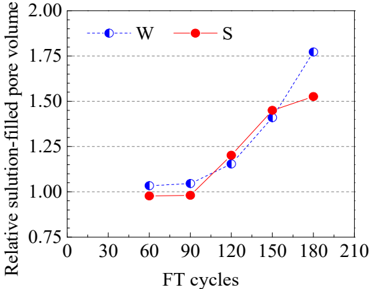
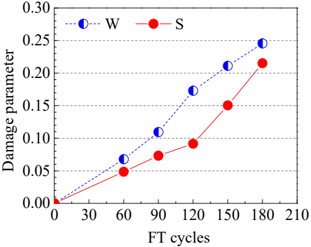
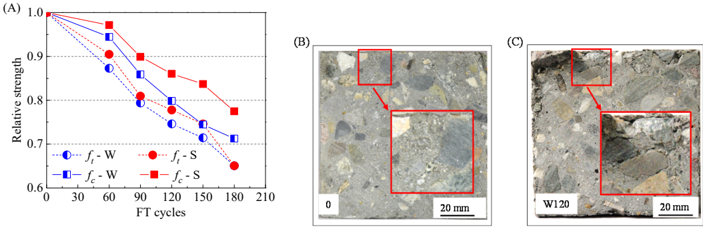
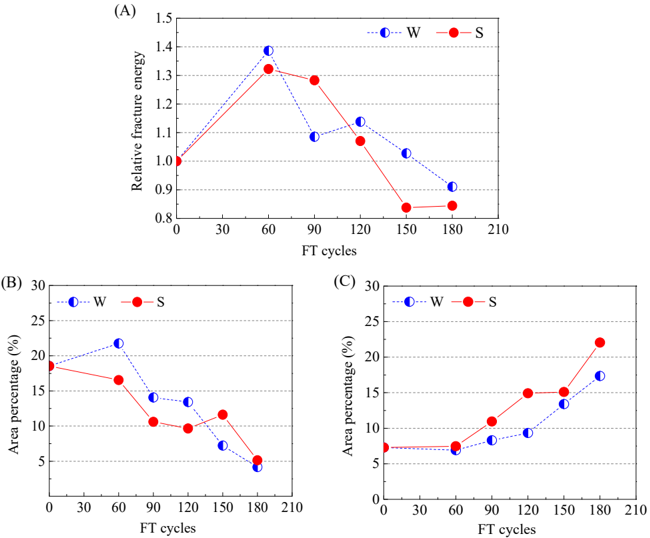
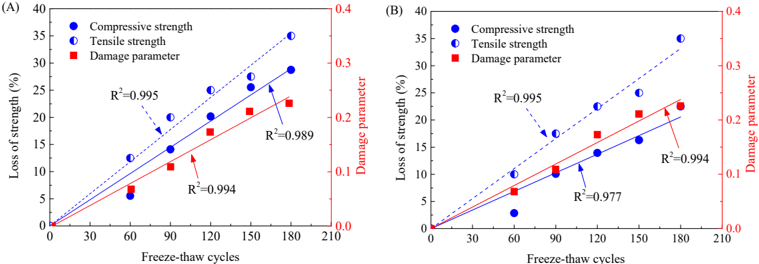
The high porosity of recycled coarse aggregate, which results in recycled aggregate concrete (RAC) more vulnerable to freeze–thaw (FT) damage and chemical attack, is a dominant factor that limits the industrialization of recycled aggregate concrete in civil engineering. This paper presents an experimental study on the combined effects of FT damage and sulfate attack on mechanical properties of high-performance RAC. The influence of the combined damage on the mass, solution-filled pore volume, dynamic elastic modulus, compressive strength, splitting tensile strength and fracture energy of RAC was studied. Results showed that the water-exposed FT cycles would result in more severe deterioration in the mass loss, elastic modulus and compressive strength, while for the sulfate-exposed FT cycles, the splitting tensile strength and fracture energy have more significant degradation. Moreover, compared with compressive strength, deterioration in splitting tensile strength is more severe. The maximum losses in compressive and splitting tensile strength were 28.7% and 35%, respectively. The fracture energy showed an increasing trend to 60 FT cycles, followed by an overall decrease to 180 FT cycles. The fracture energy exhibits a maximum increment of about 45% and 39% for water- and sulfate-exposed samples, respectively, after being subjected to 60 FT cycles. The analysis of failure modes of coarse aggregate has revealed that FT damage results in a significant deterioration in the binding force of mortar. After being subjected to 180 FT cycles, the area percentage of pulled-out failure was increased from 7.3% to larger than 17.3%.
Overview
CoChat Summary
TL;DR
This experimental study examines how coupled freeze–thaw (FT) cycles and sulfate attack affect high-performance recycled aggregate concrete (RAC). Water-exposed FT cycles caused greater mass, elastic modulus, and compressive strength loss, while sulfate-exposed FT cycles caused greater splitting tensile strength and fracture energy degradation.
Key findings
- Water-exposed FT cycles produced more severe deterioration in mass loss, dynamic elastic modulus, and compressive strength; sulfate-exposed FT cycles produced more severe degradation in splitting tensile strength and fracture energy.
- Maximum losses in compressive and splitting tensile strength were 28.7% and 35%, respectively. After 180 FT cycles, residual compressive strength was about 71% (water) and 78% (sulfate) of original, while residual splitting tensile strength was about 65% for both exposures.
- Fracture energy increased up to 60 FT cycles, then decreased to 180 FT cycles. Maximum increments at 60 FT cycles were about 45% (water) and 39% (sulfate); at 180 FT cycles, fracture energy decreased about 16% for sulfate-exposed and 9% for water-exposed specimens.
- After 180 FT cycles, the area percentage of pulled-out failure increased from 7.3% to larger than 17.3%; at 180 FT cycles it was 22.1% for sulfate-exposed and 17.3% for water-exposed specimens.
Methods
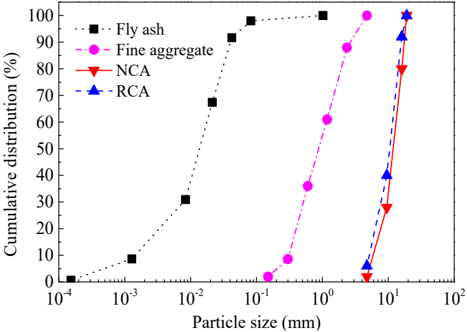
- Experimental study on high-performance RAC made with recycled coarse aggregate from crushed and sieved waste pavement concrete (water absorption 8.5%), 20% fly ash replacement, polycarboxylic superplasticizer, w/c = 0.5, w/b = 0.4; specimens cured in water at 20 °C for 3 months.
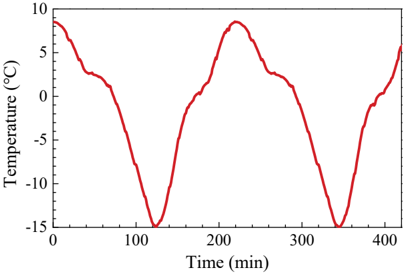
- Rapid FT tests followed GB/T 50082-2009, with internal temperature cycling between 5 ± 2 °C and −15 ± 2 °C over nearly 4 h per cycle. Specimens were exposed to water or 5% sodium sulfate solution and tested after 60, 90, 120, 150, and 180 FT cycles.
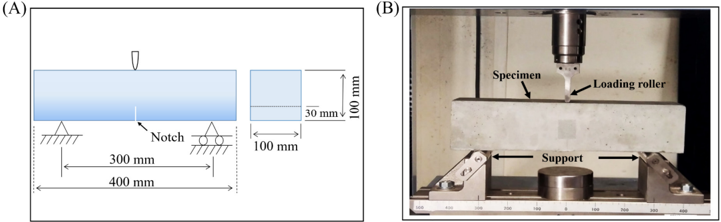
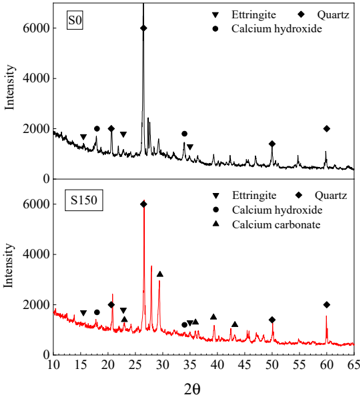
- Beam specimens were 100 mm × 100 mm × 400 mm; notched beams had span-to-depth ratio 3 and notch-to-depth ratio 0.3. Measured mass, solution-filled pore volume, dynamic elastic modulus, compressive strength, splitting tensile strength, and fracture energy via three-point bending; XRD was performed on control and sulfate-exposed S150 specimens.
Limitations
- The paper does not state a limitations section; no explicit limitations are given.
- Evident from the text: the study uses a single RAC mixture and a single RCA source, and only water or 5% sodium sulfate exposure, so broader mixture and exposure variability is not captured.
- Evident from the text: XRD analysis was performed only on sulfate-exposed specimens, not water-exposed specimens, and the text does not report replicate numbers or statistical uncertainty.
Model-written summary. Check it against the paper before relying on it.
Integrity signals
Registry
Cites
Statistics
Figures
Verification
Claims the paper makes
0 Valid · 0 Not valid · 27 Not checked · 73 Own results and interpretations
A result the paper reports from its own data — it cites no other source for it, so there is none to check. The quote shows it is in the paper.
In the paper
“while for the sulfate-exposed FT cycles, the splitting tensile strength and fracture energy have more significant degradation.”
§ Performance Evolution of Recycled Aggregate Concrete under the Coupled Effect of Freeze-Thaw Cycles and Sulfate Attack > Abstract
plainstates a cause- Asserted: passes — The authors put it forward as true.
- Checkable: passes — It can be checked against evidence.
- Load-bearing: passes — The paper’s conclusions depend on it.
- Based: passes — The paper gives a reason why it holds.
A result the paper reports from its own data — it cites no other source for it, so there is none to check. The quote shows it is in the paper.
In the paper
“The maximum losses in compressive and splitting tensile strength were 28.7% and 35%, respectively.”
§ Performance Evolution of Recycled Aggregate Concrete under the Coupled Effect of Freeze-Thaw Cycles and Sulfate Attack > Abstract
plain- Asserted: passes — The authors put it forward as true.
- Checkable: passes — It can be checked against evidence.
- Load-bearing: passes — The paper’s conclusions depend on it.
- Based: passes — The paper gives a reason why it holds.
A result the paper reports from its own data — it cites no other source for it, so there is none to check. The quote shows it is in the paper.
In the paper
“Moreover, compared with compressive strength, deterioration in splitting tensile strength is more severe.”
§ Performance Evolution of Recycled Aggregate Concrete under the Coupled Effect of Freeze-Thaw Cycles and Sulfate Attack > Abstract
plainstates an association- Asserted: passes — The authors put it forward as true.
- Checkable: passes — It can be checked against evidence.
- Load-bearing: passes — The paper’s conclusions depend on it.
- Based: passes — The paper gives a reason why it holds.
A result the paper reports from its own data — it cites no other source for it, so there is none to check. The quote shows it is in the paper.
In the paper
“while for the sulfate-exposed FT cycles, the splitting tensile strength and fracture energy have more significant degradation.”
§ Performance Evolution of Recycled Aggregate Concrete under the Coupled Effect of Freeze-Thaw Cycles and Sulfate Attack > Abstract
plainstates a cause- Asserted: passes — The authors put it forward as true.
- Checkable: passes — It can be checked against evidence.
- Load-bearing: passes — The paper’s conclusions depend on it.
- Based: passes — The paper gives a reason why it holds.
A result the paper reports from its own data — it cites no other source for it, so there is none to check. The quote shows it is in the paper.
In the paper
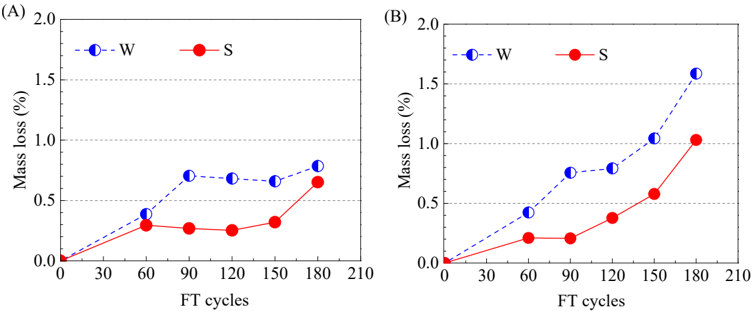
“It is clear that saturated and oven-dried specimens exposed to water have more mass loss than those exposed to sulfate solution.”
§ Performance Evolution of Recycled Aggregate Concrete under the Coupled Effect of Freeze-Thaw Cycles and Sulfate Attack > 3.1. Mass Loss and Water Absorption
boostedstates a cause- Asserted: passes — The authors put it forward as true.
- Checkable: passes — It can be checked against evidence.
- Load-bearing: passes — The paper’s conclusions depend on it.
- Based: passes — The paper gives a reason why it holds.
56 more claims
Create a free account to see all 100 claims and to verify the 32 references still open.
- It may state two separate claims as one. 25
- Probably not a substantial claim. 20
Claims other papers make about this one
Each is checked against this paper’s own text: does it say what the citing paper says it does?
In the citing paper
“These studies generally indicate that the strength of concrete under sulfate exposure follows a typical pattern of initial increase followed by a subsequent decline, regardless of sulfate concentration13–16.”
Self-check
Percentages, sums and reported differences re-computed from the paper’s own numbers.
Rated minor: it would not touch a result — a value no result rests on, a p-value that stays on the same side of the significance level, or a conflict that is clerical, resolved elsewhere in the paper, or outside its own findings.
In the paper
“| 440 | 610 | 620 | 620 | 110 | 1.1 | 165 | 0.5 | 0.4 |”
§ Performance Evolution of Recycled Aggregate Concrete under the Coupled Effect of Freeze-Thaw Cycles and Sulfate Attack > 4. Conclusions
Reported 0.5 · recomputed 0.375
Citations
Cites
The greening of the concrete industry
Meyer, C. (2009) · Cement and Concrete Composites · doi:10.1016/j.cemconcomp.2008.12.010 · Cited by 1,548
Behera, M., Bhattacharyya, S. K., Minocha, A. K., Deoliya, R., & Maiti, S. (2014) · Construction and Building Materials · doi:10.1016/j.conbuildmat.2014.07.003 · Cited by 1,188
(1985) · Materials and Structures · doi:10.1007/bf02472918 · Cited by 999
The confused world of sulfate attack on concrete
Neville, A. (2004) · Cement and Concrete Research · doi:10.1016/j.cemconres.2004.04.004 · Cited by 811
Hasanbeigi, A., Price, L., & Lin, E. (2012) · Renewable and Sustainable Energy Reviews · doi:10.1016/j.rser.2012.07.019 · Cited by 686
Influence of the amount of recycled coarse aggregate in concrete design and durability properties
Kwan, W. H., Ramli, M., Kam, K. J., & Sulieman, M. Z. (2012) · Construction and Building Materials · doi:10.1016/j.conbuildmat.2011.06.059 · Cited by 501
Durability of recycled aggregates concrete: a safe way to sustainable development
Levy, S. M., & Helene, P. (2004) · Cement and Concrete Research · doi:10.1016/j.cemconres.2004.02.009 · Cited by 466
Effect of air voids on salt scaling and internal freezing
Sun, Z., & Scherer, G. W. (2009) · Cement and Concrete Research · doi:10.1016/j.cemconres.2009.09.027 · Cited by 354
Dilbas, H., Şimşek, M., & Çakır, Ö. (2014) · Construction and Building Materials · doi:10.1016/j.conbuildmat.2014.02.057 · Cited by 334
Kou, S.-C., & Poon, C.-S. (2015) · Construction and Building Materials · doi:10.1016/j.conbuildmat.2014.12.035 · Cited by 309
Research works printed but not linked: 2
- Mehta, P.K.; Monteiro, P.J.M. Concrete: Microstructure, Properties and Materials; McGraw Hill: New York, NY, USA, 2006.
- Wan, X.S.; Lai, Y.M. Experimental study on freezing temperature and salt crystal precipitation of sodium sulphate soulotion and sodium sulphate saline soil. Chin. J. Geotech. Eng. 2013, 35, 7. (In Chinese)
Cited by
Damage Mechanism and Modeling of Concrete in Freeze–Thaw Cycles: A Review
Guo, J., Sun, W., Xu, Y., Lin, W., & Jing, W. (2022) · Buildings · doi:10.3390/buildings12091317 · Cited by 138
Dong, J., Liu, Y., Yuan, S., Li, K., Zhang, F., Guan, Z., Chai, H. K., & Wang, Q. (2024) · Construction and Building Materials · doi:10.1016/j.conbuildmat.2024.136836 · Cited by 124
Self-citationA review of the mechanical properties and durability of basalt fiber recycled concrete
Yang, W., Liu, L., Wu, W., Zhang, K., Xiong, X., Li, C., Huang, Y., Zhang, X., & Zhou, H. Y. (2024) · Construction and Building Materials · doi:10.1016/j.conbuildmat.2024.134882 · Cited by 96
Mechanical Properties and Damage Model of Modified Recycled Concrete under Freeze-Thaw Cycles
Wang, Y., Xie, M., & Zhang, J. (2023) · Journal of Building Engineering · doi:10.1016/j.jobe.2023.107680 · Cited by 30
Güler, S., & Akbulut, Z. F. (2023) · Construction and Building Materials · doi:10.1016/j.conbuildmat.2023.132100 · Cited by 56
Metadata
- Authors
- Jia, P., Li, L., Zhou, J., Zhang, D., Guan, Z., Dong, J., & Wang, Q.
- Affiliations
- Xi'an Jiaotong University (CN)
- Sichuan University (CN)
- University of Liverpool (GB)
- Corresponding author
- Dong, Jiangfeng
- Wang, Qingyuan
- Venue
- Applied Sciences
- Publisher
- MDPI AG
- Published
- 2022-07-08
- Volume
- 12
- Issue
- 14
- Pages
- 6950
- ISSN
- 2076-3417 (ISSN-L)
- OpenAlex
- W4284966813
- Cited by
- 24
- References
- 39
- Citations by year
- 2026: 8 · 2025: 3 · 2024: 8 · 2023: 4 · 2022: 1
- FWCI
- 1.55
- Type
- journal article
- Language
- en
- Open access
- gold
- doi.org
- Licence
- Locations
- Applied Sciences (publishedVersion, cc-by)
- DOAJ (DOAJ: Directory of Open Access Journals) (submittedVersion)
- Funders
- Natural Science Basic Research Program of Shaanxi (2021JQ-004, FMEDP202114)
- 2021 Open Project of Failure Mechanics and Engineering Disaster Prevention, Key Lab of Sichuan Province (2021JQ-004, FMEDP202114)
- Topics
- Physical Sciences › Engineering › Building and Construction › Recycled Aggregate Concrete Performance
- Physical Sciences › Engineering › Civil and Structural Engineering › Concrete and Cement Materials Research
- Physical Sciences › Engineering › Civil and Structural Engineering › Innovative concrete reinforcement materials
- Keywords
- recycled aggregate concrete, freeze-thaw cycles, sulfate attack, compressive strength, splitting tensile strength, fracture energy, elastic modulus, pore volume, failure modes, high-performance concrete
About these checks
Registry, retraction, Cites and statistics results are computed, not judged, with one exception: a printed reference that no index lists is read once by a model before it counts as a citation error. Claims are extracted by a model and kept only when their quote appears verbatim in the text; each cited source is then checked, with a model’s help, for whether it says what the claim relies on. Those verdicts can be wrong — read the claim’s quote and the cited source before relying on one.
A language model drew the claims from the paper on 2026-11-27, under version 3 of the claim definition (model deepseek-v4.1-flash, prompt extract-v3).
A second model labelled each claim on 2026-11-27 (model jev-1.13-20260917, definition revision gold-guideline-v0.2).
Statistics and arithmetic are recomputed, not judged.
Confidence bands are shown only for fields calibrated on our annotated test set. None is calibrated yet, so no band is shown.
What counts as a claim ›How we measure confidence ›How we check this ›
Are you an author, or do you see a problem with this page? Request a review
How to cite
Cite CoChat for the checks on this page, and the paper for its own findings.
- This page
- CoChat. (2026). Citation check: Performance Evolution of Recycled Aggregate Concrete under the Coupled Effect of Freeze–Thaw Cycles and Sulfate Attack. https://app.cochat.ai/papers/10.3390/app12146950
- The paper
- Jia, P., Li, L., Zhou, J., Zhang, D., Guan, Z., Dong, J., & Wang, Q. (2022). Performance Evolution of Recycled Aggregate Concrete under the Coupled Effect of Freeze–Thaw Cycles and Sulfate Attack. Applied Sciences. https://doi.org/10.3390/app12146950
Data sources
Bibliographic data: Semantic Scholar, OpenAlex, Crossref.
Contains information from the Semantic Scholar Academic Graph Datasets, made available under the ODC Attribution License (ODC-BY 1.0).
Semantic Scholar’s data is described in: Kinney, R., et al. (2023). The Semantic Scholar Open Data Platform. arXiv:2301.10140.
