

Crack Location and Degree Detection Method Based on YOLOX Model
Open accessThe DOI matches its Crossref record; 42 of the 42 references it cites were found in a registry or an index.
Abstract
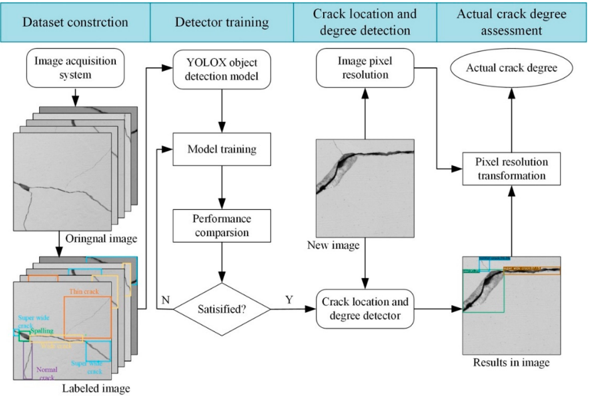
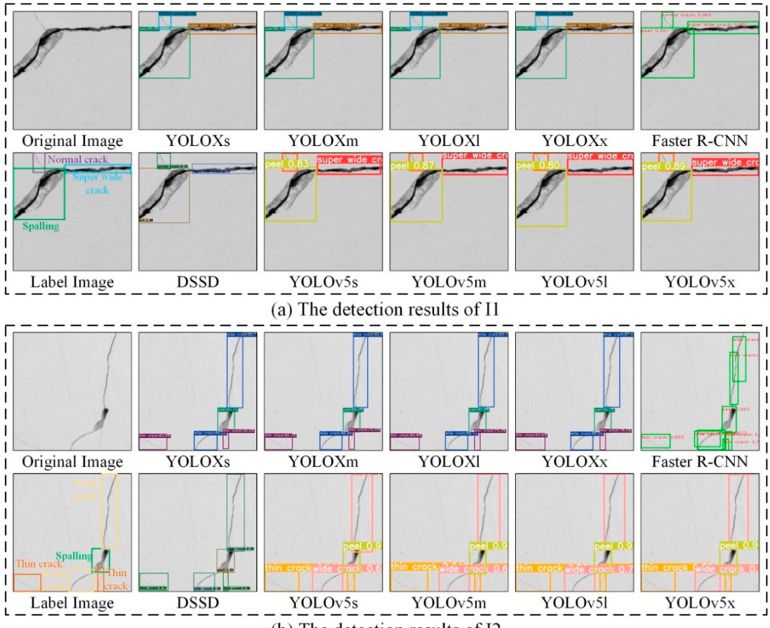
Damage detection and evaluation are concerns in structural health monitoring. Traditional damage detection techniques are inefficient because of the need for damage detection before evaluation. To address these problems, a novel crack location and degree detector based on YOLOX is proposed, which directly realizes damage detection and evaluation. Moreover, the detector presents a superior detection effect and speed to other advanced deep learning models. Additionally, rather than at the pixel level, the detection results are determined in actual scales according to resolution. The results demonstrate that the proposed model can detect and evaluate damage accurately and automatically.
Overview
The claims and statistics of this paper haven’t been checked yet.
Free: it reads the open-access text and checks the first 5 claims that cite a source we can check. Create a free account to check every claim.
Integrity signals
Registry
Cites
Statistics
Figures
Verification
Claims the paper makes
The claims and statistics of this paper haven’t been checked yet.
Free: it reads the open-access text and checks the first 5 claims that cite a source we can check. Create a free account to check every claim.
Claims other papers make about this one
Each is checked against this paper’s own text: does it say what the citing paper says it does?
The source backs part of the claim, not all of it — or backs it for a different population, condition or comparison.
In the citing paper
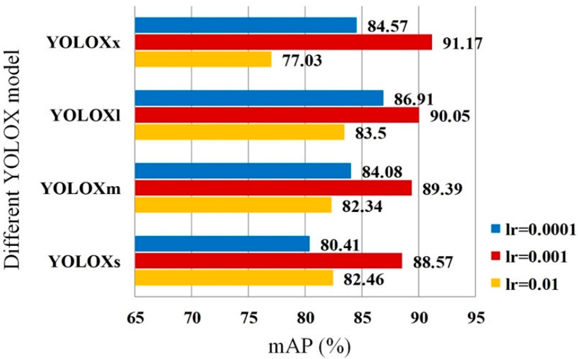
“Wang et al. [44] found that among YOLOX, Faster R-CNN, Deconvolutional Single Shot Detector, and YOLOv5, the MAP of YOLOX in crack detection was 88.5%, showing the best performance.”
From Deep Learning for Structural Health Monitoring: Data, Algorithms, Applications, Challenges, and Trends (2023) · cites this paper as [44]
Experimental — accuracy not yet measuredThe source backs part of the claim, not all of it — or backs it for a different population, condition or comparison.
In the citing paper
“Although DL algorithms have higher performance than ML, a large amount of labeled data is needed to ensure model performance when the DL algorithm is used for image classification [131], location [44], and segmentation [201], resulting in data shortage.”
From Deep Learning for Structural Health Monitoring: Data, Algorithms, Applications, Challenges, and Trends (2023) · cites this paper as [44]
Experimental — accuracy not yet measured
Self-check
Percentages, sums and reported differences re-computed from the paper’s own numbers.
The self-check needs the paper’s full text.
Citations
Cites
Faster R-CNN: Towards Real-Time Object Detection with Region Proposal Networks
Ren, S., He, K., Girshick, R., & Sun, J. (2017) · IEEE Transactions on Pattern Analysis and Machine Intelligence · doi:10.1109/tpami.2016.2577031 · Cited by 73,472
You Only Look Once: Unified, Real-Time Object Detection
Redmon, J., Divvala, S., Girshick, R., & Farhadi, A. (2016) · 2016 IEEE Conference on Computer Vision and Pattern Recognition (CVPR) · doi:10.1109/cvpr.2016.91 · Cited by 53,803
Rich Feature Hierarchies for Accurate Object Detection and Semantic Segmentation
Girshick, R., Donahue, J., Darrell, T., & Malik, J. (2014) · 2014 IEEE Conference on Computer Vision and Pattern Recognition · doi:10.1109/cvpr.2014.81 · Cited by 32,684
(2016) · Cited by 31,590
Girshick, R. (2015) · 2015 IEEE International Conference on Computer Vision (ICCV) · doi:10.1109/iccv.2015.169 · Cited by 28,105
SSD: Single Shot MultiBox Detector
Liu, W., Anguelov, D., Erhan, D., Szegedy, C., Reed, S., Fu, C.-Y., & Berg, A. C. (2016) · Lecture Notes in Computer Science · doi:10.1007/978-3-319-46448-0_2 · Cited by 22,128
YOLO9000: Better, Faster, Stronger
Redmon, J., & Farhadi, A. (2017) · 2017 IEEE Conference on Computer Vision and Pattern Recognition (CVPR) · doi:10.1109/cvpr.2017.690 · Cited by 19,892
The pascal visual object classes (VOC) challenge
Everingham, M., Van Gool, L., Williams, C. K. I., Winn, J., & Zisserman, A. (2010) · International Journal of Computer Vision · doi:10.1007/s11263-009-0275-4 · Cited by 19,599
Spatial Pyramid Pooling in Deep Convolutional Networks for Visual Recognition
He, K., Zhang, X., Ren, S., & Sun, J. (2015) · IEEE Transactions on Pattern Analysis and Machine Intelligence · doi:10.1109/tpami.2015.2389824 · Cited by 11,971
Generalized Intersection Over Union: A Metric and a Loss for Bounding Box Regression
Rezatofighi, H., Tsoi, N., Gwak, J., Sadeghian, A., Reid, I., & Savarese, S. (2019) · 2019 IEEE/CVF Conference on Computer Vision and Pattern Recognition (CVPR) · doi:10.1109/cvpr.2019.00075 · Cited by 6,612
Research works printed but not linked: 5
- Fan, Z., Wu, Y., Lu, J., and Li, W. (2018). Automatic pavement crack detection based on structured prediction with the convolutional neural network. arXiv.
- Redmon, J., and Farhadi, A. (2018). Yolov3: An incremental improvement. arXiv.
- Bochkovskiy, A., Wang, C.Y., and Liao, H.Y.M. (2020). Yolov4: Optimal speed and accuracy of object detection. arXiv.
- Ge, Z., Liu, S., Wang, F., Li, Z., and Sun, J. (2021). Yolox: Exceeding yolo series in 2021. arXiv.
- Fu, C.Y., Liu, W., Ranga, A., Tyagi, A., and Berg, A.C. (2017). Dssd: Deconvolutional single shot detector. arXiv.
Cited by
Hütten, N., Gomes, M. A., Hölken, F., Andricevic, K., Meyes, R., & Meisen, T. (2024) · Applied System Innovation · doi:10.3390/asi7010011 · Cited by 250
Jia, J., & Li, Y. (2023) · Sensors · doi:10.3390/s23218824 · Cited by 182
“…can make use of structural surface defect images of bridges, frame structures, dams, tunnels, and other infrastructures for crack detection [40–44], bolt loosening detection [45–47], rebar surface defect detection [48], delamination and reinforcement exposure detection [49], displacement…”
BackgroundInfluentialA Review of Detection Technologies for Underwater Cracks on Concrete Dam Surfaces
Chen, D., Huang, B., & Kang, F. (2023) · Applied Sciences · doi:10.3390/app13063564 · Cited by 106
Self-citationHang, X., Zhu, X., Gao, X., Wang, Y., & Liu, L. (2024) · Renewable Energy · doi:10.1016/j.renene.2024.120152 · Cited by 69
Cao, W., Li, J., Zhang, X., Kang, F., & Wu, X. (2024) · Structures · doi:10.1016/j.istruc.2024.107834 · Cited by 22
Self-citationReal-Time Target Detection System for Intelligent Vehicles Based on Multi-Source Data Fusion
Zou, J., Zheng, H., & Wang, F. (2023) · Sensors · doi:10.3390/s23041823 · Cited by 19
“In terms of pavement disease detection, a YOLOX-based pavement disease detection method was proposed in Reference [35], which effectively solves the problem of slow identification by traditional methods.”
MethodResearch on road damage recognition and classification based on improved VGG-19
Wang, J., Wang, K., & Li, K. (2023) · Mathematical Models in Engineering · doi:10.21595/mme.2023.23455 · Cited by 11
“The generation and extension of road damages will reduce the performance and life of road [2].”
BackgroundXu, H., Wang, B., Zhu, Y., Bi, R., Zhao, T., Huang, T. K., Zhang, D., & Qian, P. (2025) · Measurement · doi:10.1016/j.measurement.2025.117248 · Cited by 10
Improved YOLOv5-based multi-crack detection in concrete wall surfaces
Philip, R. E., Andrushia, A. D., Anand, N., Mathews, M. E., Naser, M. Z., & Lublóy, É. (2025) · Applications in Engineering Science · doi:10.1016/j.apples.2025.100247 · Cited by 15
Li, B., Liu, Y., & Kuang, G. (2024) · Periodica Polytechnica Civil Engineering · doi:10.3311/ppci.37929 · Cited by 6
“However, there are few studies on damage recognition using the YOLOX, and the application effect of the YOLOX in crack detec - tion remains to be further investigated [34].”
Guo, J., Chen, J.-Y., Xu, Q., Li, J., Li, S., Qin, L., & Cao, X.-Y. (2026) · Advanced Engineering Informatics · doi:10.1016/j.aei.2025.104062 · Cited by 4
Self-citationExperimental study on the effectiveness of uniform sand in the crack-filling of zoned dams
Malik, B. A., Dar, A. Q., & Lone, M. A. (2024) · Innovative Infrastructure Solutions · doi:10.1007/s41062-024-01375-y · Cited by 2
“Many methods mentioned in the literature, like ultrasonic [2], uncrewed aerial vehicles [3, 4], electromagnetic [5], computer vision methods [6, 7], and sensing techniques [8–11], help detect cracking occurrences above and below the water surfaces in dams.”
Review: Thermal data acquisition for 3D cracks characterization and experiment
Moshayedi, A. J., Chanthavisouk, A., Chanthavisouk, S., Nguyen, Q., Ozbek, R., & Bassir, D. (2026) · E3S Web of Conferences · doi:10.1051/e3sconf/202672304009 · Cited by 1
A hybrid underwater crack image enhancement method
Ding, D., Fan, X., Shi, P., & Chen, L. (2026) · Scientific Reports · doi:10.1038/s41598-026-60181-x
Metadata
- Authors
- Wang, L., Li, J., & Kang, F.
- Affiliations
- Dalian University of Technology (CN)
- Hohai University (CN)
- Corresponding author
- Li, Junjie
- Kang, Fei
- Venue
- Applied Sciences
- Publisher
- MDPI AG
- Published
- 2022-12-08
- Volume
- 12
- Issue
- 24
- Pages
- 12572
- ISSN
- 2076-3417 (ISSN-L)
- OpenAlex
- W4311960846
- Cited by
- 12
- References
- 42
- Citations by year
- 2026: 1 · 2025: 3 · 2024: 4 · 2023: 4
- FWCI
- 1.24
- Type
- journal article
- Language
- en
- Open access
- gold
- doi.org
- Licence
- Locations
- Applied Sciences (publishedVersion, cc-by)
- DOAJ (DOAJ: Directory of Open Access Journals) (submittedVersion, cc-by-sa)
- Funders
- National Natural Science Foundation of China (51779035, 51769033, 51979027, 52079022, DUT21TD106)
- Central Universities (51779035, 51769033, 51979027, 52079022, DUT21TD106)
- Topics
- Physical Sciences › Engineering › Civil and Structural Engineering › Infrastructure Maintenance and Monitoring
- Physical Sciences › Engineering › Civil and Structural Engineering › Structural Health Monitoring Techniques
- Physical Sciences › Engineering › Industrial and Manufacturing Engineering › Industrial Vision Systems and Defect Detection
- Keywords
- crack detection, YOLOX, structural health monitoring, damage detection, object detection
About these checks
Registry, retraction, Cites and statistics results are computed, not judged, with one exception: a printed reference that no index lists is read once by a model before it counts as a citation error. Claims are extracted by a model and kept only when their quote appears verbatim in the text; each cited source is then checked, with a model’s help, for whether it says what the claim relies on. Those verdicts can be wrong — read the claim’s quote and the cited source before relying on one.
Statistics and arithmetic are recomputed, not judged.
Confidence bands are shown only for fields calibrated on our annotated test set. None is calibrated yet, so no band is shown.
What counts as a claim ›How we measure confidence ›How we check this ›
Are you an author, or do you see a problem with this page? Request a review
Data sources
Bibliographic data: Semantic Scholar, OpenAlex, Crossref.
Contains information from the Semantic Scholar Academic Graph Datasets, made available under the ODC Attribution License (ODC-BY 1.0).
Semantic Scholar’s data is described in: Kinney, R., et al. (2023). The Semantic Scholar Open Data Platform. arXiv:2301.10140.
