

An Alternative Audio-Tactile Method of Presenting Structural Information Contained in Mathematical Drawings Adapted to the Needs of the Blind
Open accessThe DOI matches its Crossref record; 47 of the 48 references it cites were found in a registry or an index; none of the 34 sources its claims cite is checked for support yet.
Abstract
Alternative methods of presenting the information contained in mathematical images, which are adapted to the needs of blind people, are significant challenges in modern education. This article presents an alternative multimodal method that substitutes the sense of sight with the sense of touch and hearing to convey graphical information. The developed method was evaluated at a center specializing in the education of the blind in Poland, on a group of 46 students aged 15–19. They solved a set of 60 high school-level problems on geometry, mathematical analysis, and various types of graphs. We assessed the mechanisms introduced for the sense of touch and hearing, as well as the overall impression of the users. The system usability scale and the NASA task load index tests were used in the evaluation. The results obtained indicate an overall increase in user satisfaction and usefulness of the proposed approach and a reduction in the workload during exercise solving. The results also show a significant impact of the proposed navigation modes on the average time to reach objects in the drawing. Therefore, the presented method could significantly contribute to the development of systems supporting multimodal education for people with blindness.
Overview
CoChat Summary
TL;DR
The paper presents an audio-tactile method that substitutes sight with touch and hearing to convey structural information in mathematical drawings for blind students. Evaluation with 46 blind students found improved usability and reduced workload with feedback mechanisms, and navigation modes reduced object-reach times.
Key findings
- SUS total score increased from 65 without feedback mechanisms to 78 with them; NASA-TLX total score decreased from 73 to 61. Subscales changed as follows: physical demand 93→76, mental demand 74→62, effort 75→62, frustration 74→63, and performance 50→40; temporal demand was not evaluated.
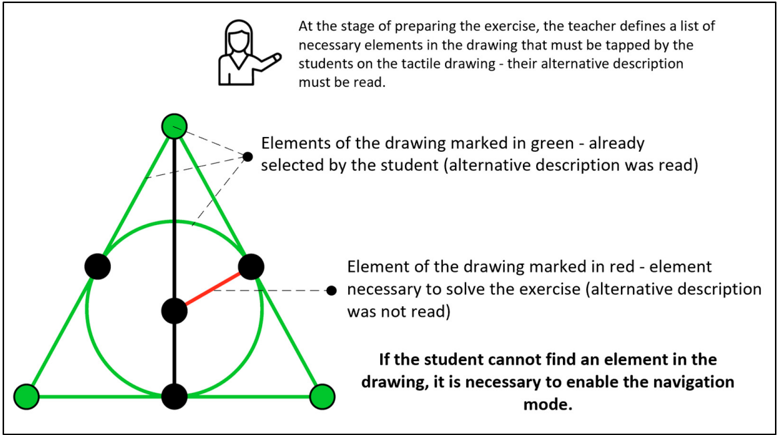
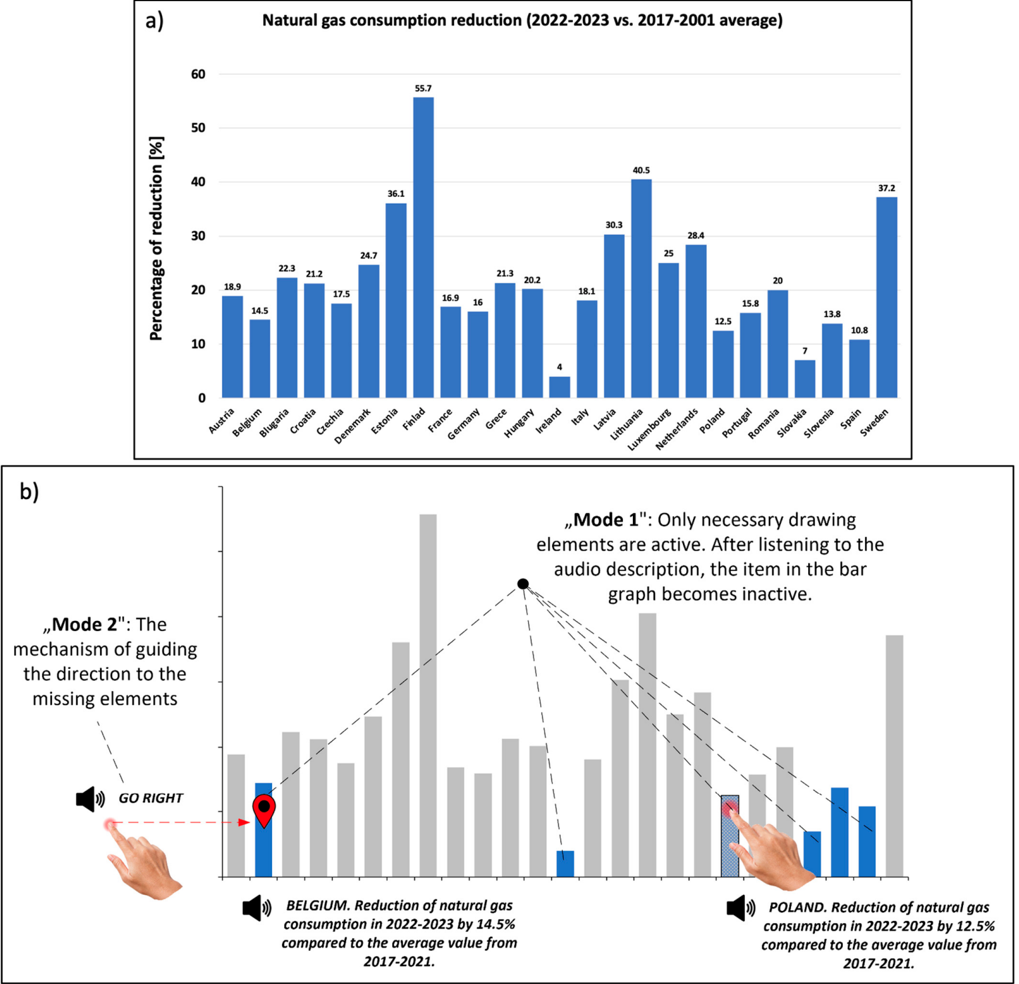
- Average time to reach a required object was 8.5 s in mode 0 (no navigation), 3.6 s in mode 1 (only missing elements audio active), and 2.8 s in mode 2 (missing elements plus directional guidance); modes 1 and 2 showed a statistically significant reduction compared with mode 0.
- For touch adaptation, the activation area was changed for 12 students and the gesture time interval was adjusted for 10 students; after adaptation, the average hit completeness coefficient was greater than 0.8. The default activation area width was 5 mm with a cut-off threshold of 0.5 and extension by 2 mm; the default 2- and 3-tap interval was 335 ms.
- Overlapping-object detection final accuracy was confirmed at 100% after minor initial errors were removed; the YOLO model evaluation showed that 70% of exercises required no correction at the parameterization and matching class objects stage.
Methods
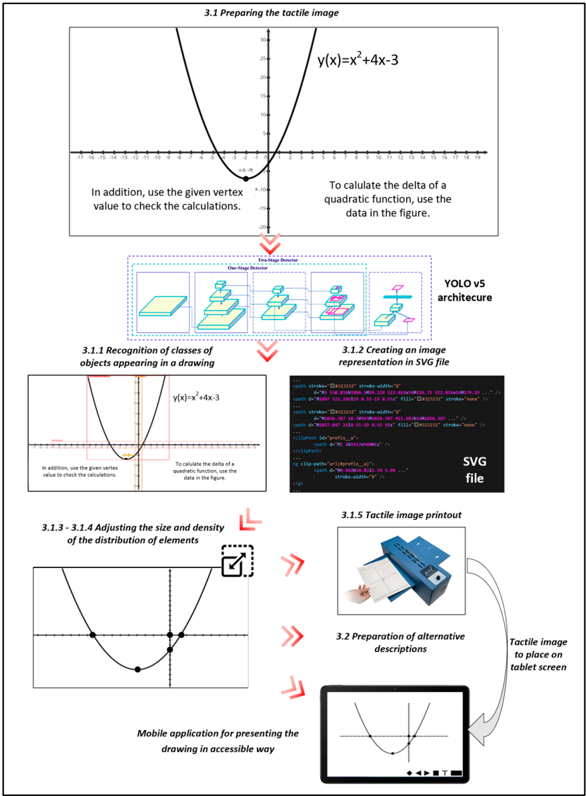
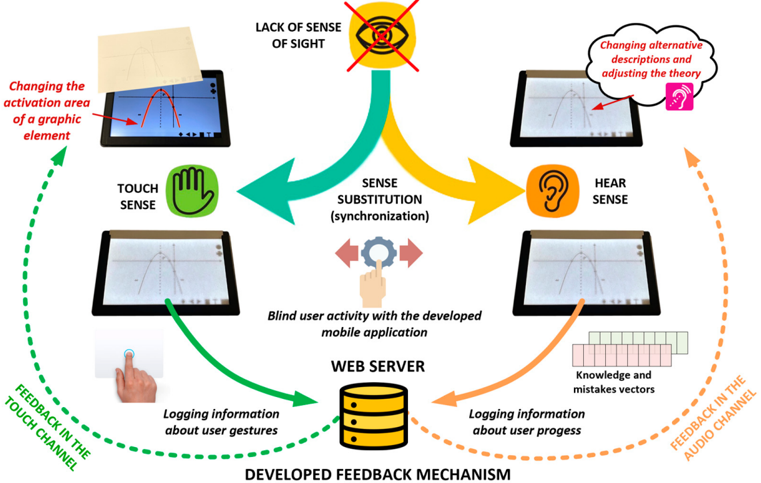
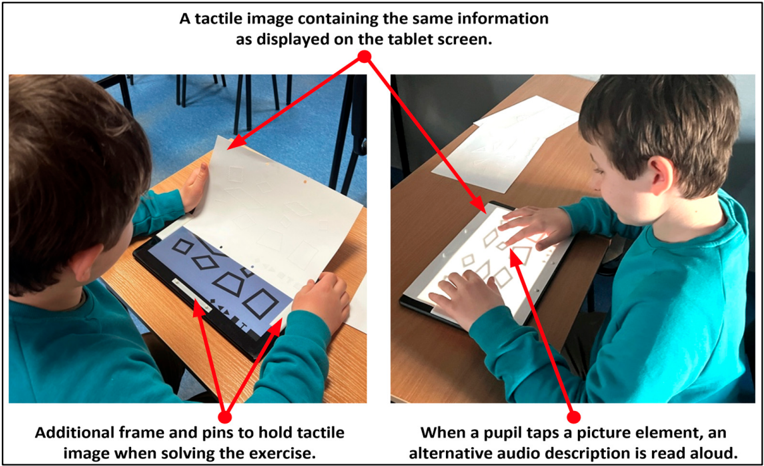
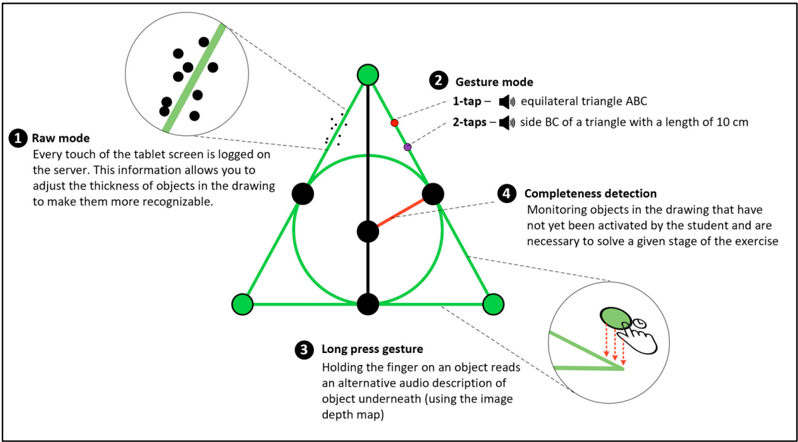
- Design: a multimodal audio-tactile method in which original graphics are processed using YOLO v5 object detection into an SVG template, parameterized, density-adjusted, and printed as a tactile image on a Braille printer; an Android mobile app and web app provide 1-tap, 2-tap, 3-tap, and long-hold gestures, navigation modes 0–2, and feedback loops for touch and hearing.
- Sample and data: 46 blind participants (19 women, 27 men), aged 15–19, median age 17, standard deviation 1.21, with more than 90% vision loss, in secondary school, without mental disabilities, at a center in Poland; they solved 60 high-school-level problems (20 geometry, 20 mathematical analysis, 20 charts), each containing from a few to a dozen graphic elements, with element sizes from 2 to 8 cm and bar charts with 10 to 25 bars.
- Analysis: exercises were divided into two parts to compare solving without feedback mechanisms versus with all proposed mechanisms, using the System Usability Scale and NASA Task Load Index; the study also measured hit completeness, activation area, gesture intervals, object-reach time across navigation modes, and accuracy of overlapping-object detection.
Limitations
- The paper states that the method was evaluated only in one center, specifically the central educational center for blind students in Poland, and that the exercise scope was limited to mathematical exercises, not other technical images such as diagrams, maps, and other types of graphs.
- The paper states that participants solved exercises without an imposed time limit, so temporal demand was not evaluated in the NASA-TLX.
- Evident from the text: the sample was 46 blind students aged 15–19 at high-school level, so findings may not generalize to other ages, education levels, or settings; the text also does not report randomization or order control for the two exercise parts compared.
Model-written summary. Check it against the paper before relying on it.
Integrity signals
Registry
Cites
Statistics
Figures
Verification
Claims the paper makes
0 Valid · 2 Not valid · 22 Not checked · 55 Own results and interpretations
A result the paper reports from its own data — it cites no other source for it, so there is none to check. The quote shows it is in the paper.
In the paper
“The results obtained indicate an overall increase in user satisfaction and usefulness of the proposed approach and a reduction in the workload during exercise solving.”
§ An Alternative Audio-Tactile Method of Presenting Structural Information Contained in Mathematical Drawings Adapted to the Needs of the Blind > Abstract
hedgedstates a cause- Asserted: passes — The authors put it forward as true.
- Checkable: passes — It can be checked against evidence.
- Load-bearing: passes — The paper’s conclusions depend on it.
- Based: passes — The paper gives a reason why it holds.
A result the paper reports from its own data — it cites no other source for it, so there is none to check. The quote shows it is in the paper.
In the paper
“The results also show a significant impact of the proposed navigation modes on the average time to reach objects in the drawing.”
§ An Alternative Audio-Tactile Method of Presenting Structural Information Contained in Mathematical Drawings Adapted to the Needs of the Blind > Abstract
plainstates a cause- Asserted: passes — The authors put it forward as true.
- Checkable: passes — It can be checked against evidence.
- Load-bearing: passes — The paper’s conclusions depend on it.
- Based: passes — The paper gives a reason why it holds.
A result the paper reports from its own data — it cites no other source for it, so there is none to check. The quote shows it is in the paper.
In the paper
“The results obtained indicate an overall increase in user satisfaction and usefulness of the proposed approach and a reduction in the workload during exercise solving.”
§ An Alternative Audio-Tactile Method of Presenting Structural Information Contained in Mathematical Drawings Adapted to the Needs of the Blind > Abstract
hedgedstates a cause- Asserted: passes — The authors put it forward as true.
- Checkable: passes — It can be checked against evidence.
- Load-bearing: passes — The paper’s conclusions depend on it.
- Based: passes — The paper gives a reason why it holds.
A result the paper reports from its own data — it cites no other source for it, so there is none to check. The quote shows it is in the paper.
In the paper
“In both the effort and frustration categories, there was a similar reduction in task load.”
§ An Alternative Audio-Tactile Method of Presenting Structural Information Contained in Mathematical Drawings Adapted to the Needs of the Blind > 4.3. General Results
plain- Asserted: passes — The authors put it forward as true.
- Checkable: passes — It can be checked against evidence.
- Load-bearing: unclear — It is unclear whether the paper’s conclusions depend on it.
- Based: passes — The paper gives a reason why it holds.
28 more claims
Create a free account to see all 79 claims and to verify the 34 references still open.
- It may state two separate claims as one. 15
- Probably not a substantial claim. 39
- The quote only partly states this claim. 1
Citations
Cites
Development of NASA-TLX (Task Load Index): Results of Empirical and Theoretical Research
(1988) · Advances in Psychology · doi:10.1016/s0166-4115(08)62386-9 · Cited by 20,029
SUS: A 'Quick and Dirty' Usability Scale
(1996) · Usability Evaluation In Industry · doi:10.1201/9781498710411-35 · Cited by 8,989
Steinmetz, J. D., Bourne, R. R. A., Briant, P. S., Flaxman, S. R., Taylor, H. R. B., Jonas, J. B., Abdoli, A. A., Abrha, W. A., Abualhasan, A., Abu-Gharbieh, E. G., et al. (2021) · The Lancet Global Health · doi:10.1016/s2214-109x(20)30489-7 · Cited by 3,189 · cited 2×
“Such prints contain raised lines that can be analyzed by touch, allowing the user to become familiar with them using tactile perception [1,13].”
BackgroundMethodImplications of Cognitive Load Theory for Multimedia Learning
Paas, F., & Sweller, J. (2014) · The Cambridge Handbook of Multimedia Learning · doi:10.1017/cbo9781139547369.004 · Cited by 862
Determining what individual SUS scores mean
(2009) · Journal of Usability Studies archive · doi:10.5555/2835587.2835589 · Cited by 412
SF-YOLOv5: A Lightweight Small Object Detection Algorithm Based on Improved Feature Fusion Mode
Liu, H., Sun, F., Gu, J., & Deng, L. (2022) · Sensors · doi:10.3390/s22155817 · Cited by 185
Accessible Maps for the Blind: Comparing 3D Printed Models with Tactile Graphics
Holloway, L., Marriott, K., & Butler, M. (2018) · Proceedings of the 2018 CHI Conference on Human Factors in Computing Systems · doi:10.1145/3173574.3173772 · Cited by 149
Evaluation of multimodal graphs for blind people
Yu, W., & Brewster, S. (2003) · Universal Access in the Information Society · doi:10.1007/s10209-002-0042-6 · Cited by 120 · cited 1×
“Many scientists have demonstrated that combining the sense of touch with signals such as force, vibration, and additional voice messages allows blind users to acquire a larger amount of information [28,29].”
BackgroundDesigning sensory-substitution devices: Principles, pitfalls and potential1
Kristjánsson, Á., Moldoveanu, A., Jóhannesson, Ó. I., Balan, O., Spagnol, S., Valgeirsdóttir, V. V., & Unnthorsson, R. (2016) · Restorative Neurology and Neuroscience · doi:10.3233/rnn-160647 · Cited by 116
Asamoah, E., Ofori‐Dua, K., Cudjoe, E., Abdullah, A., & Nyarko, J. A. (2018) · SAGE Open · doi:10.1177/2158244018807791 · Cited by 96
Cited by
YOLO-Type Neural Networks in the Process of Adapting Mathematical Graphs to the Needs of the Blind
Kawulok, M., & Maćkowski, M. (2024) · Applied Sciences · doi:10.3390/app142411829 · Cited by 12
Self-citationDzierzgowska, E., Maćkowski, M., Kawulok, M., Brzoza, P., Maćkowska, S., & Spińczyk, D. (2025) · Scientific Reports · doi:10.1038/s41598-025-07710-2 · Cited by 8
Self-citationTouching Movement: 3D Tactile Poses for Supporting Blind People in Learning Body Movements
Tanaka, K., Wang, X., Takagi, H., Ochiai, Y., & Asakawa, C. (2026) · International Conference on Tangible, Embedded, and Embodied Interaction (TEI) · doi:10.1145/3731459.3773325 · Cited by 8
Penuela, R. E. G., Liu, F., MacIntyre, B., & Saffo, D. (2025) · Proceedings of the ACM on Interactive Mobile Wearable and Ubiquitous Technologies · doi:10.1145/3770654 · Cited by 5
Ramôa, G., & Müller, K. (2025) · International ACM SIGACCESS Conference on Computers and Accessibility (ASSETS) · doi:10.1145/3663547.3746398 · Cited by 4
Kawulok, M., Maćkowska, S., Maćkowski, M., & Spinczyk, D. (2025) · Proceedings of the 30th ACM Conference on Innovation and Technology in Computer Science Education V. 1 · doi:10.1145/3724363.3729098 · Cited by 2
Self-citationChimah, J. N. (2024) · Mousaion South African Journal of Information Studies · doi:10.25159/2663-659x/15078 · Cited by 2
Fukushi, M., Miura, T., Sakajiri, M., Onishi, J., & Matsuo, M. (2026) · Lecture notes in computer science · doi:10.1007/978-3-032-31285-3_22
Supporting VI Learners in Communicating Mathematical Diagrams
Austin, D., Jadhav, N., Kolesnikov, A., Siefken, J., & Sorge, V. (2027) · Lecture Notes in Computer Science · doi:10.1007/978-3-032-31285-3_24
Borah, P. P., & Sorathia, K. B. (2025) · International Journal of Human-Computer Interaction · doi:10.1080/10447318.2025.2491791
Bae, S.-Y., & Jun, H.-K. (2026) · Journal of Software Forensics · doi:10.29056/jsf.2026.03.05
New Interaction Techniques for MobileHCI: Sonified Touch for Accessible Museum Visits
Opara, C., Lewis, M., & Choudhury, I. (2026) · International Conference on Human-Computer Interaction with Mobile Devices and Services (MobileHCI) · doi:10.1145/3821581.3833130
Japaries, W., Agussalim, W. S., Tjong, H. S., Sari, M., Suhendry, E. C., Audisapta, A. P., Susita, O., Adrianus Suyadi, S. J., Anastasia, S. P., Susanti, D., et al. (2025) · IJECS Indonesian Journal of Empowerment and Community Services · doi:10.32585/ijecs.v6i2.7240
Syabila, R. F., Katrina, A., Pane, S. D., Aldi, K. R., Rahman, R. M. F., & Hutapea, T. A. (2025) · BUDIMAS JURNAL PENGABDIAN MASYARAKAT
Metadata
- Authors
- Maćkowski, M., Kawulok, M., Brzoza, P., Janczy, M., & Spinczyk, D.
- Affiliations
- Silesian University of Technology (PL)
- Department of Medical Informatics and Artificial Intelligence, Silesian University of Technology, 41800 Zabrze, Poland
- Corresponding author
- Maćkowski, Michał
- Venue
- Applied Sciences
- Publisher
- MDPI AG
- Published
- 2023-09-04
- Volume
- 13
- Issue
- 17
- Pages
- 9989
- ISSN
- 2076-3417 (ISSN-L)
- OpenAlex
- W4386423381
- Semantic Scholar
- 92fdcd056efd36460731aa567fd1556f7bf3b696
- Cited by
- 14
- References
- 47
- Citations by year
- 2026: 5 · 2025: 7 · 2024: 2
- FWCI
- 1.45
- Type
- journal article
- Language
- en
- Open access
- gold
- doi.org
- Licence
- Locations
- Applied Sciences (publishedVersion, cc-by)
- DOAJ (DOAJ: Directory of Open Access Journals) (submittedVersion)
- Funders
- program Research University Excellence Initiative (31/010/SDU20/0006-10)
- Topics
- Life Sciences › Neuroscience › Cognitive Neuroscience › Tactile and Sensory Interactions
- Social Sciences › Human Factors and Ergonomics › Digital Accessibility for Disabilities
- Health Sciences › Health Professions › Occupational Therapy › Assistive Technology in Communication and Mobility
- Keywords
- blind students, mathematical drawing, accessibility, multimodal education, tactile graphics, audio description, geometry, mathematical analysis, graphs, usability, workload, special education
About these checks
Registry, retraction, Cites and statistics results are computed, not judged, with one exception: a printed reference that no index lists is read once by a model before it counts as a citation error. Claims are extracted by a model and kept only when their quote appears verbatim in the text; each cited source is then checked, with a model’s help, for whether it says what the claim relies on. Those verdicts can be wrong — read the claim’s quote and the cited source before relying on one.
A language model drew the claims from the paper on 2026-11-24, under version 3 of the claim definition (model deepseek-v4.1-flash, prompt extract-v3).
A second model labelled each claim on 2026-11-24 (model jev-1.13-20260917, definition revision gold-guideline-v0.2).
Statistics and arithmetic are recomputed, not judged.
Confidence bands are shown only for fields calibrated on our annotated test set. None is calibrated yet, so no band is shown.
What counts as a claim ›How we measure confidence ›How we check this ›
Are you an author, or do you see a problem with this page? Request a review
Data sources
Bibliographic data: Semantic Scholar, OpenAlex, Crossref.
Contains information from the Semantic Scholar Academic Graph Datasets, made available under the ODC Attribution License (ODC-BY 1.0).
Semantic Scholar’s data is described in: Kinney, R., et al. (2023). The Semantic Scholar Open Data Platform. arXiv:2301.10140.
