

Short- and Long-Term Mechanical and Durability Performance of Concrete with Copper Slag and Recycled Coarse Aggregate Under Magnesium Sulfate Attack
Open accessThe DOI matches its Crossref record; 103 of the 103 references it cites were found in a registry or an index; none of the 41 sources its claims cite is checked for support yet.
Abstract
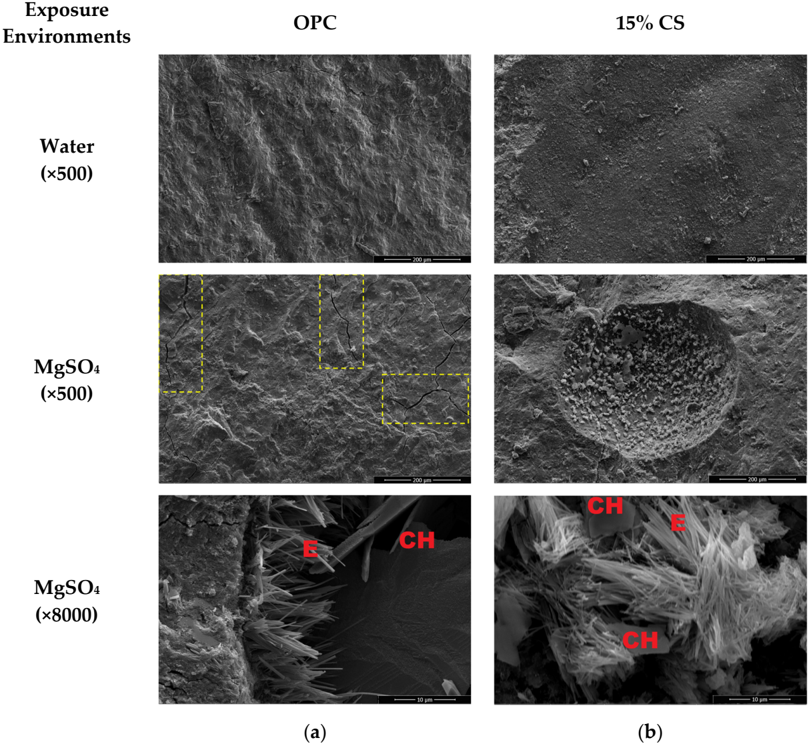
Sustainability in the construction sector has become a fundamental objective for mitigating escalating environmental challenges; given that concrete is the most widely used man-made material, extending its service life is therefore critical. Among durability concerns, magnesium sulfate (MgSO4) attack is particularly deleterious to concrete structures. Therefore, this study investigates the short- and long-term performance of concrete produced with copper slag (CS)—a massive waste generated by copper mining activities worldwide—employed as a supplementary cementitious material (SCM), together with recycled coarse aggregate (RCA), obtained from concrete construction and demolition waste, when exposed to MgSO4. CS was used as a 15 vol% cement replacement, while RCA was incorporated at 0%, 20%, 50%, and 100 vol%. Compressive strength, bulk density, water absorption, and porosity were measured after water curing (7–388 days) and following immersion in a 5 wt.% MgSO4 solution for 180 and 360 days. Microstructural characteristics were assessed using scanning electron microscopy (SEM), X-ray diffraction (XRD), thermogravimetric analysis with its differential thermogravimetric derivative (TG-DTG), and Fourier transform infrared spectroscopy (FTIR) techniques. The results indicated that replacing 15% cement with CS reduced 7-day strength by ≤10%, yet parity with the reference mix was reached at 90 days. Strength losses increased monotonically with RCA content. Under MgSO4 exposure, all mixtures experienced an initial compressive strength gain during the short-term exposures (28–100 days), attributed to the pore-filling effect of expansive sulfate phases. However, at long-term exposure (180–360 days), a clear strength decline was observed, mainly due to internal cracking, brucite formation, and the transformation of C–S–H into non-cementitious M–S–H gel. Based on these findings, the combined use of CS and RCA at low replacement levels shows potential for producing environmentally friendly concrete with mechanical and durability performance comparable to those of concrete made entirely with virgin materials.
Overview
CoChat Summary
TL;DR
This study evaluates concrete with 15 vol% copper slag (CS) as a supplementary cementitious material and 0–100 vol% recycled coarse aggregate (RCA) under 5 wt% MgSO₄ exposure. It finds short-term sulfate exposure increases compressive strength via pore-filling expansive phases, but long-term exposure causes strength loss, with RCA increasing losses and CS reducing brucite/gypsum while promoting M-S-H formation.
Key findings
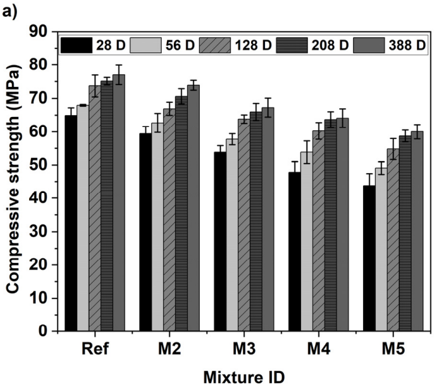
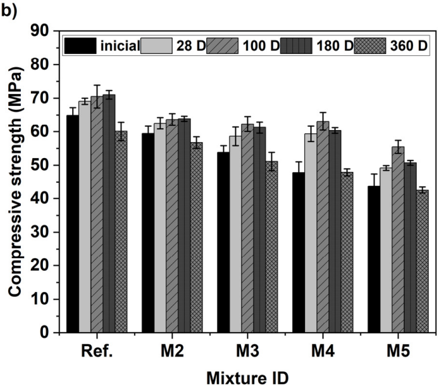
- Replacing 15% cement with CS reduced early compressive strength: at 28 and 56 days, M2 was 8.44% and 7.78% lower than the reference; by 208 and 388 days, M2 reached 70.62 MPa and 73.62 MPa, only 5.9% and 4.0% lower than the reference. The abstract reports 7-day strength reduction ≤10% and parity with the reference at 90 days.
- RCA caused monotonic compressive strength losses: at 28 and 56 days, M5 (15% CS + 100% RCA) was 32.5% and 27.8% lower than the reference; at 388 days, M3, M4, and M5 were 12.6%, 16.71%, and 22.0% lower than the reference.
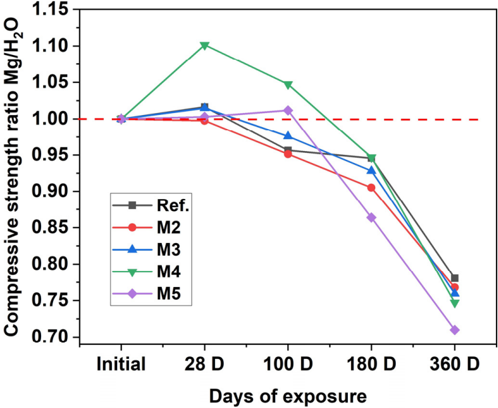
- Under MgSO₄ exposure, all mixtures gained strength at 28–100 days due to pore-filling by expansive phases such as gypsum and ettringite, but at 180–360 days all mixtures lost strength due to internal cracking, brucite formation, and C-S-H transformation into non-cementitious M-S-H. RCA mixtures M3–M5 showed the greatest losses, ranging from 24% to 29% versus water-cured counterparts at 180 and 360 days.
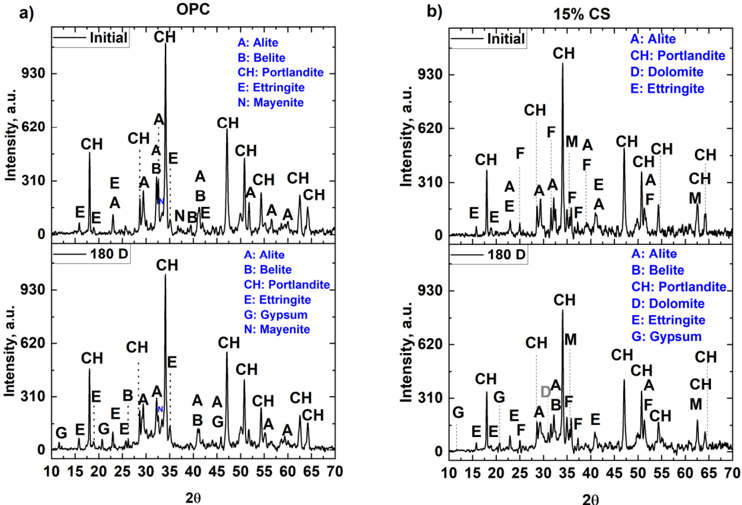
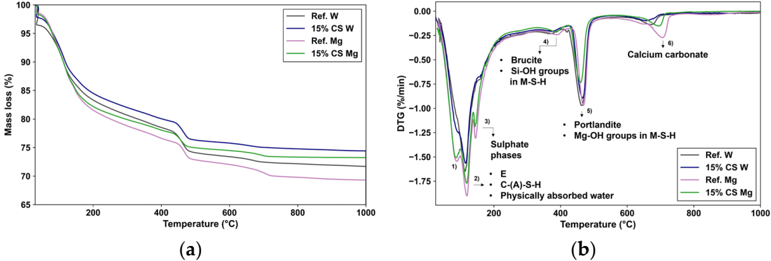
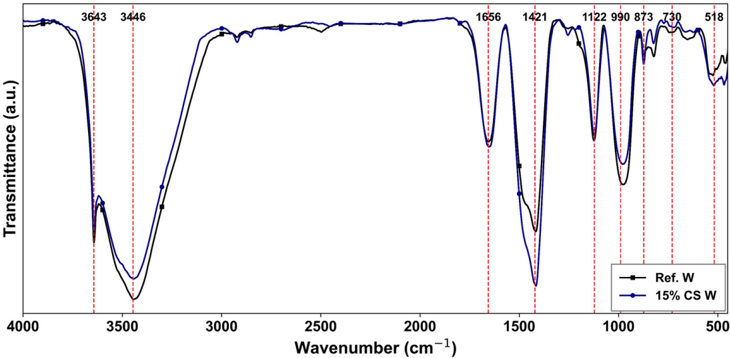
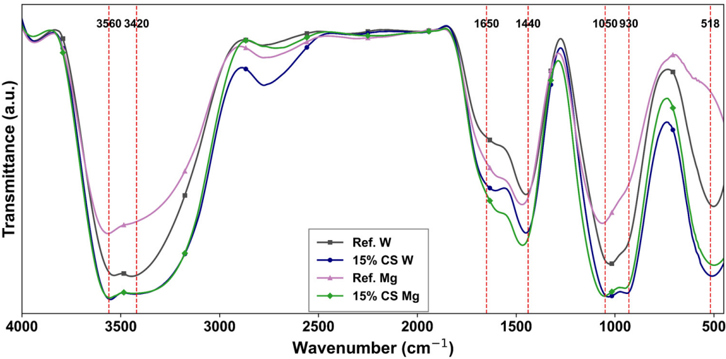
- Microstructural analyses showed that 15% CS reduced brucite and gypsum formation and modified the MgSO₄ attack mechanism by partially converting C-S-H into M-S-H; XRD showed decreased portlandite peaks and gypsum formation after 180 days, while TG-DTG and FTIR supported M-S-H formation.
Methods
- Five concrete mixtures were prepared with fixed water content (196 kg/m³) and constant superplasticizer: a reference with 400 kg/m³ OPC and 0% RCA; M2 with 15 vol% CS replacing OPC (340 kg/m³ OPC + 71.4 kg/m³ CS); and M3–M5 with 20%, 50%, and 100 vol% RCA replacing natural coarse aggregate.
- Specimens were water-cured at 23 ± 2 °C. Compressive strength was measured in water at 28, 56, 128, 208, and 388 days; for sulfate exposure, specimens were initially water-cured for 28 days, then immersed in 5 wt% MgSO₄ and tested after 28, 100, 180, and 360 days of exposure. Testing followed ASTM C39; density, water absorption, and voids followed ASTM C642.
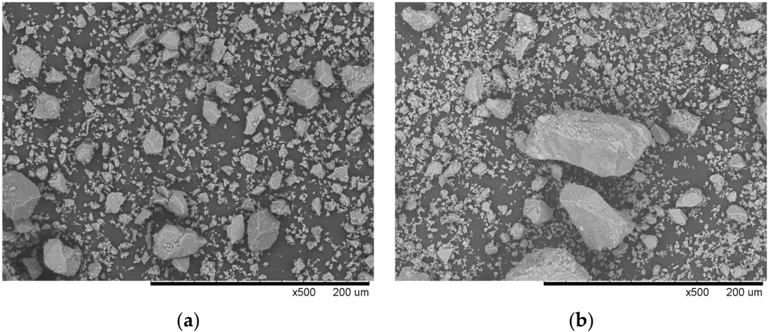
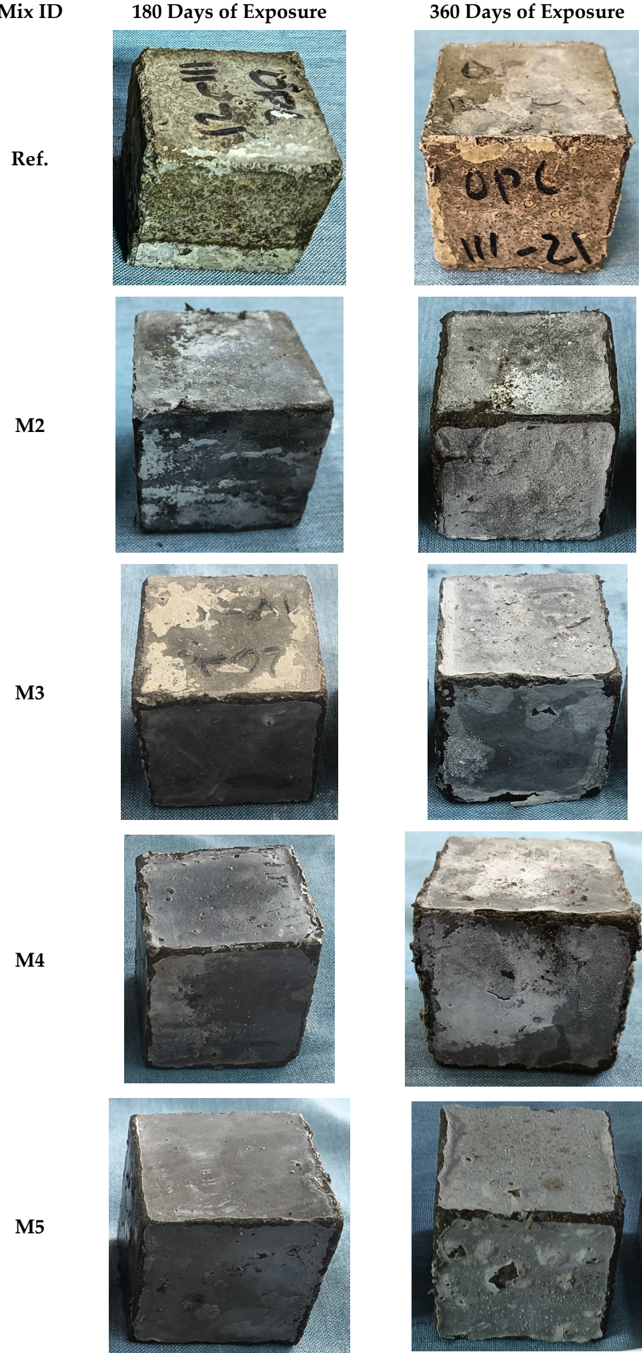
- Visual inspection was performed on 5 × 5 cm cubes after 180 and 360 days of MgSO₄ exposure. Microstructural characterization used XRD, TG-DTG, FTIR, and SEM on cement pastes with 100% OPC or 85% OPC–15% CS.
Limitations
- The paper states that no quantitative image-based automated analysis was performed; no quantitative modeling linked chemical transformations such as M-S-H formation to mechanical performance loss; pore size distribution and connectivity were not characterized; SEM-EDS or STEM-EDS mapping was not used to directly confirm spatial gradients in decalcification and Mg uptake; M-(A)-S-H formation remains speculative; and head-to-head comparisons with other SCM systems were not included.
- Evident from the text: RCA was used only in its untreated state, only one CS dosage (15 vol%) was tested, and the study used a single 5 wt% MgSO₄ solution exposure rather than field or varied sulfate conditions.
Model-written summary. Check it against the paper before relying on it.
Integrity signals
Registry
Cites
Statistics
Figures

Verification
Claims the paper makes
0 Valid · 0 Not valid · 28 Not checked · 90 Own results and interpretations
A result the paper states — it cites no source for it, so there is none to check. The quote shows it is in the paper.
In the paper
“Under MgSO 4 exposure, all mixtures experienced an initial compressive strength gain during the short-term exposures (28-100 days)”
- Also stated in: § 3.2. Compressive Strength · plain
“At 28 and 100 days of exposure, all mixtures showed higher compressive strength compared to the strength developed prior to the onset of exposure.”
- Also stated in: § 3.2. Compressive Strength · plain
“At 28 days of exposure, no negative effect on the compressive strength of concretes exposed to this aggressive environment is observed; on the contrary, a strength gain is even recorded compared to the specimens cured in water over the same period.”
§ Short-and Long-Term Mechanical and Durability Performance of Concrete with Copper Slag and Recycled Coarse Aggregate Under Magnesium Sulfate Attack > Abstract
plainstates a cause- Asserted: passes — The authors put it forward as true.
- Checkable: passes — It can be checked against evidence.
- Load-bearing: passes — The paper’s conclusions depend on it.
- Based: passes — The paper gives a reason why it holds.
- Also stated in: § 3.2. Compressive Strength · plain
A result the paper reports from its own data — it cites no other source for it, so there is none to check. The quote shows it is in the paper.
In the paper
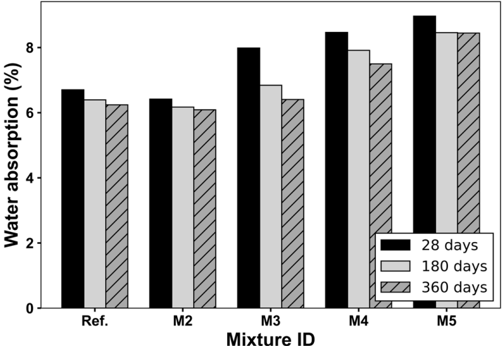
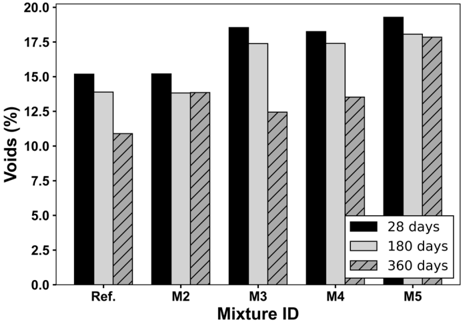
“Ref. and M2 mixtures maintain the lowest void content values at all ages.”
§ Short-and Long-Term Mechanical and Durability Performance of Concrete with Copper Slag and Recycled Coarse Aggregate Under Magnesium Sulfate Attack > 3.3. Water Absorption, Density and Voids
plain- Asserted: passes — The authors put it forward as true.
- Checkable: passes — It can be checked against evidence.
- Load-bearing: unclear — It is unclear whether the paper’s conclusions depend on it.
- Based: passes — The paper gives a reason why it holds.
A result the paper reports from its own data — it cites no other source for it, so there is none to check. The quote shows it is in the paper.
In the paper
“at early curing ages such as 28 and 56 days, when comparing the Ref. mixture (100% virgin materials) with M2 (containing 15% CS as SCM), the compressive strength decreased by 8.44% and 7.78%, respectively.”
§ Short-and Long-Term Mechanical and Durability Performance of Concrete with Copper Slag and Recycled Coarse Aggregate Under Magnesium Sulfate Attack > 3.2. Compressive Strength
plainstates a cause- Asserted: passes — The authors put it forward as true.
- Checkable: passes — It can be checked against evidence.
- Load-bearing: passes — The paper’s conclusions depend on it.
- Based: passes — The paper gives a reason why it holds.
A result the paper states — it cites no source for it, so there is none to check. The quote shows it is in the paper.
In the paper
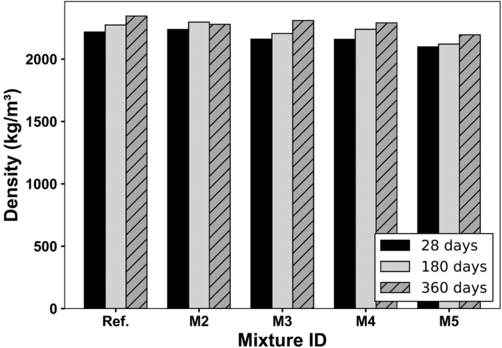
“Mixtures M2, M3, and M4, combining CS and increasing amounts of RCAs, exhibited a monotonic reduction in density proportional to the RCA content.”
§ Short-and Long-Term Mechanical and Durability Performance of Concrete with Copper Slag and Recycled Coarse Aggregate Under Magnesium Sulfate Attack > 3.3. Water Absorption, Density and Voids
plainstates a cause- Asserted: passes — The authors put it forward as true.
- Checkable: passes — It can be checked against evidence.
- Load-bearing: unclear — It is unclear whether the paper’s conclusions depend on it.
- Based: passes — The paper gives a reason why it holds.
A result the paper reports from its own data — it cites no other source for it, so there is none to check. The quote shows it is in the paper.
In the paper
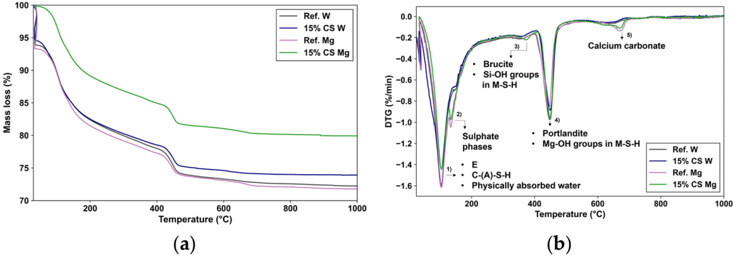
“Subsequently, a second DTG peak (labelled b) emerges between 100 and 150 • C is visible, and more pronounced in Ref. Mg than in 15% CS Mg.”
§ Short-and Long-Term Mechanical and Durability Performance of Concrete with Copper Slag and Recycled Coarse Aggregate Under Magnesium Sulfate Attack > 3.4.2. TG-DTG Analyses
plainstates an association- Asserted: passes — The authors put it forward as true.
- Checkable: passes — It can be checked against evidence.
- Load-bearing: passes — The paper’s conclusions depend on it.
- Based: passes — The paper gives a reason why it holds.
73 more claims
Create a free account to see all 118 claims and to verify the 41 references still open.
- It may state two separate claims as one. 26
- Probably not a substantial claim. 7
- The quote only partly states this claim. 7
Self-check
Percentages, sums and reported differences re-computed from the paper’s own numbers.
Each contradiction between two passages listed here was confirmed by an independent check.
Rated major: it would touch a result — a value a result rests on, reported and recomputed p-values on opposite sides of the significance level, two passages that conflict with no sign which is right, or a cited work retracted before this paper was published.
In the paper
§ Short-and Long-Term Mechanical and Durability Performance of Concrete with Copper Slag and Recycled Coarse Aggregate Under Magnesium Sulfate Attack > Abstract
“The results indicated that replacing 15% cement with CS reduced 7-day strength by ≤10%, yet parity with the reference mix was reached at 90 days.”
§ Short-and Long-Term Mechanical and Durability Performance of Concrete with Copper Slag and Recycled Coarse Aggregate Under Magnesium Sulfate Attack > 2.3.2. Compressive Strength Test
“For the mixtures cured in water, compressive strength was measured at 28, 56, 128, 208, and 388 days.”
Rated major: it would touch a result — a value a result rests on, reported and recomputed p-values on opposite sides of the significance level, two passages that conflict with no sign which is right, or a cited work retracted before this paper was published.
In the paper
§ Short-and Long-Term Mechanical and Durability Performance of Concrete with Copper Slag and Recycled Coarse Aggregate Under Magnesium Sulfate Attack > 3.4.3. FTIR Analyses
“Overall, incorporating 15 vol% of CS partially enhances the sulfate resistance of cement pastes by reducing the formation of brucite and gypsum, preserving the C-S-H gel, and possibly promoting the development of M-S-H or M-A-S-H phases.”
§ Short-and Long-Term Mechanical and Durability Performance of Concrete with Copper Slag and Recycled Coarse Aggregate Under Magnesium Sulfate Attack > 3.4.2. TG-DTG Analyses
“Conversely, the lower intensity in 15% CS Mg supports the hypothesis that less gypsum precipitates and that the dominant degradation product in 15% CS Mg is M-S-H, consistent with a more advanced attack on the C-S-H structure.”
Rated minor: it would not touch a result — a value no result rests on, a p-value that stays on the same side of the significance level, or a conflict that is clerical, resolved elsewhere in the paper, or outside its own findings.
In the paper
§ Short-and Long-Term Mechanical and Durability Performance of Concrete with Copper Slag and Recycled Coarse Aggregate Under Magnesium Sulfate Attack > 2.3. Experimental Methods
“After demolding at 23 ± 2 h, all specimens were fully immersed in water at 23 ± 2 • C, consistent with ASTM C192 [67], from demolding until the specified testing age (up to 360 days) to ensure consistent hydration and pozzolanic development.”
§ Short-and Long-Term Mechanical and Durability Performance of Concrete with Copper Slag and Recycled Coarse Aggregate Under Magnesium Sulfate Attack > 2.3.2. Compressive Strength Test
“For the mixtures cured in water, compressive strength was measured at 28, 56, 128, 208, and 388 days.”
Rated minor: it would not touch a result — a value no result rests on, a p-value that stays on the same side of the significance level, or a conflict that is clerical, resolved elsewhere in the paper, or outside its own findings.
In the paper
§ Short-and Long-Term Mechanical and Durability Performance of Concrete with Copper Slag and Recycled Coarse Aggregate Under Magnesium Sulfate Attack > 3.3. Water Absorption, Density and Voids
“Despite this improvement, their void levels remain above those of Ref., though slightly lower than M2, indicating that the combined use of CS and RCAs may promote a viable densification mechanism over time, potentially offsetting some of the drawbacks associated with RCA alone.”
§ Short-and Long-Term Mechanical and Durability Performance of Concrete with Copper Slag and Recycled Coarse Aggregate Under Magnesium Sulfate Attack > 3.3. Water Absorption, Density and Voids
“Ref. and M2 mixtures maintain the lowest void content values at all ages.”
Rated minor: it would not touch a result — a value no result rests on, a p-value that stays on the same side of the significance level, or a conflict that is clerical, resolved elsewhere in the paper, or outside its own findings.
In the paper
§ Short-and Long-Term Mechanical and Durability Performance of Concrete with Copper Slag and Recycled Coarse Aggregate Under Magnesium Sulfate Attack > 3.4.2. TG-DTG Analyses
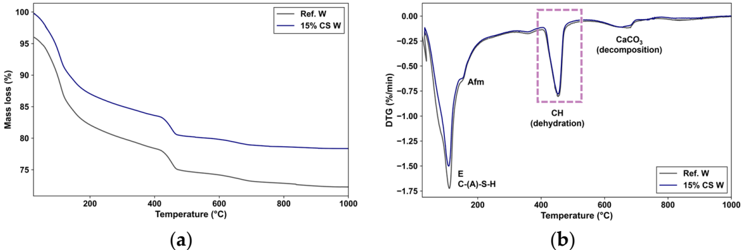
“Compared to 28-day results, in Figure 11a,b, Ref. and 15% CS mixtures cured in water exhibit an increase in total mass loss, indicating continued hydration over time.”
§ Short-and Long-Term Mechanical and Durability Performance of Concrete with Copper Slag and Recycled Coarse Aggregate Under Magnesium Sulfate Attack > 3.4.2. TG-DTG Analyses
“Figure 10a shows that the total mass loss between 50 and 1000 • C was approximately 22.7% for Ref. in water and 19.9% for 15% CS in water, confirming a lower degree of hydration in the CS-blended cement at early ages.”
Citations
Cites
A Practical Guide to Microstructural Analysis of Cementitious Materials
(2018) · CRC Press eBooks · doi:10.1201/b19074 · Cited by 2,110
Influence of limestone on the hydration of Portland cements
Lothenbach, B., Le Saout, G., Gallucci, E., & Scrivener, K. (2008) · Cement and Concrete Research · doi:10.1016/j.cemconres.2008.01.002 · Cited by 1,889
A review of recycled aggregate in concrete applications (2000–2017)
Tam, V. W. Y., Soomro, M., & Evangelista, A. C. J. (2018) · Construction and Building Materials · doi:10.1016/j.conbuildmat.2018.03.240 · Cited by 1,235
de Andrade Salgado, F., & de Andrade Silva, F. (2022) · Journal of Building Engineering · doi:10.1016/j.jobe.2022.104452 · Cited by 390
Attack on plain and blended cements exposed to aggressive sulfate environments
Baghabra Al-Amoudi, O. S. (2002) · Cement and Concrete Composites · doi:10.1016/s0958-9465(01)00082-8 · Cited by 376
Magnesium sulfate attack on hardened blended cement pastes under different circumstances
Hekal, E., Kishar, E. A., & Mostafa, H. (2002) · Cement and Concrete Research · doi:10.1016/s0008-8846(02)00801-3 · Cited by 232
Magnesium sulfate attack on portland cement paste-I. Microstructural analysis
Bonen, D., & Cohen, M. D. (1992) · Cement and Concrete Research · doi:10.1016/0008-8846(92)90147-n · Cited by 223
Characterization of magnesium silicate hydrate (M-S-H)
Bernard, E., Lothenbach, B., Chlique, C., Wyrzykowski, M., Dauzères, A., Pochard, I., & Cau-Dit-Coumes, C. (2019) · Cement and Concrete Research · doi:10.1016/j.cemconres.2018.09.007 · Cited by 218
Alsheyab, M. A. T. (2021) · International Journal of Environmental Science and Technology · doi:10.1007/s13762-021-03217-1 · Cited by 177
Lori, A. R., Hassani, A., & Sedghi, R. (2018) · Construction and Building Materials · doi:10.1016/j.conbuildmat.2018.11.230 · Cited by 175
Su, Y., Luo, B., Luo, Z., Xu, F., Huang, H., Long, Z., & Shen, C. (2023) · Journal of Building Engineering · doi:10.1016/j.jobe.2023.106459 · Cited by 133
A critical review of magnesium silicate hydrate (M-S-H) phases for binder applications
Sreenivasan, H., Bernard, E., Santos, H. S., Nguyen, H., Moukannaa, S., Adediran, A. A., Provis, J. L., & Kinnunen, P. (2024) · Cement and Concrete Research · doi:10.1016/j.cemconres.2024.107462 · Cited by 119
Aluminum incorporation into magnesium silicate hydrate (M-S-H)
Bernard, E., Lothenbach, B., Coumes, C. C. D., Pochard, I., & Rentsch, D. (2019) · Cement and Concrete Research · doi:10.1016/j.cemconres.2019.105931 · Cited by 116
Zhu, J., Wang, Z., Tao, Y., Ju, L., & Yang, H. F. (2024) · Journal of Cleaner Production · doi:10.1016/j.jclepro.2024.141496 · Cited by 112
Gu, Y., Dangla, P., Martin, R.-P., Metalssi, O. O., & Fen-Chong, T. (2021) · Cement and Concrete Research · doi:10.1016/j.cemconres.2021.106676 · Cited by 103
Ouldkhaoua, Y., Benabed, B., Abousnina, R. M., Kadri, E.-H., & Khatib, J. (2019) · Construction and Building Materials · doi:10.1016/j.conbuildmat.2019.117802 · Cited by 99
Zhang, H., Ji, T., & Liu, H. (2020) · Construction and Building Materials · doi:10.1016/j.conbuildmat.2020.118675 · Cited by 98
Sharifi, Y., Afshoon, I., Asad-Abadi, S., & Aslani, F. (2020) · Journal of Environmental Management · doi:10.1016/j.jenvman.2020.111013 · Cited by 89
Ma, X., Hu, H., Luo, Y., Wu, Y., Wei, Y., & She, A. (2025) · Journal of Cleaner Production · doi:10.1016/j.jclepro.2025.144772 · Cited by 84
Luo, B., Su, Y., Ding, X., Chen, Y., & Liu, C. (2025) · Materials Today Communications · doi:10.1016/j.mtcomm.2025.113295 · Cited by 82
Xu, F., Wang, S., Li, T., Liu, B., Zhao, N., & Liu, K. (2021) · Construction and Building Materials · doi:10.1016/j.conbuildmat.2020.121273 · Cited by 73
Zunino, F., & Lopez, M. (2016) · Cement and Concrete Composites · doi:10.1016/j.cemconcomp.2015.10.003 · Cited by 72
Ding, X.-H., Luo, B., Zhou, H.-T., & Chen, Y. (2024) · Computers and Geotechnics · doi:10.1016/j.compgeo.2024.106944 · Cited by 72
Chen, L., Huang, Z., Pan, W., Su, R. K. L., Zhong, Y., & Zhang, Y. (2024) · Journal of Building Engineering · doi:10.1016/j.jobe.2024.109368 · Cited by 70
Kaptan, K., Cunha, S., & de Aguiar, J. L. B. (2024) · Applied Sciences · doi:10.3390/app14219775 · Cited by 70
Sbahieh, S., McKay, G., Nurdiawati, A., & Al‐Ghamdi, S. G. (2025) · Journal of Building Engineering · doi:10.1016/j.jobe.2025.112830 · Cited by 62
Sotiriadis, K., Hlobil, M., Viani, A., Mácová, P., & Vopálenský, M. (2021) · Cement and Concrete Research · doi:10.1016/j.cemconres.2021.106566 · Cited by 57
Performance of recycled aggregate concrete using copper slag as fine aggregate
Sahu, A., Kumar, S., Srivastava, A. K., & Pratap, B. (2023) · Journal of Building Engineering · doi:10.1016/j.jobe.2023.108364 · Cited by 57
Use of Copper Slag Microparticles in Self-Consolidating Concrete
Afshoon, I., & Sharifi, Y. (2017) · ACI Materials Journal · doi:10.14359/51700887 · Cited by 50
Kasaniya, M., & Thomas, M. D. (2022) · Cement and Concrete Research · doi:10.1016/j.cemconres.2022.107007 · Cited by 49
Shi, T., Li, K.-M., Wang, C.-Z., Jin, Z., Hao, X.-K., Sun, P., Han, Y.-X., Pan, C., Fu, N., & Wang, H. (2025) · Case Studies in Construction Materials · doi:10.1016/j.cscm.2025.e04866 · Cited by 48
Sun, L., Lan, S., & Wang, C. (2025) · Construction and Building Materials · doi:10.1016/j.conbuildmat.2025.141399 · Cited by 48
Ameri, F., Shoaei, P., Zahedi, M., Karimzadeh, M., Musaeei, H. R., & Cheah, C. B. (2021) · Journal of Building Engineering · doi:10.1016/j.jobe.2021.102289 · Cited by 45
Yuan, Q., Zhang, J., Zhang, S., Zheng, K., & Chen, L. (2024) · The Science of The Total Environment · doi:10.1016/j.scitotenv.2024.175163 · Cited by 44
Deterioration of mortar bars immersed in magnesium containing sulfate solutions
Kunther, W., Lothenbach, B., & Scrivener, K. L. (2013) · Materials and Structures · doi:10.1617/s11527-013-0032-6 · Cited by 42
Image-Based Automated Width Measurement of Surface Cracking
Carrasco, M., Araya-Letelier, G., Velázquez, R., & Visconti, P. (2021) · Sensors · doi:10.3390/s21227534 · Cited by 40
Self-citationRen, X., Yang, J., Chen, W., Huang, Y., Wang, G., Niu, J., & Wu, J. (2024) · Construction and Building Materials · doi:10.1016/j.conbuildmat.2024.137860 · Cited by 40
Wang, J., Fan, Y., Che, Z., Zhang, K., & Niu, D. (2023) · Construction and Building Materials · doi:10.1016/j.conbuildmat.2023.131149 · Cited by 39
Krishnan, A., & Subramanian, S. S. (2023) · Construction and Building Materials · doi:10.1016/j.conbuildmat.2023.134663 · Cited by 36
Mahajan, D. S., & Muhammad, S. (2023) · Journal of Building Engineering · doi:10.1016/j.jobe.2023.108375 · Cited by 35
Durgun, M. Y., & Sevinç, A. H. (2022) · Journal of Building Engineering · doi:10.1016/j.jobe.2022.104849 · Cited by 34
Agwa, I. S., Mostafa, S. A., Abd-Elrahman, M. H., & Amin, M. (2025) · Journal of Building Engineering · doi:10.1016/j.jobe.2025.113292 · Cited by 34
The influence of sulfate attack on existing concrete bridges: Study of external sulfate attack (ESA)
Belghali, M., Ayed, K., Ezziane, M., & Leklou, N. (2025) · Construction and Building Materials · doi:10.1016/j.conbuildmat.2025.141751 · Cited by 32
Degradation of C–S–H(I) at different decalcification degrees
Jin, M., Ma, Y., Li, W., Huang, J., Zeng, H., Lü, C., Zhang, J., & Liu, J. (2022) · Journal of Materials Science · doi:10.1007/s10853-022-07857-7 · Cited by 31
Influence of Optimum Particle Packing on the Macro and Micro Properties of Sustainable Concrete
Abushama, W. J., Al-Tamimi, A. K., Tabsh, S. W., El-Emam, M., Ibrahim, A., & Ali, T. K. M. (2023) · Sustainability · doi:10.3390/su151914331 · Cited by 30
Evaluating the effectiveness of copper slag waste as a fine aggregate in concrete
Pushpakumara, B. H. J., & Bandara, P. M. K. N. (2025) · Construction and Building Materials · doi:10.1016/j.conbuildmat.2025.141046 · Cited by 30
Singh, P. K., & Rajhans, P. (2023) · Construction and Building Materials · doi:10.1016/j.conbuildmat.2023.132032 · Cited by 29
Wang, J., Fu, M., Zheng, K., Zhang, K., Fan, Y., & Niu, D. (2024) · Construction and Building Materials · doi:10.1016/j.conbuildmat.2024.136273 · Cited by 29
Navaneetha, E. R., Rao, P. N., & Bahurudeen, A. (2025) · Construction and Building Materials · doi:10.1016/j.conbuildmat.2025.140329 · Cited by 27
Practice for Making and Curing Concrete Test Specimens in the Laboratory
C09 Committee (2025) · ASTM Standards · doi:10.1520/c0192_c0192m-25a · Cited by 26
Jia, R., Wang, Q., & Luo, T. (2023) · Construction and Building Materials · doi:10.1016/j.conbuildmat.2023.133117 · Cited by 25
Xiao, R., Prentice, D. P., Collin, M., Balonis, M., Plante, E. C. L., Torabzadegan, M., Gädt, T., & Sant, G. (2024) · Journal of the American Ceramic Society · doi:10.1111/jace.20004 · Cited by 24
Performance of cement-based materials incorporating ultra-fine copper slag
Wang, Y., Hu, Y. Z., Yang, J., He, Y., He, X., Su, Y., & Strnadel, B. (2023) · Construction and Building Materials · doi:10.1016/j.conbuildmat.2023.132949 · Cited by 24
Liu, X., Li, D.-N., Li, M., Xie, H., Yu, X., Wang, H., Wang, W., Hong, J., Zhang, Z., & Feng, P. (2025) · Cement and Concrete Research · doi:10.1016/j.cemconres.2025.107920 · Cited by 24
Kanagaraj, B., Anand, N., & Lublóy, É. (2024) · Developments in the Built Environment · doi:10.1016/j.dibe.2024.100517 · Cited by 23
Silva, Y. F., Delvasto, S., Izquierdo, S., & Araya-Letelier, G. (2021) · Construction and Building Materials · doi:10.1016/j.conbuildmat.2021.125382 · Cited by 22
Self-citationShanks, B., Howe, C., Draper, S., Wong, H. S., & Cheeseman, C. R. (2024) · Materials Letters · doi:10.1016/j.matlet.2024.136133 · Cited by 22
Al-Kerttani, O. M. G., Hilal, N., Hama, S. M., Sor, N. H., Banyhussan, Q. S., & Tawfik, T. A. (2024) · Results in Engineering · doi:10.1016/j.rineng.2024.103310 · Cited by 21
Sustainable 3D Printable Concrete mix using copper slag
Ambily, P. S., Kaliyavaradhan, S. K., Sebastian, S., & Shekar, D. (2025) · Journal of Building Engineering · doi:10.1016/j.jobe.2025.111950 · Cited by 21
Study on novel alkali-activated cementitious grout for scour control of offshore foundation
Sha, F., Dong, Y., Gu, S., Fan, X., & Xiao, W. (2025) · Geomechanics for Energy and the Environment · doi:10.1016/j.gete.2025.100663 · Cited by 20
Chaitanya, B. K., Sivakumar, I., Madhavi, Y., Cruze, D., Venkatesh, C., Mahesh, Y., & Durga, C. S. S. (2024) · Infrastructures · doi:10.3390/infrastructures9050085 · Cited by 20
Mohanty, S., Sahoo, K. K., & Samal, K. (2025) · Journal of Building Engineering · doi:10.1016/j.jobe.2025.112354 · Cited by 20
Damage-based ion transport in recycled aggregate concrete under external sulfate attack
Jin, L., Wang, Z., Wu, T., Xie, Z., & Xue, P. (2024) · Construction and Building Materials · doi:10.1016/j.conbuildmat.2024.137944 · Cited by 18
Jia, Y., Ding, M., Lin, Y., Wang, L., Wei, Y., & Han, S. (2025) · Construction and Building Materials · doi:10.1016/j.conbuildmat.2024.139752 · Cited by 18
Sulfate attack resistance of self-compacting concrete with residue of masonry
Silva, Y. F., & Delvasto, S. (2021) · Construction and Building Materials · doi:10.1016/j.conbuildmat.2020.121095 · Cited by 18
Ishaq, M. B., Mohammed, A. S., & Mohammed, A. A. (2025) · Sustainable Chemistry and Pharmacy · doi:10.1016/j.scp.2025.102019 · Cited by 17
Amin, M., Elsakhawy, Y., el‐hassan, K. A., & Abdelsalam, B. A. (2025) · Journal of Building Engineering · doi:10.1016/j.jobe.2025.112898 · Cited by 17
Bavithra, K., & Mohana, R. (2025) · Construction and Building Materials · doi:10.1016/j.conbuildmat.2025.140565 · Cited by 17
Moodi, Y., Hamzehkolaei, N. S., & Afshoon, I. (2025) · Materials Today Communications · doi:10.1016/j.mtcomm.2025.112572 · Cited by 16
Efecto del residuo de mampostería en la hidratación de pastas de cemento Portland
Urrego, Y. F. S., Izquierdo, S. R., & Silvio Delvasto, A. (2019) · DYNA · doi:10.15446/dyna.v86n209.77286 · Cited by 16
Mesoscale modeling of mechanical deterioration in sulfate-attacked concrete
Qin, S., Zhang, M., Zou, D., Liu, T., & Li, Y. (2025) · Engineering Fracture Mechanics · doi:10.1016/j.engfracmech.2025.111229 · Cited by 16
Long-Term Effects of External Sulfate Attack on Low-Carbon Cementitious Materials at Early Age
Inaty, F. E., Aydin, B., Houhou, M., Marchetti, M., Quiertant, M., & Metalssi, O. O. (2024) · Applied Sciences · doi:10.3390/app14072831 · Cited by 15
Burbano-Garcia, C., Urrego, Y. F. S., Araya-Letelier, G., & González, M. (2025) · Journal of Building Engineering · doi:10.1016/j.jobe.2025.113673 · Cited by 15
Self-citationDurability of Mortars with Partial Cement Replacement by Recycled Brick Powder
Lliso-Ferrando, J. R., Arenós-Barrachina, A., Monzón-Bello, P., & Valcuende, M. (2025) · Applied Sciences · doi:10.3390/app15084133 · Cited by 15
Waste copper slag in special concrete: Current research and future applications
Nieświec, M., Niewiadomski, P., Sadowski, Ł., & Schroefl, C. (2025) · Materials & Design · doi:10.1016/j.matdes.2025.113970 · Cited by 15
Hua, T., Cao, Z., Zhang, S., & Guo, R. (2025) · Construction and Building Materials · doi:10.1016/j.conbuildmat.2025.142091 · Cited by 14
Arredondo, P. W. C., Silva, Y. F., Araya-Letelier, G., & Hernández, H. (2024) · Sustainability · doi:10.3390/su162411239 · Cited by 13
Self-citationKumar, P., Pasla, D., & Saravanan, T. J. (2025) · Journal of Building Engineering · doi:10.1016/j.jobe.2025.112969 · Cited by 13
Kang, J., Fan, L., Yang, J., Yu, Z., Chen, X., & Tian, Y. (2025) · Materials Today Communications · doi:10.1016/j.mtcomm.2025.112531 · Cited by 12
Analysis of construction and demolition waste prediction post-earthquake disasters
Temelli, U. E., Sezgin, N., Cumali, B. O., & Nemlioğlu, S. (2025) · Engineering Science and Technology an International Journal · doi:10.1016/j.jestch.2025.102078 · Cited by 11
Silva, Y. F., Burbano-Garcia, C., Araya-Letelier, G., & González, M. (2024) · Case Studies in Construction Materials · doi:10.1016/j.cscm.2024.e03302 · Cited by 11
Self-citationRole of porous aggregate types on the sulfate attack resistance of cement mortar
Yu, Z., Li, Y., Liu, Y., & Shen, X. (2025) · Construction and Building Materials · doi:10.1016/j.conbuildmat.2025.141781 · Cited by 11
Effect of magnesium sulphate and sulphuric acid attack on limestone calcined clay cement concrete
Gunjal, S. M., Turkane, S. D., Patankar, S. V., & Kondraivendhan, B. (2023) · Materials Today: Proceedings · doi:10.1016/j.matpr.2023.03.488 · Cited by 11
Hou, Y., Zhang, X., Liu, J., He, C., & Ji, X. (2024) · Construction and Building Materials · doi:10.1016/j.conbuildmat.2024.139271 · Cited by 10
Deep, A., Zade, N. P., & Sarkar, P. (2024) · Structures · doi:10.1016/j.istruc.2024.107670 · Cited by 10
Chemical–physical–mechanical stability of MKG mortars under sulfate attacks
Yan, D., Chen, S., Jin, J., Zhu, X., Wang, J., & Zeng, Q. (2020) · Advances in Cement Research · doi:10.1680/jadcr.19.00094 · Cited by 9
Silva, Y. F., Burbano-Garcia, C., Araya-Letelier, G., & Izquierdo, S. (2025) · Case Studies in Construction Materials · doi:10.1016/j.cscm.2025.e04846 · Cited by 9
Self-citationSong, Y., Wang, Y., Wang, Y., & Liu, B. (2025) · Construction and Building Materials · doi:10.1016/j.conbuildmat.2025.141131 · Cited by 9
Urrego, Y. F. S., Villaquirán‐Caicedo, M. A., & Izquierdo, S. R. (2023) · Materials · doi:10.3390/ma16206677 · Cited by 8
Arif, R., Javed, M. F., Asghar, R., Iqtidar, A., Ahmed, B., Alyousef, R., & Khan, M. A. (2025) · REVIEWS ON ADVANCED MATERIALS SCIENCE · doi:10.1515/rams-2024-0082 · Cited by 8
Joseph, H. S., Pachiappan, T., Avudaiappan, S., & Guindos, P. (2023) · Revista de la Construcción · doi:10.7764/rdlc.22.1.178 · Cited by 7
Rosales, J., Rosales, M., Cabrera, M., Cubero, A., Agrela, F., & Redel-Macías, M. D. (2025) · Journal of Building Engineering · doi:10.1016/j.jobe.2025.112724 · Cited by 6
Zhang, H., Yi, S., Xu, X., & Yao, J. (2025) · Journal of Building Engineering · doi:10.1016/j.jobe.2024.111525 · Cited by 6
Xuyong, C., Jiawei, M., Qiaoyun, W., Jie, L., Shukai, C., & Zhuo, L. (2025) · Journal of Building Engineering · doi:10.1016/j.jobe.2024.111744 · Cited by 6
Wang, W., Shen, A., Zhou, J., Ebohon, O. J., & Zhan, Q. (2025) · Case Studies in Construction Materials · doi:10.1016/j.cscm.2025.e04585 · Cited by 6
Fang, Z., Wang, C., Hu, H., Li, Z., Ran, B., & Zhou, S. (2025) · Journal of Building Engineering · doi:10.1016/j.jobe.2025.112750 · Cited by 6
Effect of fineness of high-alumina ground granulated blastfurnace slag on magnesium sulphate attack
Lee, S. T., Hooton, R. D., Kim, S. S., & Kim, E. K. (2006) · Magazine of Concrete Research · doi:10.1680/macr.2006.58.5.301 · Cited by 6
Kanagaraj, B., Anand, N., Raj, R. S., & Lublóy, É. (2024) · Case Studies in Construction Materials · doi:10.1016/j.cscm.2024.e03898 · Cited by 5
Urrego, Y. F. S., Izquierdo, S. R., Delvasto, S., & Araya-Letelier, G. (2024) · European Journal of Environmental and Civil engineering · doi:10.1080/19648189.2024.2414221 · Cited by 5
Self-citationAllal, M., Zeghichi, L., & Siline, M. (2024) · Journal of Building Engineering · doi:10.1016/j.jobe.2024.109852 · Cited by 4
Zhang, L., Yao, J., & Tong, Y. (2025) · KSCE Journal of Civil Engineering · doi:10.1016/j.kscej.2025.100236 · Cited by 4
Yadav, A., Jayappa, S. M., Mahadevaiah, R. R., Gowda, S., Jitesh, N., Pasmanabh, J., Anand, V., & Nagarajaiah, M. (2024) · International Conference on Recent Advances in Science and Engineering (RAiSE) · doi:10.3390/engproc2023059224 · Cited by 4
Binary Supplementary Cementitious Material from Expanded Clay Production Dust and Opoka
Kaminskas, R., Barauskas, I., Uselis, S., & Savickaite, B. (2025) · Sustainability · doi:10.3390/su17020794 · Cited by 2
Research works printed but not linked: 4
- ASTM C150; Standard Specification for Portland Cement. ASTM International: West Conshohocken, PA, USA, 2022; pp. 1-9.
- ASTM C136/C136M; Standard Test Method for Sieve Analysis of Fine and Coarse Aggregates. ASTM International: West Conshohocken, PA, USA, 2019; In Proceedings of the Astm C136-14, pp. 1-5.
- ASTM C128; Standard Test Method for Relative Density (Specific Gravity) and Absorption of Fine Aggregate. ASTM International: West Conshohocken, PA, USA, 2022; Volume I, pp. 1-6.
- ASTM C127; Standard Test Method for Relative Density (Specific Gravity) and Absorption of Coarse Aggregate. ASTM International: West Conshohocken, PA, USA, 2024; pp. 1-6.
Cited by
Castillo, I. F., Aponte, D., & Barra, M. (2025) · Case Studies in Construction Materials · doi:10.1016/j.cscm.2025.e05562 · Cited by 6
Humagain, S., Sarker, P. K., & Shaikh, F. U. A. (2025) · Applied Sciences · doi:10.3390/app15189958 · Cited by 5
Engineering Performance of Copper Slag in Sustainable Construction: A Systematic Review
Vijayan, D. S., Devarajan, P., Nartowska, E., Sivasuriyan, A., Piętocha, A., & Koda, E. (2026) · Buildings · doi:10.3390/buildings16091849 · Cited by 3
Effect of fly ash content on concrete durability under magnesium sulfate attack and sustained load
Sun, Q., Qiao, H., An, B., & Su, R. (2026) · Proceedings of the Institution of Civil Engineers - Structures and Buildings · doi:10.1680/jstbu.25.00273 · Cited by 2
Yang, C., Sun, W., Wang, S., & Chen, C. (2026) · Environmental Monitoring and Assessment · doi:10.1007/s10661-026-15352-8 · Cited by 1
“The reaction between finely ground gypsum powder (CaSO 4 ·2H 2 O) and alumina-con-taining phases (e.g., C 3 A) under alkaline conditions leads to the formation of ettringite (AFt) (Bai et al., 2024; Silva et al., 2025).”
Metadata
- Authors
- Silva, Y. F., Burbano-Garcia, C., Rueda, E. J., Reyes-Román, A., & Araya-Letelier, G.
- Affiliations
- School of Civil Construction, Faculty of Engineering, Pontificia Universidad Católica de Chile, Santiago 8331150, Chile
- Pontificia Universidad Católica de Chile (CL)
- Department of Mining Engineering, University of Antofagasta, Antofagasta 1270300, Chile
- Corresponding author
- Araya-Letelier, Gerardo
- ORCID
- Venue
- Applied Sciences
- Publisher
- MDPI AG
- Published
- 2025-07-26
- Volume
- 15
- Issue
- 15
- Pages
- 8329
- ISSN
- 2076-3417 (ISSN-L)
- OpenAlex
- W4412695076
- Cited by
- 13
- References
- 103
- Citations by year
- 2026: 9 · 2025: 4
- FWCI
- 3.67
- Type
- journal article
- Language
- en
- Open access
- gold
- doi.org
- Licence
- Locations
- Applied Sciences (publishedVersion, cc-by)
- DOAJ (DOAJ: Directory of Open Access Journals) (submittedVersion)
- Funders
- National Agency for Research and Development (ANID) through Fondecyt Regular Project (1250096, Folio 21221769)
- Scholarship ANID Doctorado Nacional 2022 (1250096, Folio 21221769)
- Academic Insertion Program (PIA-UC) (1250096, Folio 21221769)
- Topics
- Physical Sciences › Engineering › Building and Construction › Recycled Aggregate Concrete Performance
- Physical Sciences › Engineering › Civil and Structural Engineering › Concrete and Cement Materials Research
- Physical Sciences › Engineering › Building and Construction › Materials Engineering and Processing
- Keywords
- copper slag, recycled coarse aggregate, magnesium sulfate attack, concrete durability, supplementary cementitious materials, compressive strength, sulfate expansion, construction and demolition waste, cement replacement, internal cracks, porosity
About these checks
Registry, retraction, Cites and statistics results are computed, not judged, with one exception: a printed reference that no index lists is read once by a model before it counts as a citation error. Claims are extracted by a model and kept only when their quote appears verbatim in the text; each cited source is then checked, with a model’s help, for whether it says what the claim relies on. Those verdicts can be wrong — read the claim’s quote and the cited source before relying on one.
A language model drew the claims from the paper on 2026-11-27, under version 3 of the claim definition (model deepseek-v4.1-flash, prompt extract-v3).
A second model labelled each claim on 2026-11-27 (model jev-1.13-20260917, definition revision gold-guideline-v0.2).
Statistics and arithmetic are recomputed, not judged.
Confidence bands are shown only for fields calibrated on our annotated test set. None is calibrated yet, so no band is shown.
What counts as a claim ›How we measure confidence ›How we check this ›
Are you an author, or do you see a problem with this page? Request a review
Data sources
Bibliographic data: Semantic Scholar, OpenAlex, Crossref.
Contains information from the Semantic Scholar Academic Graph Datasets, made available under the ODC Attribution License (ODC-BY 1.0).
Semantic Scholar’s data is described in: Kinney, R., et al. (2023). The Semantic Scholar Open Data Platform. arXiv:2301.10140.
