

The DOI matches its Crossref record; 48 of the 48 references it cites were found in a registry or an index; none of the 6 sources its claims cite is checked for support yet.
Hydration and Fluid Intake in Basketball Players During Training: Comparison of Different Age Categories
Open accessAbstract
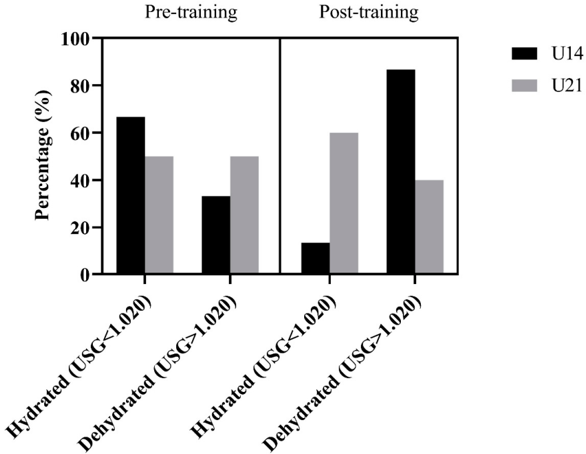
There are many studies on basketball players’ hydration in the literature. However, no studies have compared the hydration status of basketball players in different age categories. Therefore, this study aims to compare the hydration status and fluid intake of male basketball players of different age categories during a training session. A total of 70 athletes, actively competing in U14 (n = 30) and U21 (n = 40) teams, voluntarily participated. Urine samples were collected before and after the session to assess hydration status via urine specific gravity (USG). Fluid intake was also individually monitored during the training. Results showed a significant interaction between time and age group in terms of USG (F(1,68) = 23.72, p < 0.001, η2 = 0.083). While dehydration levels increased in U14 players during the session, U21 players showed improved hydration. The U21 group consumed significantly more fluid (1.16 ± 0.65 L) than the U14 group (0.72 ± 0.50 L; p = 0.003). No significant correlation was found between fluid intake and hydration change in either group. These findings suggest that younger athletes may require more guidance and education regarding proper hydration habits during training.
Overview
CoChat Summary
TL;DR
In 70 male basketball players from U14 and U21 teams, hydration status and fluid intake during training differed by age: U14 players became more dehydrated, while U21 players improved hydration, and U21 consumed more fluid. The authors conclude that younger athletes may require more guidance and education about proper hydration during training.
Key findings
- A significant time × age-group interaction was found for urine specific gravity (USG): F(1,68) = 23.72, p < 0.001, η² = 0.083. U14 USG increased from 1.020 ± 0.007 pre-training to 1.024 ± 0.006 post-training (p = 0.03), whereas U21 USG decreased from 1.020 ± 0.005 to 1.016 ± 0.008 (p < 0.001).
- U21 players consumed significantly more fluid during training than U14 players: 1.16 ± 0.65 L vs. 0.72 ± 0.50 L (p = 0.003).
- Fluid intake was not significantly correlated with hydration change in either group: U14 r = 0.037, p = 0.845; U21 r = 0.162, p = 0.318.
- Both groups began training at a mean USG of 1.020, which is at the study’s hypohydration threshold (USG ≥ 1.020 g·mL⁻¹); U14 pre-training USG was also significantly higher than U21 post-training USG (p = 0.03).
Methods
- Participants were 70 male basketball players from U14 (n = 30) and U21 (n = 40) teams of a local club in Kastamonu, Türkiye. Inclusion required at least 3 years of competitive basketball experience, active competition in the past year, regular training at least 3 days/week, and no injury preventing training for the past 6 months; athletes using diuretics, medications, or supplements were excluded.
- Data were collected during preparatory training sessions at the same environmental temperature (24.3 ± 1.1 °C). Urine samples were collected before and after training to assess USG via a digital refractometer (ATAGO PAL-10S), and fluid intake was monitored from 2-L bottles given to each athlete.
- Analyses used JASP 0.18.3.0. Normality was checked with Shapiro-Wilk and skewness/kurtosis; independent t-tests compared descriptive variables; repeated-measures ANOVA (2 groups × 2 time points) examined USG change; Pearson correlation examined USG change vs. fluid intake; significance was set at p < 0.05. Post hoc power was 0.88.
Limitations
- Stated: USG variability and sensitivity to recent fluid intake may influence single-time-point measurements; morning USG and 24-h hydration monitoring would better assess baseline and habitual hydration; body mass change was not monitored pre- and post-training; diet and physical activity in the days before testing were not controlled.
- Stated: the pre–post training design specifically targeted in-session hydration management rather than broader daily hydration patterns.
- Evident from the text: the sample was male basketball players from a single local club, so findings may not generalize to female athletes, other sports, or other settings; the study also did not encourage fluid intake, and the correlation analysis does not establish causality.
Model-written summary. Check it against the paper before relying on it.
Integrity signals
Registry
Cites
Statistics
Figures
Verification
Claims the paper makes
0 Valid · 0 Not valid · 4 Not checked · 19 Own results and interpretations
A result the paper reports from its own data — it cites no other source for it, so there is none to check. The quote shows it is in the paper.
In the paper
“Results showed a significant interaction between time and age group in terms of USG (F (1,68) = 23.72,p < 0.001, η 2 = 0.083).”
- Also stated in: § 3. Results · plain
“However, a significant interaction was observed between measurement time and age group on USG variation (F 1,68 = 23.72,p < 0.001, η 2 = 0.083).”
§ Hydration and Fluid Intake in Basketball Players During Training: Comparison of Different Age Categories > Abstract
plainstates an association- Asserted: passes — The authors put it forward as true.
- Checkable: passes — It can be checked against evidence.
- Load-bearing: passes — The paper’s conclusions depend on it.
- Based: passes — The paper gives a reason why it holds.
- Also stated in: § 3. Results · plain
A result the paper reports from its own data — it cites no other source for it, so there is none to check. The quote shows it is in the paper.
In the paper
“Post hoc analyses with Holm correction revealed that the U14 athletes exhibited a marked increase in post-training USG compared to their pre-training values (p = 0.03).”
- Also stated in: § Abstract · plain
“While dehydration levels increased in U14 players during the session, U21 players showed improved hydration.”
§ Hydration and Fluid Intake in Basketball Players During Training: Comparison of Different Age Categories > 3. Results
plainstates a causen = 30- Asserted: passes — The authors put it forward as true.
- Checkable: passes — It can be checked against evidence.
- Load-bearing: passes — The paper’s conclusions depend on it.
- Based: passes — The paper gives a reason why it holds.
- Also stated in: § Abstract · plain
A result the paper reports from its own data — it cites no other source for it, so there is none to check. The quote shows it is in the paper.
In the paper
“The timing of measurements (pre-vs.post-training) did not significantly influence USG changes (F 1,68 = 0.35, p = 0.555, η 2 = 0.001).”
§ Hydration and Fluid Intake in Basketball Players During Training: Comparison of Different Age Categories > 3. Results
plain- Asserted: passes — The authors put it forward as true.
- Checkable: passes — It can be checked against evidence.
- Load-bearing: unclear — It is unclear whether the paper’s conclusions depend on it.
- Based: passes — The paper gives a reason why it holds.
A result the paper reports from its own data — it cites no other source for it, so there is none to check. The quote shows it is in the paper.
In the paper
“Second, U14 players not only commenced training with a poorer hydration status but also experienced further dehydration postexercise.”
- Also stated in: § Abstract · plain
“While dehydration levels increased in U14 players during the session, U21 players showed improved hydration.”
§ Hydration and Fluid Intake in Basketball Players During Training: Comparison of Different Age Categories > 4. Discussion
plainstates a causen = 30- Asserted: passes — The authors put it forward as true.
- Checkable: passes — It can be checked against evidence.
- Load-bearing: passes — The paper’s conclusions depend on it.
- Based: passes — The paper gives a reason why it holds.
- Also stated in: § Abstract · plain
A result the paper reports from its own data — it cites no other source for it, so there is none to check. The quote shows it is in the paper.
In the paper
“Notably, while the U21 basketball players showed a significant decrease in USG after training (p < 0.001) from their initially elevated pre-training levels, the U14 team demonstrated a substantial rise in USG post-exercise (p < 0.001).”
- Also stated in: § Abstract · plain
“While dehydration levels increased in U14 players during the session, U21 players showed improved hydration.”
§ Hydration and Fluid Intake in Basketball Players During Training: Comparison of Different Age Categories > 3. Results
plainstates a causen = 40- Asserted: passes — The authors put it forward as true.
- Checkable: passes — It can be checked against evidence.
- Load-bearing: passes — The paper’s conclusions depend on it.
- Based: passes — The paper gives a reason why it holds.
- Also stated in: § Abstract · plain
11 more claims
Create a free account to see all 23 claims and to verify the 6 references still open.
- It may state two separate claims as one. 5
- The quote only partly states this claim. 1
- Probably not a substantial claim. 2
Statistics recomputed
Every reported test result, recomputed from its test statistic and degrees of freedom. A result shows as not adding up only once an independent check has confirmed it.
- ConsistentF(1, 68) = 23.72reported p < .001 · recomputed p < .001
“F (1,68) = 23.72,p < .001”
Self-check
Percentages, sums and reported differences re-computed from the paper’s own numbers.
Each contradiction between two passages listed here was confirmed by an independent check.
Rated minor: it would not touch a result — a value no result rests on, a p-value that stays on the same side of the significance level, or a conflict that is clerical, resolved elsewhere in the paper, or outside its own findings.
In the paper
§ Hydration and Fluid Intake in Basketball Players During Training: Comparison of Different Age Categories > 3. Results
“Post hoc analyses with Holm correction revealed that the U14 athletes exhibited a marked increase in post-training USG compared to their pre-training values (p = 0.03).”
§ Hydration and Fluid Intake in Basketball Players During Training: Comparison of Different Age Categories > 3. Results
“the U14 team demonstrated a substantial rise in USG post-exercise (p < 0.001).”
Citations
Cites
Statistical power analyses using G∗Power 3.1: tests for correlation and regression analyses
Faul, F., Erdfelder, E., Buchner, A., & Lang, A.-G. (2009) · Behavior Research Methods · doi:10.3758/brm.41.4.1149 · Cited by 37,615
Descriptive statistics and normality tests for statistical data
Gupta, A., Mishra, P., Pandey, C., Singh, U., Sahu, C., & Keshri, A. (2019) · Annals of Cardiac Anaesthesia · doi:10.4103/aca.aca_157_18 · Cited by 2,628
Reduced Thirst after Water Deprivation in Healthy Elderly Men
Phillips, P. A., Rolls, B. J., Ledingham, J. G. G., Forsling, M. L., Morton, J. J., Crowe, M. J., & Wollner, L. (1984) · New England Journal of Medicine · doi:10.1056/nejm198409203111202 · Cited by 780
The physiological load imposed on basketball players during competition
McInnes, S. E., Carlson, J. S., Jones, C. J., & McKenna, M. J. (1995) · Journal of Sports Sciences · doi:10.1080/02640419508732254 · Cited by 714
The Aging Kidney: Physiological Changes
Weinstein, J. R., & Anderson, S. (2010) · Advances in Chronic Kidney Disease · doi:10.1053/j.ackd.2010.05.002 · Cited by 639
Stojanović, E., Stojiljković, N., Scanlan, A. T., Dalbo, V. J., Berkelmans, D. M., & Milanović, Z. (2018) · Sports Medicine · doi:10.1007/s40279-017-0794-z · Cited by 592
McDermott, B. P., Anderson, S. A., Armstrong, L. E., Casa, D. J., Cheuvront, S. N., Cooper, L., Kenney, W. L., O'Connor, F. G., & Roberts, W. O. (2017) · Journal of Athletic Training · doi:10.4085/1062-6050-52.9.02 · Cited by 438
Influence of age on thirst and fluid intake
KENNEY, W. L., & CHIU, P. (2001) · Medicine & Science in Sports & Exercise · doi:10.1097/00005768-200109000-00016 · Cited by 304
A comparison of the activity demands of elite and sub-elite Australian men's basketball competition
Scanlan, A., Dascombe, B., & Reaburn, P. (2011) · Journal of Sports Sciences · doi:10.1080/02640414.2011.582509 · Cited by 296
Casa, D. J., Clarkson, P. M., & Roberts, W. O. (2005) · Current Sports Medicine Reports · doi:10.1097/01.csmr.0000306194.67241.76 · Cited by 236
Research works printed but not linked: 1
- Pediatrics, 2000, Climatic heat stress and the exercising child and adolescent. American Academy of Pediatrics, Comm. Sports Med. Fitness. Pediatr., 106, 158
Cited by
Still being checked.
Metadata
- Authors
- Kaplan, A., Ceylan, B., Baydil, B., & Šimenko, J.
- Affiliations
- Hitit Üniversitesi (TR)
- Kastamonu University (TR)
- University of Ljubljana (SI)
- Corresponding author
- Kaplan, Abdurrahim
- Šimenko, Jožef
- Venue
- Applied Sciences
- Publisher
- MDPI AG
- Published
- 2025-09-23
- Volume
- 15
- Issue
- 19
- Pages
- 10304
- ISSN
- 2076-3417 (ISSN-L)
- OpenAlex
- W4414418623
- Cited by
- 0
- References
- 48
- FWCI
- 0.00
- Type
- journal article
- Language
- en
- Open access
- gold
- doi.org
- Licence
- Locations
- Applied Sciences (publishedVersion, cc-by)
- Repository of the University of Ljubljana (University of Ljubljana) (submittedVersion, cc-by)
- DOAJ (DOAJ: Directory of Open Access Journals) (submittedVersion, cc-by-sa)
- Hitit University Institutional Repository (submittedVersion, cc-by-nc-nd)
- Funders
- Kastamonu Üniversitesi
- Topics
- Health Sciences › Medicine › Physiology (medical) › Thermoregulation and physiological responses
- Health Sciences › Medicine › Orthopedics and Sports Medicine › Sports Performance and Training
- Health Sciences › Medicine › Orthopedics and Sports Medicine › Sports injuries and prevention
- Keywords
- hydration status, fluid intake, basketball players, youth athletes, age differences, dehydration, urine specific gravity, training sessions, hydration education
About these checks
Registry, retraction, Cites and statistics results are computed, not judged, with one exception: a printed reference that no index lists is read once by a model before it counts as a citation error. Claims are extracted by a model and kept only when their quote appears verbatim in the text; each cited source is then checked, with a model’s help, for whether it says what the claim relies on. Those verdicts can be wrong — read the claim’s quote and the cited source before relying on one.
A language model drew the claims from the paper on 2026-11-14, under version 3 of the claim definition (model deepseek-v4.1-flash, prompt extract-v3).
A second model labelled each claim on 2026-11-14 (model jev-1.13-20260917, definition revision gold-guideline-v0.2).
Statistics and arithmetic are recomputed, not judged.
Confidence bands are shown only for fields calibrated on our annotated test set. None is calibrated yet, so no band is shown.
What counts as a claim ›How we measure confidence ›How we check this ›
Are you an author, or do you see a problem with this page? Request a review
Data sources
Bibliographic data: Semantic Scholar, OpenAlex, Crossref.
Contains information from the Semantic Scholar Academic Graph Datasets, made available under the ODC Attribution License (ODC-BY 1.0).
Semantic Scholar’s data is described in: Kinney, R., et al. (2023). The Semantic Scholar Open Data Platform. arXiv:2301.10140.
