

The DOI matches its Crossref record.
Research on the Mechanical, Thermal, Induction Heating and Healing Properties of Steel Slag/Steel Fibers Composite Asphalt Mixture
Abstract
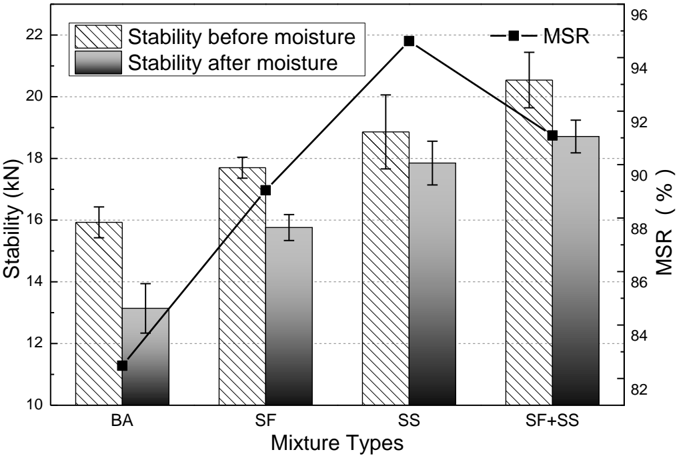
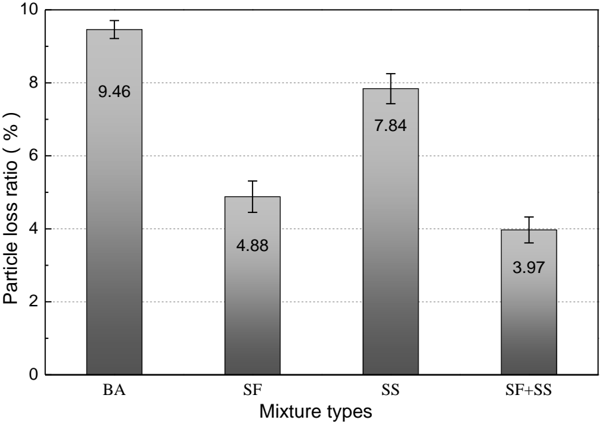
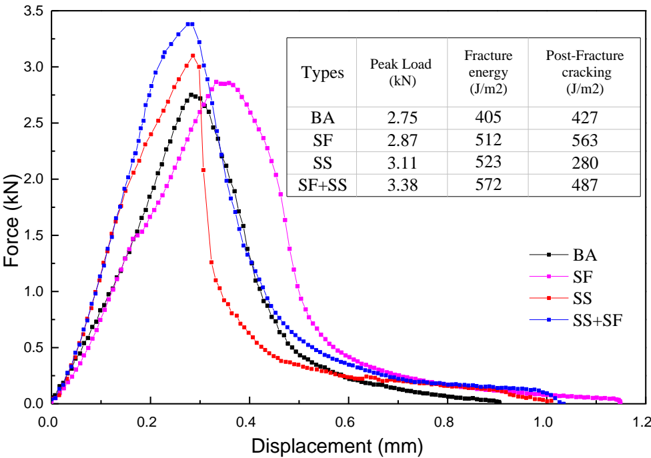
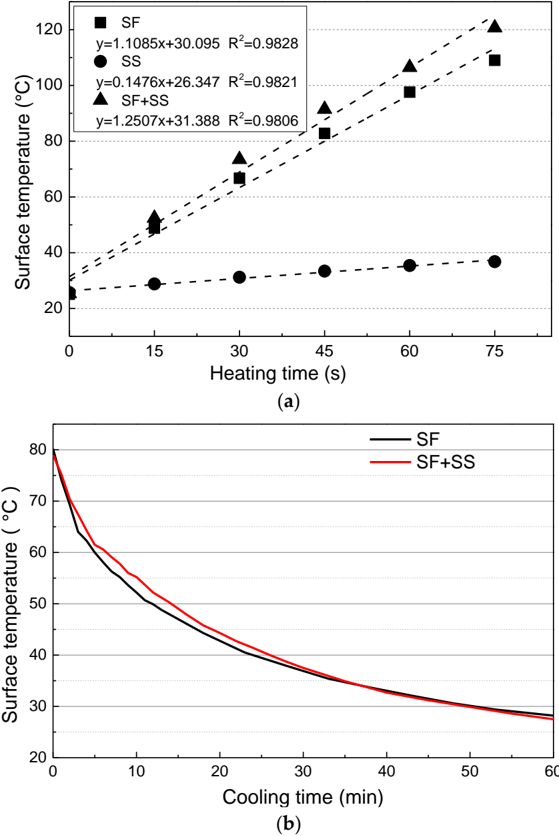
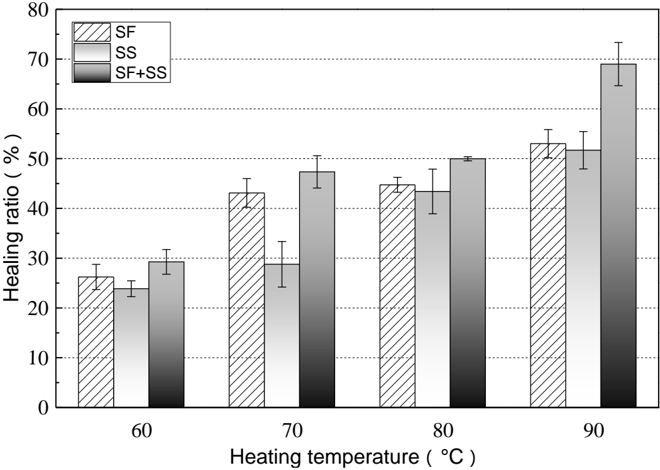
In this paper, steel slag/steel fiber composite asphalt mixture were prepared. The effects of the addition of steel slag and/or steel fibers on the mechanical, thermal, induction heating and healing properties of asphalt mixture were investigated. The results showed that adding steel slag and/or steel fibers improves the water stability, particle loss resistance and fracture energy of asphalt mixtures. The addition of steel fibers increased the thermal conductivity and thermal diffusion of the asphalt mixture, and steel slag showed a reverse effect. Steel slag asphalt mixture cooled more slowly than steel fiber asphalt mixture, which is beneficial to crack healing of asphalt mixture. The composite of steel fibers and steel slag can enhance the induction heating speed, heating homogeneity and thus enhance the induction healing ratio of asphalt mixture. It is concluded that steel slag/steel fibers composite asphalt mixture achieves good mechanical and induction healing properties.
Overview
The claims and statistics of this paper haven’t been checked yet.
Run the check — free, no account needed. It reads the open-access text and checks the sources it cites.
Integrity signals
Registry
Cites
Statistics
Figures
Verification
Claims the paper makes
The claims and statistics of this paper haven’t been checked yet.
Run the check — free, no account needed. It reads the open-access text and checks the sources it cites.
Claims other papers make about this one
Each is checked against this paper’s own text: does it say what the citing paper says it does?
In the citing paper
“Studies focused on the influence of the workpiece characteristics over the heating process [13][14][15] have shown that the inductor geometry characteristics have a critical impact on the electromagnetic field shape and must be considered with the specific workpiece.”
Self-check
Percentages, sums and reported differences re-computed from the paper’s own numbers.
The self-check needs the paper’s full text.
Citations
Cites
No references could be resolved yet.
Research works printed but not linked: 24
- Tabaković, A., Schuyffel, L., Karač, A., and Schlangen, E. (2017). An evaluation of the efficiency of compartmented alginate fibres encapsulating a rejuvenator as an asphalt pavement healing system. Appl. Sci., 7. · DOI
- Little, D., and Bhasin, A. (2007). Exploring mechanisms of healing in asphalt mixtures and quantifying its impact. Self Healing Materials an Alternative Approach to 20 Centuries of Materials Science, Springer. · DOI
- 2012, Self-healing of open cracks in asphalt mastic, Fuel, 93, 264, 10.1016/j.fuel.2011.09.009 · DOI
- Schlangen, 2009, Electrical conductivity of asphalt mortar containing conductive fibers and fillers, Constr, Build. Mater., 23, 3175, 10.1016/j.conbuildmat.2009.06.014 · DOI
- Ajam, 2016, Effect of air voids content on asphalt self-healing via induction and infrared heating, Constr. Build. Mater., 126, 957, 10.1016/j.conbuildmat.2016.09.115 · DOI
- Liu, 2010, Induction heating of electrically conductive porous asphalt concrete, Constr. Build. Mater., 24, 1207, 10.1016/j.conbuildmat.2009.12.019 · DOI
- Liu, 2013, Induction heating of asphalt mastic for crack control, Constr. Build. Mater., 41, 345, 10.1016/j.conbuildmat.2012.11.075 · DOI
- Yang, 2016, Effects of amorphous metallic fibers on the properties of asphalt concrete, Constr. Build. Mater., 128, 176, 10.1016/j.conbuildmat.2016.10.082 · DOI
- Pamulapati, 2017, Evaluation of self-healing of asphalt concrete through induction heating and metallic fibers, Constr. Build. Mater., 146, 66, 10.1016/j.conbuildmat.2017.04.064 · DOI
- Schlangen, 2011, Induction heating of mastic containing conductive fibers and fillers, Mater Struct., 44, 499, 10.1617/s11527-010-9644-2 · DOI
- Sun, 2017, Self-healing performance of asphalt mixtures through heating fibers or aggregate, Constr. Build. Mater., 150, 673, 10.1016/j.conbuildmat.2017.06.007 · DOI
- Liu, 2012, Evaluation of the induction healing effect of porous asphalt concrete through four point bending fatigue test, Constr. Build. Mater., 29, 403, 10.1016/j.conbuildmat.2011.10.058 · DOI
- Dai, 2013, Investigation of induction healing effects on electrically conductive asphalt mastic and asphalt concrete beams through fracture-healing tests, Constr. Build. Mater., 49, 729, 10.1016/j.conbuildmat.2013.08.089 · DOI
- Menozzi, 2015, Induction healing of fatigue damage in asphalt test samples, Constr. Build. Mater., 74, 162, 10.1016/j.conbuildmat.2014.10.034 · DOI
- He, 2017, Research on induction heating activated self-healing of cracks in dense graded asphalt mixture, China J. Highw. Transp., 30, 17
- Liu, Q. (2012). Induction Healing of Porous Asphalt Concrete. [Ph.D. Thesis, Delft University of Technology].
- 2016, Self-healing of asphalt mixture by microwave and induction heating, Master. Des., 106, 404
- Partl, 2013, Experimental evaluation of dense asphalt concrete properties for induction heating purposes, Constr. Build. Mater., 46, 48, 10.1016/j.conbuildmat.2013.04.030 · DOI
- Bueno, 2013, Induction healing of dense asphalt concrete, Constr. Build. Mater., 49, 1, 10.1016/j.conbuildmat.2013.07.105 · DOI
- Li, 2010, Using Semi Circular Bending Test to Evaluate Low Temperature Fracture Resistance for Asphalt Concrete, Exp. Mech., 5, 867, 10.1007/s11340-009-9303-0 · DOI
- RILEM TV-50 FMC (1985). Determination of the fracture energy of mortar and concrete by means of three-point bend tests on notched beams. Mater. Struct., 18, 285–290. · DOI
- Rossi, C., Teltayev, B., and Angelico, R. (2017). Adhesion Promoters in Bituminous Road Materials: A Review. Appl. Sci., 7. · DOI
- Sheng, Y., Li, H., Guo, P., Zhao, G., Chen, H., and Xiong, R. (2017). Effect of Fibers on Mixture Design of Stone Matrix Asphalt. Appl. Sci., 7. · DOI
- Xie, 2012, Recycling of basic oxygen furnace slag in asphalt mixture: Material characterization & moisture damage investigation, Constr. Build. Mater., 36, 467, 10.1016/j.conbuildmat.2012.06.023 · DOI
Cited by
Dimitrov, B., Hayatleh, K., Barker, S., & Collier, G. (2021) · Electricity · doi:10.3390/electricity2040026 · Cited by 3
Metadata
- Authors
- Liu, Q., Li, B., Schlangen, E., Sun, Y., & Wu, S.
- Venue
- Applied Sciences
- Publisher
- MDPI AG
- Published
- 2017-10-20
- Volume
- 7
- Issue
- 10
- Pages
- 1088
- ISSN
- 2076-3417
- Cited by
- 77
- References
- 0
- Language
- en
About these checks
Registry, retraction, Cites and statistics results are computed, not judged, with one exception: a printed reference that no index lists is read once by a model before it counts as a citation error. Claims are extracted by a model and kept only when their quote appears verbatim in the text; each cited source is then checked, with a model’s help, for whether it says what the claim relies on. Those verdicts can be wrong — read the claim’s quote and the cited source before relying on one.
Statistics and arithmetic are recomputed, not judged.
Confidence bands are shown only for fields calibrated on our annotated test set. None is calibrated yet, so no band is shown.
What counts as a claim ›How we measure confidence ›How we check this ›
Are you an author, or do you see a problem with this page? Request a review
Data sources
Bibliographic data: Semantic Scholar, OpenAlex, Crossref.
Contains information from the Semantic Scholar Academic Graph Datasets, made available under the ODC Attribution License (ODC-BY 1.0).
Semantic Scholar’s data is described in: Kinney, R., et al. (2023). The Semantic Scholar Open Data Platform. arXiv:2301.10140.
