

Heatwaves in South Asia: Characterization, Consequences on Human Health, and Adaptation Strategies
Open accessThe DOI matches its Crossref record; 109 of the 112 references it cites were found in a registry or an index, and 2 are not checked yet; 29 of the 136 sources its claims cite were checked for support.
Abstract
South Asia, with more than one-fifth of the world’s population, is highly vulnerable to heatwaves and associated health consequences. The population experiences considerably higher residential vulnerability due to limited infrastructural capacities, economic resources, and health and environmental quality deficiencies. However, a limited number of studies are available from the region to account for the health effects of heatwaves. Therefore, this study has conducted a comprehensive review to characterize heatwaves across South Asian countries. The review explicitly identifies the population’s vulnerability to heatwaves during recent years and heatwave management policies in the region. The literature review suggests increased heat-related deaths in most South Asian countries, with few exceptions. In addition, the analysis of historical temperature records identified an upward trend in annual average temperature across the South Asian countries. The study highlights various heatwave definitions that have been used in the region to facilitate comparative evidence. The review of policies identified that only a few South Asian countries have functional heatwave management plans and majorly lack community and residential preparedness for heatwaves. Therefore, this study identifies potential community- and residential-based adaptation strategies to mitigate heat discomfort. As prospective solutions, the study recommends adaptation strategies such as blue–green spaces, indoor passive cooling, infrastructural adjustments, heat action plans, etc. However, such adaptation measures require a holistic amalgamation of different stakeholders to fabricate heatwave-resilient cities.
Verified 2026-11-22 · 2 references not checked yet
Overview
CoChat Summary
## TL;DR
This is a narrative review of heatwaves in South Asia that synthesizes definitions, historical temperature trends, health impacts, policies, and adaptation options. It concludes that South Asian countries are warming, heat-related mortality is substantial in the region, and coordinated heatwave definitions and heat action plans are needed.
## Key findings
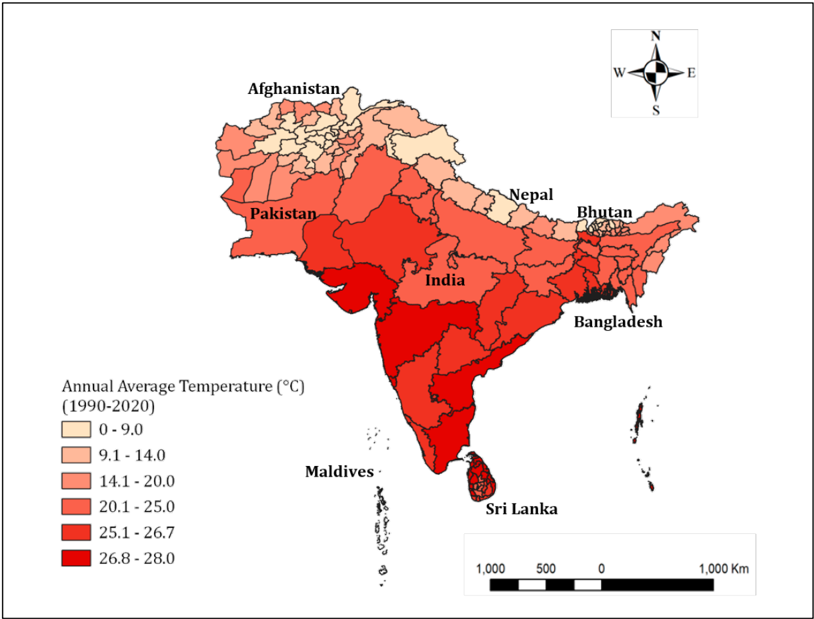
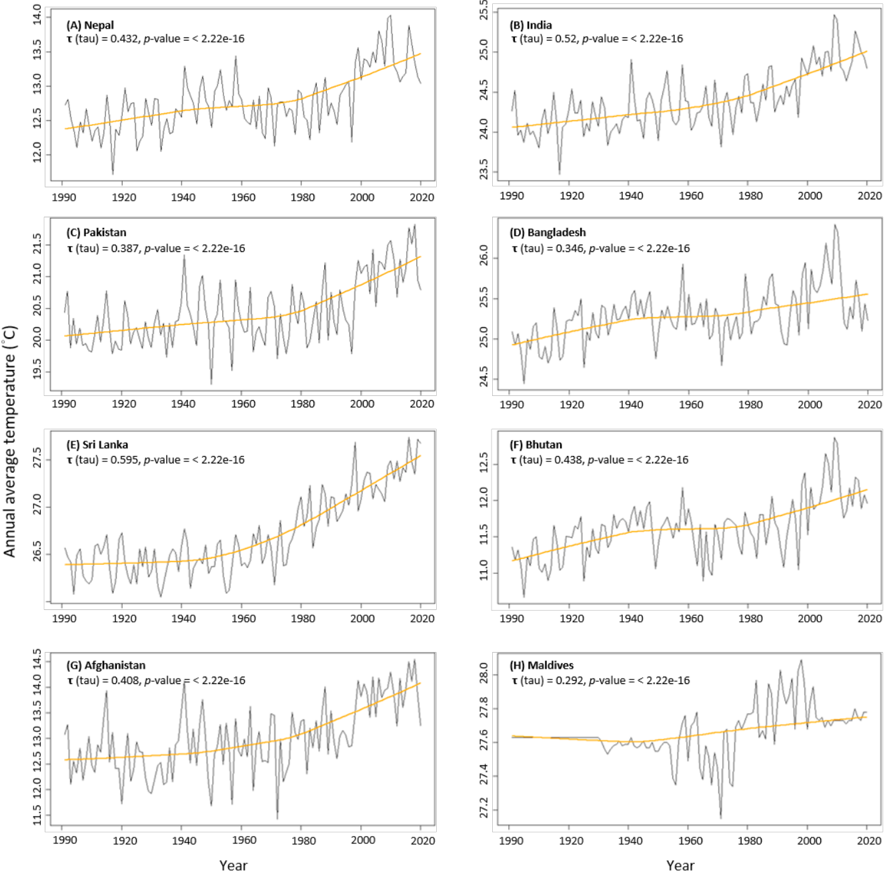
- Historical temperature trends showed a statistically significant upward trend in annual average temperature for all countries analyzed (at the 0.05 level). Reported per-decade increases for 1990–2010 were 0.27 °C in Afghanistan, 0.17 °C in Pakistan, 0.17 °C in Sri Lanka, 0.15 °C in Bhutan, 0.14 °C in Nepal, 0.11 °C in India, 0.09 °C in Bangladesh, and 0.07 °C in the Maldives.
- The review reports substantial heat-related mortality in several countries, including 25,716 heat-related deaths in India between 1992 and 2016, 1,233 deaths in Pakistan’s 2015 heatwaves, and a 22% mortality increase during heatwave days in Bangladesh.
- The paper finds that heatwave definitions vary widely across South Asia, using absolute thresholds, percentile-based thresholds, and indices such as the Heat Wave Magnitude Index (HWMI) and Excess Heat Factor (EHF).
- It states that only a few South Asian countries have functional heatwave management plans; India, Pakistan, Nepal, and Bangladesh have some plans, while Afghanistan, Maldives, Sri Lanka, and Bhutan do not have specific heatwave policies.
## Methods
- Narrative review of literature on heatwave definitions, health vulnerability, and management policies in South Asia, using Google Scholar, PubMed, and SCOPUS with keywords including “heatwaves,” “temperature thresholds,” “health risk,” “South Asia,” and adaptation-related terms.
- Retrieved open-source annual temperature data from the World Bank Climate Knowledge Portal for 1900–2020 and used R’s Kendall package to conduct Mann-Kendall trend tests; maps were created in QGIS.
- The review also synthesized adaptation strategies from the literature, grouped into outdoor cooling, infrastructural, passive indoor cooling, heat action plans, administrative/policy measures, and behavioral measures.
## Limitations
- The paper explicitly states that the accuracy of the various heatwave definitions “has not been confirmed and checked,” and recommends a common definition.
- It explicitly notes that literature on heat-associated health risks is scarce in the region, with Afghanistan, Sri Lanka, Bhutan, and the Maldives lacking heat-based health-risk assessment.
- Evident from the text: the study relies on a review of existing literature and open-source temperature data rather than new primary health data, so its conclusions depend on the completeness and quality of the available studies and documents.
Model-written summary. Check it against the paper before relying on it.
Integrity signals
Registry
Cites
Statistics
Figures
Verification
Claims the paper makes
19 Valid · 11 Not valid · 76 Not checked · 48 Own results and interpretations
At least one cited source doesn’t support this claim or points to a different paper, and none confirmed it — see the verdicts below.
In the paper
“Increasing the albedo can improve pedestrian thermal comfort [18,79,80].”
§ Heatwaves in South Asia: Characterization, Consequences on Human Health, and Adaptation Strategies > 6.1. Outdoor Cooling Strategies
What the sources say
- Disputedcites [18] 18. Karimi, A.; Sanaieian, H.; Farhadi, H.; Norouzian-Maleki, S. Evaluation of the thermal indices and thermal comfort improvement by different vegetation species and materials in a medium-sized urban park. Energy Rep. 2020, 6, 1670-1684. [CrossRef] sourceExperimental — accuracy not yet measured
The Introduction describes increasing albedo as a proposed thermal-comfort strategy, but the paper's own results do not support it. In §3.2, high-albedo pavement increased physiological equivalent temperature (PET) by 0.1 °C on average, while low-albedo pavement reduced it by 0.1 °C; the Abstract says substantial albedo changes had no considerable effect on thermal-comfort improvement in urban parks. Page numbers are not available in the supplied passages. (LLM, conf=0.88)
Checked by a reasoning model — may be wrong.
- Not checked — no full text of the sourcecites [79] 79. Erell, E.; Pearlmutter, D.; Boneh, D.; Kutiel, P.B. Effect of high-albedo materials on pedestrian heat stress in urban street canyons. Urban Clim. 2014, 10, 367-386. [CrossRef] source
- Not checked — no full text of the sourcecites [80] 80. Falasca, S.; Ciancio, V.; Salata, F.; Golasi, I.; Rosso, F.; Curci, G. High albedo materials to counteract heat waves in cities: An assessment of meteorology, buildings energy needs and pedestrian thermal comfort. Build. Environ. 2019, 163, 106242. [CrossRef] source
plainstates a cause- Asserted: passes — The authors put it forward as true.
- Checkable: passes — It can be checked against evidence.
- Load-bearing: passes — The paper’s conclusions depend on it.
- Based: passes — The paper gives a reason why it holds.
- Disputed
The cited sources support only part of this claim — read each source’s verdict below.
In the paper
“Studies from India and Pakistan qualified heatwaves based on a direct temperature threshold, i.e., the daily maximum temperature ranged between 40 to 45 • C without considering duration or periods [34,36].”
§ Heatwaves in South Asia: Characterization, Consequences on Human Health, and Adaptation Strategies > 3.2. Heatwave Definitions
What the sources say
- Not checked — no full text of the sourcecites [34] 34. Zahid, M.; Rasul, G. Changing trends of thermal extremes in Pakistan. Clim. Change 2012, 113, 883-896. [CrossRef] source
- Partly supportedcites [36] 36. Azhar, G.S.; Mavalankar, D.; Nori-Sarma, A.; Rajiva, A.; Dutta, P.; Jaiswal, A.; Sheffield, P.; Knowlton, K.; Hess, J.J. Heat-Related Mortality in India: Excess All-Cause Mortality Associated with the 2010 Ahmedabad Heat Wave. PLoS ONE 2014, 9, e91831. [CrossRef] [PubMed] sourceExperimental — accuracy not yet measured
The Introduction describes Indian heat-wave criteria based on daily maximum temperature, including an absolute threshold above 45°C. It does not give 40–45°C as the qualifying range: the Ahmedabad days it identifies reached 44.5–46.8°C. The Methods also explicitly analyzes a four-day extreme-heat period within a specified week, so the claim that the study did not consider periods is unsupported. (LLM, conf=0.86)
plain- Asserted: passes — The authors put it forward as true.
- Checkable: passes — It can be checked against evidence.
- Load-bearing: unclear — It is unclear whether the paper’s conclusions depend on it.
- Based: passes — The paper gives a reason why it holds.
The sources with a verdict support this claim; the rest weren’t checked yet, have no full text we could read, or their verdicts aren’t rated yet.
In the paper
“From the Indian continent, a few studies reported increased all-cause deaths during heatwave days compared to non-heatwave days [36,[49][50][51][52].”
§ Heatwaves in South Asia: Characterization, Consequences on Human Health, and Adaptation Strategies > 4. Health Risk Associated with Heatwaves in South Asian Countries
What the sources say
- Supportedcites [36] 36. Azhar, G.S.; Mavalankar, D.; Nori-Sarma, A.; Rajiva, A.; Dutta, P.; Jaiswal, A.; Sheffield, P.; Knowlton, K.; Hess, J.J. Heat-Related Mortality in India: Excess All-Cause Mortality Associated with the 2010 Ahmedabad Heat Wave. PLoS ONE 2014, 9, e91831. [CrossRef] [PubMed] source
The Results report significantly higher all-cause mortality during Ahmedabad’s May 2010 heat wave than during reference periods. This Indian study supports the cited statement as one example; the other citations are not needed to establish what this paper reports. (LLM, conf=0.93)
- Not checked — no full text of the sourcecites [49] 49. Nori-Sarma, A.; Anderson, G.B.; Rajiva, A.; ShahAzhar, G.; Gupta, P.; Pednekar, M.S.; Son, J.-Y.; Peng, R.D.; Bell, M.L. The impact of heat waves on mortality in Northwest India. Environ. Res. 2019, 176, 108546. [CrossRef] [PubMed] source
- Not checked — no full text of the sourcecites [50] 50. Dimitrova, A.; Ingole, V.; Basagaña, X.; Ranzani, O.; Milà, C.; Ballester, J.; Tonne, C. Association between ambient temperature and heat waves with mortality in South Asia: Systematic review and meta-analysis. Environ. Int. 2021, 146, 106170. [CrossRef] [PubMed] source
plainstates an association- Asserted: passes — The authors put it forward as true.
- Checkable: passes — It can be checked against evidence.
- Load-bearing: unclear — It is unclear whether the paper’s conclusions depend on it.
- Based: passes — The paper gives a reason why it holds.
- Supported
The cited sources support only part of this claim — read each source’s verdict below.
In the paper
“Some studies from South Asian countries have identified increased rates of infectious diseases such as diarrhea [64][65][66][67] and cholera [68,69] with an increase in temperature.”
§ Heatwaves in South Asia: Characterization, Consequences on Human Health, and Adaptation Strategies > 4. Health Risk Associated with Heatwaves in South Asian Countries
What the sources say
- Partly supportedcites [68] 68. Kelly-Hope, L.A.; Alonso, W.J.; Thiem, V.D.; Canh, D.G.; Anh, D.D.; Lee, H.; Miller, M.A. Temporal trends and climatic factors associated with bacterial enteric diseases in Vietnam, 1991-2001. Environ. Health Perspect. 2008, 116, 7-12. [CrossRef] sourceExperimental — accuracy not yet measured
The Discussion reports that hotter conditions were associated with higher incidence during high-disease periods, and cholera was among the diseases studied. But the Results (Climate associations) identify significant associations for cholera with precipitation and wet days, not temperature. The study was conducted in Vietnam, which is in Southeast Asia, not South Asia. (LLM, conf=0.86)
- Partly supportedcites [69] 69. Rodo, X.; Pascual, M.; Fuchs, G.; Faruque, A.S.G. ENSO and cholera: A nonstationary link related to climate change? Proc. Natl. Acad. Sci. USA 2002, 99, 12901-12906. [CrossRef] [PubMed] sourceExperimental — accuracy not yet measured
Our copy of Rodó et al. (2002) reports a cholera–climate link for Dhaka, Bangladesh, but its own analysis is against ENSO indices: the Results state that correlations are 'positive for Niño 3.4 ... indicating an increase/decrease in cholera after warm/cold ENSO events,' not against local temperature. The temperature–cholera association is explicitly credited elsewhere in the Discussion: 'Regional correlation maps have shown a significant association of temperature with the recent cholera data for Dhaka (7)' and 'Water temperature is known to affect the proliferation of the bacterium (34)', where ref. 7 is Pascual, Rodó, Ellner, Colwell & Bouma, Science 2000 (References section). So the source supports increased cholera with warm ENSO phases and invokes regional warming (Discussion: 2–3°C winter SAT increase over India, 1981–1997) as a possible mechanism, but the specific finding of increased cholera rates with rising temperature is not this paper's own result — that part of the claim is not supported here. (LLM, conf=0.72)
hedgedstates an association- Asserted: passes — The authors put it forward as true.
- Checkable: passes — It can be checked against evidence.
- Load-bearing: unclear — It is unclear whether the paper’s conclusions depend on it.
- Based: passes — The paper gives a reason why it holds.
- Partly supported
The cited sources support only part of this claim — read each source’s verdict below.
In the paper
“Some studies from South Asian countries have identified increased rates of infectious diseases such as diarrhea [64][65][66][67] and cholera [68,69] with an increase in temperature.”
§ Heatwaves in South Asia: Characterization, Consequences on Human Health, and Adaptation Strategies > 4. Health Risk Associated with Heatwaves in South Asian Countries
What the sources say
- Supportedcites [64] 64. Anwar, M.Y.; Warren, J.L.; Pitzer, V.E. Diarrhea Patterns and Climate: A Spatiotemporal Bayesian Hierarchical Analysis of Diarrheal Disease in Afghanistan. Am. J. Trop. Med. Hyg. 2019, 101, 525-533. [CrossRef] [PubMed] source
Our copy reports exactly this association: the Abstract and Results state that mean daily temperature was significantly and positively associated with diarrhea incidence (0.70% increase in relative risk per 1°C), and the Discussion ("The positive association we identified between temperature and diarrhea incidence...") describes the rise in diarrhea reports as closely correlated with increasing temperature in summer. The study is set in Afghanistan, which falls within the South/Southern Asian grouping the citing sentence invokes, so attributing it as a South Asian study showing higher diarrhea rates with higher temperature is accurate. The only nuance our copy adds is that average annual temperature was inversely associated (3.7% risk decrease per °C) as a surrogate for warmer, flatter districts, which does not negate the temperature-increase finding the claim rests on. (LLM, conf=0.85)
- Supportedcites [65] 65. Dhimal, M.; Bhandari, D.; Dhimal, M.L.; Kafle, N.; Pyakurel, P.; Mahotra, N.; Akhtar, S.; Ismail, T.; Dhiman, R.C.; Groneberg, D.A.; et al. Impact of Climate Change on Health and Well-Being of People in Hindu Kush Himalayan Region: A Narrative Review. Front. Physiol. 2021, 12. [CrossRef] [PubMed] source
The Results section, under “Water- and Food-Borne Diseases in the HKH Region” (page not provided), reports studies in Nepal and Bhutan finding higher diarrhea incidence with rising temperature. It also reports a positive temperature–diarrhea association in Afghanistan. These findings support the claim about studies from South Asian countries. (LLM, conf=0.94)
- Partly supportedcites [66] 66. Liang, M.; Ding, X.; Wu, Y.; Sun, Y. Temperature and risk of infectious diarrhea: A systematic review and meta-analysis. Environ. Sci. Pollut. Res. 2021, 28, 68144-68154. [CrossRef] sourceExperimental — accuracy not yet measured
Liang et al. (2021) does report a positive temperature–infectious-diarrhea association (Abstract; Characteristics of eligible studies: RR cumulative = 1.42, 95%CI 1.07–1.88; RR single-day = 1.08, 95%CI 1.03–1.14), and its included-study table (Table 1, Discussion/appendix section) contains a South Asian study with exactly that finding — Dewan 2013, Bangladesh, Dhaka: 'typhoid incidence was seen to increase with temperature, rainfall and river level'. However, our copy never frames the evidence as coming from 'South Asian countries' in the plural: the only South Asian location it names is Bangladesh (the remaining non-Chinese studies are in Australia, Tanzania, Zambia and Malawi), and the other Bangladeshi study it credits (Wu 2018, cholera) is hedged — 'heatwaves might promote the occurrence of cholera, while this relationship was modified by rainfall and tree cover'. The bulk of the pooled estimate comes from China (3 national, 5 northern, 12 southern studies), so the multi-country South Asian diarrhea claim is only partly carried by this source. (LLM, conf=0.72)
plainstates an association- Asserted: passes — The authors put it forward as true.
- Checkable: passes — It can be checked against evidence.
- Load-bearing: unclear — It is unclear whether the paper’s conclusions depend on it.
- Based: passes — The paper gives a reason why it holds.
- Supported
67 more claims · 7 with their cited sources checked
Create a free account to see all 154 claims and to verify the 31 references still open.
- It may state two separate claims as one. 42
- Probably not a substantial claim. 48
- The quote only partly states this claim. 1
Citations
Cites
World map of the Köppen-Geiger climate classification updated
Kottek, M., Grieser, J., Beck, C., Rudolf, B., & Rubel, F. (2006) · Meteorologische Zeitschrift · doi:10.1127/0941-2948/2006/0130 · Cited by 11,456
Stanaway, J. D., Afshin, A., Gakidou, E., Lim, S. S., Abate, D., Abate, K. H., Abbafati, C., Abbasi, N., Abbastabar, H., Abd-Allah, F., et al. (2018) · The Lancet · doi:10.1016/s0140-6736(18)32225-6 · Cited by 4,943
Self-citationMore Intense, More Frequent, and Longer Lasting Heat Waves in the 21st Century
Meehl, G. A., & Tebaldi, C. (2004) · Science · doi:10.1126/science.1098704 · Cited by 4,322
Use of mass media campaigns to change health behaviour
Wakefield, M. A., Loken, B., & Hornik, R. C. (2010) · The Lancet · doi:10.1016/s0140-6736(10)60809-4 · Cited by 2,485
Relation between elevated ambient temperature and mortality: A review of the epidemiologic evidence
Basu, R. (2002) · Epidemiologic Reviews · doi:10.1093/epirev/mxf007 · Cited by 1,381
Norton, B. A., Coutts, A. M., Livesley, S. J., Harris, R. J., Hunter, A. M., & Williams, N. S. G. (2015) · Landscape and Urban Planning · doi:10.1016/j.landurbplan.2014.10.018 · Cited by 1,288
World Population Prospects 2022: Summary of Results
Nations, U. (2022) · Statistical Papers - United Nations (Ser. A), Population and Vital Statistics Report · doi:10.18356/9789210014380 · Cited by 1,010
Pataki, D. E., Carreiro, M. M., Cherrier, J., Grulke, N. E., Jennings, V., Pincetl, S., Pouyat, R. V., Whitlow, T. H., & Zipperer, W. C. (2011) · Frontiers in Ecology and the Environment · doi:10.1890/090220 · Cited by 860
The Urban Heat Island: Implications for Health in a Changing Environment
Heaviside, C., Macintyre, H., & Vardoulakis, S. (2017) · Current Environmental Health Reports · doi:10.1007/s40572-017-0150-3 · Cited by 849
A Review of the European Summer Heat Wave of 2003
García-Herrera, R., Díaz, J., Trigo, R. M., Luterbacher, J., & Fischer, E. M. (2010) · Critical Reviews in Environmental Science and Technology · doi:10.1080/10643380802238137 · Cited by 832
Research works printed but not linked: 4
- 4. IPCC. Climate Change and Land: An IPCC Special Report on Climate Change, Desertification, Land Degradation, Sustainable Land Management, Food Security, and Greenhouse Gas Fluxes in Terrestrial Ecosystems; IPCC: Geneva, Switzerland, 2019; pp. 1-864.
- 6. Contribution of Working Group I to the Sixth Assessment Report of the Intergovernmental Panel on Climate Change. Regional fact sheet-Asia. In Climate Change 2021: The Physical Science Basis; IPCC: Geneva, Switzerland, 2021; pp. 8-9.
- 16. Bicknell, J.; Dodman, D.; Satterthwaite, D. Adapting Cities to Climate Change: Understanding and Addressing the Development Challenges (Sterling: Earthscan); Routledge Taylor and Francis Group: London, UK, 2009.
- 37. Dhimal, M.; Karki, K.; Aryal, K.; Shrestha, S.; Pradhan, B.; Nepal, S.; Adhikari, T.; Khanal, M.; Jha, B.; Pun, S.; et al. Effects of Climate Factors on Diarrheal Diseases at National and Sub-national Levels in Nepal. In Proceedings of the Climate change and diarrheal diseases in Nepal, Geneva, Switzerland, 1 May-31 December 2016.
Cited by
Temperature projections and heatwave attribution scenarios over India: A systematic review
Ravindra, K., Bhardwaj, S., Ram, C., Goyal, A., Singh, V., Venkataraman, C., Bhan, S. C., Sokhi, R. S., & Mor, S. (2024) · Heliyon · doi:10.1016/j.heliyon.2024.e26431 · Cited by 124
“Expanding agroforestry and afforestation programs to increase tree cover and green spaces would aid in localized mitigation by providing evaporative cooling and radiation shading [66].”
BackgroundHeat tolerance of urban trees − A review
Percival, G. (2023) · Urban forestry & urban greening · doi:10.1016/j.ufug.2023.128021 · Cited by 71
Zhu, Y., He, C., Bell, M. L., Zhang, Y., Fatmi, Z., Zhang, Y., Zaid, M., Bachwenkizi, J., Liu, C., Zhou, L., et al. (2023) · JAMA Psychiatry · doi:10.1001/jamapsychiatry.2023.1958 · Cited by 75
Spatiotemporal Changes in Population Exposure to Heat Stress in South Asia
Kyaw, A. K., Hamed, M. M., Kamruzzaman, M., & Shahid, S. (2022) · Sustainable Cities and Society · doi:10.1016/j.scs.2023.104544 · Cited by 59
Fattah, M. A., Hasan, M. M., Dola, I. A., et al. (2023) · Groundwater for Sustainable Development · doi:10.1016/j.gsd.2023.101060 · Cited by 46
Tiwari, I., Tilstra, M. H., Campbell, S. M., Nielsen, C. C., Hodgins, S., Osornio-Vargas, Á. R., Whitfield, K. Y., Sapkota, B. P., & Yamamoto, S. S. (2022) · Heliyon · doi:10.1016/j.heliyon.2022.e10811 · Cited by 50
Lai, E. T. C., Chau, P. H., Cheung, K., Kwan, M., Lau, K. K., & Woo, J. (2023) · Frontiers in Public Health · doi:10.3389/fpubh.2023.1056800 · Cited by 45
Hossain, I., Rana, M. S., Haque, A. K. M. M., & Masud, A. A. (2024) · Discover Sustainability · doi:10.1007/s43621-024-00697-2 · Cited by 38
“Bangladesh has experienced over 200 natural disasters in the last three decades [59].”
Kotharkar, R., Dongarsane, P., Ghosh, A., & Kotharkar, V. (2023) · Sustainable Cities and Society · doi:10.1016/j.scs.2023.105099 · Cited by 34
Rahman, M. A., Afridi, S., Hossain, M. B., Rana, M., Masum, A. A., Rahman, M. M., & Al-Maruf, A. (2023) · Environmental Challenges · doi:10.1016/j.envc.2023.100802 · Cited by 35
Todeschi, V., Pappalardo, S. E., Zanetti, C., Peroni, F., & Marchi, M. D. (2022) · ISPRS International Journal of Geo-Information · doi:10.3390/ijgi11090490 · Cited by 39
“Currently, there is no mechanism for monitoring and reporting adaptation strategies, which would allow for the supervision and evaluation of the adaptation process and support the involvement of weak actors in urban planning strategies [66,67].”
BackgroundYang, X., Shen, C., Ullah, I., Curio, J., & Chen, D. (2024) · npj Climate and Atmospheric Science · doi:10.1038/s41612-024-00764-5 · Cited by 26
Heatwave vulnerability of large metropolitans in Bangladesh: An evaluation
Adnan, M. S. G., Kabir, I., Hossain, M. A., Chakma, S., Tasneem, S. N., Saha, C. R., Hassan, Q. K., & Dewan, A. M. (2024) · Geomatica · doi:10.1016/j.geomat.2024.100020 · Cited by 34
Chau, P. H., Lau, K. K., Qian, X., Luo, H., & Woo, J. (2022) · International Journal of Biometeorology · doi:10.1007/s00484-022-02332-z · Cited by 25
“Developing early warning and forecast system for heat should form part of the heat action plans as an administrative tool to increase people’s preparedness against extreme heat events (Sharma et al. 2022).”
BackgroundInfluentialSingh, S., Suthar, G., Kulshreshtha, N. M., Brighu, U., Bezbaruah, A. N., & Gupta, A. B. (2024) · ACS ES&T Water · doi:10.1021/acsestwater.4c00346 · Cited by 19
Debnath, K. B., Jenkins, D. P., Patidar, S., Peacock, A. D., & Bridgens, B. (2023) · ASME Journal of Engineering for Sustainable Buildings and Cities · doi:10.1115/1.4064021 · Cited by 24
Evaluation of community-based heat adaptation interventions: a systematic review
Das, J. K., Kumari, B., Rahman, A. R., Azhar, M., Khan, S., Masood, U., Karan, D., Yasin, R., Burman, C., Augustin, J., et al. (2025) · BMJ Public Health · doi:10.1136/bmjph-2024-002332 · Cited by 21
“Furthermore, investing in long-term research and monitoring will provide valuable insights into acceptance, durability, BMJ Public Health cost-effectiveness and broader health benefits to the population at large.”
Bhandari, R., Paudel, H., Alharbi, S. A., Ansari, M. J., Poudel, M. R., Neupane, M. P., Solanki, P. R., & Kushwaha, U. K. S. (2024) · Journal of Agriculture and Food Research · doi:10.1016/j.jafr.2024.101506 · Cited by 31
Estimating economic losses from perceived heat stress in a global south country, Bangladesh
Bardhan, M., Patwary, M. M., Imran, S. A., Billah, S. M., Hasan, M., Disha, A. S., Kabir, M. P., Saha, C., Pitol, M. N. S., & Browning, M. H. E. M. (2024) · Urban Climate · doi:10.1016/j.uclim.2024.102072 · Cited by 18
Domingo, A., Little, M., Beggs, B., Brubacher, L. J., Lau, L. L., & Dodd, W. (2024) · Public Health · doi:10.1016/j.puhe.2024.07.023 · Cited by 20
Recent trends and variability of temperature and atmospheric water vapor over South Asia
Adeliyi, T. E., & Akinsanola, A. A. (2024) · Atmospheric Research · doi:10.1016/j.atmosres.2024.107556 · Cited by 16
Urban heat stress and perceived health impacts in major cities of Bangladesh
Patwary, M. M., Disha, A. S., Sikder, D., Hasan, S., Hossan, J., Bardhan, M., Billah, S. M., Hasan, M., Hasan, M., Haque, M. Z., et al. (2024) · International Journal of Disaster Risk Reduction · doi:10.1016/j.ijdrr.2024.105066 · Cited by 15
Abella, D. J., & Ahn, K.-H. (2024) · Weather and Climate Extremes · doi:10.1016/j.wace.2024.100669 · Cited by 15
Toha, M., Ariyan, T. N., & Alam, M. (2025) · Cleaner Waste Systems · doi:10.1016/j.clwas.2025.100235 · Cited by 15
Sharma, A., Dutta, P., Shah, P., Iyer, V. J., He, H., Sapkota, A., Gao, C., & Wang, Y.-C. (2024) · Urban Climate · doi:10.1016/j.uclim.2024.101832 · Cited by 13
Self-citationSharif, F., Shahzad, L., & Batool, M. (2024) · International Journal of Environmental Health Research · doi:10.1080/09603123.2024.2302040 · Cited by 17
Characterization and outlook of climatic hazards in an agricultural area of Pakistan
Bhatti, M. T., Anwar, A. A., & Hussain, K. (2023) · Scientific Reports · doi:10.1038/s41598-023-36909-4 · Cited by 16
Hoang, N. (2025) · Discover Civil Engineering · doi:10.1007/s44290-025-00301-0 · Cited by 8
Extreme Temperature Events in Kazakhstan and Their Impacts on Public Health and Energy Demand
Broomandi, P., Satyanaga, A., Bagheri, M., Hadei, M., Galán‐Madruga, D., Fard, A. M., Roshani, A., Fathian, A., Nourian, A., Leuchner, M., et al. (2024) · Global Challenges · doi:10.1002/gch2.202400207 · Cited by 17
A pilot heat-health warning system co-designed for a subtropical city
Lung, S. C., Liou, M.-L., Yeh, J.-C. J., & Hwang, J. (2023) · PLoS ONE · doi:10.1371/journal.pone.0294281 · Cited by 8
Yerezhepova, N., Kurmanbayeva, M. S., Terletskaya, N. V., Жумагул, М., Kebert, M., Rašeta, M., Gafforov, Y., Jalmakhanbetova, R. I., & Razhanov, M. (2024) · Forests · doi:10.3390/f15050790 · Cited by 14
Is PET an Adequate Index to Determine Human Thermal Comfort in Mexico City?
Ballinas, M., Morales-Santiago, S. I., Barradas, V. L., Lira, A., & Oliva-Salinas, G. (2022) · Sustainability · doi:10.3390/su141912539 · Cited by 14
Afro-Asian climate response to future solar radiation management
Adeliyi, T. E., Akinsanola, A. A., & Taguela, T. N. (2025) · Sustainable Cities and Society · doi:10.1016/j.scs.2025.106825 · Cited by 5
Under-five mortality burden in low- and middle-income countries set to increase under future warming
Zhu, Y., He, C., Bachwenkizi, J., Fatmi, Z., Zhou, L., Liu, C., Liu, S., Kan, H., & Chen, R. (2025) · One Earth · doi:10.1016/j.oneear.2025.101424 · Cited by 10
Impact of Extreme Heat on Cardiovascular Health in Kuwait: Present and Future Projections
Alwadi, Y., Al-Hemoud, A. M., Khraishah, H., Al‐Mulla, F., Koutrakis, P., Ali, H., & Alahmad, B. (2024) · Journal of Epidemiology and Global Health · doi:10.1007/s44197-024-00330-5 · Cited by 6
A 19-year analysis of hot and cold temperature burdens on mortality in Amman, Jordan
Alwadi, Y., Al‐Delaimy, W. K., Abdulla, F. A., Koutrakis, P., & Alahmad, B. (2024) · The Science of The Total Environment · doi:10.1016/j.scitotenv.2024.175624 · Cited by 6
Health-related hazards of heatwaves in Pakistan
Rasool, W., Ajmal, H., Amin, M. H. J., & Nashwan, A. J. (2024) · Journal of Medicine Surgery and Public Health · doi:10.1016/j.glmedi.2024.100125 · Cited by 11
Mapping urban heatwaves and islands: the reverse effect of Salento’s “white cities”
Razza, S. D., Zanetti, C., Marchi, M. D., & Pappalardo, S. E. (2024) · Frontiers in Earth Science · doi:10.3389/feart.2024.1375827 · Cited by 7
Kebert, M., Kostić, S., Rašeta, M. J., et al. (2023) · Horticulturae · doi:10.3390/horticulturae9101157 · Cited by 5
Estimating the health production function for Pakistan: Do environmental factors matter?
Awan, A. M., Azam, M., & Khan, S. (2023) · Review of Development Economics · doi:10.1111/rode.13048 · Cited by 9
Heatwave vulnerability of large metropolitans in Bangladesh: an evaluationPreprint
Adnan, M. S. G., Kabir, I., Hossain, M. A., et al. (2023) · Research Square · doi:10.21203/rs.3.rs-3093933/v1 · Cited by 5
Heatwave health risk index for Karnataka, India
Thakkar, V., Srinivas, V., Siddhappanavara, P. M., et al. (2025) · The Journal of Climate Change and Health · doi:10.1016/j.joclim.2025.100428 · Cited by 4
“Heat-related health impacts are determined by the timing, duration, and severity of a temperature event as well as the level of acclimatization and adaptation of infrastructure, local residents, and institutions to the surrounding environment [13].”
Nair, A. V., Araujo, D. S. A., Dobariya, R., Gurung, D. R., & Nikolopoulos, E. I. (2025) · Environmental Research Communications · doi:10.1088/2515-7620/addbad · Cited by 3
Saha, M., Dixit, V. V., & Karthikeyan, L. (2026) · Geophysical Research Letters · doi:10.1029/2025gl118998 · Cited by 6
“Recent studies have increasingly emphasized the need to distinguish between different types of heatwave events due to their distinct thermodynamic structures and societal impacts (De Bont et al., 2024; Sharma et al., 2022).”
How cities are striving to cope with ever-increasing temperatures
Filho, W. L., Dinis, M. A. P., Fracassi, U., & Nagy, G. J. (2026) · International Journal of Climate Change Strategies and Management · doi:10.1108/ijccsm-09-2024-0167 · Cited by 4
“…concerning record temperatures (Adnan et al. , 2022; Broadbent et al. , 2022; Marvuglia et al. , 2020; Nandi and Swain, 2023; Nishant et al. , 2022; Sharma et al. , 2022; Sethi et al. , 2021; Shen et al. , 2022; Yang et al. , 2019; Yin et al , 2018) and plotted them on a global base map (Figure 3).”
InfluentialRising compound heatwave exposure in India: insights from CMIP6 climate model projections
Sahithi, K., Manikanta, V., & Das, J. (2025) · Environmental Research Letters · doi:10.1088/1748-9326/ae1498 · Cited by 5
Ai, S., Zhang, D., Cao, J., Lu, J., Hong, L., He, H., & Zhou, X. (2025) · International Journal of Hygiene and Environmental Health · doi:10.1016/j.ijheh.2025.114593 · Cited by 3
Climate Governance in South Asia
Eqan, M., & Wan, J. (2024) · Sustainable finance · doi:10.1007/978-3-031-56423-9_7 · Cited by 5
Saunik, S., & Shaw, R. (2026) · Climate · doi:10.3390/cli14070149 · Cited by 2
Heat-related health impacts in ASEAN countries: A scoping review
Aung, H. W., Kliengchuay, W., Niampradit, S., Aendo, P., Aye, T. S., Intrakun, S., Arthan, D., Koompapong, K. N., Lin, T.-H., Vardoulakis, S., et al. (2026) · Environmental and Sustainability Indicators · doi:10.1016/j.indic.2026.101272 · Cited by 2
Feroz, A., & Rana, I. A. (2026) · Journal of Environmental Management · doi:10.1016/j.jenvman.2026.129683 · Cited by 3
Shafiq, H., Haq, Z. U., & Mariam, A. (2026) · Theoretical and Applied Climatology · doi:10.1007/s00704-026-06035-y · Cited by 1
“As a hotspot for heatwaves, there are many conversations in South Asia about which heat waves are the worst, why, how often they occur, and what all this means ( Sharma et al. 2022).”
Zou, A., Yang, Y., Wang, H., Wang, P., Li, K., Yang, Y., Liu, C., Wang, J., & Liao, H. (2025) · Environmental Research Letters · doi:10.1088/1748-9326/adf2c0 · Cited by 2
Sharma, A., Dutta, P., Shah, P., Iyer, V. J., He, H., Gao, C., Sapkota, A., & Wang, Y.-C. (2025) · International Journal of Biometeorology · doi:10.1007/s00484-025-02959-8 · Cited by 2
“The acceleration of urbanization and (Robine et al. 2008 , Karoly 2009 , Sharma et al. 2022).”
Self-citationWetland Loss Intensifies Regional Heat and Stress: Insights from the 2023 Southeast Asia HeatwavePreprint
Liu, C. X., Hiraga, Y., Mbugua, J. M., Hokson, J. A., & Kazama, S. (2025) · Research Square · doi:10.21203/rs.3.rs-6812001/v1 · Cited by 1
Climate Change and Sustainability in the South Asian Region: Challenges and Issues
Rathnasiri, M. S. H., & Gunathilaka, D. (2025) · doi:10.1108/s2043-052320250000025006 · Cited by 1
Patwary, M. M., Disha, A. S., Sikder, D., Hasan, S., Hossan, J., Bardhan, M., Billah, S. M., Hasan, M., Hasan, M., Haque, M. Z., et al. (2023) · doi:10.32942/x2060p · Cited by 1
Optimizing removal kinetics in constructed wetlands for sustainable wastewater treatment
Singh, S., Suthar, G., & Tiwari, M. K. (2026) · Water Practice & Technology · doi:10.2166/wpt.2026.422
Lone, M. H., Mahindrakar, A. B., & Kumar, K. (2026) · Frontiers in Climate · doi:10.3389/fclim.2026.1880364 · Cited by 1
Emerging Heat Wave Hotspots in Sri Lanka: The Role of Ocean–Atmosphere CouplingPreprint
Galagamage, P., Pathirana, U. P. G., Geng, X., Wang, D., & Premarthne, U. (2026) · Research Square · doi:10.21203/rs.3.rs-10697012/v1
Kumari, R., Kumari, P., Yadav, B., Singh, S. K., Sharma, V., Tiwari, M., Khanam, S., Dawar, P., Verma, K., & Madan, A. K. (2026) · International Journal of Biometeorology · doi:10.1007/s00484-026-03307-0
“The frequency and intensity of heat waves have also increased worldwide, with developing regions being more vulnerable (Sharma et al. 2022).”
InfluentialManaging Extreme Heat Through Indigenous Knowledge and Practices at Four Villages in Wardha, India
Tasgaonkar, P. P., Murari, K. K., & Tangney, M. (2026) · The International Journal of Community and Social Development · doi:10.1177/25166026261472713
A Multi-Scalar Correlation Analysis of Urban Heat Resilience in Indian Cities
Saunik, S., & Shaw, R. (2026) · Journal of Sustainability Research · doi:10.20900/jsr20260072
“Unlike sudden-onset hazards, heatwaves function as slow-onset stressors that accumulate over time, amplifying health risks, productivity losses, food insecurity, and livelihood instability [3,4].”
Cortés‐Ramos, J., Mendoza‐Rosas, A. T., Torres, V. M., León‐Cruz, J. F., Becerra-Acosta, E., Quintanar, A. I., & Romero, D. (2026) · International Journal of Climatology · doi:10.1002/joc.70538
Jadhav, T. S., & Dhorde, A. G. (2026) · International Journal of Biometeorology · doi:10.1007/s00484-026-03271-9
“Heat stress in northern India, especially during mid-day and afternoon, poses significant risks due to high environ - mental factors, with indices like WBGT and TSI rising above safe limits, harming worker productivity and increas - ing health risks (Sharma et al. 2022a , b ).”
Small Tropical Islands Also Exposed to Extreme Humid Heat by the End of the Century
Bald, L., Belmadani, A., Leroux, M.-D., Pannekoucke, O., Gentric, A., & Qasmi, S. (2026) · Geophysical Research Letters · doi:10.1029/2026gl122466 · Cited by 1
“There exist different methods to detect and characterize heatwaves based on persistent exceedance of warm temperature thresholds over several days and/or nights (Ouzeau et al., 2016; Rohini et al., 2016; Sharma et al., 2022), which are applied here to HI values.”
Aslam, S., Khadicha, R., Tilavov, U. G., Masharipova, G., & Aziza, N. (2026) · Theoretical and Applied Climatology · doi:10.1007/s00704-026-06417-2
“Third, qualitative research from comparable LMIC settings, including Bangladesh, India, and sub-Saharan Africa, con - sistently identifies the same post-recovery adaptation defi - cit this framework addresses, affirming its cross-contextual validity (Kamara et al. 2019).”
InfluentialZachariah, M., Vautard, R., Arulalan, T., Schwingshackl, C., T, C. S., Kimutai, J., Barnes, C. R., AchutaRao, K. M., Singh, R., Vahlberg, M., et al. (2026) · Global Environmental Change Advances · doi:10.1016/j.gecadv.2026.100035
Hassan, M. M., Lim, K. B., Yeo, S. F., et al. (2026) · Heart & Lung · doi:10.1016/j.hrtlng.2026.102861
Pal, D., Banerjee, S., Nagabhatla, N., et al. (2026) · Journal of Environmental Management · doi:10.1016/j.jenvman.2026.129923
Long‐Term Trends of Heat Stress Over the Coastal Regions of India
Rohini, P., RAJEEVAN, M., Sabeerali, C. T., & Sreejith, O. P. (2026) · International Journal of Climatology · doi:10.1002/joc.70307 · Cited by 1
Heatwave-induced health hazards of construction workers in urban areas of Bangladesh
Haque, A., Mohona, M., Sultana, S., Raihan, R., Aziz, T., & Islam, R. (2026) · Climatic Change · doi:10.1007/s10584-025-04098-w · Cited by 1
“In the past three decades, Bangladesh has experienced about 200 natural disasters (Sharma et al. 2022).”
Composite Heat Wave Risk (CHWR) for Assessing Agro Community ResiliencePreprint
Pal, D., Banerjee, S., Nagabhatla, N., et al. (2026) · SSRN Electronic Journal · doi:10.2139/ssrn.6136411
Climate Change-Induced Vulnerability Management Strategies in African Countries
Nubuor, S. A., & Damoah, O. B. O. (2026) · Advances in African economic, social and political development · doi:10.1007/978-3-032-15259-6_4
Sofiany, I. R., Nurannisa, F. R., Rusprayunita, N. R. A., Evrilianto, A., & Nugraheni, Y. R. (2026) · Springer eBooks · doi:10.1007/978-981-95-9880-9_7
Temperature Pattern and the Escalation of Heat Waves
Malik, R., Mittal, T., Kanyal, D., Rana, S., Choudhury, T., Nzeyimana, B. S., Amesho, K. T. T., & Awasthi, A. (2026) · Springer eBooks · doi:10.1007/978-3-032-29477-7_1
Rising heat, failing kidneys: Heat stress nephropathy in climate crisis
Garg, R. (2025) · RMC Global Journal · doi:10.25259/rmcgj_17_2025 · Cited by 2
Blanford, J. I. (2025) · PRIMUS · doi:10.1080/10511970.2025.2477280 · Cited by 1
Media literacy and Health Issues in Asia Due to Global Warming: A Quantitative Research StudyPreprint
Sarfraz, H. H. (2025) · SSRN Electronic Journal · doi:10.2139/ssrn.5045214
High-resolution projections of outdoor thermal stress in the 21st century: a Tasmanian case studyPreprint
Weeding, B., Love, P. T., Beyer, K., et al. (2023) · Research Square · doi:10.21203/rs.3.rs-3472070/v1
Abella, D. J., & Ahn, K.-H. (2023) · SSRN Electronic Journal · doi:10.2139/ssrn.4597377
Heat Stroke in Pakistan: Examining the Trends and Impact Over the Years
medtigo, Balach, R., Ibrahim, M., et al. (2023) · medtigo Journal of Medicine · doi:10.63096/medtigo3062256
Metadata
- Authors
- Sharma, A., Andhikaputra, G., & Wang, Y.-C.
- Affiliations
- Chung Yuan Christian University (TW)
- Corresponding author
- Wang, Yu-Chun
- Venue
- Atmosphere
- Publisher
- MDPI AG
- Published
- 2022-05-04
- Volume
- 13
- Issue
- 5
- Pages
- 734
- ISSN
- 2073-4433 (ISSN-L)
- OpenAlex
- W4225409603
- Cited by
- 87
- References
- 106
- Citations by year
- 2026: 30 · 2025: 16 · 2024: 21 · 2023: 15 · 2022: 5
- FWCI
- 5.58
- Type
- journal article
- Language
- en
- Open access
- gold
- doi.org
- Licence
- Locations
- Atmosphere (publishedVersion, cc-by)
- DOAJ (DOAJ: Directory of Open Access Journals) (submittedVersion, cc-by-sa)
- Funders
- Taiwan Ministry of Science and Technology (MOST 108-2625-M-033-002, MOST 109-2621-M-033-001-MY3, MOST 109-2625-M-033-002, MOST 110-2625-M-033-002, (Award Number (FAIN): 2025470, AS-SS-111-03)
- National Science Foundation through Belmont Forum (MOST 108-2625-M-033-002, MOST 109-2621-M-033-001-MY3, MOST 109-2625-M-033-002, MOST 110-2625-M-033-002, (Award Number (FAIN): 2025470, AS-SS-111-03)
- Academia Sinica (MOST 108-2625-M-033-002, MOST 109-2621-M-033-001-MY3, MOST 109-2625-M-033-002, MOST 110-2625-M-033-002, (Award Number (FAIN): 2025470, AS-SS-111-03)
- Topics
- Physical Sciences › Environmental Science › Health, Toxicology and Mutagenesis › Climate Change and Health Impacts
- Physical Sciences › Environmental Science › Environmental Engineering › Urban Heat Island Mitigation
- Health Sciences › Medicine › Physiology (medical) › Thermoregulation and physiological responses
- Keywords
- heat waves, South Asia, heat-related mortality, heatwave vulnerability, heat wave definition, heat action plans, climate change adaptation, urban heat, green and blue spaces, passive cooling, temperature trends
About these checks
Registry, retraction, Cites and statistics results are computed, not judged, with one exception: a printed reference that no index lists is read once by a model before it counts as a citation error. Claims are extracted by a model and kept only when their quote appears verbatim in the text; each cited source is then checked, with a model’s help, for whether it says what the claim relies on. Those verdicts can be wrong — read the claim’s quote and the cited source before relying on one.
The claim verdicts this report counts are experimental: their accuracy is not yet measured.
A language model drew the claims from the paper on 2026-10-10, under version 3 of the claim definition (model deepseek-v4.1-flash, prompt extract-v3).
A second model labelled each claim on 2026-10-10 (model jev-1.13-20260917, definition revision gold-guideline-v0.2).
Cited sources are checked with a language model’s help (gpt-6-sol and qwen3.8-omni-flash).
Statistics and arithmetic are recomputed, not judged.
Confidence bands are shown only for fields calibrated on our annotated test set. None is calibrated yet, so no band is shown.
What counts as a claim ›How we measure confidence ›How we check this ›
Are you an author, or do you see a problem with this page? Request a review
Data sources
Bibliographic data: Semantic Scholar, OpenAlex, Crossref.
Contains information from the Semantic Scholar Academic Graph Datasets, made available under the ODC Attribution License (ODC-BY 1.0).
Semantic Scholar’s data is described in: Kinney, R., et al. (2023). The Semantic Scholar Open Data Platform. arXiv:2301.10140.
