

Item Response Theory Investigation of Misophonia Auditory Triggers
Open accessThe DOI matches its Crossref record; 44 of the 44 references it cites were found in a registry or an index.
Abstract
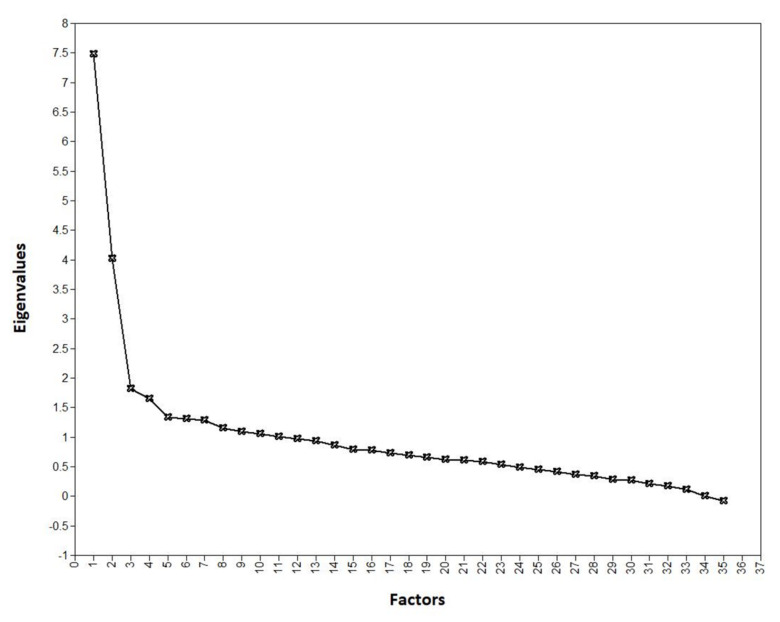
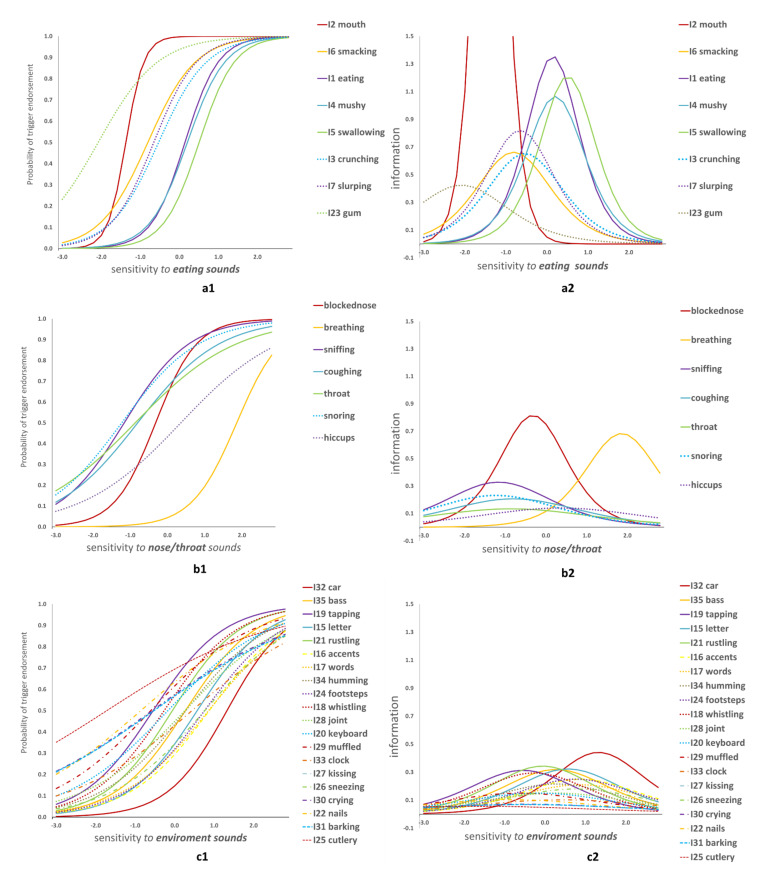
Misophonia is characterised by a low tolerance for day-to-day sounds, causing intense negative affect. This study conducts an in-depth investigation of 35 misophonia triggers. A sample of 613 individuals who identify as experiencing misophonia and 202 individuals from the general population completed self-report measures. Using contemporary psychometric methods, we studied the triggers in terms of internal consistency, stability in time, precision, severity, discrimination ability, and information. Three dimensions of sensitivity were identified, namely, to eating sounds, to nose/throat sounds, and to general environmental sounds. The most informative and discriminative triggers belonged to the eating sounds. Participants identifying with having misophonia had also significantly increased odds to endorse eating sounds as auditory triggers than others. This study highlights the central role of eating sounds in this phenomenon and finds that different triggers are endorsed by those with more severe sound sensitivities than those with low sensitivity.
Overview
The claims and statistics of this paper haven’t been checked yet.
Free: it reads the open-access text and checks the first 5 claims that cite a source we can check. Create a free account to check every claim.
Integrity signals
Registry
Cites
Statistics
Figures
Verification
Claims the paper makes
The claims and statistics of this paper haven’t been checked yet.
Free: it reads the open-access text and checks the first 5 claims that cite a source we can check. Create a free account to check every claim.
Claims other papers make about this one
Each is checked against this paper’s own text: does it say what the citing paper says it does?
The source backs part of the claim, not all of it — or backs it for a different population, condition or comparison.
In the citing paper
“(5) Selective Sound Sensitivity Syndrome Scale (S-Five) examines emotions, behaviors, experiences, and appraisals [30].”
From Misophonia: A Systematic Review of Current and Future Trends in This Emerging Clinical Field (2022) · cites this paper as [30]
Experimental — accuracy not yet measured
Self-check
Percentages, sums and reported differences re-computed from the paper’s own numbers.
The self-check needs the paper’s full text.
Citations
Cites
Controlling the False Discovery Rate: A Practical and Powerful Approach to Multiple Testing
Benjamini, Y., & Hochberg, Y. (1995) · Journal of the Royal Statistical Society Series B: Statistical Methodology · doi:10.1111/j.2517-6161.1995.tb02031.x · Cited by 109,482 · cited 1×
“To adjust for multiple comparisons over the 35 triggers, we used the Benjamini and Hochberg [38] method.”
MethodHu, L., & Bentler, P. M. (1999) · Structural Equation Modeling A Multidisciplinary Journal · doi:10.1080/10705519909540118 · Cited by 108,788 · cited 1×
“05 indicate close fit [29], the relative chi-square Rel χ2: values close to 2 indicate adequate fit [30], the comparative fit index (CFI): values above 0.”
BackgroundThe Measurement of Observer Agreement for Categorical Data
Landis, J. R., & Koch, G. G. (1977) · Biometrics · doi:10.2307/2529310 · Cited by 81,148 · cited 1×
“Stability (test-retest reliability assessed at two weeks) was evaluated via Cohen’s [35] weighted Kappa (kw) for each item, following Landis and Koch [36] interpretations, along with the percentage of agreement and the Psi coefficient [37].”
MethodCoefficient Alpha and the Internal Structure of Tests
Cronbach, L. J. (1951) · Psychometrika · doi:10.1007/bf02310555 · Cited by 43,931 · cited 2×
“Cronbach’s alpha was moderately high (eating sounds a = 0.77 and general environment sounds a = 0.74) to moderate (nose/throat dimension a = 0.56).”
MethodInfluentialComparative fit indexes in structural models.
Bentler, P. M. (1990) · Psychological Bulletin · doi:10.1037/0033-2909.107.2.238 · Cited by 25,266 · cited 1×
“90 indicate close fit [31], the Taylor-Lewis (TLI): values above 0.”
BackgroundSignificance tests and goodness of fit in the analysis of covariance structures.
Bentler, P. M., & Bonett, D. G. (1980) · Psychological Bulletin · doi:10.1037//0033-2909.88.3.588 · Cited by 19,023 · cited 1×
“90 are required for close fit [32], and the standardised root mean residual (SRMR): values below 0.”
BackgroundThe Scree Test For The Number Of Factors
Cattell, R. B. (1966) · Multivariate Behavioral Research · doi:10.1207/s15327906mbr0102_10 · Cited by 13,554 · cited 1×
“The number of items to be retained was decided taking under consideration the Guttman–Kaiser criterion [25,26], scree plot [27] and the percentage of variance explained [28].”
MethodThe application of electronic computers to factor analysis
Kaiser, H. F. (1960) · Educational and Psychological Measurement · doi:10.1177/001316446002000116 · Cited by 12,459 · cited 1×
“The number of items to be retained was decided taking under consideration the Guttman–Kaiser criterion [25,26], scree plot [27] and the percentage of variance explained [28].”
MethodWeighted kappa: nominal scale agreement provision for scaled disagreement or partial credit
Cohen, J. (1968) · Psychological Bulletin · doi:10.1037/h0026256 · Cited by 8,736 · cited 1×
“Stability (test-retest reliability assessed at two weeks) was evaluated via Cohen’s [35] weighted Kappa (kw) for each item, following Landis and Koch [36] interpretations, along with the percentage of agreement and the Psi coefficient [37].”
MethodSome necessary conditions for common-factor analysis
Guttman, L. (1954) · Psychometrika · doi:10.1007/bf02289162 · Cited by 1,689 · cited 1×
“The number of items to be retained was decided taking under consideration the Guttman–Kaiser criterion [25,26], scree plot [27] and the percentage of variance explained [28].”
Method
Research works printed but not linked: 2
- Jastreboff M.M. Jastreboff P.J. Components of decreased sound tolerance: Hyperacusis, misophonia, phonophobia ITHS News Lett. 2001 2 5 7
- Nunnally J.C. Bernstein I.H. Psychometric Theory McGraw-Hill New York, NY, USA 1994
Cited by
Misophonia in the UK: Prevalence and norms from the S-Five in a UK representative sample
Vitoratou, S., Hayes, C., Uglik‐Marucha, N., Pearson, O. P., Graham, T., & Gregory, J. E. (2023) · PLoS ONE · doi:10.1371/journal.pone.0282777 · Cited by 103
Self-citationMisophonia: A Systematic Review of Current and Future Trends in This Emerging Clinical Field
Ferrer-Torres, A., & Giménez-Llort, L. (2022) · International Journal of Environmental Research and Public Health · doi:10.3390/ijerph19116790 · Cited by 64
The neurophysiological approach to misophonia: Theory and treatment
Jastreboff, P. J., & Jastreboff, M. M. (2023) · Frontiers in Neuroscience · doi:10.3389/fnins.2023.895574 · Cited by 71
“Misophonic triggers cover a wide variety of sounds with different spectral energy and without the indication of the preferred range of frequencies or the range of sound energy (Jastreboff and Jastreboff, 2014b; Jager et al., 2020; Hansen et al., 2021; Vitoratou et al., 2021; Henry et al., 2022).”
BackgroundThe neurobiology of misophonia and implications for novel, neuroscience-driven interventions
Neacsiu, A. D., Szymkiewicz, V., Galla, J. T., Li, B., Kulkarni, Y., & Spector, C. W. (2022) · Frontiers in Neuroscience · doi:10.3389/fnins.2022.893903 · Cited by 68
“Sounds such as chewing, eating, slurping (Vitoratou et al., 2021), throat clearing, and breathing/sniffing are common triggers for misophonia.”
BackgroundDoes context matter in misophonia? A multi-method experimental investigation
Siepsiak, M., Vrana, S. R., Rynkiewicz, A., Rosenthal, M. Z., & Dragan, W. Ł. (2023) · Frontiers in Neuroscience · doi:10.3389/fnins.2022.880853 · Cited by 53
Cobbaert, L., Hay, P., Mitchell, P. B., Roza, S. J., & Perkes, I. E. (2024) · International Journal of Eating Disorders · doi:10.1002/eat.24184 · Cited by 44
Specificity of Affective Responses in Misophonia Depends on Trigger Identification
Savard, M.-A., Sares, A. G., Coffey, E. B. J., & Deroche, M. L. D. (2022) · Frontiers in Neuroscience · doi:10.3389/fnins.2022.879583 · Cited by 39
Bagrowska, P., Pionke‐Ubych, R., & Gawęda, Ł. (2022) · Schizophrenia Research · doi:10.1016/j.schres.2022.11.005 · Cited by 36
A nomological network for misophonia in two German samples using the S-Five model for misophonia
Remmert, N., Jebens, A., Gruzman, R., Gregory, J. E., & Vitoratou, S. (2022) · Frontiers in Psychology · doi:10.3389/fpsyg.2022.902807 · Cited by 33
“, 2022), most commonly sounds related to eating, nose and throat sounds, and repetitive environmental sounds (Vitoratou et al., 2021a).”
BackgroundSelf-citationRemmert, N., Schmidt, K. M. B., Mussel, P., Hagel, M. L., & Eid, M. (2022) · PLoS ONE · doi:10.1371/journal.pone.0269428 · Cited by 32
Toward a Multidimensional Understanding of Misophonia Using Cluster-Based Phenotyping
Norris, J. E., Kimball, S. H., Nemri, D. C., & Ethridge, L. E. (2022) · Frontiers in Neuroscience · doi:10.3389/fnins.2022.832516 · Cited by 25
“Future research may take advantage of the newly described S-Five trigger endorsement factor structure to compare to MQ symptoms severity scores for misophonia group determination outcomes (Vitoratou et al., 2021).”
BackgroundMethodVitoratou, S., Wang, J., Hayes, C., Wang, Q., Stefanatou, P., & Gregory, J. E. (2022) · Frontiers in Psychology · doi:10.3389/fpsyg.2022.879881 · Cited by 21
“Trigger sounds have been identified to broadly cluster into the three groups of eating sounds, nose/throat sounds and environmental sounds (Vitoratou et al., 2021a), with decreased sound tolerance to eating sounds appearing to be at the centre of the disorder (Jager et al.”
BackgroundSelf-citationToward cognitive models of misophonia
Savard, M., & Coffey, E. B. J. (2025) · Hearing Research · doi:10.1016/j.heares.2025.109184 · Cited by 16
“More psychometrically-validated scales have recently become available such as the Selective Sound Sensitivity Syndrome Scale (S-Five; Vitoratou et al., 2021), the Duke Misophonia Questionnaire (DMQ; Rosenthal et al., 2021), the Duke-Vanderbilt Misophonia Screening Questionnaire (DVMSQ; Williams et…”
Psychometric Evaluation and Misophonic Experience in a Portuguese-Speaking Sample
Hayes, C., Gregory, J. E., Aziz, R., Cerejeira, J., Cruz, M., Simões, J. A., & Vitoratou, S. (2024) · Behavioral Sciences · doi:10.3390/bs14020107 · Cited by 12
Self-citationWard, R. T., Gilbert, F. E., Pouliot, J. J., Chiasson, P., McIlvanie, S., Traiser, C. M., Riels, K. M., Mears, R. P., & Keil, A. (2022) · Frontiers in Neuroscience · doi:10.3389/fnins.2022.899476 · Cited by 11
Aazh, H., Moore, B. C. J., & Erfanian, M. (2024) · PLoS ONE · doi:10.1371/journal.pone.0302837 · Cited by 10
Self-citationLiu, D. T., Mueller, C. A., & Sedaghat, A. R. (2024) · Laryngoscope Investigative Otolaryngology · doi:10.1002/lio2.1208 · Cited by 6
Hansen, H. A., Norris, J. E., Bain, C. M., Ethridge, L. E., & Tardif, C. L. (2026) · Human Brain Mapping · doi:10.1002/hbm.70468 · Cited by 6
Curation of FOAMS: a Free Open-Access Misophonia Stimuli Database
Orloff, D., Benesch, D., & Hansen, H. A. (2023) · Journal of Open Psychology Data · doi:10.5334/jopd.94 · Cited by 7
“…2021; Schröder et al., 2013), large-scale surveys and experimental investigations of misophonia have revealed a wide variety of reported triggers: chewing, sniffling, keyboard typing, rustling plastic/paper, cutlery noises, etc. (Cavanna & Seri, 2015; Hansen et al., 2021; Vitoratou et al., 2021).”
Misophonia and its Relationship with Other Psychiatric Disorders
MUTLU, K., Tamam, L., Namlı, Z., Demirkol, M. E., & Karaytuğ, M. O. (2023) · Medical Records · doi:10.37990/medr.1208093 · Cited by 7
“In Erfanian et al.'s study (17), 57.7% of 52 misophonic participants, whereas in Vitoratou et al.'s study (29), 78.2% of 613 misophonic participants were women.”
InfluentialUglik‐Marucha, N., Siepsiak, M., Zielińska, J., Dragan, W. Ł., Gregory, J. E., & Vitoratou, S. (2024) · Frontiers in Psychology · doi:10.3389/fpsyg.2024.1372870 · Cited by 13
“For instance, Vitoratou et al. (2021a) reported that people self-identifying with misophonia were more than 40 and 20 times more likely than those without misophonia to be triggered by eating sounds and breathing sounds, respectively.”
BackgroundMethodSelf-citationAsakura, T. (2023) · Acoustics Australia · doi:10.1007/s40857-023-00307-7 · Cited by 2
Psychometric Properties of Misophonia Measurement Questionnaires: A Systematic Review
Maleki, M., Pashazadeh, F., & Abolhasanpour, N. (2025) · Journal of Audiology & Otology · doi:10.7874/jao.2025.00241 · Cited by 2
“…Misophonia Scale (A-MISO-S) [10], the Misophonia Questionnaire (MQ) [11], the Misophonia Physical Response Scale (MPRS) [12], MisoQuest [13], the Selective Sound Sensitivity Syndrome Scale (S-Five) [14], the Misophonia Activation Scale (MAS-1) [15], and the Duke Misophonia Questionnaire (DMQ) [16].”
Gumus, M. C., Aydın, E. P., Demirci, H., & Özer, Ö. A. (2026) · BMC Psychology · doi:10.1186/s40359-026-04390-z · Cited by 3
“…is commonly triggered by specific every-day sounds, typically rhythmic and repetitive human-generated sounds—such as lip-smacking, chewing, coughing, yawning, snoring, whistling—or mechanical stimuli such as clinking cutlery, crumpling paper, ticking clocks, or keyboard sounds [2, 4, 13, 14].”
InfluentialImpact of a Virtual Reality-Based Simulation on Empathy and Knowledge Toward Misophonia
Lopes, I. S., de Almeida, R. S., & Marques, A. J. (2023) · Experiment@International Conference · doi:10.1109/exp.at2358782.2023.10546205 · Cited by 1
“Trigger sounds can be grouped into three categories: human-produced non-oral/nasal sounds (such as clicking a key), non-human/nature sounds (such as clock ticking), and oral/nasal sounds produced by humans (such as chewing), these being the most common [1], [3], [4].”
BackgroundInfluentialPsychometric Properties of a Self-Perception Questionnaire for Adults with Suspected Misophonia
Castillo, B., Muñoz-Quezada, M. T., & Lucero, B. A. (2024) · SAGE Open · doi:10.1177/21582440241287097 · Cited by 1
“…Responses Scale (MER) (Dozier, 2015); Online Misophonia Questionnaire (Rouw & Erfanian, 2017); Selective Sound Sensitivity Syndrome Scale (S-Five) (Vitoratou et al., 2021); MisoQuest (Siepsiak et al., 2020); Misophonia Response Scale (MRS) (Dibb et al., 2021); Duke Misophonia Questionnaire (DMQ)…”
Sashida, K., & Tanaka, G. (2026) · International Joint Conference on Neural Networks (IJCNN) · doi:10.1109/ijcnn69854.2026.11728734
“…sniffing, throat clearing, coughing, and breathing sounds) and two non-oronasal everyday sounds (typing as a human-generated mechanical sound and clock ticking as a machine-generated mechanical sound), selected based on prior reports of common triggers and practical data availability [7], [16].”
Kamışlı, G. İ. Ş., Ülkeroğlu, Ö., KARATAŞ, S., & Durusu, A. N. (2026) · The Journal of Laryngology & Otology · doi:10.1017/s0022215126104526
“3,4 These trigger sounds can vary widely between individuals.”
Turğut, F. S., Öztürk, M., Akan, Z., & Yılmaz, E. D. (2026) · Turkish Journal of Psychiatry · doi:10.5080/u27720
Turğut, F. S., Öztürk, M., İpek, R., & Gültekin, E. (2026) · Pediatrics International · doi:10.1111/ped.70462
Temeltürk, R. D., Karabıyıkoğlu, Y. Ö., Aynigül, K. D., Kurtuldu, E., & Yürümez, E. (2026) · BMC Pediatrics · doi:10.1186/s12887-026-07387-0
“Previous studies have similarly reported strong associations between misophonia and internalizing psycho-pathology, particularly depressive, anxiety, emotional dysregulation, and obsessive-compulsive symptoms [5, 7, 13, 20, 30].”
Cognitive Behavioural Therapy for Misophonia: A Systematic Narrative Review of Clinical Studies
Aazh, H. (2026) · Journal of Disability Research · doi:10.57197/jdr-2026-0910
Social-Cognitive Dysregulation Model of Misophonia: Perspective from a Behavioural StudyPreprint
Erfanian, M., & Kumar, S. (2026) · bioRxiv (Cold Spring Harbor Laboratory) · doi:10.64898/2026.09.03.749152
“…everyday sounds, most commonly human-generated orofacial sounds such as chewing, breathing, or swallowing, although its triggers extend well beyond this category of auditory triggers (Black et al., 2025; Brout et al., 2018; Swedo et al., 2022; Vitoratou et al., 2023; S. Vitoratou et al., 2021).”
Self-citationWeiss, H. V., & Werff, K. R. V. (2026) · American Journal of Audiology · doi:10.1044/2026_aja-25-00333
Psychophysiological and psychological correlates of misophonia
Siepsiak, M. (2023) · ReIn UW (University of Warsaw)
Metadata
- Authors
- Vitoratou, S., Uglik-Marucha, N., Hayes, C., Erfanian, M., Pearson, O., & Gregory, J.
- Affiliations
- King's College London (GB)
- Psychometrics and Measurement Lab, Biostatistics and Health Informatics Department, Institute of Psychiatry, Psychology and Neuroscience, King’s College London, London SE5 8AB, UK
- University College London (GB)
- South London and Maudsley NHS Foundation Trust (GB)
- Corresponding author
- Gregory, Jane
- Venue
- Audiology Research
- Publisher
- MDPI AG
- Published
- 2021-10-14
- Volume
- 11
- Issue
- 4
- Pages
- 567-581
- ISSN
- 2039-4330 (ISSN-L)
- 2039-4349
- PMC
- PMC8544191
- OpenAlex
- W3206728459
- Cited by
- 36
- References
- 42
- Citations by year
- 2026: 8 · 2025: 2 · 2024: 6 · 2023: 8 · 2022: 12
- FWCI
- 3.62
- Type
- journal article
- Language
- en
- Open access
- gold
- doi.org
- Licence
- Locations
- Audiology Research (publishedVersion, cc-by)
- Europe PMC (PubMed Central) (publishedVersion, other-oa)
- PubMed Central (publishedVersion, cc-by)
- PubMed (publishedVersion)
- Research Portal (King's College London) (publishedVersion, cc-by)
- DOAJ (DOAJ: Directory of Open Access Journals) (submittedVersion, cc-by-sa)
- UCL Discovery (University College London) (submittedVersion)
- Funders
- Wellcome Trust (102176/B/13/Z)
- Topics
- Life Sciences › Neuroscience › Sensory Systems › Hearing, Cochlea, Tinnitus, Genetics
- Physical Sciences › Physics and Astronomy › Acoustics and Ultrasonics › Noise Effects and Management
- Health Sciences › Health Professions › Speech and Hearing › Hearing Loss and Rehabilitation
- Keywords
- misophonia, sound sensitivity, environmental sounds, item response theory, psychometric properties
About these checks
Registry, retraction, Cites and statistics results are computed, not judged, with one exception: a printed reference that no index lists is read once by a model before it counts as a citation error. Claims are extracted by a model and kept only when their quote appears verbatim in the text; each cited source is then checked, with a model’s help, for whether it says what the claim relies on. Those verdicts can be wrong — read the claim’s quote and the cited source before relying on one.
Statistics and arithmetic are recomputed, not judged.
Confidence bands are shown only for fields calibrated on our annotated test set. None is calibrated yet, so no band is shown.
What counts as a claim ›How we measure confidence ›How we check this ›
Are you an author, or do you see a problem with this page? Request a review
Data sources
Bibliographic data: Semantic Scholar, OpenAlex, Crossref.
Contains information from the Semantic Scholar Academic Graph Datasets, made available under the ODC Attribution License (ODC-BY 1.0).
Semantic Scholar’s data is described in: Kinney, R., et al. (2023). The Semantic Scholar Open Data Platform. arXiv:2301.10140.
