

The Interaction of Viruses with the Cellular Senescence Response
Open accessThe DOI matches its Crossref record; 146 of the 149 references it cites were found in a registry or an index.
Abstract
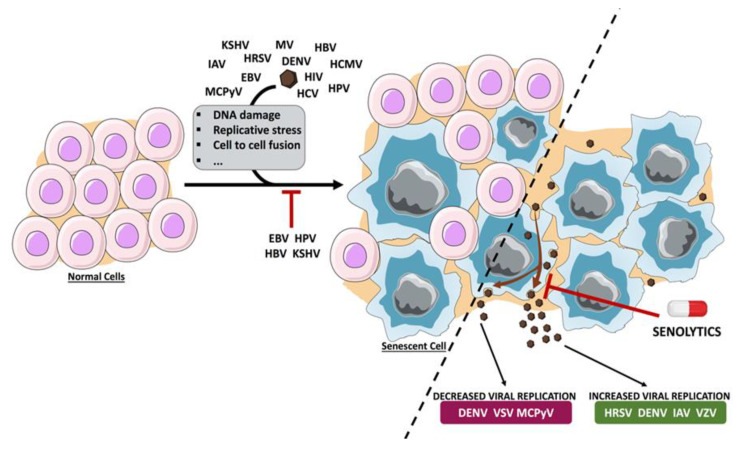
Cellular senescence is viewed as a mechanism to prevent malignant transformation, but when it is chronic, as occurs in age-related diseases, it may have adverse effects on cancer. Therefore, targeting senescent cells is a novel therapeutic strategy against senescence-associated diseases. In addition to its role in cancer protection, cellular senescence is also considered a mechanism to control virus replication. Both interferon treatment and some viral infections can trigger cellular senescence as a way to restrict virus replication. However, activation of the cellular senescence program is linked to the alteration of different pathways, which can be exploited by some viruses to improve their replication. It is, therefore, important to understand the potential impact of senolytic agents on viral propagation. Here we focus on the relationship between virus and cellular senescence and the reported effects of senolytic compounds on virus replication.
Overview
The claims and statistics of this paper haven’t been checked yet.
Free: it reads the open-access text and checks the first 5 claims that cite a source we can check. Create a free account to check every claim.
Integrity signals
Registry
Cites
Statistics
Figures
Verification
Claims the paper makes
The claims and statistics of this paper haven’t been checked yet.
Free: it reads the open-access text and checks the first 5 claims that cite a source we can check. Create a free account to check every claim.
Claims other papers make about this one
Each is checked against this paper’s own text: does it say what the citing paper says it does?
The source backs part of the claim, not all of it — or backs it for a different population, condition or comparison.
In the citing paper
“VIS appears to be a universal stress response in host cells and can be induced by many different virus species.”
From COVID-19 and cellular senescence (2023) · cites this paper as [38]
Experimental — accuracy not yet measuredThe cited source says what the claim attributes to it.
In the citing paper
“A large variety of viruses have been shown to induce senescence in vitro and in vivo27,28,38, whereas no VIS phenotype was observed upon infection with the mild seasonal influenza A (H1N1) virus in Syrian hamsters62, implying that not all virus infections might be susceptible to senolytic strategies.”
From COVID-19 and cellular senescence (2023) · cites this paper as [38]
Self-check
Percentages, sums and reported differences re-computed from the paper’s own numbers.
The self-check needs the paper’s full text.
Citations
Cites
The HCV Life Cycle: In vitro Tissue Culture Systems and Therapeutic Targets
Gerold, G., & Pietschmann, T. (2014) · Digestive Diseases · doi:10.1159/000360830 · Cited by 4,854
Cellular Senescence: Defining a Path Forward
Gorgoulis, V., Adams, P. D., Alimonti, A., Bennett, D. C., Bischof, O., Bishop, C., Campisi, J., Collado, M., Evangelou, K., Ferbeyre, G., et al. (2019) · Cell · doi:10.1016/j.cell.2019.10.005 · Cited by 3,225
Hallmarks of Cellular Senescence
Hernandez-Segura, A., Nehme, J., & Demaria, M. (2018) · Trends in Cell Biology · doi:10.1016/j.tcb.2018.02.001 · Cited by 2,605
The Achilles' heel of senescent cells: from transcriptome to senolytic drugs
Zhu, Y., Tchkonia, T., Pirtskhalava, T., Gower, A. C., Ding, H., Giorgadze, N., Palmer, A. K., Ikeno, Y., Hubbard, G. B., Lenburg, M., et al. (2015) · Aging Cell · doi:10.1111/acel.12344 · Cited by 2,584
Senescence in Health and Disease
He, S., & Sharpless, N. E. (2017) · Cell · doi:10.1016/j.cell.2017.05.015 · Cited by 1,766 · cited 1×
“Cellular senescence can occur in response to different stimuli, including chemotherapeutic treatment, oxidative or genotoxic stress, ionizing radiation, telomere shortening, oncogenic signaling or virus infection [10].”
BackgroundDasatinib in imatinib-resistant Philadelphia chromosome-positive leukemias
Talpaz, M., Shah, N. P., Kantarjian, H., Donato, N., Nicoll, J., Paquette, R., Cortes, J., O'Brien, S., Nicaise, C., Bleickardt, E., et al. (2006) · New England Journal of Medicine · doi:10.1056/nejmoa055229 · Cited by 1,760
Molecular targets of dietary agents for prevention and therapy of cancer
Aggarwal, B. B., & Shishodia, S. (2006) · Biochemical Pharmacology · doi:10.1016/j.bcp.2006.02.009 · Cited by 1,754
Cellular senescence in cancer and aging.
Collado, M., Blasco, M. A., & Serrano, M. (2007) · Cell · doi:10.1016/j.cell.2007.07.003 · Cited by 1,708 · cited 1×
“However, senescence can also contribute to the development of different pathologies such as age-related disorders, cancer, inflammatory diseases and virus replication [5,16].”
BackgroundLombardo, L. J., Lee, F. Y., Chen, P., Norris, D., Barrish, J. C., Behnia, K., Castaneda, S., Cornelius, L. A. M., Das, J., Doweyko, A. M., et al. (2004) · Journal of Medicinal Chemistry · doi:10.1021/jm049486a · Cited by 1,297
Senolytics in idiopathic pulmonary fibrosis: Results from a first-in-human, open-label, pilot study
Justice, J. N., Nambiar, A. M., Tchkonia, T., LeBrasseur, N. K., Pascual, R., Hashmi, S. K., Prata, L., Masternak, M. M., Kritchevsky, S. B., Musi, N., et al. (2019) · EBioMedicine · doi:10.1016/j.ebiom.2018.12.052 · Cited by 1,261
Cited by
Cytoplasmic DNA: sources, sensing, and role in aging and disease
Miller, K. N., Victorelli, S. G., Salmonowicz, H., Dasgupta, N., Liu, T., Passos, J. F., & Adams, P. D. (2021) · Cell · doi:10.1016/j.cell.2021.09.034 · Cited by 288
COVID-19 and cellular senescence
Schmitt, C. A., Tchkonia, T., Niedernhofer, L. J., Robbins, P. D., Kirkland, J. L., & Lee, S. (2023) · Nature Reviews Immunology · doi:10.1038/s41577-022-00785-2 · Cited by 153
The Impact of Immune System Aging on Infectious Diseases
Quiros-Roldan, E., Sottini, A., Natali, P. G., & Imberti, L. (2024) · Microorganisms · doi:10.3390/microorganisms12040775 · Cited by 133
“…of human lung fibroblast cells by the measles virus generates cellular senescence, as documented by reduced cell proliferation, sa β -gal activity, increased expression of p53 and p21, as well as the induction of pro-inflammatory secretome with IL-8 or C-C motif chemokine ligand 5 expression [164].”
Cellular senescence and cardiovascular diseases: moving to the “heart” of the problem
Evangelou, K., Vasileiou, P. V. S., Papaspyropoulos, A., Hazapis, O. G., Petty, R., Demaria, M., & Gorgoulis, V. G. (2022) · Physiological Reviews · doi:10.1152/physrev.00007.2022 · Cited by 136
Kandhaya‐Pillai, R., Yang, X., Tchkonia, T., Martin, G. M., Kirkland, J. L., & Oshima, J. (2022) · Aging Cell · doi:10.1111/acel.13646 · Cited by 119
“At the same time, viruses may exploit cellular senescence, since expression of viral receptors is increased in senescent cells (Kim et al., 2017; Kohli et al., 2021; Meyer et al., 2021; Seoane et al., 2020).”
BackgroundEvangelou, K., Veroutis, D., Paschalaki, K., Foukas, P. G., Lagopati, N., Dimitriou, M., Papaspyropoulos, A., Konda, B., Hazapis, O., Polyzou, A., et al. (2022) · European Respiratory Journal · doi:10.1183/13993003.02951-2021 · Cited by 98
Cellular senescence in Alzheimer’s disease: from physiology to pathology
Zhu, J., Wu, C., & Yang, L. (2024) · Translational Neurodegeneration · doi:10.1186/s40035-024-00447-4 · Cited by 79
Immunosenescence in atherosclerosis: A role for chronic viral infections
Talepoor, A. G., & Doroudchi, M. (2022) · Frontiers in Immunology · doi:10.3389/fimmu.2022.945016 · Cited by 72
Delval, L., Hantute-Ghesquier, A., Sencio, V., Flaman, J., Robil, C., Angulo, F. S., Lipskaia, L., Çobanoglu, Ö., Lacoste, A., Machelart, A., et al. (2023) · Nature Aging · doi:10.1038/s43587-023-00442-w · Cited by 60
Implications of Innate Immunity in Post-Acute Sequelae of Non-Persistent Viral Infections
Hirschenberger, M., Hunszinger, V., & Sparrer, K. M. J. (2021) · Cells · doi:10.3390/cells10082134 · Cited by 61
COVID-19 Immunobiology: Lessons Learned, New Questions Arise
Kaklamanos, A., Belogiannis, K., Skendros, P., Gorgoulis, V. G., Vlachoyiannopoulos, P. G., & Tzioufas, A. G. (2021) · Frontiers in Immunology · doi:10.3389/fimmu.2021.719023 · Cited by 41
“To illustrate the latter, the use of senolytics has been associated with reactivation of latent viral infections (242), systemic toxicity”
BackgroundContribution of viral and bacterial infections to senescence and immunosenescence
Reyes, A., Ortiz, G., Duarte, L. F., Fernández, C., Hernández‐Armengol, R., Palacios, P. A., Prado, Y., Andrade, C. A., Rodríguez‐Guilarte, L., Kalergis, A. M., et al. (2023) · Frontiers in Cellular and Infection Microbiology · doi:10.3389/fcimb.2023.1229098 · Cited by 40
“Another example is measles virus (MV), which when infecting human lung fibroblast cells (IMR90 cells) is capable of generating cellular senescence as evidenced by reduced cell proliferation, SA-bGal activity, increased expression of p53 and p21, or the induction of SASP with interleukin-8 (IL-8) or C-C motif chemokine…”
BackgroundGenetic origins, regulators, and biomarkers of cellular senescence
Torres, G., Salladay-Perez, I. A., Dhingra, A., & Covarrubias, A. J. (2024) · Trends in Genetics · doi:10.1016/j.tig.2024.08.007 · Cited by 25
Saleh, T., Khasawneh, A. I., Himsawi, N. M., Abu-Raideh, J. A., Ejeilat, V., Elshazly, A. M., & Gewirtz, D. A. (2022) · International Journal of Molecular Sciences · doi:10.3390/ijms232415512 · Cited by 24
The ageing immune system as a potential target of senolytics
Du, P. Y., Gandhi, A., Bawa, M., & Gromala, J. (2023) · Oxford Open Immunology · doi:10.1093/oxfimm/iqad004 · Cited by 22
“Senolytics have demonstrated promise in downregulating viral replication and even clearing SnCs infected by a wide range of viruses in vitro [69, 70].”
BackgroundIto, K., Daly, L., & Coates, M. S. (2023) · Frontiers in Medicine · doi:10.3389/fmed.2023.1144050 · Cited by 15
“At least, virus infection was reported to induce cellular senescence (21, 22), but this is not proof that virus is susceptible to senescent cells.”
BackgroundShafqat, A., Masters, M. C., Tripathi, U., Tchkonia, T., Kirkland, J. L., & Hashmi, S. K. (2024) · Ageing Research Reviews · doi:10.1016/j.arr.2024.102400 · Cited by 15
Teulière, J., Bernard, C., Bonnefous, H., Martens, J., Lopez, P., & Bapteste, E. P. (2023) · Molecular Biology and Evolution · doi:10.1093/molbev/msad012 · Cited by 15
“In contrast, even though interference with cellular senescence has been associated with HBV-induced hepatocellular carcinoma upon chronic infection (Seoane et al. 2020; Giannakoulis et al. 2021), only few differentially expressed SenMayo biomarkers were detected in cultured cells upon HBV…”
BackgroundInfluentialCellular Transformation by Human Cytomegalovirus
Herbein, G. (2024) · Cancers · doi:10.3390/cancers16111970 · Cited by 15
“Although non-oncogenic viral infections (human respiratory syncytial virus, influenza A virus, HIV, measle virus, and dengue virus) favor senescence, most oncogenic viruses (EBV, KSHV, HBV, HCV, and MCPyV) and HCMV have been reported to trigger senescence but also to generate PGCCs [26,143].”
BackgroundTeulière, J., Bernard, C., & Bapteste, E. P. (2021) · Ageing Research Reviews · doi:10.1016/j.arr.2021.101375 · Cited by 13
Bharathiraja, S., Larabee, J. L., Bodas, M., Moore, A. R., Burgett, A. W. G., Myers, D. A., Georgescu, C., Wren, J. D., Papin, J. F., & Walters, M. S. (2021) · Viruses · doi:10.3390/v13081603 · Cited by 12
Pham, A. M., Ortiz, L. E., Lukacher, A. E., & Kwun, H. J. (2023) · Cells · doi:10.3390/cells12030380 · Cited by 13
Brügger, M., Machahua, C., Zumkehr, T., Cismaru, C. V., Jandrasits, D., Trüeb, B. S., Ezzat, S., Esteves, B. I. O., Dorn, P., Marti, T. M., et al. (2025) · Respiratory Research · doi:10.1186/s12931-025-03190-0 · Cited by 13
“In some cases, virus infection can induce cellular senescence and subsequently restrict or improve virus propagation, while in others, certain viruses evolved strategies to subvert senescence [86].”
The emerging role of cellular senescence in complications of COVID-19
Mohiuddin, M., & Kasahara, K. (2021) · Cancer Treatment and Research Communications · doi:10.1016/j.ctarc.2021.100399 · Cited by 11
Trapp-Fragnet, L., Schermuly, J., Kohn, M., Bertzbach, L. D., Pfaff, F., Denesvre, C., Kaufer, B. B., & Härtle, S. (2021) · PLoS Pathogens · doi:10.1371/journal.ppat.1010006 · Cited by 13
Should We Expect an Increase in the Number of Cancer Cases in People with Long COVID?
Amiama-Roig, A., Pérez‐Martínez, L., Ledo, P. R., Verdugo‐Sivianes, E. M., & Blanco, J. R. (2023) · Microorganisms · doi:10.3390/microorganisms11030713 · Cited by 10
Bapteste, E. P., Huneman, P., Keller, L., Teulière, J., Lopez, P., Teeling, E. C., Lindner, A. B., Baudisch, A., Ludington, W. B., & Franceschi, C. (2023) · Ageing Research Reviews · doi:10.1016/j.arr.2023.101982 · Cited by 10
Storozynsky, Q. T., Han, X., Komant, S. J., Agopsowicz, K. C., Potts, K. G., Gamper, A. M., Godbout, R., Evans, D. H., & Hitt, M. (2023) · Cancers · doi:10.3390/cancers15133341 · Cited by 9
Ramirez, G. A., & Viel, T. A. (2024) · Aging advances. · doi:10.4103/agingadv.agingadv-d-24-00014 · Cited by 9
Benites, L. F., & Alves-Lima, C. (2022) · Applied Phycology · doi:10.1080/26388081.2022.2059701 · Cited by 11
Ismael, S., Umar, M., Ouvrier, B., Hall, G., Cummins, M., Sapkota, A., Talkington, G. M., White, A. L., Milner, R., Khismatullin, D. B., et al. (2025) · Viruses · doi:10.3390/v17060784 · Cited by 6
“VIS is induced by many species of viruses, including members of the Polyomaviridae, Retroviridae, Paramyxoviri-dae, Rhabdoviridae, Parvoviridae, and Coronaviridae families [49–54].”
Chentoufi, A. A., Khan, A. A., Srivastava, R., Karan, S., Lekbach, Y., Vahed, H., & BenMohamed, L. (2025) · Viruses · doi:10.3390/v17050606 · Cited by 5
“Several chronic viral infections such as HIV, HCMV, EBV, hepatitis C virus, human parvovirus B 19 , Kaposi sarcoma as well as natural acute measles infection in children show increased populations of CD8 + CD28 − (CD8 + CD57 + ) T-cells (Reviewed in [33,34]).”
Impact of in vitro SARS-CoV-2 infection on breast cancer cells
Sommariva, M., Dolci, M., Triulzi, T., Ambrogi, F., Dugo, M., Cecco, L. D., Noci, V. L., Bernardo, G., Anselmi, M., Montanari, E., et al. (2024) · Scientific Reports · doi:10.1038/s41598-024-63804-3 · Cited by 5
“Therefore, this ER-blocker may trigger cellular senescence, which, in turn, can function as an antiviral defense mechanism 17,18 .”
Loss of CFTR Reverses Senescence Hallmarks in SARS-CoV-2 Infected Bronchial Epithelial Cells
Merigo, F., Lagni, A., Boschi, F., Bernardi, P., Conti, A., Plebani, R., Romano, M., Sorio, C., Lotti, V., & Sbarbati, A. (2024) · International Journal of Molecular Sciences · doi:10.3390/ijms25116185 · Cited by 4
Leal, L., Guardo, A. C., Bedoya, L. M., de Miguel, C. R., Climent, N., Rovira, C., Beltrán, M., Llach, J., Alcamí, J., Kashuba, A. D. M., et al. (2022) · AIDS Research and Human Retroviruses · doi:10.1089/aid.2021.0232 · Cited by 4
“43 To the best of our knowledge there are no other studies describing these results.”
HIV infection in microglia leads to senescence, triggering activation of neurotoxicity pathwaysPreprint
Mason, S. J., Sreeram, S., Niazi, F., Leskov, K., Levine, A. D., Karn, J., & Valadkhan, S. (2025) · bioRxiv (Cold Spring Harbor Laboratory) · doi:10.1101/2025.05.08.651477 · Cited by 5
Lee, M.-J., Yeon, J.-H., Lee, J., Kang, Y. H., Park, B. S., Park, J. H., Yun, S., Wirth, D., Yoo, S., Park, C., et al. (2024) · Journal of Clinical Investigation · doi:10.1172/jci183561 · Cited by 2
“While senescence can act as a host defense mechanism against viral infections, some viruses have evolved mechanisms to trigger senescence in host cells as a strategy to enhance viral infection (42, 43).”
Liver aging and associated diseases
Xu, Y., Deng, Q., Chen, Y., & Wang, H. (2026) · Chinese Science Bulletin (Chinese Version) · doi:10.1360/csb-2025-5918 · Cited by 2
Mechanism and significance of cell senescence induced by viral infection
Chang, Y., Wu, X., Deng, L., Wang, S., & Mao, G. (2025) · Journal of Zhejiang University (Medical Sciences) · doi:10.3724/zdxbyxb-2024-0213 · Cited by 1
Zeng, Y., Hsu, M.-K., Cai, J., & Wang, H.-Y. (2024) · Scientific Reports · doi:10.1038/s41598-024-54847-7 · Cited by 1
Potential Medicinal Plants for the Treatment of Dengue Fever: A Systematic ReviewPreprint
Ajaegbu, E. E., & Ikegbuna, C. P. (2023) · Preprints.org · doi:10.20944/preprints202311.0833.v1 · Cited by 1
Réseaux de communication au sein de communautés microbiennes environnementales
Bernard, C. (2022) · theses.fr (ABES) · doi:10.70675/165de9b0z3cfbz416dz91a5zb86f8cdd5f70
Love in the Time of COVID: Psychiatric Outcomes Related to Oxytocin and the “Endocrine Organ”
Sfera, A., Hazan, S., Anton, J., Ciuperca, I., Klein, C. A., & Thomas, K. G. (2025) · OBM Neurobiology · doi:10.21926/obm.neurobiol.2502287
Portillo, A. I. (2023) · Dipòsit Digital de la Universitat de Barcelona (Universitat de Barcelona)
Bonnefous, H. (2025) · theses.fr (ABES) · doi:10.70675/67742b4az1242z4d30z964ezd8bf9300d4ac · Cited by 1
Hu, A., Zhao, Z., Shen, M., Chen, Y., Chen, Y., Li, M., Lin, L., Zheng, H., Peng, J., Liang, Y., et al. (2026) · Molecular Plant Pathology · doi:10.1111/mpp.70271
“Expansin-mediated cell wall loosening can facilitate pathogen movement through plant tissues (Cosgrove 2024), while senescence-associated transcriptional programmes may create cellular environments permissive to viral replication and spread (Seoane et al. 2020).”
Oncoviruses at the Crossroads of Ageing and Cancer: Molecular Mechanisms and Key Signalling Pathways
Allehyani, N., Alissa, M., Alghamdi, A., AlShehri, M. A., Abusalim, G. S., Juraybi, T. N., Alsuwat, M. A., & Safhi, A. Y. (2026) · Reviews in Medical Virology · doi:10.1002/rmv.70195
Lidsky, P. V., & Ogrodnik, M. B. (2026) · Ageing Research Reviews · doi:10.1016/j.arr.2026.103304
Pathogenic modulators of cellular senescence
Simoroz, E. V., Antonov, Y. V., Muravyov, G. S., Vasilevska, J., & Рогаев, Е. И. (2026) · Vavilov Journal of Genetics and Breeding · doi:10.18699/vjgb-26-72
“This interaction contributes to pathological conditions during viral infections, especially in elderly individuals, through mechanisms such as cytokine storms and immune response dysfunction (Seoane et al., 2020).”
Nadholta, P., Volety, I., & Shukla, D. (2026) · Virology · doi:10.1016/j.virol.2026.111113
Metadata
- Authors
- Seoane, R., Vidal, S., Bouzaher, Y. H., El Motiam, A., & Rivas, C.
- Affiliations
- Universidade de Santiago de Compostela (ES)
- Centro de Investigación en Medicina Molecular y Enfermedades Crónicas (CIMUS), Universidad de Santiago de Compostela, 15706 Santiago de Compostela, Spain
- Consejo Superior de Investigaciones Científicas (ES)
- Corresponding author
- Rivas, Carmen
- Venue
- Biology
- Publisher
- MDPI AG
- Published
- 2020-12-09
- Volume
- 9
- Issue
- 12
- Pages
- 455
- ISSN
- 2079-7737 (ISSN-L)
- PMC
- PMC7764305
- OpenAlex
- W3111554493
- Cited by
- 49
- References
- 149
- Citations by year
- 2026: 6 · 2025: 7 · 2024: 11 · 2023: 10 · 2022: 8 · 2021: 7
- FWCI
- 0.80
- Type
- journal article
- Language
- en
- Open access
- gold
- doi.org
- Licence
- Locations
- Biology (publishedVersion, cc-by)
- PubMed Central (publishedVersion, cc-by)
- PubMed (publishedVersion)
- DIGITAL.CSIC (Spanish National Research Council (CSIC)) (submittedVersion, cc-by)
- LA Referencia (Red Federada de Repositorios Institucionales de Publicaciones Científicas) (submittedVersion, cc-by)
- DOAJ (DOAJ: Directory of Open Access Journals) (submittedVersion, cc-by-sa)
- Hispana (submittedVersion, cc-by)
- Repositorio institucional da Universidade de Santiago de Compostela (University of Santiago de Compostela) (submittedVersion, other-oa)
- Funders
- Ministerio de Ciencia, Innovación y Universidades (BFU-2017-88880-P)
- Xunta de Galicia (ED431G 2019/02)
- Consellería de Cultura, Educación e Ordenación Universitaria, Xunta de Galicia (ED481A-2018/110, ED481A-2020/160)
- Topics
- Life Sciences › Biochemistry, Genetics and Molecular Biology › Cell Biology › Telomeres, Telomerase, and Senescence
- Life Sciences › Immunology and Microbiology › Immunology › interferon and immune responses
- Life Sciences › Biochemistry, Genetics and Molecular Biology › Aging › Genetics, Aging, and Longevity in Model Organisms
- Keywords
- cellular senescence, viral replication, senolytics, cancer prevention, interferon, age-related diseases, antiviral therapy
About these checks
Registry, retraction, Cites and statistics results are computed, not judged, with one exception: a printed reference that no index lists is read once by a model before it counts as a citation error. Claims are extracted by a model and kept only when their quote appears verbatim in the text; each cited source is then checked, with a model’s help, for whether it says what the claim relies on. Those verdicts can be wrong — read the claim’s quote and the cited source before relying on one.
Statistics and arithmetic are recomputed, not judged.
Confidence bands are shown only for fields calibrated on our annotated test set. None is calibrated yet, so no band is shown.
What counts as a claim ›How we measure confidence ›How we check this ›
Are you an author, or do you see a problem with this page? Request a review
Data sources
Bibliographic data: Semantic Scholar, OpenAlex, Crossref.
Contains information from the Semantic Scholar Academic Graph Datasets, made available under the ODC Attribution License (ODC-BY 1.0).
Semantic Scholar’s data is described in: Kinney, R., et al. (2023). The Semantic Scholar Open Data Platform. arXiv:2301.10140.
