

The Interaction of Viruses with the Cellular Senescence Response
Open accessThe DOI matches its Crossref record; 146 of the 149 references it cites were found in a registry or an index.
Abstract
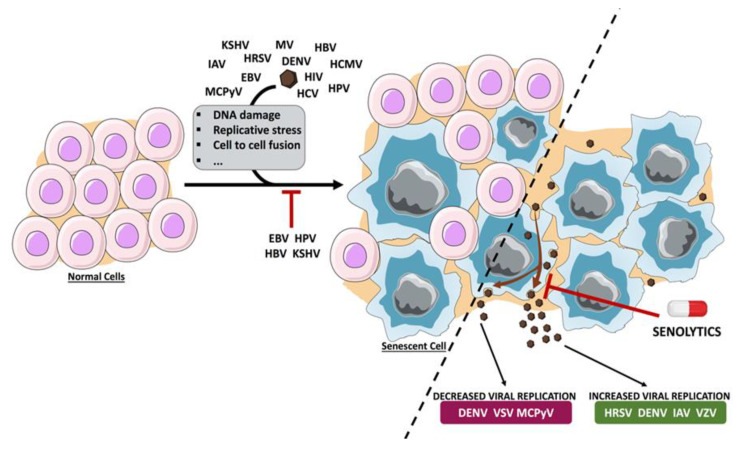
Cellular senescence is viewed as a mechanism to prevent malignant transformation, but when it is chronic, as occurs in age-related diseases, it may have adverse effects on cancer. Therefore, targeting senescent cells is a novel therapeutic strategy against senescence-associated diseases. In addition to its role in cancer protection, cellular senescence is also considered a mechanism to control virus replication. Both interferon treatment and some viral infections can trigger cellular senescence as a way to restrict virus replication. However, activation of the cellular senescence program is linked to the alteration of different pathways, which can be exploited by some viruses to improve their replication. It is, therefore, important to understand the potential impact of senolytic agents on viral propagation. Here we focus on the relationship between virus and cellular senescence and the reported effects of senolytic compounds on virus replication.
Overview
The claims and statistics of this paper haven’t been checked yet.
Free: it reads the open-access text and checks the first 5 claims that cite a source we can check. Create a free account to check every claim.
Integrity signals
Registry
Cites
Statistics
Figures
Verification
Claims the paper makes
The claims and statistics of this paper haven’t been checked yet.
Free: it reads the open-access text and checks the first 5 claims that cite a source we can check. Create a free account to check every claim.
Claims other papers make about this one
Each is checked against this paper’s own text: does it say what the citing paper says it does?
The source backs part of the claim, not all of it — or backs it for a different population, condition or comparison.
In the citing paper
“VIS appears to be a universal stress response in host cells and can be induced by many different virus species.”
From COVID-19 and cellular senescence (2023) · cites this paper as [38]
Experimental — accuracy not yet measuredThe cited source says what the claim attributes to it.
In the citing paper
“A large variety of viruses have been shown to induce senescence in vitro and in vivo27,28,38, whereas no VIS phenotype was observed upon infection with the mild seasonal influenza A (H1N1) virus in Syrian hamsters62, implying that not all virus infections might be susceptible to senolytic strategies.”
From COVID-19 and cellular senescence (2023) · cites this paper as [38]
Self-check
Percentages, sums and reported differences re-computed from the paper’s own numbers.
The self-check needs the paper’s full text.
Citations
Cites
The HCV Life Cycle: In vitro Tissue Culture Systems and Therapeutic Targets
Gerold, G., & Pietschmann, T. (2014) · Digestive Diseases · doi:10.1159/000360830 · Cited by 4,854
Cellular Senescence: Defining a Path Forward
Gorgoulis, V., Adams, P. D., Alimonti, A., Bennett, D. C., Bischof, O., Bishop, C., Campisi, J., Collado, M., Evangelou, K., Ferbeyre, G., et al. (2019) · Cell · doi:10.1016/j.cell.2019.10.005 · Cited by 3,225
Hallmarks of Cellular Senescence
Hernandez-Segura, A., Nehme, J., & Demaria, M. (2018) · Trends in Cell Biology · doi:10.1016/j.tcb.2018.02.001 · Cited by 2,605
The Achilles' heel of senescent cells: from transcriptome to senolytic drugs
Zhu, Y., Tchkonia, T., Pirtskhalava, T., Gower, A. C., Ding, H., Giorgadze, N., Palmer, A. K., Ikeno, Y., Hubbard, G. B., Lenburg, M., et al. (2015) · Aging Cell · doi:10.1111/acel.12344 · Cited by 2,584
Senescence in Health and Disease
He, S., & Sharpless, N. E. (2017) · Cell · doi:10.1016/j.cell.2017.05.015 · Cited by 1,766 · cited 1×
“Cellular senescence can occur in response to different stimuli, including chemotherapeutic treatment, oxidative or genotoxic stress, ionizing radiation, telomere shortening, oncogenic signaling or virus infection [10].”
BackgroundDasatinib in imatinib-resistant Philadelphia chromosome-positive leukemias
Talpaz, M., Shah, N. P., Kantarjian, H., Donato, N., Nicoll, J., Paquette, R., Cortes, J., O'Brien, S., Nicaise, C., Bleickardt, E., et al. (2006) · New England Journal of Medicine · doi:10.1056/nejmoa055229 · Cited by 1,760
Molecular targets of dietary agents for prevention and therapy of cancer
Aggarwal, B. B., & Shishodia, S. (2006) · Biochemical Pharmacology · doi:10.1016/j.bcp.2006.02.009 · Cited by 1,754
Cellular senescence in cancer and aging.
Collado, M., Blasco, M. A., & Serrano, M. (2007) · Cell · doi:10.1016/j.cell.2007.07.003 · Cited by 1,708 · cited 1×
“However, senescence can also contribute to the development of different pathologies such as age-related disorders, cancer, inflammatory diseases and virus replication [5,16].”
BackgroundLombardo, L. J., Lee, F. Y., Chen, P., Norris, D., Barrish, J. C., Behnia, K., Castaneda, S., Cornelius, L. A. M., Das, J., Doweyko, A. M., et al. (2004) · Journal of Medicinal Chemistry · doi:10.1021/jm049486a · Cited by 1,297
Senolytics in idiopathic pulmonary fibrosis: Results from a first-in-human, open-label, pilot study
Justice, J. N., Nambiar, A. M., Tchkonia, T., LeBrasseur, N. K., Pascual, R., Hashmi, S. K., Prata, L., Masternak, M. M., Kritchevsky, S. B., Musi, N., et al. (2019) · EBioMedicine · doi:10.1016/j.ebiom.2018.12.052 · Cited by 1,261
Senolytic drugs: from discovery to translation
Kirkland, J. L., & Tchkonia, T. (2020) · Journal of Internal Medicine · doi:10.1111/joim.13141 · Cited by 1,227
Kiyono, T., Foster, S. A., Koop, J. I., McDougall, J. K., Galloway, D. A., & Klingelhutz, A. J. (1998) · Nature · doi:10.1038/23962 · Cited by 1,206
Zhu, Y., Tchkonia, T., Fuhrmann‐Stroissnigg, H., Dai, H. M., Ling, Y. Y., Stout, M. B., Pirtskhalava, T., Giorgadze, N., Johnson, K. O., Giles, C. B., et al. (2016) · Aging Cell · doi:10.1111/acel.12445 · Cited by 1,148
Forging a signature of in vivo senescence
Sharpless, N. E., & Sherr, C. J. (2015) · Nature Reviews Cancer · doi:10.1038/nrc3960 · Cited by 1,104 · cited 5×
“Among the diverse hallmarks of cellular senescence, some of the most characteristic ones are a persistent DDR; a stable cell cycle arrest mediated by the p53/p21Cip1 and p16INK4a/pRb pathways; morphological changes characterized by enlarged size, flattened shape, extensive vacuolization and multinucleation; upregulati…”
BackgroundInfluentialUnmasking senescence: context-dependent effects of SASP in cancer
Faget, D. V., Ren, Q., & Stewart, S. A. (2019) · Nature Reviews Cancer · doi:10.1038/s41568-019-0156-2 · Cited by 863 · cited 1×
“This process can be beneficial and protect against cancer or other types of stress, but an excess of senescent cells can favor cancer progression [6].”
BackgroundAutophagy during viral infection — a double-edged sword
Choi, Y., Bowman, J. W., & Jung, J. U. (2018) · Nature Reviews Microbiology · doi:10.1038/s41579-018-0003-6 · Cited by 838 · cited 1×
“However, some viruses have developed strategies to avoid these antiviral responses or subvert them for their own benefit [1,2].”
BackgroundZhu, Y., Doornebal, E. J., Pirtskhalava, T., Giorgadze, N., Wentworth, M., Fuhrmann-Stroissnigg, H., Niedernhofer, L. J., Robbins, P. D., Tchkonia, T., & Kirkland, J. L. (2017) · Aging · doi:10.18632/aging.101202 · Cited by 757
Härtlova, A., Erttmann, S. F., Raffi, F. A., Schmalz, A. M., Resch, U., Anugula, S., Lienenklaus, S., Nilsson, L. M., Kröger, A., Nilsson, J. A., et al. (2015) · Immunity · doi:10.1016/j.immuni.2015.01.012 · Cited by 716
Lupberger, J., Zeisel, M. B., Xiao, F., Thumann, C., Fofana, I., Zona, L., Davis, C., Mee, C. J., Turek, M., Gorke, S., et al. (2011) · Nature Medicine · doi:10.1038/nm.2341 · Cited by 706
Identification of HSP90 inhibitors as a novel class of senolytics
Fuhrmann-Stroissnigg, H., Ling, Y. Y., Zhao, J., McGowan, S. J., Zhu, Y., Brooks, R. W., Grassi, D., Gregg, S. Q., Stripay, J. L., Dorronsoro, A., et al. (2017) · Nature Communications · doi:10.1038/s41467-017-00314-z · Cited by 701
Weisberg, E., Manley, P. W., Cowan-Jacob, S. W., Hochhaus, A., & Griffin, J. D. (2007) · Nature Reviews Cancer · doi:10.1038/nrc2126 · Cited by 636
The Clinical potential of Senolytic Drugs
Kirkland, J. L., Tchkonia, T., Zhu, Y., Niedernhofer, L. J., & Robbins, P. D. (2017) · Journal of the American Geriatrics Society · doi:10.1111/jgs.14969 · Cited by 539
Goh, W. C., Rogel, M. E., Kinsey, C. M., Michael, S. F., Fultz, P. N., Nowak, M. A., Hahn, B. H., & Emerman, M. (1998) · Nature Medicine · doi:10.1038/nm0198-065 · Cited by 518 · cited 1×
“For example, the human immunodeficiency virus (HIV) is more transcriptionally active in G2 [3], and a G2 cell cycle arrest increases the number of integrated HIV provirus [4].”
BackgroundMicroRNA 217 Modulates Endothelial Cell Senescence via Silent Information Regulator 1
Menghini, R., Casagrande, V., Cardellini, M., Martelli, E., Terrinoni, A., Amati, F., Vasa-Nicotera, M., Ippoliti, A., Novelli, G., Melino, G., et al. (2009) · Circulation · doi:10.1161/circulationaha.109.864629 · Cited by 482 · cited 1×
“Thus, expression of HIV Tat in endothelial cells or in transgenic mice upregulates the expression of the microRNA miR-34a [32], a molecule that targets sirtuin 1 (SIRT1), leading to the induction of senescence [33,34].”
BackgroundDNA damage, cellular senescence and organismal ageing: causal or correlative?
Chen, J.-H., Hales, C. N., & Ozanne, S. E. (2007) · Nucleic Acids Research · doi:10.1093/nar/gkm681 · Cited by 476 · cited 1×
“DNA damage is a key event for the induction of cell senescence in response to many of these stimuli, such as treatment with chemotherapeutic drugs, oxidative stress, the shortening of telomeres, or oncogenic stress [11].”
BackgroundQuercetin as an Antiviral Agent Inhibits Influenza A Virus (IAV) Entry
Wu, W., Li, R., Li, X., He, J., Jiang, S., Liu, S., & Yang, J. (2015) · Viruses · doi:10.3390/v8010006 · Cited by 425
Identification and characterization of Cardiac Glycosides as senolytic compounds
Triana-Martínez, F., Picallos-Rabina, P., Da Silva-Álvarez, S., Pietrocola, F., Llanos, S., Rodilla, V., Soprano, E., Pedrosa, P., Ferreirós, A., Barradas, M., et al. (2019) · Nature Communications · doi:10.1038/s41467-019-12888-x · Cited by 384
Cardiac glycosides are broad-spectrum senolytics
Guerrero, A., Herranz, N., Sun, B., Wagner, V., Gallage, S., Guiho, R., Wolter, K., Pombo, J., Irvine, E. E., Innes, A. J., et al. (2019) · Nature Metabolism · doi:10.1038/s42255-019-0122-z · Cited by 359
Herpes viral cyclin/Cdk6 complexes evade inhibition by CDK inhibitor proteins
Swanton, C., Mann, D. J., Fleckenstein, B., Neipel, F., Peters, G., & Jones, N. (1997) · Nature · doi:10.1038/36606 · Cited by 334 · cited 1×
“KSHV vCyclin forms active kinase complexes with Cdk6 that are resistant to the inhibition by p21Cip1, p16INK4a and p27Kip1 [51] and induces p27 degradation [52] suppressing replicative senescence in primary human lymphatic endothelial cells [53] as well as senescence triggered by NF-kB hyperactivation [54].”
BackgroundRoles of flavonoids against coronavirus infection
Russo, M., Moccia, S., Spagnuolo, C., Tedesco, I., & Russo, G. L. (2020) · Chemico-Biological Interactions · doi:10.1016/j.cbi.2020.109211 · Cited by 323
Replicative senescence in normal liver, chronic hepatitis C, and hepatocellular carcinomas
Paradis, V., Youssef, N., Dargère, D., Bâ, N., Bonvoust, F., Deschatrette, J., & Bedossa, P. (2001) · Human Pathology · doi:10.1053/hupa.2001.22747 · Cited by 314 · cited 12×
“It has been speculated that increased DC-SIGN expression in senescent monocytes might increase infectivity by other viruses, including IAV, HIV, Ebola, HCV, cytomegalovirus and severe acute respiratory syndrome coronavirus (SARS-CoV) since these pathogens can be captured by DC-SIGN [61].”
BackgroundInfluentialKim, K. H., Shin, H., Kim, K., Choi, H. M., Rhee, S. H., Moon, H., Kim, H. H., Yang, U. S., Yu, D., & Cheong, J. (2007) · Gastroenterology · doi:10.1053/j.gastro.2007.03.039 · Cited by 281
ABT-199 (venetoclax) and BCL-2 inhibitors in clinical development
Cang, S., Iragavarapu, C., Savooji, J., Song, Y., & Liu, D. (2015) · Journal of Hematology & Oncology · doi:10.1186/s13045-015-0224-3 · Cited by 281
Geller, R., Vignuzzi, M., Andino, R., & Frydman, J. (2007) · Genes & Development · doi:10.1101/gad.1505307 · Cited by 263
Cell fusion induced by ERVWE1 or measles virus causes cellular senescence
Chuprin, A., Gal, H., Biron-Shental, T., Biran, A., Amiel, A., Rozenblatt, S., & Krizhanovsky, V. (2013) · Genes & Development · doi:10.1101/gad.227512.113 · Cited by 262 · cited 2×
“MV infection also triggered senescence in the adenocarcinoma cell line A549, and this induction occurs in a p53-dependent manner [28].”
BackgroundDNA damage-induced type I interferon promotes senescence and inhibits stem cell function
Yu, Q., Katlinskaya, Y. V., Carbone, C. J., Zhao, B., Katlinski, K. V., Zheng, H., Guha, M., Li, N., Chen, Q., Yang, T., et al. (2015) · Cell Reports · doi:10.1016/j.celrep.2015.03.069 · Cited by 260
DNA Damage Signaling and p53-dependent Senescence after Prolonged β-Interferon Stimulation
Moiseeva, O., Mallette, F. A., Mukhopadhyay, U. K., Moores, A., & Ferbeyre, G. (2006) · Molecular Biology of the Cell · doi:10.1091/mbc.e05-09-0858 · Cited by 252 · cited 1×
“Persistent beta IFN treatment triggers a DNA damage signaling pathway and senescence [12], and DNA damage induces type I IFN and stimulate IFN signaling, which amplifies DNA damage responses and promotes a p53-dependent senescence program [13–15].”
BackgroundThe green tea molecule EGCG inhibits Zika virus entry
Carneiro, B. M., Batista, M. N., Braga, A. C. S., Nogueira, M. L., & Rahal, P. (2016) · Virology · doi:10.1016/j.virol.2016.06.012 · Cited by 244
Decreased bone mineral density in HIV-infected patients is independent of antiretroviral therapy
Bruera, D., Luna, N., David, D. O., Bergoglio, L. M., & Zamudio, J. (2003) · AIDS · doi:10.1097/00002030-200309050-00010 · Cited by 240
Nikitin, P. A., Yan, C. M., Forte, E., Bocedi, A., Tourigny, J. P., White, R. E., Allday, M. J., Patel, A., Dave, S. S., Kim, W., et al. (2010) · Cell Host & Microbe · doi:10.1016/j.chom.2010.11.004 · Cited by 235 · cited 9×
“Among the diverse hallmarks of cellular senescence, some of the most characteristic ones are a persistent DDR; a stable cell cycle arrest mediated by the p53/p21Cip1 and p16INK4a/pRb pathways; morphological changes characterized by enlarged size, flattened shape, extensive vacuolization and multinucleation; upregulati…”
BackgroundInfluentialThe DNA Damage Response Induces IFN
Brzostek-Racine, S., Gordon, C., Van Scoy, S., & Reich, N. C. (2011) · The Journal of Immunology · doi:10.4049/jimmunol.1100040 · Cited by 234
Yamaguchi, K., Honda, M., Ikigai, H., Hara, Y., & Shimamura, T. (2002) · Antiviral Research · doi:10.1016/s0166-3542(01)00189-9 · Cited by 225
Bachmetov, L., Gal‐Tanamy, M., Shapira, A., Vorobeychik, M., Giterman‐Galam, T., Sathiyamoorthy, P., Golan‐Goldhirsh, A., Benhar, I., Tur‐Kaspa, R., & Zemel, R. (2012) · Journal of Viral Hepatitis · doi:10.1111/j.1365-2893.2011.01507.x · Cited by 206
The heat shock protein inhibitor Quercetin attenuates hepatitis C virus production†
Gonzalez, O., Fontanes, V., Raychaudhuri, S., Loo, R., Loo, J., Arumugaswami, V., Sun, R., Dasgupta, A., & French, S. W. (2009) · Hepatology · doi:10.1002/hep.23232 · Cited by 189
Molecular Mechanisms of Na/K‐ATPase‐Mediated Signal Transduction
XIE, Z. (2003) · Annals of the New York Academy of Sciences · doi:10.1111/j.1749-6632.2003.tb07234.x · Cited by 188
Degradation of p27Kip cdk inhibitor triggered by Kaposi's sarcoma virus cyclin-cdk6 complex
Ellis, M. (1999) · The EMBO Journal · doi:10.1093/emboj/18.3.644 · Cited by 178
Hallmarks of HPV carcinogenesis: The role of E6, E7 and E5 oncoproteins in cellular malignancy
Estêvão, D., Costa, N. R., da Costa, R. M. G., & Medeiros, R. (2019) · Biochimica et Biophysica Acta (BBA) - Gene Regulatory Mechanisms · doi:10.1016/j.bbagrm.2019.01.001 · Cited by 177
Delaisse, J.-M. (2014) · BoneKEy Reports · doi:10.1038/bonekey.2014.56 · Cited by 170
Clinical strategies and animal models for developing senolytic agents
Kirkland, J. L., & Tchkonia, T. (2015) · Experimental Gerontology · doi:10.1016/j.exger.2014.10.012 · Cited by 168
DC-SIGN and L-SIGN: the SIGNs for infection
Khoo, U.-S., Chan, K. Y. K., Chan, V. S. F., & Lin, C. L. S. (2008) · Journal of Molecular Medicine · doi:10.1007/s00109-008-0350-2 · Cited by 162
Viruses and the DNA Damage Response: Activation and Antagonism
Luftig, M. A. (2014) · Annual Review of Virology · doi:10.1146/annurev-virology-031413-085548 · Cited by 158 · cited 7×
“Among the diverse hallmarks of cellular senescence, some of the most characteristic ones are a persistent DDR; a stable cell cycle arrest mediated by the p53/p21Cip1 and p16INK4a/pRb pathways; morphological changes characterized by enlarged size, flattened shape, extensive vacuolization and multinucleation; upregulati…”
BackgroundInfluentialLongitudinal Analysis of Bone Density in Human Immunodeficiency Virus-Infected Women
Dolan, S. E., Kanter, J. R., & Grinspoon, S. (2006) · The Journal of Clinical Endocrinology & Metabolism · doi:10.1210/jc.2006-0127 · Cited by 156
c-Src protein kinase inhibitors block assembly and maturation of dengue virus
Chu, J. J. H., & Yang, P. L. (2007) · Proceedings of the National Academy of Sciences · doi:10.1073/pnas.0611681104 · Cited by 154
G2/M cell cycle arrest in the life cycle of viruses
Davy, C., & Doorbar, J. (2007) · Virology · doi:10.1016/j.virol.2007.05.043 · Cited by 153 · cited 2×
“However, senescence can also contribute to the development of different pathologies such as age-related disorders, cancer, inflammatory diseases and virus replication [5,16].”
Backgroundde Sousa, L. R. F., Wu, H., Nebo, L., Fernandes, J. B., da Silva, M. F. D. G. F., Kiefer, W., Kanitz, M., Bodem, J., Diederich, W. E., Schirmeister, T., et al. (2014) · Bioorganic & Medicinal Chemistry · doi:10.1016/j.bmc.2014.12.015 · Cited by 150
Connor, J. H., McKenzie, M. O., Parks, G. D., & Lyles, D. S. (2007) · Virology · doi:10.1016/j.virol.2006.12.026 · Cited by 146
Badi, I., Burba, I., Ruggeri, C., Zeni, F., Bertolotti, M., Scopece, A., Pompilio, G., & Raucci, A. (2015) · The Journals of Gerontology Series A: Biological Sciences and Medical Sciences · doi:10.1093/gerona/glu180 · Cited by 134 · cited 1×
“Thus, expression of HIV Tat in endothelial cells or in transgenic mice upregulates the expression of the microRNA miR-34a [32], a molecule that targets sirtuin 1 (SIRT1), leading to the induction of senescence [33,34].”
BackgroundLim, H., Nguyen, T. T. H., Kim, N. M., Park, J., Jang, T., & Kim, D. (2016) · Biotechnology Letters · doi:10.1007/s10529-016-2261-6 · Cited by 131
The Small Molecules AZD0530 and Dasatinib Inhibit Dengue Virus RNA Replication via Fyn Kinase
de Wispelaere, M., LaCroix, A. J., & Yang, P. L. (2013) · Journal of Virology · doi:10.1128/jvi.00632-13 · Cited by 130
Li, J., Wang, X., Diaz, J., Tsang, S. H., Buck, C. B., & You, J. (2013) · Journal of Virology · doi:10.1128/jvi.01216-13 · Cited by 128 · cited 1×
“The accumulation of phosphorylated KAP-1 has been associated with a G2 phase arrest, a mechanism that may avoid viral DNA replication [24,25].”
BackgroundEffect of Quercetin on Hepatitis C Virus Life Cycle: From Viral to Host Targets
Rojas, Á., Campo, J. A. D., Clément, S., Lemasson, M., García-Valdecasas, M., Gil‐Gómez, A., Ranchal, I., Bartosch, B., Bautista, J., Rosenberg, A. R., et al. (2016) · Scientific Reports · doi:10.1038/srep31777 · Cited by 128
ATP1A1-Mediated Src Signaling Inhibits Coronavirus Entry into Host Cells
Burkard, C., Verheije, M. H., Haagmans, B. L., van Kuppeveld, F. J., Rottier, P. J. M., Bosch, B.-J., & de Haan, C. A. M. (2015) · Journal of Virology · doi:10.1128/jvi.03274-14 · Cited by 121
Leidal, A. M., Cyr, D. P., Hill, R. J., Lee, P. W. K., & McCormick, C. (2012) · Cell Host & Microbe · doi:10.1016/j.chom.2012.01.005 · Cited by 113 · cited 1×
“Suppression of autophagy has been proposed as the mechanism that mediates the senescence bypass by KSHV v-FLIP [55].”
BackgroundDigoxin Suppresses HIV-1 Replication by Altering Viral RNA Processing
Wong, R., Balachandran, A., Ostrowski, M., & Cochrane, A. (2013) · PLoS Pathogens · doi:10.1371/journal.ppat.1003241 · Cited by 112
Cho, J., Lee, Y. J., Kim, J. H., Kim, S. I., Kim, S. S., Choi, B., & Choi, J. (2020) · Scientific Reports · doi:10.1038/s41598-020-72879-7 · Cited by 111
Viral Oncogene–Induced DNA Damage Response Is Activated in Kaposi Sarcoma Tumorigenesis
Koopal, S., Furuhjelm, J. H., Järviluoma, A., Jäämaa, S., Pyakurel, P., Pussinen, C., Wirzenius, M., Biberfeld, P., Alitalo, K., Laiho, M., et al. (2007) · PLoS Pathogens · doi:10.1371/journal.ppat.0030140 · Cited by 108 · cited 2×
“The deregulation of cell proliferation that occurs after the initial infection of primary cells in response to the expression of latent viral oncoproteins from the Epstein–Barr virus (EBV) or Kaposi’s sarcoma-associated herpesvirus (KSHV) elicits the activation of a DNA damage response [47,48] and the induction of onc…”
BackgroundEpstein-Barr virus LMP1 blocks p16INK4a–RB pathway by promoting nuclear export of E2F4/5
Ohtani, N., Brennan, P., Gaubatz, S., Sanij, E., Hertzog, P., Wolvetang, E., Ghysdael, J., Rowe, M., & Hara, E. (2003) · The Journal of Cell Biology · doi:10.1083/jcb.200302085 · Cited by 104 · cited 1×
“However, the expression of the EBV latent proteins EBNA3C and LPM1 of EBV has been shown to attenuate the DNA damage response [47] and to block the p16INK4a-Rb pathway promoting senescence bypass [49,50].”
BackgroundInhibition of heat-shock protein 90 reduces Ebola virus replication
Smith, D. R., McCarthy, S., Chrovian, A., Olinger, G., Stossel, A., Geisbert, T. W., Hensley, L. E., & Connor, J. H. (2010) · Antiviral Research · doi:10.1016/j.antiviral.2010.04.015 · Cited by 104
Structure-activity relationship of flavonoid bifunctional inhibitors against Zika virus infection
Zou, M., Liu, H., Li, J., Yao, X., Chen, Y., Ke, C., & Liu, S. (2020) · Biochemical Pharmacology · doi:10.1016/j.bcp.2020.113962 · Cited by 104
Cell senescence is an antiviral defense mechanism
Baz-Martínez, M., Da Silva-Álvarez, S., Rodríguez, E., Guerra, J., El Motiam, A., Vidal, A., García-Caballero, T., González-Barcia, M., Sánchez, L., Muñoz-Fontela, C., et al. (2016) · Scientific Reports · doi:10.1038/srep37007 · Cited by 103 · cited 2×
“Senescence induction in a mouse model of bleomycin-induced lung injury reduced the VSV recovery from the lungs of the infected mice [44].”
BackgroundSelf-citationAntiviral Activities of Quercetin and Isoquercitrin Against Human Herpesviruses
Kim, C. H., Kim, J., & Song, Y. (2020) · Molecules · doi:10.3390/molecules25102379 · Cited by 103
Divergent antiviral effects of bioflavonoids on the hepatitis C virus life cycle
Khachatoorian, R., Arumugaswami, V., Raychaudhuri, S., Yeh, G. K., Maloney, E. M., Wang, J., Dasgupta, A., & French, S. W. (2012) · Virology · doi:10.1016/j.virol.2012.08.029 · Cited by 102
Solution conformations of Zika NS2B-NS3pro and its inhibition by natural products from edible plants
Roy, A., Lim, L., Srivastava, S., Lu, Y., & Song, J. (2017) · PLoS ONE · doi:10.1371/journal.pone.0180632 · Cited by 102
Host cell factor requirement for hepatitis C virus enzyme maturation
Waxman, L., Whitney, M. A., Pollok, B. A., Kuo, L. C., & Darke, P. L. (2001) · Proceedings of the National Academy of Sciences · doi:10.1073/pnas.241510898 · Cited by 102
Mattiuzzi, G. N., Cortes, J. E., Talpaz, M., Reuben, J. M., Rios, M. B., Shan, J., Kontoyiannis, D. P., Giles, F. J., RAAD, I. I., Verstovšek, S., et al. (2003) · PubMed · Cited by 101
Severe COVID-19 virus reactivation following treatment for B cell acute lymphoblastic leukemia
Lancman, G., Mascarenhas, J. O., & Bar‐Natan, M. (2020) · Journal of Hematology & Oncology · doi:10.1186/s13045-020-00968-1 · Cited by 97
Houttuynia cordata Targets the Beginning Stage of Herpes Simplex Virus Infection
Hung, P.-Y., Ho, B., Lee, S.-Y., Chang, S., Kao, C., Lee, S., & Lee, C. (2015) · PLoS ONE · doi:10.1371/journal.pone.0115475 · Cited by 96
Novel dual Src/Abl inhibitors for hematologic and solid malignancies
Schenone, S., Brullo, C., Musumeci, F., & Botta, M. (2010) · Expert Opinion on Investigational Drugs · doi:10.1517/13543784.2010.499898 · Cited by 90
Cell Cycle Arrest in G 2 /M Promotes Early Steps of Infection by Human Immunodeficiency Virus
Gröschel, B., & Bushman, F. D. (2005) · Journal of Virology · doi:10.1128/jvi.79.9.5695-5704.2005 · Cited by 90 · cited 1×
“For example, the human immunodeficiency virus (HIV) is more transcriptionally active in G2 [3], and a G2 cell cycle arrest increases the number of integrated HIV provirus [4].”
BackgroundBeaupere, C., Garcia, M., Larghero, J., Fève, B., Capeau, J., & Lagathu, C. (2015) · Aging Cell · doi:10.1111/acel.12308 · Cited by 85 · cited 8×
“Human immunodeficiency virus (HIV) HIV Tat protein activates NF-kB [21,31] HIV Tat, and gp120 proteins upregulate miR34a [32,35] HIV Nef protein inhibits autophagy [21]”
BackgroundInfluentialWilliamson, G., & Kerimi, A. (2020) · Biochemical Pharmacology · doi:10.1016/j.bcp.2020.114123 · Cited by 82
Stone, B., Dockrell, D. H., Bowman, C., & McCloskey, E. V. (2010) · Archives of Biochemistry and Biophysics · doi:10.1016/j.abb.2010.07.029 · Cited by 79 · cited 1×
“Similarly, infection with Merkel cell polyomavirus (MCPyV) also activates a host DDR resulting in the induction of senescence of normal human dermal fibroblasts [20].”
BackgroundThe anti-HSV-1 effect of quercetin is dependent on the suppression of TLR-3 in Raw 264.7 cells
Lee, S., Lee, H. H., Shin, Y. S., Kang, H., & Cho, H. (2017) · Archives of Pharmacal Research · doi:10.1007/s12272-017-0898-x · Cited by 79
Ujino, S., Yamaguchi, S., Shimotohno, K., & Takaku, H. (2009) · Journal of Biological Chemistry · doi:10.1074/jbc.m806452200 · Cited by 76
Enhanced Viral Replication by Cellular Replicative Senescence
Kim, J.-A., Seong, R.-K., & Shin, O. S. (2016) · Immune Network · doi:10.4110/in.2016.16.5.286 · Cited by 73 · cited 1×
“A reduction in the virus-induced type I IFN expression in senescent cells is the mechanism proposed by Kim et al. (2016) to explain the increased susceptibility of primary human bronchial epithelial cells and human dermal fibroblasts undergoing replicative senescence to both IAV and…”
BackgroundBeyond attachment: Roles of DC‐SIGN in dengue virus infection
Liu, P., Ridilla, M., Patel, P., Betts, L., Gallichotte, E. N., Shahidi, L., Thompson, N. L., & Jacobson, K. (2017) · Traffic · doi:10.1111/tra.12469 · Cited by 73
Yadav, R., Selvaraj, C., Aarthy, M., Kumar, P., Kumar, A., Singh, S. K., & Giri, R. (2020) · Journal of Biomolecular Structure and Dynamics · doi:10.1080/07391102.2019.1709546 · Cited by 72
Yang, X., He, Z., Xin, B., & Cao, L. (2000) · Oncogene · doi:10.1038/sj.onc.1203515 · Cited by 71 · cited 1×
“However, the expression of the EBV latent proteins EBNA3C and LPM1 of EBV has been shown to attenuate the DNA damage response [47] and to block the p16INK4a-Rb pathway promoting senescence bypass [49,50].”
BackgroundMaintenance of the HIV Reservoir Is Antagonized by Selective BCL2 Inhibition
Cummins, N. W., Sainski-Nguyen, A. M., Natesampillai, S., Aboulnasr, F., Kaufmann, S., & Badley, A. D. (2017) · Journal of Virology · doi:10.1128/jvi.00012-17 · Cited by 70
Therapeutic Potential of Senolytics in Cardiovascular Disease
Dookun, E., Passos, J. F., Arthur, H. M., & Richardson, G. D. (2022) · Cardiovascular Drugs and Therapy · doi:10.1007/s10557-020-07075-w · Cited by 69
Induction of DNA double-strand breaks and cellular senescence by human respiratory syncytial virus
Martínez, I., García-Carpizo, V., Guijarro, T., García-Gomez, A., Navarro, D., Aranda, A., & Zambrano, A. (2016) · Virulence · doi:10.1080/21505594.2016.1144001 · Cited by 68 · cited 2×
“A contribution of the HRSV-induced senescence to the physiopathology of the infection has been proposed since the senescence state, and DNA damage induction still persists in the lungs of the infected mice [23].”
BackgroundSekoguchi, S., Nakajima, T., Moriguchi, M., Jo, M., Nishikawa, T., Katagishi, T., Kimura, H., Minami, M., Itoh, Y., Kagawa, K., et al. (2007) · Journal of Gastroenterology and Hepatology · doi:10.1111/j.1440-1746.2006.04454.x · Cited by 67 · cited 2×
“Hepatitis C virus (HCV) Telomere shortening [37,38]”
BackgroundDodson, A. W., Taylor, T. J., Knipe, D. M., & Coen, D. M. (2007) · Virology · doi:10.1016/j.virol.2007.05.001 · Cited by 65
Singh, V. V., Dutta, D., Ansari, M. A., Dutta, S., & Chandran, B. (2013) · Journal of Virology · doi:10.1128/jvi.03126-13 · Cited by 63 · cited 2×
“Activation of the ATM kinase is also the mechanism inducing the DDR signaling in response to KSHV infection [48].”
BackgroundCell Cycle Arrest by Human Cytomegalovirus 86-kDa IE2 Protein Resembles Premature Senescence
Noris, E., Zannetti, C., Demurtas, A., Sinclair, J., De Andrea, M., Gariglio, M., & Landolfo, S. (2002) · Journal of Virology · doi:10.1128/jvi.76.23.12135-12148.2002 · Cited by 62 · cited 2×
“Infection of fibroblasts with HCMV induces cell cycle arrest and premature senescence, probably mediated by the expression of the viral IE2 protein [29,30].”
BackgroundCai, H., Kapoor, A., He, R., Venkatadri, R., Forman, M., Posner, G. H., & Arav‐Boger, R. (2013) · Antimicrobial Agents and Chemotherapy · doi:10.1128/aac.01972-13 · Cited by 59
Tachtatzis, P. M., Marshall, A., Aravinthan, A., Verma, S., Penrhyn-Lowe, S., Mela, M., Scarpini, C., Davies, S. E., Coleman, N., & Alexander, G. J. M. (2015) · PLOS ONE · doi:10.1371/journal.pone.0127511 · Cited by 58
Bermejo, M., López‐Huertas, M. R., García‐Pérez, J., Climent, N., Descours, B., Ambrosioni, J., Mateos, E., Rodríguez-Mora, S., Rus-Bercial, L., Benkirane, M., et al. (2016) · Biochemical Pharmacology · doi:10.1016/j.bcp.2016.02.002 · Cited by 57
Enhanced killing of therapy‐induced senescent tumor cells by oncolytic measles vaccine viruses
Weiland, T., Lampe, J., Essmann, F., Venturelli, S., Berger, A., Bossow, S., Berchtold, S., Schulze‐Osthoff, K., Lauer, U. M., & Bitzer, M. (2014) · International Journal of Cancer · doi:10.1002/ijc.28350 · Cited by 55
Sarwar, M. W., Riaz, A., Dilshad, S. M. R., Al-Qahtani, A. A., Nawaz‐ul‐Rehman, M. S., & Mubin, M. (2018) · BMC Structural Biology · doi:10.1186/s12900-018-0084-5 · Cited by 55
Kakkola, L., Denisova, O. V., Tynell, J., Viiliäinen, J., Ysenbaert, T., Matos, R. C., Nagaraj, A., Öhman, T., Kuivanen, S., Paavilainen, H., et al. (2013) · Cell Death & Disease · doi:10.1038/cddis.2013.267 · Cited by 54
Human Cytomegalovirus Inhibition by Cardiac Glycosides: Evidence for Involvement of the hERG Gene
Kapoor, A., Cai, H., Forman, M., He, R., Shamay, M., & Arav-Boger, R. (2012) · Antimicrobial Agents and Chemotherapy · doi:10.1128/aac.00898-12 · Cited by 54
Gillet, G., & Brun, G. (1996) · Trends in Microbiology · doi:10.1016/0966-842x(96)10047-0 · Cited by 53 · cited 1×
“However, some viruses have developed strategies to avoid these antiviral responses or subvert them for their own benefit [1,2].”
BackgroundPark, S., Jung, J. K., Lim, J. S., Tiwari, I., & Jang, K. L. (2011) · Journal of General Virology · doi:10.1099/vir.0.029512-0 · Cited by 51
Senescence: an antiviral defense that is tumor suppressive?
Reddel, R. R. (2010) · Carcinogenesis · doi:10.1093/carcin/bgp274 · Cited by 50 · cited 6×
“Persistent beta IFN treatment triggers a DNA damage signaling pathway and senescence [12], and DNA damage induces type I IFN and stimulate IFN signaling, which amplifies DNA damage responses and promotes a p53-dependent senescence program [13–15].”
BackgroundInfluentialTaguchi, Y., & Turki, T. (2020) · PLoS ONE · doi:10.1371/journal.pone.0238907 · Cited by 49
Antiviral Properties of Chemical Inhibitors of Cellular Anti-Apoptotic Bcl-2 Proteins
Bulanova, D. R., Ianevski, A., Bugai, A., Akimov, Y. A., Kuivanen, S. H., Paavilainen, H., Kakkola, L., Nandania, J., Turunen, L., Öhman, T., et al. (2017) · Viruses · doi:10.3390/v9100271 · Cited by 46
Ando, T., Kojima, K., Isoda, H., Eguchi, Y., Honda, T., Ishigami, M., & Kimura, S. H. (2015) · International Journal of Hematology · doi:10.1007/s12185-015-1788-y · Cited by 44
Src Family Kinase Inhibitors Block Translation of Alphavirus Subgenomic mRNAs
Broeckel, R. M., Sarkar, S., May, N. A., Totonchy, J. E., Kreklywich, C. N., Smith, P. P., Graves, L. M., DeFilippis, V. R., Heise, M. T., Morrison, T. E., et al. (2019) · Antimicrobial Agents and Chemotherapy · doi:10.1128/aac.02325-18 · Cited by 43
Enhanced oncolysis mediated by Coxsackievirus A21 in combination with doxorubicin hydrochloride
Skelding, K. A., Barry, R. D., & Shafren, D. R. (2010) · Investigational New Drugs · doi:10.1007/s10637-010-9614-0 · Cited by 42
Gorwood, J., Ejlalmanesh, T., Bourgeois, C., Mantecon, M., Rose, C., Atlan, M., Desjardins, D., Grand, R. L., Fève, B., Lambotte, O., et al. (2020) · Cells · doi:10.3390/cells9040854 · Cited by 41
Amarelle, L., Katzen, J. B., Shigemura, M., Welch, L. C., Cajigas, H. R., Peteranderl, C., Celli, D. A., Herold, S., Lecuona, E., & Sznajder, J. I. (2019) · American Journal of Physiology-Lung Cellular and Molecular Physiology · doi:10.1152/ajplung.00173.2018 · Cited by 41
Quercetin Phytosome® as a potential candidate for managing COVID-19
DI PIERRO, F., KHAN, A., BERTUCCIOLI, A., MAFFIOLI, P., DEROSA, G., KHAN, S., KHAN, B. A., NIGAR, R., UJJAN, I., & DEVRAJANI, B. R. (2021) · Minerva Gastroenterology · doi:10.23736/s2724-5985.20.02771-3 · Cited by 41
Laird, G. M., Eisele, E. E., Rabi, S. A., Nikolaeva, D., & Siliciano, R. F. (2013) · Journal of Antimicrobial Chemotherapy · doi:10.1093/jac/dkt471 · Cited by 40
Inhibition of Virus Growth by Ouabain: Effect of Ouabain on the Growth of HVJ in Chick Embryo Cells
Nagai, Y., Maeno, K., Iinuma, M., Yoshida, T., & Matsumoto, T. (1972) · Journal of Virology · doi:10.1128/jvi.9.2.234-243.1972 · Cited by 39
Yuan, Y., Zhou, C., Yang, Q., Ma, S., Wang, X., Guo, X., Ding, Y., Tang, J., Zeng, Y., & Li, D. (2019) · Virus Research · doi:10.1016/j.virusres.2019.197756 · Cited by 37 · cited 6×
“Human immunodeficiency virus (HIV) HIV Tat protein activates NF-kB [21,31] HIV Tat, and gp120 proteins upregulate miR34a [32,35] HIV Nef protein inhibits autophagy [21]”
BackgroundInfluentialKSHV vCyclin counters the senescence/G1 arrest response triggered by NF-κB hyperactivation
Zhi, H., Zahoor, M. A., Shudofsky, A. D., & Giam, C. (2014) · Oncogene · doi:10.1038/onc.2013.567 · Cited by 35 · cited 1×
“KSHV vCyclin forms active kinase complexes with Cdk6 that are resistant to the inhibition by p21Cip1, p16INK4a and p27Kip1 [51] and induces p27 degradation [52] suppressing replicative senescence in primary human lymphatic endothelial cells [53] as well as senescence triggered by NF-kB hyperactivation [54].”
BackgroundMechanisms of Oncolysis by Paramyxovirus Sendai
Matveeva, O. V., Kochneva, G. V., Sv, N., Оникиенко, С. Б., & Chumakov, P. M. (2015) · Acta Naturae · doi:10.32607/20758251-2015-7-2-6-16 · Cited by 34 · cited 1×
“Another mechanism that mediates virus-induced cellular senescence is cell-to-cell fusion, a strategy that may facilitate viral spreading, avoiding detection by the immune system [27].”
BackgroundSenescence Affects Endothelial Cells Susceptibility to Dengue Virus Infection
Abubakar, S., Shu, M.-H., Johari, J., & Wong, P.-F. (2014) · International Journal of Medical Sciences · doi:10.7150/ijms.7896 · Cited by 33 · cited 3×
“Senescence of HUVEC cells was also reported to inhibit DENV infection [26].”
BackgroundInfluentialmiR-34a is a common link in both HIV- and antiretroviral therapy-induced vascular aging
Zhan, J., Qin, S., Lu, L., Hu, X., Zhou, J., Sun, Y., Yang, J., Liu, Y., Wang, Z., Tan, N., et al. (2016) · Aging · doi:10.18632/aging.101118 · Cited by 32 · cited 2×
“Human immunodeficiency virus (HIV) HIV Tat protein activates NF-kB [21,31] HIV Tat, and gp120 proteins upregulate miR34a [32,35] HIV Nef protein inhibits autophagy [21]”
BackgroundWei, C., Li, L., Menon, M. C., Zhang, W., Fu, J., Kidd, B. A., Keung, K. L., Woytovich, C., Greene, I., Xiao, W., et al. (2016) · Journal of the American Society of Nephrology · doi:10.1681/asn.2016020238 · Cited by 32
Effects of HIV-1 gp120 and tat on endothelial cell sensescence and senescence-associated microRNAs
Hijmans, J. G., Stockleman, K., Reiakvam, W., Levy, M. V., Brewster, L. M., Bammert, T. D., Greiner, J. J., Connick, E., & DeSouza, C. A. (2018) · Physiological Reports · doi:10.14814/phy2.13647 · Cited by 31 · cited 2×
“Together with Tat and Nef, other HIV proteins can also increase the expression of this senescence-associated microRNA and contribute to the induction of cell senescence, as revealed after the expression of the gp120 protein from X4 and R5 HIV-1 strains in endothelial cells [35].”
BackgroundPrestes, D. P., Arbona, E., Nevett-Fernandez, A., Woolley, A. E., Ho, V. T., Koo, S., Baden, L. R., Koreth, J., Hammond, S. P., Issa, N. C., et al. (2017) · Clinical Infectious Diseases · doi:10.1093/cid/cix325 · Cited by 31
DiMaio, T. A., Vogt, D. T., & Lagunoff, M. (2020) · PLoS Pathogens · doi:10.1371/journal.ppat.1008634 · Cited by 31 · cited 1×
“KSHV vCyclin forms active kinase complexes with Cdk6 that are resistant to the inhibition by p21Cip1, p16INK4a and p27Kip1 [51] and induces p27 degradation [52] suppressing replicative senescence in primary human lymphatic endothelial cells [53] as well as senescence triggered by NF-kB hyperactivation [54].”
BackgroundSenescence in Monocytes Facilitates Dengue Virus Infection by Increasing Infectivity
Hsieh, T.-H., Tsai, T.-T., Chen, C., Shen, T., Jhan, M.-K., Tseng, P., & Lin, C. (2020) · Frontiers in Cellular and Infection Microbiology · doi:10.3389/fcimb.2020.00375 · Cited by 30 · cited 1×
“However, this effect seems to be cell type-dependent since senescence induction in monocytes has been shown to trigger an increase in the expression of the dendritic cell-specific intercellular adhesion molecule-3 (ICAM-3) grabbing nonintegrin (DC-SIGN) receptor facilitating DENV infection [45].”
BackgroundCohen, T. S. D., Williams, J. D., Opperman, T. J., Sánchez, R., Lurain, N. S., & Tortorella, D. (2016) · Journal of Virology · doi:10.1128/jvi.01050-16 · Cited by 26
Chemovirotherapy for pancreatic cancer: Gemcitabine plus oncolytic measles vaccine virus
May, V. L. J. I., Berchtold, S., Berger, A., Venturelli, S., Burkard, M., Leischner, C., Malek, N. P., & Lauer, U. M. (2019) · Oncology Letters · doi:10.3892/ol.2019.10901 · Cited by 25
Dasatinib protects humanized mice from acute HIV-1 infection
Salgado, M., Martínez‐Picado, J., Gálvez, C., Rodríguez-Mora, S., Rivaya, B., Urrea, V., Mateos, E., Alcamí, J., & Coiras, M. (2019) · Biochemical Pharmacology · doi:10.1016/j.bcp.2019.113625 · Cited by 25
Abl Tyrosine Kinase Regulates Hepatitis C Virus Entry
Min, S., Lim, Y.-S., Shin, D.-J., Park, C., Park, J., Kim, S., Windisch, M. P., & Hwang, S. B. (2017) · Frontiers in Microbiology · doi:10.3389/fmicb.2017.01129 · Cited by 24
Choi, J.-K., Cho, S., Choi, S., Kim, G. H., Lee, S., Lee, S., Kim, D., & Lee, D. (2018) · Infection and Chemotherapy · doi:10.3947/ic.2018.50.2.153 · Cited by 22
García‐Muñoz, R., Galar, A., Moreno, C., Rodríguez‐Otero, P., Panizo, E., Ponz‐Sarvisé, M., Fernández-Alonso, M., Rubio, M. F., Merino, J., Cuesta, B., et al. (2007) · Leukemia & lymphoma/Leukemia and lymphoma · doi:10.1080/10428190701671044 · Cited by 22
Siebels, S., Czech‐Sioli, M., Spohn, M., Schmidt, C., Theiß, J., Indenbirken, D., Günther, T., Grundhoff, A. T., & Fischer, N. (2020) · mBio · doi:10.1128/mbio.00142-20 · Cited by 21 · cited 15×
“Among the diverse hallmarks of cellular senescence, some of the most characteristic ones are a persistent DDR; a stable cell cycle arrest mediated by the p53/p21Cip1 and p16INK4a/pRb pathways; morphological changes characterized by enlarged size, flattened shape, extensive vacuolization and multinucleation; upregulati…”
BackgroundInfluentialCharacterization of the EBV-Induced Persistent DNA Damage Response
Hafez, A. Y., & Luftig, M. A. (2017) · Viruses · doi:10.3390/v9120366 · Cited by 21
Pogliaghi, M., Papagno, L., Lambert-Niclot, S., Câlin, R., Cálvez, V., Katlama, C., & Autran, B. (2013) · AIDS · doi:10.1097/qad.0000000000000073 · Cited by 20
Zannetti, C., Mondini, M., Andrea, M. D., Caposio, P., Hara, E., Peters, G. G., Gribaudo, G., Gariglio, M., & Landolfo, S. (2006) · Virology · doi:10.1016/j.virol.2006.01.042 · Cited by 19 · cited 2×
“Infection of fibroblasts with HCMV induces cell cycle arrest and premature senescence, probably mediated by the expression of the viral IE2 protein [29,30].”
BackgroundLi, Y., Lu, Q.-N., Wang, H., Tao, P., & Jiang, J. (2012) · The Journal of Antibiotics · doi:10.1038/ja.2012.67 · Cited by 19
NS1 of H7N9 Influenza A Virus Induces NO-Mediated Cellular Senescence in Neuro2a Cells
Yan, Y., Du, Y., Zheng, H., Wang, G., Li, R., Chen, J., & Li, K. (2017) · Cellular Physiology and Biochemistry · doi:10.1159/000481848 · Cited by 18 · cited 2×
“Thus, the increase in nitric oxide synthase expression and nitric oxide release by neuro2a cells and primary cultured mouse cortical neurons in response to NS1 protein from H7N9 IAV expression can activate a cellular senescence program [40].”
BackgroundHB x triggers either cellular senescence or cell proliferation depending on cellular phenotype
Idrissi, M. E., Hachem, H., Koering, C., Merle, P., Thénoz, M., Mortreux, F., & Wattel, E. (2015) · Journal of Viral Hepatitis · doi:10.1111/jvh.12450 · Cited by 18 · cited 1×
“Hepatitis B virus (HBV) The C-terminally truncated HBx protein of HBV upregulates p16INK4a and p21Cip1 and downmodulates pRb [39,43]”
Backgroundvon Olshausen, G., Quasdorff, M., Bester, R., Arzberger, S., Ko, C., van de Klundert, M. A. A., Zhang, K., Odenthal, M., Ringelhan, M., Niessen, C. M., et al. (2018) · Oncotarget · doi:10.18632/oncotarget.26103 · Cited by 17
Bhattacharya, D., Ansari, I. H., Mehle, A., & Striker, R. (2012) · Journal of Virology · doi:10.1128/jvi.00645-12 · Cited by 17
Kim, S., Kim, H. J., Kwak, J., Kim, J. S., Mun, Y., Park, J. S., Sohn, S. K., & Kim, D. (2012) · Blood · doi:10.1182/blood.v120.21.3738.3738 · Cited by 14
Quercetin Phytosome R as a potential candidate for managing COVID-19
Pierro, F. D., Khan, A., Bertuccioli, A., Maffioli, P., Derosa, G., Khan, S., Khan, B., Nigar, R., Ujjan, I., & Devrajani, B. R. (2020) · Minerva Gastroenterologica e Dietologica · doi:10.23736/s1121-421x.20.02771-3 · Cited by 12
Tachtatzis, P., Marshall, A., Aravinthan, A. D., Verma, S., Penrhyn-Lowe, S., Mela, M., Scarpini, C. G., Davies, S. E., Coleman, N., & Alexander, G. (2015) · PLoS ONE · doi:10.1371/journal.pone.0134315 · Cited by 11 · cited 2×
“Hepatitis B virus (HBV) The C-terminally truncated HBx protein of HBV upregulates p16INK4a and p21Cip1 and downmodulates pRb [39,43]”
BackgroundAlphavirus Replication: The Role of Cardiac Glycosides and Ion Concentration in Host Cells
Souza, K. F. C. D. S. E., Gonçalves-de-Albuquerque, C. F., Cirne-Santos, C. C., Paixão, I. C. N. D. P., & Burth, P. (2020) · BioMed Research International · doi:10.1155/2020/2813253 · Cited by 8
CMV Colitis in a Patient Receiving Dasatinib.
Khan, M. A., Walling, T., Cumpston, A., & Craig, M. (2007) · Blood · doi:10.1182/blood.v110.11.4567.4567 · Cited by 1
Cited by
Cytoplasmic DNA: sources, sensing, and role in aging and disease
Miller, K. N., Victorelli, S. G., Salmonowicz, H., Dasgupta, N., Liu, T., Passos, J. F., & Adams, P. D. (2021) · Cell · doi:10.1016/j.cell.2021.09.034 · Cited by 288
COVID-19 and cellular senescence
Schmitt, C. A., Tchkonia, T., Niedernhofer, L. J., Robbins, P. D., Kirkland, J. L., & Lee, S. (2023) · Nature Reviews Immunology · doi:10.1038/s41577-022-00785-2 · Cited by 153
The Impact of Immune System Aging on Infectious Diseases
Quiros-Roldan, E., Sottini, A., Natali, P. G., & Imberti, L. (2024) · Microorganisms · doi:10.3390/microorganisms12040775 · Cited by 133
“…of human lung fibroblast cells by the measles virus generates cellular senescence, as documented by reduced cell proliferation, sa β -gal activity, increased expression of p53 and p21, as well as the induction of pro-inflammatory secretome with IL-8 or C-C motif chemokine ligand 5 expression [164].”
Cellular senescence and cardiovascular diseases: moving to the “heart” of the problem
Evangelou, K., Vasileiou, P. V. S., Papaspyropoulos, A., Hazapis, O. G., Petty, R., Demaria, M., & Gorgoulis, V. G. (2022) · Physiological Reviews · doi:10.1152/physrev.00007.2022 · Cited by 136
Kandhaya‐Pillai, R., Yang, X., Tchkonia, T., Martin, G. M., Kirkland, J. L., & Oshima, J. (2022) · Aging Cell · doi:10.1111/acel.13646 · Cited by 119
“At the same time, viruses may exploit cellular senescence, since expression of viral receptors is increased in senescent cells (Kim et al., 2017; Kohli et al., 2021; Meyer et al., 2021; Seoane et al., 2020).”
Background
Metadata
- Authors
- Seoane, R., Vidal, S., Bouzaher, Y. H., El Motiam, A., & Rivas, C.
- Affiliations
- Universidade de Santiago de Compostela (ES)
- Centro de Investigación en Medicina Molecular y Enfermedades Crónicas (CIMUS), Universidad de Santiago de Compostela, 15706 Santiago de Compostela, Spain
- Consejo Superior de Investigaciones Científicas (ES)
- Corresponding author
- Rivas, Carmen
- Venue
- Biology
- Publisher
- MDPI AG
- Published
- 2020-12-09
- Volume
- 9
- Issue
- 12
- Pages
- 455
- ISSN
- 2079-7737 (ISSN-L)
- PMC
- PMC7764305
- OpenAlex
- W3111554493
- Cited by
- 49
- References
- 149
- Citations by year
- 2026: 6 · 2025: 7 · 2024: 11 · 2023: 10 · 2022: 8 · 2021: 7
- FWCI
- 0.80
- Type
- journal article
- Language
- en
- Open access
- gold
- doi.org
- Licence
- Locations
- Biology (publishedVersion, cc-by)
- PubMed Central (publishedVersion, cc-by)
- PubMed (publishedVersion)
- DIGITAL.CSIC (Spanish National Research Council (CSIC)) (submittedVersion, cc-by)
- LA Referencia (Red Federada de Repositorios Institucionales de Publicaciones Científicas) (submittedVersion, cc-by)
- DOAJ (DOAJ: Directory of Open Access Journals) (submittedVersion, cc-by-sa)
- Hispana (submittedVersion, cc-by)
- Repositorio institucional da Universidade de Santiago de Compostela (University of Santiago de Compostela) (submittedVersion, other-oa)
- Funders
- Ministerio de Ciencia, Innovación y Universidades (BFU-2017-88880-P)
- Xunta de Galicia (ED431G 2019/02)
- Consellería de Cultura, Educación e Ordenación Universitaria, Xunta de Galicia (ED481A-2018/110, ED481A-2020/160)
- Topics
- Life Sciences › Biochemistry, Genetics and Molecular Biology › Cell Biology › Telomeres, Telomerase, and Senescence
- Life Sciences › Immunology and Microbiology › Immunology › interferon and immune responses
- Life Sciences › Biochemistry, Genetics and Molecular Biology › Aging › Genetics, Aging, and Longevity in Model Organisms
- Keywords
- cellular senescence, viral replication, senolytics, cancer prevention, interferon, age-related diseases, antiviral therapy
About these checks
Registry, retraction, Cites and statistics results are computed, not judged, with one exception: a printed reference that no index lists is read once by a model before it counts as a citation error. Claims are extracted by a model and kept only when their quote appears verbatim in the text; each cited source is then checked, with a model’s help, for whether it says what the claim relies on. Those verdicts can be wrong — read the claim’s quote and the cited source before relying on one.
Statistics and arithmetic are recomputed, not judged.
Confidence bands are shown only for fields calibrated on our annotated test set. None is calibrated yet, so no band is shown.
What counts as a claim ›How we measure confidence ›How we check this ›
Are you an author, or do you see a problem with this page? Request a review
Data sources
Bibliographic data: Semantic Scholar, OpenAlex, Crossref.
Contains information from the Semantic Scholar Academic Graph Datasets, made available under the ODC Attribution License (ODC-BY 1.0).
Semantic Scholar’s data is described in: Kinney, R., et al. (2023). The Semantic Scholar Open Data Platform. arXiv:2301.10140.
