

The Senescence-Associated Secretory Phenotype (SASP) in the Challenging Future of Cancer Therapy and Age-Related Diseases
Open accessThe DOI matches its Crossref record; 115 of the 116 references it cites were found in a registry or an index.
Abstract
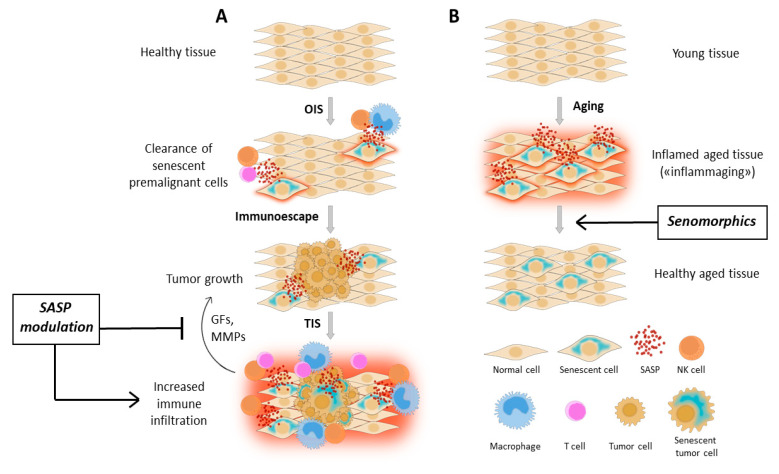
Cellular senescence represents a robust tumor-protecting mechanism that halts the proliferation of stressed or premalignant cells. However, this state of stable proliferative arrest is accompanied by the Senescence-Associated Secretory Phenotype (SASP), which entails the copious secretion of proinflammatory signals in the tissue microenvironment and contributes to age-related conditions, including, paradoxically, cancer. Novel therapeutic strategies aim at eliminating senescent cells with the use of senolytics or abolishing the SASP without killing the senescent cell with the use of the so-called “senomorphics”. In addition, recent works demonstrate the possibility of modifying the composition of the secretome by genetic or pharmacological intervention. The purpose is not to renounce the potent immunostimulatory nature of SASP, but rather learning to modulate it for combating cancer and other age-related diseases. This review describes the main molecular mechanisms regulating the SASP and reports the evidence of the feasibility of abrogating or modulating the SASP, discussing the possible implications of both strategies.
Overview
The claims and statistics of this paper haven’t been checked yet.
Free: it reads the open-access text and checks the first 5 claims that cite a source we can check. Create a free account to check every claim.
Integrity signals
Registry
Cites
Statistics
Figures
Verification
Claims the paper makes
The claims and statistics of this paper haven’t been checked yet.
Free: it reads the open-access text and checks the first 5 claims that cite a source we can check. Create a free account to check every claim.
Claims other papers make about this one
Each is checked against this paper’s own text: does it say what the citing paper says it does?
The cited source says what the claim attributes to it.
In the citing paper
“Senescent cells contribute to aging and age-related pathologies21,22,23 through their senescence-associated secretory phenotype (SASP).24,25,26”
From Uncovering the signatures of aging and senescence in the human dorsolateral prefrontal cortex (2026) · cites this paper as [25]
The cited source says what the claim attributes to it.
In the citing paper
“The SASP is composed of pro-inflammatory cytokines, chemokines, exosomes, growth factors, and extracellular matrix-degrading proteins that are released into the surrounding tissue environment following the induction of growth arrest.24,25,26,27,28,29”
From Uncovering the signatures of aging and senescence in the human dorsolateral prefrontal cortex (2026) · cites this paper as [25]
The check wasn’t confident either way, so it gives no verdict — never disputed.
In the citing paper
“we generated a gene set (SenMayo) consisting of 125 previously identified senescence/SASP-associated factors”
From A new gene set identifies senescent cells and predicts senescence-associated pathways across tissues (2022) · cites this paper as [63]
Experimental — accuracy not yet measured
Self-check
Percentages, sums and reported differences re-computed from the paper’s own numbers.
The self-check needs the paper’s full text.
Citations
Cites
The senescence-associated secretory phenotype: the dark side of tumor suppression
Coppé, J.-P., Desprez, P.-Y., Krtolica, A., & Campisi, J. (2010) · Annual Review of Pathology: Mechanisms of Disease · doi:10.1146/annurev-pathol-121808-102144 · Cited by 5,206
Clearance of p16Ink4a-positive senescent cells delays ageing-associated disorders
Baker, D. J., Wijshake, T., Tchkonia, T., LeBrasseur, N. K., Childs, B. G., van de Sluis, B., Kirkland, J. L., & van Deursen, J. M. (2011) · Nature · doi:10.1038/nature10600 · Cited by 3,670
Cellular Senescence: Defining a Path Forward
Gorgoulis, V., Adams, P. D., Alimonti, A., Bennett, D. C., Bischof, O., Bishop, C., Campisi, J., Collado, M., Evangelou, K., Ferbeyre, G., et al. (2019) · Cell · doi:10.1016/j.cell.2019.10.005 · Cited by 3,225
The Achilles' heel of senescent cells: from transcriptome to senolytic drugs
Zhu, Y., Tchkonia, T., Pirtskhalava, T., Gower, A. C., Ding, H., Giorgadze, N., Palmer, A. K., Ikeno, Y., Hubbard, G. B., Lenburg, M., et al. (2015) · Aging Cell · doi:10.1111/acel.12344 · Cited by 2,584
Senescence and tumour clearance is triggered by p53 restoration in murine liver carcinomas
Xue, W., Zender, L., Miething, C., Dickins, R. A., Hernando, E., Krizhanovsky, V., Cordon-Cardo, C., & Lowe, S. W. (2007) · Nature · doi:10.1038/nature05529 · Cited by 2,473
Persistent DNA damage signalling triggers senescence-associated inflammatory cytokine secretion
Rodier, F., Coppé, J.-P., Patil, C. K., Hoeijmakers, W. A. M., Muñoz, D. P., Raza, S. R., Freund, A., Campeau, E., Davalos, A. R., & Campisi, J. (2009) · Nature Cell Biology · doi:10.1038/ncb1909 · Cited by 2,232
Oncogene-Induced Senescence Relayed by an Interleukin-Dependent Inflammatory Network
Kuilman, T., Michaloglou, C., Vredeveld, L. C. W., Douma, S., van Doorn, R., Desmet, C. J., Aarden, L. A., Mooi, W. J., & Peeper, D. S. (2008) · Cell · doi:10.1016/j.cell.2008.03.039 · Cited by 2,086
An Essential Role for Senescent Cells in Optimal Wound Healing through Secretion of PDGF-AA
Demaria, M., Ohtani, N., Youssef, S. A., Rodier, F., Toussaint, W., Mitchell, J. R., Laberge, R.-M., Vijg, J., Van Steeg, H., Dollé, M. E. T., et al. (2014) · Developmental Cell · doi:10.1016/j.devcel.2014.11.012 · Cited by 2,045
Clearance of senescent cells by ABT263 rejuvenates aged hematopoietic stem cells in mice
Chang, J., Wang, Y., Shao, L., Laberge, R.-M., Demaria, M., Campisi, J., Janakiraman, K., Sharpless, N. E., Ding, S., Feng, W., et al. (2016) · Nature Medicine · doi:10.1038/nm.4010 · Cited by 1,819
Chemokine signaling via the CXCR2 receptor reinforces senescence
Acosta, J. C., O'Loghlen, A., Banito, A., Guijarro, M. V., Augert, A., Raguz, S., Fumagalli, M., Da Costa, M., Brown, C., Popov, N., et al. (2008) · Cell · doi:10.1016/j.cell.2008.03.038 · Cited by 1,801
Cited by
Items 101–200 of 308
He, J., Li, J., Li, Y., Xu, Z., Ma, M., Chen, H., Chen, P., Lv, L., Shang, X., & Liu, G. (2024) · Aging · doi:10.18632/aging.205538 · Cited by 22
Venkataraman, A., Kordic, I., Li, J., Zhang, N. Y., Bharadwaj, N. S., Fang, Z., Das, S., & Coskun, A. F. (2024) · npj Aging · doi:10.1038/s41514-024-00178-w · Cited by 23
Rehman, A., Satyam, S. M., El‐Tanani, M., Prabhakar, S., KUMARI, R. R., Shetty, P., Mohammed, S. S. N., Nafees, Z., & Alomar, B. (2025) · Cancers · doi:10.3390/cancers17152466 · Cited by 22
“Additionally, metformin significantly attenuates the release of senescence-associated secretory phenotype (SASP) factors, reducing IL-6 levels by 58% and MMP-3 by 64%, thereby mitigating the pro-inflammatory environment associated with aging [61,98,99].”
Han, Q., Li, H., Zhao, F., Gao, J., Liu, X., & Ma, B. (2023) · Nutrients · doi:10.3390/nu15173731 · Cited by 21
“However, there was a certain degree of overlap in various SASP factors, and specific proteins were almost always found, such as IL-8, IL-6, IL-1, and so on [23].”
BackgroundPapadakos, S. P., Arvanitakis, K., Stergiou, I. Ε., Vallilas, C., Sougioultzis, S., Germanidis, G. S., & Theocharis, S. E. (2023) · Pharmaceutics · doi:10.3390/pharmaceutics15102460 · Cited by 21
“Additionally, autophagy has been shown to regulate the senescence-associated secretory phenotype (SASP), which is a pro-inflammatory response that contributes to age-related diseases [66].”
BackgroundPolyploidy and mTOR signaling: a possible molecular link
Choudhury, D., Ghosh, D., Mondal, M., Singha, D., Pothuraju, R., & Malakar, P. (2024) · Cell Communication and Signaling · doi:10.1186/s12964-024-01526-9 · Cited by 23
Zhang, J., Guan, X., & Zhong, X. (2024) · Seminars in Cancer Biology · doi:10.1016/j.semcancer.2024.10.006 · Cited by 26
Targeting cellular senescence to combat cancer and ageing
Wang, C., Hao, X., & Zhang, R. (2022) · Molecular Oncology · doi:10.1002/1878-0261.13266 · Cited by 21
Sato, K., Iwasaki, S., & Yoshino, H. (2021) · International Journal of Molecular Sciences · doi:10.3390/ijms222413233 · Cited by 19
“Senolytic agents are drugs that can selectively eliminate senescent cells, and are expected to treat age-related diseases and undesirable effects induced by senescent cells [10].”
BackgroundFarag, N. H., Alsaggaf, Z. H., Bamardouf, N. O., Khesfaty, D., Fatani, M. M., Alghamdi, M. K., & Saharti, S. N. (2022) · Cureus · doi:10.7759/cureus.33092 · Cited by 20
“Paradoxically, SASP can contribute to the development of age-related diseases such as cancer due to the immunosuppressive environment that it creates [26].”
BackgroundHrncir, H. R., Hantelys, F., & Gracz, A. D. (2023) · American Journal Of Pathology · doi:10.1016/j.ajpath.2023.02.012 · Cited by 21
“126 e 128,140,141 Following liver injury, reactive oxygen species and DNA damage promote TGF-b signaling, which can induce SASPs.”
Ding, F., Yu, Y., Zhao, J., Wei, S., Zhang, Y., Han, J. H., Li, Z., Jiang, H., Ryu, D., Cho, M., et al. (2025) · Frontiers in Cell and Developmental Biology · doi:10.3389/fcell.2025.1593096 · Cited by 19
“…(including IL-6, IL-8, and growth factors) boosted reprogramming efficiency and tissue repair, but prolonged SASP exposure had the opposite effect–prolonged senescence was sensed as aberrant, activating barriers that blocked excessive cell plasticity (Rhinn et al., 2019; Cuollo et al., 2020).”
Luo, Y., Liu, H., Fu, H. Y., Ding, G., & Teng, F. (2022) · Frontiers in Immunology · doi:10.3389/fimmu.2022.974377 · Cited by 19
Cellular senescence in the tumor with a bone niche microenvironment: friend or foe?
Alavimanesh, S., Jazi, N. N., Choubani, M., Saeidi, F., Afkhami, H., Yarahmadi, A., Ronaghi, H., Khani, P., & Modarressi, M. H. (2025) · Clinical and Experimental Medicine · doi:10.1007/s10238-025-01564-8 · Cited by 19
“Furthermore, SASPs contribute to age-related pathologies like osteoarthritis, atherosclerosis, and neurodegenerative diseases, indirectly promoting cancer by fostering a systemic environment favorable to tumor development [12, 13].”
Aging and oral squamous cell carcinoma development: the role of cellular senescence
Niklander, S. E., Aránguiz, P., Faunes, F., & Flores, R. (2023) · Frontiers in Oral Health · doi:10.3389/froh.2023.1285276 · Cited by 20
Innovative immunotherapies and emerging treatments in type 1 diabetes management
Zarei, M., Sheikholeslami, M. A., Mozaffari, M., & Mortada, Y. (2024) · Diabetes Epidemiology and Management · doi:10.1016/j.deman.2024.100247 · Cited by 23
Senescent macrophages in tumor: phenotypes, roles, and interventions
Shen, W., Huang, Y., Yang, X., Zhang, Y., Pan, Y., Xiao, Y., Wang, J., Wang, C., Mao, W., & Zhao, A. (2025) · Cell Death and Disease · doi:10.1038/s41419-025-08000-5 · Cited by 17
“The collection of cytokines (IL-1a, IL-6), chemokines (CXCL12), growth factors (FGF, VEGF), matrix metalloproteinases (MMPs), and regulatory factors like TGF-β are collectively known as SASP [2, 58 – 60].”
Han, Y., Micklem, G., & Kim, S. Y. (2023) · Ageing Research Reviews · doi:10.1016/j.arr.2023.101849 · Cited by 19
“Alterations to the surrounding milieu through the senescence associated secretory phenotype (SASP) is a key characteristic that is essential in reinforcing senescence (Ohtani, 2022) and when prolonged, can contribute to cancer development (Cuollo et al., 2020; Park et al., 2021).”
BackgroundCellular senescence in cancer: Friend or fraud?
Chen, Q., Liu, J., Wu, J., Xiang, X., Zhou, X., Mi, J., Wei, J., Zou, X., & Wu, A. (2026) · Drug Resistance Updates · doi:10.1016/j.drup.2026.101363 · Cited by 20
Fraile‐Μartinez, O., León-Oliva, D. D., Boaru, D. L., Castro-Martinez, P. D., Montero, C. G., Barrena-Blázquez, S., García-García, J., García‐Honduvilla, N., Álvarez‐Mon, M., López-González, L., et al. (2024) · Frontiers in Genetics · doi:10.3389/fgene.2024.1345459 · Cited by 17
“Mechanisms such as the NF-κ B, C/EBPbd GATA4, mTOR, p38 MAPK, and cGAS-STING pathways and cytoplasmic chromatin fragments contribute to SASP activation (Salminen et al., 2012; Kang et al., 2015; Cuollo et al., 2020; Miller et al., 2021).”
BackgroundCommon features between aging and cancer: a narrative review
Abubakar, M., Hameed, Y., Kiani, M. N., & Aftab, A. (2024) · Aging advances. · doi:10.4103/agingadv.agingadv-d-24-00023 · Cited by 17
Khan, A., Alzahrani, H. A., Felemban, S. G., Algarni, A. S., Alenezi, A. B. S., Kamal, M., Rehman, Z. U., Asdaq, S. M. B., Ahmed, N., Alharbi, B., et al. (2025) · Biogerontology · doi:10.1007/s10522-025-10226-x · Cited by 16
“Given that the prostate is an aging organ that is very vulnerable to such a pro-inflammatory state, it can be a reason why BPH is a prevalent condition, which legiti-mizes the importance of SASP research in the context of BPH (Cuollo et al. 2020b).”
MicroRNAs-associated with FOXO3 in cellular senescence and other stress responses
Khor, Y.-S., & Wong, P. (2023) · Biogerontology · doi:10.1007/s10522-023-10059-6 · Cited by 16
“1) can cause tissue dysfunction by inducing chronic inflammation through the persistent production of pro-inflammatory cytokines, proteases, growth factors and immune modulators (Cuollo et al. 2020).”
Kasprzyk-Pawelec, A., Tan, M., Rahhal, R., McIntosh, A. T., Fernandez, H. R., Mosaoa, R., Jiang, L., Pearson, G. W., Glasgow, E. F., Vockley, J., et al. (2024) · Cell Death and Differentiation · doi:10.1038/s41418-024-01428-w · Cited by 18
Senile Osteoarthritis Regulated by the Gut Microbiota: From Mechanisms to Treatments
Yu, F., Zhu, C., & Wu, W. (2025) · International Journal of Molecular Sciences · doi:10.3390/ijms26041505 · Cited by 17
“The SASP is an umbrella term for pro-inflammatory cytokines, chemokines, and matrix metalloproteinases involved in the destruction of joint tissues and is activated in conjunction with the dynamic build-up of the aging process [57,58].”
Tackling cellular senescence by targeting miRNAs
Wang, Z., Gao, J., & Xu, C. (2022) · Biogerontology · doi:10.1007/s10522-022-09972-z · Cited by 16
“The SASP includes proinflammatory cytokines (such as IL-6 and IL-8), chemokines (such as MCPs and MIPs), growth factors (such as TGF-β and GM-CSF) and proteases (Ovadya and Krizhanovsk 2014) The different biological activities induced by the SASP are closely related to the microenvironment in which these cells are loc…”
BackgroundThe positive regulatory loop of TCF4N/p65 promotes glioblastoma tumourigenesis and chemosensitivity
Hu, Y., Zhang, B., Lu, P., Wang, J., Chen, C. Y., Yin, Y., Wan, Q., Wang, J., Jiao, J., Fang, X., et al. (2022) · Clinical and Translational Medicine · doi:10.1002/ctm2.1042 · Cited by 14
Cellular Senescence in Liver Cancer: How Dying Cells Become “Zombie” Enemies
Gazzillo, A., Volponi, C., Soldani, C., Polidoro, M. A., Franceschini, B., Lleò, A., Bonavita, E., & Donadon, M. (2023) · Biomedicines · doi:10.3390/biomedicines12010026 · Cited by 15
Braga, C. E. H. V. P. F., de Brito, J. S., Ribeiro, M. M., Coutinho‐Wolino, K. S., Regis, B., Calixto, B., Rodrigues, R. C. B., Wang, A. Y.-M., Stenvinkel, P., & Mafra, D. (2025) · Biochimie · doi:10.1016/j.biochi.2025.10.008 · Cited by 19
McGrath, M. K., Abolhassani, A., Guy, L., Elshazly, A. M., Barrett, J. T., Mivechi, N. F., Gewirtz, D. A., & Schoenlein, P. V. (2024) · Frontiers in Endocrinology · doi:10.3389/fendo.2024.1298423 · Cited by 15
“During senescence-mediated growth arrest, tumor cells can secrete a wide range of cytokines, chemokines, growth factors, and matrix remodeling factors, known collectively as senescence-associated secretory phenotype or SASP factors (134).”
BackgroundAging, Age-Related Diseases, and the Zebrafish Model
Abou-Dahech, M. S., & Williams, F. E. (2024) · Journal of dementia and Alzheimer's disease · doi:10.3390/jdad1010004 · Cited by 13
Tumor-Associated Senescent Macrophages, Their Markers, and Their Role in Tumor Microenvironment
Pukhalskaia, T. V., Yurakova, T. R., Bogdanova, D. A., & Demidov, O. N. (2024) · Biochemistry (Moscow) · doi:10.1134/s0006297924050055 · Cited by 15
“Moreover, the heterogeneity of the mechanisms and pleiotropy of the senescence mediators in tumor diseases is further complicated by the genetic diversity of human tumors and complex interactions between the tumor cells and cells in their microenvironment during oncogenesis [30].”
BackgroundRaman Spectroscopy in Cellular and Tissue Aging Research
Kim, J. H., Yang, D., & Park, S. (2025) · Aging Cell · doi:10.1111/acel.14494 · Cited by 14
“Senescent cells, a subset of aging cells, are known to secrete pathological molecules, senescence-associated secretory phenotypes (SASPs) (Cuollo et al. 2020), and display increased lysosomal content (Tan and Finkel 2023) and senescence-associated heterochromatin foci (SAHFs) (Aird and Zhang 2013).”
Rewinding the Clock: Emerging Pharmacological Strategies for Human Anti-Aging Therapy
Delrue, C., Speeckaert, R., & Speeckaert, M. M. (2025) · International Journal of Molecular Sciences · doi:10.3390/ijms26199372 · Cited by 14
“…eliminate senescent cells, senomorphics suppress or reprogram the SASP without inducing cell death, thereby mitigating deleterious paracrine effects while preserving the beneficial, context-dependent functions of senescent cells, such as tissue repair, wound healing, and tumor suppression [68].”
Alam, M. T., Mansoor, M. A. M., Ashiqueali, S., Golusiński, P., Golusińska-Kardach, E., Strzelczyk, J. K., Rubiś, B., Golusiński, W., & Masternak, M. M. (2025) · Cancers · doi:10.3390/cancers17244024 · Cited by 17
“In addition, the SASP’s dynamic character, which varies over time and in response to therapy, adds another layer of intricacy [119,120].”
Mao, Y., Xu, J., Xu, X., Qiu, J., Hu, Z., Jiang, F., & Zhou, G. (2022) · Frontiers in Pharmacology · doi:10.3389/fphar.2022.987398 · Cited by 12
Liang, X., Lin, X., Lin, Z., Lin, W., Peng, Z., & Wei, S. (2023) · Computers in Biology and Medicine · doi:10.1016/j.compbiomed.2023.106850 · Cited by 13
An, T., Zhang, X., Gao, X., Zhang, X., Shen, T., Li, H., Dou, L., Huang, X., Man, Y., Li, G., et al. (2023) · Journal of Bioenergetics and Biomembranes · doi:10.1007/s10863-023-09965-8 · Cited by 12
Senescent Cells: Dual Implications on the Retinal Vascular System
Habibi-Kavashkohie, M. R., Scorza, T., & Oubaha, M. (2023) · Cells · doi:10.3390/cells12192341 · Cited by 13
“Reduced expression of SASP genes following depletion of DDR components such as ATM, NBS1, or CHK2 supports the importance of DDR activation for robust SASP production [60].”
BackgroundBarrera-Vázquez, O. S., Montenegro-Herrera, S. A., Martínez-Enríquez, M. E., Escobar-Ramírez, J. L., & Magos-Guerrero, G. A. (2023) · Biomolecules · doi:10.3390/biom13111673 · Cited by 14
“The para-senescence process, which is triggered by secretory phenotypes linked to senescence (SASPs), leads to the generation of persistent inflammation [7].”
BackgroundThe role of DNA damage in neural stem cells ageing
Zhong, Y., Wang, G., Yang, S., Zhang, Y., & Wang, X. (2024) · Journal of Cellular Physiology · doi:10.1002/jcp.31187 · Cited by 13
Chen, Z. Y., Liu, C., Ye, T., Zhang, Y., & Chen, Y. (2023) · Epigenomics · doi:10.2217/epi-2023-0150 · Cited by 11
Peng, X., Liu, N., Zeng, B., Bai, Y., Xu, Y., Chen, Y., Chen, L., & Xia, L. (2024) · Frontiers in Bioengineering and Biotechnology · doi:10.3389/fbioe.2024.1450626 · Cited by 11
“This particular secretory state, known as the SASP, mediates many of the cell ’ s physiological and pathological effects (Cuollo et al., 2020).”
BackgroundPalbociclib-Induced Cellular Senescence Is Modulated by the mTOR Complex 1 and Autophagy
Cayo, Á., Venturini, W., Rebolledo-Mira, D., Moore‐Carrasco, R., Herrada, A. A., Nova‐Lamperti, E., Valenzuela, C. A., & Brown, N. E. (2023) · International Journal of Molecular Sciences · doi:10.3390/ijms24119284 · Cited by 14
“Thus, the post-therapy persistence of senescence cells, with their SASP-mediated paracrine actions, could lead, paradoxically, to cancer recurrence or accelerated tumor growth [24,100–102].”
BackgroundTatar, C., Avcı, Ç. B., Açıkgöz, E., & Öktem, G. (2023) · Biochemical and Biophysical Research Communications · doi:10.1016/j.bbrc.2023.09.032 · Cited by 13
Alexa‐Stratulat, T., Tanasa, M. P., Cianga, V. A., & Antoniu, S. A. (2022) · Expert Review of Anticancer Therapy · doi:10.1080/14737140.2022.2139242 · Cited by 13
“factors (C/EBPβ, STATs) and further translated in an mTORdependent manner [43,44].”
BackgroundH2S contributed from CSE during cellular senescence suppresses inflammation and nitrosative stress
Gupta, K., Mathew, A. B., Chakrapani, H., & Saini, D. K. (2022) · Biochimica et Biophysica Acta (BBA) - Molecular Cell Research · doi:10.1016/j.bbamcr.2022.119388 · Cited by 11
Transcriptome-Based Traits of Radioresistant Sublines of Non-Small Cell Lung Cancer Cells
Pustovalova, M. V., Malakhov, P., Guryanova, A., Sorokin, M., Suntsova, M., Buzdin, A. A., Osipov, A. N., & Leonov, S. V. (2023) · International Journal of Molecular Sciences · doi:10.3390/ijms24033042 · Cited by 14
“Interleukins as secretory proteins are involved in SASP-related radioresistance [50].”
BackgroundSigns of Alzheimer’s Disease: Tied to Aging
Chen, J., Zhu, Z., & Xu, Y. (2025) · International Journal of Molecular Sciences · doi:10.3390/ijms26114974 · Cited by 12
Tkachenko, A. S., Havránek, O., Lang, F. J. W., Lang, K. S., & Wieder, T. (2025) · GeroScience · doi:10.1007/s11357-025-02010-z · Cited by 12
Solomon, J., Mandal, S., & Aran, K. R. (2026) · Gene · doi:10.1016/j.gene.2026.150000 · Cited by 10
Saemann, L., Naujoks, P., Hartrumpf, L., Pohl, S., Simm, A., & Szabo, G. B. (2023) · International Journal of Molecular Sciences · doi:10.3390/ijms241411727 · Cited by 12
Senescent cells in systemic aging: SASP heterogeneity, immune escape, and endocrine modulation
Qoura, L. A., Churov, A. V., Maltseva, O. N., Ерусланова, К. А., & Zeng, G. (2026) · Biogerontology · doi:10.1007/s10522-026-10449-6 · Cited by 12
“The SASP environment notably disrupts communication between granulosa cells and the oocyte, hindering the essential metabolic and structural support necessary for oocyte maturation (Cuollo et al. 2020).”
Zheng, S., Lin, N., Wu, Q., He, H., & Yang, C. (2023) · Frontiers in Surgery · doi:10.3389/fsurg.2023.1090700 · Cited by 9
“SASP mediates chronic inflammation and stimulates the growth of cancer, while SASP also enhances cell cycle arrest, prompting immune cells to defend cancer (28, 29).”
BackgroundSenescent cell-derived vaccines: a new concept towards an immune response against cancer and aging?
Pessoa, J., Pereira, S. N., & de Jesus, B. B. (2024) · Aging · doi:10.18632/aging.205975 · Cited by 10
Pan, Q., Ye, Z., Ye, Z., Zhang, H., Wang, J., Yi, G., Li, Z., Xu, R., Wang, L., Wu, Z., et al. (2025) · BMEMat · doi:10.1002/bmm2.12137 · Cited by 11
Alhaddad, L., Nofal, Z., Pustovalova, M. V., Osipov, A. N., & Leonov, S. V. (2023) · International Journal of Molecular Sciences · doi:10.3390/ijms24032002 · Cited by 10
“However, this state of stable proliferative arrest is accompanied by the Senescence-Associated Secretory Phenotype (SASP), which entails the abundant secretion of pro-inflammatory molecules in the tissue microenvironment and contributes to age-related diseases, including GBM [22].”
BackgroundKhan, G. H., Veltkamp, F., Scheper, M., Hoebe, R. A., Claessen, N., Butter, L. M., Bouts, A. H. M., Florquin, S., & Guikema, J. E. J. (2023) · European Journal of Immunology · doi:10.1002/eji.202350562 · Cited by 10
“While these characteristics align with our data, we did not see an increase of cytokines that are typically associated with the senescence-associated secretory phenotype, such as TNF-α , IL-1 β , and IL-6 [55, 56] (data not shown).”
BackgroundCadmium, Cellular Senescence, and Cancer
Tan, H. W., Seen, D. L. T., Xu, Y., & Lau, A. T. Y. (2023) · Reviews of Environmental Contamination and Toxicology · doi:10.1007/s44169-023-00042-0 · Cited by 13
“Studies have indicated that SASP factors are modulated by extremely complex molecular mechanisms at multiple levels, including transcription, translation, mRNA stability, and secretion (Cuollo et al. 2020).”
BackgroundScieszka, D. P., Hulse, J. P., Gu, H., Barkley‐Levenson, A. M., Barr, E., Garcia, M. A., Begay, J., Herbert, G., McCormick, M. A., Brigman, J. L., et al. (2025) · Particle and Fibre Toxicology · doi:10.1186/s12989-025-00639-4 · Cited by 9
“Senescence is a pro-inflammatory state of cell cycle arrest that has been proposed as a root cause of aging [20–23], resulting in systemic inflammation through the release of senescence-associated secretory phenotype molecules into the circulation [24].”
Wei, J., Cui, F., Huang, Z., Li, Z., Mao, Z., & Zhang, P. (2025) · Frontiers in Aging · doi:10.3389/fragi.2025.1684450 · Cited by 9
“…usually increases with aging, and it exhibits strong associations with the development of multiple age-related disorders, encompassing cardiovascular diseases (Ferroni et al., 2003), diabetes (Pradhan et al., 2001), and cancer (Cuollo et al., 2020; Ortiz-Montero et al., 2017; Faget et al., 2019).”
Integrating Senescence and Oxidative Stress in Cardiac Disease
Yun, H. R., Singh, M. K., Han, S., Ranbhise, J. S., Ha, J., Kim, S. S., & Kang, I. (2025) · International Journal of Molecular Sciences · doi:10.3390/ijms262411917 · Cited by 8
“Moreover, mitochondria in the senescent cells typically exhibit decreased mitochondrial respiratory capacity and membrane potential ( ∆Ψ m), accompanied by increased ROS production [113,116].”
Liu, X., Bin, C., Gao, Q., Li, M., Xue, L., Zhou, Z., Liu, M., Ji, X., & Wei, S. (2026) · Biomarker Research · doi:10.1186/s40364-026-00914-2 · Cited by 10
“The convergence of shortened telomeres and unrepaired DNA lesions triggers the senescence-associated secretory phenotype (SASP), through which granulosa cells secrete inflammatory cytokines (IL6, IL8, TNF-α), matrix metalloproteinases (MMP1, MMP3), and growth factors (VEGF, FGF2) [185, 200–204].”
TEAD4 antagonizes cellular senescence by remodeling chromatin accessibility at enhancer regions
Zhang, D., Zhu, Y., Ju, Y., Zhang, H., Zou, X., She, S., Zhu, D., & Guan, Y. (2023) · Cellular and Molecular Life Sciences · doi:10.1007/s00018-023-04980-9 · Cited by 8
“Notably, the senescence-associated secretory phenotype (SASP) has become the most fundamental feature of cellular senescence, representing a substantial supply of secretory signals to the extra-and intracellular microenvironments for the initiation of inflammation and tissue-remodeling [7, 8].”
BackgroundKällberg, E., Mehmeti, M., Gunnarsdottir, F. B., Göransson, M., Bergenfelz, C., Allaoui, R., Hagerling, C., Johansson, M., Welinder, C., Jirström, K., et al. (2023) · Journal of Leukocyte Biology · doi:10.1093/jleuko/qiad152 · Cited by 8
HOZUMI, C., Iizuka, A., Ikeya, T., Miyata, H., Maeda, C., Ashizawa, T., Nagashima, T., Urakami, K., Shimoda, Y., Ohshima, K., et al. (2023) · Cancer Genomics & Proteomics · doi:10.21873/cgp.20432 · Cited by 8
Targeting ATAD3A Phosphorylation Mediated by TBK1 Ameliorates Senescence‐Associated Pathologies
He, Y., Liu, Y., Zheng, M., Zou, Y., Huang, M., Wang, L., Gao, G., Zhou, Z., & Jin, G. (2024) · Advanced Science · doi:10.1002/advs.202404109 · Cited by 8
Nikita, N., Sun, Z., Sharma, S., Shaver, A. L., Seewaldt, V. L., & Lu-Yao, G. L. (2025) · Cancers · doi:10.3390/cancers17050866 · Cited by 9
“The consequences of chemotherapy on aging-related pathways extend beyond the tumor microenvironment and have broader implications for the overall health and well-being of cancer patients [14].”
Suzuki, K., Kawamura, K., Ujiie, R., Nakayama, T., & Mitsutake, N. (2022) · Mutation Research/Genetic Toxicology and Environmental Mutagenesis · doi:10.1016/j.mrgentox.2022.503448 · Cited by 10
Fei, B., Wang, H., Ding, Y., Shao, N., Wen, P., Cao, Y., Li, J., Tanaka, M., Wang, Z., & Li, S. (2025) · Materials Today Bio · doi:10.1016/j.mtbio.2025.101996 · Cited by 11
Sutanto, H., Ahkami, A., Fetarayani, D., & Romadhon, P. Z. (2025) · Journal of the Egyptian National Cancer Institute · doi:10.1186/s43046-025-00333-8 · Cited by 10
“This secretory profile is largely regulated by transcription factors NF-κB and C/EBPβ, which are activated in part by persistent DDR and stress signaling even in the absence of extensive DNA damage [5, 18, 19].”
Zhi, Y., Xie, S., & Sun, Y. (2026) · Frontiers in Nutrition · doi:10.3389/fnut.2025.1680349 · Cited by 8
“Persistent accumulation of these cells impairs tissue regeneration, disrupts normal intercellular signaling, and contributes to chronic inflammation (45, 46).”
Jiang, H., & Xu, B. (2026) · Critical Reviews in Oncology/Hematology · doi:10.1016/j.critrevonc.2026.105189 · Cited by 9
Zhu, R., Zhang, L., Zhang, H., & Hu, Z. (2024) · Cellular Signalling · doi:10.1016/j.cellsig.2024.111127 · Cited by 7
Elocalcitol mitigates high-fat diet-induced microglial senescence via miR-146a modulation
Chithanathan, K., Jürgenson, M., Ducena, K., Remm, A., Kask, K., Rebane, A., Li, T., & Zharkovsky, A. (2024) · Immunity & Ageing · doi:10.1186/s12979-024-00485-6 · Cited by 7
“The pro-inflammatory components of SASP contribute to chronic, systemic, low-grade inflammation, called “inflammaging,” which is one of the main risk factors for the development age related diseases [34–36].”
Rajabinasab, F., Tabatabaei, F. S. A., Kheirandish, A., Hajimirzaei, P., Abolfazli, S., Aromolaran, A. S., Jamialahmadi, T., & Sahebkar, A. (2025) · Ageing Research Reviews · doi:10.1016/j.arr.2025.102801 · Cited by 182
Hsu, W., Noda, M., Yoshioka, T., & Ito, E. (2021) · Exploration of Targeted Anti-tumor Therapy · doi:10.37349/etat.2021.00053 · Cited by 9
“00053 Page 3 inflammation response (SIR) and senescence-associated secretory phenotype (SASP) activation, leading to genomic instability and cancer progression [23].”
BackgroundOdeh, A., Eddini, H., Shawasha, L., Chaban, A., Avivi, A., Shams, I., & Manov, I. (2023) · International Journal of Molecular Sciences · doi:10.3390/ijms24065132 · Cited by 7
“Unlike senolytics, the senomorphic strategy is designed to suppress SASP while maintaining cell cycle cessation in tumor cells [reviewed in [26]].”
MethodThe Yin and Yang of IκB Kinases in Cancer
Abdrabou, A. M. (2023) · Kinases and Phosphatases · doi:10.3390/kinasesphosphatases2010002 · Cited by 7
“These immune cells play pivotal roles in orchestrating immune responses against cancer.”
BackgroundNyáry, D., Fekete, M., Ceglédi, A., Fazekas‐Pongor, V., Lipécz, Á., Csípő, T., Major, D., Péterfi, A., Csík, B., Zábó, V., et al. (2026) · Nutrients · doi:10.3390/nu18121920 · Cited by 7
“Senescent cells acquire a characteristic senescence-associated secretory phenotype (SASP), characterized by the sustained release of pro-inflammatory cytokines, chemokines, growth factors, and matrix-remodeling enzymes [14].”
Cavagnino, A., Azadiguian, G., Breton, L., Baraibar, M. A., & Black, A. F. (2025) · Current Issues in Molecular Biology · doi:10.3390/cimb47120971 · Cited by 6
“Environmental stressors such as UVA, PM10, and PAHs accelerate oxidative damage, upregulate MMP1, and trigger pro-inflammatory cytokines like IL-1 α [40–46].”
Li, F., & Xue, X. (2023) · Journal of Oncology · doi:10.1155/2023/4615297 · Cited by 6
Human Diseases Induced by Oxidative Damage in DNA
Panda, S., Chatterjee, O., Mukherjee, G., & Chatterjee, S. (2023) · Springer eBooks · doi:10.1007/978-981-19-8520-1_5 · Cited by 6
Wong, L. P., Alias, H., Tan, K. M., Wong, P., Murugan, D. D., Hu, Z., & Lin, Y. (2023) · Frontiers in Pharmacology · doi:10.3389/fphar.2023.1254470 · Cited by 6
Cellular senescence: A potential mode of circular RNAs regulating prostate cancer
Li, Y., Fan, A., Zhang, Y., Guo, Z., Meng, W., Pan, W., Ma, Z., & Chen, W. (2023) · MedComm – Oncology · doi:10.1002/mog2.61 · Cited by 9
Minoxidil Regulates Aging-Like Phenotypes in Rat Cortical Astrocytes In Vitro
Bang, M., Yang, S. J., Ahn, T., Han, S., Shin, C. Y., & Kwon, K. J. (2022) · Biomolecules & Therapeutics · doi:10.4062/biomolther.2022.144 · Cited by 6
“This is consistent with the previous research suggesting the upregulation of immune-related factors such as SASP with aging (Coppe et al., 2010; Davalos et al., 2010; Michaud et al., 2013; Cuollo et al., 2020).”
ResultA New Gene Set Identifies Senescent Cells and Predicts Senescence-Associated Pathways Across Tissues
(2021) · doi:10.21203/rs.3.rs-1034608/v1 · Cited by 6
Expression and prognosis of cellular senescence genes in head and neck squamous cell carcinoma
Feng, C., Mao, W., Xiao, Q., Liu, Y., Yan, M., Dong, P., Liu, Y., & Chen, X. (2025) · Holistic Integrative Oncology · doi:10.1007/s44178-024-00115-7 · Cited by 5
Senescent fibroblasts modulate the radiation response of neighboring epithelial cells
Buchholzki, M., Stasch, L. M., Budeus, B., Ketheeswaranathan, V., Sevindik, Z. F., Jendrossek, V., & Klein, D. (2025) · Cell Death Discovery · doi:10.1038/s41420-025-02796-z · Cited by 6
“One central hallmark of senescent cells is the hyper-secretory phenotype, known as senescence-associated secretory phenotype (SASP), wherein the cells release high levels of pro-in fl ammatory cytokines, growth factors, and other bioactive factors into the surrounding microenvironment [6, 7].”
Oxidative stress biomarkers as predictors of aging and age-related diseases
Kumar, Y., Pant, A., Yadav, S., & Maurya, P. K. (2026) · The Journals of Gerontology Series A · doi:10.1093/gerona/glag056 · Cited by 8
Dietary Polyphenols in Brain Aging: Molecular Mechanisms and Implications for Neurodegeneration
Mózes, N., Varga, J. T., Szwajgier, D., Kryczyk‐Poprawa, A., Zábó, V., Lehoczki, A., Lipécz, Á., Csípő, T., Fazekas‐Pongor, V., Major, D., et al. (2026) · Nutrients · doi:10.3390/nu18091470 · Cited by 6
“A hallmark feature of senescent cells is the senescence-associated secretory phenotype (SASP), characterized by the release of pro-inflammatory cytokines, growth factors, proteases, and other signaling molecules [81,82].”
Senescence-related signatures predict prognosis and response to immunotherapy in colon cancer
Hu, X., Zhu, X., Chen, Y., Zhang, W., Li, L., Liang, H., Байматович, У. Б., Donadon, M., Yusupbekov, A., & Zheng, Y. (2024) · Journal of Gastrointestinal Oncology · doi:10.21037/jgo-24-339 · Cited by 5
“Numerous studies have shown that senescent cells that are not cleared by the immune system promote the senescence-associated secretory phenotype and release cytokines, growth factors, and extracellular matrix components, leading to the aging process and tumor development (13-16) .”
Bibliometric and visual analysis of chronic stress in cancer research from 2014 to 2024
Wei, Z., Li, A., Su, L., Zhang, B., & Yan, Y. (2025) · Discover Oncology · doi:10.1007/s12672-025-01744-8 · Cited by 5
“Various factors contribute to the development of cancer, encompassing genetics [5], environmental influences [6], lifestyle choices [7], infections [8], age-related factors [9], and immune system dysfunctions [10].”
Iswarya, B. R., & John, C. M. (2025) · Molecular Biology Reports · doi:10.1007/s11033-025-10904-6 · Cited by 5
The role of senescence-associated secretory phenotype (SASP) in cellular senescene
Lime, F. V. I. D., & Hardiany, N. S. (2021) · Acta Biochimica Indonesiana · doi:10.32889/actabioina.33 · Cited by 7
“Thus, the transcription factors NF-κB and C/EBP are the primary regulators of SASP expression [19].”
BackgroundInfluentialExtracellular Vesicles and Cellular Ageing
Romero-García, N., Mas‐Bargues, C., Huete-Acevedo, J., & Borrás, C. (2023) · Sub-cellular biochemistry/Subcellular biochemistry · doi:10.1007/978-3-031-21410-3_11 · Cited by 6
Wu, L., Zheng, H., Guo, X., Li, N., Qin, L., Li, X., & Lou, G. (2024) · Heliyon · doi:10.1016/j.heliyon.2024.e34524 · Cited by 6
Kitsugi, K., Noritake, H., Matsumoto, M., Hanaoka, T., Umemura, M., Yamashita, M., Takatori, S., Ito, J., Ohta, K., Chida, T., et al. (2023) · Molecular and Cellular Biochemistry · doi:10.1007/s11010-023-04883-0 · Cited by 6
Progress of immune senescence in multiple myeloma treatment resistance
Jia, Y., Yan, L., Fan, C., Sun, H., Zhou, X., & Shi, Z. (2025) · Discover Oncology · doi:10.1007/s12672-025-02136-8 · Cited by 5
“Furthermore, the SASP phenotype of senescent cells has been identified as an important promoter of tumorigenesis during aging [47].”
Li, Y. H., Liao, X., Yu, X., Xiao, Y., Tao, X., & Zhong, T. (2025) · International Journal of Molecular Sciences · doi:10.3390/ijms26104471 · Cited by 14
“Aging chondrocytes disrupt the cellular redox homeostasis [10] and secrete pro-inflammatory factors, including p16 (p16 inhibitor of CDK4), CDK2 (cyclin-dependent kinase 2), Cyclin D1, IL-6 (Interleukin-6), IL-1 β (Interleukin-1 β ), and TNF-α (Tumor Necrosis Factor-α ) [11,12].”
Metadata
- Authors
- Cuollo, L., Antonangeli, F., Santoni, A., & Soriani, A.
- Affiliations
- Italian Institute of Technology (IT)
- Institute of Molecular Biology and Pathology (IT)
- Istituto Neurologico Mediterraneo (IT)
- Istituto Pasteur (IT)
- Corresponding author
- Soriani, Alessandra
- Venue
- Biology
- Publisher
- MDPI AG
- Published
- 2020-12-21
- Volume
- 9
- Issue
- 12
- Pages
- 485
- ISSN
- 2079-7737 (ISSN-L)
- PMC
- PMC7767554
- OpenAlex
- W3116631834
- Semantic Scholar
- 1c19c85bb4915c05a4f264e6e8fb7a6ba30f4445
- Cited by
- 291
- References
- 116
- Citations by year
- 2026: 41 · 2025: 68 · 2024: 55 · 2023: 65 · 2022: 40 · 2021: 22
- FWCI
- 4.04
- Type
- journal article
- Language
- en
- Open access
- gold
- doi.org
- Licence
- Locations
- Biology (publishedVersion, cc-by)
- PubMed Central (publishedVersion, cc-by)
- PubMed (publishedVersion)
- IRIS Research product catalog (Sapienza University of Rome) (submittedVersion, cc-by)
- DOAJ (DOAJ: Directory of Open Access Journals) (submittedVersion, cc-by-sa)
- Funders
- AIRC 5x1000 (21147)
- Progetto di Ricerca 2019 – Sapienza University of Rome (RP11916B79E083FC.)
- Topics
- Life Sciences › Biochemistry, Genetics and Molecular Biology › Cell Biology › Telomeres, Telomerase, and Senescence
- Life Sciences › Biochemistry, Genetics and Molecular Biology › Aging › Genetics, Aging, and Longevity in Model Organisms
- Health Sciences › Medicine › Geriatrics and Gerontology › Sirtuins and Resveratrol in Medicine
- Keywords
- senescence-associated secretory phenotype, cellular senescence, senolytics, senomorphics, senolytic therapy, senescence-associated secretome, tumor microenvironment, inflammatory cytokines, age-related diseases, cancer therapy
About these checks
Registry, retraction, Cites and statistics results are computed, not judged, with one exception: a printed reference that no index lists is read once by a model before it counts as a citation error. Claims are extracted by a model and kept only when their quote appears verbatim in the text; each cited source is then checked, with a model’s help, for whether it says what the claim relies on. Those verdicts can be wrong — read the claim’s quote and the cited source before relying on one.
Statistics and arithmetic are recomputed, not judged.
Confidence bands are shown only for fields calibrated on our annotated test set. None is calibrated yet, so no band is shown.
What counts as a claim ›How we measure confidence ›How we check this ›
Are you an author, or do you see a problem with this page? Request a review
Data sources
Bibliographic data: Semantic Scholar, OpenAlex, Crossref.
Contains information from the Semantic Scholar Academic Graph Datasets, made available under the ODC Attribution License (ODC-BY 1.0).
Semantic Scholar’s data is described in: Kinney, R., et al. (2023). The Semantic Scholar Open Data Platform. arXiv:2301.10140.
