

The Senescence-Associated Secretory Phenotype (SASP) in the Challenging Future of Cancer Therapy and Age-Related Diseases
Open accessThe DOI matches its Crossref record; 115 of the 116 references it cites were found in a registry or an index.
Abstract
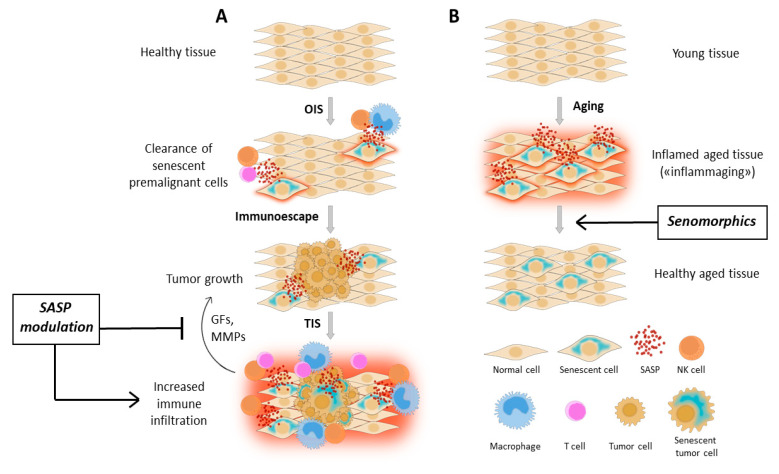
Cellular senescence represents a robust tumor-protecting mechanism that halts the proliferation of stressed or premalignant cells. However, this state of stable proliferative arrest is accompanied by the Senescence-Associated Secretory Phenotype (SASP), which entails the copious secretion of proinflammatory signals in the tissue microenvironment and contributes to age-related conditions, including, paradoxically, cancer. Novel therapeutic strategies aim at eliminating senescent cells with the use of senolytics or abolishing the SASP without killing the senescent cell with the use of the so-called “senomorphics”. In addition, recent works demonstrate the possibility of modifying the composition of the secretome by genetic or pharmacological intervention. The purpose is not to renounce the potent immunostimulatory nature of SASP, but rather learning to modulate it for combating cancer and other age-related diseases. This review describes the main molecular mechanisms regulating the SASP and reports the evidence of the feasibility of abrogating or modulating the SASP, discussing the possible implications of both strategies.
Overview
The claims and statistics of this paper haven’t been checked yet.
Free: it reads the open-access text and checks the first 5 claims that cite a source we can check. Create a free account to check every claim.
Integrity signals
Registry
Cites
Statistics
Figures
Verification
Claims the paper makes
The claims and statistics of this paper haven’t been checked yet.
Free: it reads the open-access text and checks the first 5 claims that cite a source we can check. Create a free account to check every claim.
Claims other papers make about this one
Each is checked against this paper’s own text: does it say what the citing paper says it does?
The cited source says what the claim attributes to it.
In the citing paper
“Senescent cells contribute to aging and age-related pathologies21,22,23 through their senescence-associated secretory phenotype (SASP).24,25,26”
From Uncovering the signatures of aging and senescence in the human dorsolateral prefrontal cortex (2026) · cites this paper as [25]
The cited source says what the claim attributes to it.
In the citing paper
“The SASP is composed of pro-inflammatory cytokines, chemokines, exosomes, growth factors, and extracellular matrix-degrading proteins that are released into the surrounding tissue environment following the induction of growth arrest.24,25,26,27,28,29”
From Uncovering the signatures of aging and senescence in the human dorsolateral prefrontal cortex (2026) · cites this paper as [25]
The check wasn’t confident either way, so it gives no verdict — never disputed.
In the citing paper
“we generated a gene set (SenMayo) consisting of 125 previously identified senescence/SASP-associated factors”
From A new gene set identifies senescent cells and predicts senescence-associated pathways across tissues (2022) · cites this paper as [63]
Experimental — accuracy not yet measured
Self-check
Percentages, sums and reported differences re-computed from the paper’s own numbers.
The self-check needs the paper’s full text.
Citations
Cites
The senescence-associated secretory phenotype: the dark side of tumor suppression
Coppé, J.-P., Desprez, P.-Y., Krtolica, A., & Campisi, J. (2010) · Annual Review of Pathology: Mechanisms of Disease · doi:10.1146/annurev-pathol-121808-102144 · Cited by 5,206
Clearance of p16Ink4a-positive senescent cells delays ageing-associated disorders
Baker, D. J., Wijshake, T., Tchkonia, T., LeBrasseur, N. K., Childs, B. G., van de Sluis, B., Kirkland, J. L., & van Deursen, J. M. (2011) · Nature · doi:10.1038/nature10600 · Cited by 3,670
Cellular Senescence: Defining a Path Forward
Gorgoulis, V., Adams, P. D., Alimonti, A., Bennett, D. C., Bischof, O., Bishop, C., Campisi, J., Collado, M., Evangelou, K., Ferbeyre, G., et al. (2019) · Cell · doi:10.1016/j.cell.2019.10.005 · Cited by 3,225
The Achilles' heel of senescent cells: from transcriptome to senolytic drugs
Zhu, Y., Tchkonia, T., Pirtskhalava, T., Gower, A. C., Ding, H., Giorgadze, N., Palmer, A. K., Ikeno, Y., Hubbard, G. B., Lenburg, M., et al. (2015) · Aging Cell · doi:10.1111/acel.12344 · Cited by 2,584
Senescence and tumour clearance is triggered by p53 restoration in murine liver carcinomas
Xue, W., Zender, L., Miething, C., Dickins, R. A., Hernando, E., Krizhanovsky, V., Cordon-Cardo, C., & Lowe, S. W. (2007) · Nature · doi:10.1038/nature05529 · Cited by 2,473
Persistent DNA damage signalling triggers senescence-associated inflammatory cytokine secretion
Rodier, F., Coppé, J.-P., Patil, C. K., Hoeijmakers, W. A. M., Muñoz, D. P., Raza, S. R., Freund, A., Campeau, E., Davalos, A. R., & Campisi, J. (2009) · Nature Cell Biology · doi:10.1038/ncb1909 · Cited by 2,232
Oncogene-Induced Senescence Relayed by an Interleukin-Dependent Inflammatory Network
Kuilman, T., Michaloglou, C., Vredeveld, L. C. W., Douma, S., van Doorn, R., Desmet, C. J., Aarden, L. A., Mooi, W. J., & Peeper, D. S. (2008) · Cell · doi:10.1016/j.cell.2008.03.039 · Cited by 2,086
An Essential Role for Senescent Cells in Optimal Wound Healing through Secretion of PDGF-AA
Demaria, M., Ohtani, N., Youssef, S. A., Rodier, F., Toussaint, W., Mitchell, J. R., Laberge, R.-M., Vijg, J., Van Steeg, H., Dollé, M. E. T., et al. (2014) · Developmental Cell · doi:10.1016/j.devcel.2014.11.012 · Cited by 2,045
Clearance of senescent cells by ABT263 rejuvenates aged hematopoietic stem cells in mice
Chang, J., Wang, Y., Shao, L., Laberge, R.-M., Demaria, M., Campisi, J., Janakiraman, K., Sharpless, N. E., Ding, S., Feng, W., et al. (2016) · Nature Medicine · doi:10.1038/nm.4010 · Cited by 1,819
Chemokine signaling via the CXCR2 receptor reinforces senescence
Acosta, J. C., O'Loghlen, A., Banito, A., Guijarro, M. V., Augert, A., Raguz, S., Fumagalli, M., Da Costa, M., Brown, C., Popov, N., et al. (2008) · Cell · doi:10.1016/j.cell.2008.03.038 · Cited by 1,801
Cited by
A new gene set identifies senescent cells and predicts senescence-associated pathways across tissues
Saul, D., Kosinsky, R. L., Atkinson, E. J., Doolittle, M. L., Zhang, X., LeBrasseur, N. K., Pignolo, R. J., Robbins, P. D., Niedernhofer, L. J., Ikeno, Y., et al. (2022) · Nature Communications · doi:10.1038/s41467-022-32552-1 · Cited by 1,022
The senescence-associated secretory phenotype and its physiological and pathological implications
Wang, B., Han, J., Elisseeff, J. H., & Demaria, M. (2024) · Nature Reviews Molecular Cell Biology · doi:10.1038/s41580-024-00727-x · Cited by 948
“As discussed above, the SASP includes numerous molecules that promote the migration of immune cells and modulate the phenotype and function of different immune cell subsets 167 .”
Neuroinflammation in Alzheimer’s Disease
Onyango, I. G., Jauregui, G. V., Čarná, M., Bennett, J. P., & Stokin, G. B. (2021) · Biomedicines · doi:10.3390/biomedicines9050524 · Cited by 330
Immunosenescence, aging and successful aging
Wang, Y., Dong, C., Han, Y., Gu, Z., & Sun, C. (2022) · Frontiers in Immunology · doi:10.3389/fimmu.2022.942796 · Cited by 201
“For example, SASP may attract innate and adaptive immune cells near tumor cells and precancerous lesions to resist cancer invasion (15).”
BackgroundThe Cancer SENESCopedia: A delineation of cancer cell senescence
Jochems, F., Thijssen, B., De Conti, G., Jansen, R., Pogacar, Z., Groot, K., Wang, L., Schepers, A., Wang, C., Jin, H., et al. (2021) · Cell Reports · doi:10.1016/j.celrep.2021.109441 · Cited by 201
Advances in Understanding of the Role of Lipid Metabolism in Aging
Chung, K. W. (2021) · Cells · doi:10.3390/cells10040880 · Cited by 182
Cellular Senescence: Molecular Targets, Biomarkers, and Senolytic Drugs
Kudlova, N., De Sanctis, J. B., & Hajduch, M. (2022) · International Journal of Molecular Sciences · doi:10.3390/ijms23084168 · Cited by 171
“Some studies have tracked cytokine secretion associated with the SASP, which is characterized by the extensive secretion of pro-inflammatory compounds [66].”
BackgroundImmunosenescence, Inflammaging, and Frailty: Role of Myeloid Cells in Age-Related Diseases
Bleve, A., Motta, F., Durante, B., Pandolfo, C., Selmi, C., & Sica, A. (2022) · Clinical Reviews in Allergy & Immunology · doi:10.1007/s12016-021-08909-7 · Cited by 153
Microglia regulation of central nervous system myelin health and regeneration
Kent, S. A., & Miron, V. E. (2024) · Nature Reviews Immunology · doi:10.1038/s41577-023-00907-4 · Cited by 183
“Cellular senescence is a state defined by permanent growth arrest, distinct phenotypic alterations and a senescence-associated secretory phenotype (SASP) of various pro-inflammatory cytokines, chemokines, matrix metalloproteinases and growth factors 139,140 .”
Aging of mesenchymal stem cell: machinery, markers, and strategies of fighting
Al-Azab, M., Safi, M., Idiiatullina, E., Al-Shaebi, F., & Zaky, M. Y. (2022) · Cellular & Molecular Biology Letters · doi:10.1186/s11658-022-00366-0 · Cited by 164
Cellular senescence in musculoskeletal homeostasis, diseases, and regeneration
Wan, M., Gray-Gaillard, E. F., & Elisseeff, J. H. (2021) · Bone Research · doi:10.1038/s41413-021-00164-y · Cited by 167
Enomoto, Y., Katsura, H., Fujimura, T., Ogata, A., Baba, S., Yamaoka, A., Kihara, M., Abe, T., Nishimura, O., Kadota, M., et al. (2023) · Nature Communications · doi:10.1038/s41467-023-40617-y · Cited by 132
Alqahtani, S., Alqahtani, T., Venkatesan, K., Sivadasan, D., Ahmed, R., Sirag, N., Elfadil, H., Mohamed, H. A., A, H., Ahmed, R. E., et al. (2025) · Cells · doi:10.3390/cells14080608 · Cited by 112
Zhang, C., Zhong, W., Liu, Y., Duan, J., Jiang, N., Yang, H., Ma, S., Jin, L., Hong, J., Zhou, Y., et al. (2023) · Redox Biology · doi:10.1016/j.redox.2023.102765 · Cited by 104
Effects of Air Pollution on Cellular Senescence and Skin Aging
Martic, I., Jansen-Dürr, P., & Cavinato, M. (2022) · Cells · doi:10.3390/cells11142220 · Cited by 95
“The composition of the SASP is determined by the type of senescence and cell type but the most common cytokines upregulated in cutaneous skin cells during aging are interleukin (IL)-1 and IL-6, as well as the matrix metalloproteases (MMP)-1 and MMP-3 [26,28].”
BackgroundMatar, D. B., Zhra, M., Nassar, W. K., Altemyatt, H., Naureen, A., Abotouk, N., Elahi, M. A., & Aljada, A. (2025) · Frontiers in Endocrinology · doi:10.3389/fendo.2025.1592683 · Cited by 111
“JAK pathway targeting presents therapeutic potential for addressing SASP-mediated in fl ammation and frailty in aging populations (422), driving research into SASP-modulating therapeutic approaches including senolytic and senomorphic compounds (423).”
Colucci, M., Zumerle, S., Bressan, S., Gianfanti, F., Troiani, M., Valdata, A., D’Ambrosio, M., Pasquini, E., Varesi, A., Cogo, F., et al. (2024) · Cancer Cell · doi:10.1016/j.ccell.2024.02.004 · Cited by 93
Spotlight on the Mechanism of Action of Semaglutide
Papakonstantinou, I. P., Tsioufis, K. P., & Katsi, V. K. (2024) · Current Issues in Molecular Biology · doi:10.3390/cimb46120872 · Cited by 102
“In addition, PTBP1 depletion by semaglutide downmodulates the NF-kB pathway and mechanistically can be envisioned to counteract the inflammatory effects of SASP [191].”
Muthamil, S., Kim, H., Jang, H., Lyu, J., Shin, U. C., Go, Y., Park, S., Lee, H. G., & Park, J. H. (2024) · Advanced Biology · doi:10.1002/adbi.202400079 · Cited by 99
The controversial role of senescence-associated secretory phenotype (SASP) in cancer therapy
Cao, L., Li, K., Li, Q., Tong, Q., Wang, Y., & Huang, L. (2025) · Molecular Cancer · doi:10.1186/s12943-025-02475-8 · Cited by 93
“While TIS can lower tumor burden by inhibiting cancer cell proliferation, the consequent buildup of senescent cells and associated SASP can result in treatment failure and disease recurrence [127].”
The senescence journey in cancer immunoediting
Zingoni, A., Antonangeli, F., Sozzani, S., Santoni, A., Cippitelli, M., & Soriani, A. (2024) · Molecular Cancer · doi:10.1186/s12943-024-01973-5 · Cited by 84
“The majority of senomorphics target key SASP regulators including chromatin readers (i.e.: BRD4, MLL1, HMGB2), JAK2/STAT3, cGAS/STING, mTOR, p38MAPK, and NF-kB [12, 177–179].”
BackgroundSelf-citationCellular senescence in Alzheimer’s disease: from physiology to pathology
Zhu, J., Wu, C., & Yang, L. (2024) · Translational Neurodegeneration · doi:10.1186/s40035-024-00447-4 · Cited by 79
Hallmarks and Biomarkers of Skin Senescence: An Updated Review of Skin Senotherapeutics
Bulbiankova, D., Díaz‐Puertas, R., Álvarez‐Martínez, F. J., Herranz‐López, M., Barrajón‐Catalán, E., & Micol, V. (2023) · Antioxidants · doi:10.3390/antiox12020444 · Cited by 75
Senescence: A DNA damage response and its role in aging and Neurodegenerative Diseases
Shreeya, T., Ansari, M. S., Kumar, P., Saifi, M., Shati, A. A., Alfaifi, M. Y., & Elbehairi, S. E. I. (2024) · Frontiers in Aging · doi:10.3389/fragi.2023.1292053 · Cited by 85
The role of cellular senescence in ovarian aging
Hense, J. D., Isola, J. V. V., Garcia, D. N., Magalhães, L. S., Masternak, M. M., Stout, M. B., & Schneider, A. (2024) · npj Aging · doi:10.1038/s41514-024-00157-1 · Cited by 72
Liang, Y., Su, W., & Wang, F. (2023) · Clinical Cosmetic and Investigational Dermatology · doi:10.2147/ccid.s408765 · Cited by 74
Mitochondrial dynamics and metabolism across skin cells: implications for skin homeostasis and aging
Martic, I., Papaccio, F., Bellei, B., & Cavinato, M. S. (2023) · Frontiers in Physiology · doi:10.3389/fphys.2023.1284410 · Cited by 65
Chakrabarty, A., Chakraborty, S., Bhattacharya, R., & Chowdhury, G. (2021) · Frontiers in Oncology · doi:10.3389/fonc.2021.674354 · Cited by 62
“Transcription factors NF-kb and CCAAT enhancer-binding protein b (C/EBPb) are involved in global regulation of SASP constituents (41, 94, 95).”
BackgroundA New Gene Set Identifies Senescent Cells and Predicts Senescence-Associated Pathways Across Tissues
(2021) · doi:10.1101/2021.12.10.472095 · Cited by 58
Asl, M. H., Khelejani, F. P., Mahdavi, S. Z. B., Emrahi, L., Jebelli, A., & Mokhtarzadeh, A. (2022) · Journal of Cellular Biochemistry · doi:10.1002/jcb.30221 · Cited by 61
IFN-γ and TNF Induce Senescence and a Distinct Senescence-Associated Secretory Phenotype in Melanoma
Homann, L., Rentschler, M., Brenner, E., Böhm, K., Röcken, M., & Wieder, T. (2022) · Cells · doi:10.3390/cells11091514 · Cited by 66
Deciphering the mechanisms, biochemistry, physiology, and social habits in the process of aging
Asejeje, F. O., & Ogunro, O. B. (2023) · Archives of Gerontology and Geriatrics Plus · doi:10.1016/j.aggp.2023.100003 · Cited by 72
Vascular Ageing: Mechanisms, Risk Factors, and Treatment Strategies
Ya, J., & Bayraktutan, U. (2023) · International Journal of Molecular Sciences · doi:10.3390/ijms241411538 · Cited by 57
“NF-κB, an important transcription factor, in turn regulates the expression of many genes responsible for both the innate and adaptive immune responses, including those of several pro-inflammatory factors, including IL-6, IL-8, and granulocyte macrophage colony-stimulating factor (GM-CSF), that make up SASP [56].”
BackgroundLong-term cardiovascular complications following sepsis: is senescence the missing link?
Merdji, H., Schini‐Kerth, V. B., Meziani, F., & Toti, F. (2021) · Annals of Intensive Care · doi:10.1186/s13613-021-00937-y · Cited by 66
Senescence-Associated Secretory Phenotype as a Hinge Between Cardiovascular Diseases and Cancer
Banerjee, P., Kotla, S., Velatooru, L. R., Abe, R. J., Olmsted‐Davis, E. A., Cooke, J. P., Schadler, K., Deswal, A. M., Herrmann, J., Lin, S. H., et al. (2021) · Frontiers in Cardiovascular Medicine · doi:10.3389/fcvm.2021.763930 · Cited by 58
“SASP is also induced by various cancer treatments (87).”
BackgroundTheodorakis, N., Feretzakis, G., Tzelves, L., Paxinou, E., Hitas, C., Vamvakou, G., Verykios, V. S., & Nikolaou, M. (2024) · Journal of Personalized Medicine · doi:10.3390/jpm14090931 · Cited by 51
“Furthermore, ML can also model the composition and dynamics of the SASP, providing insights into how these factors contribute to tissue dysfunction and aging [35].”
BackgroundDistinct mechanisms mediating therapy-induced cellular senescence in prostate cancer
Kallenbach, J., Roozbahani, G. A., Horestani, M. H., & Baniahmad, A. (2022) · Cell & Bioscience · doi:10.1186/s13578-022-00941-0 · Cited by 59
“In addition, SASP can induce a systemic pro-inflammation to change and induce an inflammatory process also in the microenvironment [27].”
BackgroundGonzález, L., Sierra‐Cristancho, A., Cafferata, E. A., Melgar‐Rodríguez, S., Rojas, C., Carvajal, P., Cortéz, C., & Vernal, R. (2022) · International Journal of Molecular Sciences · doi:10.3390/ijms23052543 · Cited by 54
“In addition, SASP contributes to the stabilization of the senescent phenotype in the cell that expresses it, in an autocrine manner, and induces senescence in neighboring healthy cells, a phenomenon termed paracrine senescence or bystander effect [10,19,25].”
BackgroundImmune surveillance of senescence: potential application to age-related diseases
Wang, T., & Nakanishi, M. (2024) · Trends in Cell Biology · doi:10.1016/j.tcb.2024.06.007 · Cited by 54
Klepacki, H., Kowalczuk, K., Łepkowska, N., & Hermanowicz, J. M. (2025) · Cells · doi:10.3390/cells14130942 · Cited by 57
“If that signal becomes sustained, it leads to the development of SASP [103].”
Coppola, C., Greco, M., Munir, A., Musarò, D., Quarta, S., Massaro, M., Lionetto, M. G., & Maffia, M. (2024) · Current Issues in Molecular Biology · doi:10.3390/cimb46050251 · Cited by 60
“This gives origin to a senescence-associated secretory phenotype (SASP), resulting in a massive release of proinflammatory cytokines and proteases in the joint space [198].”
Zheng, L., He, S., Wang, H., Li, J., Liu, Y., & Liu, S. (2024) · Aging and Disease · doi:10.14336/ad.2024.0206 · Cited by 83
“A number of SASP factors have been shown to be associated with pro-tumorigenic processes, including chronic inflammation, mitogenic signaling, stemness, angiogenesis, migration, and invasion [86, 87].”
Senescence, NK cells, and cancer: navigating the crossroads of aging and disease
Gergues, M., Bari, R., Koppisetti, S., Gosiewska, A., Kang, L., & HARIRI, R. J. (2025) · Frontiers in Immunology · doi:10.3389/fimmu.2025.1565278 · Cited by 52
Mechanisms of Hydroxyurea‐Induced Cellular Senescence: An Oxidative Stress Connection?
Kapor, S., Čokić, V. P., & Santibanez, J. F. (2021) · Oxidative Medicine and Cellular Longevity · doi:10.1155/2021/7753857 · Cited by 54
“The SASP encompasses a plethora of cytokines, growth factors, and proteases such as interleukin- (IL-) 1, IL-6, IL-8, growth-regulated oncogene (GRO) α/β, granulocyte-macrophage colonystimulating factor (GM-CSF), insulin-like growth factor binding proteins (IGFBPs), matrix metalloproteinases(MMP-) 1, MMP-3, and MMP-10…”
BackgroundLin, W., Wang, X., Wang, Z., Shao, F., Yang, Y., Cao, Z., Feng, X., Gao, Y., & He, J. (2021) · Frontiers in Cell and Developmental Biology · doi:10.3389/fcell.2021.780461 · Cited by 52
Mechanisms of Melanoma Progression and Treatment Resistance: Role of Cancer Stem-like Cells
Hmada, Y. A., Brodell, R. T., Kharouf, N., Flanagan, T. W., AlAmodi, A. A., Hassan, S.-Y., Shalaby, H., Hassan, S.-L., Haïkel, Y., Megahed, M., et al. (2024) · Cancers · doi:10.3390/cancers16020470 · Cited by 49
“The temporal and spatial regulation of SASP and NOTCH signaling may regulate SASP composition [289,290].”
BackgroundThe role of vitamin D on redox regulation and cellular senescence
Sosa-Díaz, E., Cruz, E. Y. H., & Pedraza‐Chaverrí, J. (2022) · Free Radical Biology and Medicine · doi:10.1016/j.freeradbiomed.2022.10.003 · Cited by 44
Impact of immunosenescence and inflammaging on the effects of immune checkpoint inhibitors
Hou, C., Wang, Z., & Lu, X. (2023) · Cancer Pathogenesis and Therapy · doi:10.1016/j.cpt.2023.08.001 · Cited by 44
“93 Senescent cells produce cytokines that can induce an in fl ammatory state in the tissue microenvironment and affect surrounding cells through autocrine and paracrine signaling, which can accelerate the aging process; 92 (2) with age, the abundance of damage-associated molecular patterns (DAMPs)…”
BackgroundEmerging Roles of Vitamin B12 in Aging and Inflammation
Simonenko, S. Y., Bogdanova, D. A., & Kuldyushev, N. A. (2024) · International Journal of Molecular Sciences · doi:10.3390/ijms25095044 · Cited by 46
The role of oxidative stress in intervertebral disc cellular senescence
Cheng, F., Yang, H., Cheng, Y., Liu, Y., Hai, Y., & Zhang, Y. (2022) · Frontiers in Endocrinology · doi:10.3389/fendo.2022.1038171 · Cited by 42
Airway Epithelium Senescence as a Driving Mechanism in COPD Pathogenesis
Bateman, G., Guo-Parke, H., Rodgers, A. M., Linden, D. A., Bailey, M., Weldon, S., Kidney, J. C., & Taggart, C. C. (2023) · Biomedicines · doi:10.3390/biomedicines11072072 · Cited by 44
“ROS can activate NF-κB-mediated SASP response not only by promoting nuclear translocation of NEMO (NF-κB essential modulator) through the activation of ATM but also by inhibiting SIRT 1 via activation of the PI3K/AKT/mTOR pathway and increased MMP-9 [4,44,80,81].”
BackgroundSienkiewicz, M., Sroka, K., Binienda, A., Jurk, D., & Fichna, J. (2023) · Ageing Research Reviews · doi:10.1016/j.arr.2023.102083 · Cited by 40
Wang, H., Liu, S., Sun, Y., Chen, C., Hu, Z., Li, Q., Long, J., Yan, Q., Liang, J., Lin, Y., et al. (2024) · Ageing Research Reviews · doi:10.1016/j.arr.2024.102472 · Cited by 42
Voros, C., Chatzinikolaou, F. G., Papadimas, G. K., Polykalas, S., Mavrogianni, D., Koulakmanidis, A.-M., Athanasiou, D., Kanaka, V., Bananis, K., Athanasiou, A. I., et al. (2026) · International Journal of Molecular Sciences · doi:10.3390/ijms27020950 · Cited by 45
Mechanisms Underlying Vascular Inflammaging: Current Insights and Potential Treatment Approaches
Zeng, Y., Buonfiglio, F., Li, J., Pfeiffer, N., & Gericke, A. (2025) · Aging and Disease · doi:10.14336/ad.2024.0922 · Cited by 44
“Promising strategies include the use of senolytics to eliminate senescent cells, inhibitors to block key SASP factors or pathways, and antioxidants to reduce oxidative stress, thereby inhibiting SASP-inducing mechanisms [86].”
Targeting cellular senescence in cancer by plant secondary metabolites: A systematic review
Fakhri, S., Moradi, S. Z., Ash-Rafzadeh, A., & Bishayee, A. (2021) · Pharmacological Research · doi:10.1016/j.phrs.2021.105961 · Cited by 39
Role of Peritoneal Mesothelial Cells in the Progression of Peritoneal Metastases
Li, J., & Guo, T. (2022) · Cancers · doi:10.3390/cancers14122856 · Cited by 39
“Second, senescent cells secrete soluble factors such as colony-stimulating factors (CSFs), including granulocyte macrophage-CSF and G-CSF, osteoprotegerin, prostaglandin E2 (PGE2), and COX-2, which is the enzyme responsible for the production of PGE2 and other prostaglandins [46,50,54].”
BackgroundPreininger, M. K., Zaytseva, D., Lin, J. M., & Kaufer, D. (2023) · Aging Cell · doi:10.1111/acel.13747 · Cited by 36
Li, Y., Lü, J., Hou, Y., Huang, S., & Pei, G. (2022) · Frontiers in Cellular Neuroscience · doi:10.3389/fncel.2022.906270 · Cited by 48
Senescent cells and SASP in cancer microenvironment: New approaches in cancer therapy
Özdemir, A., Demir, Y. D. Ş., Yeşilyurt, Z. E., & Ark, M. (2022) · Advances in protein chemistry and structural biology · doi:10.1016/bs.apcsb.2022.10.002 · Cited by 37
Wang, Z., Chen, Y., Fang, H., Xiao, K., Wu, Z., Xie, X., Liu, J., Chen, F., He, Y., Wang, L., et al. (2024) · Science Advances · doi:10.1126/sciadv.adp7022 · Cited by 41
“A unique biological outcome of cancer therapy is the induction of cellular senescence, which is associated with a positive or negative impact on therapeutic outcomes ( 24 , 28 ).”
BackgroundCharacterizing microglial senescence: Tau as a key player
Karabag, D., Scheiblich, H., Griep, A., Santarelli, F., Schwartz, S., Heneka, M. T., & Ising, C. (2023) · Journal of Neurochemistry · doi:10.1111/jnc.15866 · Cited by 38
“…senescent cells become hyperfunctional and affect other cells in an autocrine and paracrine fashion through the release of a SASP, thereby contributing to the detrimental effects on tissue loss and degeneration seen in aging and age- related diseases (Coppé et al., 2010; Cuollo et al., 2020).”
BackgroundMiller, S., Campbell, C. E., Jimenez-Corea, H. A., Wu, G., & Logan, R. A. (2022) · Frontiers in Neuroscience · doi:10.3389/fnins.2022.824191 · Cited by 38
Tieing together loose ends: telomere instability in cancer and aging
Borges, G. D. O., Criqui, M., & Harrington, L. A. (2022) · Molecular Oncology · doi:10.1002/1878-0261.13299 · Cited by 37
Hansel, C., Barr, S., Schemann, A. V., Lauber, K., Hess, J., Unger, K., Zitzelsberger, H., Jendrossek, V., & Klein, D. (2021) · International Journal of Molecular Sciences · doi:10.3390/ijms22137064 · Cited by 33
Giant Multinucleated Cells in Aging and Senescence—An Abridgement
Kloc, M., Uosef, A., Subuddhi, A., Kubiak, J. Z., Piprek, R. P., & Ghobrial, R. M. (2022) · Biology · doi:10.3390/biology11081121 · Cited by 33
Ahmad, A., Braden, A. A., Khan, S., Xiao, J., & Khan, M. M. (2024) · Seminars in Immunopathology · doi:10.1007/s00281-024-01016-7 · Cited by 35
Iskandar, M., Barbero, M. X., Jaber, M. T., Chen, R., Gomez-Guevara, R., Cruz, E., & Westerheide, S. D. (2025) · Cancers · doi:10.3390/cancers17020257 · Cited by 35
Sahu, P., & Satapathy, T. (2025) · Inflammopharmacology · doi:10.1007/s10787-025-01867-y · Cited by 36
“Modulating the senescence-associated secretory phenotype (SASP) has gained significant attention as a therapeutic approach to address aging and its related pathologies, primarily due to SASP’s pivotal role in sustaining chronic inflammation and disrupting tissue integrity (Cuollo et al. 2020).”
Reprogramming cellular senescence and aging clocks for advanced cancer immunotherapy
Yang, H., Liu, D., Qiu, L., Wang, R., Zhang, C., Yu, D., Zhong, Q., Yuki, N., Song, Z., Zhu, Τ., et al. (2025) · Molecular Cancer · doi:10.1186/s12943-025-02459-8 · Cited by 38
“They not only inhibit the antigen presentation ability of dendritic cells and hinder the recruitment of naive T cells, but also promote the clonal expansion of regulatory T cells (Tregs) and myeloid-derived suppressor cells (MDSCs) [271–273].”
In Vitro Determination of the Skin Anti-Aging Potential of Four-Component Plant-Based Ingredient
Quiles, J. L., Cabrera, M., Jones, J. C. R., Tsapekos, M., & Caturla, N. (2022) · Molecules · doi:10.3390/molecules27228101 · Cited by 34
“Furthermore, in senescence they begin to secrete proinflammatory cytokines, catabolic modulators such as matrix metalloproteinases (MMPs), and reactive oxygen species, resulting in a decline in the function and appearance of skin, as well as a decrease in the skin’s natural self-regenerative potential, along with redu…”
BackgroundVun, J. S. H., Iqbal, N., Jones, E., & Ganguly, P. (2023) · Bioengineering · doi:10.3390/bioengineering10080987 · Cited by 37
“It plays a significant role in SCs that ultimately contributes towards accelerated aging and ARDs via the process of cellular senescence [57] and, as outlined earlier, also towards inflammaging [10].”
BackgroundTargeting senescent cells for vascular aging and related diseases
Ding, Y.-N., Wang, H.-Y., Chen, H., & Liu, D. (2021) · Journal of Molecular and Cellular Cardiology · doi:10.1016/j.yjmcc.2021.08.009 · Cited by 31
Salech, F., SanMartín, C. D., Concha-Cerda, J., Romero-Hernández, E., Ponce, D. P., Liabeuf, G., Rogers, N. K., Murgas, P., Bruna, B., More, J., et al. (2022) · International Journal of Molecular Sciences · doi:10.3390/ijms23169387 · Cited by 29
Zhang, Y., Gao, D., Yuan, Y., Zheng, R., Sun, M., Jia, S., & Liu, J. (2023) · International Journal of Molecular Sciences · doi:10.3390/ijms24076554 · Cited by 32
“Previous studies have revealed functionally crucial factors such as p38 and JAK, which mainly regulate the SASP via NF-κB transcription [21].”
BackgroundCurrent Landscape and Evolving Therapies for Primary Biliary Cholangitis
Fiorucci, S., Urbani, G., Giorgio, C. D., Biagioli, M., & Distrutti, E. (2024) · Cells · doi:10.3390/cells13181580 · Cited by 31
“…conductance regulator (CFTR)-mediated chloride and bicarbonate secretion, which strengthens the “bicarbonate umbrella” effect [94]; (b) the enhanced expression and phosphorylation of junctional adhesion molecule A (JAM-A), leading to the stabilization and regulation of the biliary epithelial…”
BackgroundBarra, V., Chiavetta, R. F., Titoli, S., Provenzano, I. M., Carollo, P. S., & Leonardo, A. D. (2022) · Genes · doi:10.3390/genes13071125 · Cited by 31
“However, SASP occurrence could be tested to evaluate its cause–effect relationship with a persistent and transient DNA damage response [41,42].”
BackgroundPalacios, Y., Ramón‐Luing, L. A., Ruíz, A., García-Martínez, A., Sánchez-Monciváis, A., Barreto-Rodríguez, O., Falfán‐Valencia, R., Pérez-Rubio, G., Quero, K. M., Buendía-Roldán, I., et al. (2023) · Microbes and Infection · doi:10.1016/j.micinf.2023.105179 · Cited by 29
Cellular Aging and Senescence in Cancer: A Holistic Review of Cellular Fate Determinants
Tufail, M., Huang, Y., Hu, J.-J., Liang, J., He, C., Wan, W., Jiang, C., Wu, H., & Li, N. (2024) · Aging and Disease · doi:10.14336/ad.2024.0421 · Cited by 49
“For instance, antibodies against specific SASP components like IL-6 and IL-8 have shown promise in preclinical studies, highlighting the potential for targeted SASP modulation in cancer therapy [123].”
Neutrophil-activating secretome characterizes palbociclib-induced senescence of breast cancer cells
Favaretto, G., Rossi, M. N., Cuollo, L., Laffranchi, M., Cervelli, M., Soriani, A., Sozzani, S., Santoni, A., & Antonangeli, F. (2024) · Cancer Immunology Immunotherapy · doi:10.1007/s00262-024-03695-5 · Cited by 26
“Indeed, senescent cells can be specifically targeted by seno-lytics and senomorphics, agents aimed at selectively eliminating senescent cells and abrogating/modulating the SASP, respectively [67, 68].”
BackgroundSelf-citationLongevity, cellular senescence and the gut microbiome: lessons to be learned from crocodiles
Siddiqui, R., Maciver, S. K., Elmoselhi, A. B., Soares, N. C., & Khan, N. A. (2021) · Heliyon · doi:10.1016/j.heliyon.2021.e08594 · Cited by 29
“Nevertheless, this state of stable proliferative arrest is associated with the senescence-associated secretory phenotype (SASP), that may contribute to age-related conditions, as well as cancer (Cuollo et al., 2020).”
BackgroundTranscriptional Heterogeneity of Cellular Senescence in Cancer
Junaid, M., Lee, A., Kim, J., Park, T. J., & Lim, S. B. (2022) · Molecules and Cells · doi:10.14348/molcells.2022.0036 · Cited by 28
“These phenotypic factors combine many aspects of cell physiology and decide the fate of the cell, i.e., survival, death, proliferation, or stagnant growth, demonstrating the context-dependent broad spectrum of SASP (Cuollo et al., 2020; Sikora et al., 2021).”
BackgroundCellular senescence in aging: Molecular basis, implications and therapeutic interventions
Princilly, J., Veerabhadrappa, B., Rao, N. N., & Dyavaiah, M. (2023) · Advances in protein chemistry and structural biology · doi:10.1016/bs.apcsb.2023.02.021 · Cited by 29
Monoterpenes as Sirtuin-1 Activators: Therapeutic Potential in Aging and Related Diseases
Sousa, C., & Mendes, A. F. (2022) · Biomolecules · doi:10.3390/biom12070921 · Cited by 26
Tragoonlugkana, P., Pruksapong, C., Ontong, P., Kamprom, W., & Supokawej, A. (2024) · Scientific Reports · doi:10.1038/s41598-024-65339-z · Cited by 200
“SASP can lead to chronic inflammation and affect neighboring cell behavior, proliferation, migration, and tissue regeneration capacity 34 .”
BackgroundTumorigenic Aspects of MSC Senescence—Implication in Cancer Development and Therapy
Mojsilović, S. B., Jauković, A., Кукољ, Т., Obradović, H., Djordjević, I. O., Petrović, A., & Bugarski, D. S. (2021) · Journal of Personalized Medicine · doi:10.3390/jpm11111133 · Cited by 27
ATM and p53 in aging and cancer: a double-edged sword in genomic integrity
Pandey, S. N., Afzal, M., Uikey, J., Ganesan, S., Mishra, S., Bansal, P., Kazmi, I. A., Alzarea, S. I., Almalk, W. H., Goyal, K., et al. (2025) · Biogerontology · doi:10.1007/s10522-025-10249-4 · Cited by 26
“On the other hand, chronic SASP induction leads to systemic inflammation, tissue dysfunction, and age-related diseases, while SASP helps reinforce senescence and promote tissue repair (Cuollo et al. 2020).”
Luca, F. D., Camporeale, V., Leccese, G., Cuttano, R., Troise, D. E., Infante, B., Stallone, G., Netti, G. S., & Ranieri, E. (2025) · Cells · doi:10.3390/cells14221831 · Cited by 29
“For example, SASP may attract innate and adaptive immune cells near tumor cells [29] and a persistent secretion may cause chronic systemic inflammation and tissue damage and inhibit immune cell function in the elderly [30].”
The impact of the senescent microenvironment on tumorigenesis: Insights for cancer therapy
Zhang, W., Zhang, K., Shi, J., Qiu, H., Kan, C., Ma, Y., Hou, N., Han, F., & Sun, X. (2024) · Aging Cell · doi:10.1111/acel.14182 · Cited by 24
“This remodeling occurs partly through the activation of the senescence-associated secretory phenotype (SASP), a complex mixture of various cytokines and signaling molecules (Cuollo et al., 2020).”
BackgroundYusri, K., Kumar, S., Fong, S., Gruber, J., & Sorrentino, V. (2024) · International Journal of Molecular Sciences · doi:10.3390/ijms25126793 · Cited by 26
Dietary flavonoid actions on senescence, aging, and applications for health
Watkins, B. A., Mitchell, A. E., Shin, A. C., Dehghani, F., & Shen, C. (2025) · The Journal of Nutritional Biochemistry · doi:10.1016/j.jnutbio.2025.109862 · Cited by 24
Ling, Z., Zeng, X., Luo, Q., Li, X., & Cui, L. (2025) · Journal of Orthopaedic Surgery and Research · doi:10.1186/s13018-025-06075-6 · Cited by 24
“Additionally, experimental studies demonstrated that the up-regulation of NP cellular senescence markers p16INK4a and p21 was associated with a large increase in aggregated proteoglycan fragments, indicating that the ECM is degrading more quickly [35].”
The Impact of T-cell Aging on Alloimmunity and Inflammaging
Iske, J., Dedeilia, A., Xiao, Y., Martin, F., Emmert, M. Y., Sage, P. T., Abdi, R., Zhou, H., & Tullius, S. G. (2023) · Transplantation · doi:10.1097/tp.0000000000004715 · Cited by 23
“74 Of additional relevance, human aging also correlated with an increased CD8 + T cell–derived production of mitochondrial reactive oxygen species, 75 further promoting cellular senescence through SASP induction.”
BackgroundTargeting the senescence-related genes MAPK12 and FOS to alleviate osteoarthritis
Geng, N., Xian, M., Deng, L., Kuang, B., Pan, Y., Liu, K., Ye, Y., Fan, M., Bai, Z., & Guo, F. (2024) · Journal of Orthopaedic Translation · doi:10.1016/j.jot.2024.06.008 · Cited by 29
“In addition, senescent cells can also secrete various pro-inflammatory proteins, such as inflammatory cytokines and chemokines, called senescence-associated secretory phenotype (SASP) [2,9].”
BackgroundCooksley, G., Nam, M., Nahomi, R. B., Rankenberg, J., Smith, A. J. O., Wormstone, Y. M., Wormstone, I. M., & Nagaraj, R. H. (2024) · Aging Cell · doi:10.1111/acel.14249 · Cited by 24
“SASP consists of many factors, including growth factors and cytokines (Cuollo et al., 2020 ).”
BackgroundObesity-induced neuronal senescence: Unraveling the pathophysiological links
Ghosh, P., Fontanella, R. A., Scisciola, L., Taktaz, F., Pesapane, A., Basilicata, M. G., Tortorella, G., Matacchione, G., Capuano, A., Vietri, M. T., et al. (2024) · Ageing Research Reviews · doi:10.1016/j.arr.2024.102533 · Cited by 25
Arachidonic acid drives adaptive responses to chemotherapy-induced stress in malignant mesothelioma
Cioce, M., Canino, C., Pass, H. I., Blandino, G., Strano, S., & Fazio, V. M. (2021) · Journal of Experimental & Clinical Cancer Research · doi:10.1186/s13046-021-02118-y · Cited by 23
The role of VEGF in vascular dementia: impact of aging and cellular senescence
Agrawal, N., Afzal, M., Khan, N. H., Ganesan, S., Kumari, M., Sunitha, S., Dash, A., Goyal, K., Kushwaha, B., Rekha, A., et al. (2025) · Biogerontology · doi:10.1007/s10522-025-10219-w · Cited by 23
“VEGF, a crucial SASP factor, has been demonstrated to disrupt eNOS/NO signalling, leading to malfunction in CECs in ARDs.”
InfluentialNobile, V., Schiano, I., Germani, L., Cestone, E., Navarro, P., Jones, J. C. R., & Caturla, N. (2023) · Cosmetics · doi:10.3390/cosmetics10010016 · Cited by 26
Méndez, N., Corvalan, F., Halabí, D., Ehrenfeld, P., Maldonado, R., Vergara, K., Serón‐Ferré, M., & Torres‐Farfan, C. (2023) · Journal of Pineal Research · doi:10.1111/jpi.12908 · Cited by 21
“48,140,143 In this line, has been demonstrated that both central and peripheral circadian clocks become less robust and responsive to environmental cues in aged rats, with reduced phase ‐ shifting effects of light exposure.”
Metadata
- Authors
- Cuollo, L., Antonangeli, F., Santoni, A., & Soriani, A.
- Affiliations
- Italian Institute of Technology (IT)
- Institute of Molecular Biology and Pathology (IT)
- Istituto Neurologico Mediterraneo (IT)
- Istituto Pasteur (IT)
- Corresponding author
- Soriani, Alessandra
- Venue
- Biology
- Publisher
- MDPI AG
- Published
- 2020-12-21
- Volume
- 9
- Issue
- 12
- Pages
- 485
- ISSN
- 2079-7737 (ISSN-L)
- PMC
- PMC7767554
- OpenAlex
- W3116631834
- Semantic Scholar
- 1c19c85bb4915c05a4f264e6e8fb7a6ba30f4445
- Cited by
- 291
- References
- 116
- Citations by year
- 2026: 41 · 2025: 68 · 2024: 55 · 2023: 65 · 2022: 40 · 2021: 22
- FWCI
- 4.04
- Type
- journal article
- Language
- en
- Open access
- gold
- doi.org
- Licence
- Locations
- Biology (publishedVersion, cc-by)
- PubMed Central (publishedVersion, cc-by)
- PubMed (publishedVersion)
- IRIS Research product catalog (Sapienza University of Rome) (submittedVersion, cc-by)
- DOAJ (DOAJ: Directory of Open Access Journals) (submittedVersion, cc-by-sa)
- Funders
- AIRC 5x1000 (21147)
- Progetto di Ricerca 2019 – Sapienza University of Rome (RP11916B79E083FC.)
- Topics
- Life Sciences › Biochemistry, Genetics and Molecular Biology › Cell Biology › Telomeres, Telomerase, and Senescence
- Life Sciences › Biochemistry, Genetics and Molecular Biology › Aging › Genetics, Aging, and Longevity in Model Organisms
- Health Sciences › Medicine › Geriatrics and Gerontology › Sirtuins and Resveratrol in Medicine
- Keywords
- senescence-associated secretory phenotype, cellular senescence, senolytics, senomorphics, senolytic therapy, senescence-associated secretome, tumor microenvironment, inflammatory cytokines, age-related diseases, cancer therapy
About these checks
Registry, retraction, Cites and statistics results are computed, not judged, with one exception: a printed reference that no index lists is read once by a model before it counts as a citation error. Claims are extracted by a model and kept only when their quote appears verbatim in the text; each cited source is then checked, with a model’s help, for whether it says what the claim relies on. Those verdicts can be wrong — read the claim’s quote and the cited source before relying on one.
Statistics and arithmetic are recomputed, not judged.
Confidence bands are shown only for fields calibrated on our annotated test set. None is calibrated yet, so no band is shown.
What counts as a claim ›How we measure confidence ›How we check this ›
Are you an author, or do you see a problem with this page? Request a review
Data sources
Bibliographic data: Semantic Scholar, OpenAlex, Crossref.
Contains information from the Semantic Scholar Academic Graph Datasets, made available under the ODC Attribution License (ODC-BY 1.0).
Semantic Scholar’s data is described in: Kinney, R., et al. (2023). The Semantic Scholar Open Data Platform. arXiv:2301.10140.
