

The DOI matches its Crossref record; 92 of the 95 references it cites were found in a registry or an index.
Calcium Overload and Mitochondrial Metabolism
Open accessAbstract
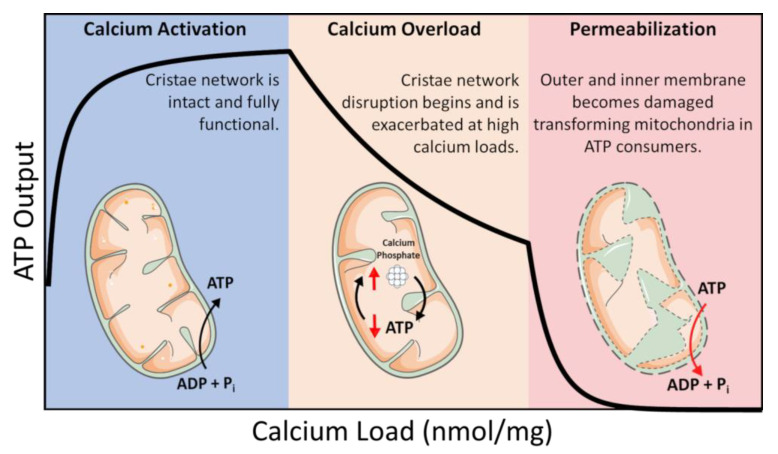
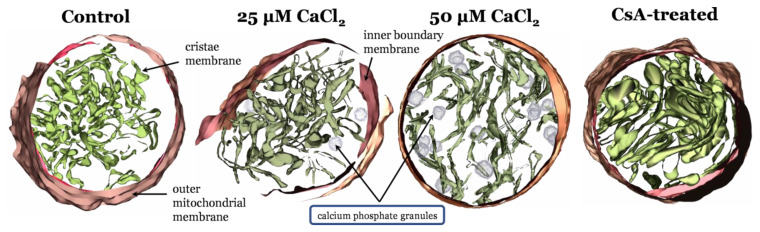
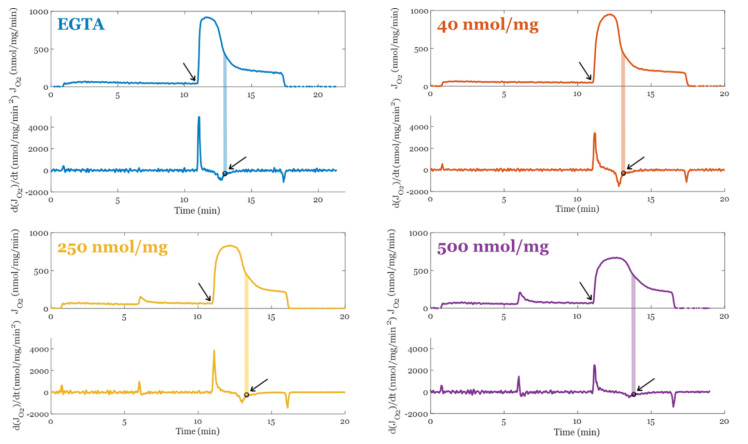
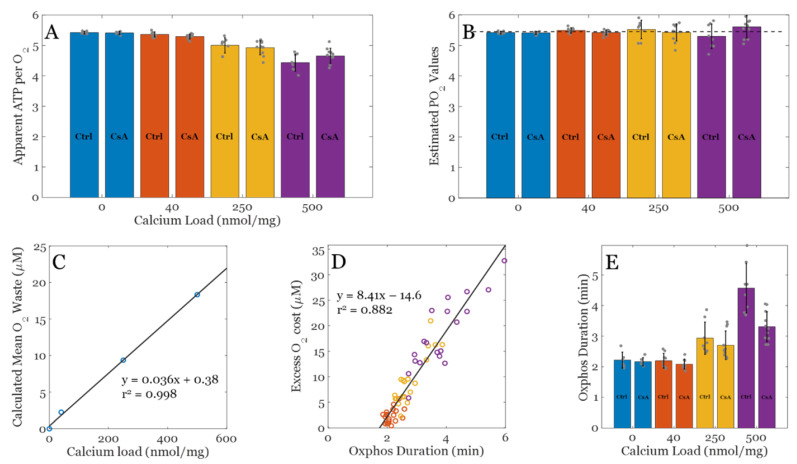
Mitochondria calcium is a double-edged sword. While low levels of calcium are essential to maintain optimal rates of ATP production, extreme levels of calcium overcoming the mitochondrial calcium retention capacity leads to loss of mitochondrial function. In moderate amounts, however, ATP synthesis rates are inhibited in a calcium-titratable manner. While the consequences of extreme calcium overload are well-known, the effects on mitochondrial function in the moderately loaded range remain enigmatic. These observations are associated with changes in the mitochondria ultrastructure and cristae network. The present mini review/perspective follows up on previous studies using well-established cryo–electron microscopy and poses an explanation for the observable depressed ATP synthesis rates in mitochondria during calcium-overloaded states. The results presented herein suggest that the inhibition of oxidative phosphorylation is not caused by a direct decoupling of energy metabolism via the opening of a calcium-sensitive, proteinaceous pore but rather a separate but related calcium-dependent phenomenon. Such inhibition during calcium-overloaded states points towards mitochondrial ultrastructural modifications, enzyme activity changes, or an interplay between both events.
Overview
The claims and statistics of this paper haven’t been checked yet.
Run the check — free, no account needed. It reads the open-access text and checks the sources it cites.
Integrity signals
Registry
Cites
Statistics
Figures
Verification
Claims the paper makes
The claims and statistics of this paper haven’t been checked yet.
Run the check — free, no account needed. It reads the open-access text and checks the sources it cites.
Claims other papers make about this one
Each is checked against this paper’s own text: does it say what the citing paper says it does?
The source backs part of the claim, not all of it — or backs it for a different population, condition or comparison.
In the citing paper
“Ca2+ activates mitochondrial metabolism and stimulates ATP synthesis”
From CYFIP1 governs the development of cortical axons by modulating calcium availability (2025) · cites this paper as [104]
Experimental — accuracy not yet measuredThe cited source says what the claim attributes to it.
In the citing paper
“mitochondria also buffer cytosolic calcium51,103,104.”
From CYFIP1 governs the development of cortical axons by modulating calcium availability (2025) · cites this paper as [104]
Self-check
Percentages, sums and reported differences re-computed from the paper’s own numbers.
The self-check needs the paper’s full text.
Citations
Cites
Computer Visualization of Three-Dimensional Image Data Using IMOD
Kremer, J. R., Mastronarde, D. N., & McIntosh, J. R. (1996) · Journal of Structural Biology · doi:10.1006/jsbi.1996.0013 · Cited by 5,530
Mitochondrial Transport of Cations: Channels, Exchangers, and Permeability Transition
Bernardi, P. (1999) · Physiological Reviews · doi:10.1152/physrev.1999.79.4.1127 · Cited by 1,546
Annexins: linking Ca2+ signalling to membrane dynamics
Gerke, V., Creutz, C. E., & Moss, S. E. (2005) · Nature Reviews Molecular Cell Biology · doi:10.1038/nrm1661 · Cited by 1,412
The mitochondrial calcium uniporter is a highly selective ion channel
Kirichok, Y., Krapivinsky, G., & Clapham, D. E. (2004) · Nature · doi:10.1038/nature02246 · Cited by 1,409
Mitochondria and calcium: from cell signalling to cell death
Duchen, M. R. (2000) · The Journal of Physiology · doi:10.1111/j.1469-7793.2000.00057.x · Cited by 1,261
Microdomains of Intracellular Ca2+: Molecular Determinants and Functional Consequences
Rizzuto, R., & Pozzan, T. (2005) · Physiological Reviews · doi:10.1152/physrev.00004.2005 · Cited by 1,234
What is the mitochondrial permeability transition pore?
Halestrap, A. P. (2009) · Journal of Molecular and Cellular Cardiology · doi:10.1016/j.yjmcc.2009.02.021 · Cited by 966
Role of Mitochondrial Ca2+ in the Regulation of Cellular Energetics
Glancy, B. C., & Balaban, R. S. (2012) · Biochemistry · doi:10.1021/bi2018909 · Cited by 649
Annexins – unique membrane binding proteins with diverse functions
Rescher, U., & Gerke, V. (2004) · Journal of Cell Science · doi:10.1242/jcs.01245 · Cited by 595
MICU1 Controls Both the Threshold and Cooperative Activation of the Mitochondrial Ca2+ Uniporter
Csordás, G., Golenár, T., Seifert, E. L., Kamer, K. J., Sancak, Y., Perocchi, F., Moffat, C., Weaver, D., de la Fuente, S., Bogorad, R. L., et al. (2013) · Cell Metabolism · doi:10.1016/j.cmet.2013.04.020 · Cited by 499
Research works printed but not linked: 1
- Andrade, L.O. (2019). Chapter Three—Annexins and Plasma Membrane Repai. Plasma Membrane Repair, Elsevier.
Cited by
Sorted by citations
Liu, T., Li, X., Zhou, X., Chen, W. J., Wen, A., Liu, M., & Ding, Y. (2024) · Neural Regeneration Research · doi:10.4103/nrr.nrr-d-24-00568 · Cited by 123
Li, F., Guan, Z., Gao, Y., Bai, Y., Zhan, X., Ji, X., Xu, J., Zhou, H., & Rao, Z. (2024) · Hepatology Communications · doi:10.1097/hc9.0000000000000399 · Cited by 62
Wu, J., Yi, S., Cao, Y., Zu, M., Li, B., Yang, W. J., Shahbazi, M., Wan, Y., Reis, R. L., Kundu, S. C., et al. (2023) · Biomaterials · doi:10.1016/j.biomaterials.2023.122332 · Cited by 59
Rahi, V., & Kaundal, R. K. (2024) · Life Sciences · doi:10.1016/j.lfs.2024.122651 · Cited by 57
Role of hydrogen sulfide in health and disease
Jin, Y., Yuan, H., Liu, Y., Zhu, Y., Wang, Y., Liang, X., Gao, W., Ren, Z., Ji, X., & Wu, D. (2024) · MedComm · doi:10.1002/mco2.661 · Cited by 54
Metadata
- Authors
- Walkon, L. L., Strubbe-Rivera, J. O., & Bazil, J. N.
- Affiliations
- Michigan State University (US)
- Department of Pharmacology and Toxicology, Michigan State University, East Lansing, MI 48824, USA
- Venue
- Biomolecules
- Publisher
- MDPI AG
- Published
- 2022-12-17
- Volume
- 12
- Issue
- 12
- Pages
- 1891
- ISSN
- 2218-273X (ISSN-L)
- PMC
- PMC9775684
- OpenAlex
- W4313236994
- Cited by
- 187
- References
- 95
- Citations by year
- 2026: 50 · 2025: 75 · 2024: 50 · 2023: 12
- FWCI
- 3.57
- Type
- journal article
- Language
- en
- Open access
- gold
- doi.org
- Licence
- Locations
- Biomolecules (publishedVersion, cc-by)
- PubMed Central (publishedVersion, cc-by)
- PubMed (publishedVersion)
- DOAJ (DOAJ: Directory of Open Access Journals) (submittedVersion, cc-by-sa)
- Funders
- National Institutes of Health (F31HL152623)
- Topics
- Life Sciences › Biochemistry, Genetics and Molecular Biology › Molecular Biology › Mitochondrial Function and Pathology
- Life Sciences › Biochemistry, Genetics and Molecular Biology › Molecular Biology › ATP Synthase and ATPases Research
- Life Sciences › Biochemistry, Genetics and Molecular Biology › Cell Biology › Autophagy in Disease and Therapy
- Keywords
- mitochondrial calcium overload, mitochondrial calcium retention capacity, ATP synthesis inhibition, oxidative phosphorylation, mitochondrial ultrastructure, cryo-electron microscopy, mitochondrial function
- MeSH terms
- Adenosine Triphosphate, Calcium, Energy Metabolism, Mitochondria, Cryoelectron Microscopy
About these checks
Registry, retraction, Cites and statistics results are computed, not judged, with one exception: a printed reference that no index lists is read once by a model before it counts as a citation error. Claims are extracted by a model and kept only when their quote appears verbatim in the text; each cited source is then checked, with a model’s help, for whether it says what the claim relies on. Those verdicts can be wrong — read the claim’s quote and the cited source before relying on one.
Statistics and arithmetic are recomputed, not judged.
Confidence bands are shown only for fields calibrated on our annotated test set. None is calibrated yet, so no band is shown.
What counts as a claim ›How we measure confidence ›How we check this ›
Are you an author, or do you see a problem with this page? Request a review
