

The War after War: Volumetric Muscle Loss Incidence, Implication, Current Therapies and Emerging Reconstructive Strategies, a Comprehensive Review
Open accessThe DOI matches its Crossref record; 62 of the 62 references it cites were found in a registry or an index.
Abstract
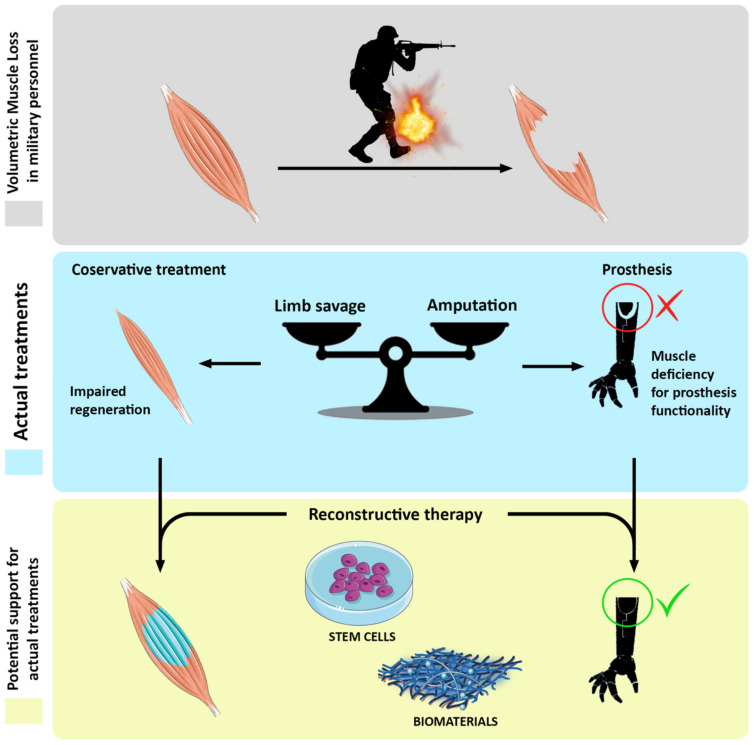
Volumetric muscle loss (VML) is the massive wasting of skeletal muscle tissue due to traumatic events or surgical ablation. This pathological condition exceeds the physiological healing process carried out by the muscle itself, which owns remarkable capacity to restore damages but only when limited in dimensions. Upon VML occurring, the affected area is severely compromised, heavily influencing the affected a person’s quality of life. Overall, this condition is often associated with chronic disability, which makes the return to duty of highly specialized professional figures (e.g., military personnel or athletes) almost impossible. The actual treatment for VML is based on surgical conservative treatment followed by physical exercise; nevertheless, the results, in terms of either lost mass and/or functionality recovery, are still poor. On the other hand, the efforts of the scientific community are focusing on reconstructive therapy aiming at muscular tissue void volume replenishment by exploiting biomimetic matrix or artificial tissue implantation. Reconstructing strategies represent a valid option to build new muscular tissue not only to recover damaged muscles, but also to better socket prosthesis in terms of anchorage surfaces and reinnervation substrates for reconstructed mass.
Overview
The claims and statistics of this paper haven’t been checked yet.
Free: it reads the open-access text and checks the first 5 claims that cite a source we can check. Create a free account to check every claim.
Integrity signals
Registry
Cites
Statistics
Figures
Verification
Claims the paper makes
The claims and statistics of this paper haven’t been checked yet.
Free: it reads the open-access text and checks the first 5 claims that cite a source we can check. Create a free account to check every claim.
Claims other papers make about this one
Each is checked against this paper’s own text: does it say what the citing paper says it does?
The source backs part of the claim, not all of it — or backs it for a different population, condition or comparison.
In the citing paper
“Traditional treatment methods such as autologous tissue transfer (Tissue-free flaps) and bracing have resulted in insufficient tissue regeneration due to implant mismatch and donor site morbidity [2–5].”
From Development of silk microfiber-reinforced bioink for muscle tissue engineering and in situ printing by a handheld 3D printer (2025) · cites this paper as [3]
Experimental — accuracy not yet measuredThe source backs part of the claim, not all of it — or backs it for a different population, condition or comparison.
In the citing paper
“Currently, available tissue repair methods are mostly pre-constructed in vitro scaffolds implanted onto a defect site, which elicits scaffold mismatch, inferior support, and time consumption, significantly affecting effective tissue regeneration [2, 3].”
From Development of silk microfiber-reinforced bioink for muscle tissue engineering and in situ printing by a handheld 3D printer (2025) · cites this paper as [3]
Experimental — accuracy not yet measured
Self-check
Percentages, sums and reported differences re-computed from the paper’s own numbers.
The self-check needs the paper’s full text.
Citations
Cites
Estimating the Prevalence of Limb Loss in the United States: 2005 to 2050
Ziegler-Graham, K., MacKenzie, E. J., Ephraim, P. L., Travison, T. G., & Brookmeyer, R. (2008) · Archives of Physical Medicine and Rehabilitation · doi:10.1016/j.apmr.2007.11.005 · Cited by 2,816
Muscle Injuries: Biology and Treatment
Järvinen, T. A. H., Järvinen, T. L. N., Kääriäinen, M., Kalimo, H., & Järvinen, M. (2005) · The American Journal of Sports Medicine · doi:10.1177/0363546505274714 · Cited by 1,072
An Analysis of Outcomes of Reconstruction or Amputation after Leg-Threatening Injuries
Bosse, M. J., MacKenzie, E. J., Kellam, J. F., Burgess, A. R., Webb, L. X., Swiontkowski, M. F., Sanders, R. W., Jones, A. L., McAndrew, M. P., Patterson, B. M., et al. (2002) · New England Journal of Medicine · doi:10.1056/nejmoa012604 · Cited by 913 · cited 2×
“Unfortunately, VML occurs in a large percentage of muscle-related trauma, often leading to the development of chronic disability [29].”
BackgroundPitfalls in the measurement of muscle mass: A need for a reference standard
Buckinx, F., Landi, F., Cesari, M., Fielding, R. A., Visser, M., Engelke, K., Maggi, S., Dennison, E., Al‐Daghri, N. M., Allepaerts, S., et al. (2018) · Journal of Cachexia, Sarcopenia and Muscle · doi:10.1002/jcsm.12268 · Cited by 765 · cited 1×
“After an accurate study of these methods and possibilities of implementing them in battlefield hospitals, Buckinx and colleagues made the conclusion that DXA, based on the feasibility (accuracy, safety, and low cost), could be considered as the referenced standard for evaluating muscle mass [33].”
MethodBiosynthetic hydrogel scaffolds made from fibrinogen and polyethylene glycol for 3D cell cultures
Almany, L., & Seliktar, D. (2005) · Biomaterials · doi:10.1016/j.biomaterials.2004.06.047 · Cited by 551
Sicari, B. M., Rubin, J. P., Dearth, C. L., Wolf, M. T., Ambrosio, F., Boninger, M., Turner, N. J., Weber, D. J., Simpson, T. W., Wyse, A., et al. (2014) · Science Translational Medicine · doi:10.1126/scitranslmed.3008085 · Cited by 491 · cited 1×
“In a study performed by Sicari and colleagues [45], five patients with documented VML (three military persons and two civilians), previously”
BackgroundHeymsfield, S. B., Gonzalez, M. C., Lu, J., Jia, G., & Zheng, J. (2015) · Proceedings of the Nutrition Society · doi:10.1017/s0029665115000129 · Cited by 483
Mijnarends, D. M., Meijers, J. M. M., Halfens, R. J. G., ter Borg, S., Luiking, Y. C., Verlaan, S., Schoberer, D., Cruz Jentoft, A. J., van Loon, L. J. C., & Schols, J. M. G. A. (2013) · Journal of the American Medical Directors Association · doi:10.1016/j.jamda.2012.10.009 · Cited by 475
On the Shared Control of an EMG-Controlled Prosthetic Hand: Analysis of User–Prosthesis Interaction
Cipriani, C., Zaccone, F., Micera, S., & Carrozza, M. C. (2008) · IEEE Transactions on Robotics · doi:10.1109/tro.2007.910708 · Cited by 453 · cited 1×
“This continuous effort brings most of them to feel fatigue after a prolonged use of an artificial limb [35].”
BackgroundThe epidemiology of tibial fractures
Court-Brown, C., & McBirnie, J. (1995) · The Journal of Bone and Joint Surgery. British volume · doi:10.1302/0301-620x.77b3.7744927 · Cited by 396 · cited 2×
“Besides military personnel exposed to a wide series of combat-related trauma [6], civilian categories such as athletes, construction workers, or simply people behind the wheel are frequently victims of these kinds of incidents [27,28].”
Background
Research works printed but not linked: 1
- Potter, B.K.; Burns, T.C.; Lacap, A.P.; Granville, R.R.; Gajewski, D.A. Heterotopic Ossification Following Traumatic and Combat- Related Amputations. J. Bone Jt. Surg. Am. Vol. 2007, 89, 476-486. [CrossRef] · DOI · Paper page
Cited by
Extracellular matrix: Brick and mortar in the skeletal muscle stem cell niche
Schüler, S. C., Liu, Y., Dumontier, S., Grandbois, M., Moal, E. L., Cornelison, D., & Bentzinger, C. F. (2022) · Frontiers in Cell and Developmental Biology · doi:10.3389/fcell.2022.1056523 · Cited by 101
“A well-known example of this kind of injury is volumetric muscle loss (VML) occurring after excision of large portions of skeletal muscle, for instance as a consequence of explosions on the battlefield (Testa et al., 2021).”
BackgroundA novel extrusion-based 3D bioprinting system for skeletal muscle tissue engineering
Fornetti, E., Paolis, F. D., Fuoco, C., Bernardini, S., Giannitelli, S. M., Rainer, A., Seliktar, D., Magdinier, F., Baldi, J., Biagini, R., et al. (2023) · Biofabrication · doi:10.1088/1758-5090/acb573 · Cited by 67
“In vitro and in vivo resulting samples were accordingly processed for immunofluorescence analysis as previously described [23, 24].”
BackgroundMethodSelf-citationGranular Hydrogels Improve Myogenic Invasion and Repair after Volumetric Muscle Loss
Tanner, G. I., Schiltz, L., Narra, N., Figueiredo, M. L., & Qazi, T. H. (2024) · Advanced Healthcare Materials · doi:10.1002/adhm.202303576 · Cited by 45
“A total of four groups were tested with TA muscles across animals randomly assigned to: (1) Sham, (2) Bulk hydrogel, (3) Granular hydrogel containing small particles, (4) Granular hydrogel containing large particles.”
Tissue Engineered 3D Constructs for Volumetric Muscle Loss
Gahlawat, S., Oruc, D., Paul, N., Ragheb, M., Patel, S., Fasasi, O., Sharma, P. K., Shreiber, D. I., & Freeman, J. W. (2024) · Annals of Biomedical Engineering · doi:10.1007/s10439-024-03541-w · Cited by 34
“While promising, this approach requires a highly skilled surgical team and proper patient selection, with factors like blood supply, muscle architecture, and donor site morbidity dictating success [18–21].”
BackgroundIonic medicine: Exploiting metallic ions to stimulate skeletal muscle tissue regeneration
Lu, H., Ege, D., Salehi, S., & Boccaccini, A. R. (2024) · Acta Biomaterialia · doi:10.1016/j.actbio.2024.10.033 · Cited by 22
Biomaterial-Based Regenerative Strategies for Volumetric Muscle Loss: Challenges and Solutions
Cai, C. W., Grey, J. A., Hubmacher, D., & Han, W. M. (2024) · Advances in Wound Care · doi:10.1089/wound.2024.0079 · Cited by 26
“6,7 In a retrospective analysis of battle fi eld-injured service members, VML accounted for 65% of the disabilities experienced by medically retired personnel following an open-tibial type III fracture.”
3D in vitro Models of Pathological Skeletal Muscle: Which Cells and Scaffolds to Elect?
Carraro, E., Rossi, L., Maghin, E., Canton, M., & Piccoli, M. (2022) · Frontiers in Bioengineering and Biotechnology · doi:10.3389/fbioe.2022.941623 · Cited by 26
Kamaraj, M., Rezayof, O., Barer, A., Kim, H., Moghimi, N., Joshi, A., Dokmeci, M. R., Khademhosseini, A., Alambeigi, F., & John, J. V. (2025) · Biomaterials Advances · doi:10.1016/j.bioadv.2024.214057 · Cited by 17
Wang, D., Zhang, Q., Xiang, Y., Fang, Q., Ge, Z., Deng, X., Zhao, R., Tang, Y., Zhang, Z., Liu, W., et al. (2023) · Nano Energy · doi:10.1016/j.nanoen.2023.108971 · Cited by 17
Wang, Z., Liang, W., Ao, R., & An, Y. (2025) · Biomaterials Research · doi:10.34133/bmr.0174 · Cited by 18
“The enormous demand, the inadequacy of existing treatments, and the stringent criteria for successful treatment have rendered the repair of large muscle defects a clinical challenge and an active field of research [ 5 ].”
Upscaled Skeletal Muscle Engineered Tissue with In Vivo Vascularization and Innervation Potential
Borisov, V., Solé, L. G., Reid, G., Milan, G., Hütter, G., Grapow, M. T. R., Eckstein, F. S., Isu, G., & Marsano, A. (2023) · Bioengineering · doi:10.3390/bioengineering10070800 · Cited by 12
Long-term longitudinal study on swine VML model
Paolis, F. D., Testa, S., Guarnaccia, G., Reggio, A., Fornetti, E., Cicciarelli, F., Deodati, R., Bernardini, S., Peluso, D., Baldi, J., et al. (2023) · Biology Direct · doi:10.1186/s13062-023-00399-1 · Cited by 10
“This disabling pathological condition, known as Volumetric Muscle Loss (VML), can occur following serious primary trauma (such as crash injuries, blasts or penetrating injuries) or as a consequence to sarcomas surgical ablation [16].”
InfluentialSelf-citationJeon, E. J., An, S., Han, S. Y., Jeong, E., Song, Y. S., Lee, J. S., & Cho, S. (2025) · Advanced Healthcare Materials · doi:10.1002/adhm.202403747 · Cited by 13
Repairing Volumetric Muscle Loss with Commercially Available Hydrogels in an Ovine Model
Su, E. Y., Kennedy, C. S., Vega-Soto, E. E., Pallas, B. D., Lukpat, S. N., Hwang, D. H., Bosek, D. W., Forester, C. E., Loebel, C., & Larkin, L. M. (2023) · Tissue Engineering Part A · doi:10.1089/ten.tea.2023.0240 · Cited by 11
“…regenerative medicine strategies, such as hydrogels (HGs), are being developed to decrease the acute inflammation and fibrosis that occur with VML. 21,22 HGs are water-swollen polymer networks that can be engineered to develop highly tunable, biocompatible, nonimmunogenic biomaterials to acutely…”
Recent Advances in Implantable Biomaterials for the Treatment of Volumetric Muscle Loss
Schiltz, L., Grivetti, E., Tanner, G. I., & Qazi, T. H. (2024) · Cells Tissues Organs · doi:10.1159/000536262 · Cited by 14
“The severe structural and physiological de fi cits seen after VML injury are challenging to reverse with any bioengineering strategy, especially the one that bypasses the delivery of cells [19].”
Jin, Y., Huang, Y., Wang, J., Zhou, X., Chen, J., Ding, W., Jia, Z., & Xu, Y. X. (2025) · Burns & Trauma · doi:10.1093/burnst/tkaf052 · Cited by 11
“VML is the most common complication in Gustilo-Anderson type III fractures, accounting for ∼ 65% [12].”
Acrylated Hyaluronic-Acid Based Hydrogel for the Treatment of Craniofacial Volumetric Muscle Loss
Rohrer, L., Kato, S., Browne, S., Striedinger, K., Healy, K. E., & Pomerantz, J. H. (2024) · Tissue Engineering Part A · doi:10.1089/ten.tea.2023.0241 · Cited by 8
“7 The in fl ammatory response to VML injuries involves a complex interaction between macrophages, cytokines, and myogenic cells, presenting many theoretical targets for regenerative medicine approaches.”
Redhead, C., Taye, N., Chin-Young, B., Oguntuyo, K., Cummins, J. H., Hart, K. J., Han, W. M., & Hubmacher, D. (2025) · iScience · doi:10.1016/j.isci.2025.112712 · Cited by 6
“50,51 After VML, muscle stem cells and FAPs migrate into the defect site from uninjured muscle tissue but are unable to restore muscle architecture and function.”
Tan, Y. H., Alcazar, C. A., Holbrook, J. G., Habing, K. M., Lally, O. J., Vanderpool, J. C., Seah, T., Liu, R., Ahsan, R., Li, L., et al. (2025) · Advanced Healthcare Materials · doi:10.1002/adhm.202501357 · Cited by 7
Human muscle in gene edited pigs for treatment of volumetric muscle loss
Greising, S. M., Weiner, J. I., Garry, D. J., Sachs, D. H., & Garry, M. G. (2022) · Frontiers in Genetics · doi:10.3389/fgene.2022.948496 · Cited by 6
Engineering 3D Skeletal Muscle Tissue with Complex Multipennate Myofiber ArchitecturesPreprint
Stang, M. A., Lee, A. R., Bliley, J. M., Coffin, B. D., Yerneni, S. S., Campbell, P. G., & Feinberg, A. W. (2025) · bioRxiv (Cold Spring Harbor Laboratory) · doi:10.1101/2025.01.06.631119 · Cited by 6
Fioretti, D., Ledda, M., Iurescia, S., Carletti, R., Gioia, C. R. T. D., Lolli, M. G., Marchese, R., Lisi, A., & Rinaldi, M. (2023) · Biomedicines · doi:10.3390/biomedicines12010030 · Cited by 7
“The consequences for the affected patients are often detrimental, causing severe physical impairment that leaves the patient in extreme pain and discomfort, often with a life-long disability [4,5].”
BackgroundCollagen Scaffold Viscoelasticity Regulates Muscle Cell Phenotype
Roloson, E. B., Jung, W., McNamara, S. L., Stone, C. L. V., Lafuente‐Gómez, N., Morgan, D. M., Gibbs, R. M., Rubin, L. L., Duda, G. N., & Mooney, D. J. (2025) · Advanced Healthcare Materials · doi:10.1002/adhm.202502775 · Cited by 3
Nelson, M. L., Burgoyne, H. M., Kouchi, F. R., White, F., Rektor, A., Fujimoto, K. T., Sawyer, M., Tibbits, A., Toodeshki, E. H., Semodji, A. M., et al. (2026) · ACS Applied Bio Materials · doi:10.1021/acsabm.5c02206 · Cited by 3
Patil, N., Saket, R., Diwakar, R., Reddy, G. H. V., Kumar, K. A., & Sathe, A. M. (2026) · Cureus · doi:10.7759/cureus.104429 · Cited by 8
“To be more specific, telerehabilitation can be defined as the remote provision of rehabilitation evaluation, monitoring, and guided care involving telecommunication tools [15].”
InfluentialRodent Model of Masseter Volumetric Muscle Loss for Studying Bioengineering Materials
Rohrer, L., Striedinger, K., & Pomerantz, J. H. (2024) · Journal of Visualized Experiments · doi:10.3791/66450 · Cited by 3
Biswas, A., Dogra, N., Rajasekaran, R., Biswas, B. K., Vaidya, P. V., Biswas, S., Ojha, A. K., Mukherjee, S., Roy, T., Mishra, S., et al. (2025) · International Journal of Biological Macromolecules · doi:10.1016/j.ijbiomac.2025.148771 · Cited by 3
Jin, M., Zhang, Y., Lin, W., Li, Z., Liang, W., & An, Y. (2026) · Materials Today Bio · doi:10.1016/j.mtbio.2026.103053 · Cited by 5
“It is commonly caused by combat trauma, oncological resection, or the progression of degenerative myopathy [8,9].”
An electro-responsive functional neurovascularized engineered muscle
Ding, S., Ye, X., Chen, Y., Wang, X., Zhuang, L., Huang, S., Lin, Y., Li, S., Yang, J., He, Y., et al. (2026) · Cell Biomaterials · doi:10.1016/j.celbio.2025.100305 · Cited by 2
Pandey, G., Kashikar, P., Nathani, K., Mangrulkar, S. V., Sawarkar, S. P., & Omri, A. (2026) · Drug Design Development and Therapy · doi:10.2147/dddt.s544862 · Cited by 1
He, X., Luo, Z., & He, S. (2025) · bioRxiv (Cold Spring Harbor Laboratory) · doi:10.1101/2025.06.07.657281 · Cited by 1
He, X., Luo, Z., & He, S. (2025) · bioRxiv (Cold Spring Harbor Laboratory) · doi:10.1101/2025.06.19.660623 · Cited by 1
Farini, A. (2021) · Biomedicines · doi:10.3390/biomedicines9121911
“suggested that the cell-based reconstructive approach could be a feasible approach to circumvent chronic dysfunctions in healing processes that affect DMD muscles [4].”
RISK-ORIENTED ANALYSIS OF LIMB LOSS IN VICTIMS OF MODERN HOSTILITIES
Guryev, S. О., Solovyov, O. S., Lysun, D. M., Iskra, N. I., Kushnir, V. A., Tsvyakh, A. I., & Marchenkova, N. O. (2022) · Wiadomości Lekarskie · doi:10.36740/wlek202206125
Leiva‐Cepas, F., Gil-Belmonte, M. J., Jimena, I., Peña-Toledo, M. Á., Villalba, R., & Peña, J. (2025) · European Journal of Translational Myology · doi:10.4081/ejtm.2025.13574
“9 However, to date, we had not addressed the histological substrate that explains this ultrasound pattern.”
Repairing Volumetric Muscle Loss with Skeletal Muscle Units and Hyaluronic Acid Hydrogel in Rats
Su, E. Y., Vega-Soto, E. E., Novakova, S. S., Killaars, A. R., Healy, K. E., Christ, G. J., & Larkin, L. M. (2025) · Tissue Engineering Part A · doi:10.1177/19373341251410209
Qutub, M., Tatode, A., Premchandani, T., Taksande, J., & Umekar, M. J. (2026) · European Journal of Pharmaceutics and Biopharmaceutics · doi:10.1016/j.ejpb.2026.114983
Mojica-Santiago, J., Agarwal, G., Robles‐Blasini, S., Young, I. C., Lopez, V. A., Giza, S., Choi, A., Malany, S., & Schmidt, C. E. (2026) · Journal of Biomedical Materials Research Part A · doi:10.1002/jbma.70039
Schätzlein, E., Weeger, O., Scholpp, S., Faulhaber, L., Fritschen, A., Gerhardus, J. S., Maatz, R., Neuhäusler, A., Mandal, S., von Klitzing, R., et al. (2026) · Biomaterials Science · doi:10.1039/d5bm01465d
Toward an Integrated Strategy for Volumetric Muscle Loss Regeneration
Dcosta, C., Zhang, K. L., Duazo, M., Grubišić, V., Hamzah, R. N., & Alghazali, K. M. (2026) · Journal of Clinical Medicine · doi:10.3390/jcm15155901
“Current clinical treatments remain limited for VML [158,159].”
Hilman, M. C., Krizman, E. N., Mourkioti, F., Das, S., & Cullen, D. K. (2026) · Macromolecular Bioscience · doi:10.1002/mabi.202500660
“The resizable microtissue unit described here has the capacity to bulk up and fill large, human-sized muscle defects [ 60 ].”
Histopathological evaluation of experimentally induced volumetric muscle loss in rats
Zăvoi, A. A., DREANCĂ, A., Magyari, K., Negoescu, A. G., & Oană, L. (2026) · Cluj Veterinary Journal · doi:10.52331/v31i3dw89
“However, the degree of long-term functional impairment varies across studies, and recent findings suggest that some injury sizes previously considered representative of VML may still allow substantial recovery over extended time periods [11,12].”
Khurram, M., Vesy, K., Kim, J., Marjan, T., Desai, M., Stornello, D. E., & Qazi, T. H. (2026) · Acta Biomaterialia · doi:10.1016/j.actbio.2026.09.047
Metadata
- Authors
- Testa, S., Fornetti, E., Fuoco, C., Sanchez-Riera, C., Rizzo, F., Ciccotti, M., Cannata, S., Sciarra, T., & Gargioli, C.
- Affiliations
- University of Rome Tor Vergata (IT)
- Department of Biology, Rome University Tor Vergata, 00133 Rome, Italy
- Joint Veteran Center, Scientific Department, Army Medical Center, 00184 Rome, Italy
- Corresponding author
- Sciarra, Tommaso
- Gargioli, Cesare
- ORCID
- Venue
- Biomedicines
- Publisher
- MDPI AG
- Published
- 2021-05-18
- Volume
- 9
- Issue
- 5
- Pages
- 564
- ISSN
- 2227-9059 (ISSN-L)
- PMC
- PMC8157822
- OpenAlex
- W3163366133
- Semantic Scholar
- 8732df1e78e19e8b0155edfff50f24a422136509
- Cited by
- 43
- References
- 62
- Citations by year
- 2026: 12 · 2025: 12 · 2024: 8 · 2023: 6 · 2022: 4 · 2021: 1
- FWCI
- 1.14
- Type
- journal article
- Language
- en
- Open access
- gold
- doi.org
- Licence
- Locations
- Biomedicines (publishedVersion, cc-by)
- PubMed Central (publishedVersion, cc-by)
- PubMed (publishedVersion)
- IRIS Research product catalog (Sapienza University of Rome) (submittedVersion, cc-by)
- Cineca Institutional Research Information System (Tor Vergata University) (submittedVersion)
- DOAJ (DOAJ: Directory of Open Access Journals) (submittedVersion, cc-by-sa)
- Funders
- Ministry of Defense (RESUMO n° 2018.019)
- Topics
- Health Sciences › Medicine › Surgery › Tissue Engineering and Regenerative Medicine
- Life Sciences › Biochemistry, Genetics and Molecular Biology › Molecular Biology › Muscle Physiology and Disorders
- Physical Sciences › Engineering › Biomedical Engineering › Bone Tissue Engineering Materials
- Keywords
- volumetric muscle loss, muscle atrophy, traumatic muscle injury, surgical ablation, muscle regeneration, biomimetic scaffolds, prosthetic socket, reinnervation, chronic disability, military personnel, athletes
About these checks
Registry, retraction, Cites and statistics results are computed, not judged, with one exception: a printed reference that no index lists is read once by a model before it counts as a citation error. Claims are extracted by a model and kept only when their quote appears verbatim in the text; each cited source is then checked, with a model’s help, for whether it says what the claim relies on. Those verdicts can be wrong — read the claim’s quote and the cited source before relying on one.
Statistics and arithmetic are recomputed, not judged.
Confidence bands are shown only for fields calibrated on our annotated test set. None is calibrated yet, so no band is shown.
What counts as a claim ›How we measure confidence ›How we check this ›
Are you an author, or do you see a problem with this page? Request a review
Data sources
Bibliographic data: Semantic Scholar, OpenAlex, Crossref.
Contains information from the Semantic Scholar Academic Graph Datasets, made available under the ODC Attribution License (ODC-BY 1.0).
Semantic Scholar’s data is described in: Kinney, R., et al. (2023). The Semantic Scholar Open Data Platform. arXiv:2301.10140.
