

The War after War: Volumetric Muscle Loss Incidence, Implication, Current Therapies and Emerging Reconstructive Strategies, a Comprehensive Review
Open accessThe DOI matches its Crossref record; 62 of the 62 references it cites were found in a registry or an index.
Abstract
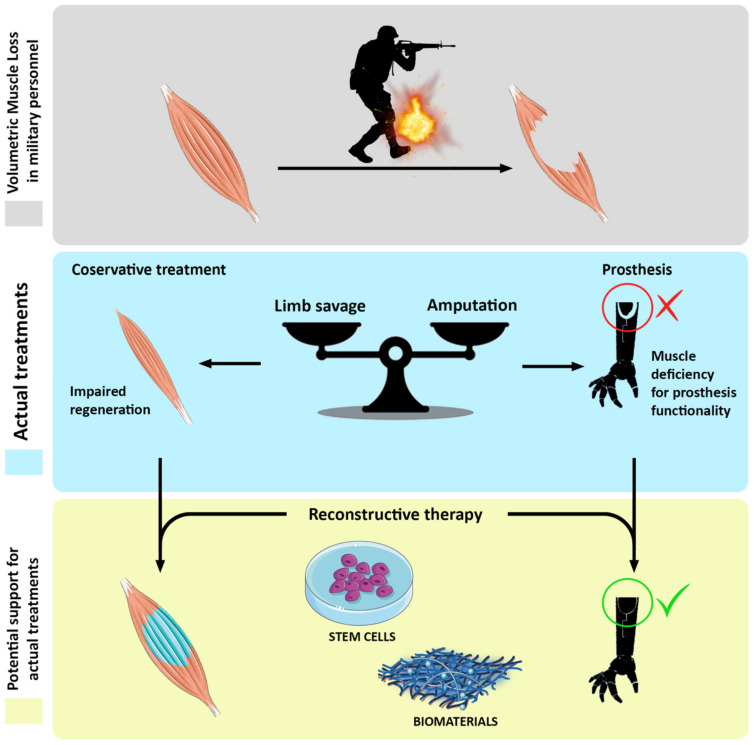
Volumetric muscle loss (VML) is the massive wasting of skeletal muscle tissue due to traumatic events or surgical ablation. This pathological condition exceeds the physiological healing process carried out by the muscle itself, which owns remarkable capacity to restore damages but only when limited in dimensions. Upon VML occurring, the affected area is severely compromised, heavily influencing the affected a person’s quality of life. Overall, this condition is often associated with chronic disability, which makes the return to duty of highly specialized professional figures (e.g., military personnel or athletes) almost impossible. The actual treatment for VML is based on surgical conservative treatment followed by physical exercise; nevertheless, the results, in terms of either lost mass and/or functionality recovery, are still poor. On the other hand, the efforts of the scientific community are focusing on reconstructive therapy aiming at muscular tissue void volume replenishment by exploiting biomimetic matrix or artificial tissue implantation. Reconstructing strategies represent a valid option to build new muscular tissue not only to recover damaged muscles, but also to better socket prosthesis in terms of anchorage surfaces and reinnervation substrates for reconstructed mass.
Overview
The claims and statistics of this paper haven’t been checked yet.
Free: it reads the open-access text and checks the first 5 claims that cite a source we can check. Create a free account to check every claim.
Integrity signals
Registry
Cites
Statistics
Figures
Verification
Claims the paper makes
The claims and statistics of this paper haven’t been checked yet.
Free: it reads the open-access text and checks the first 5 claims that cite a source we can check. Create a free account to check every claim.
Claims other papers make about this one
Each is checked against this paper’s own text: does it say what the citing paper says it does?
The source backs part of the claim, not all of it — or backs it for a different population, condition or comparison.
In the citing paper
“Traditional treatment methods such as autologous tissue transfer (Tissue-free flaps) and bracing have resulted in insufficient tissue regeneration due to implant mismatch and donor site morbidity [2–5].”
From Development of silk microfiber-reinforced bioink for muscle tissue engineering and in situ printing by a handheld 3D printer (2025) · cites this paper as [3]
Experimental — accuracy not yet measuredThe source backs part of the claim, not all of it — or backs it for a different population, condition or comparison.
In the citing paper
“Currently, available tissue repair methods are mostly pre-constructed in vitro scaffolds implanted onto a defect site, which elicits scaffold mismatch, inferior support, and time consumption, significantly affecting effective tissue regeneration [2, 3].”
From Development of silk microfiber-reinforced bioink for muscle tissue engineering and in situ printing by a handheld 3D printer (2025) · cites this paper as [3]
Experimental — accuracy not yet measured
Self-check
Percentages, sums and reported differences re-computed from the paper’s own numbers.
The self-check needs the paper’s full text.
Citations
Cites
Estimating the Prevalence of Limb Loss in the United States: 2005 to 2050
Ziegler-Graham, K., MacKenzie, E. J., Ephraim, P. L., Travison, T. G., & Brookmeyer, R. (2008) · Archives of Physical Medicine and Rehabilitation · doi:10.1016/j.apmr.2007.11.005 · Cited by 2,816
Muscle Injuries: Biology and Treatment
Järvinen, T. A. H., Järvinen, T. L. N., Kääriäinen, M., Kalimo, H., & Järvinen, M. (2005) · The American Journal of Sports Medicine · doi:10.1177/0363546505274714 · Cited by 1,072
An Analysis of Outcomes of Reconstruction or Amputation after Leg-Threatening Injuries
Bosse, M. J., MacKenzie, E. J., Kellam, J. F., Burgess, A. R., Webb, L. X., Swiontkowski, M. F., Sanders, R. W., Jones, A. L., McAndrew, M. P., Patterson, B. M., et al. (2002) · New England Journal of Medicine · doi:10.1056/nejmoa012604 · Cited by 913 · cited 2×
“Unfortunately, VML occurs in a large percentage of muscle-related trauma, often leading to the development of chronic disability [29].”
BackgroundPitfalls in the measurement of muscle mass: A need for a reference standard
Buckinx, F., Landi, F., Cesari, M., Fielding, R. A., Visser, M., Engelke, K., Maggi, S., Dennison, E., Al‐Daghri, N. M., Allepaerts, S., et al. (2018) · Journal of Cachexia, Sarcopenia and Muscle · doi:10.1002/jcsm.12268 · Cited by 765 · cited 1×
“After an accurate study of these methods and possibilities of implementing them in battlefield hospitals, Buckinx and colleagues made the conclusion that DXA, based on the feasibility (accuracy, safety, and low cost), could be considered as the referenced standard for evaluating muscle mass [33].”
MethodBiosynthetic hydrogel scaffolds made from fibrinogen and polyethylene glycol for 3D cell cultures
Almany, L., & Seliktar, D. (2005) · Biomaterials · doi:10.1016/j.biomaterials.2004.06.047 · Cited by 551
Sicari, B. M., Rubin, J. P., Dearth, C. L., Wolf, M. T., Ambrosio, F., Boninger, M., Turner, N. J., Weber, D. J., Simpson, T. W., Wyse, A., et al. (2014) · Science Translational Medicine · doi:10.1126/scitranslmed.3008085 · Cited by 491 · cited 1×
“In a study performed by Sicari and colleagues [45], five patients with documented VML (three military persons and two civilians), previously”
BackgroundHeymsfield, S. B., Gonzalez, M. C., Lu, J., Jia, G., & Zheng, J. (2015) · Proceedings of the Nutrition Society · doi:10.1017/s0029665115000129 · Cited by 483
Mijnarends, D. M., Meijers, J. M. M., Halfens, R. J. G., ter Borg, S., Luiking, Y. C., Verlaan, S., Schoberer, D., Cruz Jentoft, A. J., van Loon, L. J. C., & Schols, J. M. G. A. (2013) · Journal of the American Medical Directors Association · doi:10.1016/j.jamda.2012.10.009 · Cited by 475
On the Shared Control of an EMG-Controlled Prosthetic Hand: Analysis of User–Prosthesis Interaction
Cipriani, C., Zaccone, F., Micera, S., & Carrozza, M. C. (2008) · IEEE Transactions on Robotics · doi:10.1109/tro.2007.910708 · Cited by 453 · cited 1×
“This continuous effort brings most of them to feel fatigue after a prolonged use of an artificial limb [35].”
BackgroundThe epidemiology of tibial fractures
Court-Brown, C., & McBirnie, J. (1995) · The Journal of Bone and Joint Surgery. British volume · doi:10.1302/0301-620x.77b3.7744927 · Cited by 396 · cited 2×
“Besides military personnel exposed to a wide series of combat-related trauma [6], civilian categories such as athletes, construction workers, or simply people behind the wheel are frequently victims of these kinds of incidents [27,28].”
BackgroundReamputation, mortality, and health care costs among persons with dysvascular lower-limb amputations
Dillingham, T. R., Pezzin, L. E., & Shore, A. D. (2005) · Archives of Physical Medicine and Rehabilitation · doi:10.1016/j.apmr.2004.06.072 · Cited by 352 · cited 1×
“The number of people amputated worldwide is relevant, although it is difficult to obtain a reliable estimate regarding limb amputation given that not all countries regularly register the cases: it is estimated that 150,000 people are admitted to hospitals each year to undergo amputation with many cases resulting from…”
BackgroundKaplan, F. S., Glaser, D. L., Hebela, N., & Shore, E. M. (2004) · Journal of the American Academy of Orthopaedic Surgeons · doi:10.5435/00124635-200403000-00007 · Cited by 342
Costantini, M., Testa, S., Mozetic, P., Barbetta, A., Fuoco, C., Fornetti, E., Tamiro, F., Bernardini, S., Jaroszewicz, J., Święszkowski, W., et al. (2017) · Biomaterials · doi:10.1016/j.biomaterials.2017.03.026 · Cited by 330 · cited 2×
“The work of Costantini and colleagues [1] revealed the potential of microfluidic-enhanced bioprinting in combination with a bioink composed of C2C12 (mouse myogenic progenitors) embedded in a PF–alginate hydrogel mix in driving proper differentiation of muscle fibers both in vitro and in vivo, with an impressive ameli…”
BackgroundSelf-citationPotter, C. B. K., Burns, C. T. C., Lacap, C. A. P., Granville, C. R. R., & Gajewski, L. C. D. A. (2007) · The Journal of Bone and Joint Surgery-American Volume · doi:10.2106/00004623-200703000-00003 · Cited by 317
Choi, Y.-J., Jun, Y.-J., Kim, D. Y., Yi, H.-G., Chae, S.-H., Kang, J., Lee, J., Gao, G., Kong, J.-S., Jang, J., et al. (2019) · Biomaterials · doi:10.1016/j.biomaterials.2019.03.036 · Cited by 314 · cited 1×
“The results showed that the maximum muscle reformation was reached with the mixed construct coaxially printed [25].”
BackgroundQuarta, M., Cromie, M., Chacon, R., Blonigan, J., Garcia, V., Akimenko, I., Hamer, M., Paine, P., Stok, M., Shrager, J. B., et al. (2017) · Nature Communications · doi:10.1038/ncomms15613 · Cited by 278 · cited 1×
“In a study conducted by Quarta and collaborators [54], the importance of different cellular components in engineered bio-constructs was demonstrated.”
BackgroundHeterotopic Ossification in High-Energy Wartime Extremity Injuries: Prevalence and Risk Factors
Forsberg, J. A., Pepek, J. M., Wagner, S., Wilson, K., Flint, J., Andersen, R. C., Tadaki, D., Gage, F. A., Stojadinovic, A., & Elster, E. A. (2009) · The Journal of Bone and Joint Surgery-American Volume · doi:10.2106/jbjs.h.00792 · Cited by 277
Volumetric muscle loss leads to permanent disability following extremity trauma
Corona, B. T., Rivera, J. C., Owens, J. G., Wenke, J. C., & Rathbone, C. R. (2015) · Journal of Rehabilitation Research and Development · doi:10.1682/jrrd.2014.07.0165 · Cited by 239 · cited 6×
“Besides military personnel exposed to a wide series of combat-related trauma [6], civilian categories such as athletes, construction workers, or simply people behind the wheel are frequently victims of these kinds of incidents [27,28].”
BackgroundResultInfluentialVolumetric muscle loss: Persistent functional deficits beyond frank loss of tissue
Garg, K., Ward, C. L., Hurtgen, B. J., Wilken, J. M., Stinner, D. J., Wenke, J. C., Owens, J. G., & Corona, B. T. (2015) · Journal of Orthopaedic Research · doi:10.1002/jor.22730 · Cited by 233 · cited 2×
“However, in the majority of the cases, these approaches are unsatisfactory, and the recovery of both aesthetically and functionality is completely inadequate [42].”
BackgroundKim, J. H., Kim, I., Seol, Y.-J., Ko, I. K., Yoo, J. J., Atala, A., & Lee, S. J. (2020) · Nature Communications · doi:10.1038/s41467-020-14930-9 · Cited by 229 · cited 1×
“The results highlighted the importance of the co-culture to ensure the best outcomes in terms of muscle weight, force, number of muscle fibers, and neuromuscular junctions in the regenerated muscle [58].”
BackgroundDziki, J., Badylak, S., Yabroudi, M., Sicari, B., Ambrosio, F., Stearns, K., Turner, N., Wyse, A., Boninger, M. L., Brown, E. H. P., et al. (2016) · npj Regenerative Medicine · doi:10.1038/npjregenmed.2016.8 · Cited by 219 · cited 1×
“In [46], the authors used the same approach for a group of 13 patients, with an average of 66% tissue deficit.”
MethodZheng, Y. P., Chan, M. M. F., Shi, J., Chen, X., & Huang, Q. H. (2006) · Medical Engineering & Physics · doi:10.1016/j.medengphy.2005.07.012 · Cited by 181
Corona, B. T., Garg, K., Ward, C. L., McDaniel, J. S., Walters, T. J., & Rathbone, C. R. (2013) · American Journal of Physiology-Cell Physiology · doi:10.1152/ajpcell.00189.2013 · Cited by 169 · cited 2×
“VML is a common, pathological condition that may occur in relation to primary trauma such as crush injuries, penetrating trauma and blasts, or secondary trauma-like compartment syndromes and comorbidity to open bone fracture [3,4].”
BackgroundShi, J., Zheng, Y. P., Chen, X., & Huang, Q. H. (2007) · Medical Engineering & Physics · doi:10.1016/j.medengphy.2006.07.004 · Cited by 165
The traumatic bone: trauma-induced heterotopic ossification
Dey, D., Wheatley, B. M., Cholok, D. J., Agarwal, S., Yu, P. B., Lévi, B., & Davis, T. A. (2017) · Translational research · doi:10.1016/j.trsl.2017.06.004 · Cited by 164 · cited 1×
“In particular, the wound stimulate mesenchymal stem cells (MSCs) mobilization in a injury site; here the local released growth factors (BMP family) and inflammatory cytokines (IL-3, IL-6, and IL-10) promote the differentiation of MSCs in osteoprogenitors through the Runx-2-mediated pathway [11].”
BackgroundPathophysiology of Volumetric Muscle Loss Injury
Corona, B. T., Wenke, J. C., & Ward, C. L. (2016) · Cells Tissues Organs · doi:10.1159/000443925 · Cited by 162 · cited 2×
“VML is a common, pathological condition that may occur in relation to primary trauma such as crush injuries, penetrating trauma and blasts, or secondary trauma-like compartment syndromes and comorbidity to open bone fracture [3,4].”
BackgroundCell therapy to improve regeneration of skeletal muscle injuries
Qazi, T. H., Duda, G. N., Ort, M. J., Perka, C., Geissler, S., & Winkler, T. (2019) · Journal of Cachexia, Sarcopenia and Muscle · doi:10.1002/jcsm.12416 · Cited by 160 · cited 1×
“In particular, several cell populations were investigated to test their myogenic potential and their appeal in cell culture [47], as well as different biological scaffolds and their resulting combinations.”
BackgroundShi, J., Yong-Ping, Z., Qing-Hua, H., & Chen, X. (2008) · IEEE Transactions on Biomedical Engineering · doi:10.1109/tbme.2007.909538 · Cited by 131
Bian, W., & Bursac, N. (2008) · IEEE Engineering in Medicine and Biology Magazine · doi:10.1109/memb.2008.928460 · Cited by 123 · cited 1×
“In particular, there are three main limitations to overcome: (i) finding the optimal muscle progenitor source that show both myogenic potential and high proliferation rates to obtain a sufficient amount of cells; (ii) achieving a 3D tissue with an adequate density, dimensions and cell alignment to be comparable with a…”
BackgroundIsolation and Characterization of Mesoangioblasts from Mouse, Dog, and Human Tissues
Tonlorenzi, R., Dellavalle, A., Schnapp, E., Cossu, G., & Sampaolesi, M. (2007) · Current Protocols in Stem Cell Biology · doi:10.1002/9780470151808.sc02b01s3 · Cited by 112
The Nature and Incidence of Musculoskeletal Combat Wounds in Iraq and Afghanistan (2005–2009)
Belmont, P. J., McCriskin, B. J., Hsiao, M. S., Burks, R. T., Nelson, K. J., & Schoenfeld, A. J. (2012) · Journal of Orthopaedic Trauma · doi:10.1097/bot.0b013e3182703188 · Cited by 110
Therapeutic Approaches for Volumetric Muscle Loss Injury: A Systematic Review and Meta-Analysis
Greising, S. M., Corona, B. T., McGann, C., Frankum, J. K., & Warren, G. L. (2019) · Tissue Engineering Part B: Reviews · doi:10.1089/ten.teb.2019.0207 · Cited by 109 · cited 1×
“For this reason, over the last years, many research teams have focused their efforts on this aim [49].”
BackgroundBlast injuries and heterotopic ossification
Alfieri, K. A., Forsberg, J. A., & Potter, B. K. (2012) · Bone and Joint Research · doi:10.1302/2046-3758.18.2000102 · Cited by 107 · cited 1×
“For these reasons, HO pathology represents the most significant obstacle to independence, functional mobility, and return to duty for combat-injured veterans [16].”
BackgroundLustgarten, M. S., & Fielding, R. A. (2011) · The Journal of nutrition, health and aging · doi:10.1007/s12603-011-0049-x · Cited by 104
In vivo generation of a mature and functional artificial skeletal muscle
Fuoco, C., Rizzi, R., Biondo, A., Longa, E., Mascaro, A., Shapira‐Schweitzer, K., Kossovar, O., Benedetti, S., Salvatori, M. L., Santoleri, S., et al. (2015) · EMBO Molecular Medicine · doi:10.15252/emmm.201404062 · Cited by 101 · cited 2×
“Moreover, Fuoco and colleagues [48] studied the potential of a PEG-Fibrinogen (PF)-based biomimetic matrix combined with murine mesoangioblast as a cellular component for muscle reconstruction in a tibialis anterior (TA) VML mouse model [51–53].”
BackgroundSelf-citationDetermination of a Critical Size Threshold for Volumetric Muscle Loss in the Mouse Quadriceps
Anderson, S. E., Han, W. M., Srinivasa, V., Mohiuddin, M., Ruehle, M. A., Moon, J. Y., Shin, E.-J., Emeterio, C. L. S., Ogle, M. E., Botchwey, E. A., et al. (2019) · Tissue Engineering Part C Methods · doi:10.1089/ten.tec.2018.0324 · Cited by 97
Fuoco, C., Salvatori, M. L., Biondo, A., Shapira‐Schweitzer, K., Santoleri, S., Antonini, S., Bernardini, S., Tedesco, F. S., Cannata, S. M., Seliktar, D., et al. (2012) · Skeletal Muscle · doi:10.1186/2044-5040-2-24 · Cited by 92
Self-citationLi, M. T. A., Willett, N. J., Uhrig, B. A., Guldberg, R. E., & Warren, G. L. (2013) · Journal of Biomechanics · doi:10.1016/j.jbiomech.2013.10.057 · Cited by 86
An Autologous Muscle Tissue Expansion Approach for the Treatment of Volumetric Muscle Loss
Ward, C. L., Ji, L. L., & Corona, B. T. (2015) · BioResearch open access · doi:10.1089/biores.2015.0009 · Cited by 85
Goldman, S. M., Henderson, B. E. P., Walters, T. J., & Corona, B. T. (2018) · PLoS ONE · doi:10.1371/journal.pone.0191245 · Cited by 63 · cited 1×
“Experiments conducted on rat models of VML reported an increment in new muscle formation in the compromised area and a partial restoration of force and functionality [3,55,56].”
BackgroundWard, C. L., Pollot, B. E., Goldman, S. M., Greising, S. M., Wenke, J. C., & Corona, B. T. (2016) · Journal of Orthopaedic Trauma · doi:10.1097/bot.0000000000000673 · Cited by 62 · cited 1×
“However, in recent years, some progress has been accomplished: Ward and collaborators have used an approach developed on rodents that consists in the implantation of autologous minced skeletal muscle on a VML site [59].”
BackgroundHoyt, B. W., Pavey, G. J., Potter, B. K., & Forsberg, J. A. (2018) · Bone · doi:10.1016/j.bone.2018.02.009 · Cited by 53 · cited 1×
“Nowadays, the only effective therapy for HO is surgical removal that has to be ideally performed at least six months after the injury occurs to allow for an adequately ectopic bone cortication and maturation [15].”
BackgroundBiofabricating murine and human myo‐substitutes for rapid volumetric muscle loss restoration
Costantini, M., Testa, S., Fornetti, E., Fuoco, C., Sanchez Riera, C., Nie, M., Bernardini, S., Rainer, A., Baldi, J., Zoccali, C., et al. (2021) · EMBO Molecular Medicine · doi:10.15252/emmm.202012778 · Cited by 51 · cited 1×
“Moreover, very recently, the same authors [57] demonstrated the real potentiality of 3D printing technology in obtaining macroscopic myo-substitutes in vitro and in vivo, showing an astonishing functional and morphological recovery of TA VML mouse models (90% of TA muscle mass ablation) within just 3 weeks, revealing…”
BackgroundSelf-citationEsfandiari, E., Yavari, A., KARİMİ, A., Masoumi, M., Soroush, M., & Saeedi, H. (2018) · Acta Orthopaedica et Traumatologica Turcica · doi:10.1016/j.aott.2017.04.004 · Cited by 50
Aligned nanofibers of decellularized muscle extracellular matrix for volumetric muscle loss
Patel, K. H., Talovic, M., Dunn, A. J., Patel, A., Vendrell, S., Schwartz, M., & Garg, K. (2020) · Journal of Biomedical Materials Research Part B: Applied Biomaterials · doi:10.1002/jbm.b.34584 · Cited by 46 · cited 1×
“VML includes both traumatic lesions and surgical removals of a large muscle area with the associated loss of stem cells and extracellular matrices (ECMs) and the consequent impairment of regenerative capabilities [2].”
BackgroundHeterotopic Ossification After Femoral Intramedullary Rodding
Steinberg, G. G., & Hubbard, C. (1993) · Journal of Orthopaedic Trauma · doi:10.1097/00005131-199312000-00009 · Cited by 42 · cited 1×
“HO can occur in both civilian and military trauma, but the incidence is unpaired: for civilian trauma, HO formation is due to the combination of a central nervous system (CNS) trauma and mainly a fracture of the femur (54% of patients with thigh trauma) [12].”
BackgroundExtracellular matrix scaffolds for treatment of large volume muscle injuries: A review
Sarrafian, T. L., Bodine, S. C., Murphy, B. G., Grayson, J. K., & Stover, S. M. (2018) · Veterinary Surgery · doi:10.1111/vsu.12787 · Cited by 42 · cited 1×
“In fact, the biological function of an ECM in recreating a suitable microenvironment niche, which is able to promote the healing process toward a reconstructive and functional outcome, is intensively studied [43,44].”
BackgroundHan, N., Yabroudi, M. A., Stearns-Reider, K., Helkowski, W., Sicari, B. M., Rubin, J. P., Badylak, S. F., Boninger, M. L., & Ambrosio, F. (2016) · Physical Therapy · doi:10.2522/ptj.20150133 · Cited by 40 · cited 1×
“In fact, the biological function of an ECM in recreating a suitable microenvironment niche, which is able to promote the healing process toward a reconstructive and functional outcome, is intensively studied [43,44].”
BackgroundHealth concerns of veterans with high-level lower extremity amputations
Faraji, E., Allami, M., Feizollahi, N., Karimi, A., Yavari, A., Soroush, M., & مودی, م. (2018) · Military Medical Research · doi:10.1186/s40779-018-0183-4 · Cited by 39
Raman spectroscopic analysis of combat-related heterotopic ossification development
Crane, N. J., Polfer, E. M., Elster, E. A., Potter, B. K., & Forsberg, J. A. (2013) · Bone · doi:10.1016/j.bone.2013.08.026 · Cited by 32 · cited 1×
“In war trauma, HO occurs with or without CNS trauma, with a high incidence rate that reaches 64%, following military blast injuries [13,14].”
BackgroundTalbot, L. A., Brede, E., & Metter, E. J. (2017) · Military Medicine · doi:10.7205/milmed-d-16-00328 · Cited by 31 · cited 1×
“In a recent study on physical and psychological health in military amputees during rehabilitation, Talbot and colleagues noticed that, whereas physical health improved as might be expected upon rehabilitation, mental health component did not [20].”
BackgroundRepairing Volumetric Muscle Loss in the Ovine Peroneus Tertius Following a 3-Month Recovery
Novakova, S. S., Rodriguez, B. L., Vega-Soto, E. E., Nutter, G. P., Armstrong, R. E., Macpherson, P. C. D., & Larkin, L. M. (2020) · Tissue Engineering Part A · doi:10.1089/ten.tea.2019.0288 · Cited by 29 · cited 1×
“Furthermore, the immune histological analysis revealed the presence of muscle fibers and neuromuscular junctions at the VML site, indicating the amelioration of the regeneration process, despite the large amount of fibrotic tissue in all experimental conditions [61].”
BackgroundCorona, B. T., Rivera, J. C., Wenke, J. C., & Greising, S. M. (2017) · Journal of Experimental Orthopaedics · doi:10.1186/s40634-017-0112-6 · Cited by 26
Singh, J., Dhillon, M. S., & Dhatt, S. S. (2020) · Malaysian Orthopaedic Journal · doi:10.5704/moj.2003.010 · Cited by 26 · cited 2×
“In a recently published work [41], a study on 33 patients affected by open tibial fractures is reported.”
BackgroundMethodMilitary and Civilian Collaboration: The Power of Numbers
Stinner, D. J., Wenke, J. C., Ficke, J. R., Gordon, W. T., Toledano, J. E., Carlini, A. R., Scharfstein, D. O., MacKenzie, E. J., Bosse, M. J., & Hsu, J. R. (2017) · Military Medicine · doi:10.7205/milmed-d-16-00138 · Cited by 24
Rosina, M., Langone, F., Giuliani, G., Perpetuini, A. C., Reggio, A., Calderone, A., Fuoco, C., Castagnoli, L., Gargioli, C., & Cesareni, G. (2019) · Scientific Reports · doi:10.1038/s41598-019-41926-3 · Cited by 24
Self-citationYang, X., Zhang, D., Wang, Y., Feng, J., & Xu, W. (2018) · Journal of NeuroEngineering and Rehabilitation · doi:10.1186/s12984-018-0376-9 · Cited by 23 · cited 1×
“These areas are used as “switches” to produce surface electromyography (EMG) signals, which are recorded by the prosthesis’ sensors, allowing the execution of precise movements like bending the forearm, turning the palm, and/or closing the hand [34].”
MethodWang, H. D., Lough, D., Kurlander, D. E., Lopez, J., Quan, A. Q., & Kumar, A. R. (2018) · Plastic & Reconstructive Surgery · doi:10.1097/prs.0000000000005273 · Cited by 17 · cited 1×
“Wang and colleagues [50] used an approach based on collagen I scaffold and murine-musclederived stem cells to restore VML injuries done on rectus femoris.”
MethodThe use of ultrasound for the estimation of muscle mass: one site fits most?
Abe, T., Loenneke, J. P., & Thiebaud, R. S. (2017) · Journal of Cachexia Sarcopenia and Muscle · doi:10.1002/jcsm.12257 · Cited by 14
Extremity injuries in soldiers during the conflict in Mali: experience of Togo Level two Hospital
Akpoto, Y. M., ABALO, A. G., Adam, S., Sama, H. D., Dellanh, Y. Y., Amavi, K. A., Bakriga, B., Walla, A., & Dossim, A. M. (2015) · International Orthopaedics · doi:10.1007/s00264-015-2909-1 · Cited by 11 · cited 1×
“Akpoto and collaborators [7], in a study conducted from 1st May to 31st December 2014 (8 months) during the Mali conflict, examined war-related extremity injuries in 50 soldiers recovered at Togo Level two Hospital.”
BackgroundInfluence of the scale reduction in designing sockets for trans-tibial amputees
Dakhil, N., Tarrade, T., Behr, M., Mo, F., Evin, M. A., Théfenne, L., Liu, T., & Llari, M. (2020) · Proceedings of the Institution of Mechanical Engineers Part H Journal of Engineering in Medicine · doi:10.1177/0954411920921648 · Cited by 9 · cited 2×
“However, initial solutions are more commonly found for VML in the lower extremities, which is still a field that needs further investigation given the large number of people involved [19].”
BackgroundUse of muscle thickness change to control powered prosthesis: A pilot study
Guo, J., Chen, X., & Zheng, Y. (2009) · doi:10.1109/iembs.2009.5333640 · Cited by 3 · cited 1×
“Changes in muscle thickness captured by SMG are used to start specific movements of a prosthesis; and, the first studies have demonstrated a significantly higher accuracy with SMG compared to that with EMG control systems [40].”
Result
Research works printed but not linked: 1
- Potter, B.K.; Burns, T.C.; Lacap, A.P.; Granville, R.R.; Gajewski, D.A. Heterotopic Ossification Following Traumatic and Combat- Related Amputations. J. Bone Jt. Surg. Am. Vol. 2007, 89, 476-486. [CrossRef] · DOI · Paper page
Cited by
Extracellular matrix: Brick and mortar in the skeletal muscle stem cell niche
Schüler, S. C., Liu, Y., Dumontier, S., Grandbois, M., Moal, E. L., Cornelison, D., & Bentzinger, C. F. (2022) · Frontiers in Cell and Developmental Biology · doi:10.3389/fcell.2022.1056523 · Cited by 101
“A well-known example of this kind of injury is volumetric muscle loss (VML) occurring after excision of large portions of skeletal muscle, for instance as a consequence of explosions on the battlefield (Testa et al., 2021).”
BackgroundA novel extrusion-based 3D bioprinting system for skeletal muscle tissue engineering
Fornetti, E., Paolis, F. D., Fuoco, C., Bernardini, S., Giannitelli, S. M., Rainer, A., Seliktar, D., Magdinier, F., Baldi, J., Biagini, R., et al. (2023) · Biofabrication · doi:10.1088/1758-5090/acb573 · Cited by 67
“In vitro and in vivo resulting samples were accordingly processed for immunofluorescence analysis as previously described [23, 24].”
BackgroundMethodSelf-citationGranular Hydrogels Improve Myogenic Invasion and Repair after Volumetric Muscle Loss
Tanner, G. I., Schiltz, L., Narra, N., Figueiredo, M. L., & Qazi, T. H. (2024) · Advanced Healthcare Materials · doi:10.1002/adhm.202303576 · Cited by 45
“A total of four groups were tested with TA muscles across animals randomly assigned to: (1) Sham, (2) Bulk hydrogel, (3) Granular hydrogel containing small particles, (4) Granular hydrogel containing large particles.”
Tissue Engineered 3D Constructs for Volumetric Muscle Loss
Gahlawat, S., Oruc, D., Paul, N., Ragheb, M., Patel, S., Fasasi, O., Sharma, P. K., Shreiber, D. I., & Freeman, J. W. (2024) · Annals of Biomedical Engineering · doi:10.1007/s10439-024-03541-w · Cited by 34
“While promising, this approach requires a highly skilled surgical team and proper patient selection, with factors like blood supply, muscle architecture, and donor site morbidity dictating success [18–21].”
BackgroundIonic medicine: Exploiting metallic ions to stimulate skeletal muscle tissue regeneration
Lu, H., Ege, D., Salehi, S., & Boccaccini, A. R. (2024) · Acta Biomaterialia · doi:10.1016/j.actbio.2024.10.033 · Cited by 22
Metadata
- Authors
- Testa, S., Fornetti, E., Fuoco, C., Sanchez-Riera, C., Rizzo, F., Ciccotti, M., Cannata, S., Sciarra, T., & Gargioli, C.
- Affiliations
- University of Rome Tor Vergata (IT)
- Department of Biology, Rome University Tor Vergata, 00133 Rome, Italy
- Joint Veteran Center, Scientific Department, Army Medical Center, 00184 Rome, Italy
- Corresponding author
- Sciarra, Tommaso
- Gargioli, Cesare
- ORCID
- Venue
- Biomedicines
- Publisher
- MDPI AG
- Published
- 2021-05-18
- Volume
- 9
- Issue
- 5
- Pages
- 564
- ISSN
- 2227-9059 (ISSN-L)
- PMC
- PMC8157822
- OpenAlex
- W3163366133
- Semantic Scholar
- 8732df1e78e19e8b0155edfff50f24a422136509
- Cited by
- 43
- References
- 62
- Citations by year
- 2026: 12 · 2025: 12 · 2024: 8 · 2023: 6 · 2022: 4 · 2021: 1
- FWCI
- 1.14
- Type
- journal article
- Language
- en
- Open access
- gold
- doi.org
- Licence
- Locations
- Biomedicines (publishedVersion, cc-by)
- PubMed Central (publishedVersion, cc-by)
- PubMed (publishedVersion)
- IRIS Research product catalog (Sapienza University of Rome) (submittedVersion, cc-by)
- Cineca Institutional Research Information System (Tor Vergata University) (submittedVersion)
- DOAJ (DOAJ: Directory of Open Access Journals) (submittedVersion, cc-by-sa)
- Funders
- Ministry of Defense (RESUMO n° 2018.019)
- Topics
- Health Sciences › Medicine › Surgery › Tissue Engineering and Regenerative Medicine
- Life Sciences › Biochemistry, Genetics and Molecular Biology › Molecular Biology › Muscle Physiology and Disorders
- Physical Sciences › Engineering › Biomedical Engineering › Bone Tissue Engineering Materials
- Keywords
- volumetric muscle loss, muscle atrophy, traumatic muscle injury, surgical ablation, muscle regeneration, biomimetic scaffolds, prosthetic socket, reinnervation, chronic disability, military personnel, athletes
About these checks
Registry, retraction, Cites and statistics results are computed, not judged, with one exception: a printed reference that no index lists is read once by a model before it counts as a citation error. Claims are extracted by a model and kept only when their quote appears verbatim in the text; each cited source is then checked, with a model’s help, for whether it says what the claim relies on. Those verdicts can be wrong — read the claim’s quote and the cited source before relying on one.
Statistics and arithmetic are recomputed, not judged.
Confidence bands are shown only for fields calibrated on our annotated test set. None is calibrated yet, so no band is shown.
What counts as a claim ›How we measure confidence ›How we check this ›
Are you an author, or do you see a problem with this page? Request a review
Data sources
Bibliographic data: Semantic Scholar, OpenAlex, Crossref.
Contains information from the Semantic Scholar Academic Graph Datasets, made available under the ODC Attribution License (ODC-BY 1.0).
Semantic Scholar’s data is described in: Kinney, R., et al. (2023). The Semantic Scholar Open Data Platform. arXiv:2301.10140.
