

Psychometric Evaluation of Social Cognition and Behavior Measures in Children and Adolescents with Down Syndrome
Open accessThe DOI matches its Crossref record; 35 of the 37 references it cites were found in a registry or an index; 12 of the 21 sources its claims cite were checked for support.
Abstract
Individuals with Down syndrome (DS) are often described as socially engaged; however, challenges with social cognition, expressive language, and social interaction are also common in DS and are prospective outcomes of interest for clinical trials. The current study evaluates the psychometric properties of standardized measurements of social cognition and social behavior for potential use as outcome measures for children and adolescents with DS. Seventy-three youth ages 6 to 17 years old (M = 12.67, SD = 3.16) with DS were assessed on social cognition subtests of a neuropsychological assessment at two time points. Caregivers also completed a parent-report measure of social behavior. Measures were evaluated for feasibility, test-retest reliability, practice effects, convergent validity, and associations with broader developmental domains (i.e., age, cognition, and language). All social cognition and behavior measures met criteria for a portion of the psychometric indices evaluated, yet feasibility limitations were identified for the Developmental Neuropsychological Assessment, Second Edition (NEPSY-II) Affect Recognition subtest, and the NEPSY-II Theory of Mind subtest had problematic floor effects for percentile ranks. The Social Responsiveness Scale, Second Edition (SRS-2; T-scores) had high feasibility, moderate to excellent test-retest reliability, and no practice effects, suggesting this measure could be appropriate for use in clinical trials involving youth with DS.
Overview
CoChat Summary
## TL;DR
This study evaluated whether the NEPSY-II Theory of Mind and Affect Recognition subtests and the SRS-2 are feasible and psychometrically useful outcome measures in 73 children and adolescents with Down syndrome aged 6–17 years. The SRS-2 performed best overall, while NEPSY-II Affect Recognition had feasibility problems and NEPSY-II Theory of Mind had problematic percentile-rank floor effects.
## Key findings
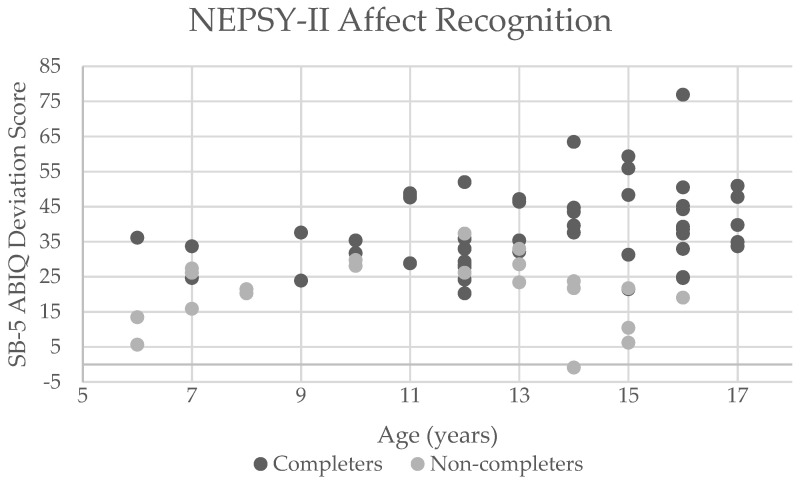
- Feasibility met the study’s a priori criterion for the NEPSY-II Theory of Mind (86.3–87.7%) and the SRS-2 (87.7%), but not for NEPSY-II Affect Recognition (71.2%).
- Floor effects were acceptable for NEPSY-II Theory of Mind raw scores (15.1–19.2%) and the SRS-2 (12.3%), but problematic for NEPSY-II Theory of Mind percentile ranks: 95% of completers had the lowest percentile rank for Verbal and 97% for Total; 39% had the lowest standard score on Affect Recognition.
- Test-retest reliability over a two-week interval was moderate for NEPSY-II Theory of Mind raw scores, poor for NEPSY-II Affect Recognition, and moderate to excellent for the SRS-2, with all SRS-2 ICCs ≥ 0.70.
- No practice effects were detected on any measure. Convergent validity across direct social-cognition tasks and parent-report SRS-2 social-cognition/social-awareness subscales was not supported; correlations between NEPSY-II Theory of Mind and Affect Recognition were 0.43–0.51, below the study’s ≥0.50 criterion.
## Methods
- Psychometric evaluation study of social cognition and social behavior measures in children and adolescents with Down syndrome, using two study visits spaced two weeks apart.
- Sample: 73 participants with DS, ages 6–17 years (M = 12.67, SD = 3.16), with average IQ 48.70 (SD = 4.76); 54.8% male; most were White (87.7%) and non-Hispanic (93.2%).
- Measures/analysis: NEPSY-II Theory of Mind and Affect Recognition, SRS-2 parent report, plus SB-5 ABIQ, EVT-3, and PPVT-5. Analyses included feasibility percentages, floor effects, intraclass correlation coefficients for test-retest reliability, paired t-tests for practice effects, and Pearson correlations for convergent validity and associations with age, cognition, and language. Post hoc sensitivity/specificity analyses were used for the low-feasibility Affect Recognition subtest.
## Limitations
- The paper states that ASD rates in the sample were lower than in other DS studies, so additional work is needed to determine whether the measures are appropriate for children with DS and co-occurring ASD.
- The paper states that a longer follow-up period is needed to evaluate these measures over 6 months or a year, and that narrower age bands should be studied in future work.
- The paper states that social behavior was only measured by parent report and that no direct assessments of social behavior were included; it also notes that the NEPSY-II direct assessments did not correlate with SRS-2 social cognition/awareness, raising questions about ecological validity and generalizability to real-world contexts.
- Evident from the text: the excerpted full text is incomplete at the end of the limitations section, so the paper’s full limitation list is not fully visible here.
Model-written summary. Check it against the paper before relying on it.
Integrity signals
Registry
Cites
Statistics
Figures
Verification
Claims the paper makes
7 Valid · 3 Not valid · 3 Not checked · 36 Own results and interpretations
The cited sources that could be checked couldn’t confirm or dispute this claim.
In the paper
“Affect and emotion recognition is also an area of challenge in DS in comparison with children with typical development matched on cognitive or receptive language level [16,17].”
§ Psychometric Evaluation of Social Cognition and Behavior Measures in Children and Adolescents with Down Syndrome > 1. Introduction
What the sources say
- Not checked — no full text of the sourcecites [16] Williams K.R. Wishart J.G. Pitcairn T.K. Willis D.S. Emotion recognition by children with Down syndrome: Investigation of specific impairments and error patterns Am. J. Ment. Retard. 2005 110 378 392 10.1352/0895-8017(2005)110[378:ERBCWD]2.0.CO;2 16080776 source
- Could not verifycites [17] Hippolyte L. Barisnikov K. Van der Linden M. Detraux J.J. From facial emotional recognition abilities to emotional attribution: A study in Down syndrome Res. Dev. Disabil. 2009 30 1007 1022 10.1016/j.ridd.2009.02.004 19297130 sourceExperimental — accuracy not yet measured
Our copy of Hippolyte et al. (2009) is the ORBi repository record: the section '2009 • In Research in Developmental Disabilities, 30 (5), p. 1007-1022' gives only keywords (Adult; Down syndrome; Emotional attribution; Facial expressions; Child; ...) with the 'Abstract :' field empty in the retrieved text, plus the reference list and a 'Similar publications' block. No passage of this paper's own introduction, methods or results is retrievable, so nothing in our copy states that the DS group was impaired relative to typically developing children matched on cognitive level or receptive language. The matched-control findings that do appear belong to other works quoted inside the record's similar-publications/reference material — the 2008 Hippolyte, Barisnikov & Van der Linden AJMR abstract (adults with DS vs. child controls matched for receptive vocabulary) and the Santana et al. 2014 abstract — not to the 2009 paper's own text. Searched: emotion recognition vs. matched controls, mental-age/receptive-vocabulary matching, facial emotional expression results, emotional attribution. (LLM, conf=0.62)
plainstates an association- Asserted: passes — The authors put it forward as true.
- Checkable: passes — It can be checked against evidence.
- Load-bearing: unclear — It is unclear whether the paper’s conclusions depend on it.
- Based: passes — The paper gives a reason why it holds.
The cited sources that could be checked couldn’t confirm or dispute this claim.
In the paper
“Low feasibility and standard scores on this measure may be, in part, due to difficulties individuals with DS have with recognizing emotional expressions in others [16,17].”
§ Psychometric Evaluation of Social Cognition and Behavior Measures in Children and Adolescents with Down Syndrome > 4. Discussion > 4.1. Feasibility and Floor Effects
What the sources say
- Not checked — no full text of the sourcecites [16] Williams K.R. Wishart J.G. Pitcairn T.K. Willis D.S. Emotion recognition by children with Down syndrome: Investigation of specific impairments and error patterns Am. J. Ment. Retard. 2005 110 378 392 10.1352/0895-8017(2005)110[378:ERBCWD]2.0.CO;2 16080776 source
- Could not verifycites [17] Hippolyte L. Barisnikov K. Van der Linden M. Detraux J.J. From facial emotional recognition abilities to emotional attribution: A study in Down syndrome Res. Dev. Disabil. 2009 30 1007 1022 10.1016/j.ridd.2009.02.004 19297130 sourceExperimental — accuracy not yet measured
Our copy of Hippolyte et al. (2009, RDD 30(5):1007-1022) is only the ORBi repository record — bibliographic metadata and keywords (section '2009 • In Research in Developmental Disabilities, 30 (5), p. 1007-1022', where the 'Abstract :' field is empty/truncated), the reference list, and 'Similar publications' abstracts (section '3 Recent citations > 1.1 Relative Citation Ratio'). No passage of this paper's own text reports its findings on facial emotional recognition in DS; the statements about DS emotion-recognition difficulties in our copy belong to other works listed as similar publications (Hippolyte, Barisnikov & Van der Linden 2008, AJMR 11:292-306, on adults; Santana, Pena de Souza & Feitosa 2014, on children aged 6-11 using TEPEF/WISC-III). Searched: recognition of facial emotional expressions in Down syndrome, emotional attribution/vignettes, 'the present study aimed to', conclusions/results — none returned the 2009 article's body or abstract, so the claim can be neither supported nor contradicted. (LLM, conf=0.70)
hedgedstates a possible cause- Asserted: passes — The authors put it forward as true.
- Checkable: passes — It can be checked against evidence.
- Load-bearing: passes — The paper’s conclusions depend on it.
- Based: passes — The paper gives a reason why it holds.
Every source the paper cites for this claim was checked and supports it.
In the paper
“This study also replicated previous reports of no correlation between the SRS-2 subscales and expressive language [5].”
§ Psychometric Evaluation of Social Cognition and Behavior Measures in Children and Adolescents with Down Syndrome > 4. Discussion > 4.2. Test-Retest Reliability, Practice Effects, and Validity
What the sources say
- Supportedcites [5] Channell M.M. The Social Responsiveness Scale (SRS-2) in school-age children with Down syndrome at low risk for autism spectrum disorder Autism Dev. Lang. Impair. 2020 5 2396941520962406 10.1177/2396941520962406 PMC8232392 34179506 source
The Results section’s Table 3 reports no statistically significant correlations between the two SRS-2 domain scores (SCI and RRB) and either expressive vocabulary or expressive morphosyntax in this sample of school-age children with Down syndrome. The finding concerns nonsignificant correlations, not correlations of exactly zero. (LLM, conf=0.88)
plain- Asserted: passes — The authors put it forward as true.
- Checkable: passes — It can be checked against evidence.
- Load-bearing: unclear — It is unclear whether the paper’s conclusions depend on it.
- Based: passes — The paper gives a reason why it holds.
- Supported
A result the paper reports from its own data — it cites no other source for it, so there is none to check. The quote shows it is in the paper.
In the paper
“The NEPSY-II Affect Recognition had poor test-retest reliability, again below acceptable criterion.”
§ Psychometric Evaluation of Social Cognition and Behavior Measures in Children and Adolescents with Down Syndrome > 3. Results > 3.2. Aim 2: Test-Retest Reliability, Practice Effects, and Validity
plain- Asserted: passes — The authors put it forward as true.
- Checkable: passes — It can be checked against evidence.
- Load-bearing: passes — The paper’s conclusions depend on it.
- Based: passes — The paper gives a reason why it holds.
A result the paper reports from its own data — it cites no other source for it, so there is none to check. The quote shows it is in the paper.
In the paper
“There were no practice effects on any of the measures evaluated in this study (see Table 2).”
§ Psychometric Evaluation of Social Cognition and Behavior Measures in Children and Adolescents with Down Syndrome > 3. Results > 3.2. Aim 2: Test-Retest Reliability, Practice Effects, and Validity
plain- Asserted: passes — The authors put it forward as true.
- Checkable: passes — It can be checked against evidence.
- Load-bearing: passes — The paper’s conclusions depend on it.
- Based: passes — The paper gives a reason why it holds.
17 more claims
Create a free account to see all 49 claims and to verify the 1 reference still open.
- It may state two separate claims as one. 24
- Probably not a substantial claim. 6
- Borderline: one of the tests for a substantial claim is unclear. 1
Citations
Cites
A guideline of selecting and reporting intraclass correlation coefficients for reliability research
Koo, T. K., & Li, M. Y. (2016) · Journal of Chiropractic Medicine · doi:10.1016/j.jcm.2016.02.012 · Cited by 31,709 · cited 1×
“90) [33,40], and a priori good or excellent classifications were deemed suitable.”
BackgroundConstantino, J. N. (2013) · Encyclopedia of Autism Spectrum Disorders · doi:10.1007/978-1-4419-1698-3_296 · Cited by 908
Language Skills of Children and Adolescents With Down Syndrome: II. Production Deficits
Chapman, R. S., Seung, H.-K., Schwartz, S. E., & Kay-Raining Bird, E. (1998) · Journal of Speech, Language, and Hearing Research · doi:10.1044/jslhr.4104.861 · Cited by 317
Social Cognition Psychometric Evaluation: Results of the Initial Psychometric Study
Pinkham, A. E., Penn, D. L., Green, M. F., & Harvey, P. D. (2016) · Schizophrenia Bulletin · doi:10.1093/schbul/sbv056 · Cited by 303
Annual Research Review: Towards a developmental neuroscience of atypical social cognition
Happé, F., & Frith, U. (2014) · Journal of Child Psychology and Psychiatry · doi:10.1111/jcpp.12162 · Cited by 293
Social Cognition Psychometric Evaluation: Results of the Final Validation Study
Pinkham, A. E., Harvey, P. D., & Penn, D. L. (2018) · Schizophrenia Bulletin · doi:10.1093/schbul/sbx117 · Cited by 290 · cited 1×
“Finally, because few standardized clinical assessments focus on social cognition, further examination of a greater variety of social cognition laboratory-based measures is needed to ensure that the measures appropriate for the general population [29,31] are also suitable for individuals with DS.”
BackgroundSocial Cognition, Language Acquisition and The Development of the Theory of Mind
Garfield, J. L., Peterson, C. C., & Perry, T. (2001) · Mind & Language · doi:10.1111/1468-0017.00180 · Cited by 266
DiGuiseppi, C., Hepburn, S., Davis, J. M., Fidler, D. J., Hartway, S., Lee, N. R., Miller, L., Ruttenber, M., & Robinson, C. (2010) · Journal of Developmental & Behavioral Pediatrics · doi:10.1097/dbp.0b013e3181d5aa6d · Cited by 233 · cited 1×
“Recent studies show that approximately 15–18% of children with DS also have an ASD diagnosis, which is markedly higher than the 1% reported in the general population [6,7].”
BackgroundOutcome Measures for Clinical Trials in Down Syndrome
Esbensen, A. J., Hooper, S. R., Fidler, D., Hartley, S. L., Edgin, J., d'Ardhuy, X. L., Capone, G., Conners, F. A., Mervis, C. B., Abbeduto, L., et al. (2017) · American Journal on Intellectual and Developmental Disabilities · doi:10.1352/1944-7558-122.3.247 · Cited by 153 · cited 2×
“A summary from this working group identified no direct assessments of social cognition with evidence for use in DS but did state that the SRS2 showed promise based on the sensitivity of the measure to detect ASD symptoms in DS [19,28].”
BackgroundSelf-citationImproving IQ measurement in intellectual disabilities using true deviation from population norms
Sansone, S. M., Schneider, A., Bickel, E., Berry-Kravis, E., Prescott, C., & Hessl, D. (2014) · Journal of Neurodevelopmental Disorders · doi:10.1186/1866-1955-6-16 · Cited by 148
Abbeduto, L., Pavetto, M., Kesin, E., Weissman, M., Karadottir, S., O’Brien, A., & Cawthon, S. (2001) · Down Syndrome Research and Practice · doi:10.3104/reports.109 · Cited by 145 · cited 3×
“below their overall nonverbal cognitive abilities [14,15].”
BackgroundResultHessl, D., Sansone, S. M., Berry-Kravis, E., Riley, K., Widaman, K. F., Abbeduto, L., Schneider, A., Coleman, J., Oaklander, D., Rhodes, K. C., et al. (2016) · Journal of Neurodevelopmental Disorders · doi:10.1186/s11689-016-9167-4 · Cited by 126 · cited 1×
“This selection was informed by previous work on the psychometrics of cognitive measurements in intellectual disability and DS [33,39].”
MethodWishart, J. G., Cebula, K. R., Willis, D. S., & Pitcairn, T. K. (2007) · Journal of Intellectual Disability Research · doi:10.1111/j.1365-2788.2006.00947.x · Cited by 122 · cited 1×
“Most of these measures are laboratory-based and include false belief tasks involving the location of objects [15,21,22] or the content of a container [15], appearance reality tasks [15,22], and emotion-matching tasks [16,17,23].”
BackgroundWilliams, K. R., Wishart, J. G., Pitcairn, T. K., & Willis, D. S. (2005) · American Journal on Mental Retardation · doi:10.1352/0895-8017(2005)110[378:erbcwd]2.0.co;2 · Cited by 110 · cited 3×
“Low feasibility and standard scores on this measure may be, in part, due to difficulties individuals with DS have with recognizing emotional expressions in others [16,17].”
BackgroundResultSocial cognition in children with Down's syndrome: challenges to research and theory building
Cebula, K. R., Moore, D. G., & Wishart, J. G. (2010) · Journal of Intellectual Disability Research · doi:10.1111/j.1365-2788.2009.01215.x · Cited by 105 · cited 2×
“Although the majority of research on social cognition is completed with toddlers and preschool-aged children [9], these measures are used in the assessment of older children, adolescents, and young adults with DS [14,15].”
BackgroundNonverbal Requesting and Problem-Solving by Toddlers With Down Syndrome
Fidler, D. J., Philofsky, A., Hepburn, S. L., & Rogers, S. J. (2005) · American Journal on Mental Retardation · doi:10.1352/0895-8017(2005)110[312:nrapbt]2.0.co;2 · Cited by 104 · cited 1×
“Individuals with Down syndrome (DS) are commonly described as socially engaged [1] and as having relatively strong nonverbal social functioning in early childhood [2].”
BackgroundLoukusa, S., Mäkinen, L., Kuusikko‐Gauffin, S., Ebeling, H., & Moilanen, I. (2014) · International Journal of Language & Communication Disorders · doi:10.1111/1460-6984.12091 · Cited by 98
Korkman, M., Kirk, U., & Kemp, S. (2012) · PsycTESTS Dataset · doi:10.1037/t15125-000 · Cited by 98
Autism symptoms in toddlers with Down syndrome: a descriptive study
Hepburn, S., Philofsky, A., Fidler, D. J., & Rogers, S. (2008) · Journal of Applied Research in Intellectual Disabilities · doi:10.1111/j.1468-3148.2007.00368.x · Cited by 94 · cited 1×
“Recent studies show that approximately 15–18% of children with DS also have an ASD diagnosis, which is markedly higher than the 1% reported in the general population [6,7].”
BackgroundMiranda, A., Berenguer, C., Roselló, B., Baixauli, I., & Colomer, C. (2017) · Frontiers in Psychology · doi:10.3389/fpsyg.2017.01035 · Cited by 93
Channell, M. M., Phillips, B. A., Loveall, S. J., Conners, F. A., Bussanich, P. M., & Klinger, L. G. (2015) · Journal of Neurodevelopmental Disorders · doi:10.1186/1866-1955-7-5 · Cited by 88 · cited 9×
“As we learn more about the social phenotype of children with DS and DS+ASD and as social challenges are better characterized [8,19], additional socially focused interventions tailored to children with DS will be needed.”
BackgroundMethodResultInfluentialDaunhauer, L. A., & Fidler, D. J. (2011) · Occupational Therapy In Health Care · doi:10.3109/07380577.2010.535601 · Cited by 84 · cited 1×
“Individuals with Down syndrome (DS) are commonly described as socially engaged [1] and as having relatively strong nonverbal social functioning in early childhood [2].”
BackgroundDonepezil for treatment of cognitive dysfunction in children with Down syndrome aged 10–17
Kishnani, P. S., Heller, J. H., Spiridigliozzi, G. A., Lott, I., Escobar, L., Richardson, S., Zhang, R., & McRae, T. (2010) · American Journal of Medical Genetics Part A · doi:10.1002/ajmg.a.33730 · Cited by 83 · cited 1×
“Lower bounds of chronological age in previous clinical trials in DS informed benchmark selection [41].”
BackgroundTheory of mind deficits in children with fragile X syndrome
Cornish, K., Burack, J. A., Rahman, A., Munir, F., Russo, N., & Grant, C. (2005) · Journal of Intellectual Disability Research · doi:10.1111/j.1365-2788.2005.00678.x · Cited by 83 · cited 1×
“Most of these measures are laboratory-based and include false belief tasks involving the location of objects [15,21,22] or the content of a container [15], appearance reality tasks [15,22], and emotion-matching tasks [16,17,23].”
BackgroundSocial Cognition in Children with Down Syndrome
Cebula, K. R., & Wishart, J. G. (2008) · International review of research in mental retardation · doi:10.1016/s0074-7750(07)35002-7 · Cited by 76 · cited 1×
“For a review of social cognition development in DS, see [20].”
BackgroundAbbeduto, L., Short‐Meyerson, K., Benson, G., & Dolish, J. (2004) · Journal of Intellectual Disability Research · doi:10.1111/j.1365-2788.2004.00524.x · Cited by 58 · cited 3×
“Further, the NEPSY-II Theory of Mind is moderately correlated with receptive and expressive language, and overall language abilities may be confounding performance, as has occurred in previous studies [21].”
BackgroundMethodResultSocial Information Processing in Preschool Children Diagnosed with Autism Spectrum Disorder
Ziv, Y., Hadad, B. S., Khateeb, Y., & Terkel-Dawer, R. (2013) · Journal of Autism and Developmental Disorders · doi:10.1007/s10803-013-1935-3 · Cited by 56 · cited 1×
“In children with ASD, specific connections have been made between social information processing and social behavior [12,13].”
BackgroundFrom facial emotional recognition abilities to emotional attribution: A study in Down syndrome
Hippolyte, L., Barisnikov, K., Van der Linden, M., & Detraux, J.-J. (2009) · Research in Developmental Disabilities · doi:10.1016/j.ridd.2009.02.004 · Cited by 55 · cited 3×
“Low feasibility and standard scores on this measure may be, in part, due to difficulties individuals with DS have with recognizing emotional expressions in others [16,17].”
BackgroundResultGiaouri, S., Alevriadou, A., & Tsakiridou, E. (2010) · Procedia - Social and Behavioral Sciences · doi:10.1016/j.sbspro.2010.03.609 · Cited by 46 · cited 4×
“below their overall nonverbal cognitive abilities [14,15].”
BackgroundResultInfluentialLanguage Development in Individuals With Intellectual and Developmental Disabilities
(2016) · International Review of Research in Developmental Disabilities · doi:10.1016/bs.irrdd.2016.05.006 · Cited by 43
Cognitive Profiles and Autism Symptoms in Comorbid Down Syndrome and Autism Spectrum Disorder
Hamner, T., Hepburn, S., Zhang, F., Fidler, D. J., Rosenberg, C. R., Robins, D. L., & Lee, N. (2019) · Journal of Developmental & Behavioral Pediatrics · doi:10.1097/dbp.0000000000000745 · Cited by 38 · cited 2×
“Children with DS, with and without co-occurring ASD, experience social challenges that impede interactions with peers [5,8].”
BackgroundChannell, M. M. (2020) · Autism & Developmental Language Impairments · doi:10.1177/2396941520962406 · Cited by 36 · cited 7×
“Finally, associations with chronological age were minimal and corroborate previous reports of a lack of association with the SRS [5,19], suggesting that developmental level is a better indicator of social cognition and behavior than age.”
BackgroundMethodResultInfluentialTwomey, C. D., O'Connell, H., Lillis, M. A., Tarpey, S. L., & O’Reilly, G. (2017) · Autism Research · doi:10.1002/aur.1911 · Cited by 35 · cited 1×
“The ABIQ is strongly correlated with the full-scale IQ in samples of children with a neurodevelopmental disorder [36], and reliability is also high for the ABIQ (r = 0.”
BackgroundWill, E., Schworer, E. K., & Esbensen, A. J. (2021) · Child Neuropsychology · doi:10.1080/09297049.2021.1917531 · Cited by 32 · cited 1×
“Data from the participants in this study have been used in other manuscripts focused on the assessment of working memory outcome measures [33] and the association between executive function and adaptive skills [34].”
ResultSelf-citationEvaluating working memory outcome measures for children with Down syndrome
Schworer, E. K., Esbensen, A. J., Fidler, D. J., Beebe, D. W., Carle, A., & Wiley, S. (2022) · Journal of Intellectual Disability Research · doi:10.1111/jir.12833 · Cited by 26 · cited 4×
“These analyses were completed for any measure that did not meet study feasibility criteria, and suggestions for age and cognitive ability of participants for future administration were established (as per [33]).”
BackgroundMethodResultSelf-citationPino, M. C., Mariano, M., Peretti, S., D’Amico, S., Masedu, F., Valenti, M., & Mazza, M. (2018) · European Journal of Developmental Psychology · doi:10.1080/17405629.2018.1537876 · Cited by 18 · cited 2×
“In children with ASD, specific connections have been made between social information processing and social behavior [12,13].”
BackgroundImproving Theory of Mind Skills in Down Syndrome? A Pilot Study
Comblain, A., & Schmetz, C. (2020) · Journal of Cognitive Education and Psychology · doi:10.1891/jcep-d-18-00034 · Cited by 11 · cited 1×
“Pilot interventions targeting theory of mind skills have recently been completed with children and adolescents with DS [26] and suggest that these skills can be improved with targeted behavioral intervention.”
Background
Research works printed but not linked: 3
- Roid G. Stanford-Binet Intelligence Scale: Fifth Edition Riverside Chicago, CA, USA 2003
- Williams K.T. Expressive Vocabulary Test 3rd ed. Pearson Bloomington, MN, USA 2018
- Dunn D.M. Peabody Picture Vocabulary Test 5th ed. Pearson Bloomington, MN, USA 2019
Cited by
Latent profiles of autism symptoms in children and adolescents with Down syndrome
Fidler, D. J., Prince, M. A., Deusen, K. V., Esbensen, A. J., Thurman, A. J., Abbeduto, L., Patel, L., Mervis, C. Β., Schworer, E. K., Lee, N.-H., et al. (2022) · Journal of Intellectual Disability Research · doi:10.1111/jir.12910 · Cited by 26
Self-citationVandoni, M., Giuriato, M., Pirazzi, A., Zanelli, S., Gaboardi, F., Pellino, V. C., Gazzarri, A. A., Baldassarre, P., Zuccotti, G., & Calcaterra, V. (2023) · Pediatric Reports · doi:10.3390/pediatric15040062 · Cited by 45
“Another popular test to evaluate inhibition was NEPSY II [79,80].”
BackgroundSchworer, E. K., Ahmed, A. T., Hogenkamp, L., Moore, S., & Esbensen, A. J. (2022) · Research in Developmental Disabilities · doi:10.1016/j.ridd.2022.104236 · Cited by 20
Self-citationSchworer, E. K., Soltani, A., Altaye, M., Fidler, D. J., & Esbensen, A. J. (2023) · Research in Developmental Disabilities · doi:10.1016/j.ridd.2022.104416 · Cited by 22
Self-citationSchworer, E. K., Voth, K., Hoffman, E. K., & Esbensen, A. J. (2021) · Research in Developmental Disabilities · doi:10.1016/j.ridd.2021.104147 · Cited by 16
Self-citation
Metadata
- Authors
- Schworer, E., Hoffman, E., & Esbensen, A.
- Affiliations
- Cincinnati Children's Hospital Medical Center (US)
- Corresponding author
- Schworer, Emily
- Venue
- Brain Sciences
- Publisher
- MDPI AG
- Published
- 2021-06-24
- Volume
- 11
- Issue
- 7
- Pages
- 836
- ISSN
- 2076-3425 (ISSN-L)
- PMC
- PMC8301941
- OpenAlex
- W3176014376
- Cited by
- 24
- References
- 35
- Citations by year
- 2026: 1 · 2025: 2 · 2024: 1 · 2023: 11 · 2022: 6 · 2021: 3
- FWCI
- 4.54
- Type
- journal article
- Language
- en
- Open access
- gold
- doi.org
- Licence
- Locations
- Brain Sciences (publishedVersion, cc-by)
- PubMed Central (publishedVersion, cc-by)
- PubMed (publishedVersion)
- DOAJ (DOAJ: Directory of Open Access Journals) (submittedVersion, cc-by-sa)
- Funders
- Eunice Kennedy Shriver National Institute of Child Health and Human Development (R01 HD093754)
- Topics
- Health Sciences › Medicine › Public Health, Environmental and Occupational Health › Down syndrome and intellectual disability research
- Life Sciences › Neuroscience › Cognitive Neuroscience › Autism Spectrum Disorder Research
- Life Sciences › Neuroscience › Developmental Neuroscience › Williams Syndrome Research
- Keywords
- Down syndrome, social cognition, social behavior, outcome measures, psychometric properties, children and adolescents, theory of mind, affect recognition, Social Responsiveness Scale, NEPSY-II, test-retest reliability, convergent validity, floor effect, caregiver reports
About these checks
Registry, retraction, Cites and statistics results are computed, not judged, with one exception: a printed reference that no index lists is read once by a model before it counts as a citation error. Claims are extracted by a model and kept only when their quote appears verbatim in the text; each cited source is then checked, with a model’s help, for whether it says what the claim relies on. Those verdicts can be wrong — read the claim’s quote and the cited source before relying on one.
The claim verdicts this report counts are experimental: their accuracy is not yet measured.
A language model drew the claims from the paper on 2026-10-10, under version 3 of the claim definition (model deepseek-v4.1-flash, prompt extract-v3).
A second model labelled each claim on 2026-10-10 (model jev-1.13-20260917, definition revision gold-guideline-v0.2).
Cited sources are checked with a language model’s help (qwen3.8-omni-flash and gpt-6-sol).
Statistics and arithmetic are recomputed, not judged.
Confidence bands are shown only for fields calibrated on our annotated test set. None is calibrated yet, so no band is shown.
What counts as a claim ›How we measure confidence ›How we check this ›
Are you an author, or do you see a problem with this page? Request a review
Data sources
Bibliographic data: Semantic Scholar, OpenAlex, Crossref.
Contains information from the Semantic Scholar Academic Graph Datasets, made available under the ODC Attribution License (ODC-BY 1.0).
Semantic Scholar’s data is described in: Kinney, R., et al. (2023). The Semantic Scholar Open Data Platform. arXiv:2301.10140.
