

Sensory Processing Phenotypes in Phelan-McDermid Syndrome and SYNGAP1-Related Intellectual Disability
Open accessPublished version of a preprint
The DOI matches its Crossref record; 39 of the 42 references it cites were found in a registry or an index.
Abstract
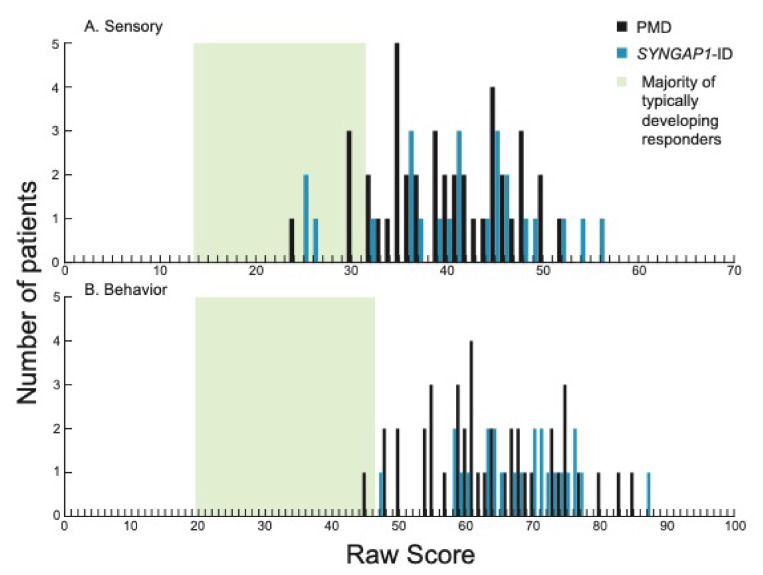
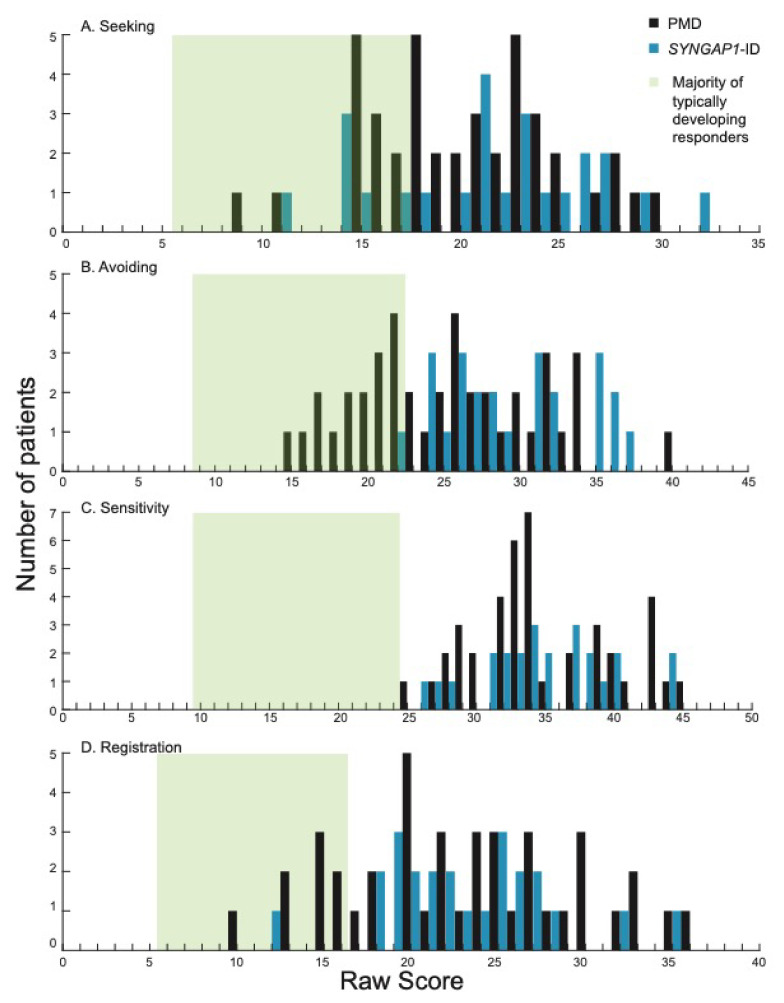
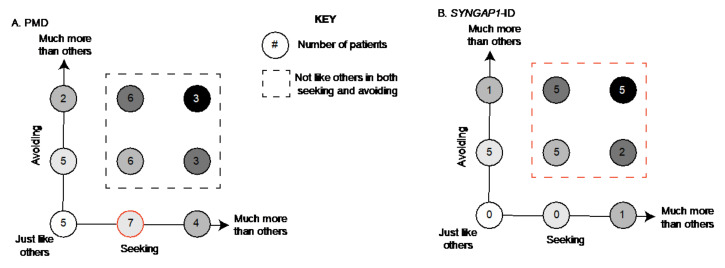
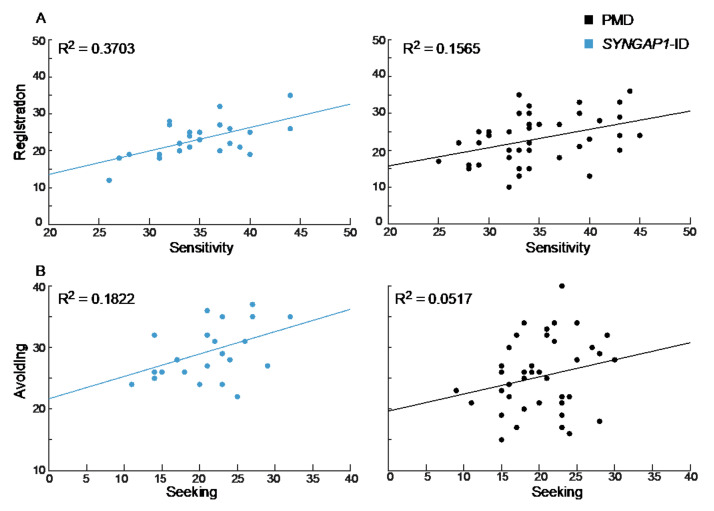
Sensory processing differences are an established feature of both syndromic and non-syndromic Autism Spectrum Disorders (ASDs). Significant work has been carried out to characterize and classify specific sensory profiles in non-syndromic autism. However, it is not known if syndromic autism disorders, such as Phelan-McDermid Syndrome (PMD) or SYNGAP1-related Intellectual Disability (SYNGAP1-ID), have unique sensory phenotypes. Understanding the sensory features of these disorders is important for providing appropriate care and for understanding their underlying mechanisms. Our objective in this work was to determine the sensory processing abnormalities present in two syndromic ASDs: Phelan-McDermid Syndrome and SYNGAP1-related Intellectual Disability. Using a standardized instrument, the Short Sensory Profile-2, we characterized sensory features in 41 patients with PMD and 24 patients with SYNGAP1-ID, and sub-scores were then calculated for seeking, avoiding, sensitivity and registration, as well as overall sensory and behavior scores. We found both patient groups exhibited atypical sensory features, including high scores in the areas of avoiding and seeking. Thus, we discovered significant sensory processing abnormalities are common in these syndromic ASDs. Measurements of sensory processing could serve as useful clinical endpoints for trials of novel therapeutics for these populations.
Overview
The claims and statistics of this paper haven’t been checked yet.
Free: it reads the open-access text and checks the first 5 claims that cite a source we can check. Create a free account to check every claim.
Integrity signals
Registry
Cites
Statistics
Figures
Verification
Claims the paper makes
The claims and statistics of this paper haven’t been checked yet.
Free: it reads the open-access text and checks the first 5 claims that cite a source we can check. Create a free account to check every claim.
Claims other papers make about this one
Each is checked against this paper’s own text: does it say what the citing paper says it does?
The source backs part of the claim, not all of it — or backs it for a different population, condition or comparison.
In the citing paper
“Despite the validation reported by the authors concerning children up to 10 years of age, we decided to administer SSP1 to school-aged subjects until 18 years of age because of their ID level, as already used by other authors [42,43,44,45,46].”
From Sensory Profile of Children and Adolescents with Autism Spectrum Disorder and Tip-Toe Behavior: Results of an Observational Pilot Study (2022) · cites this paper as [46]
Experimental — accuracy not yet measured
Self-check
Percentages, sums and reported differences re-computed from the paper’s own numbers.
The self-check needs the paper’s full text.
Citations
Cites
Satterstrom, F. K., Kosmicki, J. A., Wang, J., Breen, M. S., De Rubeis, S., An, J.-Y., Peng, M., Collins, R., Grove, J., Klei, L., et al. (2020) · Cell · doi:10.1016/j.cell.2019.12.036 · Cited by 2,321
Robertson, C. E., & Baron-Cohen, S. (2017) · Nature Reviews Neuroscience · doi:10.1038/nrn.2017.112 · Cited by 1,157
Describing the Sensory Abnormalities of Children and Adults with Autism
Leekam, S. R., Nieto, C., Libby, S. J., Wing, L., & Gould, J. (2007) · Journal of Autism and Developmental Disorders · doi:10.1007/s10803-006-0218-7 · Cited by 1,140
Dunn, W. (1997) · Infants & Young Children · doi:10.1097/00001163-199704000-00005 · Cited by 899 · cited 1×
“This was later updated to the Short Sensory Profile 2 (SSP-2) [24] based on the Dunn model of sensory processing [25].”
MethodThe Sensations of Everyday Life: Empirical, Theoretical, and Pragmatic Considerations
Dunn, W. (2001) · The American Journal of Occupational Therapy · doi:10.5014/ajot.55.6.608 · Cited by 614
Rogers, S. J., Hepburn, S., & Wehner, E. (2003) · Journal of Autism and Developmental Disorders · doi:10.1023/b:jadd.0000006000.38991.a7 · Cited by 609 · cited 1×
“Interestingly, when compared to children with autism, sensory scores on the Short Sensory Profile (SSP) for patients with Fragile X syndrome exhibited similar ranges even when the mean score was significantly different [39].”
BackgroundGao, R., & Penzes, P. (2015) · Current Molecular Medicine · doi:10.2174/1566524015666150303003028 · Cited by 516
The impact of atypical sensory processing on social impairments in autism spectrum disorder
Thye, M. D., Bednarz, H. M., Herringshaw, A. J., Sartin, E. B., & Kana, R. K. (2018) · Developmental Cognitive Neuroscience · doi:10.1016/j.dcn.2017.04.010 · Cited by 513
Sensory and attention abnormalities in autistic spectrum disorders
Liss, M., Saulnier, C., Fein, D., & Kinsbourne, M. (2006) · Autism · doi:10.1177/1362361306062021 · Cited by 450 · cited 1×
“used selected questions from the sensory profile with additional sensory-specific questions and found four clusters, including a cluster with high scores in under-responsivity and sensory seeking [37].”
MethodSensory Over-Responsivity in Elementary School: Prevalence and Social-Emotional Correlates
Ben-Sasson, A., Carter, A. S., & Briggs-Gowan, M. J. (2009) · Journal of Abnormal Child Psychology · doi:10.1007/s10802-008-9295-8 · Cited by 406
Research works printed but not linked: 2
- Phelan K. Rogers R.C. Boccuto L. Phelan-McDermid Syndrome GeneReviews® [Internet] Adam M.P. University of Washington Seattle, DC, USA 2018 20301377
- Dunn W. Sensory Profile 2. User’s Manual Pearson New York, NY, USA 2014
Cited by
Wang, L., Wang, B., Wu, C., Wang, J., & Sun, M. (2023) · International Journal of Molecular Sciences · doi:10.3390/ijms24031819 · Cited by 237
Circuit-level theories for sensory dysfunction in autism: convergence across mouse models
Monday, H. R., Wang, H. C., & Feldman, D. E. (2023) · Frontiers in Neurology · doi:10.3389/fneur.2023.1254297 · Cited by 33
Bridging the translational gap: what can synaptopathies tell us about autism?
Molloy, C. J., Cooke, J., Gatford, N. J. F., Rivera-Olvera, A., Avazzadeh, S., Homberg, J. R., Grandjean, J., Fernandes, C., Shen, S., Loth, E., et al. (2023) · Frontiers in Molecular Neuroscience · doi:10.3389/fnmol.2023.1191323 · Cited by 26
Lucas, C. C., Pereira, A. P. D. S., Almeida, L. S., & Beaudry‐Bellefeuille, I. (2023) · Journal of Occupational Therapy Schools & Early Intervention · doi:10.1080/19411243.2023.2203418 · Cited by 25
Valagussa, G., Purpura, G., Nale, A., Pirovano, R., Mazzucchelli, M., Grossi, E., & Perin, C. (2022) · Children · doi:10.3390/children9091336 · Cited by 20
Lyons-Warren, A. M., Wangler, M. F., & Wan, Y. (2022) · International Journal of Molecular Sciences · doi:10.3390/ijms232113030 · Cited by 20
Self-citationLachiewicz, A. M., Stackhouse, T. M., Burgess, K. M., Burgess, D., Andrews, H., Choo, T.-H. J., Kaufmann, W. E., & Kidd, S. A. (2023) · Journal of Autism and Developmental Disorders · doi:10.1007/s10803-023-06135-y · Cited by 17
Chen, L., Li, Z., & Fan, Y. (2025) · Frontiers in Cellular and Infection Microbiology · doi:10.3389/fcimb.2025.1601888 · Cited by 16
Understanding the role of AMPA receptors in autism: insights from circuit and synapse dysfunction
Jiménez-Gómez, A., Nguyen, M. X., & Gill, J. S. (2024) · Frontiers in Psychiatry · doi:10.3389/fpsyt.2024.1304300 · Cited by 15
Syngap1 promotes cognitive function through regulation of cortical sensorimotor dynamics
Vaissière, T., Michaelson, S. D., Creson, T. K., Goins, J., Fürth, D., Balázsfi, D., Rojas, C., Golovin, R. M., Meletis, K., Miller, C. A., et al. (2025) · Nature Communications · doi:10.1038/s41467-025-56125-0 · Cited by 14
Sensory processing in 16p11.2 deletion and 16p11.2 duplication
Smith, H. L., Lane, C., Al‐Jawahiri, R., & Freeth, M. (2022) · Autism Research · doi:10.1002/aur.2802 · Cited by 12
SYNGAP-1 Mutation And Catatonia: A Case Series and Systematic Review
Baldwin, I., Cho, A., Orenstein, G., Wilner, N., Nicoli, D., & Smith, J. R. (2024) · Journal of Child and Adolescent Psychopharmacology · doi:10.1089/cap.2024.0055 · Cited by 11
Sensory processing in Sotos syndrome and Tatton-Brown–Rahman Syndrome.
Smith, H. L., Lane, C., Al‐Jawahiri, R., & Freeth, M. (2023) · Journal of Psychopathology and Clinical Science · doi:10.1037/abn0000837 · Cited by 11
Behavioural and neurodevelopmental characteristics of SYNGAP1
Bednarczuk, N. F., Housby, H., Lee, I., Skuse, D., & Wolstencroft, J. (2024) · Journal of Neurodevelopmental Disorders · doi:10.1186/s11689-024-09563-8 · Cited by 10
Jadhav, V., Carreño-Muñoz, M. I., Chehrazi, P., Michaud, J. L., Chattopadhyaya, B., & Cristo, G. D. (2024) · Journal of Neuroscience · doi:10.1523/jneurosci.0946-24.2024 · Cited by 10
Behavioural phenotype of SYNGAP1‐related intellectual disability
Kranak, M. P., Rooker, G. W., & Smith‐Hicks, C. L. (2024) · Journal of Intellectual Disability Research · doi:10.1111/jir.13145 · Cited by 9
Sensory processing and adaptive behavior in Phelan-McDermid syndrome: a cross-sectional study
Serrada-Tejeda, S., Cuadrado, M. L., Martínez-Piédrola, R. M., Máximo-Bocanegra, N., Sánchez-Herrera-Baeza, P., Camacho-Montaño, L. R., & Pérez‐de‐Heredia‐Torres, M. (2022) · European Journal of Pediatrics · doi:10.1007/s00431-022-04564-y · Cited by 9
Sumathipala, S. H., Khan, S., Kozol, R. A., Araki, Y., Syed, S., Huganir, R. L., & Dallman, J. E. (2024) · Frontiers in Molecular Neuroscience · doi:10.3389/fnmol.2024.1401746 · Cited by 7
Cunnane, K. A., Miskimen, A. C. C., Arnesen, R. A., & Grinspan, Z. M. (2025) · Pediatric Neurology · doi:10.1016/j.pediatrneurol.2025.05.017 · Cited by 6
Zhang, J., xue, G., Wang, X., Rao, X., Chen, J., Fan, L., Liu, L., & Gan, J. Y. (2026) · Frontiers in Neurology · doi:10.3389/fneur.2026.1773363 · Cited by 6
Samanta, D. (2026) · Epilepsy & Behavior · doi:10.1016/j.yebeh.2026.111098 · Cited by 6
Dynamic glycosylation remodeling in neurological disorders
Xing, D., Gong, Y., Xia, W., Tu, H., Yuan, L., Yin, Y., & Wang, K. (2025) · Frontiers in Molecular Neuroscience · doi:10.3389/fnmol.2025.1674665 · Cited by 4
Katsanevaki, D., Dupuy, N., Booker, S. A., Wright, D., Kenny, A., Chen, Z., Kudryashova, N., Howitt, P., Stanfield, A. C., Kind, P. C., et al. (2025) · bioRxiv (Cold Spring Harbor Laboratory) · doi:10.1101/2025.04.09.647923 · Cited by 2
Layton, C., & Bennetto, L. (2026) · Research in Autism · doi:10.1016/j.reia.2026.202941 · Cited by 1
Electroencephalographic Transient Beta Event Rates in Autism and Related Neurogenetic ConditionsPreprint
Parra, G., Szilagyi, K., Braverman, Y., Kranz, D., Bebin, E. M., Bernier, R., Bernstein, J. A., Berry‐Kravis, E., Buxbaum, J. D., Chawarska, K., et al. (2026) · medRxiv · doi:10.64898/2026.08.02.26359366 · Cited by 1
Prospective One-Year Follow-Up of Sensory Processing in Phelan–McDermid Syndrome
Serrada-Tejeda, S., Sánchez-Herrera-Baeza, P., Martínez-Piédrola, R. M., Máximo-Bocanegra, N., Pedrajo, N. T., Rodríguez-Pérez, M. P., Fernández-Gómez, G., & Pérez‐de‐Heredia‐Torres, M. (2023) · Children · doi:10.3390/children10061086
Novel parent survey measures sensory behaviors incorporating sensory modality and stimulus intensity
Yee, C., Rather, E., Hoque, S., Lee, J., Marton, S. A., Roth, J., Oswald, F. L., Nobleza, K. J., Banerjee, A., Harris, H. K., et al. (2025) · Heliyon · doi:10.1016/j.heliyon.2025.e43661
Self-citationThe impact of MYT1L-syndrome on behaviour and cognition
Stokes, L. (2023) · White Rose eTheses Online (University of Leeds, The University of Sheffield, University of York)
Metadata
- Authors
- Lyons-Warren, A. M., McCormack, M. C., & Holder, J. L.
- Affiliations
- Baylor College of Medicine (US)
- Corresponding author
- Holder, Jimmy L.
- Venue
- Brain Sciences
- Publisher
- MDPI AG
- Published
- 2022-01-20
- Volume
- 12
- Issue
- 2
- Pages
- 137
- ISSN
- 2076-3425 (ISSN-L)
- PMC
- PMC8869824
- OpenAlex
- W4206642631
- Cited by
- 29
- References
- 42
- Citations by year
- 2026: 3 · 2025: 6 · 2024: 6 · 2023: 10 · 2022: 4
- FWCI
- 3.35
- Type
- journal article
- Language
- en
- Open access
- gold
- doi.org
- Licence
- Locations
- Brain Sciences (publishedVersion, cc-by)
- medRxiv (acceptedVersion, cc-by-nc-nd)
- PubMed Central (publishedVersion, cc-by)
- PubMed (publishedVersion)
- Digital Commons-TMC (Texas Medical Center) (submittedVersion)
- DOAJ (DOAJ: Directory of Open Access Journals) (submittedVersion, cc-by-sa)
- Funders
- SYNGAP1 Foundation (Center of Excellence)
- Joan and Stanford Alexander Foundation (Endowed Chair for Neuropsychiatric Genetics)
- Topics
- Life Sciences › Neuroscience › Cognitive Neuroscience › Autism Spectrum Disorder Research
- Life Sciences › Biochemistry, Genetics and Molecular Biology › Genetics › Genetics and Neurodevelopmental Disorders
- Health Sciences › Medicine › Psychiatry and Mental health › Child Nutrition and Feeding Issues
- Keywords
- sensory processing, Phelan-McDermid syndrome, sensory seeking, sensory avoiding, sensory sensitivity, sensory registration, clinical trial endpoints
About these checks
Registry, retraction, Cites and statistics results are computed, not judged, with one exception: a printed reference that no index lists is read once by a model before it counts as a citation error. Claims are extracted by a model and kept only when their quote appears verbatim in the text; each cited source is then checked, with a model’s help, for whether it says what the claim relies on. Those verdicts can be wrong — read the claim’s quote and the cited source before relying on one.
Statistics and arithmetic are recomputed, not judged.
Confidence bands are shown only for fields calibrated on our annotated test set. None is calibrated yet, so no band is shown.
What counts as a claim ›How we measure confidence ›How we check this ›
Are you an author, or do you see a problem with this page? Request a review
Data sources
Bibliographic data: Semantic Scholar, OpenAlex, Crossref.
Contains information from the Semantic Scholar Academic Graph Datasets, made available under the ODC Attribution License (ODC-BY 1.0).
Semantic Scholar’s data is described in: Kinney, R., et al. (2023). The Semantic Scholar Open Data Platform. arXiv:2301.10140.
