

Effects of differential strategies of emotion regulation
Open accessThe DOI matches its Crossref record; 66 of the 74 references it cites were found in a registry or an index; 17 of the 53 sources its claims cite were checked for support.
Abstract
Patients suffering from mental disorders, especially anxiety disorders, are often impaired by inadequate emotional reactions. Specific aspects are the insufficient perception of their own emotional states and the use of dysfunctional emotion regulation strategies. Both aspects are interdependent. Thus, Cognitive Behavioral Therapy (CBT) comprises the development and training of adequate emotion regulation strategies. Traditionally, reappraisal is the most common strategy, but strategies of acceptance are becoming more important in the course of advancing CBT. Indeed, there is evidence that emotion regulation strategies differ in self-reported effectiveness, psychophysiological reactions, and underlying neural correlates. However, comprehensive comparisons of different emotion regulation strategies are sparse. The present study, therefore, compared the effect of three common emotion regulation strategies (reappraisal, acceptance, and suppression) on self-reported effectiveness, recollection, and psychophysiological as well as electroencephalographic dimensions. Twenty-nine healthy participants were instructed to either reappraise, accept, suppress, or passively observe their upcoming emotional reactions while anxiety-and sadness-inducing pictures were presented. Results showed a compelling effect of reappraisal on emotional experience, skin conductance response, and P300 amplitude. Acceptance was almost as effective as reappraisal, but led to increased emotional experience. Combining all results, suppression was shown to be the least effective but significantly decreased emotional experience when thoughts and feelings had to be suppressed. Moreover, results show that greater propensity for rumination differentially impairs strategies of emotion regulation. © 2019 by the authors. Licensee MDPI, Basel, Switzerland.
Overview
CoChat Summary
## TL;DR
This study compared reappraisal, acceptance, suppression, and passive viewing while 29 healthy participants viewed anxiety- and sadness-inducing pictures. Reappraisal was the most consistently effective strategy, acceptance was often similar on psychophysiology but increased emotional experience, and suppression’s effects depended on whether participants were told to suppress thoughts/feelings as well as expression.
## Key findings
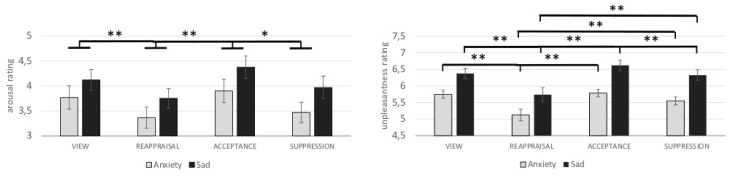
- In the self-report ratings, reappraisal reduced arousal compared with view and acceptance (e.g., arousal: t(29) = 3.27, p(FDR) < 0.01 vs view; t(29) = 4.28, p(FDR) < 0.01 vs acceptance) and reduced unpleasantness for both anxiety and sadness pictures (e.g., anxiety: t(29) = 4.74, p(FDR) < 0.01 vs view; sadness: t(29) = 4.59, p(FDR) < 0.01 vs view).
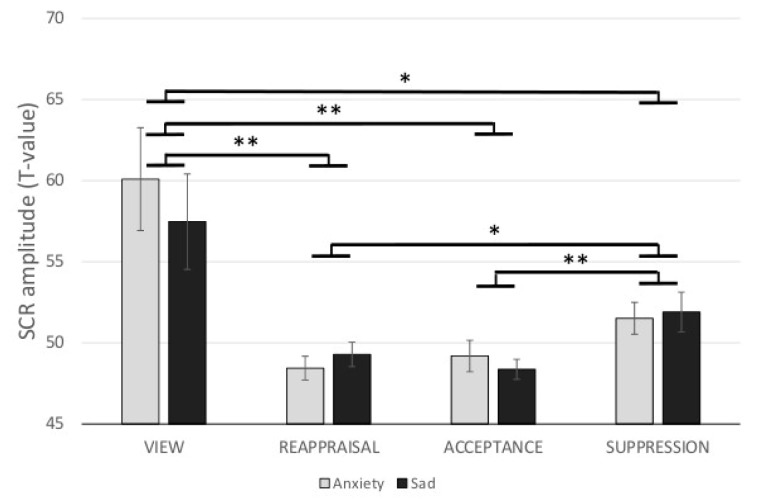
- For skin conductance response (SCR), there was only a main effect of emotion regulation (F(1.26,35.34) = 8.91, η2 = 0.24): SCR was reduced in reappraisal, acceptance, and suppression versus view (all p(FDR) < 0.01 or < 0.05), while suppression showed higher SCR than reappraisal (t(29) = 2.58, p(FDR) < 0.05) and acceptance (t(29) = 3.26, p(FDR) < 0.01).
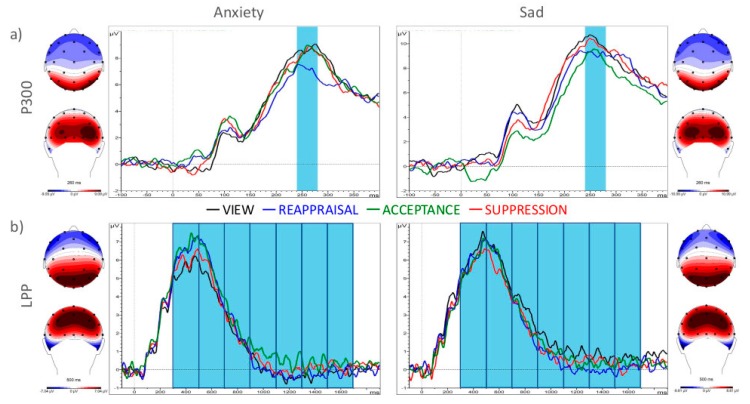
- For EEG, reappraisal reduced P300 amplitude versus view (t(29) = 3.34, p(FDR) < 0.05) and versus suppression (t(29) = 2.78, p(FDR) < 0.05); the paper also reports significant main effects of ER (F(3,87) = 2.83, η2 = 0.09) and emotion (F(1,29) = 5.83, η2 = 0.17).
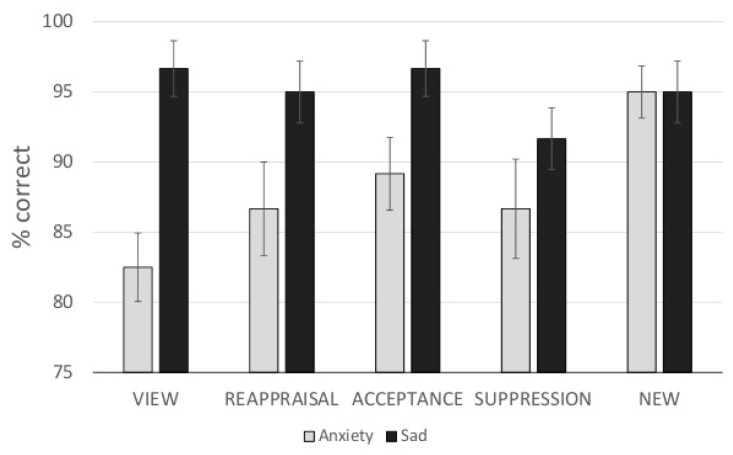
- In the recognition test, there was a main effect of emotion (F(1,29) = 18.70, η2 = 0.39), with sadness-inducing pictures better recognized, but post-hoc tests did not remain significant after alpha adjustment.
## Methods
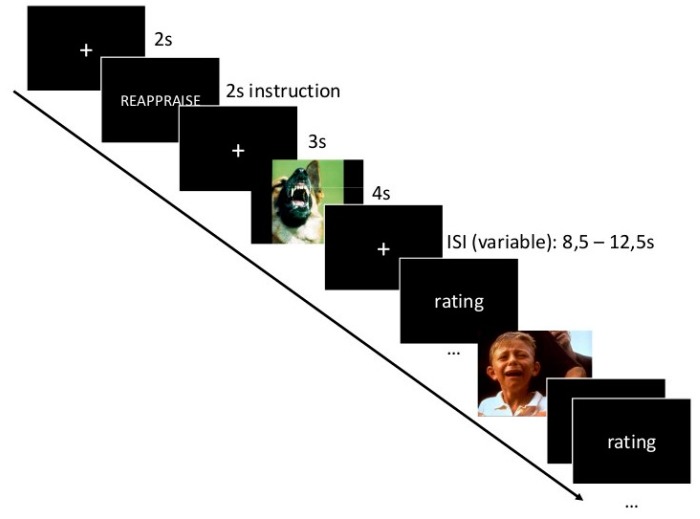
- Design: Repeated-measures experiment comparing four instructions: reappraise, accept, suppress, view; participants rated each picture for arousal and unpleasantness, completed a recognition test, and underwent SCR and EEG recording.
- Sample/data: 31 recruited from the University of Regensburg; 29 analyzed (25 female), healthy participants with normal or corrected-to-normal vision and no neurological or mental disease.
- Analysis: Repeated-measures ANOVAs with FDR correction for post-hoc t-tests; correlation analyses tested associations of STAI-trait, PSWQ, and BDI-II with outcomes. The stimulus set included 36 anxiety-inducing and 36 sadness-inducing IAPS pictures.
## Limitations
- The paper explicitly states the sample size is quite small, the number of trials was relatively low, and effects for EEG and especially the recognition test may have been underestimated.
- The authors note generalizability is limited because the sample was relatively young and healthy.
- The text also notes a potential stimulus limitation: the IAPS anxiety pictures were less variable than the sadness pictures, which might be responsible for impaired memory performance.
Model-written summary. Check it against the paper before relying on it.
Integrity signals
Registry
Cites
Statistics
Figures
Verification
Claims the paper makes
10 Valid · 1 Not valid · 12 Not checked · 79 Own results and interpretations
A result the paper reports from its own data — it cites no other source for it, so there is none to check. The quote shows it is in the paper.
In the paper
“Moreover, results show that greater propensity for rumination differentially impairs strategies of emotion regulation.”
§ Effects of Differential Strategies of Emotion Regulation > Abstract Patients suffering from mental disorders, especially anxiety disorders, are often impaired by inadequate emotional reactions. Specific aspects are the insufficient perception of their own emotional states and the use of dysfunctional emotion regulation strategies. Both aspects are interdependent. Thus, Cognitive Behavioral Therapy (CBT) comprises the development and training of adequate emotion regulation strategies. Traditionally, reappraisal is the most common strategy, but strategies of acceptance are becoming more important in the course of advancing CBT. Indeed, there is evidence that emotion regulation strategies differ in self-reported effectiveness, psychophysiological reactions, and underlying neural correlates. However, comprehensive comparisons of different emotion regulation strategies are sparse. The present study, therefore, compared the effect of three common emotion regulation strategies (reappraisal, acceptance, and suppression) on self-reported effectiveness, recollection, and psychophysiological as well as electroencephalographic dimensions. Twenty-nine healthy participants were instructed to either reappraise, accept, suppress, or passively observe their upcoming emotional reactions while anxiety- and sadness-inducing pictures were presented. Results showed a compelling effect of reappraisal on emotional experience, skin conductance response, and P300 amplitude. Acceptance was almost as effective as reappraisal, but led to increased emotional experience. Combining all results, suppression was shown to be the least effective but significantly decreased emotional experience when thoughts and feelings had to be suppressed. Moreover, results show that greater propensity for rumination differentially impairs strategies of emotion regulation.
plainstates a cause- Asserted: passes — The authors put it forward as true.
- Checkable: passes — It can be checked against evidence.
- Load-bearing: passes — The paper’s conclusions depend on it.
- Based: passes — The paper gives a reason why it holds.
In the paper
“Based on the data by Bradley and Lang [48], the two subsets differed in valence (anxiety-inducing subset: mean rating = 3.67 ± 0.80; sadness-inducing subset: mean rating = 2.64 ± 1.04; t = 4.07; p < 0.05) and arousal ratings (anxiety-inducing subset: mean rating = 6.13 ± 0.63; sadness-inducing subset: mean rating = 5.32 ± 0.97; t = 4.24; p < 0.05).”
§ Effects of Differential Strategies of Emotion Regulation > 2. Materials and Methods > 2.2. Stimuli
What the sources say
- Not checked — no full text of the sourcecites [48] Bradley M.M. Lang P.J. The International Affective Picture System (IAPS) in the study of emotion and attention Handbook of Emotion Elicitation and Assessment Oxford University Press New York, NY, USA 2007 29 46 source
plain- Asserted: passes — The authors put it forward as true.
- Checkable: passes — It can be checked against evidence.
- Load-bearing: passes — The paper’s conclusions depend on it.
- Based: passes — The paper gives a reason why it holds.
A result the paper reports from its own data — it cites no other source for it, so there is none to check. The quote shows it is in the paper.
In the paper
“Pictures were rated as significantly less unpleasant in the REAPPRAISAL condition than in the VIEW condition (anxiety: t(29) = 4.74, p(FDR) < 0.01; sadness: t(29) = 4.59, p(FDR) < 0.01), in the ACCEPT condition (anxiety: t(29) = 4.12, p(FDR) < 0.01; sadness: t(29) = 5.01, p(FDR) < 0.01), and in the SUPPRESSION condition (anxiety: t(29) = 3.15, p(FDR) < 0.01; sadness: t(29) = 4.76, p(FDR) < 0.01).”
§ Effects of Differential Strategies of Emotion Regulation > 3. Results > 3.1. Ratings of Arousal and Unpleasantness Each picture was rated for perceived arousal and unpleasantness. The statistical analysis revealed a main effect of ER (arousal: F(3,87) = 8.20, η2 = 0.22; unpleasantness: F(1.72,49.76) = 18.40, η2 = 0.39) and emotion (arousal: F (1,29) = 19,21, η2 = 0.40; unpleasantness: F (1,29) = 48.16, η2 = 0.62). The effect ER × Emotion was only significant for ratings of unpleasantness (arousal: F (1.90,55.13) = 0.87 n.s., η2 = 0.03; unpleasantness: F (3,87) = 2.72, η2 = 0.09). Post-hoc t-tests revealed that pictures were rated as less arousing in the REAPPRAISAL than in the VIEW (t(29) = 3.27, p(FDR) < 0.01) and in the ACCEPT condition (t(29) = 4.28, p(FDR) < 0.01). Additionally, pictures were rated as less arousing in the SUPPRESSION than in the ACCEPT condition (t(29) = 3.08, p(FDR) < 0.01). Comparing arousal ratings between the instructions VIEW and ACCEPT (t(29) = 1.28, p(FDR) > 0.05), VIEW and SUPPRESSION (t(29) = 1.94, p(FDR) > 0.05), and REAPPRAISAL and SUPPRESSION (t(29) = 1.87, p(FDR) > 0.05) did not reveal significance. Pictures were rated as significantly less unpleasant in the REAPPRAISAL condition than in the VIEW condition (anxiety: t(29) = 4.74, p(FDR) < 0.01; sadness: t(29) = 4.59, p(FDR) < 0.01), in the ACCEPT condition (anxiety: t(29) = 4.12, p(FDR) < 0.01; sadness: t(29) = 5.01, p(FDR) < 0.01), and in the SUPPRESSION condition (anxiety: t(29) = 3.15, p(FDR) < 0.01; sadness: t(29) = 4.76, p(FDR) < 0.01). Additionally, sadness-inducing pictures in the SUPPRESSION condition were rated as less unpleasant than sadness-inducing pictures in the ACCEPT condition (t(29) = 3.07, p(FDR) < 0.01). Comparing unpleasantness ratings between the instructions VIEW vs. ACCEPT (anxiety: t(29) = 0.36, p(FDR) > 0.05; sadness: t(29) = 2.55, p(FDR) > 0.05), VIEW vs. SUPPRESSION (anxiety: t(29) = 2.59, p(FDR) > 0.05; sadness: t(29) = 0.71, p(FDR) > 0.05), and ACCEPT vs. SUPPRESSION (anxiety: t(29) = 2.51, p(FDR) > 0.05) failed significance. Rating data are depicted in Figure 2.
plainstates a cause- Asserted: passes — The authors put it forward as true.
- Checkable: passes — It can be checked against evidence.
- Load-bearing: passes — The paper’s conclusions depend on it.
- Based: passes — The paper gives a reason why it holds.
- Rests on 2 assumptions not shown here.
A result the paper reports from its own data — it cites no other source for it, so there is none to check. The quote shows it is in the paper.
In the paper
“The effect ER × Emotion was only significant for ratings of unpleasantness (arousal: F (1.90,55.13) = 0.87 n.s., η2 = 0.03; unpleasantness: F (3,87) = 2.72, η2 = 0.09).”
§ Effects of Differential Strategies of Emotion Regulation > 3. Results > 3.1. Ratings of Arousal and Unpleasantness Each picture was rated for perceived arousal and unpleasantness. The statistical analysis revealed a main effect of ER (arousal: F(3,87) = 8.20, η2 = 0.22; unpleasantness: F(1.72,49.76) = 18.40, η2 = 0.39) and emotion (arousal: F (1,29) = 19,21, η2 = 0.40; unpleasantness: F (1,29) = 48.16, η2 = 0.62). The effect ER × Emotion was only significant for ratings of unpleasantness (arousal: F (1.90,55.13) = 0.87 n.s., η2 = 0.03; unpleasantness: F (3,87) = 2.72, η2 = 0.09). Post-hoc t-tests revealed that pictures were rated as less arousing in the REAPPRAISAL than in the VIEW (t(29) = 3.27, p(FDR) < 0.01) and in the ACCEPT condition (t(29) = 4.28, p(FDR) < 0.01). Additionally, pictures were rated as less arousing in the SUPPRESSION than in the ACCEPT condition (t(29) = 3.08, p(FDR) < 0.01). Comparing arousal ratings between the instructions VIEW and ACCEPT (t(29) = 1.28, p(FDR) > 0.05), VIEW and SUPPRESSION (t(29) = 1.94, p(FDR) > 0.05), and REAPPRAISAL and SUPPRESSION (t(29) = 1.87, p(FDR) > 0.05) did not reveal significance. Pictures were rated as significantly less unpleasant in the REAPPRAISAL condition than in the VIEW condition (anxiety: t(29) = 4.74, p(FDR) < 0.01; sadness: t(29) = 4.59, p(FDR) < 0.01), in the ACCEPT condition (anxiety: t(29) = 4.12, p(FDR) < 0.01; sadness: t(29) = 5.01, p(FDR) < 0.01), and in the SUPPRESSION condition (anxiety: t(29) = 3.15, p(FDR) < 0.01; sadness: t(29) = 4.76, p(FDR) < 0.01). Additionally, sadness-inducing pictures in the SUPPRESSION condition were rated as less unpleasant than sadness-inducing pictures in the ACCEPT condition (t(29) = 3.07, p(FDR) < 0.01). Comparing unpleasantness ratings between the instructions VIEW vs. ACCEPT (anxiety: t(29) = 0.36, p(FDR) > 0.05; sadness: t(29) = 2.55, p(FDR) > 0.05), VIEW vs. SUPPRESSION (anxiety: t(29) = 2.59, p(FDR) > 0.05; sadness: t(29) = 0.71, p(FDR) > 0.05), and ACCEPT vs. SUPPRESSION (anxiety: t(29) = 2.51, p(FDR) > 0.05) failed significance. Rating data are depicted in Figure 2.
plain- Asserted: passes — The authors put it forward as true.
- Checkable: passes — It can be checked against evidence.
- Load-bearing: unclear — It is unclear whether the paper’s conclusions depend on it.
- Based: passes — The paper gives a reason why it holds.
- Rests on 2 assumptions not shown here.
A result the paper reports from its own data — it cites no other source for it, so there is none to check. The quote shows it is in the paper.
In the paper
“Comparing arousal ratings between the instructions VIEW and ACCEPT (t(29) = 1.28, p(FDR) > 0.05), VIEW and SUPPRESSION (t(29) = 1.94, p(FDR) > 0.05), and REAPPRAISAL and SUPPRESSION (t(29) = 1.87, p(FDR) > 0.05) did not reveal significance.”
§ Effects of Differential Strategies of Emotion Regulation > 3. Results > 3.1. Ratings of Arousal and Unpleasantness Each picture was rated for perceived arousal and unpleasantness. The statistical analysis revealed a main effect of ER (arousal: F(3,87) = 8.20, η2 = 0.22; unpleasantness: F(1.72,49.76) = 18.40, η2 = 0.39) and emotion (arousal: F (1,29) = 19,21, η2 = 0.40; unpleasantness: F (1,29) = 48.16, η2 = 0.62). The effect ER × Emotion was only significant for ratings of unpleasantness (arousal: F (1.90,55.13) = 0.87 n.s., η2 = 0.03; unpleasantness: F (3,87) = 2.72, η2 = 0.09). Post-hoc t-tests revealed that pictures were rated as less arousing in the REAPPRAISAL than in the VIEW (t(29) = 3.27, p(FDR) < 0.01) and in the ACCEPT condition (t(29) = 4.28, p(FDR) < 0.01). Additionally, pictures were rated as less arousing in the SUPPRESSION than in the ACCEPT condition (t(29) = 3.08, p(FDR) < 0.01). Comparing arousal ratings between the instructions VIEW and ACCEPT (t(29) = 1.28, p(FDR) > 0.05), VIEW and SUPPRESSION (t(29) = 1.94, p(FDR) > 0.05), and REAPPRAISAL and SUPPRESSION (t(29) = 1.87, p(FDR) > 0.05) did not reveal significance. Pictures were rated as significantly less unpleasant in the REAPPRAISAL condition than in the VIEW condition (anxiety: t(29) = 4.74, p(FDR) < 0.01; sadness: t(29) = 4.59, p(FDR) < 0.01), in the ACCEPT condition (anxiety: t(29) = 4.12, p(FDR) < 0.01; sadness: t(29) = 5.01, p(FDR) < 0.01), and in the SUPPRESSION condition (anxiety: t(29) = 3.15, p(FDR) < 0.01; sadness: t(29) = 4.76, p(FDR) < 0.01). Additionally, sadness-inducing pictures in the SUPPRESSION condition were rated as less unpleasant than sadness-inducing pictures in the ACCEPT condition (t(29) = 3.07, p(FDR) < 0.01). Comparing unpleasantness ratings between the instructions VIEW vs. ACCEPT (anxiety: t(29) = 0.36, p(FDR) > 0.05; sadness: t(29) = 2.55, p(FDR) > 0.05), VIEW vs. SUPPRESSION (anxiety: t(29) = 2.59, p(FDR) > 0.05; sadness: t(29) = 0.71, p(FDR) > 0.05), and ACCEPT vs. SUPPRESSION (anxiety: t(29) = 2.51, p(FDR) > 0.05) failed significance. Rating data are depicted in Figure 2.
plain- Asserted: passes — The authors put it forward as true.
- Checkable: passes — It can be checked against evidence.
- Load-bearing: unclear — It is unclear whether the paper’s conclusions depend on it.
- Based: passes — The paper gives a reason why it holds.
- Rests on 2 assumptions not shown here.
59 more claims
Create a free account to see all 102 claims and to verify the 4 references still open.
- It may state two separate claims as one. 22
- Probably not a substantial claim. 20
Statistics recomputed
Every reported test result, recomputed from its test statistic and degrees of freedom. A result shows as not adding up only once an independent check has confirmed it.
- ConsistentF(1.08, 31.29) = 0.54reported p > .2 · recomputed p = .468
“F(1.08,31.29) = 0.54, p > .20”
- ConsistentF(3, 87) = 0.55reported n.s. · recomputed p = .649
“F (3,87) = 0.55, n.s.”
- ConsistentF(2.87, 83.27) = 2.36reported n.s. · recomputed p = .077
“F (2.87,83.27) = 2.36, n.s.”
Self-check
Percentages, sums and reported differences re-computed from the paper’s own numbers.
Self-check results appear here once an independent check has confirmed them.
Citations
Cites
Diagnostic and Statistical Manual of Mental Disorders
American Psychiatric Association (2013) · doi:10.1176/appi.books.9780890425596 · Cited by 116,369
Controlling the False Discovery Rate: A Practical and Powerful Approach to Multiple Testing
Benjamini, Y., & Hochberg, Y. (1995) · Journal of the Royal Statistical Society Series B: Statistical Methodology · doi:10.1111/j.2517-6161.1995.tb02031.x · Cited by 109,482 · cited 2×
“To avoid alpha-cumulation, alpha was adjusted using the false discovery rate (FDR [57] and implemented by [58]).”
MethodGross, J. J., & John, O. P. (2003) · Journal of Personality and Social Psychology · doi:10.1037/0022-3514.85.2.348 · Cited by 11,929
Assessing coping strategies: A theoretically based approach.
Carver, C. S., Scheier, M. F., & Weintraub, J. K. (1989) · Journal of Personality and Social Psychology · doi:10.1037/0022-3514.56.2.267 · Cited by 11,507 · cited 1×
“, [20,21]) and had its peak after cognitive interventions were included in Behavioral Therapy (e.”
BackgroundMeasuring emotion: The self-assessment manikin and the semantic differential
Bradley, M. M., & Lang, P. J. (1994) · Journal of Behavior Therapy and Experimental Psychiatry · doi:10.1016/0005-7916(94)90063-9 · Cited by 9,538 · cited 1×
“Subsequently, participants rated perceived unpleasantness (1 = very pleasant to 9 = very unpleasant, 5 = neutral) and arousal (1 = not arousing to 9 = very arousing) for each picture on two nine-point Likert scales (Self Assessment Manakin [SAM] [52]).”
MethodGratz, K. L., & Roemer, L. (2004) · Journal of Psychopathology and Behavioral Assessment · doi:10.1023/b:joba.0000007455.08539.94 · Cited by 8,942 · cited 1×
“, [30]), with the term “acceptance” describing a non-elaborative, non-judgmental, presence-centered awareness in which thoughts, feelings, and sensations are accepted as they occur [31,32].”
BackgroundUpdating P300: An integrative theory of P3a and P3b
Polich, J. (2007) · Clinical Neurophysiology · doi:10.1016/j.clinph.2007.04.019 · Cited by 7,919
Beck, A. T., Steer, R. A., & Brown, G. (2011) · PsycTESTS Dataset · doi:10.1037/t00742-000 · Cited by 7,535
(1975) · Medical Entomology and Zoology · Cited by 7,245
Emotion-regulation strategies across psychopathology: A meta-analytic review
Aldao, A., Nolen-Hoeksema, S., & Schweizer, S. (2010) · Clinical Psychology Review · doi:10.1016/j.cpr.2009.11.004 · Cited by 6,686 · cited 1×
“Previous researchers defined several strategies of ER that differ in (mal)adaptiveness [5,6], identifying suppression as a less adaptive strategy of ER.”
Background
Research works printed but not linked: 1
- Lazarus R.S. Folkman S. Stress, Appraisal, and Coping Springer New York, NY, USA 1984
Cited by
Wojnarowska, A., Kobylinska, D., & Lewczuk, K. (2020) · Frontiers in Psychology · doi:10.3389/fpsyg.2020.00242 · Cited by 82
“One recent study showed for example that acceptance can be ineffective on the level of emotional experience, while still successfully downregulating psychophysiological responses (Boehme et al., 2019), although not all studies led to similar findings (Kohl et al.”
ResultMohammed, A., Kosonogov, V., & Lyusin, D. (2021) · International Journal of Psychophysiology · doi:10.1016/j.ijpsycho.2021.06.007 · Cited by 82
A theoretical model of climate anxiety and coping
Crandon, T., Scott, J. G., Charlson, F., & Thomas, H. J. (2024) · Discover Psychology · doi:10.1007/s44202-024-00212-8 · Cited by 76
“…may struggle to identify or implement strategies that could help mitigate their existential conflict, or they may succumb to habitual maladaptive behavior to avoid or alleviate negative feelings in the short term (e.g., excessive suppression, substance use, risk-taking behaviors) [18, 93, 94].”
Zhang, Y., Hu, Y., & Yu, M. (2024) · Language Teaching Research · doi:10.1177/13621688241266184 · Cited by 57
“These learners may find it more challenging to maintain a higher level of interest and focus on EFL learning tasks and are also more likely to struggle to follow teacher instructions (Boehme et al., 2019; Djambazova-Popordanoska, 2016; Jarrell et al., 2022).”
How People Emotionally Respond to the News on COVID-19: An Online Survey
Hamidein, Z., Hatami, J., & Rezapour, T. (2020) · Basic and Clinical Neuroscience Journal · doi:10.32598/bcn.11.covid19.809.2 · Cited by 32
Raugh, I. M., Berglund, A. M., & Strauss, G. P. (2024) · Affective Science · doi:10.1007/s42761-024-00281-x · Cited by 50
The impact of childhood maltreatment on adaptive emotion regulation strategies
Wooten, W., Laubaucher, C., George, G. C., Heyn, S. A., & Herringa, R. J. (2022) · Child Abuse & Neglect · doi:10.1016/j.chiabu.2022.105494 · Cited by 31
Turner, M. J., Wood, A. G., Boatwright, D., Chadha, N. J., Jones, J. K., & Bennett, R. (2021) · Psychotherapy Research · doi:10.1080/10503307.2020.1871524 · Cited by 27
“In sum, cognitive change boasts empirical support within emotion regulation literature (Boehme et al., 2019), and is the backbone of prominent psychotherapies.”
InfluentialMansell, P. C., Sparks, K. V., Wright, J. L., Roe, L., Carrington, S., Lock, J., & Slater, M. (2023) · Journal of Applied Sport Psychology · doi:10.1080/10413200.2023.2296900 · Cited by 33
“In addition, reappraisal is considered to be an efficacious approach to encouraging individuals to think about stress in more helpful ways (Jamieson et al., 2018), such as regulating negative affect (Boehme et al., 2019).”
BackgroundCristaldi, F. D. P., Mento, G., Buodo, G., & Sarlo, M. (2022) · Frontiers in Behavioral Neuroscience · doi:10.3389/fnbeh.2022.947063 · Cited by 20
“, 2019), P3 (Boehme et al., 2019), and Late Positive Potential (LPP; Hajcak et al.”
BackgroundThe role of engagement and arousal in emotion regulation: an EEG study
Kosonogov, V., Ntoumanis, I., Hajiyeva, G., & Jääskeläinen, I. P. (2023) · Experimental Brain Research · doi:10.1007/s00221-023-06741-3 · Cited by 15
“For example, in a study by Boehme et al. (2019), reappraisal was more effective at reducing both anxiety and sadness, while Mohammed et al. (2021) found a higher effectiveness of reappraisal to a vast spectrum of negative pictures.”
Electrophysiological Studies of Cognitive Reappraisal Success and Failure in aMCI
Xiao, S., Li, Y., Liu, M., & Li, Y. (2021) · Brain Sciences · doi:10.3390/brainsci11070855 · Cited by 9
Ritkumrop, K., Surakarn, A., & Ekpanyaskul, C. (2021) · Journal of Health Research · doi:10.1108/jhr-03-2020-0067 · Cited by 22
Yao, Y., & Xu, D. (2023) · Current Psychology · doi:10.1007/s12144-023-04943-0 · Cited by 9
“Laboratory studies that have instructed participants to use cognitive reappraisal or expressive inhibition found that cognitive reappraisal was superior to expression suppression, especially in terms of neurophysiological responses and cognitive functions (Boehme et al., 2019; Zhu et al., 2021).”
Duville, M. M., Pérez, Y., Hugues-Gudiño, R., Naal-Ruiz, N. E., Alonso-Valerdi, L. M., & Zárate, D. I. I. (2023) · Applied Sciences · doi:10.3390/app13126896 · Cited by 9
Creating a Supportive Work Environment: A Cognitive Behavioral Approach for Nurse Leaders
Zusman, N., Andrews, C. S., Kaslin, V., & Wruble, A. C. K. W. (2025) · Nursing Reports · doi:10.3390/nursrep15030091 · Cited by 8
“Appraisal is then altered—bringing on a change in physiological, experiential, and behavioral responses [32,33].”
Cognitive reappraisal and acceptance following acute stress
Hamza, J., Vytykačová, S., Janšáková, K., & Rajčáni, J. (2024) · Stress and Health · doi:10.1002/smi.3469 · Cited by 9
Sistiaga, S., Bodart, A., Sequeira, H., & Campanella, S. (2024) · Clinical EEG and Neuroscience · doi:10.1177/15500594241302553 · Cited by 6
“Boehme et al 134 examined the effects of various ER strategies (reappraisal, acceptance, and suppression) on psychophysiological responses.”
Bocharov, A. V., Savostyanov, A. N., Tamozhnikov, S. S., Proshina, E. A., & Knyazev, G. G. (2022) · Human Physiology · doi:10.1134/s0362119722010030 · Cited by 5
Hernández-Gómez, A., & Hervás, G. (2022) · Psychological Reports · doi:10.1177/00332941221084900 · Cited by 5
“Similarly, in the study from Boehme et al. (2019), cognitive reappraisal led to minor subjective arousal and unpleasantness ratings for both anxiety-and sadness-inducing pictures compared to acceptance condition.”
InfluentialA sleepless night disrupts the resolution of emotional conflicts: Behavioural and neural evidence
Lam, Y. C., Li, C., Hsiao, J. H., & Lau, E. Y. Y. (2024) · Journal of Sleep Research · doi:10.1111/jsr.14176 · Cited by 8
“Evidence also suggests that engaging in the cognitive reappraisal of emotional information results in reduced P300 amplitudes, further supporting the use of P300 as a useful index of emotion regulation (Boehme et al., 2019).”
The effect of induced COVID-19-related fear on psychological distance and time perception
Schelhorn, I., Buchner, E. L., Kosak, F., Hutmacher, F., Kinateder, M. T., & Shiban, Y. (2021) · Cognition & Emotion · doi:10.1080/02699931.2021.2005543 · Cited by 4
“Afterwards, they were instructed to accept their emotional state as it was, to increase unpleasant emotional experience in the short term (Boehme et al., 2019).”
BackgroundTurner, M. J., Chadha, N. J., & Wood, A. G. (2022) · PLoS ONE · doi:10.1371/journal.pone.0269928 · Cited by 7
“Cognitive reappraisal is demonstrably one of the most effective [6], and well-studied [7] emotion regulation strategies, associated with adaptive psychophysiological [8], and neurological [9] outcomes.”
BackgroundWatson, K. H., Siciliano, R. E., Anderson, A. S., Ciriegio, A. E., Henry, L. M., Gruhn, M. A., Vreeland, A., Torres, S., Kuhn, T. M., Ebert, J. S., et al. (2025) · Research on Child and Adolescent Psychopathology · doi:10.1007/s10802-025-01290-5 · Cited by 7
“While a small body of research has reported similar findings in experimental studies of acceptance (e.g., Boehme et al., 2019), this requires additional research.”
Brooks, M., & Turner, M. J. (2025) · Anxiety Stress & Coping · doi:10.1080/10615806.2025.2558729 · Cited by 4
“Of these strategies, ample evidence indicates that cognitive reappraisal of a situation to alter its emotional impact (Gross, 2015) is one of the most effective emotion regulation strategies (Boehme et al., 2019) linked to adaptive psychophysiological outcomes (Ray et al., 2010).”
Turner, M. J., Boatwright, D., Evans, A. L., Garip, G., Chandler, C., Chadha, N. J., & Wood, A. G. (2024) · PLoS ONE · doi:10.1371/journal.pone.0294777 · Cited by 4
Abraham, D., Andrews, E. S., Pan, C. X., & McRae, K. (2024) · Motivation and Emotion · doi:10.1007/s11031-024-10064-3 · Cited by 3
“…electrocortical and peripheral physiological markers of arousal in response to stress such as skin conductance, facial electromyography (fEMG), startle eye blink, and cardiac responses (Boehme et al., 2019; Hajcak & Nieuwenhuis, 2006; Pavlov et al., 2014; Ray et al., 2010; Zaehringer et al., 2018).”
Emotion Regulation: a Psychophysiological Review
Гаджиева, Г. И., & Kosonogov, V. (2023) · Психиатрия психотерапия и клиническая психология · doi:10.34883/pi.2023.14.1.005 · Cited by 3
On the Estimation of Difficulty in Emotion Regulation using Spoken Dialogue
Gupta, R. K., & Sinha, R. (2021) · IEEE Region 10 Conference (TENCON) · doi:10.1109/tencon54134.2021.9707222 · Cited by 3
Terjesen, M. D., Artiran, M. K., Claffey, J., David, D., Jordana, A., Outar, L., Palmer, S., Goldman, S., & Turner, M. J. (2023) · Journal of Rational-Emotive & Cognitive-Behavior Therapy · doi:10.1007/s10942-023-00500-7 · Cited by 2
Guo, S., Yang, J., Lipp, O. V., & Zhang, J. (2025) · Cognition & Emotion · doi:10.1080/02699931.2025.2459149 · Cited by 2
“Some studies also demonstrated that cognitive reap-praisal was more beneficial compared to other regulation strategies, like rumination, and suppression (Boehme et al., 2019; Chen et al., 2020; Chervonsky & Hunt, 2019; Rammensee et al., 2023; Wante et al., 2018).”
Laughter regulation in solitary and social contexts varies across emotion regulation strategies
Mitschke, V., Ziereis, A. C., Manivasagam, S., & Schacht, A. (2025) · Communications Psychology · doi:10.1038/s44271-025-00368-6 · Cited by 1
The effects of implicit emotion regulation on impulsive choice
Wang, D., Zhang, L., Li, J., Mao, W., Zhou, M., Lu, Z., Qiao, X., & Hu, Y. (2026) · British Journal of Psychology · doi:10.1111/bjop.70067 · Cited by 2
Negative emotionality and coping in forensic outpatients with sexually transgressive behaviour
Wilpert, J. (2024) · Journal of Sexual Aggression · doi:10.1080/13552600.2024.2378042
“For example, in an interesting (although very underpowered) study, Boehme et al. (2019) found that the acceptance strategy in ER was nearly as efficacious as the reappraisal strategy but resulted in heightened emotional experience.”
Emotion Regulation in Individuals with ADHD: A Clinical Guide
Mahdavi, A., & Elaheh, H. (2024) · IntechOpen eBooks · doi:10.5772/intechopen.1006053
Self-Regulation in Eating Disorders
Shevlin, B. R. K., Chester, M. A., Qiu, J. L., Lou, S., & Berner, L. A. (2025) · Oxford University Press eBooks · doi:10.1093/9780197675212.003.0013
Medvedeva, A. D., Rudenkiy, N., Shelepenkov, D., & Kosonogov, V. (2026) · Behavioural Brain Research · doi:10.1016/j.bbr.2026.116169 · Cited by 2
Effects of four emotion regulation strategies in negative and neutral contextsPreprint
Oblak, L., Kocjan, G. Z., Matkovič, A., Ozimič, A. S., & Repovš, G. (2026) · Research Square · doi:10.21203/rs.3.rs-9081386/v1
Altın, M., Koç, M., Kutluay, P., & Ünal, Z. M. (2026) · European Journal of Psychology and Educational Research · doi:10.12973/ejper.9.2.59
Lv, Z., Zhang, H., Wei, Y., & Lei, X. (2026) · Sleep Medicine · doi:10.1016/j.sleep.2026.109214
Metadata
- Authors
- Boehme, S., Biehl, S. C., & Mühlberger, A.
- Affiliations
- University of Regensburg (DE)
- Corresponding author
- Boehme, Stephanie
- Venue
- Brain Sciences
- Publisher
- MDPI AG
- Published
- 2019-09-05
- Volume
- 9
- Issue
- 9
- Pages
- 225
- ISSN
- 2076-3425 (ISSN-L)
- PMC
- PMC6769771
- OpenAlex
- W2972208537
- Semantic Scholar
- 24f8755c7dea5596d1a1b58c45ee15b0d8312421
- Cited by
- 42
- References
- 74
- Citations by year
- 2026: 6 · 2025: 7 · 2024: 10 · 2023: 6 · 2022: 5 · 2021: 6 · 2020: 2
- FWCI
- 3.83
- Type
- journal article
- Language
- en
- Open access
- gold
- dx.doi.org
- Licence
- Locations
- Brain Sciences (publishedVersion, cc-by)
- Europe PMC (PubMed Central) (publishedVersion, cc-by)
- PubMed Central (publishedVersion, cc-by)
- PubMed (publishedVersion)
- University of Regensburg Publication Server (University of Regensburg) (acceptedVersion)
- DOAJ (DOAJ: Directory of Open Access Journals) (submittedVersion, cc-by-sa)
- University of Regensburg Publication Server (University of Regensburg)
- Topics
- Social Sciences › Psychology › Experimental and Cognitive Psychology › Anxiety, Depression, Psychometrics, Treatment, Cognitive Processes
- Life Sciences › Neuroscience › Cognitive Neuroscience › Neural and Behavioral Psychology Studies
- Social Sciences › Psychology › Clinical Psychology › Mindfulness and Compassion Interventions
- Keywords
- emotion regulation strategies, cognitive reappraisal, acceptance, emotional suppression, rumination, anxiety, sadness, emotional experience, skin conductance response, P300, EEG, cognitive behavioral therapy
About these checks
Registry, retraction, Cites and statistics results are computed, not judged, with one exception: a printed reference that no index lists is read once by a model before it counts as a citation error. Claims are extracted by a model and kept only when their quote appears verbatim in the text; each cited source is then checked, with a model’s help, for whether it says what the claim relies on. Those verdicts can be wrong — read the claim’s quote and the cited source before relying on one.
The claim verdicts this report counts are experimental: their accuracy is not yet measured.
A language model drew the claims from the paper on 2026-10-11, under version 3 of the claim definition (model deepseek-v4.1-flash, prompt extract-v3).
A second model labelled each claim on 2026-10-11 (model jev-1.13-20260917, definition revision gold-guideline-v0.2).
Statistics and arithmetic are recomputed, not judged.
Confidence bands are shown only for fields calibrated on our annotated test set. None is calibrated yet, so no band is shown.
What counts as a claim ›How we measure confidence ›How we check this ›
Are you an author, or do you see a problem with this page? Request a review
Data sources
Bibliographic data: Semantic Scholar, OpenAlex, Crossref.
Contains information from the Semantic Scholar Academic Graph Datasets, made available under the ODC Attribution License (ODC-BY 1.0).
Semantic Scholar’s data is described in: Kinney, R., et al. (2023). The Semantic Scholar Open Data Platform. arXiv:2301.10140.
