

Effects of differential strategies of emotion regulation
Open accessThe DOI matches its Crossref record; 66 of the 74 references it cites were found in a registry or an index; 17 of the 53 sources its claims cite were checked for support.
Abstract
Patients suffering from mental disorders, especially anxiety disorders, are often impaired by inadequate emotional reactions. Specific aspects are the insufficient perception of their own emotional states and the use of dysfunctional emotion regulation strategies. Both aspects are interdependent. Thus, Cognitive Behavioral Therapy (CBT) comprises the development and training of adequate emotion regulation strategies. Traditionally, reappraisal is the most common strategy, but strategies of acceptance are becoming more important in the course of advancing CBT. Indeed, there is evidence that emotion regulation strategies differ in self-reported effectiveness, psychophysiological reactions, and underlying neural correlates. However, comprehensive comparisons of different emotion regulation strategies are sparse. The present study, therefore, compared the effect of three common emotion regulation strategies (reappraisal, acceptance, and suppression) on self-reported effectiveness, recollection, and psychophysiological as well as electroencephalographic dimensions. Twenty-nine healthy participants were instructed to either reappraise, accept, suppress, or passively observe their upcoming emotional reactions while anxiety-and sadness-inducing pictures were presented. Results showed a compelling effect of reappraisal on emotional experience, skin conductance response, and P300 amplitude. Acceptance was almost as effective as reappraisal, but led to increased emotional experience. Combining all results, suppression was shown to be the least effective but significantly decreased emotional experience when thoughts and feelings had to be suppressed. Moreover, results show that greater propensity for rumination differentially impairs strategies of emotion regulation. © 2019 by the authors. Licensee MDPI, Basel, Switzerland.
Overview
CoChat Summary
## TL;DR
This study compared reappraisal, acceptance, suppression, and passive viewing while 29 healthy participants viewed anxiety- and sadness-inducing pictures. Reappraisal was the most consistently effective strategy, acceptance was often similar on psychophysiology but increased emotional experience, and suppression’s effects depended on whether participants were told to suppress thoughts/feelings as well as expression.
## Key findings
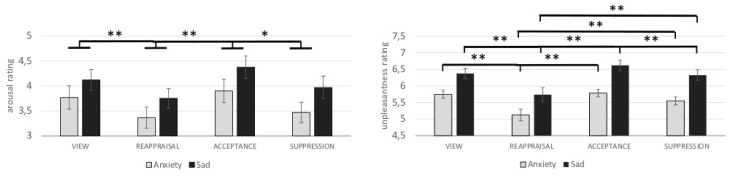
- In the self-report ratings, reappraisal reduced arousal compared with view and acceptance (e.g., arousal: t(29) = 3.27, p(FDR) < 0.01 vs view; t(29) = 4.28, p(FDR) < 0.01 vs acceptance) and reduced unpleasantness for both anxiety and sadness pictures (e.g., anxiety: t(29) = 4.74, p(FDR) < 0.01 vs view; sadness: t(29) = 4.59, p(FDR) < 0.01 vs view).
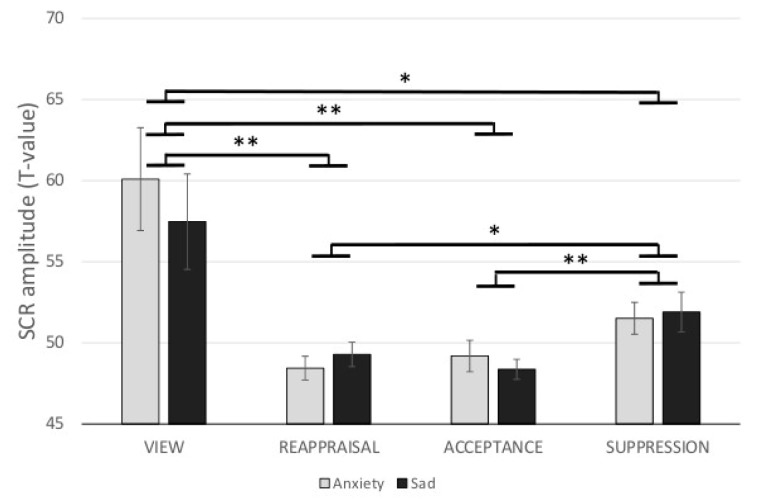
- For skin conductance response (SCR), there was only a main effect of emotion regulation (F(1.26,35.34) = 8.91, η2 = 0.24): SCR was reduced in reappraisal, acceptance, and suppression versus view (all p(FDR) < 0.01 or < 0.05), while suppression showed higher SCR than reappraisal (t(29) = 2.58, p(FDR) < 0.05) and acceptance (t(29) = 3.26, p(FDR) < 0.01).
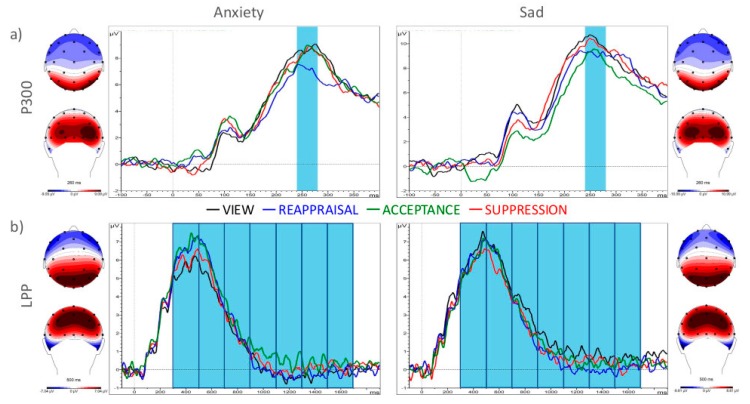
- For EEG, reappraisal reduced P300 amplitude versus view (t(29) = 3.34, p(FDR) < 0.05) and versus suppression (t(29) = 2.78, p(FDR) < 0.05); the paper also reports significant main effects of ER (F(3,87) = 2.83, η2 = 0.09) and emotion (F(1,29) = 5.83, η2 = 0.17).
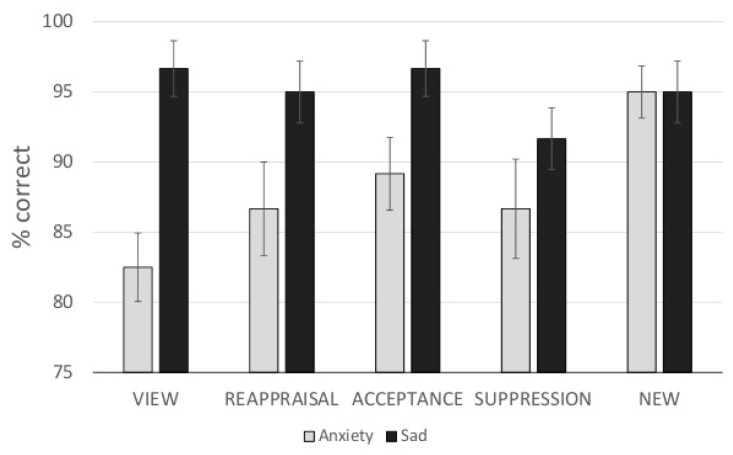
- In the recognition test, there was a main effect of emotion (F(1,29) = 18.70, η2 = 0.39), with sadness-inducing pictures better recognized, but post-hoc tests did not remain significant after alpha adjustment.
## Methods
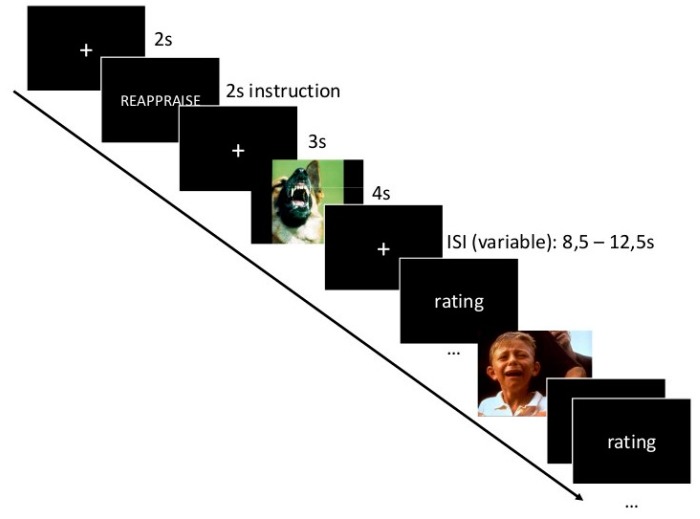
- Design: Repeated-measures experiment comparing four instructions: reappraise, accept, suppress, view; participants rated each picture for arousal and unpleasantness, completed a recognition test, and underwent SCR and EEG recording.
- Sample/data: 31 recruited from the University of Regensburg; 29 analyzed (25 female), healthy participants with normal or corrected-to-normal vision and no neurological or mental disease.
- Analysis: Repeated-measures ANOVAs with FDR correction for post-hoc t-tests; correlation analyses tested associations of STAI-trait, PSWQ, and BDI-II with outcomes. The stimulus set included 36 anxiety-inducing and 36 sadness-inducing IAPS pictures.
## Limitations
- The paper explicitly states the sample size is quite small, the number of trials was relatively low, and effects for EEG and especially the recognition test may have been underestimated.
- The authors note generalizability is limited because the sample was relatively young and healthy.
- The text also notes a potential stimulus limitation: the IAPS anxiety pictures were less variable than the sadness pictures, which might be responsible for impaired memory performance.
Model-written summary. Check it against the paper before relying on it.
Integrity signals
Registry
Cites
Statistics
Figures
Verification
Claims the paper makes
10 Valid · 1 Not valid · 12 Not checked · 79 Own results and interpretations
A result the paper reports from its own data — it cites no other source for it, so there is none to check. The quote shows it is in the paper.
In the paper
“Moreover, results show that greater propensity for rumination differentially impairs strategies of emotion regulation.”
§ Effects of Differential Strategies of Emotion Regulation > Abstract Patients suffering from mental disorders, especially anxiety disorders, are often impaired by inadequate emotional reactions. Specific aspects are the insufficient perception of their own emotional states and the use of dysfunctional emotion regulation strategies. Both aspects are interdependent. Thus, Cognitive Behavioral Therapy (CBT) comprises the development and training of adequate emotion regulation strategies. Traditionally, reappraisal is the most common strategy, but strategies of acceptance are becoming more important in the course of advancing CBT. Indeed, there is evidence that emotion regulation strategies differ in self-reported effectiveness, psychophysiological reactions, and underlying neural correlates. However, comprehensive comparisons of different emotion regulation strategies are sparse. The present study, therefore, compared the effect of three common emotion regulation strategies (reappraisal, acceptance, and suppression) on self-reported effectiveness, recollection, and psychophysiological as well as electroencephalographic dimensions. Twenty-nine healthy participants were instructed to either reappraise, accept, suppress, or passively observe their upcoming emotional reactions while anxiety- and sadness-inducing pictures were presented. Results showed a compelling effect of reappraisal on emotional experience, skin conductance response, and P300 amplitude. Acceptance was almost as effective as reappraisal, but led to increased emotional experience. Combining all results, suppression was shown to be the least effective but significantly decreased emotional experience when thoughts and feelings had to be suppressed. Moreover, results show that greater propensity for rumination differentially impairs strategies of emotion regulation.
plainstates a cause- Asserted: passes — The authors put it forward as true.
- Checkable: passes — It can be checked against evidence.
- Load-bearing: passes — The paper’s conclusions depend on it.
- Based: passes — The paper gives a reason why it holds.
In the paper
“Based on the data by Bradley and Lang [48], the two subsets differed in valence (anxiety-inducing subset: mean rating = 3.67 ± 0.80; sadness-inducing subset: mean rating = 2.64 ± 1.04; t = 4.07; p < 0.05) and arousal ratings (anxiety-inducing subset: mean rating = 6.13 ± 0.63; sadness-inducing subset: mean rating = 5.32 ± 0.97; t = 4.24; p < 0.05).”
§ Effects of Differential Strategies of Emotion Regulation > 2. Materials and Methods > 2.2. Stimuli
What the sources say
- Not checked — no full text of the sourcecites [48] Bradley M.M. Lang P.J. The International Affective Picture System (IAPS) in the study of emotion and attention Handbook of Emotion Elicitation and Assessment Oxford University Press New York, NY, USA 2007 29 46 source
plain- Asserted: passes — The authors put it forward as true.
- Checkable: passes — It can be checked against evidence.
- Load-bearing: passes — The paper’s conclusions depend on it.
- Based: passes — The paper gives a reason why it holds.
A result the paper reports from its own data — it cites no other source for it, so there is none to check. The quote shows it is in the paper.
In the paper
“Pictures were rated as significantly less unpleasant in the REAPPRAISAL condition than in the VIEW condition (anxiety: t(29) = 4.74, p(FDR) < 0.01; sadness: t(29) = 4.59, p(FDR) < 0.01), in the ACCEPT condition (anxiety: t(29) = 4.12, p(FDR) < 0.01; sadness: t(29) = 5.01, p(FDR) < 0.01), and in the SUPPRESSION condition (anxiety: t(29) = 3.15, p(FDR) < 0.01; sadness: t(29) = 4.76, p(FDR) < 0.01).”
§ Effects of Differential Strategies of Emotion Regulation > 3. Results > 3.1. Ratings of Arousal and Unpleasantness Each picture was rated for perceived arousal and unpleasantness. The statistical analysis revealed a main effect of ER (arousal: F(3,87) = 8.20, η2 = 0.22; unpleasantness: F(1.72,49.76) = 18.40, η2 = 0.39) and emotion (arousal: F (1,29) = 19,21, η2 = 0.40; unpleasantness: F (1,29) = 48.16, η2 = 0.62). The effect ER × Emotion was only significant for ratings of unpleasantness (arousal: F (1.90,55.13) = 0.87 n.s., η2 = 0.03; unpleasantness: F (3,87) = 2.72, η2 = 0.09). Post-hoc t-tests revealed that pictures were rated as less arousing in the REAPPRAISAL than in the VIEW (t(29) = 3.27, p(FDR) < 0.01) and in the ACCEPT condition (t(29) = 4.28, p(FDR) < 0.01). Additionally, pictures were rated as less arousing in the SUPPRESSION than in the ACCEPT condition (t(29) = 3.08, p(FDR) < 0.01). Comparing arousal ratings between the instructions VIEW and ACCEPT (t(29) = 1.28, p(FDR) > 0.05), VIEW and SUPPRESSION (t(29) = 1.94, p(FDR) > 0.05), and REAPPRAISAL and SUPPRESSION (t(29) = 1.87, p(FDR) > 0.05) did not reveal significance. Pictures were rated as significantly less unpleasant in the REAPPRAISAL condition than in the VIEW condition (anxiety: t(29) = 4.74, p(FDR) < 0.01; sadness: t(29) = 4.59, p(FDR) < 0.01), in the ACCEPT condition (anxiety: t(29) = 4.12, p(FDR) < 0.01; sadness: t(29) = 5.01, p(FDR) < 0.01), and in the SUPPRESSION condition (anxiety: t(29) = 3.15, p(FDR) < 0.01; sadness: t(29) = 4.76, p(FDR) < 0.01). Additionally, sadness-inducing pictures in the SUPPRESSION condition were rated as less unpleasant than sadness-inducing pictures in the ACCEPT condition (t(29) = 3.07, p(FDR) < 0.01). Comparing unpleasantness ratings between the instructions VIEW vs. ACCEPT (anxiety: t(29) = 0.36, p(FDR) > 0.05; sadness: t(29) = 2.55, p(FDR) > 0.05), VIEW vs. SUPPRESSION (anxiety: t(29) = 2.59, p(FDR) > 0.05; sadness: t(29) = 0.71, p(FDR) > 0.05), and ACCEPT vs. SUPPRESSION (anxiety: t(29) = 2.51, p(FDR) > 0.05) failed significance. Rating data are depicted in Figure 2.
plainstates a cause- Asserted: passes — The authors put it forward as true.
- Checkable: passes — It can be checked against evidence.
- Load-bearing: passes — The paper’s conclusions depend on it.
- Based: passes — The paper gives a reason why it holds.
- Rests on 2 assumptions not shown here.
A result the paper reports from its own data — it cites no other source for it, so there is none to check. The quote shows it is in the paper.
In the paper
“The effect ER × Emotion was only significant for ratings of unpleasantness (arousal: F (1.90,55.13) = 0.87 n.s., η2 = 0.03; unpleasantness: F (3,87) = 2.72, η2 = 0.09).”
§ Effects of Differential Strategies of Emotion Regulation > 3. Results > 3.1. Ratings of Arousal and Unpleasantness Each picture was rated for perceived arousal and unpleasantness. The statistical analysis revealed a main effect of ER (arousal: F(3,87) = 8.20, η2 = 0.22; unpleasantness: F(1.72,49.76) = 18.40, η2 = 0.39) and emotion (arousal: F (1,29) = 19,21, η2 = 0.40; unpleasantness: F (1,29) = 48.16, η2 = 0.62). The effect ER × Emotion was only significant for ratings of unpleasantness (arousal: F (1.90,55.13) = 0.87 n.s., η2 = 0.03; unpleasantness: F (3,87) = 2.72, η2 = 0.09). Post-hoc t-tests revealed that pictures were rated as less arousing in the REAPPRAISAL than in the VIEW (t(29) = 3.27, p(FDR) < 0.01) and in the ACCEPT condition (t(29) = 4.28, p(FDR) < 0.01). Additionally, pictures were rated as less arousing in the SUPPRESSION than in the ACCEPT condition (t(29) = 3.08, p(FDR) < 0.01). Comparing arousal ratings between the instructions VIEW and ACCEPT (t(29) = 1.28, p(FDR) > 0.05), VIEW and SUPPRESSION (t(29) = 1.94, p(FDR) > 0.05), and REAPPRAISAL and SUPPRESSION (t(29) = 1.87, p(FDR) > 0.05) did not reveal significance. Pictures were rated as significantly less unpleasant in the REAPPRAISAL condition than in the VIEW condition (anxiety: t(29) = 4.74, p(FDR) < 0.01; sadness: t(29) = 4.59, p(FDR) < 0.01), in the ACCEPT condition (anxiety: t(29) = 4.12, p(FDR) < 0.01; sadness: t(29) = 5.01, p(FDR) < 0.01), and in the SUPPRESSION condition (anxiety: t(29) = 3.15, p(FDR) < 0.01; sadness: t(29) = 4.76, p(FDR) < 0.01). Additionally, sadness-inducing pictures in the SUPPRESSION condition were rated as less unpleasant than sadness-inducing pictures in the ACCEPT condition (t(29) = 3.07, p(FDR) < 0.01). Comparing unpleasantness ratings between the instructions VIEW vs. ACCEPT (anxiety: t(29) = 0.36, p(FDR) > 0.05; sadness: t(29) = 2.55, p(FDR) > 0.05), VIEW vs. SUPPRESSION (anxiety: t(29) = 2.59, p(FDR) > 0.05; sadness: t(29) = 0.71, p(FDR) > 0.05), and ACCEPT vs. SUPPRESSION (anxiety: t(29) = 2.51, p(FDR) > 0.05) failed significance. Rating data are depicted in Figure 2.
plain- Asserted: passes — The authors put it forward as true.
- Checkable: passes — It can be checked against evidence.
- Load-bearing: unclear — It is unclear whether the paper’s conclusions depend on it.
- Based: passes — The paper gives a reason why it holds.
- Rests on 2 assumptions not shown here.
A result the paper reports from its own data — it cites no other source for it, so there is none to check. The quote shows it is in the paper.
In the paper
“Comparing arousal ratings between the instructions VIEW and ACCEPT (t(29) = 1.28, p(FDR) > 0.05), VIEW and SUPPRESSION (t(29) = 1.94, p(FDR) > 0.05), and REAPPRAISAL and SUPPRESSION (t(29) = 1.87, p(FDR) > 0.05) did not reveal significance.”
§ Effects of Differential Strategies of Emotion Regulation > 3. Results > 3.1. Ratings of Arousal and Unpleasantness Each picture was rated for perceived arousal and unpleasantness. The statistical analysis revealed a main effect of ER (arousal: F(3,87) = 8.20, η2 = 0.22; unpleasantness: F(1.72,49.76) = 18.40, η2 = 0.39) and emotion (arousal: F (1,29) = 19,21, η2 = 0.40; unpleasantness: F (1,29) = 48.16, η2 = 0.62). The effect ER × Emotion was only significant for ratings of unpleasantness (arousal: F (1.90,55.13) = 0.87 n.s., η2 = 0.03; unpleasantness: F (3,87) = 2.72, η2 = 0.09). Post-hoc t-tests revealed that pictures were rated as less arousing in the REAPPRAISAL than in the VIEW (t(29) = 3.27, p(FDR) < 0.01) and in the ACCEPT condition (t(29) = 4.28, p(FDR) < 0.01). Additionally, pictures were rated as less arousing in the SUPPRESSION than in the ACCEPT condition (t(29) = 3.08, p(FDR) < 0.01). Comparing arousal ratings between the instructions VIEW and ACCEPT (t(29) = 1.28, p(FDR) > 0.05), VIEW and SUPPRESSION (t(29) = 1.94, p(FDR) > 0.05), and REAPPRAISAL and SUPPRESSION (t(29) = 1.87, p(FDR) > 0.05) did not reveal significance. Pictures were rated as significantly less unpleasant in the REAPPRAISAL condition than in the VIEW condition (anxiety: t(29) = 4.74, p(FDR) < 0.01; sadness: t(29) = 4.59, p(FDR) < 0.01), in the ACCEPT condition (anxiety: t(29) = 4.12, p(FDR) < 0.01; sadness: t(29) = 5.01, p(FDR) < 0.01), and in the SUPPRESSION condition (anxiety: t(29) = 3.15, p(FDR) < 0.01; sadness: t(29) = 4.76, p(FDR) < 0.01). Additionally, sadness-inducing pictures in the SUPPRESSION condition were rated as less unpleasant than sadness-inducing pictures in the ACCEPT condition (t(29) = 3.07, p(FDR) < 0.01). Comparing unpleasantness ratings between the instructions VIEW vs. ACCEPT (anxiety: t(29) = 0.36, p(FDR) > 0.05; sadness: t(29) = 2.55, p(FDR) > 0.05), VIEW vs. SUPPRESSION (anxiety: t(29) = 2.59, p(FDR) > 0.05; sadness: t(29) = 0.71, p(FDR) > 0.05), and ACCEPT vs. SUPPRESSION (anxiety: t(29) = 2.51, p(FDR) > 0.05) failed significance. Rating data are depicted in Figure 2.
plain- Asserted: passes — The authors put it forward as true.
- Checkable: passes — It can be checked against evidence.
- Load-bearing: unclear — It is unclear whether the paper’s conclusions depend on it.
- Based: passes — The paper gives a reason why it holds.
- Rests on 2 assumptions not shown here.
59 more claims
Create a free account to see all 102 claims and to verify the 4 references still open.
- It may state two separate claims as one. 22
- Probably not a substantial claim. 20
Statistics recomputed
Every reported test result, recomputed from its test statistic and degrees of freedom. A result shows as not adding up only once an independent check has confirmed it.
- ConsistentF(1.08, 31.29) = 0.54reported p > .2 · recomputed p = .468
“F(1.08,31.29) = 0.54, p > .20”
- ConsistentF(3, 87) = 0.55reported n.s. · recomputed p = .649
“F (3,87) = 0.55, n.s.”
- ConsistentF(2.87, 83.27) = 2.36reported n.s. · recomputed p = .077
“F (2.87,83.27) = 2.36, n.s.”
Self-check
Percentages, sums and reported differences re-computed from the paper’s own numbers.
Self-check results appear here once an independent check has confirmed them.
Citations
Cites
Diagnostic and Statistical Manual of Mental Disorders
American Psychiatric Association (2013) · doi:10.1176/appi.books.9780890425596 · Cited by 116,369
Controlling the False Discovery Rate: A Practical and Powerful Approach to Multiple Testing
Benjamini, Y., & Hochberg, Y. (1995) · Journal of the Royal Statistical Society Series B: Statistical Methodology · doi:10.1111/j.2517-6161.1995.tb02031.x · Cited by 109,482 · cited 2×
“To avoid alpha-cumulation, alpha was adjusted using the false discovery rate (FDR [57] and implemented by [58]).”
MethodGross, J. J., & John, O. P. (2003) · Journal of Personality and Social Psychology · doi:10.1037/0022-3514.85.2.348 · Cited by 11,929
Assessing coping strategies: A theoretically based approach.
Carver, C. S., Scheier, M. F., & Weintraub, J. K. (1989) · Journal of Personality and Social Psychology · doi:10.1037/0022-3514.56.2.267 · Cited by 11,507 · cited 1×
“, [20,21]) and had its peak after cognitive interventions were included in Behavioral Therapy (e.”
BackgroundMeasuring emotion: The self-assessment manikin and the semantic differential
Bradley, M. M., & Lang, P. J. (1994) · Journal of Behavior Therapy and Experimental Psychiatry · doi:10.1016/0005-7916(94)90063-9 · Cited by 9,538 · cited 1×
“Subsequently, participants rated perceived unpleasantness (1 = very pleasant to 9 = very unpleasant, 5 = neutral) and arousal (1 = not arousing to 9 = very arousing) for each picture on two nine-point Likert scales (Self Assessment Manakin [SAM] [52]).”
MethodGratz, K. L., & Roemer, L. (2004) · Journal of Psychopathology and Behavioral Assessment · doi:10.1023/b:joba.0000007455.08539.94 · Cited by 8,942 · cited 1×
“, [30]), with the term “acceptance” describing a non-elaborative, non-judgmental, presence-centered awareness in which thoughts, feelings, and sensations are accepted as they occur [31,32].”
BackgroundUpdating P300: An integrative theory of P3a and P3b
Polich, J. (2007) · Clinical Neurophysiology · doi:10.1016/j.clinph.2007.04.019 · Cited by 7,919
Beck, A. T., Steer, R. A., & Brown, G. (2011) · PsycTESTS Dataset · doi:10.1037/t00742-000 · Cited by 7,535
(1975) · Medical Entomology and Zoology · Cited by 7,245
Emotion-regulation strategies across psychopathology: A meta-analytic review
Aldao, A., Nolen-Hoeksema, S., & Schweizer, S. (2010) · Clinical Psychology Review · doi:10.1016/j.cpr.2009.11.004 · Cited by 6,686 · cited 1×
“Previous researchers defined several strategies of ER that differ in (mal)adaptiveness [5,6], identifying suppression as a less adaptive strategy of ER.”
BackgroundKirschbaum, C., Pirke, K.-M., & Hellhammer, D. H. (2008) · Neuropsychobiology · doi:10.1159/000119004 · Cited by 6,093
Development and validation of the Penn State Worry Questionnaire
Meyer, T. J., Miller, M. L., Metzger, R. L., & Borkovec, T. D. (1990) · Behaviour Research and Therapy · doi:10.1016/0005-7967(90)90135-6 · Cited by 5,099 · cited 8×
“Increased PSWQ-scores were correlated with an increased SCR-response to anxiety-inducing pictures in the REAPPRAISAL condition (r = 0.51, p 0.01) as well as with increased unpleasantness ratings of anxiety-inducing pictures in the SUPPRESSION condition (r = 0.49, p < 0.01).”
BackgroundInfluentialA new method for off-line removal of ocular artifact
Gratton, G., Coles, M. G. H., & Donchin, E. (1983) · Electroencephalography and Clinical Neurophysiology · doi:10.1016/0013-4694(83)90135-9 · Cited by 5,055 · cited 2×
“1 Hz, High cutoff: 30 Hz, Notch filter: 50 Hz), corrected for ocular artifacts (following the procedure described by Gratton and Coles [53]), and re-referenced to average recorded reference.”
MethodInfluentialEmotion regulation: affective, cognitive, and social consequences.
Gross, J. J. (2002) · Psychophysiology · doi:10.1017/s0048577201393198 · Cited by 4,890 · cited 2×
“In addition, the recognition performance of emotional stimuli seems to be unaffected by emotional reappraisal (see [9,28] but see [29]), whereas suppression leads to impaired recognition [8,9].”
BackgroundGross, J. J. (1998) · Journal of Personality and Social Psychology · doi:10.1037//0022-3514.74.1.224 · Cited by 4,671 · cited 2×
“In addition, the recognition performance of emotional stimuli seems to be unaffected by emotional reappraisal (see [9,28] but see [29]), whereas suppression leads to impaired recognition [8,9].”
BackgroundAutonomic nervous system activity in emotion: a review
Kreibig, S. D. (2010) · Biological Psychology · doi:10.1016/j.biopsycho.2010.03.010 · Cited by 3,188 · cited 1×
“An appropriate method of measurement of sympathetic activity is electrodermal activity (EDA) or phasic skin conductance response (SCR), respectively [14,15].”
MethodBoucsein, W. (2012) · doi:10.1007/978-1-4614-1126-0 · Cited by 2,526
John, O. P., & Gross, J. J. (2004) · Journal of Personality · doi:10.1111/j.1467-6494.2004.00298.x · Cited by 2,381 · cited 1×
“Previous researchers defined several strategies of ER that differ in (mal)adaptiveness [5,6], identifying suppression as a less adaptive strategy of ER.”
BackgroundThe Oxford Handbook of Event-Related Potential Components
(2011) · doi:10.1093/oxfordhb/9780195374148.001.0001 · Cited by 2,263
Webb, T. L., Miles, E., & Sheeran, P. (2012) · Psychological Bulletin · doi:10.1037/a0027600 · Cited by 2,006 · cited 1×
“, [10,16,17]), but the actual subject of suppression seems crucial (e.”
BackgroundCuthbert, B. N., Schupp, H. T., Bradley, M. M., Birbaumer, N., & Lang, P. J. (2000) · Biological Psychology · doi:10.1016/s0301-0511(99)00044-7 · Cited by 1,900 · cited 1×
“Greater LPP amplitudes were associated with more intense/arousing stimuli [34] and decreased LPP amplitudes might reflect neuromodulatory activity, e.”
BackgroundHiding feelings: The acute effects of inhibiting negative and positive emotion
Gross, J. J., & Levenson, R. W. (1997) · Journal of Abnormal Psychology · doi:10.1037/0021-843x.106.1.95 · Cited by 1,834 · cited 1×
“, [10,16,17]), but the actual subject of suppression seems crucial (e.”
BackgroundDawson, M. E., Schell, A. M., Filion, D. L., & Berntson, G. G. (2009) · Handbook of Psychophysiology · doi:10.1017/cbo9780511546396.007 · Cited by 1,720 · cited 1×
“, [56]), analyses were restricted to the mean of the first four events per condition.”
Breuer, J., Freud, S., Strachey, J., Strachey, A., & Richards, A. (1895) · Medical Entomology and Zoology · Cited by 1,614
Emotion regulation and memory: the cognitive costs of keeping one's cool
Richards, J. M., & Gross, J. J. (2000) · Journal of Personality and Social Psychology · doi:10.1037/0022-3514.79.3.410 · Cited by 1,472
The social consequences of expressive suppression
Butler, E. A., Egloff, B., Wlhelm, F. H., Smith, N. C., Erickson, E. A., & Gross, J. J. (2003) · Emotion · doi:10.1037/1528-3542.3.1.48 · Cited by 1,400 · cited 1×
“, [11,50,51]); however, we additionally asked participants to suppress and downregulate any feelings and thoughts that would be produced by the pictures.”
BackgroundEvent-Related Potentials, Emotion, and Emotion Regulation: An Integrative Review
Hajcak, G., MacNamara, A., & Olvet, D. M. (2010) · Developmental Neuropsychology · doi:10.1080/87565640903526504 · Cited by 1,370 · cited 3×
“The early event-related potential P300 was repeatedly associated with subjective stimulus salience [7] and was shown to be increased after viewing emotional stimuli (e.”
BackgroundResultInfluentialWenzlaff, R. M., & Wegner, D. M. (2000) · Annual Review of Psychology · doi:10.1146/annurev.psych.51.1.59 · Cited by 1,063
Emotion and attention: event-related brain potential studies
Schupp, H. T., Flaisch, T., Stockburger, J., & Junghöfer, M. (2006) · Progress in Brain Research · doi:10.1016/s0079-6123(06)56002-9 · Cited by 1,029
The International Affective Picture System (IAPS) in the Study of Emotion and Attention
Bradley, M. M., & Lang, P. J. (2007) · Handbook of Emotion Elicitation and Assessment · doi:10.1093/oso/9780195169157.003.0003 · Cited by 915
A direct brainstem–amygdala–cortical ‘alarm’system for subliminal signals of fear.
Liddell, B. J., Brown, K. J., Kemp, A. H., Barton, M. J., Das, P., Peduto, A., Gordon, E., & Williams, L. M. (2005) · NeuroImage · doi:10.1016/j.neuroimage.2004.08.016 · Cited by 670
Emotional regulation and emotional development
Thompson, R. A. (1991) · Educational Psychology Review · doi:10.1007/bf01319934 · Cited by 641
Composure at Any Cost? The Cognitive Consequences of Emotion Suppression
Richards, J. M., & Gross, J. J. (1999) · Personality and Social Psychology Bulletin · doi:10.1177/01461672992511010 · Cited by 607
Automatic attention to emotional stimuli: Neural correlates
Carretié, L., Hinojosa, J. A., Martín‐Loeches, M., Mercado, F., & Tapia, M. (2004) · Human Brain Mapping · doi:10.1002/hbm.20037 · Cited by 585
On the embodiment of emotion regulation: interoceptive awareness facilitates reappraisal
Füstös, J., Gramann, K., Herbert, B. M., & Pollatos, O. (2013) · Social Cognitive and Affective Neuroscience · doi:10.1093/scan/nss089 · Cited by 530
Hofmann, S. G., Heering, S., Sawyer, A. T., & Asnaani, A. (2009) · Behaviour Research and Therapy · doi:10.1016/j.brat.2009.02.010 · Cited by 464 · cited 2×
“, [13]) One important aspect of ER research is its effect on neural processes, and one common tool to assess neural activity is to measure electrocortical signal changes.”
BackgroundFoti, D., & Hajcak, G. (2008) · Journal of Cognitive Neuroscience · doi:10.1162/jocn.2008.20066 · Cited by 458 · cited 2×
“[39], or Grecucci [40], but contrary to the majority of earlier studies which showed a decreased LPP for reappraisal [36,37,66].”
BackgroundResultThought suppression and psychopathology
Purdon, C. (1999) · Behaviour Research and Therapy · doi:10.1016/s0005-7967(98)00200-9 · Cited by 454 · cited 1×
“Research in clinical populations, however, suggests that maladaptive emotional suppression is not just the suppression of expressive behavior, it is also the attempt of suppressing the associated thoughts (for an overview see [19]).”
BackgroundThe persistence of attention to emotion: Brain potentials during and after picture presentation.
Hajcak, G., & Olvet, D. M. (2008) · Emotion · doi:10.1037/1528-3542.8.2.250 · Cited by 443
Regulating Positive and Negative Emotions in Daily Life
Nezlek, J. B., & Kuppens, P. (2008) · Journal of Personality · doi:10.1111/j.1467-6494.2008.00496.x · Cited by 441
The temporal dynamics of emotion regulation: An EEG study of distraction and reappraisal
Thiruchselvam, R., Blechert, J., Sheppes, G., Rydstrom, A., & Gross, J. J. (2011) · Biological Psychology · doi:10.1016/j.biopsycho.2011.02.009 · Cited by 431 · cited 2×
“To investigate possible LPP differences, averaged mean activations of consecutive time sequences of 200 ms in length were extracted from 300 ms to 1700 ms after stimulus onset (see [37]).”
MethodResultIntentional modulation of emotional responding to unpleasant pictures: An ERP study
Moser, J. S., Hajcak, G., Bukay, E., & Simons, R. F. (2006) · Psychophysiology · doi:10.1111/j.1469-8986.2006.00402.x · Cited by 392 · cited 1×
“, [35]) and after reappraisal of negative emotional stimuli (e.”
BackgroundThought Suppression and Psychopathology
Najmi, S., & Wegner, D. M. (2015) · Handbook of Approach and Avoidance Motivation · doi:10.4324/9780203888148.ch26 · Cited by 369
Subjective responses to emotional stimuli during labeling, reappraisal, and distraction
Lieberman, M. D., Inagaki, T. K., Tabibnia, G., & Crockett, M. J. (2011) · Emotion · doi:10.1037/a0023503 · Cited by 288
Egloff, B., Schmukle, S. C., Burns, L. R., & Schwerdtfeger, A. (2006) · Emotion · doi:10.1037/1528-3542.6.3.356 · Cited by 285
Wolgast, M., Lundh, L.-G., & Viborg, G. (2011) · Behaviour Research and Therapy · doi:10.1016/j.brat.2011.09.011 · Cited by 278 · cited 1×
“, [13,24]) as well as to a reduction of the associated psychophysiological response [24].”
BackgroundCognitive reappraisal of negative affect: Converging evidence from EMG and self-report
Ray, R. D., McRae, K., Ochsner, K. N., & Gross, J. J. (2010) · Emotion · doi:10.1037/a0019015 · Cited by 256
The psychometric properties of the late positive potential during emotion processing and regulation
Moran, T. P., Jendrusina, A. A., & Moser, J. S. (2013) · Brain Research · doi:10.1016/j.brainres.2013.04.018 · Cited by 241 · cited 1×
“However, there is evidence that the findings regarding LPP amplitude are a stable outcome (see [69]).”
BackgroundEmotion Regulation and Well-Being
(2011) · Springer eBooks · doi:10.1007/978-1-4419-6953-8 · Cited by 239
The effect of emotion regulation strategies on anger
Szasz, P. L., Szentagotai, A., & Hofmann, S. G. (2011) · Behaviour Research and Therapy · doi:10.1016/j.brat.2010.11.011 · Cited by 207
Multidimensional normative ratings for the International Affective Picture System
Libkuman, T. M., Otani, H., Kern, R., Viger, S. G., & Novak, N. (2007) · Behavior Research Methods · doi:10.3758/bf03193164 · Cited by 190
Shiota, M. N., & Levenson, R. W. (2012) · Journal of Personality and Social Psychology · doi:10.1037/a0029208 · Cited by 174
Cardiovascular responses of embarrassment and effects of emotional suppression in a social setting
Harris, C. R. (2001) · Journal of Personality and Social Psychology · doi:10.1037/0022-3514.81.5.886 · Cited by 166
Intentional systemic mindfulness: an integrative model for self-regulation and health.
Shapiro, S. L., & SCHWARTZ, G. E. R. (2000) · PubMed · doi:10.1054/ambm.1999.0118 · Cited by 135 · cited 1×
“, [30]), with the term “acceptance” describing a non-elaborative, non-judgmental, presence-centered awareness in which thoughts, feelings, and sensations are accepted as they occur [31,32].”
BackgroundEmotional intelligence and mental disorder
Hertel, J., Schütz, A., & Lammers, C. (2009) · Journal of Clinical Psychology · doi:10.1002/jclp.20597 · Cited by 132
Bebko, G. M., Franconeri, S. L., Ochsner, K. N., & Chiao, J. Y. (2011) · Emotion · doi:10.1037/a0024009 · Cited by 125 · cited 1×
“, [11,50,51]); however, we additionally asked participants to suppress and downregulate any feelings and thoughts that would be produced by the pictures.”
BackgroundMoser, J. S., Most, S. B., & Simons, R. F. (2010) · Cognitive, Affective, & Behavioral Neuroscience · doi:10.3758/cabn.10.2.195 · Cited by 110 · cited 1×
“[39], or Grecucci [40], but contrary to the majority of earlier studies which showed a decreased LPP for reappraisal [36,37,66].”
ResultP300 and categorization in brand extension
Ma, Q., Wang, X., Shu, L., & Dai, S. (2008) · Neuroscience Letters · doi:10.1016/j.neulet.2007.11.022 · Cited by 109 · cited 2×
“Therefore, electrode selection was based on grand average topography and the literature [55] and was restricted to electrodes O1/O2.”
MethodThe effect of cognitive reappraisal on physiological reactivity and emotional memory
Kim, S. H., & Hamann, S. (2012) · International Journal of Psychophysiology · doi:10.1016/j.ijpsycho.2011.12.001 · Cited by 84 · cited 1×
“In addition, the recognition performance of emotional stimuli seems to be unaffected by emotional reappraisal (see [9,28] but see [29]), whereas suppression leads to impaired recognition [8,9].”
BackgroundEmotion Regulation and Well-Being: A View from Different Angles
Nyklíček, I., Vingerhoets, A. J. J. M., & Zeelenberg, M. (2010) · Springer eBooks · doi:10.1007/978-1-4419-6953-8_1 · Cited by 66 · cited 1×
“Commonly, emotions are only perceived as problematic when they are of the wrong intensity, the wrong type, the wrong duration, or when ineffective strategies of ER are applied to them, as it is the case in patients with mental illness [4].”
BackgroundDemaree, H. A., Robinson, J. L., Pu, J., & Allen, J. J. B. (2006) · Cognition & Emotion · doi:10.1080/02699930500405303 · Cited by 56 · cited 1×
“[60] into account, who showed that it is hard to focus only on expressive behavior and that focusing on cognition also reduces the emotional experience, it is possible that the changed instruction of suppression in our study is responsible for the effective reduction in emotional experience during suppression.”
BackgroundExamining the effects of emotion regulation on the ERP response to highly negative social stigmas
Krendl, A. C., Zucker, H. R., & Kensinger, E. A. (2017) · Social Neuroscience · doi:10.1080/17470919.2016.1166155 · Cited by 24 · cited 1×
“[39], or Grecucci [40], but contrary to the majority of earlier studies which showed a decreased LPP for reappraisal [36,37,66].”
ResultLemaire, M., El-Hage, W., & Frangou, S. (2014) · Frontiers in Psychology · doi:10.3389/fpsyg.2014.00571 · Cited by 23 · cited 1×
“, [10,16,17]), but the actual subject of suppression seems crucial (e.”
BackgroundGrecucci, A., Sulpizio, S., Tommasello, E., Vespignani, F., & Job, R. (2019) · PLOS ONE · doi:10.1371/journal.pone.0209461 · Cited by 22 · cited 2×
“Our results are in line with results from Krendl et al. [39], or Grecucci [40], but contrary to the majority of earlier studies which showed a decreased LPP for reappraisal [36,37,66].”
ResultSalzer, S., Stiller, C., Tacke-Pook, A., Jacobi, C., & Leibing, E. (2009) · PubMed · doi:10.3205/psm000058 · Cited by 18
(1996) · UTC Scholar (University of Tennessee at Chattanooga) · Cited by 1
Akzeptanz- und Commitment-Therapie
Flaxman, P. E. (2014) · PiD - Psychotherapie im Dialog · doi:10.1055/s-0043-118243 · Cited by 1
Research works printed but not linked: 1
- Lazarus R.S. Folkman S. Stress, Appraisal, and Coping Springer New York, NY, USA 1984
Cited by
Wojnarowska, A., Kobylinska, D., & Lewczuk, K. (2020) · Frontiers in Psychology · doi:10.3389/fpsyg.2020.00242 · Cited by 82
“One recent study showed for example that acceptance can be ineffective on the level of emotional experience, while still successfully downregulating psychophysiological responses (Boehme et al., 2019), although not all studies led to similar findings (Kohl et al.”
ResultMohammed, A., Kosonogov, V., & Lyusin, D. (2021) · International Journal of Psychophysiology · doi:10.1016/j.ijpsycho.2021.06.007 · Cited by 82
A theoretical model of climate anxiety and coping
Crandon, T., Scott, J. G., Charlson, F., & Thomas, H. J. (2024) · Discover Psychology · doi:10.1007/s44202-024-00212-8 · Cited by 76
“…may struggle to identify or implement strategies that could help mitigate their existential conflict, or they may succumb to habitual maladaptive behavior to avoid or alleviate negative feelings in the short term (e.g., excessive suppression, substance use, risk-taking behaviors) [18, 93, 94].”
Zhang, Y., Hu, Y., & Yu, M. (2024) · Language Teaching Research · doi:10.1177/13621688241266184 · Cited by 57
“These learners may find it more challenging to maintain a higher level of interest and focus on EFL learning tasks and are also more likely to struggle to follow teacher instructions (Boehme et al., 2019; Djambazova-Popordanoska, 2016; Jarrell et al., 2022).”
How People Emotionally Respond to the News on COVID-19: An Online Survey
Hamidein, Z., Hatami, J., & Rezapour, T. (2020) · Basic and Clinical Neuroscience Journal · doi:10.32598/bcn.11.covid19.809.2 · Cited by 32
Metadata
- Authors
- Boehme, S., Biehl, S. C., & Mühlberger, A.
- Affiliations
- University of Regensburg (DE)
- Corresponding author
- Boehme, Stephanie
- Venue
- Brain Sciences
- Publisher
- MDPI AG
- Published
- 2019-09-05
- Volume
- 9
- Issue
- 9
- Pages
- 225
- ISSN
- 2076-3425 (ISSN-L)
- PMC
- PMC6769771
- OpenAlex
- W2972208537
- Semantic Scholar
- 24f8755c7dea5596d1a1b58c45ee15b0d8312421
- Cited by
- 42
- References
- 74
- Citations by year
- 2026: 6 · 2025: 7 · 2024: 10 · 2023: 6 · 2022: 5 · 2021: 6 · 2020: 2
- FWCI
- 3.83
- Type
- journal article
- Language
- en
- Open access
- gold
- dx.doi.org
- Licence
- Locations
- Brain Sciences (publishedVersion, cc-by)
- Europe PMC (PubMed Central) (publishedVersion, cc-by)
- PubMed Central (publishedVersion, cc-by)
- PubMed (publishedVersion)
- University of Regensburg Publication Server (University of Regensburg) (acceptedVersion)
- DOAJ (DOAJ: Directory of Open Access Journals) (submittedVersion, cc-by-sa)
- University of Regensburg Publication Server (University of Regensburg)
- Topics
- Social Sciences › Psychology › Experimental and Cognitive Psychology › Anxiety, Depression, Psychometrics, Treatment, Cognitive Processes
- Life Sciences › Neuroscience › Cognitive Neuroscience › Neural and Behavioral Psychology Studies
- Social Sciences › Psychology › Clinical Psychology › Mindfulness and Compassion Interventions
- Keywords
- emotion regulation strategies, cognitive reappraisal, acceptance, emotional suppression, rumination, anxiety, sadness, emotional experience, skin conductance response, P300, EEG, cognitive behavioral therapy
About these checks
Registry, retraction, Cites and statistics results are computed, not judged, with one exception: a printed reference that no index lists is read once by a model before it counts as a citation error. Claims are extracted by a model and kept only when their quote appears verbatim in the text; each cited source is then checked, with a model’s help, for whether it says what the claim relies on. Those verdicts can be wrong — read the claim’s quote and the cited source before relying on one.
The claim verdicts this report counts are experimental: their accuracy is not yet measured.
A language model drew the claims from the paper on 2026-10-11, under version 3 of the claim definition (model deepseek-v4.1-flash, prompt extract-v3).
A second model labelled each claim on 2026-10-11 (model jev-1.13-20260917, definition revision gold-guideline-v0.2).
Statistics and arithmetic are recomputed, not judged.
Confidence bands are shown only for fields calibrated on our annotated test set. None is calibrated yet, so no band is shown.
What counts as a claim ›How we measure confidence ›How we check this ›
Are you an author, or do you see a problem with this page? Request a review
Data sources
Bibliographic data: Semantic Scholar, OpenAlex, Crossref.
Contains information from the Semantic Scholar Academic Graph Datasets, made available under the ODC Attribution License (ODC-BY 1.0).
Semantic Scholar’s data is described in: Kinney, R., et al. (2023). The Semantic Scholar Open Data Platform. arXiv:2301.10140.
