

The DOI matches its Crossref record; 140 of the 142 references it cites were found in a registry or an index; 34 of the 65 sources its claims cite were checked for support.
A Single-Session Process-Based Cognitive-Behavioral Intervention Combined with Multimodal Rehabilitation Treatment for Chronic Pain Associated with Emotional Disorders
Open accessAbstract
Background and Objectives: Defined by chronic pain, rheumatic diseases are often co-occurring with anxiety and depression. Among the available psychological interventions, cognitive-behavioral therapies have an already-proven efficiency in these cases. However, the need to adjust their structure became ubiquitous during the post-pandemic period. Hence, the objective of this study was to investigate the impact of a single-session, process-based cognitive-behavioral intervention for patients with rheumatic conditions within an in-patient setting. Materials and Methods: A total of 31 participants (mean age 58.9 years) completed the single-session intervention. Assessments were conducted prior to the intervention, post-intervention and after one month. Results: Pearson’s correlations, paired samples T tests and a covariance analysis based on the Linear Mixed Model were performed for exploring the relations between baseline variables and evaluating the impact of the SSI intervention. Immediately after the intervention, a significant reduction in cognitive fusion (p = 0.001, d = 1.78), experiential avoidance (p = 0.001, d = 1.4) and dysfunctional behavioral processes was observed. At the one-month evaluation, participants reported decreased pain (p = 0.001, d = 1.11), anxiety (p = 0.004, d = 0.55) and depression (p = 0.001, d = 0.72). Conclusions: The single-session, process-based approach represents a promising intervention in healthcare contexts, as an integrative part of a multimodal rehabilitation treatment in patients with rheumatic conditions. © 2024 by the authors.
Overview
CoChat Summary
## TL;DR
This uncontrolled quasi-experimental study tested a single-session process-based CBT intervention, delivered during inpatient multimodal rehabilitation, in 31 patients with rheumatic disease and chronic pain plus anxiety/depression. The intervention was associated with immediate reductions in cognitive fusion and experiential avoidance, and at one month with lower pain, anxiety, and depression scores.
## Key findings
- In the 31 participants (mean age 58.9 years), immediate post-intervention scores showed significant reductions in cognitive fusion (t = 9.96, p = 0.001) and experiential avoidance (t = 7.79, p = 0.001).
- Several behavioral processes improved immediately after the intervention: better ability to change behavior (PBAT item 1; t = −4.37, p = 0.001), more behaviors supporting physical health (item 6; t = −4.32, p = 0.001), and lower tendencies toward complying with others’ wishes without considering one’s own needs (item 9; t = 3.86, p = 0.001), getting stuck in unproductive strategies (item 10; t = 3.27, p = 0.003), and behaving in ways that would damage health (item 17; t = 4.05, p = 0.001).
- At the one-month assessment, pain ratings decreased significantly (t = 6.21, p = 0.001), as did anxiety (t = 3.08, p = 0.004) and depression (t = 3.96, p = 0.001); fatigue did not significantly decrease.
- Baseline correlations were in the expected direction: pain correlated with anxiety (r = 0.40), cognitive fusion (r = 0.43), and PBAT Hurt Connection (r = 0.40); fatigue correlated with depression (r = 0.41) and several behavioral processes, including Important Challenges (r = 0.49) and Connect to People and Personal Importance (r = 0.41).
## Methods
- Design: uncontrolled, quasi-experimental inpatient trial; participants received a single-session process-based CBT intervention as part of multimodal rehabilitation, with assessments at baseline, 3–5 days post-intervention (T1), and one month after admission (T2).
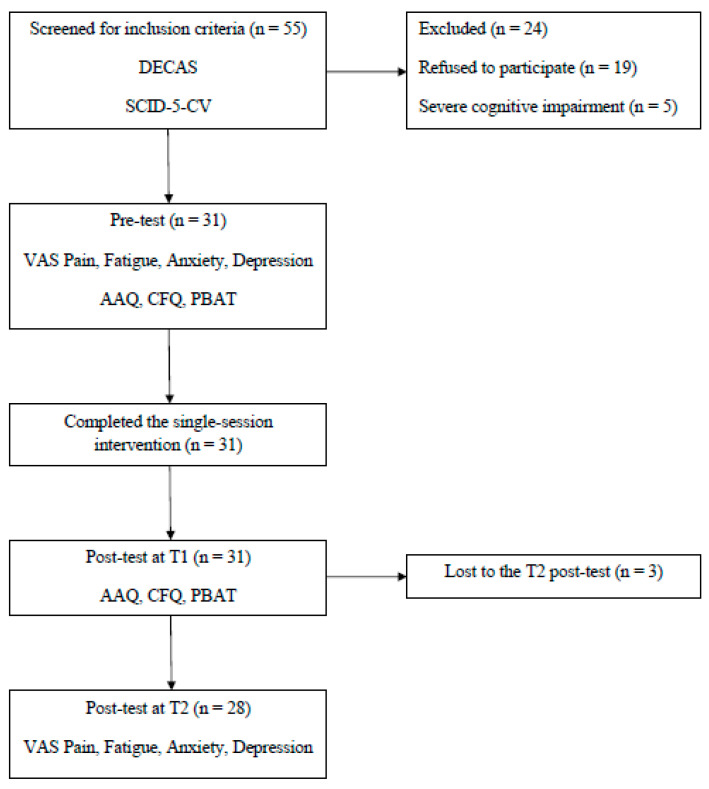
- Sample/data: 31 hospitalized adults (mean age 58.9, SD 12.03) with a musculoskeletal condition diagnosed by a rheumatologist, chronic pain for at least 3 months, and generalized anxiety disorder and/or major depressive disorder by SCID-5-CV; exclusion criteria included severe cognitive impairment, severe psychiatric disorders, and inability to understand Romanian.
- Main analysis: Pearson correlations at baseline; paired-samples t tests for pre/post changes; linear mixed model to test covariates; effect sizes reported with Cohen’s d and Hedges’ g. Measures included VAS, AAQ-II, CFQ, PBAT, DECAS, and SCID-5-CV.
## Limitations
- The paper states that there was no control group, so intervention effects could not be separated from other influences.
- The paper states that T2 did not include measures of cognitive fusion, experiential avoidance, or behavioral processes, so maintenance of psychological-flexibility changes could not be tracked.
- The paper states that confounds could not be ruled out, including medication, physical therapy, the hospitalization context, and social desirability in self-report responses; it also notes the sample was small and there were no longitudinal assessments beyond one month.
Model-written summary. Check it against the paper before relying on it.
Integrity signals
Registry
Cites
Statistics
Figures
Verification
Claims the paper makes
23 Valid · 0 Not valid · 12 Not checked · 69 Own results and interpretations
The cited sources support only part of this claim — read each source’s verdict below.
In the paper
“For example, by comparing an SSI lasting for 2 h with a standard 8-session CBT protocol, Darnall et al. (2021) showed that emotional symptoms, pain-related distress and catastrophizing equivalently reduced among the treatment arms in patients with chronic low back pain [58].”
§ A Single-Session Process-Based Cognitive-Behavioral Intervention Combined with Multimodal Rehabilitation Treatment for Chronic Pain Associated with Emotional Disorders > 1. Introduction Rheumatic conditions are highly associated with a poor quality of life, given their increased comorbidity with emotional disorders like anxiety and/or depression, which occur in approximatively 20% of patients or more [1,2,3]. Common emotional symptoms accompanying rheumatic diseases include anhedonia, withdrawal from activities, social isolation, sleeping problems and intense fear related to oneself and the future. This clinical picture has repeatedly been linked to the existence of dysfunctional thinking patterns regarding illness and pain, as well as unhealthy ways of reacting to these thoughts [4,5,6]. Specifically, the presence of chronic pain is considered one of the main mechanisms contributing to the onset of psychiatric disorders in association with rheumatic conditions [7,8]. These difficulties have a complex etiology, involving interactions between somatic, psychological and social elements [1,4]. Aside from the biological predisposition, other risk factors for the onset of this are aversive life events, such as interpersonal problems, grief, psychological abuse, financial difficulties and health-related concerns [9,10]. Particularly, due to the inherent unpredictability and burden, the COVID-19 pandemic was correlated with increased psychological distress and healthcare challenges in patients with rheumatic conditions, requiring the adjustment of therapeutic protocols and methods [11]. Along with the exacerbation of physical impairment, this context also affected psychological wellbeing and interpersonal relationships, correlating with enduring emotional symptoms and social isolation in this population [12] Also, the tendency to engage in unhealthy coping strategies was observed in association with the COVID-19 pandemic, including poor medication adherence and withdrawal from physical activity, which further emphasized the role of targeted interventions for promoting positive lifestyle changes [12,13,14]. The psychological theory of affective disorders was described as the “negative affect syndrome”, defined as the presence of persistent negative emotions in some individuals, characterized by multiple common features of anxiety and depression, as well as the high comorbidity rate between these disorders [15,16]. A main factor at the core of the negative affect syndrome is thought to be neuroticism, representing a personality trait associated with heightened stress reactivity and proneness to experience distressing emotions like anxiety and depression [17,18,19]. Moreover, the bidirectional relationship between emotional and physical symptoms generates a network defined by multimorbidity, which involves various functional difficulties [20]. Therefore, a multidisciplinary and integrative approach is recommended for the management of common rheumatic conditions, especially when emotional disorders are also present [21]. The first-line treatment involves the medical management, including disease-modifying antirheumatic drugs (DMARDs), glucocorticoids and topical nonsteroidal anti-inflammatory drugs, as well as psychiatric treatment like anxiolytics and antidepressants [22,23,24]. In addition to medical treatment, psychological interventions are highly recommended in these cases. In this regard, the efficiency of cognitive-behavioral therapies (CBT) is widely recognized in the management of chronic pain and associated emotional difficulties [25,26,27]. This approach outlines the role of pain-related thoughts in the occurrence of psychological distress, aiming to modify dysfunctional thoughts and correct specific cognitive distortions by promoting a healthier and realistic thinking style [28,29]. Symptoms within the anxious-depressive comorbidity, along with other disorders from the psychopathological spectrum, proved to be interrelated, sharing common roots and dysfunctional processes [30]. Starting from this premise, transdiagnostic psychological treatments led to the emergence of a new model, which describes psychopathological mechanisms as a network in which each process potentiates the others [31]. Confirming the association between the anxious and depressive clusters of symptoms, the CBT intervention for a specific anxiety disorder was correlated with improvements of other comorbidities, including depression [19,32]. In this way, process-based cognitive-behavioral therapy (PB-CBT) can be considered a new CBT branch that aims to change dysfunctional processes related to psychopathology with their functional counterparts, relying on the assumption that these mechanisms are modifiable and dynamic characteristics [33]. The PB-CBT is grounded in evolutionary theory, aiming to facilitate adaptation to various life contexts at the level of variation, selection and retention of strategies that operate at multiple dimensions of psychological functioning, including affectivity, cognition, attention, motivation and behavior [34]. Psychological interventions adapted for chronic pain were delivered in a variety of formats, including face-to-face, online, individual and group programs, with a typical duration of between 4 and 12 sessions [35]. However, the integration of medical and complementary treatments, along with the multiple medical appointments and time pressure inherent to the clinical environment, are associated with high withdrawal from psychotherapy in patients with chronic pain, which points to an imperious need to adjust these interventions to enhance benefits, while reducing drop-out rates [36,37]. So far, PB-CBT proved to be efficacious for alleviating anxiety and depression levels among both the general and chronic pain population, with very good acceptability [38,39,40]. This approach targets psychological inflexibility as a common process involved in the onset of psychological disorders associated with chronic pain, including cognitive fusion, experiential and behavioral avoidance [41,42,43]. Psychological inflexibility is defined as the excessive influence of thoughts and emotions over behavioral choices, resulting in the difficulty to adapt to different life contexts, including chronic pain [42,44]. Conversely, psychological flexibility refers to the ability to act concordant with personal values, despite experiencing uncomfortable emotions or physical sensations [45]. One of the main psychological inflexibility dimensions is cognitive fusion, which means that thoughts are appraised as general rules of functioning and not merely a perception of reality, so that the person takes decisions and acts according to the contents of their dysfunctional thoughts [42,46]. In chronic pain, this process is typically related to the evaluation of chronic pain as a global and pervasive experience (e.g., “I will always feel pain, meaning that my entire life is broken”). In other words, cognitive fusion occurs when patients tend to identify with the content of these negative thoughts, labelling themselves as “sick” and “worthless”, which in turn triggers negative emotions and social isolation [47,48,49]. In contrast, cognitive defusion helps separating thoughts from facts and enables a more detached perspective on them, decreasing their potential to generate distress [50]. At the level of emotions, experiential avoidance is characterized as the patient’s tendency to withdraw from distressing internal experiences, despite physical and psychological costs [42,51]. The healthier variant is represented by acceptance, or the willingness to fully experience emotions or sensations, whether pleasant or not, without attempts to control them, facilitating adaptation in the case of chronic pain [52,53]. From a behavioral point of view, difficulties are linked to the use of unhealthy coping strategies, inconsistent with the patient’s aspirations, especially in the context of a chronic health condition [40,43]. On the other hand, increasing values-based action was associated with less disability and elevated motivation in relation to chronic pain [54]. Against this background, as an alternative to the CBT short or medium-term intervention protocols, Single-Session Interventions (SSI) represent condensed treatments that can be considered useful ways to achieve the optimal results in a way that maximizes time resources [55,56]. These approaches consist of a unique psychotherapeutic session resembling the structure and contents of a typical psychological intervention that requires multiple meetings [55]. In chronic health conditions, the application of SSI with an average duration of 5.5 h, using a transdiagnostic, process-based framework was associated with moderate improvements related to functional measures, anxiety, depression and psychological inflexibility processes [57]. In this way, the main purpose of SSI is to provide solutions to specific challenges, in this case aiming to decrease psychological distress associated to chronic pain, by operating with similar concepts and techniques as full-length interventions [56,57]. For example, by comparing an SSI lasting for 2 h with a standard 8-session CBT protocol, Darnall et al. (2021) showed that emotional symptoms, pain-related distress and catastrophizing equivalently reduced among the treatment arms in patients with chronic low back pain [58]. Moreover, many patients with chronic medical conditions encounter various constraints that affect their adherence to standard psychological treatments, such as living remotely from medical institutions and hospitals which are typically located in more central places [59]. Hence the implementation of SSI is also motivated by practical considerations, enabling the delivery of psychological interventions along with the first-line medical treatment, corresponding to the requirements of institutionalized, in-patient settings. Table 1 depicts a comparative description including the main characteristics of SSI protocols and standard CBT interventions between 4 and 12 sessions. The PB-CBT model focuses on the identification and treatment of dysfunctional processes present at the cognitive, emotional and behavioral levels [60]. This approach allows a personalized intervention depending on the particularities of the patient’s psychopathological episode, which appears to be advantageous when compared to standard CBT interventions [61]. In addition, when delivered in the format of a single session, this type of intervention could serve as a suitable alternative for overcoming the obstacles to completing a standard CBT treatment, including time barriers and problematic treatment accessibility, especially for older adults with chronic pain [58]. Furthermore, the use of a PB-CBT approach facilitates the integration of multiple processes at the same time, including cognitive fusion, experiential avoidance and dysfunctional behaviors [57]. These advantages are particularly relevant during the period following the COVID-19 pandemic, enabling the use of various CBT techniques for improving psychological adjustment and overall quality of life [62,63]. Although these results are promising, further studies to investigate the benefits and feasibility of such brief interventions in clinical contexts are necessary. Based on the previous research literature, the main objective of the present study was to analyze the effects of an in-patient process-based SSI for patients with rheumatic diseases presenting chronic pain. First, starting from the PB-CBT model, we expected to find correlations between baseline measures of pain, fatigue, anxiety and depression, on the one hand, and the psychological inflexibility processes of cognitive fusion, experiential avoidance and behavioral strategies, on the other hand. Second, we expected that cognitive fusion, experiential avoidance and dysfunctional behavioral processes would reduce after the SSI, while the functional coping strategies would improve for those patients. Third, another hypothesis was that subjective pain, fatigue, anxiety and depression would decrease after the multimodal rehabilitation treatment, including an SSI based on PB-CBT.
What the sources say
- Partly supportedcites Darnall et al. (2021) sourceExperimental — accuracy not yet measured
The Methods describe a single 2-hour empowered relief session and eight CBT sessions. The Results and Discussion (no page numbers in our copy) report that empowered relief was noninferior to CBT at three months for pain catastrophizing, depression, anxiety, and pain bothersomeness. The claim overstates this as equivalent reductions among all treatment arms: both interventions outperformed the third, health-education arm on pain catastrophizing. (LLM, conf=0.88)
- Partly supportedcites [58] Darnall, 2021, Comparison of a Single-Session Pain Management Skills Intervention with a Single-Session Health Education Intervention and 8 Sessions of Cognitive Behavioral Therapy in Adults With Chronic Low Back Pain: A Randomized Clinical Trial, JAMA Netw. Open sourceExperimental — accuracy not yet measured
The Methods describe a single 2-hour Empowered Relief class and eight CBT sessions. The Results and Discussion report that Empowered Relief was noninferior to CBT at 3 months for pain catastrophizing, depression, anxiety, and pain bothersomeness. But the claim's reference to equivalent reductions “among the treatment arms” overextends that finding: both interventions outperformed the third arm, health education, on pain catastrophizing and most secondary outcomes. (LLM, conf=0.88)
plainstates a cause- Asserted: passes — The authors put it forward as true.
- Checkable: passes — It can be checked against evidence.
- Load-bearing: passes — The paper’s conclusions depend on it.
- Based: passes — The paper gives a reason why it holds.
- Partly supported
The cited sources support only part of this claim — read each source’s verdict below.
In the paper
“In chronic health conditions, the application of SSI with an average duration of 5.5 h, using a transdiagnostic, process-based framework was associated with moderate improvements related to functional measures, anxiety, depression and psychological inflexibility processes [57].”
§ A Single-Session Process-Based Cognitive-Behavioral Intervention Combined with Multimodal Rehabilitation Treatment for Chronic Pain Associated with Emotional Disorders > 1. Introduction Rheumatic conditions are highly associated with a poor quality of life, given their increased comorbidity with emotional disorders like anxiety and/or depression, which occur in approximatively 20% of patients or more [1,2,3]. Common emotional symptoms accompanying rheumatic diseases include anhedonia, withdrawal from activities, social isolation, sleeping problems and intense fear related to oneself and the future. This clinical picture has repeatedly been linked to the existence of dysfunctional thinking patterns regarding illness and pain, as well as unhealthy ways of reacting to these thoughts [4,5,6]. Specifically, the presence of chronic pain is considered one of the main mechanisms contributing to the onset of psychiatric disorders in association with rheumatic conditions [7,8]. These difficulties have a complex etiology, involving interactions between somatic, psychological and social elements [1,4]. Aside from the biological predisposition, other risk factors for the onset of this are aversive life events, such as interpersonal problems, grief, psychological abuse, financial difficulties and health-related concerns [9,10]. Particularly, due to the inherent unpredictability and burden, the COVID-19 pandemic was correlated with increased psychological distress and healthcare challenges in patients with rheumatic conditions, requiring the adjustment of therapeutic protocols and methods [11]. Along with the exacerbation of physical impairment, this context also affected psychological wellbeing and interpersonal relationships, correlating with enduring emotional symptoms and social isolation in this population [12] Also, the tendency to engage in unhealthy coping strategies was observed in association with the COVID-19 pandemic, including poor medication adherence and withdrawal from physical activity, which further emphasized the role of targeted interventions for promoting positive lifestyle changes [12,13,14]. The psychological theory of affective disorders was described as the “negative affect syndrome”, defined as the presence of persistent negative emotions in some individuals, characterized by multiple common features of anxiety and depression, as well as the high comorbidity rate between these disorders [15,16]. A main factor at the core of the negative affect syndrome is thought to be neuroticism, representing a personality trait associated with heightened stress reactivity and proneness to experience distressing emotions like anxiety and depression [17,18,19]. Moreover, the bidirectional relationship between emotional and physical symptoms generates a network defined by multimorbidity, which involves various functional difficulties [20]. Therefore, a multidisciplinary and integrative approach is recommended for the management of common rheumatic conditions, especially when emotional disorders are also present [21]. The first-line treatment involves the medical management, including disease-modifying antirheumatic drugs (DMARDs), glucocorticoids and topical nonsteroidal anti-inflammatory drugs, as well as psychiatric treatment like anxiolytics and antidepressants [22,23,24]. In addition to medical treatment, psychological interventions are highly recommended in these cases. In this regard, the efficiency of cognitive-behavioral therapies (CBT) is widely recognized in the management of chronic pain and associated emotional difficulties [25,26,27]. This approach outlines the role of pain-related thoughts in the occurrence of psychological distress, aiming to modify dysfunctional thoughts and correct specific cognitive distortions by promoting a healthier and realistic thinking style [28,29]. Symptoms within the anxious-depressive comorbidity, along with other disorders from the psychopathological spectrum, proved to be interrelated, sharing common roots and dysfunctional processes [30]. Starting from this premise, transdiagnostic psychological treatments led to the emergence of a new model, which describes psychopathological mechanisms as a network in which each process potentiates the others [31]. Confirming the association between the anxious and depressive clusters of symptoms, the CBT intervention for a specific anxiety disorder was correlated with improvements of other comorbidities, including depression [19,32]. In this way, process-based cognitive-behavioral therapy (PB-CBT) can be considered a new CBT branch that aims to change dysfunctional processes related to psychopathology with their functional counterparts, relying on the assumption that these mechanisms are modifiable and dynamic characteristics [33]. The PB-CBT is grounded in evolutionary theory, aiming to facilitate adaptation to various life contexts at the level of variation, selection and retention of strategies that operate at multiple dimensions of psychological functioning, including affectivity, cognition, attention, motivation and behavior [34]. Psychological interventions adapted for chronic pain were delivered in a variety of formats, including face-to-face, online, individual and group programs, with a typical duration of between 4 and 12 sessions [35]. However, the integration of medical and complementary treatments, along with the multiple medical appointments and time pressure inherent to the clinical environment, are associated with high withdrawal from psychotherapy in patients with chronic pain, which points to an imperious need to adjust these interventions to enhance benefits, while reducing drop-out rates [36,37]. So far, PB-CBT proved to be efficacious for alleviating anxiety and depression levels among both the general and chronic pain population, with very good acceptability [38,39,40]. This approach targets psychological inflexibility as a common process involved in the onset of psychological disorders associated with chronic pain, including cognitive fusion, experiential and behavioral avoidance [41,42,43]. Psychological inflexibility is defined as the excessive influence of thoughts and emotions over behavioral choices, resulting in the difficulty to adapt to different life contexts, including chronic pain [42,44]. Conversely, psychological flexibility refers to the ability to act concordant with personal values, despite experiencing uncomfortable emotions or physical sensations [45]. One of the main psychological inflexibility dimensions is cognitive fusion, which means that thoughts are appraised as general rules of functioning and not merely a perception of reality, so that the person takes decisions and acts according to the contents of their dysfunctional thoughts [42,46]. In chronic pain, this process is typically related to the evaluation of chronic pain as a global and pervasive experience (e.g., “I will always feel pain, meaning that my entire life is broken”). In other words, cognitive fusion occurs when patients tend to identify with the content of these negative thoughts, labelling themselves as “sick” and “worthless”, which in turn triggers negative emotions and social isolation [47,48,49]. In contrast, cognitive defusion helps separating thoughts from facts and enables a more detached perspective on them, decreasing their potential to generate distress [50]. At the level of emotions, experiential avoidance is characterized as the patient’s tendency to withdraw from distressing internal experiences, despite physical and psychological costs [42,51]. The healthier variant is represented by acceptance, or the willingness to fully experience emotions or sensations, whether pleasant or not, without attempts to control them, facilitating adaptation in the case of chronic pain [52,53]. From a behavioral point of view, difficulties are linked to the use of unhealthy coping strategies, inconsistent with the patient’s aspirations, especially in the context of a chronic health condition [40,43]. On the other hand, increasing values-based action was associated with less disability and elevated motivation in relation to chronic pain [54]. Against this background, as an alternative to the CBT short or medium-term intervention protocols, Single-Session Interventions (SSI) represent condensed treatments that can be considered useful ways to achieve the optimal results in a way that maximizes time resources [55,56]. These approaches consist of a unique psychotherapeutic session resembling the structure and contents of a typical psychological intervention that requires multiple meetings [55]. In chronic health conditions, the application of SSI with an average duration of 5.5 h, using a transdiagnostic, process-based framework was associated with moderate improvements related to functional measures, anxiety, depression and psychological inflexibility processes [57]. In this way, the main purpose of SSI is to provide solutions to specific challenges, in this case aiming to decrease psychological distress associated to chronic pain, by operating with similar concepts and techniques as full-length interventions [56,57]. For example, by comparing an SSI lasting for 2 h with a standard 8-session CBT protocol, Darnall et al. (2021) showed that emotional symptoms, pain-related distress and catastrophizing equivalently reduced among the treatment arms in patients with chronic low back pain [58]. Moreover, many patients with chronic medical conditions encounter various constraints that affect their adherence to standard psychological treatments, such as living remotely from medical institutions and hospitals which are typically located in more central places [59]. Hence the implementation of SSI is also motivated by practical considerations, enabling the delivery of psychological interventions along with the first-line medical treatment, corresponding to the requirements of institutionalized, in-patient settings. Table 1 depicts a comparative description including the main characteristics of SSI protocols and standard CBT interventions between 4 and 12 sessions. The PB-CBT model focuses on the identification and treatment of dysfunctional processes present at the cognitive, emotional and behavioral levels [60]. This approach allows a personalized intervention depending on the particularities of the patient’s psychopathological episode, which appears to be advantageous when compared to standard CBT interventions [61]. In addition, when delivered in the format of a single session, this type of intervention could serve as a suitable alternative for overcoming the obstacles to completing a standard CBT treatment, including time barriers and problematic treatment accessibility, especially for older adults with chronic pain [58]. Furthermore, the use of a PB-CBT approach facilitates the integration of multiple processes at the same time, including cognitive fusion, experiential avoidance and dysfunctional behaviors [57]. These advantages are particularly relevant during the period following the COVID-19 pandemic, enabling the use of various CBT techniques for improving psychological adjustment and overall quality of life [62,63]. Although these results are promising, further studies to investigate the benefits and feasibility of such brief interventions in clinical contexts are necessary. Based on the previous research literature, the main objective of the present study was to analyze the effects of an in-patient process-based SSI for patients with rheumatic diseases presenting chronic pain. First, starting from the PB-CBT model, we expected to find correlations between baseline measures of pain, fatigue, anxiety and depression, on the one hand, and the psychological inflexibility processes of cognitive fusion, experiential avoidance and behavioral strategies, on the other hand. Second, we expected that cognitive fusion, experiential avoidance and dysfunctional behavioral processes would reduce after the SSI, while the functional coping strategies would improve for those patients. Third, another hypothesis was that subjective pain, fatigue, anxiety and depression would decrease after the multimodal rehabilitation treatment, including an SSI based on PB-CBT.
What the sources say
- Partly supportedcites [57] Dochat, 2021, Single-Session Acceptance and Commitment Therapy (ACT) Interventions for Patients with Chronic Health Conditions: A Systematic Review and Meta-Analysis, J. Context. Behav. Sci. sourceExperimental — accuracy not yet measured
Split into 2 atoms — 1 confirmed, 1 partially supported, 0 disputed, 0 misattributed, 0 unverifiable. Expand the claim to see per-atom verdicts.
plainstates an association- Asserted: passes — The authors put it forward as true.
- Checkable: passes — It can be checked against evidence.
- Load-bearing: passes — The paper’s conclusions depend on it.
- Based: passes — The paper gives a reason why it holds.
- Partly supported
The cited sources support only part of this claim — read each source’s verdict below.
In the paper
“Furthermore, the use of a PB-CBT approach facilitates the integration of multiple processes at the same time, including cognitive fusion, experiential avoidance and dysfunctional behaviors [57].”
§ A Single-Session Process-Based Cognitive-Behavioral Intervention Combined with Multimodal Rehabilitation Treatment for Chronic Pain Associated with Emotional Disorders > 1. Introduction Rheumatic conditions are highly associated with a poor quality of life, given their increased comorbidity with emotional disorders like anxiety and/or depression, which occur in approximatively 20% of patients or more [1,2,3]. Common emotional symptoms accompanying rheumatic diseases include anhedonia, withdrawal from activities, social isolation, sleeping problems and intense fear related to oneself and the future. This clinical picture has repeatedly been linked to the existence of dysfunctional thinking patterns regarding illness and pain, as well as unhealthy ways of reacting to these thoughts [4,5,6]. Specifically, the presence of chronic pain is considered one of the main mechanisms contributing to the onset of psychiatric disorders in association with rheumatic conditions [7,8]. These difficulties have a complex etiology, involving interactions between somatic, psychological and social elements [1,4]. Aside from the biological predisposition, other risk factors for the onset of this are aversive life events, such as interpersonal problems, grief, psychological abuse, financial difficulties and health-related concerns [9,10]. Particularly, due to the inherent unpredictability and burden, the COVID-19 pandemic was correlated with increased psychological distress and healthcare challenges in patients with rheumatic conditions, requiring the adjustment of therapeutic protocols and methods [11]. Along with the exacerbation of physical impairment, this context also affected psychological wellbeing and interpersonal relationships, correlating with enduring emotional symptoms and social isolation in this population [12] Also, the tendency to engage in unhealthy coping strategies was observed in association with the COVID-19 pandemic, including poor medication adherence and withdrawal from physical activity, which further emphasized the role of targeted interventions for promoting positive lifestyle changes [12,13,14]. The psychological theory of affective disorders was described as the “negative affect syndrome”, defined as the presence of persistent negative emotions in some individuals, characterized by multiple common features of anxiety and depression, as well as the high comorbidity rate between these disorders [15,16]. A main factor at the core of the negative affect syndrome is thought to be neuroticism, representing a personality trait associated with heightened stress reactivity and proneness to experience distressing emotions like anxiety and depression [17,18,19]. Moreover, the bidirectional relationship between emotional and physical symptoms generates a network defined by multimorbidity, which involves various functional difficulties [20]. Therefore, a multidisciplinary and integrative approach is recommended for the management of common rheumatic conditions, especially when emotional disorders are also present [21]. The first-line treatment involves the medical management, including disease-modifying antirheumatic drugs (DMARDs), glucocorticoids and topical nonsteroidal anti-inflammatory drugs, as well as psychiatric treatment like anxiolytics and antidepressants [22,23,24]. In addition to medical treatment, psychological interventions are highly recommended in these cases. In this regard, the efficiency of cognitive-behavioral therapies (CBT) is widely recognized in the management of chronic pain and associated emotional difficulties [25,26,27]. This approach outlines the role of pain-related thoughts in the occurrence of psychological distress, aiming to modify dysfunctional thoughts and correct specific cognitive distortions by promoting a healthier and realistic thinking style [28,29]. Symptoms within the anxious-depressive comorbidity, along with other disorders from the psychopathological spectrum, proved to be interrelated, sharing common roots and dysfunctional processes [30]. Starting from this premise, transdiagnostic psychological treatments led to the emergence of a new model, which describes psychopathological mechanisms as a network in which each process potentiates the others [31]. Confirming the association between the anxious and depressive clusters of symptoms, the CBT intervention for a specific anxiety disorder was correlated with improvements of other comorbidities, including depression [19,32]. In this way, process-based cognitive-behavioral therapy (PB-CBT) can be considered a new CBT branch that aims to change dysfunctional processes related to psychopathology with their functional counterparts, relying on the assumption that these mechanisms are modifiable and dynamic characteristics [33]. The PB-CBT is grounded in evolutionary theory, aiming to facilitate adaptation to various life contexts at the level of variation, selection and retention of strategies that operate at multiple dimensions of psychological functioning, including affectivity, cognition, attention, motivation and behavior [34]. Psychological interventions adapted for chronic pain were delivered in a variety of formats, including face-to-face, online, individual and group programs, with a typical duration of between 4 and 12 sessions [35]. However, the integration of medical and complementary treatments, along with the multiple medical appointments and time pressure inherent to the clinical environment, are associated with high withdrawal from psychotherapy in patients with chronic pain, which points to an imperious need to adjust these interventions to enhance benefits, while reducing drop-out rates [36,37]. So far, PB-CBT proved to be efficacious for alleviating anxiety and depression levels among both the general and chronic pain population, with very good acceptability [38,39,40]. This approach targets psychological inflexibility as a common process involved in the onset of psychological disorders associated with chronic pain, including cognitive fusion, experiential and behavioral avoidance [41,42,43]. Psychological inflexibility is defined as the excessive influence of thoughts and emotions over behavioral choices, resulting in the difficulty to adapt to different life contexts, including chronic pain [42,44]. Conversely, psychological flexibility refers to the ability to act concordant with personal values, despite experiencing uncomfortable emotions or physical sensations [45]. One of the main psychological inflexibility dimensions is cognitive fusion, which means that thoughts are appraised as general rules of functioning and not merely a perception of reality, so that the person takes decisions and acts according to the contents of their dysfunctional thoughts [42,46]. In chronic pain, this process is typically related to the evaluation of chronic pain as a global and pervasive experience (e.g., “I will always feel pain, meaning that my entire life is broken”). In other words, cognitive fusion occurs when patients tend to identify with the content of these negative thoughts, labelling themselves as “sick” and “worthless”, which in turn triggers negative emotions and social isolation [47,48,49]. In contrast, cognitive defusion helps separating thoughts from facts and enables a more detached perspective on them, decreasing their potential to generate distress [50]. At the level of emotions, experiential avoidance is characterized as the patient’s tendency to withdraw from distressing internal experiences, despite physical and psychological costs [42,51]. The healthier variant is represented by acceptance, or the willingness to fully experience emotions or sensations, whether pleasant or not, without attempts to control them, facilitating adaptation in the case of chronic pain [52,53]. From a behavioral point of view, difficulties are linked to the use of unhealthy coping strategies, inconsistent with the patient’s aspirations, especially in the context of a chronic health condition [40,43]. On the other hand, increasing values-based action was associated with less disability and elevated motivation in relation to chronic pain [54]. Against this background, as an alternative to the CBT short or medium-term intervention protocols, Single-Session Interventions (SSI) represent condensed treatments that can be considered useful ways to achieve the optimal results in a way that maximizes time resources [55,56]. These approaches consist of a unique psychotherapeutic session resembling the structure and contents of a typical psychological intervention that requires multiple meetings [55]. In chronic health conditions, the application of SSI with an average duration of 5.5 h, using a transdiagnostic, process-based framework was associated with moderate improvements related to functional measures, anxiety, depression and psychological inflexibility processes [57]. In this way, the main purpose of SSI is to provide solutions to specific challenges, in this case aiming to decrease psychological distress associated to chronic pain, by operating with similar concepts and techniques as full-length interventions [56,57]. For example, by comparing an SSI lasting for 2 h with a standard 8-session CBT protocol, Darnall et al. (2021) showed that emotional symptoms, pain-related distress and catastrophizing equivalently reduced among the treatment arms in patients with chronic low back pain [58]. Moreover, many patients with chronic medical conditions encounter various constraints that affect their adherence to standard psychological treatments, such as living remotely from medical institutions and hospitals which are typically located in more central places [59]. Hence the implementation of SSI is also motivated by practical considerations, enabling the delivery of psychological interventions along with the first-line medical treatment, corresponding to the requirements of institutionalized, in-patient settings. Table 1 depicts a comparative description including the main characteristics of SSI protocols and standard CBT interventions between 4 and 12 sessions. The PB-CBT model focuses on the identification and treatment of dysfunctional processes present at the cognitive, emotional and behavioral levels [60]. This approach allows a personalized intervention depending on the particularities of the patient’s psychopathological episode, which appears to be advantageous when compared to standard CBT interventions [61]. In addition, when delivered in the format of a single session, this type of intervention could serve as a suitable alternative for overcoming the obstacles to completing a standard CBT treatment, including time barriers and problematic treatment accessibility, especially for older adults with chronic pain [58]. Furthermore, the use of a PB-CBT approach facilitates the integration of multiple processes at the same time, including cognitive fusion, experiential avoidance and dysfunctional behaviors [57]. These advantages are particularly relevant during the period following the COVID-19 pandemic, enabling the use of various CBT techniques for improving psychological adjustment and overall quality of life [62,63]. Although these results are promising, further studies to investigate the benefits and feasibility of such brief interventions in clinical contexts are necessary. Based on the previous research literature, the main objective of the present study was to analyze the effects of an in-patient process-based SSI for patients with rheumatic diseases presenting chronic pain. First, starting from the PB-CBT model, we expected to find correlations between baseline measures of pain, fatigue, anxiety and depression, on the one hand, and the psychological inflexibility processes of cognitive fusion, experiential avoidance and behavioral strategies, on the other hand. Second, we expected that cognitive fusion, experiential avoidance and dysfunctional behavioral processes would reduce after the SSI, while the functional coping strategies would improve for those patients. Third, another hypothesis was that subjective pain, fatigue, anxiety and depression would decrease after the multimodal rehabilitation treatment, including an SSI based on PB-CBT.
What the sources say
- Partly supportedcites [57] Dochat, 2021, Single-Session Acceptance and Commitment Therapy (ACT) Interventions for Patients with Chronic Health Conditions: A Systematic Review and Meta-Analysis, J. Context. Behav. Sci. sourceExperimental — accuracy not yet measured
The paper’s Discussion (page unavailable) describes ACT as a third-wave cognitive-behavioral therapy whose processes can be applied flexibly to overlapping issues, including attachment to thoughts, avoidance, and unhealthy coping behaviors. It does not identify this as a PB-CBT approach or establish that the processes are integrated at the same time. (LLM, conf=0.82)
plainstates a cause- Asserted: passes — The authors put it forward as true.
- Checkable: passes — It can be checked against evidence.
- Load-bearing: passes — The paper’s conclusions depend on it.
- Based: passes — The paper gives a reason why it holds.
- Partly supported
The cited sources support only part of this claim — read each source’s verdict below.
In the paper
“This is in line with previous findings indicating that a single workshop based on PB-CBT can reduce psychological distress in patients with chronic pain [98].”
§ A Single-Session Process-Based Cognitive-Behavioral Intervention Combined with Multimodal Rehabilitation Treatment for Chronic Pain Associated with Emotional Disorders > 4. Discussion First, the correlational analysis indicated a pattern of associations between psychological inflexibility processes and reported physical or emotional symptoms at baseline in the expected direction. This finding supports the idea that several interdependent mechanisms could underpin the comorbidity between rheumatic diseases and emotional disorders [92]. Specifically, in our study, experiential avoidance and cognitive fusion were positively associated with the tendency to behave in ways that would damage one’s health. This could point to the existence of an indirect pathway explaining the link between psychological inflexibility and health-related problems through unhealthy behavioral choices [93]. Likewise, the negative associations between psychological inflexibility processes, the existence of a broad emotional repertoire, and the ability to change thoughts to improve the mood outlined the connection between beliefs, feelings and behaviors that ultimately marks the boundary between psychopathology and healthy psychological functioning [94,95]. Also, perceived pain intensity was positively correlated to the tendency to engage in behaviors that damaged meaningful interpersonal relationships, which is in line with previous studies showing a link between interpersonal processes and pain adjustment [96]. In addition, the experience of fatigue was associated with perceived lack of meaningful reinforcements and incapacity to change inefficient strategies, akin to past research showing a connection between perceived energy level and motivational features in chronic pain [97]. Second, our results showed that a brief and compacted intervention can promptly improve psychological flexibility in patients with rheumatic diseases and emotional comorbidities. This is in line with previous findings indicating that a single workshop based on PB-CBT can reduce psychological distress in patients with chronic pain [98]. In our study, participants proved to be less prone to engage in experiential avoidance and more willing to experience uncomfortable emotions and sensations immediately after the intervention. This is concordant to a large body of evidence that demonstrated the benefits of process-based therapies to increase acceptance, especially in relation to chronic pain [99,100,101]. Furthermore, the level of cognitive fusion decreased shortly after the intervention. In a similar light, it has been proven that a single-session treatment is effective for modifying common cognitive features associated with emotional distress in chronic pain patients [102,103,104]. Third, at the behavioral level, the general direction was related to factual changes that promoted health-related activities. As expected, during the hospitalization, participants had a higher probability to engage in activities supporting physical health. Along with the inclusion of the intervention component focused on values and committed action, involving a concrete action plan with specific objectives for facilitating a balanced lifestyle, we believe this behavioral change could be strongly correlated to the inpatient context, defined by a multimodal approach in the treatment of rheumatic conditions [105]. This aligns with previous studies concluding that patients’ motivation and treatment adherence are correlated with good-quality medical care, using an integrative framework for targeting multiple areas of functioning [106,107,108]. Similarly, several investigations proved that encouraging values-based living is linked to better functioning that includes personalized action plans which facilitate the attainment of meaningful goals, despite the presence of chronic pain and potential physical constraints [109,110,111,112]. Interestingly, the likelihood of complying with others’ wishes without considering one’s own needs was also reduced, which points to an increased autonomy in the face of long-lasting health challenges [111]. Indeed, previous research indicated that promoting patients’ self-determination is related to benefits in terms of disease-related behaviors in psychosomatic medicine [113,114,115,116,117]. The qualitative analysis of changes in psychological processes from baseline to the first evaluation after the intervention showed that half of participants showed at least mild positive changes in cognitive fusion and experiential avoidance. This aligns with previous studies indicating that cognitive and emotional processes are dynamic and modifiable characteristics, presenting beneficial results after a brief intervention [60,88]. Positive behavioral changes were also observed after the SSI. However, these outcomes involve narrower topics, thus the participants’ responses present more variability. This aspect could reinforce the possibility of developing tailored CBT interventions involving different lengths and distribution of protocol dimensions for addressing the individual needs of patients with rheumatic conditions and comorbid emotional disorders [61,100,105]. Moreover, one month after the intervention, participants reported improvements related to the symptom components. Namely, as anticipated following hospitalization, significant changes were observed regarding pain perception. In addition, we could assume that this outcome is also concordant with other research showing that process-based psychological treatments have a positive impact on pain intensity and associated disability [118,119,120,121]. Furthermore, subjective anxiety and depression levels decreased after the in-patient treatment, compared to the baseline assessment. Multiple investigations resembled these findings, proving that working on dysfunctional cognitive and emotional mechanisms may notably alleviate distress in patients with chronic pain [122,123,124,125,126]. This emphasizes that even a brief intervention can facilitate the development of core skills for improving the behavioral management of chronic pain in the long run, providing a condensed package of techniques for dealing with challenging emotions and sensations, like cognitive defusion, mindfulness and action planning. We believe this outcome could serve as a premise for longitudinal investigations that plan follow-up assessments at different intervals to indicate the maintenance of these benefits. Also, the SSI could be enhanced, including a set of strategies to increase patients’ empowerment and commitment with the assumed action plan, such as guided discovery or motivational interviewing methods [37]. Given the specificity of the intervention implemented in the present study, it is noteworthy to acknowledge the potential contribution of a multitude of factors to explaining our findings. Namely, several categories of pain-relieving medications, including serotonin-norepinephrine reuptake inhibitor (SNRI) antidepressants like duloxetine or milnacipran have a positive impact on both pain and emotional symptoms, particularly depression, improving functional outcomes in patients with chronic pain [127,128]. In the same light, physical therapies can significantly reduce pain-related distress, especially when applied along with educational interventions [129]. Furthermore, there is evidence that a good therapeutic alliance may strengthen the outcomes of various interventional techniques [130]. It is possible that this relational exchange occurring between practitioners and chronic pain patients functions as a placebo, facilitating the changes observed after the treatment [131]. In this way, along with the SSI implemented in our study, we believe that all these factors could generate a combined beneficial effect, leading to the symptomatic improvement and decrease in dysfunctional psychological processes that we noticed. In addition, when covariates were introduced within the investigation, we obtained a significant effect of age on anxiety and patients’ tendency to continue using dysfunctional coping strategies. Hence, patients may present differential acceptability and responsivity to the SSI content according to their age. This aspect could become the subject of upcoming studies applying SSI approaches, bringing insights for developing more tailored psychological interventions in chronic pain. Nonetheless, several limitations could impede the interpretation of the results in the present study. There are methodological constraints that hinder the generalizability of our findings. First and foremost, since our study did not include a control group, the effects of the intervention could not be differentiated from other factors influencing the subjective experience of participants. While an uncontrolled design may provide the framework for more naturalistic research and resemble real-life circumstances, we acknowledge that a less rigorous trial generates a series of shortcomings regarding the validity and fidelity of results. Second, we grant that failing to include measures of cognitive fusion, experiential avoidance and behavioral processes, aside from the physical and emotional functioning variables at the one-month assessment, does not permit monitoring the maintenance of the observed positive changes related to psychological flexibility. Also, the connection between potential mechanisms of change and clinical symptoms could not be established in our study, which points to the need to continue the research on the effects of this protocol on chronic pain patients in the long run, with a closer look at the associations between key variables. In this way, an important limitation is the incapacity to rule out the possibility of confounds that could influence the final outcomes. For example, other components of the treatment, like administered medication, especially antidepressant medications used for the alleviation of chronic pain or physical therapy in the form of kinesiotherapy, physiotherapy or hydrotherapy sessions that participants attended during the hospitalization period, could involve benefits that extend beyond somatic components, improving the psychological adjustment in patients with rheumatic diseases. Also, the benefits observed after the hospitalization could be linked more to the context, especially the fact that participants returned home and spent more time with their families, which could create more opportunities for experiencing positive emotions and participating in different happy events, lifting the emotional burden of living with chronic pain. Third, our research included self-report measures, meaning that the results could be influenced by social desirability. This concern is particularly valid given the institutionalized environment, in which the psychological approach was integrated among various treatment components and the psychotherapist was perceived as part of the healthcare team. Specifically, participants’ responses could have been motivated by their need to be approved by the medical staff, particularly at the T1 evaluation conducted during the hospital stay. Hence, it is not possible to draw firm conclusions regarding the efficiency of the SSI implemented in the present study. While our results require a judicious and attentive interpretation, future work in this respect might consider incorporating more objective measures and different settings for the assessment and intervention phase. Fourth, another limitation assumed by the authors is related to the measurement of anxiety and depressive symptoms, rated with a single item instrument. Fifth, the sample size used in our study was small, especially considering the nature of a single-session approach implemented in the medical context, failing to provide a wide range of demographic and psychological characteristics. Sixth, we did not include longitudinal assessments for observing the evolution of these outcomes over time. Therefore, we believe future analyses could overcome these limitations by including larger sample sizes, passive and active control groups, along with additional instruments for assessing the intensity of clinical manifestations and functional aspects follow-up intervals. At the same time, further studies could include multiple assessment tools and methods for an extensive evaluation of both symptoms and psychological processes to monitor fluctuations from one time point to another, integrating clinician-rated self-reports, as well as more objective measures of health parameters. Clinical implications. The outcomes of the present study may inform the development of targeted protocols aiming to reduce emotional distress in patients with chronic pain, as part of interdisciplinary treatment packages [24,132,133]. The utility of the SSI format lies in the ability to achieve meaningful improvements in a very short time, which transforms it into an efficient tool to match the challenges of delivering psychotherapeutic interventions within in-patient contexts [57,134]. Also, by encouraging health-related action, these interventions could successfully prevent the various side effects of medication misuse in patients with psychosomatic conditions [135,136]. In addition, such approaches can be easily integrated in the routine care of patients with rheumatic diseases, being easily applicable by medical professionals for increasing patients’ motivation and treatment compliance above and beyond the hospitalization period [137,138,139]. In this way, we believe that the adoption of these treatment practices could have a positive impact on the burden of multimorbidity for the healthcare system as a whole in the long run.
What the sources say
- Partly supportedcites [98] Dindo, 2018, Acceptance and Commitment Therapy for Prevention of Chronic Postsurgical Pain and Opioid Use in At-Risk Veterans: A Pilot Randomized Controlled Study, J. Pain sourceExperimental — accuracy not yet measured
The Intervention Groups section describes a one-day ACT workshop, not a PB-CBT workshop. The Introduction and Procedures specify that this pilot study tested pain and opioid-use outcomes in at-risk surgical Veterans; they do not report that the workshop reduced psychological distress. The Discussion notes that many participants had another chronic pain condition, but that does not establish the claimed distress outcome. (LLM, conf=0.86)
plainstates a cause- Asserted: passes — The authors put it forward as true.
- Checkable: passes — It can be checked against evidence.
- Load-bearing: passes — The paper’s conclusions depend on it.
- Based: passes — The paper gives a reason why it holds.
- Partly supported
The cited sources support only part of this claim — read each source’s verdict below.
In the paper
“Similarly, several investigations proved that encouraging values-based living is linked to better functioning that includes personalized action plans which facilitate the attainment of meaningful goals, despite the presence of chronic pain and potential physical constraints [109,110,111,112].”
§ A Single-Session Process-Based Cognitive-Behavioral Intervention Combined with Multimodal Rehabilitation Treatment for Chronic Pain Associated with Emotional Disorders > 4. Discussion First, the correlational analysis indicated a pattern of associations between psychological inflexibility processes and reported physical or emotional symptoms at baseline in the expected direction. This finding supports the idea that several interdependent mechanisms could underpin the comorbidity between rheumatic diseases and emotional disorders [92]. Specifically, in our study, experiential avoidance and cognitive fusion were positively associated with the tendency to behave in ways that would damage one’s health. This could point to the existence of an indirect pathway explaining the link between psychological inflexibility and health-related problems through unhealthy behavioral choices [93]. Likewise, the negative associations between psychological inflexibility processes, the existence of a broad emotional repertoire, and the ability to change thoughts to improve the mood outlined the connection between beliefs, feelings and behaviors that ultimately marks the boundary between psychopathology and healthy psychological functioning [94,95]. Also, perceived pain intensity was positively correlated to the tendency to engage in behaviors that damaged meaningful interpersonal relationships, which is in line with previous studies showing a link between interpersonal processes and pain adjustment [96]. In addition, the experience of fatigue was associated with perceived lack of meaningful reinforcements and incapacity to change inefficient strategies, akin to past research showing a connection between perceived energy level and motivational features in chronic pain [97]. Second, our results showed that a brief and compacted intervention can promptly improve psychological flexibility in patients with rheumatic diseases and emotional comorbidities. This is in line with previous findings indicating that a single workshop based on PB-CBT can reduce psychological distress in patients with chronic pain [98]. In our study, participants proved to be less prone to engage in experiential avoidance and more willing to experience uncomfortable emotions and sensations immediately after the intervention. This is concordant to a large body of evidence that demonstrated the benefits of process-based therapies to increase acceptance, especially in relation to chronic pain [99,100,101]. Furthermore, the level of cognitive fusion decreased shortly after the intervention. In a similar light, it has been proven that a single-session treatment is effective for modifying common cognitive features associated with emotional distress in chronic pain patients [102,103,104]. Third, at the behavioral level, the general direction was related to factual changes that promoted health-related activities. As expected, during the hospitalization, participants had a higher probability to engage in activities supporting physical health. Along with the inclusion of the intervention component focused on values and committed action, involving a concrete action plan with specific objectives for facilitating a balanced lifestyle, we believe this behavioral change could be strongly correlated to the inpatient context, defined by a multimodal approach in the treatment of rheumatic conditions [105]. This aligns with previous studies concluding that patients’ motivation and treatment adherence are correlated with good-quality medical care, using an integrative framework for targeting multiple areas of functioning [106,107,108]. Similarly, several investigations proved that encouraging values-based living is linked to better functioning that includes personalized action plans which facilitate the attainment of meaningful goals, despite the presence of chronic pain and potential physical constraints [109,110,111,112]. Interestingly, the likelihood of complying with others’ wishes without considering one’s own needs was also reduced, which points to an increased autonomy in the face of long-lasting health challenges [111]. Indeed, previous research indicated that promoting patients’ self-determination is related to benefits in terms of disease-related behaviors in psychosomatic medicine [113,114,115,116,117]. The qualitative analysis of changes in psychological processes from baseline to the first evaluation after the intervention showed that half of participants showed at least mild positive changes in cognitive fusion and experiential avoidance. This aligns with previous studies indicating that cognitive and emotional processes are dynamic and modifiable characteristics, presenting beneficial results after a brief intervention [60,88]. Positive behavioral changes were also observed after the SSI. However, these outcomes involve narrower topics, thus the participants’ responses present more variability. This aspect could reinforce the possibility of developing tailored CBT interventions involving different lengths and distribution of protocol dimensions for addressing the individual needs of patients with rheumatic conditions and comorbid emotional disorders [61,100,105]. Moreover, one month after the intervention, participants reported improvements related to the symptom components. Namely, as anticipated following hospitalization, significant changes were observed regarding pain perception. In addition, we could assume that this outcome is also concordant with other research showing that process-based psychological treatments have a positive impact on pain intensity and associated disability [118,119,120,121]. Furthermore, subjective anxiety and depression levels decreased after the in-patient treatment, compared to the baseline assessment. Multiple investigations resembled these findings, proving that working on dysfunctional cognitive and emotional mechanisms may notably alleviate distress in patients with chronic pain [122,123,124,125,126]. This emphasizes that even a brief intervention can facilitate the development of core skills for improving the behavioral management of chronic pain in the long run, providing a condensed package of techniques for dealing with challenging emotions and sensations, like cognitive defusion, mindfulness and action planning. We believe this outcome could serve as a premise for longitudinal investigations that plan follow-up assessments at different intervals to indicate the maintenance of these benefits. Also, the SSI could be enhanced, including a set of strategies to increase patients’ empowerment and commitment with the assumed action plan, such as guided discovery or motivational interviewing methods [37]. Given the specificity of the intervention implemented in the present study, it is noteworthy to acknowledge the potential contribution of a multitude of factors to explaining our findings. Namely, several categories of pain-relieving medications, including serotonin-norepinephrine reuptake inhibitor (SNRI) antidepressants like duloxetine or milnacipran have a positive impact on both pain and emotional symptoms, particularly depression, improving functional outcomes in patients with chronic pain [127,128]. In the same light, physical therapies can significantly reduce pain-related distress, especially when applied along with educational interventions [129]. Furthermore, there is evidence that a good therapeutic alliance may strengthen the outcomes of various interventional techniques [130]. It is possible that this relational exchange occurring between practitioners and chronic pain patients functions as a placebo, facilitating the changes observed after the treatment [131]. In this way, along with the SSI implemented in our study, we believe that all these factors could generate a combined beneficial effect, leading to the symptomatic improvement and decrease in dysfunctional psychological processes that we noticed. In addition, when covariates were introduced within the investigation, we obtained a significant effect of age on anxiety and patients’ tendency to continue using dysfunctional coping strategies. Hence, patients may present differential acceptability and responsivity to the SSI content according to their age. This aspect could become the subject of upcoming studies applying SSI approaches, bringing insights for developing more tailored psychological interventions in chronic pain. Nonetheless, several limitations could impede the interpretation of the results in the present study. There are methodological constraints that hinder the generalizability of our findings. First and foremost, since our study did not include a control group, the effects of the intervention could not be differentiated from other factors influencing the subjective experience of participants. While an uncontrolled design may provide the framework for more naturalistic research and resemble real-life circumstances, we acknowledge that a less rigorous trial generates a series of shortcomings regarding the validity and fidelity of results. Second, we grant that failing to include measures of cognitive fusion, experiential avoidance and behavioral processes, aside from the physical and emotional functioning variables at the one-month assessment, does not permit monitoring the maintenance of the observed positive changes related to psychological flexibility. Also, the connection between potential mechanisms of change and clinical symptoms could not be established in our study, which points to the need to continue the research on the effects of this protocol on chronic pain patients in the long run, with a closer look at the associations between key variables. In this way, an important limitation is the incapacity to rule out the possibility of confounds that could influence the final outcomes. For example, other components of the treatment, like administered medication, especially antidepressant medications used for the alleviation of chronic pain or physical therapy in the form of kinesiotherapy, physiotherapy or hydrotherapy sessions that participants attended during the hospitalization period, could involve benefits that extend beyond somatic components, improving the psychological adjustment in patients with rheumatic diseases. Also, the benefits observed after the hospitalization could be linked more to the context, especially the fact that participants returned home and spent more time with their families, which could create more opportunities for experiencing positive emotions and participating in different happy events, lifting the emotional burden of living with chronic pain. Third, our research included self-report measures, meaning that the results could be influenced by social desirability. This concern is particularly valid given the institutionalized environment, in which the psychological approach was integrated among various treatment components and the psychotherapist was perceived as part of the healthcare team. Specifically, participants’ responses could have been motivated by their need to be approved by the medical staff, particularly at the T1 evaluation conducted during the hospital stay. Hence, it is not possible to draw firm conclusions regarding the efficiency of the SSI implemented in the present study. While our results require a judicious and attentive interpretation, future work in this respect might consider incorporating more objective measures and different settings for the assessment and intervention phase. Fourth, another limitation assumed by the authors is related to the measurement of anxiety and depressive symptoms, rated with a single item instrument. Fifth, the sample size used in our study was small, especially considering the nature of a single-session approach implemented in the medical context, failing to provide a wide range of demographic and psychological characteristics. Sixth, we did not include longitudinal assessments for observing the evolution of these outcomes over time. Therefore, we believe future analyses could overcome these limitations by including larger sample sizes, passive and active control groups, along with additional instruments for assessing the intensity of clinical manifestations and functional aspects follow-up intervals. At the same time, further studies could include multiple assessment tools and methods for an extensive evaluation of both symptoms and psychological processes to monitor fluctuations from one time point to another, integrating clinician-rated self-reports, as well as more objective measures of health parameters. Clinical implications. The outcomes of the present study may inform the development of targeted protocols aiming to reduce emotional distress in patients with chronic pain, as part of interdisciplinary treatment packages [24,132,133]. The utility of the SSI format lies in the ability to achieve meaningful improvements in a very short time, which transforms it into an efficient tool to match the challenges of delivering psychotherapeutic interventions within in-patient contexts [57,134]. Also, by encouraging health-related action, these interventions could successfully prevent the various side effects of medication misuse in patients with psychosomatic conditions [135,136]. In addition, such approaches can be easily integrated in the routine care of patients with rheumatic diseases, being easily applicable by medical professionals for increasing patients’ motivation and treatment compliance above and beyond the hospitalization period [137,138,139]. In this way, we believe that the adoption of these treatment practices could have a positive impact on the burden of multimorbidity for the healthcare system as a whole in the long run.
What the sources say
- Not checked — no full text of the sourcecites [109] Vowles, 2019, An analysis of within-treatment change trajectories in valued activity in relation to treatment outcomes following interdisciplinary Acceptance and Commitment Therapy for adults with chronic pain, Behav. Res. Ther. source
- Partly supportedcites [110] Jensen, 2015, Living Well with Pain: Development and Preliminary Evaluation of the Valued Living Scale, Pain Med. sourceExperimental — accuracy not yet measured
The Introduction (page not provided) reports that perceived success in living according to one’s values is associated with psychological and physical functioning in people with chronic pain. The Criterion Validity section says information about individual goals can inform a treatment plan that accounts for patient preferences. But this measure-validation study does not show that personalized action plans facilitate goal attainment despite physical constraints, so the citing sentence’s claim that investigations ‘proved’ that outcome goes beyond the source. (LLM, conf=0.86)
- Not checked — no full text of the sourcecites [111] McCracken, 2011, Processes of change in psychological flexibility in an interdisciplinary group-based treatment for chronic pain based on Acceptance and Commitment Therapy, Behav. Res. Ther. source
- Partly supportedcites [112] Kanzler, K.E., Robinson, P.J., McGeary, D.D., Mintz, J., Kilpela, L.S., Finley, E.P., McGeary, C., Lopez, E.J., Velligan, D., and Munante, M. (2022). Addressing chronic pain with Focused Acceptance and Commitment Therapy in integrated primary care: Findings from a mixed methods pilot randomized controlled trial. BMC Prim. Care, 23. sourceExperimental — accuracy not yet measured
The Introduction describes ACT as helping people engage in meaningful activities despite chronic pain, and the Results report within-group improvements in valued activities and self-reported disability. But the Results found no significant between-group difference for either outcome. The cited passages do not establish that personalized action plans facilitated goal attainment, so the sentence’s claim that the investigations ‘proved’ this is stronger than this pilot study supports. (LLM, conf=0.86)
boostedstates an association- Asserted: passes — The authors put it forward as true.
- Checkable: passes — It can be checked against evidence.
- Load-bearing: passes — The paper’s conclusions depend on it.
- Based: passes — The paper gives a reason why it holds.
64 more claims · 7 with their cited sources checked
Create a free account to see all 104 claims and to verify the 1 reference still open.
- Probably not a substantial claim. 24
- It may state two separate claims as one. 18
- The quote only partly states this claim. 1
Citations
Cites
Diagnostic and Statistical Manual of Mental Disorders
American Psychiatric Association (2013) · doi:10.1176/appi.books.9780890425596 · Cited by 116,369
Faul, F., Erdfelder, E., Lang, A.-G., & Buchner, A. (2007) · Behavior Research Methods · doi:10.3758/bf03193146 · Cited by 65,971 · cited 1×
“The sample size was calculated using the G-Power software version 3.1 [64] for a moderate effect size set at 0.5, an expected power of 0.8 and an alpha error probability of 0.05.”
MethodInfluentialValidation of the five-factor model of personality across instruments and observers.
McCrae, R. R., & Costa, P. T. (1987) · Journal of Personality and Social Psychology · doi:10.1037/0022-3514.52.1.81 · Cited by 6,404 · cited 1×
“The DECAS Personality Inventory [65] was developed and validated on the Romanian population, based on the Five Factor Model of Personality [66], providing accurate estimates of important personality dimensions in relation to clinically relevant variables such as emotional distress.”
Method(1999) · Cited by 5,934
Bond, F. W., Hayes, S. C., Baer, R. A., Carpenter, K. M., Guenole, N., Orcutt, H. K., Waltz, T., & Zettle, R. D. (2011) · Behavior Therapy · doi:10.1016/j.beth.2011.03.007 · Cited by 3,950 · cited 2×
“The mean Cronbach’s alpha coefficient obtained in the original validation study was 0.84, which suggests a very good reliability, along with the criterion and predictive validity established through comparisons with other symptom-oriented scales for assessing emotional disorders [79].”
BackgroundMethodInfluentialThe empirical status of cognitive-behavioral therapy: A review of meta-analyses
Butler, A. C., Chapman, J. E., Forman, E. M., & Beck, A. T. (2006) · Clinical Psychology Review · doi:10.1016/j.cpr.2005.07.003 · Cited by 3,215 · cited 1×
“This approach outlines the role of pain-related thoughts in the occurrence of psychological distress, aiming to modify dysfunctional thoughts and correct specific cognitive distortions by promoting a healthier and realistic thinking style [28,29].”
BackgroundPain: a review of three commonly used pain rating scales
Williamson, A., & Hoggart, B. (2005) · Journal of Clinical Nursing · doi:10.1111/j.1365-2702.2005.01121.x · Cited by 3,083 · cited 1×
“Typically, the VAS requires respondents to rate the severity of the symptom on a 10 cm scale, from 0 = not present to 10 = worst imaginable intensity of the symptom [74].”
BackgroundDescriptive statistics and normality tests for statistical data
Gupta, A., Mishra, P., Pandey, C., Singh, U., Sahu, C., & Keshri, A. (2019) · Annals of Cardiac Anaesthesia · doi:10.4103/aca.aca_157_18 · Cited by 2,628 · cited 1×
“For both skewness and kurtosis, the ± 2 threshold was assumed for indicating that data are normally distributed [91].”
BackgroundChronic pain: an update on burden, best practices, and new advances
Cohen, S. P., Vase, L., & Hooten, W. M. (2021) · The Lancet · doi:10.1016/s0140-6736(21)00393-7 · Cited by 2,614 · cited 1×
“Specifically, the presence of chronic pain is considered one of the main mechanisms contributing to the onset of psychiatric disorders in association with rheumatic conditions [7,8].”
BackgroundKolasinski, S. L., Neogi, T., Hochberg, M. C., Oatis, C., Guyatt, G., Block, J., Callahan, L., Copenhaver, C., Dodge, C., Felson, D., et al. (2020) · Arthritis Care & Research · doi:10.1002/acr.24131 · Cited by 2,516
Research works printed but not linked: 1
- Hayes, S.C., Strosahl, K.D., and Wilson, K.G. (2011). Acceptance and Commitment Therapy: The Process and Practice of Mindful Change, Guilford Press.
Cited by
Bekarissova, S., Bekarisov, O., & Bekaryssova, D. (2024) · Rheumatology International · doi:10.1007/s00296-024-05728-9 · Cited by 18
“For the effective treatment of common rheumatic dis - eases, especially in the presence of emotional disorders, a comprehensive, integrative, and interdisciplinary approach is recommended [27 ].”
Zhu, Y., Bi, Y., & Zhu, T. (2024) · Brain and Behavior · doi:10.1002/brb3.3596 · Cited by 11
Sanduvete-Chaves, S., Chacón-Moscoso, S., & Cano-García, F. J. (2024) · Journal of Psychosomatic Research · doi:10.1016/j.jpsychores.2024.111888 · Cited by 4
Chronic Pain: Epidemiology, Pathophysiology, and Clinical Management
Shang, Z., Tian, Z., Wang, Z., Yang, Z., Wang, Z., Wang, Z., Wang, Z., He, X., Yu, Y., Gong, Y., et al. (2026) · MedComm · doi:10.1002/mco2.70756 · Cited by 8
Alshahrani, M., Reddy, R. S., & Alnakhli, H. (2025) · BMJ Open · doi:10.1136/bmjopen-2024-094428 · Cited by 2
Metadata
- Authors
- Cojocaru, C.-M., Popa, C. O., Schenk, A., Jakab, Z., Suciu, B. A., Olah, P., Popoviciu, H., & Szasz, S.
- Affiliations
- Universitatea de Medicină, Farmacie, Științe și Tehnologie „George Emil Palade” din Târgu Mureș (RO)
- Department of Rheumatology, Physical and Rehabilitation Medicine, George Emil Palade University of Medicine, Pharmacy, Science and Technology, 540142 Targu-Mures, Romania
- Corresponding author
- Popa, Cosmin Octavian
- Venue
- Behavioral Sciences
- Publisher
- MDPI AG
- Published
- 2024-04-15
- Volume
- 14
- Issue
- 4
- Pages
- 327
- ISSN
- 2076-328X (ISSN-L)
- PMC
- PMC11047417
- OpenAlex
- W4394808447
- Cited by
- 7
- References
- 142
- Citations by year
- 2026: 2 · 2025: 2 · 2024: 3
- FWCI
- 3.45
- Type
- journal article
- Language
- en
- Open access
- gold
- doi.org
- Licence
- Locations
- Behavioral Sciences (publishedVersion, cc-by)
- Preprints.org (submittedVersion, cc-by)
- PubMed Central (publishedVersion, cc-by)
- PubMed (publishedVersion)
- DOAJ (DOAJ: Directory of Open Access Journals) (submittedVersion)
- Topics
- Health Sciences › Health Professions › Physical Therapy, Sports Therapy and Rehabilitation › Musculoskeletal pain and rehabilitation
- Social Sciences › Psychology › Clinical Psychology › Mindfulness and Compassion Interventions
- Social Sciences › Psychology › Clinical Psychology › Psychotherapy Techniques and Applications
- Keywords
- single-session intervention, chronic pain, rheumatic diseases, anxiety, depression, cognitive fusion, experiential avoidance, multimodal rehabilitation, inpatient rehabilitation, post-pandemic healthcare
About these checks
Registry, retraction, Cites and statistics results are computed, not judged, with one exception: a printed reference that no index lists is read once by a model before it counts as a citation error. Claims are extracted by a model and kept only when their quote appears verbatim in the text; each cited source is then checked, with a model’s help, for whether it says what the claim relies on. Those verdicts can be wrong — read the claim’s quote and the cited source before relying on one.
The claim verdicts this report counts are experimental: their accuracy is not yet measured.
A language model drew the claims from the paper on 2026-10-11, under version 3 of the claim definition (model deepseek-v4.1-flash, prompt extract-v3).
A second model labelled each claim on 2026-10-11 (model jev-1.13-20260917, definition revision gold-guideline-v0.2).
Cited sources are checked with a language model’s help (gpt-6-sol).
Statistics and arithmetic are recomputed, not judged.
Confidence bands are shown only for fields calibrated on our annotated test set. None is calibrated yet, so no band is shown.
What counts as a claim ›How we measure confidence ›How we check this ›
Are you an author, or do you see a problem with this page? Request a review
How to cite
Cite CoChat for the checks on this page, and the paper for its own findings.
- This page
- CoChat. (2026). Citation check: A Single-Session Process-Based Cognitive-Behavioral Intervention Combined with Multimodal Rehabilitation Treatment for Chronic Pain Associated with Emotional Disorders. https://app.cochat.ai/papers/10.3390/bs14040327
- The paper
- Cojocaru, C.-M., Popa, C. O., Schenk, A., Jakab, Z., Suciu, B. A., Olah, P., Popoviciu, H., & Szasz, S. (2024). A Single-Session Process-Based Cognitive-Behavioral Intervention Combined with Multimodal Rehabilitation Treatment for Chronic Pain Associated with Emotional Disorders. Behavioral Sciences. https://doi.org/10.3390/bs14040327
Data sources
Bibliographic data: Semantic Scholar, OpenAlex, Crossref.
Contains information from the Semantic Scholar Academic Graph Datasets, made available under the ODC Attribution License (ODC-BY 1.0).
Semantic Scholar’s data is described in: Kinney, R., et al. (2023). The Semantic Scholar Open Data Platform. arXiv:2301.10140.
