

The DOI matches its Crossref record; 54 of the 54 references it cites were found in a registry or an index.
The Impact of AI Usage on University Students’ Willingness for Autonomous Learning
Open accessAbstract
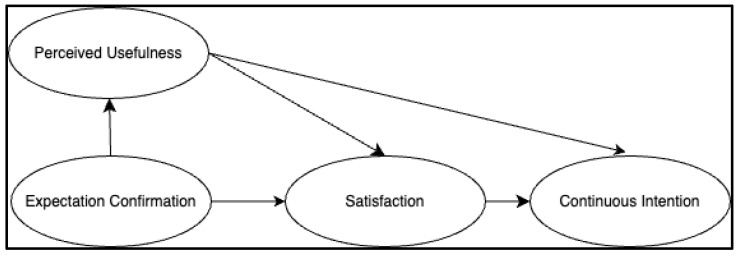
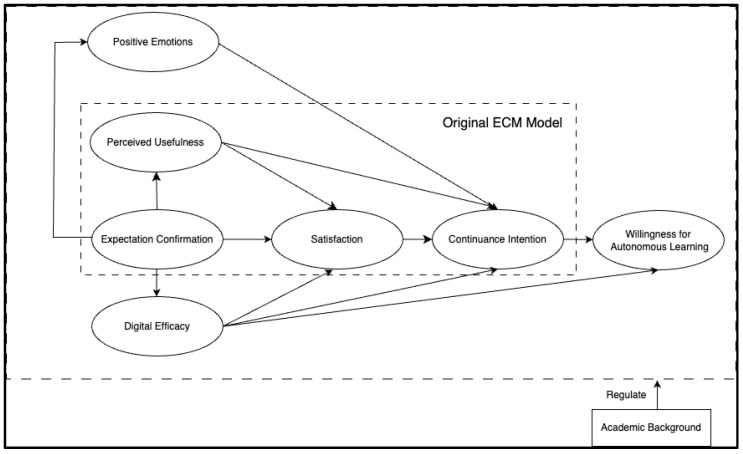
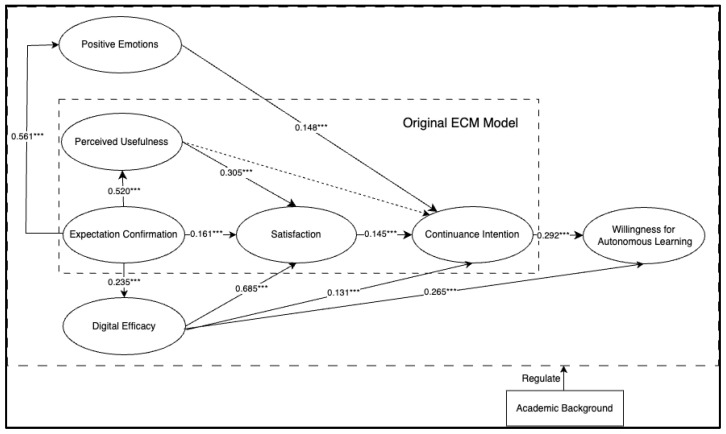
As artificial intelligence (AI) technology becomes increasingly integrated into education, understanding the theoretical mechanisms that drive university students to adopt new learning behaviors through these tools is essential. This study extends the Expectation-Confirmation Model (ECM) by incorporating both cognitive and affective variables to examine students’ current AI usage and their future expectations. The model includes intrinsic and extrinsic motivations, focusing on three key factors: positive emotions, digital efficacy, and willingness for autonomous learning. A survey of 721 valid responses revealed that positive emotions, digital efficacy, and satisfaction significantly influence continued AI usage, with positive emotions being particularly critical. Digital efficacy and perceived usefulness also impact satisfaction, but long-term usage intentions are more effectively driven by positive emotions. Furthermore, digital efficacy strongly affects the willingness for autonomous learning. Therefore, higher education institutions should promote AI technology, enhance students’ expectation-confirmation levels, and emphasize positive emotional experiences during AI use. Adopting a “human–machine symbiosis” model can foster active learning, personalized learning pathways, and the development of students’ digital efficacy and innovation capabilities.
Overview
The claims and statistics of this paper haven’t been checked yet.
Run the check — free, no account needed. It reads the open-access text and checks the sources it cites.
Integrity signals
Registry
Cites
Statistics
Figures
Verification
Claims the paper makes
The claims and statistics of this paper haven’t been checked yet.
Run the check — free, no account needed. It reads the open-access text and checks the sources it cites.
Claims other papers make about this one
Each is checked against this paper’s own text: does it say what the citing paper says it does?
The source backs part of the claim, not all of it — or backs it for a different population, condition or comparison.
In the citing paper
“Prior research has identified satisfaction as one of the strongest predictors of continuance intention”
From Exploring the Role of Generative AI as a Research Assistant in Undergraduate Sociology Research Methods (2026) · cites this paper as Wang & Li, 2024
Experimental — accuracy not yet measuredIn the citing paper
“Artificial Intelligence tools also contribute to increased intrinsic motivation, student autonomy, and psychological resilience.”
From Artificial Intelligence in Higher Education: A State-of-the-Art Overview of Pedagogical Integrity, Artificial Intelligence Literacy, and Policy Integration (2025) · cites this paper as [60]
In the citing paper
“The 24/7 availability of personalized learning support enhances student confidence while reducing anxiety often associated with traditional instruction [59,60].”
From Artificial Intelligence in Higher Education: A State-of-the-Art Overview of Pedagogical Integrity, Artificial Intelligence Literacy, and Policy Integration (2025) · cites this paper as [60]
Self-check
Percentages, sums and reported differences re-computed from the paper’s own numbers.
The self-check needs the paper’s full text.
Citations
Cites
Hu, L., & Bentler, P. M. (1999) · Structural Equation Modeling A Multidisciplinary Journal · doi:10.1080/10705519909540118 · Cited by 108,788
Perceived usefulness, perceived ease of use, and user acceptance of information technology
Davis, F. D. (1989) · MIS Quarterly · doi:10.2307/249008 · Cited by 68,483
User Acceptance of Information Technology: Toward A Unified View1
Venkatesh, V., Morris, M. G., Davis, G. B., & Davis, F. D. (2003) · MIS Quarterly · doi:10.2307/30036540 · Cited by 45,035
Self-efficacy: Toward a unifying theory of behavioral change
Bandura, A. (1977) · Psychological Review · doi:10.1037/0033-295x.84.2.191 · Cited by 43,925
A Cognitive Model of the Antecedents and Consequences of Satisfaction Decisions
Oliver, R. L. (1980) · Journal of Marketing Research · doi:10.1177/002224378001700405 · Cited by 14,494
Understanding Information Systems Continuance: An Expectation-Confirmation Model1
Bhattacherjee, A. (2001) · MIS Quarterly · doi:10.2307/3250921 · Cited by 8,767 · cited 3×
“The theoretical framework for this study is based on the Expectation-Confirmation Model (ECM), initially proposed by Bhattacherjee [10].”
BackgroundMethodInfluentialComputer Self-Efficacy: Development of a Measure and Initial Test
Compeau, D. R., & Higgins, C. A. (1995) · MIS Quarterly · doi:10.2307/249688 · Cited by 6,553
Training language models to follow instructions with human feedback
Ouyang, L., Wu, J., Jiang, X., Almeida, D., Wainwright, C. L., Mishkin, P., Zhang, C., Agarwal, S., Slama, K., Ray, A., et al. (2022) · arXiv · doi:10.48550/arxiv.2203.02155 · Cited by 4,208
Training Language Models to Follow Instructions with Human Feedback
Ouyang, L., Wu, J., Jiang, X., Almeida, D., Wainwright, C., Mishkin, P., Zhang, C., Agarwal, S., Slama, K., Ray, A., et al. (2022) · Advances in Neural Information Processing Systems 35 · doi:10.52202/068431-2011 · Cited by 3,117
Chatting and cheating: Ensuring academic integrity in the era of ChatGPT
Cotton, D. R. E., Cotton, P. A., & Shipway, J. R. (2024) · Innovations in Education and Teaching International · doi:10.1080/14703297.2023.2190148 · Cited by 3,087
Research works printed but not linked: 6
- Biggs, J.B. (2011). Teaching for Quality Learning at University: What the Student Does, McGraw-Hill Education.
- Lee, 2011, Adding Innovation Diffusion Theory to the Technology Acceptance Model: Supporting Employees’ Intentions to Use E-Learning Systems, Educ. Technol. Soc., 14, 124
- Wang, 2018, Research on the Influencing Factors of Users’ Continuous Contribution Behavior in Network Group Collaboration, Libr. J., 37, 12
- Liu, 2022, Artificial Intelligence Support for Language Study: How Anthropomorphic Technology Affects Study, J. Electrochem. Educ. Res., 10, 102
- Lv, 2019, Knowledge Purport: The Deep Driving Force Affecting the Quality of Undergraduate Learning Experience in Top Universities: Based on the SERU Survey Data of Eight Universities in China and the United States (2017–2018), High. Educ. Jiangsu, 9, 57
- Sun, 2021, Game and Construction of Human-Technology Relationship in Artificial Intelligence Education: From Reverse Domestication to Technical Mediation, Open Educ. Res., 27, 37
Cited by
Sorted by citations
Merino-Campos, C. (2025) · Trends in Higher Education · doi:10.3390/higheredu4020017 · Cited by 342
Mustofa, R. H., Kuncoro, T. G., Atmono, D., Hermawan, H. D., & Sukirman, S. (2025) · Computers and Education Artificial Intelligence · doi:10.1016/j.caeai.2025.100379 · Cited by 187
Adamakis, M., & Rachiotis, T. (2025) · Encyclopedia · doi:10.3390/encyclopedia5040180 · Cited by 76
Liu, G., & Zhao, X. (2025) · ReCALL · doi:10.1017/s0958344025100359 · Cited by 57
Ninghardjanti, P., Umam, M. C., Subarno, A., Winarno, W., Langgi, N. R., & Widodo, J. (2025) · Frontiers in Education · doi:10.3389/feduc.2025.1719625 · Cited by 50
Chun, Z., Ning, Y., Chen, J., & Wijaya, T. T. (2025) · Education and Information Technologies · doi:10.1007/s10639-025-13617-2 · Cited by 38
Li, Z., & Xiao, Y. (2025) · BMC Medical Education · doi:10.1186/s12909-025-07669-8 · Cited by 38
Ren, J., Guo, J., & Li, H. (2025) · Scientific Reports · doi:10.1038/s41598-025-18873-3 · Cited by 35
The Integration of Artificial Intelligence in Academic Learning Practices: A Comprehensive Approach
Anghel, G. A., Zanfir, C.-M., Matei, F. L., Voicu, C. D., & Neacșa, R. (2025) · Education Sciences · doi:10.3390/educsci15050616 · Cited by 32
Cui, Y. (2025) · Computers and Education: Artificial Intelligence · doi:10.1016/j.caeai.2025.100391 · Cited by 26
Factors influencing medical students’ adoption of AI educational agents: an extended UTAUT model
Zhao, X., Liu, W., Yue, S., Chen, J., Xia, D., Bing, K., Xia, X., & Wang, K. (2025) · BMC Medical Education · doi:10.1186/s12909-025-08234-z · Cited by 25
Omirali, A., Kozhakhmet, K., & Zhumaliyeva, R. (2025) · Sustainability · doi:10.3390/su17177567 · Cited by 24
Valentine Joseph Owan, P. D., Chukwu, C. O., Agama, V. U., Owan, T. J., Ogar, J. O., & Etorti, I. J. (2025) · Discover Education · doi:10.1007/s44217-025-00770-6 · Cited by 25
Skalka, J., Przybyła‐Kasperek, M., Smyrnova‐Trybulska, E., Klimeš, C., Farana, R., Dagienė, V., & Dolgopolovas, V. (2025) · IEEE Access · doi:10.1109/access.2025.3573575 · Cited by 21
Ishmuradova, I. I., Chistyakov, A. A., Brodskaya, T. A., Kosarenko, N. N., Savchenko, N. V., & Shindryaeva, N. N. (2025) · Contemporary Educational Technology · doi:10.30935/cedtech/15907 · Cited by 17
Implementation of AI in career counselling for university students: a systematic review
Sarmurzin, Y., Azhenov, A., Kudysheva, A., Ualikhanova, B. S., Saparbekova, I., & Besbayev, A. (2026) · Frontiers in Education · doi:10.3389/feduc.2026.1787689 · Cited by 15
Nuh, A., Rizan, M., & Sadat, A. M. (2025) · Interdisciplinary Journal of Information Knowledge and Management · doi:10.28945/5444 · Cited by 13
Liang, H., & Mao, X. (2025) · International Journal of Educational Development · doi:10.1016/j.ijedudev.2025.103434 · Cited by 12
Canbeldek, M., Erol, A., Erol, M., & Budak, K. S. (2026) · International Journal of Human-Computer Interaction · doi:10.1080/10447318.2026.2619035 · Cited by 12
Ode, E., Nana, R., Boro, I. O., & Ikyanyon, D. N. (2025) · Computers and Education Artificial Intelligence · doi:10.1016/j.caeai.2025.100402 · Cited by 15
Saleh, E. (2025) · East Journal of Human Science · doi:10.63496/ejhs.vol1.iss6.182 · Cited by 11
Liu, C., Zhu, K., Zhang, Z., & Ding, Y. (2025) · Frontiers in Psychology · doi:10.3389/fpsyg.2025.1727037 · Cited by 12
Enoch, S. K., Mejira, A., Bayor, N., Nyemewero, I., & Godfred, A. A. (2024) · American Journal of Technology · doi:10.58425/ajt.v3i1.301 · Cited by 10
Li, H., Yang, F., & Liu, J. (2026) · BMC Psychology · doi:10.1186/s40359-026-04204-2 · Cited by 10
Zhang, H., & Zhang, L. (2025) · Acta Psychologica · doi:10.1016/j.actpsy.2025.105423 · Cited by 8
Sari, D. A. P., Fajar, I. M., & Uma, N. (2025) · Management of Education Jurnal Manajemen Pendidikan Islam · doi:10.18592/moe.v11i1.14688 · Cited by 8
Chiang, Y.-H., Huang, C.-S., Hung, L.-S., & Huang, T. (2025) · Innovations in Education and Teaching International · doi:10.1080/14703297.2025.2533390 · Cited by 7
Du, Y. (2025) · Interactive Learning Environments · doi:10.1080/10494820.2025.2538746 · Cited by 7
Antoško, M., Polishchuk, V., Келемен, М., Korniienko, A., & Келемен, М. (2024) · Applied Sciences · doi:10.3390/app15010308 · Cited by 7
Zhang, X., Xiao-hong, Z., & Xiao-kun, L. (2025) · Education and Information Technologies · doi:10.1007/s10639-025-13756-6 · Cited by 6
Quan, Y. (2025) · European Journal of Education · doi:10.1111/ejed.70295 · Cited by 6
The implications of artificial intelligence usage on management students’ academic productivity
Idrissi, I. E., & Alami, Y. (2025) · Artificial Intelligence in Education · doi:10.1108/aiie-05-2025-0103 · Cited by 6
Zhu, Z., Gan, Q., & Duan, P. (2026) · Humanities and Social Sciences Communications · doi:10.1057/s41599-026-06692-4 · Cited by 6
Exploring student motivations for AI usage in education: Nisantasi in Turkey, a case study
AL-Sayid, F., Alpago, H., & Kirkil, G. (2026) · Acta Psychologica · doi:10.1016/j.actpsy.2026.106852 · Cited by 6
Kambhampati, V., & Patel, R. K. (2025) · IGI Global eBooks · doi:10.4018/979-8-3373-0004-7.ch007 · Cited by 6
Factors of AI Adoption in Educational Contexts: A Meta-Analytic Synthesis Through the UTAUT
Zhuang, Y., Li, R., & Duan, S. (2025) · International Conference on Distance Education and Learning (ICDEL) · doi:10.1109/icdel65868.2025.11193611 · Cited by 5
Cheung, L. M. E., Lo, O., & Shi, H. (2025) · Computers and Education Artificial Intelligence · doi:10.1016/j.caeai.2025.100516 · Cited by 6
Zou, Y., & Guo, Y. (2026) · The International Journal of Management Education · doi:10.1016/j.ijme.2026.101361 · Cited by 5
Artificial intelligence as a reflexive collaborator in graduate studies supervision
Brown, A., & Rossouw, J. (2026) · Transformation in Higher Education · doi:10.4102/the.v11i0.657 · Cited by 6
Shang, X. (2025) · European Journal of Education · doi:10.1111/ejed.70257 · Cited by 5
Salamzadeh, A., Ashkani, M., & Asgharifar, M. H. (2025) · Strategy and Leadership · doi:10.1108/sl-04-2025-0091 · Cited by 6
Gou, H., Sun, Q., Xiang, L., Hu, C., Fang, Y., & Fan, F. (2026) · Frontiers in Public Health · doi:10.3389/fpubh.2026.1754288 · Cited by 4
Exploring Student and Educator Challenges in AI Competency Development: A Comparative Analysis
Zhao, X., Miao, F., Xie, H., & Chen, X. (2026) · Multimodal Technologies and Interaction · doi:10.3390/mti10030027 · Cited by 4
Liu, Q., Zhao, L., Cui, Q., Bing, S., Dang, M., & Chen, J. (2026) · British Educational Research Journal · doi:10.1002/berj.70147 · Cited by 4
Cantaş, Ç., Celep, C., & BATUR, Ö. (2026) · Frontiers in Psychology · doi:10.3389/fpsyg.2026.1810689 · Cited by 4
Sebopelo, P., Baloyi, O. B., & Chukwuma, N. N. (2025) · Review of Artificial Intelligence in Education · doi:10.37497/rev.artif.intell.educ.v6ii.42 · Cited by 4
Rasid, S. A., & Azhari, M. F. A. (2025) · Abjadia International Journal of Education · doi:10.18860/abj.v10i2.32579 · Cited by 3
Reasons for and against GenAI: Trait-driven adoption under open innovation dynamics
Hoonsopon, D., Ketkaew, C., Puriwat, W., Viriyasitavat, W., & Tripopsakul, S. (2025) · Journal of Open Innovation Technology Market and Complexity · doi:10.1016/j.joitmc.2025.100653 · Cited by 3
Attitude of Engineering Students on AI System
Puzon, C. J., Samontina, R., Obenza, B. N., Tinio, A. J., Inguito, M., Laureta, T. M., Sayman, E. J., Aurestela, J., & Kileste, F. L. B. (2025) · Asia Pacific Journal of Educational Technologies Psychology and Social Sciences · doi:10.70847/592763 · Cited by 3
Impacto De La Inteligencia Artificial En El Aprendizaje Autónomo De Estudiantes Universitarios
Guevara-Reyes, R. J., Saltos-Verdezoto, Y. M., Garófalo, M. F. M., & Ordóñez-Vargas, A. E. (2025) · MQRInvestigar · doi:10.56048/mqr20225.9.3.2025.e985 · Cited by 3
Durán, A. G., & Alejandro, A. (2025) · Journal Emerging Technologies in Education · doi:10.70177/jete.v2i6.1920 · Cited by 2
Bahrami, M., Azizi, S. M., & Mansoory, M. S. (2025) · BMC Medical Education · doi:10.1186/s12909-025-08049-y · Cited by 3
Paltsoglou, V., & Zafiropoulos, K. (2025) · Open Education Studies · doi:10.1515/edu-2025-0104 · Cited by 2
Biri, A. K. A., Arilin, A. T., Mohammad-Rasdi, A., Dawami, M., Usman-Lando, K., Teh, A., Bakilan, H., Ishmael, I., Asiri, N. I., & Nassal, F. J. (2026) · Journal of Cultural Analysis and Social Change · doi:10.64753/jcasc.v11i1.4284 · Cited by 2
AI-Mediated Informal Digital Learning of English (AI-IDLE)
Liu, G., & Lee, J. S. (2026) · Cambridge University Press eBooks · doi:10.1017/9781009742542 · Cited by 2
Sebopelo, P., Baloyi, O. B., & Chukwuma, N. N. (2025) · SDGs Studies Review. · doi:10.37497/sdgs.v6istudies.33 · Cited by 2
Challenging cases of hyponatremia incorrectly interpreted by ChatGPT
Berend, K., Duits, A. J., & Gans, R. O. B. (2025) · BMC Medical Education · doi:10.1186/s12909-025-07235-2 · Cited by 2
Ang, J. V., Dizor, Y. C., Mendoza, S. F. A., & Cortes, P. (2025) · Environment and Social Psychology · doi:10.59429/esp.v10i7.3872 · Cited by 1
New Ideas for University Students' Career Planning from the Perspective of AI
Lin, X. (2025) · Education insights. · doi:10.70088/yfj03692 · Cited by 1
AI Dilemma in Schoolwork: Student Anxiety and Fairness Perceptions in AI Schoolwork Accusations
Biri, A. K. A., Arilin, A. T., Traigo, M. L. M., Jaji, G. T., Salasain, R. J., & Abdilla, A.-B. Y. (2025) · doi:10.7176/jep/16-11-01 · Cited by 1
Cervantes-Gómez, L. A., & Sahagún-García, A. (2026) · Dilemas contemporáneos Educación Política y Valores · doi:10.46377/dilemas.v13i2.4841 · Cited by 1
The normalization of unease: the case study of GenAI use by iSchool students
Lopatovska, I., Mack, C., Connors, E., Zhu, P., Keller, N., Kaur, S., Koonamparampath, M., Everett, M., Zapata, Z., Giordano, P., et al. (2026) · Information and Learning Sciences · doi:10.1108/ils-08-2025-0125 · Cited by 1
PERMATASARI, N., & Rahmawati, M. I. (2025) · E-Jurnal Akuntansi · doi:10.24843/eja.2025.v35.i09.p18 · Cited by 1
Chung, P. T., & Ngo, T. T. A. (2026) · Journal of Information Technology Education Research · doi:10.28945/5720 · Cited by 1
Sibarani, B. E. (2026) · American Journal of Distance Education · doi:10.1080/08923647.2026.2650245 · Cited by 1
Horváth, L., Eger, L., Tomczyk, Ł., Szwejka, Ł., Egerová, D., Rohlíková, L., Kincl, T., Pospíšil, J. Z., Medeková, K., Mikulcová, P., et al. (2026) · Computers and Education Open · doi:10.1016/j.caeo.2026.100357 · Cited by 1
Faiz, M. N., Yahya, M., Mappalotteng, A. M., Sanatang, Fathahillah, Arifyanti, F., & Subasi, S. (2026) · Journal of Vocational Informatics and Computer Education · doi:10.66053/voice.v4i1.372 · Cited by 1
An Examination of Generative Artificial Intelligence Usage Among Students with Disabilities
Aidarus, F., Lamers, T. S., & Khribi, M. K. (2026) · International Conference on Artificial Intelligence, Computer, Data Sciences and Applications (ACDSA) · doi:10.1109/acdsa67686.2026.11467848 · Cited by 1
Faiz, M. N., Yahya, M., Rosidah, & Sanatang (2026) · Information Technology Education Journal · doi:10.59562/intec.v5i1.267 · Cited by 1
Low, J., Mar, Y., & Lee, C. S. (2026) · Communications in computer and information science · doi:10.1007/978-3-032-30833-7_10 · Cited by 1
Integration of Artificial Intelligence to Strengthen Critical Thinking in Teacher Training
Cabrera-Solano, P., & Castillo-Cuesta, L. (2026) · International Journal of Learning Teaching and Educational Research · doi:10.26803/ijlter.25.7.24 · Cited by 1
Grab, M. Ö. (2026) · Social Sciences & Humanities Open · doi:10.1016/j.ssaho.2026.103465 · Cited by 1
Huang, D.-Y., & Lin, Y. (2025) · Preprints.org · doi:10.20944/preprints202509.2555.v1 · Cited by 1
AKPAN, S. M., & Valentine Joseph Owan, P. D. (2026) · SSRN Electronic Journal · doi:10.2139/ssrn.7052758 · Cited by 1
Wells, M. (2026) · Journal of Teaching and Learning with Technology · doi:10.14434/jotlt.v14i1.41671
Integrating Rapid Application Development Courses into Higher Education Curricula
Radvilaitė, U., & Kalibatienė, D. (2025) · Applied Sciences · doi:10.3390/app15063323
Promoting Cultural Awareness and Autonomous Learning in Higher Education: A Case Study
Miftari-Fetishi, I. (2025) · Balkan Research Journal · doi:10.69648/vygf5080
Computing Students' Attitudes Toward ChatGPT Across Learning Modalities in Programming Courses
Hernandez, H. E., Malimata, C. A., Lucas, J. D., Pampo, F. R., Grume, J. C., Yambao, J. A., Austria, J. A. P., Salenga, J. L., & Miranda, J. P. P. (2025) · International Conference on Information and Education Technology (ICIET) · doi:10.1109/iciet66371.2025.11046273
A Preliminary Study on Higher Education Students’ Usage, and Attitudes Towards AI
Klančar, A., & Janeš, A. (2025) · Communications in computer and information science · doi:10.1007/978-3-031-95627-0_18
Use of AI for Health Purposes and Its Association with Anxiety Among U.S. College StudentsPreprint
Akter, T. (2025) · SocArXiv (OSF Preprints) · doi:10.31235/osf.io/cvtq6_v1
ARTIFICIAL INTELLIGENCE & UNIVERSITY STUDENTS
Iosim, I., PASCARIU, A., Marin, D. C., Sălășan, C., Urlica, A.-A. D., & DUMITRESCU, C. (2025) · Research Journal of Agricultural Science · doi:10.59463/rjas.2025.2.11
Diaz, J. F. Q., Chiluiza, S. I. P., Rosero, T. A. C., & Serrano, L. F. F. (2025) · Ciencia Latina Revista Científica Multidisciplinar · doi:10.37811/cl_rcm.v9i5.19890
M., G. M. S. G., Kazim, M. H., Noor, M. T., & Rajendran, J. (2025) · International Journal of Innovative Science and Research Technology (IJISRT) · doi:10.38124/ijisrt/25nov1085
Beyond the Classroom: Motivating Independent Learning Through Technology
Buha, G. (2025) · BULETIN ŞTIINŢIFIC SERIA A Fascicula Pedagogie-Psihologie-Metodică · doi:10.37193/bs-ppm.25.06
Expectations of Empathy and Accessibility in AI-Driven Healthcare for Individuals with Diverse NeedsPreprint
Piispanen, J.-R., Kauttonen, J., Alamäki, A., & Rousi, R. (2025) · SSRN Electronic Journal · doi:10.2139/ssrn.5928847
Model of Acceptance of Artificial Intelligence Devices in Higher Education
Salazar, L., & Rivera, L. (2026) · Computers · doi:10.3390/computers15010046
University Student Smartphone Usage in Higher Education: Pre-Pandemic vs. Post-Pandemic
Atkinson, J. K., Blankenship, R. J., & Marston, S. R. (2026) · Journal of Higher Education Theory and Practice · doi:10.33423/jhetp.v26i1.8069
Bora, A., Permatasari, R. D., Hernando, L., Hanafie, A., Maylani, A., & Adriyanto, A. (2025) · ILTEK Jurnal Teknologi · doi:10.47398/iltek.v20i02.299
Enhancing Student Engagement With AI
Asrifan, A., Rismawati, R., Sulaiman, I., Abdullah, A., & Noni, N. (2026) · Advances in computational intelligence and robotics book series · doi:10.4018/979-8-3373-3000-6.ch007
ARTIFICIAL INTELLIGENCE, CRITICAL THINKING, AND UNIVERSITY STUDENTS
Dumitrescu, C. S., MIRIANICI, L., Șuba, A., MARIN, D., & Iosim, I. (2025) · Research Journal of Agricultural Science · doi:10.59463/rjas.2025.3.18
Anwar, H., Ismawati, Agusnaya, N., Risal, A. A. N., & Rifqie, D. M. (2026) · Artificial Intelligence in Lifelong and Life-Course Education · doi:10.66053/aillce.v1i2.14
Antonio, F., Veronica, V., & Giovani, S. (2026) · doi:10.2196/preprints.93111
Nathanael, E. G., Prasetyo, S. S., & Mailangkay, A. B. L. (2025) · International Conference on Artificial Intelligence and Technological Solutions (ICAITech) · doi:10.1109/icaitech66481.2025.11387592
Truong, T.-K. H. V., & Le, D. V. G. (2025) · International Conference on Applied Artificial Intelligence, Data Engineering and Sciences (ICAIDES) · doi:10.1109/icaides67265.2025.11404019
Guo, Z., Liang, Y., & Liu, Y. (2026) · Lecture notes in computer science · doi:10.1007/978-981-95-8420-8_25
University Students’ Perceptions of Artificial Intelligence (AI) in Sustainable Development
Tran, T. N. T., Ton, Q. D., & Nguyen, L. T. (2026) · Springer proceedings in business and economics · doi:10.1007/978-981-95-4017-4_21
Exploring GenAI as an Alternative to Traditional Language Learning
Eroglu, U., Oran, Ç., Severdim, K., Çelik, K. K., & Hancı-Azizoğlu, E. B. (2026) · Advances in computational intelligence and robotics book series · doi:10.4018/407558
Biswas, B., Ullah, M. N., Shaulin, N., Masud, A. A., Islam, M. S., Rahman, N., Roy, F., & Mallick, B. (2026) · Research Square · doi:10.21203/rs.3.rs-9517105/v1
Trillo, J. C., & Bustillo, J. C. M. (2026) · International Conference on Machine Learning and Autonomous Systems (ICMLAS) · doi:10.1109/icmlas67792.2026.11483654
Yu, M., Jiang, D., Xu, Q., Qiu, J., & Chen, J. (2026) · Journal of Nursing Education · doi:10.3928/01484834-20260406-02
Metadata
- Authors
- Wang, L., & Li, W.
- Affiliations
- Yili Normal University (CN)
- Nanjing University (CN)
- Corresponding author
- Li, Wenye
- ORCID
- Venue
- Behavioral Sciences
- Publisher
- MDPI AG
- Published
- 2024-10-16
- Volume
- 14
- Issue
- 10
- Pages
- 956
- ISSN
- 2076-328X (ISSN-L)
- PMC
- PMC11505466
- OpenAlex
- W4403493263
- Cited by
- 94
- References
- 54
- Citations by year
- 2026: 45 · 2025: 47 · 2024: 2
- FWCI
- 35.26
- Type
- journal article
- Language
- en
- Open access
- gold
- doi.org
- Licence
- Locations
- Behavioral Sciences (publishedVersion, cc-by)
- PubMed Central (publishedVersion, cc-by)
- PubMed (publishedVersion)
- DOAJ (DOAJ: Directory of Open Access Journals) (submittedVersion, cc-by-sa)
- Funders
- National Education Planning Topics General Project (BIA240122, KYCX24_0098)
- Postgraduate Research & Practice Innovation Program of Jiangsu Province (BIA240122, KYCX24_0098)
- Topics
- Social Sciences › Education › Artificial Intelligence in Education
- Social Sciences › Decision Sciences › Information Systems and Management › Technology Adoption and User Behaviour
- Social Sciences › Education › Online and Blended Learning
- Keywords
- artificial intelligence in education, university students, self-directed learning, expectation-confirmation model, positive emotions, perceived usefulness, user satisfaction, intrinsic and extrinsic motivation, human-machine symbiosis, personalized learning
About these checks
Registry, retraction, Cites and statistics results are computed, not judged, with one exception: a printed reference that no index lists is read once by a model before it counts as a citation error. Claims are extracted by a model and kept only when their quote appears verbatim in the text; each cited source is then checked, with a model’s help, for whether it says what the claim relies on. Those verdicts can be wrong — read the claim’s quote and the cited source before relying on one.
Statistics and arithmetic are recomputed, not judged.
Confidence bands are shown only for fields calibrated on our annotated test set. None is calibrated yet, so no band is shown.
What counts as a claim ›How we measure confidence ›How we check this ›
Are you an author, or do you see a problem with this page? Request a review
