

The Role of False Self-Presentation and Social Comparison in Excessive Social Media Use
Open accessThe DOI matches its Crossref record; 112 of the 112 references it cites were found in a registry or an index; 4 of the 72 sources its claims cite were checked for support.
Abstract
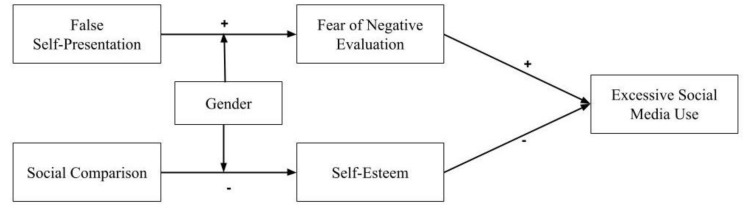
Excessive social media use has become a growing concern due to its potential to affect self-perception, particularly through lowered self-esteem and a heightened fear of negative evaluation. With the increasing tendency for individuals to curate idealised online personas, understanding the psychological factors that drive this behaviour is critical. This study applies Self-Discrepancy Theory, Social Comparison Theory, and Gender Schema Theory to explain how self-perception, constant comparisons, and internalised gender norms drive online behaviours. A survey of 400 active social media users in Pakistan was conducted, and the data were analysed using Partial Least Squares Structural Equation Modelling (PLS-SEM). This study revealed that false self-presentation significantly heightened the fear of negative evaluation, which mediated its influence on excessive social media use. Social comparison, contrary to expectations, boosted self-esteem while also fuelling excessive use, as individuals sought validation online. Gender also appeared to play a moderating role, with women experiencing a stronger link between social comparison and self-esteem. However, gender did not moderate the relationship between false self-presentation and the fear of negative evaluation, suggesting similar psychological effects across genders. This study highlights that the fear of negative evaluation and social comparison-driven self-esteem are key psychological mechanisms behind excessive social media use, while gender plays a role in shaping the impact of social comparison but not false self-presentation. This study provides empirical evidence that excessive social media use is shaped by psychological factors, such as fear of negative evaluation and validation-seeking, driven by social comparison. Interventions aimed at reducing the emotional distress associated with excessive social media use should prioritise digital literacy programs that help users identify how false self-presentation and social comparison shape their fear of negative evaluation and validation-seeking behaviours, especially in appearance-driven online environments.
Overview
CoChat Summary
TL;DR
This study tests a moderated mediation model in which false self-presentation and social comparison predict excessive social media use via fear of negative evaluation and self-esteem, with gender as moderator, among 400 active social media users in Pakistan. It finds fear of negative evaluation mediates false self-presentation’s effect, social comparison unexpectedly raises self-esteem while also increasing excessive use, and gender moderates only the social comparison–self-esteem link.
Key findings
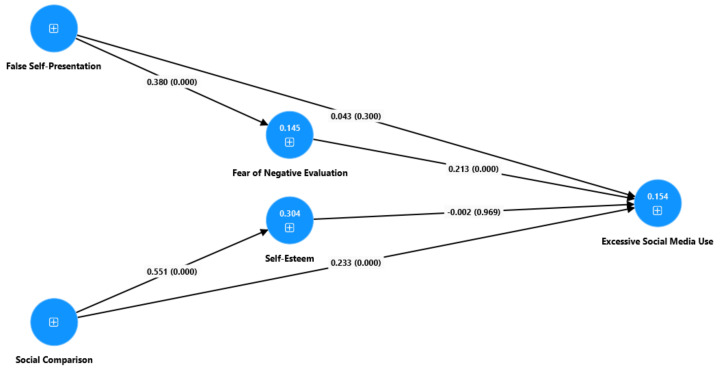
- False self-presentation significantly predicted fear of negative evaluation (β = 0.380, p = 0.000), and fear of negative evaluation significantly predicted excessive social media use (β = 0.213, p = 0.000); the direct false self-presentation → excessive use path was non-significant (β = 0.043, p = 0.300).
- Social comparison significantly predicted excessive social media use (β = 0.233, p = 0.000) and, contrary to expectation, positively predicted self-esteem (β = 0.551, p = 0.000); self-esteem did not significantly predict excessive use (β = −0.002, p = 0.969).
- Gender did not moderate false self-presentation → fear of negative evaluation (males β = 0.390; females β = 0.350; difference n.s.), but it did moderate social comparison → self-esteem, stronger for females (β = 0.600) than males (β = 0.410). Males were more likely to engage in false self-presentation; females more likely to engage in social comparison.
- The model explained 14.5% of variance in fear of negative evaluation, 30.4% in self-esteem, and 15.4% in excessive social media use; reliability/validity were acceptable (Cronbach’s α 0.74–0.936; AVE 0.563–0.796; HTMT below 0.90).
Methods
- Quantitative cross-sectional survey using purposive sampling; 432 responses collected, 400 valid responses retained from active social media users in Pakistan (accessed platforms at least once daily).
- Sample: 55.25% female (n = 221), 44.75% male (n = 179); mean age 28.4 years (SD = 8.3); largest age group 18–25 (45.75%), followed by 26–35 (34.50%). Online survey distributed via Facebook, Instagram, and WhatsApp; completion took about 15–20 min.
- Measures used 7-point Likert scales: 17-item Self-Presentation on Facebook Questionnaire, 11-item Iowa–Netherlands Social Comparison Orientation Scale, 11-item Brief Fear of Negative Evaluation Scale, 10-item Rosenberg Self-Esteem Scale, and adapted 9-item Social Media Use Questionnaire for Instagram. Analysis used PLS-SEM, including measurement model evaluation and multi-group analysis for gender moderation.
Limitations
- The paper states the cross-sectional design prevents causal inference and self-reported data may introduce bias; it recommends longitudinal designs and objective tracking measures.
- The paper states the sample is from a specific geographic and cultural context, limiting generalizability, and calls for cross-cultural research.
- The paper states Gender Schema Theory’s binary framework limits application beyond male–female categories and recommends accounting for gender diversity; evident from the text, the non-probability purposive sampling and young-adult, Pakistan-based sample further constrain generalizability.
Model-written summary. Check it against the paper before relying on it.
Integrity signals
Registry
Cites
Statistics
Figures
Verification
Claims the paper makes
2 Valid · 0 Not valid · 32 Not checked · 43 Own results and interpretations
The cited sources support only part of this claim — read each source’s verdict below.
In the paper
“The frequency of these comparisons on social media platforms contributes to excessive social media use, as users feel compelled to keep up with the seemingly perfect lives of others (Mann & Blumberg, 2022; Meier & Johnson, 2022).”
§ The Role of False Self-Presentation and Social Comparison in Excessive Social Media Use > 2. Literature Review > 2.3. Social Comparison
What the sources say
- Partly supportedcites Mann & Blumberg, 2022 matched to “Adolescents and social media: The effects of frequency of use, self-presentation, social comparison, and self esteem on possible self imagery” (2022) sourceExperimental — accuracy not yet measured
In Section 3 (Social comparison) our copy does link comparison frequency to heavier use — 'Individuals with higher SCO report using social networking sites more frequently, particularly for social comparison' — but it reports that as Vogel et al. (2015)'s finding rather than its own, and it frames the consequence as self-concept development ('higher frequency of social media use may have negative consequences for self-concept development including unhealthy comparisons'), hedged with 'may'. The paper mentions curated/overly idealistic content posted by others (Chou & Edge, 2012; Fullwood et al., 2016, Section 2), but no passage states that comparison frequency contributes to *excessive* social media use or that users feel *compelled to keep up* with others' seemingly perfect lives; that causal/compulsion framing is not supported by this source. (LLM, conf=0.72)
- Could not verifycites Meier & Johnson, 2022 matched to “Social comparison and envy on social media: a critical review” (2022) sourceExperimental — accuracy not yet measured
Our copy of Meier & Johnson (2022) never treats comparison frequency as a driver of excessive or problematic social media use: its outcome variables are well-being indicators (Introduction; §2.1 Reviews and meta-analyses, reporting associations with affect, self-esteem, life satisfaction and depressive symptoms; §2.2 on envy/inspiration). Where frequency is discussed (§2.5, International evidence from industry research), the direction runs the other way — Facebook comparison 'is more frequent among users who... spend more time on the application' — and §3.2 states research 'remains vague' about what causes comparisons, while §3.3 explicitly criticises dose-response framings in which users are 'mere recipients of content'. The 'seemingly perfect lives' element does have a counterpart (Introduction: users 'present a positively-biased version of themselves online'; Conclusion: 'highlight reels'), but I searched for excessive/problematic use, compulsion and 'keep up' and found no passage stating the attributed causal link, so the claim cannot be settled from this source. (LLM, conf=0.68)
plainstates a cause- Asserted: passes — The authors put it forward as true.
- Checkable: passes — It can be checked against evidence.
- Load-bearing: passes — The paper’s conclusions depend on it.
- Based: passes — The paper gives a reason why it holds.
- Partly supported
The cited sources support only part of this claim — read each source’s verdict below.
In the paper
“Furthermore, social media amplifies the pressures related to the ought self, where users feel the need to conform to societal norms, peer expectations, and cultural standards (Ando et al., 2021; Choi et al., 2020; Wolfers & Utz, 2022).”
§ The Role of False Self-Presentation and Social Comparison in Excessive Social Media Use > 2. Literature Review > 2.1. Self-Discrepancy Theory
What the sources say
- Not checked yetcites Ando et al., 2021 matched to “Beauty ideals, social media, and body positivity: A qualitative investigation of influences on body image among young women in Japan” (2021) source
Checked before — its earlier verdict is held back until a new check runs.
- Partly supportedcites Choi et al., 2020 matched to “A snap of your true self: How self-presentation and temporal affordance influence self-concept on social media” (2026) sourceExperimental — accuracy not yet measured
Our copy mentions the ought self only once, in 'Social media affordance and self-concept change', and solely as part of a definitional gloss borrowed from Higgins (1987): 'the ought self (attributes that people ought to possess)'. No passage attributes to social media an amplification of ought-self pressures, nor any need to conform to societal norms, peer expectations or cultural standards; the paper's own argument runs the other way, holding that ephemerality 'frees people from strategic self-presentational concerns' and reduces impression-management concerns ('Self-symbolizing'), and its empirical focus is the true/actual versus ideal self and personality-trait presentation, with the ought self never operationalized. The only pressure the paper discusses is the public-commitment drive to stay consistent with one's own previously presented self to an imagined audience ('Public commitment', Abstract), which is not conformity to external norms. So the concept is present but the specific claim attributed to Choi et al. is not. (LLM, conf=0.68)
- Partly supportedcites Wolfers & Utz, 2022 matched to “Social Media Use, Stress, and Coping” (2022) sourceExperimental — accuracy not yet measured
Wolfers & Utz (2022) treat social media as a source of socially-derived pressure: the 'Social media as stressors' section states that social media trigger approval anxiety and that 'the pressure to appear attractive and popular on social media is high' (esp. for adolescents), and that visibility to a large diverse audience creates uncertainty about others' reactions. That covers the 'amplifies pressures / peer expectations' portion of the claim. However, our copy never uses the ought-self or self-discrepancy framing, and says nothing about conforming to societal norms or cultural standards — the paper's framework is Lazarus & Folkman's transactional model (Introduction), with stressors limited to approval anxiety, FoMO, misinformation exposure, availability stress, connection overload and online vigilance. The ought-self component attributed to this source is therefore unsupported. (LLM, conf=0.68)
plainstates a cause- Asserted: passes — The authors put it forward as true.
- Checkable: passes — It can be checked against evidence.
- Load-bearing: passes — The paper’s conclusions depend on it.
- Based: passes — The paper gives a reason why it holds.
- Not checked yet
A result the paper reports from its own data — it cites no other source for it, so there is none to check. The quote shows it is in the paper.
In the paper
“However, gender did not moderate the relationship between false self-presentation and the fear of negative evaluation, suggesting similar psychological effects across genders.”
§ The Role of False Self-Presentation and Social Comparison in Excessive Social Media Use > Abstract
plain- Asserted: passes — The authors put it forward as true.
- Checkable: passes — It can be checked against evidence.
- Load-bearing: unclear — It is unclear whether the paper’s conclusions depend on it.
- Based: passes — The paper gives a reason why it holds.
A result the paper reports from its own data — it cites no other source for it, so there is none to check. The quote shows it is in the paper.
In the paper
“This study revealed that false self-presentation significantly heightened the fear of negative evaluation, which mediated its influence on excessive social media use.”
§ The Role of False Self-Presentation and Social Comparison in Excessive Social Media Use > Abstract
plainstates a cause- Asserted: passes — The authors put it forward as true.
- Checkable: passes — It can be checked against evidence.
- Load-bearing: passes — The paper’s conclusions depend on it.
- Based: passes — The paper gives a reason why it holds.
A result the paper reports from its own data — it cites no other source for it, so there is none to check. The quote shows it is in the paper.
In the paper
“Social comparison, contrary to expectations, boosted self-esteem while also fuelling excessive use, as individuals sought validation online.”
§ The Role of False Self-Presentation and Social Comparison in Excessive Social Media Use > Abstract
plainstates a cause- Asserted: passes — The authors put it forward as true.
- Checkable: passes — It can be checked against evidence.
- Load-bearing: passes — The paper’s conclusions depend on it.
- Based: passes — The paper gives a reason why it holds.
46 more claims
Create a free account to see all 77 claims and to verify the 60 references still open.
- It may state two separate claims as one. 16
- The quote only partly states this claim. 2
- Probably not a substantial claim. 11
Self-check
Percentages, sums and reported differences re-computed from the paper’s own numbers.
Each contradiction between two passages listed here was confirmed by an independent check.
Rated minor: it would not touch a result — a value no result rests on, a p-value that stays on the same side of the significance level, or a conflict that is clerical, resolved elsewhere in the paper, or outside its own findings.
In the paper
§ The Role of False Self-Presentation and Social Comparison in Excessive Social Media Use > 5. Discussion
“Furthermore, the results show that social comparison significantly influences excessive social media use (H4).”
§ The Role of False Self-Presentation and Social Comparison in Excessive Social Media Use > 4. Findings > 4.2. Structural Model Evaluation
“Furthermore, social comparison significantly predicts excessive social media use (β = 0.233, p = 0.000) (H5)”
Rated minor: it would not touch a result — a value no result rests on, a p-value that stays on the same side of the significance level, or a conflict that is clerical, resolved elsewhere in the paper, or outside its own findings.
In the paper
§ The Role of False Self-Presentation and Social Comparison in Excessive Social Media Use > 5. Discussion
“An unexpected finding is that while false self-presentation significantly influences the fear of negative evaluation, it does not have a direct effect on excessive social media use (H1), as the path between these variables was found to be non-significant.”
§ The Role of False Self-Presentation and Social Comparison in Excessive Social Media Use > 4. Findings > 4.2. Structural Model Evaluation
“However, the direct relationship between false self-presentation and excessive social media use (β = 0.043, p = 0.300) (H3) is non-significant”
Citations
Cites
A theory of social comparison processes
Festinger, L. (1954) · Human Relations · doi:10.1177/001872675400700202 · Cited by 20,926
Self-discrepancy: A theory relating self and affect.
Higgins, E. T. (1987) · Psychological Review · doi:10.1037/0033-295x.94.3.319 · Cited by 7,219 · cited 1×
“Self-Discrepancy Theory posits that individuals hold different self-concepts, and the discrepancies between these self-concepts can lead to distinct emotional and psychological outcomes (Higgins, 1987).”
Purposive sampling: complex or simple? Research case examples
Campbell, S., Greenwood, M., Prior, S., Shearer, T., Walkem, K., Young, S., Bywaters, D., & Walker, K. (2020) · Journal of Research in Nursing · doi:10.1177/1744987120927206 · Cited by 3,772
Robins, R. W., Hendin, H. M., & Trzesniewski, K. H. (2001) · Personality and Social Psychology Bulletin · doi:10.1177/0146167201272002 · Cited by 3,041 · cited 1×
“Self-esteem was measured using the widely used Rosenberg Self-Esteem Scale (RSE), a 10-item scale where participants rated their overall self-esteem, as in Robins et al. (2001).”
van Dijck, J., Poell, T., & de Waal, M. (2018) · doi:10.1093/oso/9780190889760.001.0001 · Cited by 2,951 · cited 1×
“In fact, social media has become an essential part of everyday life, influencing how people interact, communicate, and view themselves (Chaffey & Ellis-Chadwick, 2019; Coyne et al., 2020; van Dijck et al., 2018; Lilleker et al., 2021).”
A brief version of the Fear of Negative Evaluation Scale
Leary, M. R. (1983) · Personality and Social Psychology Bulletin · doi:10.1177/0146167283093007 · Cited by 2,178 · cited 1×
“The fear of negative evaluation was assessed using the Brief Fear of Negative Evaluation Scale (BFNES) developed by Leary (1983), which is an 11-item self-report measure that evaluates individuals’ discomfort and fear of being judged negatively by others.”
Gibbons, F. X., & Buunk, B. P. (1999) · Journal of Personality and Social Psychology · doi:10.1037/0022-3514.76.1.129 · Cited by 1,813
Social comparison, social media, and self-esteem.
Vogel, E. A., Rose, J. P., Roberts, L. R., & Eckles, K. (2014) · Psychology of Popular Media Culture · doi:10.1037/ppm0000047 · Cited by 1,418 · cited 2×
“The emotional responses resulting from these discrepancies are theorised to motivate individuals to reduce the gap between their different self-concepts (Chou & Edge, 2012; Vogel et al., 2014; Wechsler & Schütz, 2022).”
Chou, H.-T. G., & Edge, N. (2012) · Cyberpsychology, Behavior, and Social Networking · doi:10.1089/cyber.2011.0324 · Cited by 1,166
A Review of Key Likert Scale Development Advances: 1995–2019
Jebb, A. T., Ng, V., & Tay, L. (2021) · Frontiers in Psychology · doi:10.3389/fpsyg.2021.637547 · Cited by 770
Research works printed but not linked: 2
- Chaffey D. Ellis-Chadwick F. Digital marketing Pearson UK 2019
- Wiratama B. Does social media strengthen the effect of narcissism, envy, and materialism on conspicuous consumption? Management Analysis Journal 2022 11 2 2
Cited by
Azhar, K. A., Wel, C. A. C., & Hamid, S. N. A. (2025) · Journal of theoretical and applied electronic commerce research · doi:10.3390/jtaer20030172 · Cited by 26
Social Media Use and Digital Self-Perception in University Students
Donoso, A. M., Polaino, R. C., Martínez-Hernández, A., & Mediavilla, P. R. (2025) · Sustainability · doi:10.3390/su172411125 · Cited by 7
Relationships between problematic social media use and social comparison: a meta-analysis
Demir, M., Yayla, İ. E., Kaya, M., Koçak, L., Arpacı, İ., & Baloglu, M. (2026) · BMC Psychology · doi:10.1186/s40359-026-05023-1 · Cited by 7
Du, Y., & He, H. (2026) · arXiv (Cornell University) · doi:10.48550/arxiv.2604.10978 · Cited by 7
Iqbal, N., Nor, N. F. M., Shaari, A. H., & Azhar, K. A. (2025) · Women s Studies International Forum · doi:10.1016/j.wsif.2025.103232 · Cited by 5
Self-citation
Metadata
- Authors
- Nor, N., Iqbal, N., & Shaari, A.
- Affiliations
- National University of Malaysia (MY)
- Corresponding author
- Iqbal, Nayab
- Venue
- Behavioral Sciences
- Publisher
- MDPI AG
- Published
- 2025-05-14
- Volume
- 15
- Issue
- 5
- Pages
- 675
- ISSN
- 2076-328X (ISSN-L)
- PMC
- PMC12109065
- OpenAlex
- W4410360302
- Cited by
- 85
- References
- 111
- Citations by year
- 2026: 68 · 2025: 17
- FWCI
- 68.16
- Type
- journal article
- Language
- en
- Open access
- gold
- doi.org
- Licence
- Locations
- Behavioral Sciences (publishedVersion, cc-by)
- PubMed (publishedVersion)
- PubMed Central (publishedVersion, cc-by)
- DOAJ (DOAJ: Directory of Open Access Journals) (submittedVersion, cc-by-sa)
- Funders
- Universiti Kebangsaan Malaysia
- Topics
- Social Sciences › Sociology and Political Science › Impact of Technology on Adolescents
- Social Sciences › Psychology › Clinical Psychology › Body Image and Dysmorphia Studies
- Social Sciences › Psychology › Clinical Psychology › Personality Traits and Psychology
- Keywords
- excessive social media use, social comparison, fear of negative evaluation, self-esteem, self-discrepancy theory, social comparison theory, gender schema theory, gender differences, online personas, validation seeking, digital literacy, Pakistan
About these checks
Registry, retraction, Cites and statistics results are computed, not judged, with one exception: a printed reference that no index lists is read once by a model before it counts as a citation error. Claims are extracted by a model and kept only when their quote appears verbatim in the text; each cited source is then checked, with a model’s help, for whether it says what the claim relies on. Those verdicts can be wrong — read the claim’s quote and the cited source before relying on one.
The claim verdicts this report counts are experimental: their accuracy is not yet measured.
A language model drew the claims from the paper on 2026-11-17, under version 3 of the claim definition (model deepseek-v4.1-flash, prompt extract-v3).
A second model labelled each claim on 2026-11-17 (model jev-1.13-20260917, definition revision gold-guideline-v0.2).
Cited sources are checked with a language model’s help (qwen3.8-omni-flash).
Statistics and arithmetic are recomputed, not judged.
Confidence bands are shown only for fields calibrated on our annotated test set. None is calibrated yet, so no band is shown.
What counts as a claim ›How we measure confidence ›How we check this ›
Are you an author, or do you see a problem with this page? Request a review
Data sources
Bibliographic data: Semantic Scholar, OpenAlex, Crossref.
Contains information from the Semantic Scholar Academic Graph Datasets, made available under the ODC Attribution License (ODC-BY 1.0).
Semantic Scholar’s data is described in: Kinney, R., et al. (2023). The Semantic Scholar Open Data Platform. arXiv:2301.10140.
