

The DOI matches its Crossref record; 1 of the 87 references it cites were found in a registry or an index, and 86 are not checked yet.
The Impact of Generative AI Use on Graduate Students’ Research Competence: The Mediating Role of Critical Thinking and the Moderating Role of Research Self-Efficacy
Open accessAbstract
With the development of the digital intelligence era, generative AI is being widely used in scientific research, and its impact on graduate students’ research competence has attracted much attention from the academic community. Based on cognitive distribution theory and self-efficacy theory, this study classifies AI applications into three levels from basic to advanced—technical support AI use, text development AI use, and transformation AI use—explores their effects on graduate students’ research competence, and examines the mediating effect of critical thinking and the moderating effect of research self-efficacy. The results of the empirical analysis show that all three types of AI use behaviors are significantly correlated with research competence, with the strongest correlation for text development type and the weakest for technical support type. In the relationship between the three types of AI use behaviors and research competence, critical thinking plays a significant positive mediating role, and research self-efficacy plays a significant moderating role. Universities and tutors should guide students to focus on higher-order AI use behaviors in the text development and transformation categories, promoting the use of critical thinking to avoid technology misuse and improving research self-efficacy to help students accumulate confidence and support their research.
Overview
The claims and statistics of this paper haven’t been checked yet.
Run the check — free, no account needed. It reads the open-access text and checks the sources it cites.
Integrity signals
Registry
Cites
Statistics
Figures
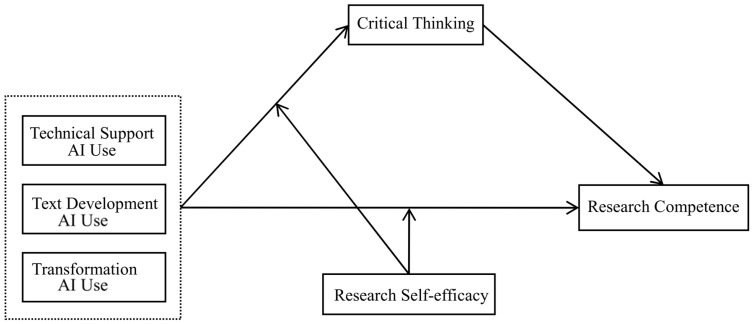
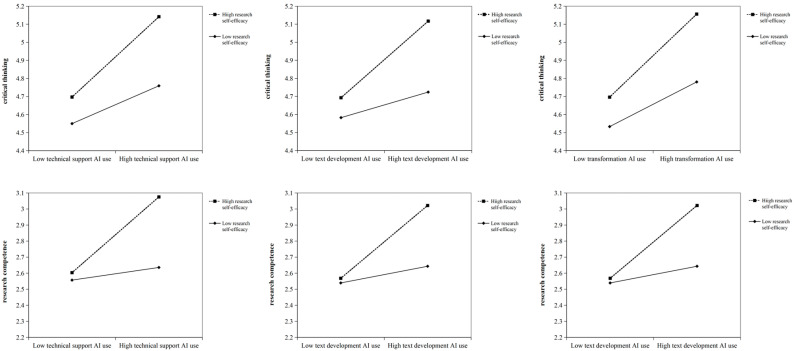
Verification
Claims the paper makes
The claims and statistics of this paper haven’t been checked yet.
Run the check — free, no account needed. It reads the open-access text and checks the sources it cites.
Claims other papers make about this one
Each is checked against this paper’s own text: does it say what the citing paper says it does?
The cited source says what the claim attributes to it.
In the citing paper
“Studies on pedagogical partnerships, research competence, and writing support indicate that the educational value of GenAI depends on whether students remain the active agents of meaning making rather than outsourcing that role to the system (Wang & Zhang, 2026; Zhu & Yang, 2026).”
From Generative AI, Cognitive Offloading, and Learner Agency in Higher Education: A Scoping Review (2026) · cites this paper as Zhu & Yang, 2026
The cited source says what the claim attributes to it.
In the citing paper
“These findings are especially important because they show that self-regulation in GenAI environments is not limited to effort management or planning; it also includes epistemic monitoring, verification, and the ability to resist the automatic acceptance of plausible AI output.”
From Generative AI, Cognitive Offloading, and Learner Agency in Higher Education: A Scoping Review (2026) · cites this paper as Zhu & Yang, 2026
Self-check
Percentages, sums and reported differences re-computed from the paper’s own numbers.
The self-check needs the paper’s full text.
Citations
Cites
Structural equation modeling in practice: A review and recommended two-step approach
Anderson, J. C., & Gerbing, D. W. (1988) · Psychological Bulletin · doi:10.1037/0033-2909.103.3.411 · Cited by 41,941
Pls-Sem: indeed a silver bullet
Hair, J. F., Ringle, C. M., & Sarstedt, M. (2011) · Journal of Marketing Theory and Practice · doi:10.2753/mtp1069-6679190202 · Cited by 21,631
Beyond Baron and Kenny: Statistical Mediation Analysis in the New Millennium
Hayes, A. F. (2009) · Communication Monographs · doi:10.1080/03637750903310360 · Cited by 9,757
Best Practices in Quantitative Methods
Osborne, J. W. (2008) · Sage eBooks · doi:10.4135/9781412995627 · Cited by 1,093
Li, H., Zhang, R., Lee, Y.-C., Kraut, R. E., & Mohr, D. C. (2023) · npj Digital Medicine · doi:10.1038/s41746-023-00979-5 · Cited by 598
Hassani, H., & Silva, E. S. (2023) · Big Data and Cognitive Computing · doi:10.3390/bdcc7020062 · Cited by 401
Liu, M., Zhang, L. J., & Biebricher, C. (2023) · Computers & Education · doi:10.1016/j.compedu.2023.104977 · Cited by 399
Factor Structures of Three Measures of Research Self-Efficacy
Forester, M., Kahn, J. H., & Hesson-McInnis, M. S. (2004) · Journal of Career Assessment · doi:10.1177/1069072703257719 · Cited by 206
Shahzad, M. F., Xu, S., & Zahid, H. (2025) · Education and Information Technologies · doi:10.1007/s10639-024-12949-9 · Cited by 204
Lingard, L. (2023) · Perspectives on Medical Education · doi:10.5334/pme.1072 · Cited by 150
Refining ChatGPT-Generated Code: Characterizing and Mitigating Code Quality Issues
Liu, Y., Le-Cong, T., Widyasari, R., Tantithamthavorn, C., Li, L., Le, X.-B. D., & Lo, D. (2024) · ACM Transactions on Software Engineering and Methodology · doi:10.1145/3643674 · Cited by 149
Allen, T. J., & Mizumoto, A. (2024) · RELC Journal · doi:10.1177/00336882241262533 · Cited by 132
Böttcher-Oschmann, F., & Thiel, F. (2017) · Higher Education · doi:10.1007/s10734-017-0128-y · Cited by 132
Artificial Intelligence in Higher Education: A Predictive Model for Academic Performance
Pacheco-Mendoza, S., Guevara, C., Albán, A. L. M., & Fernández-Escobar, J. E. (2023) · Education Sciences · doi:10.3390/educsci13100990 · Cited by 118
Goh, A. Y. H., Hartanto, A., & Majeed, N. M. (2025) · Computers in Human Behavior Reports · doi:10.1016/j.chbr.2025.100845 · Cited by 112
Saqr, R. R., Al-Somali, S. A., & Sarhan, M. Y. (2023) · Sustainability · doi:10.3390/su16010204 · Cited by 111
Examining the potential and pitfalls of ChatGPT in science and engineering problem-solving
Wang, K. D., Burkholder, E. W., Wieman, C., Salehi, S., & Haber, N. (2024) · Frontiers in Education · doi:10.3389/feduc.2023.1330486 · Cited by 109
The Nature and Development of Critical-Analytic Thinking
Byrnes, J. P., & Dunbar, K. N. (2014) · Educational Psychology Review · doi:10.1007/s10648-014-9284-0 · Cited by 107
Self-efficacy, self-discipline and academic performance: Testing a context-specific mediation model
Jung, K.-R., Zhou, A. Q., & Lee, R. M. (2017) · Learning and Individual Differences · doi:10.1016/j.lindif.2017.10.004 · Cited by 97
Students-Generative AI interaction patterns and its impact on academic writing
Kim, J., Lee, S.-S., Detrick, R., Wang, J., & Li, N. (2025) · Journal of Computing in Higher Education · doi:10.1007/s12528-025-09444-6 · Cited by 97
Li, Y., Sadiq, G., Qambar, G., & Zheng, P. (2024) · Education and Information Technologies · doi:10.1007/s10639-024-12981-9 · Cited by 94
Modeling AI-assisted writing: How self-regulated learning influences writing outcomes
Jin, F., Lin, C.-H., & Lai, C. (2025) · Computers in Human Behavior · doi:10.1016/j.chb.2024.108538 · Cited by 93
Jin, F., Sun, L., Pan, Y., & Lin, C. (2025) · Computers & Education · doi:10.1016/j.compedu.2025.105248 · Cited by 82
How generative AI supports human in conceptual design
Chen, L., Song, Y., Jia, G., Sun, L., Childs, P., & Yin, Y. (2025) · Design Science · doi:10.1017/dsj.2025.2 · Cited by 76
Zhao, G., Sheng, H., Wang, Y., Cai, X., & Long, T. (2025) · Education Sciences · doi:10.3390/educsci15050554 · Cited by 60
Exploring the impact of AI threats on originality and critical thinking in academic writing
Octaberlina, L. R., Muslimin, A. I., Chamidah, D., Surur, M., & Mustikawan, A. (2024) · Edelweiss Applied Science and Technology · doi:10.55214/25768484.v8i6.3878 · Cited by 59
Wang, S., Sun, Z., Wang, H., Yang, D., & Zhang, H. (2025) · The International Journal of Management Education · doi:10.1016/j.ijme.2025.101184 · Cited by 58
AI as your ally: The effects of AI‐assisted venting on negative affect and perceived social support
Hu, M., Chua, X. C. W., Diong, S. F., Kasturiratna, K. T. A. S., Majeed, N. M., & Hartanto, A. (2024) · Applied Psychology Health and Well-Being · doi:10.1111/aphw.12621 · Cited by 54
Let’s Talk about AI: Talking about AI is Positively Associated with AI Crafting
Dong, X., Jiang, L., Li, W., Chen, C., Gan, Y., Xia, J., & Qin, X. (2024) · Asia Pacific Journal of Management · doi:10.1007/s10490-024-09975-z · Cited by 52
Generative AI Tools in Higher Education: A Meta-Analysis of Cognitive Impact
Qu, X., Sherwood, J., Liu, P., & Aleisa, N. (2025) · CHI Conference Extended Abstracts on Human Factors in Computing Systems (CHI EA) · doi:10.1145/3706599.3719841 · Cited by 49
Khan, S. M. F. A., & Suhluli, S. A. (2025) · Technologies · doi:10.3390/technologies13110486 · Cited by 46
Luo, M., Hu, X., & Zhong, C. (2025) · Education and Information Technologies · doi:10.1007/s10639-025-13488-7 · Cited by 43
Chan, C. K. Y., & Lee, K. K. W. (2025) · Computers & Education · doi:10.1016/j.compedu.2025.105399 · Cited by 43
Can novice teachers detect AI-generated texts in EFL writing?
Wilde, V. D. (2024) · ELT Journal · doi:10.1093/elt/ccae031 · Cited by 39
"It makes you think": Provocations Help Restore Critical Thinking to AI-Assisted Knowledge WorkPreprint
Drosos, I., Sarkar, A., Xiaotong, Xu, & Toronto, N. (2025) · arXiv (Cornell University) · doi:10.48550/arxiv.2501.17247 · Cited by 37
Enhancing Metacognitive and Creativity Skills through AI-Driven Meta-Learning Strategies
Khotimah, K., Rusijono, & Mariono, A. (2024) · International Journal of Interactive Mobile Technologies (iJIM) · doi:10.3991/ijim.v18i05.47705 · Cited by 35
Li, F., Yan, X., Su, H., Shen, R., & Mao, G. (2025) · Journal of Intelligence · doi:10.3390/jintelligence13060062 · Cited by 27
Zhang, W., & Liu, X. (2025) · Education Sciences · doi:10.3390/educsci15080977 · Cited by 27
Enhancing Critical Thinking: Exploring Human-AI Synergy in Student Cognitive Development
LAMIMI, I. J., Jemli, S. E., & ZERYOUH, I. (2025) · Arab World English Journal · doi:10.24093/awej/ai.14 · Cited by 23
Anwar, N. (2025) · Trends in Higher Education · doi:10.3390/higheredu4030034 · Cited by 20
Chen, G., Yu, Z., Xie, Y., Liu, Z., & Yu, C. (2025) · Journal of Engineering Design · doi:10.1080/09544828.2025.2567155 · Cited by 20
Saha, P., Hossain, M. S., Roy, N. C., Masud, A. A., & Amin, R. (2025) · On the Horizon The International Journal of Learning Futures · doi:10.1108/oth-10-2024-0066 · Cited by 16
Enhancing Critical Thinking in Generative AI Search with Metacognitive Prompts
Singh, A., Guan, Z., & Rieh, S. Y. (2025) · Proceedings of the Association for Information Science and Technology · doi:10.1002/pra2.1287 · Cited by 15
Ofem, U. J., Ene, E. I., Ajuluchukwu, E. N., Neji, H. A., Edam-Agbor, I. B., Orim, F. S., Nwogwugwu, C. E., Ovat, S. V., Ukatu, J. O., Ekpang, P. O., et al. (2024) · Computers and Education Artificial Intelligence · doi:10.1016/j.caeai.2024.100337 · Cited by 14
Woo, H., Kim, N., Lee, J.-E., Chae, K. B., & Mathew, A. (2024) · British Journal of Guidance and Counselling · doi:10.1080/03069885.2023.2297892 · Cited by 12
Guo, H., Zhou, Z., Ma, F., & Ning, Z. (2025) · Education and Information Technologies · doi:10.1007/s10639-025-13844-7 · Cited by 12
Zhong, G. (2023) · The EUrASEANs journal on global socio-economic dynamics · doi:10.35678/2539-5645.6(43).2023.170-180 · Cited by 10
Reconceptualizing of GenAI adoption in higher education: A task-based perspective
Chaieb, M., Cuel, R., & Bouzaabia, R. (2026) · The International Journal of Management Education · doi:10.1016/j.ijme.2026.101365 · Cited by 8
Rolf, R. E. (2025) · Journal of Legal Studies Education · doi:10.1111/jlse.12154 · Cited by 8
Augmenting Human Cognition With Generative AI: Lessons From AI-Assisted Decision-MakingPreprint
Zhang, Z. T., & Reicherts, L. (2025) · arXiv (Cornell University) · doi:10.48550/arxiv.2504.03207 · Cited by 8
Zhan, Y., Wan, Z. H., & Khon, M. (2023) · Teaching in Higher Education · doi:10.1080/13562517.2023.2280268 · Cited by 7
Jadán-Guerrero, J. L., Acosta-Vargas, P., & Gracia, N. E. G.-D. (2024) · Communications in computer and information science · doi:10.1007/978-3-031-62110-9_7 · Cited by 7
THE ROLE OF CRITICAL THINKING IN FORMING STUDENTS’ RESEARCH COMPETENCE
Ibragimova, Zhumagulova, & Khegay (2024) · Журнал серии «Педагогические науки» · doi:10.48371/peds.2024.73.2.015 · Cited by 7
Rahimi, M. (2025) · Journal of University Teaching and Learning Practice · doi:10.53761/vaa8h214 · Cited by 6
Integrating GenAI interactions in marketing studies: A methodological guide
Jörling, M. (2025) · International Journal of Research in Marketing · doi:10.1016/j.ijresmar.2025.12.003 · Cited by 6
Building Intelligent Educational Agents: A Scalable LLM-Based Framework for Assessment Generation
Gahar, R. M., Gorchene, B., Hidri, A., Arfaoui, O., & Hidri, M. S. (2025) · Procedia Computer Science · doi:10.1016/j.procs.2025.09.532 · Cited by 5
A design-based approach to analysing student engagement with a GenAI-Enabled brainstorming app
Chia, J., & Frattarola, A. (2025) · Computers and Education Artificial Intelligence · doi:10.1016/j.caeai.2025.100468 · Cited by 5
Amanonce, J.-C. T. (2025) · Multidisciplinary Reviews · doi:10.31893/multirev.2025393 · Cited by 2
The Cognitive Cost of AI Assistance: Protecting Human Thinking in the Age of Generative AI
Westover, J. (2025) · Human capital leadership. · doi:10.70175/hclreview.2020.26.1.6 · Cited by 2
Palaniappan, D., Tak, T. K., Vijayan, K., Maram, B., Kshirsagar, P. R., & Ahmad, N. (2025) · Computer Modeling in Engineering & Sciences · doi:10.32604/cmes.2025.073387 · Cited by 2
Critical Thinking in Business Research
van Loon, M. S. (2020) · Oxford University Press eBooks · doi:10.1093/acrefore/9780190224851.013.277 · Cited by 1
An, T. (2025). AI as cognitive amplifier: Rethinking human judgment in the age of generative AI (version 1). arXiv.
(n.d.)
UnresolvedEvaluating research-oriented teaching: A new instrument to assess university students’ research competences
Thiel (2017) · Higher Education
UnresolvedA design-based approach to analysing student engagement with a GenAI-Enabled brainstorming app
Chia (2025) · Computers and Education: Artificial Intelligence
UnresolvedDrosos, I., Sarkar, A., and Toronto, N. (2025). “It makes you think”: Provocations help restore critical thinking to ai-assisted knowledge work (version 1). arXiv.
(n.d.)
UnresolvedFacione, P. A. (1990). The California critical thinking skills test—College level. technical report# 1. Experimental validation and content validity, ERIC.
(n.d.)
UnresolvedGreeley, A. T., Johnson, E., Seem, S., Braver, M., Dias, L., Evans, K., and Pricken, P. (, January February). Research self-efficacy scale. Unpublished Scale Presented at the Conference of the Association for Women in Psychology, Bethesda, MD, USA.
(n.d.)
UnresolvedHair, J. F., Black, W. C., Babin, B. J., Anderson, R. E., and Tatham, R. L. (2006). Multivariate data analysis, Springer.
(n.d.)
UnresolvedChinese critical thinking: Structure and measurement
Hou (2022) · Acta Scientiarum Naturalium Universitatis Pekinensis
UnresolvedAI as your ally: The effects of AI-assisted venting on negative affect and perceived social support
Hu (2025) · Applied Psychology: Health and Well-Being
UnresolvedDesign and issues of writing literatures using ChatGPT
Jung (2023) · Journal of Knowledge Information Technology and Systems
UnresolvedStudents-Generative AI interaction patterns and its impact on academic writing
Kim (2025) · Journal of Computing in Higher Education
UnresolvedIntelligent research (AI4R): The fifth research paradigm
Li (2024) · Bulletin of the Chinese Academy of Sciences
UnresolvedApplication of generative artificial intelligence learning for college students: Model construction and evaluation index system research
Liu (2025) · Modern Educational Technology
UnresolvedRefining chatgpt-generated code: Characterizing and mitigating code quality issues
Liu (2024) · ACM Transactions on Software Engineering and Methodology
UnresolvedThe impact of artificial intelligence generated content on academic ecology and countermeaures—Discussion and analysis based on ChatGPT
Luo (2023) · Modern Educational Technology
UnresolvedStrengthening students’ research efficacy in higher institutions. A joint mediating effect of the impact of artificial intelligence using partial least squares structural equation modelling (PLS-SEM)
Ofem (2024) · Computers and Education: Artificial Intelligence
UnresolvedThe influence of generative AI usage motivation on graduate students’ research creativity: The mediating role of information processing modes
Wan (2025) · Journal of Higher Education Management
UnresolvedGenerative AI empowering undergraduate research competences development: The ChatGPT-supported CUREs teaching model
Wu (2024) · Modern Distance Education Research
UnresolvedCorrelation of research ability and critical thinking among undergraduate nursing students
Xiao (2013) · Chinese Journal of Nursing Education
UnresolvedYang, Y., Zhu, A., and Qin, J. (2019). The influence of scientific research training environment on postgraduates’ research self-efficacy: An empirical analysis based on eight universities in Wuhan. Proceedings of 2019 Asia-Pacific conference on education, philosophy, management and business (ACEPMB
(n.d.)
UnresolvedCan AI enhance career well-being among young researchers? A mediated moderation model
Zhang (2025) · Modern Distance Education
UnresolvedThe development of writing self-efficacy in the human-ChatGPT collaborative continuation task and its impact on L2 output
Zhang (2025) · Modern Foreign Languages
UnresolvedThe impact of research pressure on academic misconduct among doctoral students
Zhang (2013) · Research Management
UnresolvedZhang, Z. T., and Reicherts, L. (2025). Augmenting human cognition with generative AI: Lessons from AI-assisted decision-making (version 1). arXiv.
(n.d.)
UnresolvedDistributed cognition: A new perspective on cognition
Zhou (2002) · Advances in Psychological Science
UnresolvedZohery, M. (2023). ChatGPT in academic writing and publishing: A comprehensive guide. Artificial intelligence in academia, research and science: ChatGPT as a case study, Novabret. [1st ed.].
(n.d.)
Unresolved
Cited by
Sorted by citations
Generative AI, Cognitive Offloading, and Learner Agency in Higher Education: A Scoping Review
Wang, G., Wang, W., Yang, D., & Ren, J. (2026) · Behavioral Sciences · doi:10.3390/bs16071150 · Cited by 20
“These constructs help organize why GenAI may serve as a scaffold for some learners and as a source of dependence for others, although the heterogeneous evidence base does not support a formal ranking of their causal importance (Xu et al., 2025; Zhu & Yang, 2026; C. Zhou & Wang, 2026).”
InfluentialMarin-Rodriguez, W., de Salinas, F. D. M. G. T., Ramírez, E. T. S., & Girón, E. C. A. (2026) · Iberoamerican Journal of Science Measurement and Communication · doi:10.47909/ijsmc.372 · Cited by 1
Gao, L., Sun, Y., & Khan, S. U. (2026) · Frontiers in Psychology · doi:10.3389/fpsyg.2026.1847369 · Cited by 1
Yan, Z., Fang, Z., & Zou, W. (2026) · Frontiers in Psychology · doi:10.3389/fpsyg.2026.1939286 · Cited by 1
AGUITE, A., Jr. (2026) · Research Square · doi:10.21203/rs.3.rs-9565332/v1
Metadata
- Authors
- Zhu, H., & Yang, S.
- Affiliations
- Normal College, Shihezi University, Shihezi 832003, China
- Venue
- Behavioral Sciences
- Publisher
- MDPI AG
- Published
- 2026-02-21
- Volume
- 16
- Issue
- 2
- Pages
- 304
- ISSN
- 2076-328X (ISSN-L)
- PMC
- PMC12937814
- OpenAlex
- W7130933570
- Cited by
- 13
- References
- 79
- Citations by year
- 2026: 13
- FWCI
- 108.95
- Type
- journal article
- Language
- en
- Open access
- gold
- doi.org
- Licence
- Locations
- Behavioral Sciences (publishedVersion, cc-by)
- PubMed (publishedVersion)
- PubMed Central (publishedVersion, cc-by)
- DOAJ (DOAJ: Directory of Open Access Journals) (submittedVersion)
- Topics
- Social Sciences › Education › Artificial Intelligence in Education
- Social Sciences › Education › Doctoral Education Challenges and Solutions
- Health Sciences › Medicine › Health Informatics › Artificial Intelligence in Healthcare and Education
- Keywords
- generative AI, graduate students, research skills, critical thinking, research self-efficacy, cognitive load theory, self-efficacy theory, textual development, technology misuse
About these checks
Registry, retraction, Cites and statistics results are computed, not judged, with one exception: a printed reference that no index lists is read once by a model before it counts as a citation error. Claims are extracted by a model and kept only when their quote appears verbatim in the text; each cited source is then checked, with a model’s help, for whether it says what the claim relies on. Those verdicts can be wrong — read the claim’s quote and the cited source before relying on one.
Statistics and arithmetic are recomputed, not judged.
Confidence bands are shown only for fields calibrated on our annotated test set. None is calibrated yet, so no band is shown.
What counts as a claim ›How we measure confidence ›How we check this ›
Are you an author, or do you see a problem with this page? Request a review
