

Translation control by p53.
Open accessThe DOI matches its Crossref record; 61 of the 62 references it cites were found in a registry or an index.
Abstract
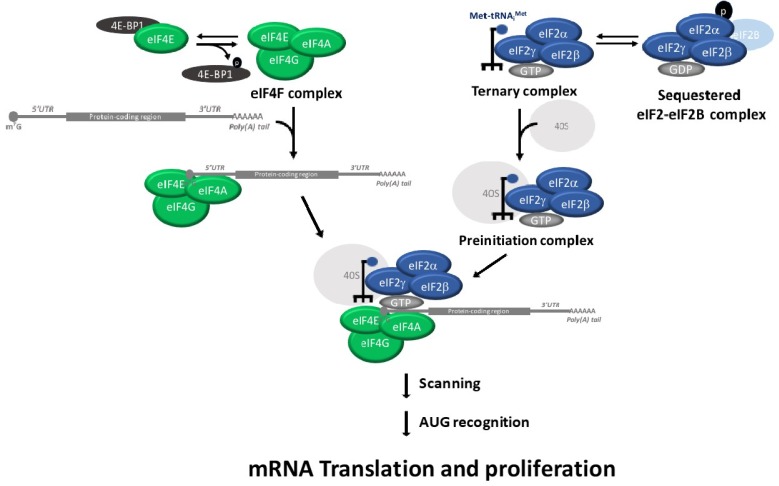
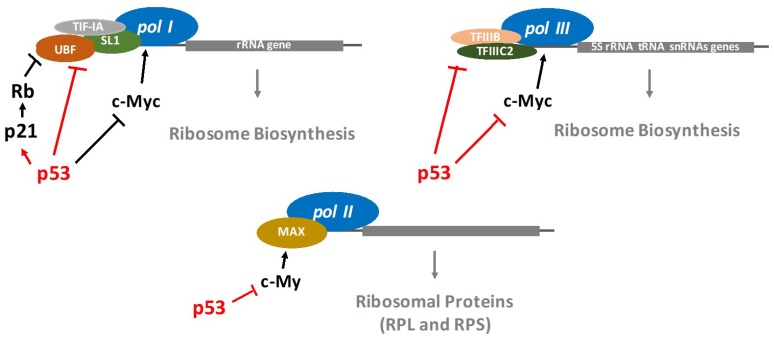
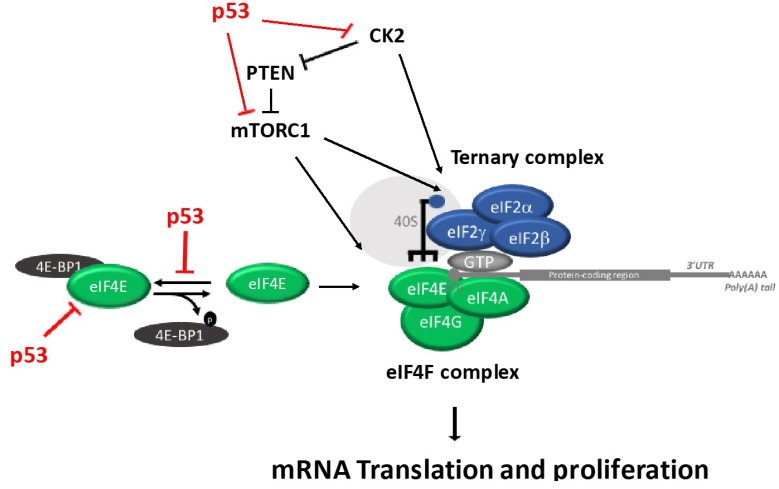
The translation of mRNAs plays a critical role in the regulation of gene expression and therefore, in the regulation of cell proliferation, differentiation and apoptosis. Unrestricted initiation of translation causes malignant transformation and plays a key role in the maintenance and progression of cancers. Translation initiation is regulated by the ternary complex and the eukaryotic initiation factor 4F (eIF4F) complex. The p53 tumor suppressor protein is the most well studied mammalian transcription factor that mediates a variety of anti-proliferative processes. Post-transcriptional mechanisms of gene expression in general and those of translation in particular play a major role in shaping the protein composition of the cell. The p53 protein regulates transcription and controls eIF4F, the ternary complex and the synthesis of ribosomal components, including the down-regulation of rRNA genes. In summary, the induction of p53 regulates protein synthesis and translational control to inhibit cell growth.
Overview
The claims and statistics of this paper haven’t been checked yet.
Free: it reads the open-access text and checks the first 5 claims that cite a source we can check. Create a free account to check every claim.
Integrity signals
Registry
Cites
Statistics
Figures
Verification
Claims the paper makes
The claims and statistics of this paper haven’t been checked yet.
Free: it reads the open-access text and checks the first 5 claims that cite a source we can check. Create a free account to check every claim.
Claims other papers make about this one
Each is checked against this paper’s own text: does it say what the citing paper says it does?
In the citing paper
“Transient stress leads to induction of p53 which activates DNA repair and leads to quiescence (Vousden and Prives, 2009; Kasteri et al., 2018).”
From Mechanisms of Cellular Senescence: Cell Cycle Arrest and Senescence Associated Secretory Phenotype (2021) · cites this paper as Kasteri et al., 2018
Self-check
Percentages, sums and reported differences re-computed from the paper’s own numbers.
The self-check needs the paper’s full text.
Citations
Cites
Genome-Wide Analysis in Vivo of Translation with Nucleotide Resolution Using Ribosome Profiling
Ingolia, N. T., Ghaemmaghami, S., Newman, J. R. S., & Weissman, J. S. (2009) · Science · doi:10.1126/science.1168978 · Cited by 3,853 · cited 1×
“used the polysome profiling technique [58].”
Kastenhuber, E. R., & Lowe, S. W. (2017) · Cell · doi:10.1016/j.cell.2017.08.028 · Cited by 1,906 · cited 1×
“The p53 tumor suppressor protein is the most well studied mammalian transcription factor that mediates a variety of anti-proliferative processes [13].”
BackgroundStructural features in eukaryotic mRNAs that modulate the initiation of translation.
Kozak, M. (1991) · Journal of Biological Chemistry · doi:10.1016/s0021-9258(18)54860-2 · Cited by 1,836 · cited 1×
“The inhibitory effects of the ternary complex reduce the expression of oncogenic proteins and increases the expression of tumor-suppressor and pro-apoptotic proteins [8,9].”
Backgroundp53 Target Genes Sestrin1 and Sestrin2 Connect Genotoxic Stress and mTOR Signaling
Budanov, A. V., & Karin, M. (2008) · Cell · doi:10.1016/j.cell.2008.06.028 · Cited by 1,326 · cited 1×
“Instead, the p53 inhibits mTOR signaling [50] and CK2 protein kinase activity (Figure 3).”
BackgroundProtein kinase CK2: structure, regulation and role in cellular decisions of life and death
LITCHFIELD, D. W. (2003) · Biochemical Journal · doi:10.1042/bj20021469 · Cited by 1,233 · cited 1×
“Protein kinase casein kinase 2 (CK2) belongs to the serine/threonine protein kinase family and consists of two catalytic (alpha and/or alpha’) subunits and two regulatory (beta) subunits [41,42].”
BackgroundHierarchical phosphorylation of the translation inhibitor 4E-BP1
Gingras, A.-C., Raught, B., Gygi, S. P., Niedzwiecka, A., Miron, M., Burley, S. K., Polakiewicz, R. D., Wyslouch-Cieszynska, A., Aebersold, R., & Sonenberg, N. (2001) · Genes & Development · doi:10.1101/gad.912401 · Cited by 883 · cited 1×
“In contrast, 4E-BP hyper-phosphorylation causes disruption of the 4E-BP:eIF4E complex and renders eIF4E available for eIF4F formation, which results in an abrogation of eIF4E-binding activity (Figure 1) [11].”
BackgroundThe Scanning Mechanism of Eukaryotic Translation Initiation
Hinnebusch, A. G. (2014) · Annual Review of Biochemistry · doi:10.1146/annurev-biochem-060713-035802 · Cited by 798 · cited 4×
“The p53-dependent FBL inhibition leads to a high translational fidelity (i.e., nonsense suppression or amino acid misincorporation) and increases the initiation of internal ribosome entry site (IRES)-dependent translation [39].”
BackgroundInfluentialInitiation of Protein Synthesis in Eukaryotic Cells
Pain, V. M. (1996) · European Journal of Biochemistry · doi:10.1111/j.1432-1033.1996.00747.x · Cited by 707
Regulation of p53 Translation and Induction after DNA Damage by Ribosomal Protein L26 and Nucleolin
Takagi, M., Absalon, M. J., McLure, K. G., & Kastan, M. B. (2005) · Cell · doi:10.1016/j.cell.2005.07.034 · Cited by 663 · cited 1×
“Interestingly, in response to DNA damage, the ribosomal protein RPL26 binds to both 5′-UTR and 3′-UTR of p53 mRNA, enhancing p53 translation and leading to p53-dependent and MDM2-independent cell cycle arrest [34,35].”
BackgroundStructures of the human and Drosophila 80S ribosome
Anger, A. M., Armache, J.-P., Berninghausen, O., Habeck, M., Subklewe, M., Wilson, D. N., & Beckmann, R. (2013) · Nature · doi:10.1038/nature12104 · Cited by 628 · cited 1×
“Ribosome biogenesis takes place in the nucleolus [15,16].”
Background
Cited by
Mechanisms of Cellular Senescence: Cell Cycle Arrest and Senescence Associated Secretory Phenotype
Kumari, R., & Jat, P. (2021) · Frontiers in Cell and Developmental Biology · doi:10.3389/fcell.2021.645593 · Cited by 1,622
Aging of the cells: Insight into cellular senescence and detection Methods.
Mohamad Kamal, N. S., Safuan, S., Shamsuddin, S., & Foroozandeh, P. (2020) · European Journal of Cell Biology · doi:10.1016/j.ejcb.2020.151108 · Cited by 287
Lipids as Regulators of Cellular Senescence
Hamsanathan, S., & Gurkar, A. U. (2022) · Frontiers in Physiology · doi:10.3389/fphys.2022.796850 · Cited by 137
A comprehensive study of p53 protein
Patil, M. R., & Bihari, A. (2022) · Journal of Cellular Biochemistry · doi:10.1002/jcb.30331 · Cited by 64
“In this review study, Kasteri et al.(258) investigate the function of p53 as a regulator of the ternary complex, the eIF4F complex, and translation ribosome biogenesis.”
Background40 Years of Research Put p53 in Translation
Marcel, V., Long, F. N. V., & Diaz, J. (2018) · Cancers · doi:10.3390/cancers10050152 · Cited by 62
“The role of p53 in regulating global protein synthesis has been previously reviewed, including one in the present issue [48].”
BackgroundTiu, G. C., Kerr, C. H., Forester, C. M., Krishnarao, P. S., Rosenblatt, H. D., Raj, N., Lantz, T. C., Zhulyn, O., Bowen, M. E., Shokat, L., et al. (2021) · Developmental Cell · doi:10.1016/j.devcel.2021.06.013 · Cited by 60
Issaeva, N. (2019) · Cancers · doi:10.3390/cancers11030332 · Cited by 45
Melatonin: Regulation of Biomolecular Condensates in Neurodegenerative Disorders
Loh, D., & Reiter, R. J. (2021) · Antioxidants · doi:10.3390/antiox10091483 · Cited by 46
A potential link between p53, cell competition and ribosomopathy in mammals and in Drosophila
Baker, N. E., Kiparaki, M., & Khan, C. (2018) · Developmental Biology · doi:10.1016/j.ydbio.2018.11.018 · Cited by 40
“…activity (Khajuria et al., 2018), in fact p53 does affect translation through a variety of mechanisms, including regulation of ribosome biogenesis, regulation of general translation initiation, and regulation of specific mRNAs (Marcel et al., 2015; Harvey and Willis, 2018; Kasteri et al., 2018).”
BackgroundSenescence and SASP Are Potential Therapeutic Targets for Ischemic Stroke
Ouvrier, B., Ismael, S., & Bix, G. J. (2024) · Pharmaceuticals · doi:10.3390/ph17030312 · Cited by 38
“P21 itself is vital for the initiation of senescence, whereas p53 expression without p21 would induce cellular qui-escence rather than senescence [21,22].”
BackgroundIonizing Radiation and Translation Control: A Link to Radiation Hormesis?
Kabilan, U., Graber, T. E., Alain, T., & Klokov, D. Y. (2020) · International Journal of Molecular Sciences · doi:10.3390/ijms21186650 · Cited by 37
Characterization of Kinesin Family Member 2C as a Proto-Oncogene in Cervical Cancer
Yang, J. L., Wu, Z., Li, Y., Jeong, J.-H., Zhu, Y., Lu, J., Wang, B., Wang, N., Wang, Y., Shen, K., et al. (2022) · Frontiers in Pharmacology · doi:10.3389/fphar.2021.785981 · Cited by 33
Kanellis, D. C., Zisi, A., Skrott, Z., Lemmens, B., Espinoza, J. A., Kosar, M., Björkman, A., Li, X., Arampatzis, S., Bartkova, J., et al. (2023) · Cell Death & Differentiation · doi:10.1038/s41418-023-01167-4 · Cited by 27
“P53 impacts translation by fine-tuning ribosome biogenesis (RiBi), modulating transcription of 4E-BP1 (master regulator of translation) [9], and shaping the formation of translation initiation complexes (ternary, eIF4F) [10].”
BackgroundAlternative Mechanisms of p53 Action During the Unfolded Protein Response
Fusée, L. T. S., Marín, M., Fåhræus, R., & López, I. (2020) · Cancers · doi:10.3390/cancers12020401 · Cited by 27
Martella, M., Catalanotto, C., Talora, C., Teana, A. L., Londei, P., & Benelli, D. (2020) · International Journal of Molecular Sciences · doi:10.3390/ijms21134583 · Cited by 22
Exploring the pan-cancer landscape of posttranscriptional regulation
Ghoshdastider, U., & Sendoel, A. (2023) · Cell Reports · doi:10.1016/j.celrep.2023.113172 · Cited by 19
Boutelle, A. M., Mabene, A. R., Yao, D., Xu, H., Wang, M., Tang, Y. J., Lopez, S. S., Sinha, S., Demeter, J., Cheng, R., et al. (2025) · Cell Death and Differentiation · doi:10.1038/s41418-025-01513-8 · Cited by 14
“Indeed, p53 serves as a key repressor of translation [40, 41] and numerous studies have linked p53 to inhibition of mTOR, a complex that can promote protein synthesis [42 – 44].”
Liu, B., Wu, Y., Xiang, A.-Y., Yu, Y., Song, S., Zhang, Y., Gu, J., Lu, H., Xu, P., Liu, F., et al. (2025) · Cell Reports · doi:10.1016/j.celrep.2025.116249 · Cited by 11
p63 orchestrates serine and one carbon metabolism enzymes expression in head and neck cancer
Cappello, A., Tosetti, G., Smirnov, A., Ganini, C., Yang, X. F., Shi, Y., Wang, Y., Melino, G., Bernassola, F., & Candi, E. (2023) · Biology Direct · doi:10.1186/s13062-023-00426-1 · Cited by 12
“As well described elsewhere, the involvement of p53 in tumour suppression [25–27] is widely recognized [28], impinging on translation [29, 30], cell death [31, 32], epigenetic regulation [33–35] or metabolism [36–39]. p63 is specifically expressed in epithelia and regulates cellular proliferation…”
BackgroundPrasad, K., Kaul, S. C., Wadhwa, R., Guruprasad, K. P., & Satyamoorthy, K. (2025) · Free Radical Biology and Medicine · doi:10.1016/j.freeradbiomed.2025.03.038 · Cited by 7
Tomanek, L., Fabela, F., & May, M. (2026) · Journal of Experimental Biology · doi:10.1242/jeb.252969 · Cited by 2
Dimayacyac-Esleta, B. R. T., Pondevida, V. B., Zarate, L. M., Porras, B. J. O., Mira, F. D., Luna, H. G. C., & Prieto, E. (2021) · The Philippine journal of science · doi:10.56899/150.6b.01 · Cited by 2
Computational and chemical approaches to drug repurposing
Li, X. (2023) · Open Archive (Karolinska Institutet) · Cited by 3
Lin, L.-W., Jang, H. S., Song, Z., Ebrahimi, A., Yang, J., Nguyen, B. D., O’Donnell, E. F., Hendrix, D. A., Maier, C. S., & Kolluri, S. K. (2024) · Biochemical Pharmacology · doi:10.1016/j.bcp.2025.116896 · Cited by 1
MDM2 binds and suppresses RNA polymerase III to restrain the innate immune response to cytosolic DNA
Weber, S., Manzini, V., Dietrich, H., Schotte, H., Moshkovskii, S. A., Hackert, P., Duman, E. T., Vu, N. Q., Prokakis, E., Salinas, G., et al. (2026) · Cell Death and Differentiation · doi:10.1038/s41418-026-01834-2 · Cited by 1
Contrôle de la différenciation érythroïde terminale : implication de la biogenèse des ribosomes
Goff, S. L. (2019) · theses.fr (ABES) · doi:10.70675/997d33d6zef5dz4719z8bf5z679329bd020d
Cappello, A., Tosetti, G., Smirnov, A., Ganini, C., Yang, X., Shi, Y., Wang, Y., Melino, G., Bernassola, F., & Candi, E. (2023) · Figshare · doi:10.6084/m9.figshare.24540560
López Ferreira, L. I., Fåhræus, R., Muñoz, M. D. R. D., Marín, M., Fernández Calero, T., & Larghero Valdivia, I. (2023) · LA Referencia (Red Federada de Repositorios Institucionales de Publicaciones Científicas)
Long, F. N. V. (2019) · theses.fr (ABES) · doi:10.70675/12a8367cz6b6bz4592zbd98zf68b8cd5151d
Metadata
- Authors
- Kasteri, J., Das, D., Zhong, X., Persaud, L., Francis, A., Muharam, H., & Sauane, M.
- Affiliations
- Lehman College (US)
- The Graduate Center, CUNY (US)
- Corresponding author
- Sauane, Moira
- Venue
- Cancers
- Publisher
- MDPI AG
- Published
- 2018-05-05
- Volume
- 10
- Issue
- 5
- Pages
- 133
- ISSN
- 2072-6694 (ISSN-L)
- PMC
- PMC5977106
- OpenAlex
- W2800089429
- Cited by
- 24
- References
- 62
- Citations by year
- 2026: 1 · 2025: 4 · 2024: 1 · 2023: 4 · 2022: 3 · 2021: 3 · 2020: 4 · 2019: 2 · 2018: 2
- FWCI
- 1.03
- Type
- journal article
- Language
- en
- Open access
- gold
- doi.org
- Licence
- Locations
- Cancers (publishedVersion, cc-by)
- PubMed Central (publishedVersion, cc-by)
- PubMed (publishedVersion)
- CUNY Academic Works (City University of New York) (submittedVersion)
- Funders
- National Institutes of Health (SC1 CA2005)
- National Cancer Institute (SC1CA200518, SC1 CA2005)
- Topics
- Health Sciences › Medicine › Oncology › Cancer-related Molecular Pathways
- Life Sciences › Biochemistry, Genetics and Molecular Biology › Molecular Biology › RNA and protein synthesis mechanisms
- Life Sciences › Biochemistry, Genetics and Molecular Biology › Molecular Biology › PI3K/AKT/mTOR signaling in cancer
- Keywords
- p53, translational regulation, mRNA translation initiation, eIF4F, ternary complex, post-transcriptional regulation, ribosomal protein synthesis, tumor suppressor, cell proliferation, apoptosis, cancer
About these checks
Registry, retraction, Cites and statistics results are computed, not judged, with one exception: a printed reference that no index lists is read once by a model before it counts as a citation error. Claims are extracted by a model and kept only when their quote appears verbatim in the text; each cited source is then checked, with a model’s help, for whether it says what the claim relies on. Those verdicts can be wrong — read the claim’s quote and the cited source before relying on one.
Statistics and arithmetic are recomputed, not judged.
Confidence bands are shown only for fields calibrated on our annotated test set. None is calibrated yet, so no band is shown.
What counts as a claim ›How we measure confidence ›How we check this ›
Are you an author, or do you see a problem with this page? Request a review
Data sources
Bibliographic data: Semantic Scholar, OpenAlex, Crossref.
Contains information from the Semantic Scholar Academic Graph Datasets, made available under the ODC Attribution License (ODC-BY 1.0).
Semantic Scholar’s data is described in: Kinney, R., et al. (2023). The Semantic Scholar Open Data Platform. arXiv:2301.10140.
