

Pancreatic Cancer Microenvironment and Cellular Composition: Current Understandings and Therapeutic Approaches
Open accessThe DOI matches its Crossref record; 158 of the 159 references it cites were found in a registry or an index.
Abstract
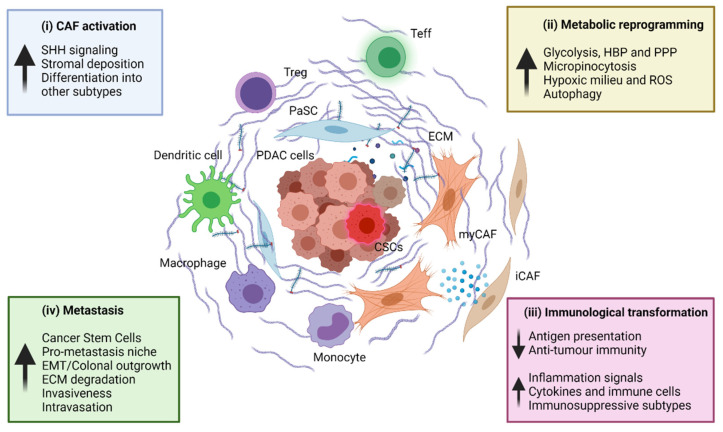
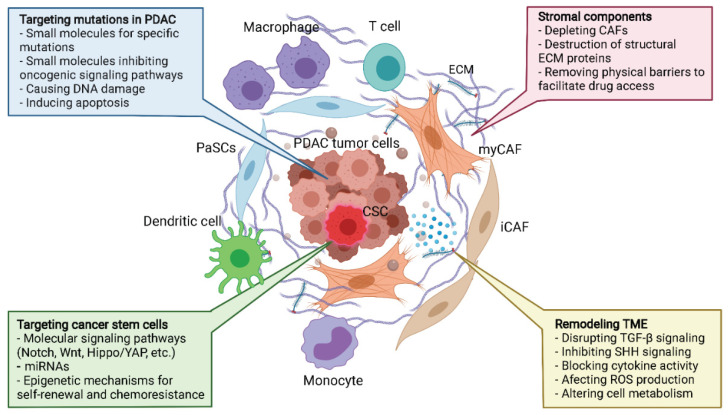
Pancreatic ductal adenocarcinoma (PDAC) remains one of the most lethal human solid tumors, despite great efforts in improving therapeutics over the past few decades. In PDAC, the distinct characteristic of the tumor microenvironment (TME) is the main barrier for developing effective treatments. PDAC TME is characterized by a dense stroma, cancer-associated fibroblasts, and immune cells populations that crosstalk to the subpopulations of neoplastic cells that include cancer stem cells (CSCs). The heterogeneity in TME is also exhibited in the diversity and dynamics of acellular components, including the Extracellular matrix (ECM), cytokines, growth factors, and secreted ligands to signaling pathways. These contribute to drug resistance, metastasis, and relapse in PDAC. However, clinical trials targeting TME components have often reported unexpected results and still have not benefited patients. The failures in those trials and various efforts to understand the PDAC biology demonstrate the highly heterogeneous and multi-faceted TME compositions and the complexity of their interplay within TME. Hence, further functional and mechanistic insight is needed. In this review, we will present a current understanding of PDAC biology with a focus on the heterogeneity in TME and crosstalk among its components. We also discuss clinical challenges and the arising therapeutic opportunities in PDAC research.
Overview
The claims and statistics of this paper haven’t been checked yet.
Free: it reads the open-access text and checks the first 5 claims that cite a source we can check. Create a free account to check every claim.
Integrity signals
Registry
Cites
Statistics
Figures
Verification
Claims the paper makes
The claims and statistics of this paper haven’t been checked yet.
Free: it reads the open-access text and checks the first 5 claims that cite a source we can check. Create a free account to check every claim.
Claims other papers make about this one
Each is checked against this paper’s own text: does it say what the citing paper says it does?
The cited source says what the claim attributes to it.
In the citing paper
“The tumor microenvironment of PDAC is marked by a dense desmoplastic stroma together with profound immune suppression”
From The antitumoral effect of statins in pancreatic ductal adenocarcinoma: a scoping review (2026) · cites this paper as Truong and Pauklin, 2021
Self-check
Percentages, sums and reported differences re-computed from the paper’s own numbers.
The self-check needs the paper’s full text.
Citations
Cites
Sung, H., Ferlay, J., Siegel, R. L., Laversanne, M., Soerjomataram, I., Jemal, A., & Bray, F. (2021) · CA: A Cancer Journal for Clinicians · doi:10.3322/caac.21660 · Cited by 108,699
Siegel, R. L., Miller, K. D., & Jemal, A. (2020) · CA: A Cancer Journal for Clinicians · doi:10.3322/caac.21590 · Cited by 20,444
Signatures of mutational processes in human cancer
Initiative, A. P. C. G., Alexandrov, L. B., ICGC Breast Cancer Consortium, ICGC MMML-Seq Consortium, PedBrain, I., Nik-Zainal, S., Wedge, D. C., Aparicio, S. A. J. R., Behjati, S., Biankin, A. V., et al. (2013) · Nature · doi:10.1038/nature12477 · Cited by 9,660
Rahib, L., Smith, B. D., Aizenberg, R., Rosenzweig, A. B., Fleshman, J. M., & Matrisian, L. M. (2014) · Cancer Research · doi:10.1158/0008-5472.can-14-0155 · Cited by 7,094
The biology and function of fibroblasts in cancer
Kalluri, R. (2016) · Nature Reviews Cancer · doi:10.1038/nrc.2016.73 · Cited by 4,366
Myofibroblasts and mechano-regulation of connective tissue remodelling
Tomasek, J. J., Gabbiani, G., Hinz, B., Chaponnier, C., & Brown, R. A. (2002) · Nature Reviews Molecular Cell Biology · doi:10.1038/nrm809 · Cited by 4,290
The 2019 WHO classification of tumours of the digestive system
Nagtegaal, I. D., Odze, R. D., Klimstra, D., Paradis, V., Rugge, M., Schirmacher, P., Washington, K. M., Carneiro, F., Cree, I. A., & the WHO Classification of Tumours Editorial Board (2020) · Histopathology · doi:10.1111/his.13975 · Cited by 4,192
Tumor-Associated Macrophages: From Mechanisms to Therapy
Noy, R., & Pollard, J. W. (2014) · Immunity · doi:10.1016/j.immuni.2014.06.010 · Cited by 4,089
Core Signaling Pathways in Human Pancreatic Cancers Revealed by Global Genomic Analyses
Jones, S., Zhang, X., Parsons, D. W., Lin, J. C.-H., Leary, R. J., Angenendt, P., Mankoo, P., Carter, H., Kamiyama, H., Jimeno, A., et al. (2008) · Science · doi:10.1126/science.1164368 · Cited by 3,969
Genomic analyses identify molecular subtypes of pancreatic cancer
Bailey, P., Chang, D. K., Nones, K., Johns, A. L., Patch, A.-M., Gingras, M.-C., Miller, D. K., Christ, A. N., Bruxner, T. J. C., Quinn, M. C., et al. (2016) · Nature · doi:10.1038/nature16965 · Cited by 3,621
Cited by
Items 101–115 of 115
Yamaguchi, T., Nakao, R., Shiota, M., Abe, K., & Akeda, Y. (2026) · bioRxiv (Cold Spring Harbor Laboratory) · doi:10.64898/2026.01.29.700732
Mapping cellular heterogeneity and dynamic interactions in pancreatic cancer
Sandhya, T., Kumari, S., Adem, M., Manam, V. K. C., Nagaraju, G. P., & Srilatha, M. (2026) · Journal of Controlled Release · doi:10.1016/j.jconrel.2026.114757
Κοκκώνης, Ρ. Ν. (2026) · University of Thessaly Institutional Repository (University of Thessaly)
Feng, Y., Lv, H., Wang, Y. B., Zhao, G., Yan, C., Sun, F., Li, G., Li, Y., Fu, Y., Li, Y., et al. (2026) · International Journal of Pharmaceutics · doi:10.1016/j.ijpharm.2026.126916
Li, L., Gao, X., Zhang, S., Wang, X., Chen, X., Miao, Y., Zhang, T., Yang, M., Liu, C., Liang, T., et al. (2026) · Acta Pharmaceutica Sinica B · doi:10.1016/j.apsb.2026.05.012
Pancreatic cancer: Tumor microenvironment, molecular complexity and therapeutic opportunities
Chakraborty, R., Afrose, N., Basu, B., & Prajapati, B. (2026) · Elsevier eBooks · doi:10.1016/b978-0-443-36783-0.00002-2
Immune Markers and Risk of Pancreatic Cancer in the European EPIC Cohort
Katzke, V. A., Chen, Y., Dutta, S., Canzian, F., Andersen, J. L. M., Rostgaard‐Hansen, A. L., Bouteille, L., Rebours, V., Truong, T., Schulze, M. B., et al. (2026) · International Journal of Cancer · doi:10.1002/ijc.70581
“Although the exact mechanisms of immune response are not fully understood, proteins actively secreted by cells or passively leaked into the bloodstream are often associated with disease onset and progression of pancreatic cancer [13–16].”
Prado, N. O., Marin, A. M., Zem, C., de Marchi, M. S., Araújo, D. D., Alves, M. J. F., Uno, M., Chammas, R. J., Zanette, D. L., & Aoki, M. N. (2026) · Biomolecules · doi:10.3390/biom16081160
Liang, W., Lyu, D., Fan, K., Liu, C., Ren, Q., Gao, H., & Zhang, Y. (2026) · Biochimica et Biophysica Acta (BBA) - Reviews on Cancer · doi:10.1016/j.bbcan.2026.189682
Ojetunde, M. M., Ma, L., Pratt, H. G., Stevens, A. M., Mizener, A. D., Pistilli, E. E., Ott, S., Abdilleh, K., Szomolay, B., Hu, G., et al. (2026) · Clinical and Translational Medicine · doi:10.1002/ctm2.70810
Ortiz, F. D. L. J., Cimmino, C., Grech, K., Huynen, M. A., van Leeuwen, F., van Zwam, M. C., van den Dries, K., Ventre, M., & Cambi, A. (2026) · Cellular and Molecular Bioengineering · doi:10.1007/s12195-026-00945-7
Proteomic analysis of bioprinted pancreatic tumor models under different nutrient conditions
Buyuk, B., Li, M., Song, X., & Ye, K. (2026) · Frontiers in Bioengineering and Biotechnology · doi:10.3389/fbioe.2026.1921652
Prehabilitation as a Strategy to Modulate the Tumor Microenvironment in Pancreatic Cancer
Sandeep, S., Schutt, J., Allenson, K., Stubbins, R., Zheng, J., Chen, S., & Dhala, A. F. (2026) · International Journal of Molecular Sciences · doi:10.3390/ijms27198900
“Even immune cells that penetrate such an environment appear senescent [13,14].”
Metadata
- Authors
- Truong, L.-H., & Pauklin, S.
- Affiliations
- University of Oxford (GB)
- Corresponding author
- Pauklin, Siim
- ORCID
- Pauklin, Siim
- Venue
- Cancers
- Publisher
- MDPI AG
- Published
- 2021-10-08
- Volume
- 13
- Issue
- 19
- Pages
- 5028
- ISSN
- 2072-6694 (ISSN-L)
- PMC
- PMC8507722
- OpenAlex
- W3201923441
- Cited by
- 102
- References
- 159
- Citations by year
- 2026: 23 · 2025: 23 · 2024: 26 · 2023: 14 · 2022: 15 · 2021: 1
- FWCI
- 1.88
- Type
- journal article
- Language
- en
- Open access
- gold
- doi.org
- Licence
- Locations
- Cancers (publishedVersion, cc-by)
- PubMed Central (publishedVersion, cc-by)
- PubMed (publishedVersion)
- DOAJ (DOAJ: Directory of Open Access Journals) (submittedVersion)
- Funders
- Cancer Research UK (C59392/A25064)
- Vingroup (Vingroup Science and Technology Scholarship Program for Overseas study)
- Topics
- Health Sciences › Medicine › Oncology › Pancreatic and Hepatic Oncology Research
- Health Sciences › Medicine › Surgery › Pancreatitis Pathology and Treatment
- Health Sciences › Medicine › Oncology › Cancer Cells and Metastasis
- Keywords
- pancreatic ductal adenocarcinoma, tumor microenvironment, tumor stroma, cancer-associated fibroblasts, extracellular matrix, cancer stem cells, immune cells, drug resistance, metastasis, TME-targeted therapy, cytokines and growth factors
About these checks
Registry, retraction, Cites and statistics results are computed, not judged, with one exception: a printed reference that no index lists is read once by a model before it counts as a citation error. Claims are extracted by a model and kept only when their quote appears verbatim in the text; each cited source is then checked, with a model’s help, for whether it says what the claim relies on. Those verdicts can be wrong — read the claim’s quote and the cited source before relying on one.
Statistics and arithmetic are recomputed, not judged.
Confidence bands are shown only for fields calibrated on our annotated test set. None is calibrated yet, so no band is shown.
What counts as a claim ›How we measure confidence ›How we check this ›
Are you an author, or do you see a problem with this page? Request a review
Data sources
Bibliographic data: Semantic Scholar, OpenAlex, Crossref.
Contains information from the Semantic Scholar Academic Graph Datasets, made available under the ODC Attribution License (ODC-BY 1.0).
Semantic Scholar’s data is described in: Kinney, R., et al. (2023). The Semantic Scholar Open Data Platform. arXiv:2301.10140.
