

Psychosocial Determinants of Lifestyle Change after a Cancer Diagnosis: A Systematic Review of the Literature
Open accessThe DOI matches its Crossref record; 154 of the 157 references it cites were found in a registry or an index.
Abstract
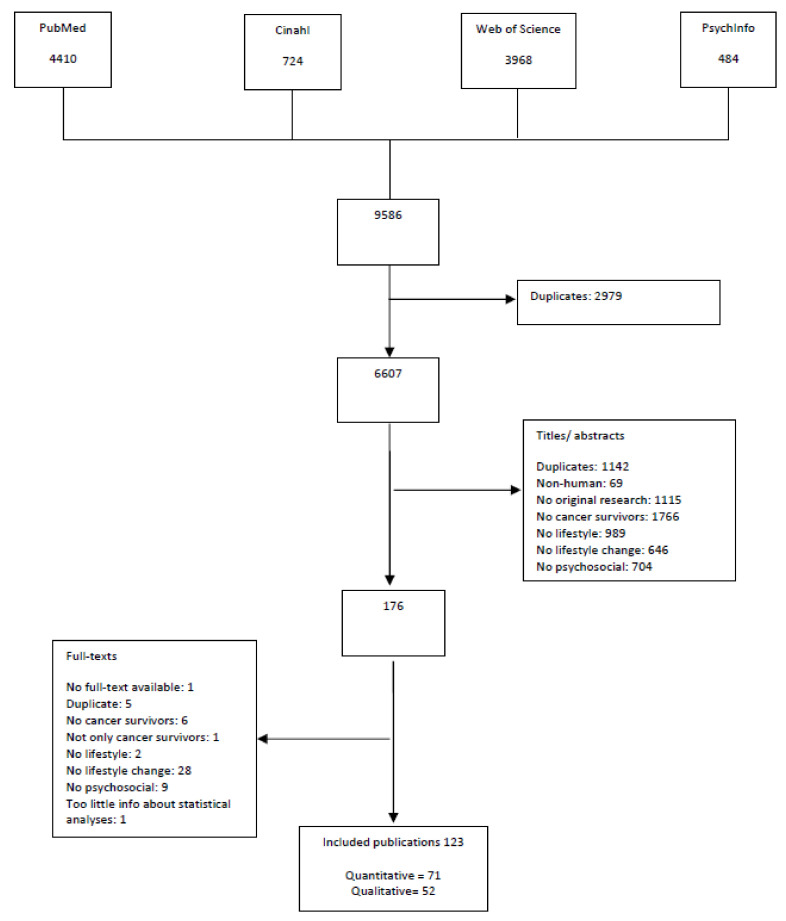
The aim of this study is to provide a systematic overview of the scientific literature on sociodemographic, psychological and social determinants that may facilitate or hamper lifestyle change after the diagnosis cancer. Four databases (PubMed, PsychINFO, Cumulative Index to Nursing and Allied Health Literature (CINAHL), and Web of Science) were searched for relevant papers up to October 2021. Of the 9586 references yielded by the literature search, 123 papers were included: 71 quantitative and 52 qualitative papers. Findings showed a large variety of determinants influencing lifestyle change after cancer diagnosis, with differences between lifestyle behaviors (physical activity, diet, smoking, alcohol, sun protection, and multiple lifestyle behaviors) and findings from quantitative vs. qualitative studies. Findings demonstrate the important role of oncology healthcare professionals in promoting healthy lifestyle changes in cancer survivors. In addition, findings inform researchers involved in the development of health promotion programs about the methods and strategies they can use to promote healthy lifestyle changes in cancer survivors. Favorable lifestyle changes are expected to have beneficial effects on cancer risk and overall health in cancer survivors.
Overview
The claims and statistics of this paper haven’t been checked yet.
Free: it reads the open-access text and checks the first 5 claims that cite a source we can check. Create a free account to check every claim.
Integrity signals
Registry
Cites
Statistics
Figures
Verification
Claims the paper makes
The claims and statistics of this paper haven’t been checked yet.
Free: it reads the open-access text and checks the first 5 claims that cite a source we can check. Create a free account to check every claim.
Claims other papers make about this one
Each is checked against this paper’s own text: does it say what the citing paper says it does?
The cited source says what the claim attributes to it.
In the citing paper
“Nevertheless, while it can be challenging to adopt lifestyle and dietary changes (especially after receiving emotionally charged news of a cancer diagnosis), many patients still want to make the effort, if only to achieve a sense of control over their situations (Hoedjes et al., 2022).”
From Microbiota-centered interventions to boost immune checkpoint blockade therapies (2025) · cites this paper as Hoedjes et al., 2022
Self-check
Percentages, sums and reported differences re-computed from the paper’s own numbers.
The self-check needs the paper’s full text.
Citations
Cites
Michie, S., van Stralen, M. M., & West, R. (2011) · Implementation Science · doi:10.1186/1748-5908-6-42 · Cited by 13,697 · cited 1×
“The Behavior Change Technique Taxonomy [152], the Behavior Change Wheel [153], and Intervention Mapping [154] could be used to translate these psychosocial determinants into personalized interventions.”
MethodMichie, S., Richardson, M., Johnston, M., Abraham, C., Francis, J., Hardeman, W., Eccles, M. P., Cane, J., & Wood, C. E. (2013) · Annals of Behavioral Medicine · doi:10.1007/s12160-013-9486-6 · Cited by 7,629 · cited 3×
“The Behavior Change Technique Taxonomy [152], the Behavior Change Wheel [153], and Intervention Mapping [154] could be used to translate these psychosocial determinants into personalized interventions.”
BackgroundMethodLichtenstein, A. H., Appel, L. J., Brands, M., Carnethon, M., Daniels, S., Franch, H. A., Franklin, B., Kris-Etherton, P., Harris, W. S., Howard, B., et al. (2006) · Circulation · doi:10.1161/circulationaha.106.176158 · Cited by 2,705 · cited 5×
“low maintainers [11] NS [22,23] *Higher educational level & positive changes in physical activity or diet [24] NS [6]”
InfluentialDiet, Nutrition, and the Prevention of Chronic Diseases
Leong, A. S.-Y. (1992) · Pathology · doi:10.1016/s0031-3025(16)36541-2 · Cited by 1,628
Watson, N. F., Badr, M. S., Belenky, G., Bliwise, D. L., Buxton, O. M., Buysse, D., Dinges, D. F., Gangwisch, J., Grandner, M. A., Kushida, C., et al. (2015) · SLEEP · doi:10.5665/sleep.4716 · Cited by 1,453 · cited 10×
“Anxiety symptoms NS [8] *Higher anxiety & less likely to increase physical activity [36] NS [8,37] NS [18,21] *Lower anxiety & abstinence [17] * Higher anxiety & unhealthy lifestyle [40]”
BackgroundInfluentialChan, D. S. M., Vieira, A. R., Aune, D., Bandera, E. V., Greenwood, D. C., McTiernan, A., Navarro Rosenblatt, D., Thune, I., Vieira, R., & Norat, T. (2014) · Annals of Oncology · doi:10.1093/annonc/mdu042 · Cited by 1,165 · cited 10×
“Depressive symptoms NS [4,8,30,32,36] *Higher levels of depressive symptoms & less likely to remain consistently sufficiently active [2] *Depression perceived barrier [30] NS [4,8,30,37]; NS for those with better fruit and vegetable and fiber intake at baseline [38] *For those with less fat consumption at baseline, in…”
BackgroundInfluentialIntervention Mapping: A Process for Developing Theory and Evidence-Based Health Education Programs
Bartholomew, L. K., Parcel, G. S., & Kok, G. (1998) · Health Education & Behavior · doi:10.1177/109019819802500502 · Cited by 1,102 · cited 1×
“The Behavior Change Technique Taxonomy [152], the Behavior Change Wheel [153], and Intervention Mapping [154] could be used to translate these psychosocial determinants into personalized interventions.”
MethodBlanchard, C. M., Courneya, K. S., & Stein, K. (2008) · Journal of Clinical Oncology · doi:10.1200/jco.2007.14.6217 · Cited by 1,021 · cited 11×
“Difficulties maintaining change after end of intervention/post-program lack of external encouragement [19] [29]”
BackgroundInfluentialEffect of obesity on survival of women with breast cancer: systematic review and meta-analysis
Protani, M., Coory, M., & Martin, J. H. (2010) · Breast Cancer Research and Treatment · doi:10.1007/s10549-010-0990-0 · Cited by 962 · cited 9×
“, low mood, depression, stress, anxiety) [6,9,15,19–22,44,45,51] [5] [13,14,27,39]”
BackgroundInfluentialÖstlund, U., Kidd, L., Wengström, Y., & Rowa-Dewar, N. (2011) · International Journal of Nursing Studies · doi:10.1016/j.ijnurstu.2010.10.005 · Cited by 742 · cited 6×
“Stage of change *Higher stage of change & increased exercise since diagnosis [25] NS [37] *Higher stage of change & healthier eating since diagnosis [25] *Lower readiness to change & continuous smoker vs.”
BackgroundMethodInfluential
Cited by
Jones, T. L., Edbrooke, L., Rawstorn, J. C., Hayes, S. C., Maddison, R., Denehy, L., & Short, C. E. (2023) · Supportive Care in Cancer · doi:10.1007/s00520-023-08040-7 · Cited by 45
Gamrath, L., Pedersen, T. B., Møller, M. V., Volmer, L. M., Holst-Christensen, L., Vestermark, L. W., & Donskov, F. (2025) · Current Oncology Reports · doi:10.1007/s11912-024-01622-6 · Cited by 30
“Patients saw lifestyle changes as a positive way to gain control [67].”
Akiyama, M. O., Ishida, N., Takahashi, H., Takahashi, M., Otsuki, A., Sato, Y., Saito, J., Yaguchi‐Saito, A., Fujimori, M., Kaji, Y., et al. (2023) · Journal of Cancer Survivorship · doi:10.1007/s11764-023-01367-4 · Cited by 25
“Previous studies have suggested that a cancer diagnosis could be a “cue to action” to motivate positive health behavior changes among cancer survivors [2, 54, 55] and their family and friends [2, 10].”
BackgroundAssociation of Cardiovascular Health Metrics and Mortality Among Individuals With and Without Cancer
Abramov, D., Kobo, O. M., & Mamas, M. A. (2024) · Journal of the American Heart Association · doi:10.1161/jaha.123.032683 · Cited by 24
Microbiota-centered interventions to boost immune checkpoint blockade therapies
Almonte, A. A., Thomas, S., & Zitvogel, L. (2025) · Journal of Experimental Medicine · doi:10.1084/jem.20250378 · Cited by 19
A Systematic Review of Dietary Interventions for Cancer Survivors and Their Families or Caregivers
Xu, J., Hoover, R. L., Woodard, N., Leeman, J., & Hirschey, R. (2023) · Nutrients · doi:10.3390/nu16010056 · Cited by 21
“However, numerous observational studies have linked the support from family members or caregivers to survivors’ adherence to healthy diets, especially for those who live with survivors [19,20,65–67].”
BackgroundThe Mediterranean Lifestyle to Contrast Low-Grade Inflammation Behavior in Cancer
Divella, R., Marino, G., Infusino, S., Lanotte, L., Gadaleta-Caldarola, G., & Gadaleta‐Caldarola, G. (2023) · Nutrients · doi:10.3390/nu15071667 · Cited by 22
“Consistent exercise alters several biochemical markers associated with cancer cell metabolism [30].”
BackgroundHsia, H.-H., Tien, Y., Lin, Y., & Huang, H.-P. (2024) · Seminars in Oncology Nursing · doi:10.1016/j.soncn.2024.151622 · Cited by 17
Mehrabizadeh, M., Zaremohzzabieh, Z., Zarean, M., Ahrari, S., & Ahmadi, A.-R. (2024) · BMC Women s Health · doi:10.1186/s12905-024-03383-7 · Cited by 25
“Cultural beliefs and values are increasingly recognized as important determinants of psychological and behavioral outcomes following cancer diagnosis and treatment [17, 18].”
BackgroundInfluentialPerperidi, M., Saliari, D., Christakis, C. E., Huybrechts, I., Saloustros, E. S., Theodorakis, Y., & Androutsos, O. (2023) · Cancer Causes & Control · doi:10.1007/s10552-023-01707-w · Cited by 21
Cardiovascular Health Metrics Differ Between Individuals With and Without Cancer
Kobo, O. M., Abramov, D., Fiúza, M., Chew, N., Ng, C. H., Parwani, P. J., Menezes, M. N., Thavendiranathan, P., & Mamas, M. A. (2023) · Journal of the American Heart Association · doi:10.1161/jaha.123.030942 · Cited by 11
“21 Our finding that overall CVH is worse in patients with cancer, mainly driven by worse cardiovascular health factors (obesity, dyslipidemia, hyperglycemia, and hypertension), provides a framework through which cardiovascular health may be targeted in patients with cancer.”
BackgroundChen, Q.-Y., Keum, N., & Giovannucci, E. L. (2025) · JNCI Journal of the National Cancer Institute · doi:10.1093/jnci/djaf098 · Cited by 11
Zhang, L., Iliescu, C., Ferencik, M., Finamore, V., Beavers, C. J., Patel, A. R., Ghoshhajra, B. B., Milgrom, S. A., Dent, S., Baldassarre, L. A., et al. (2026) · Circulation · doi:10.1161/cir.0000000000001391 · Cited by 16
Self-management Behaviors and Associated Factors in Adult Cancer Survivors: An Integrative Review
Aung, M. L., & Cheng, H. (2023) · Cancer Nursing · doi:10.1097/ncc.0000000000001289 · Cited by 10
Perperidi, M., Saltaouras, G., Konstandis, A., Craemer, M. D., Saloustros, E. S., Theodorakis, Y., & Androutsos, O. (2023) · Journal of Nutritional Science · doi:10.1017/jns.2023.94 · Cited by 7
“(13,15,19) Our study showed that participants ’ key motivators for change was maintaining physical and mental health, along with improving their appearance.”
BackgroundGavioli, C., Vlooswijk, C. C. P., Janssen, S. H. M., Kaal, S. E. J., Kerst, J. M., Tromp, J. M., Bos, M. E. M. M., van der Hulle, T., van der Graaf, W. T. A., Lalisang, R. I., et al. (2024) · Journal of Cancer Survivorship · doi:10.1007/s11764-023-01529-4 · Cited by 8
“A systematic review of the literature [45] showed that a higher education level was the psycho-social determinant most associated with favorable lifestyle changes after a cancer diagnosis, and to a higher adherence to the recommendations.”
Hoedjes, M., van Maldegem, S. J. M. V. C. –., Nimtz, C., van Loenen-Sarukhanyan, Z., van de Poll-Franse, L. V., Seidell, J. C., & Mols, F. (2025) · Health Psychology Review · doi:10.1080/17437199.2025.2539202 · Cited by 6
“Receiving a cancer diagnosis may positively influence the motivation to make lifestyle changes, particularly when knowledge about health benefits of lifestyle change after a cancer diagnosis is provided by health care professionals (Hoedjes et al., 2022).”
InfluentialSelf-citationSarrió, R. G., Fuentes, J. D. B., Samblás, V. G., Morales, M. G., Ozores, P. P., Ruiz‐Casado, A., Torres-Jiménez, J., Vieito, M., & Collectively known as the SEOM Social Determinants Working Group (2025) · Clinical & Translational Oncology · doi:10.1007/s12094-025-04129-z · Cited by 6
“…o r e s t s , t h e s ea ) [ 25 , 55 , 57 , 59 , 69 , 83 ] ( 6 ) S un e xpo s u r e E n c ou r a g e h ea lt hy s un e xpo s u r e h a b it s [ 26 , 54 , 55 , 61 ] ( 7 ) E m p l oy m e n t E n c ou r a g e t h e r e s u m p ti on o f no r m a l w o r k ac ti v iti e s ; i d e n ti f y s t r e ss f…”
InfluentialLefferts, E. C., & Lee, D.-C. (2024) · Journal of the American Heart Association · doi:10.1161/jaha.123.032886 · Cited by 7
“Additionally, cancer diagnoses and anticancer therapy may indirectly affect diet, physical activity, and other health behaviors 17,18 that may uncouple or attenuate the relationship between behavior and arterial stiffness.”
BackgroundResultLiu, Z., Luo, X., Yang, H., Ma, M., He, H. G., & Xiao, H. (2025) · Frontiers in Psychology · doi:10.3389/fpsyg.2025.1597999 · Cited by 4
Greenlee, H., Santiago‐Torres, M., Contento, I. R., Koch, P. A., Rillamas‐Sun, E., Gray, H. L., Brickman, A. M., Gaffney, A. O., Thomson, C. A., Crane, T. E., et al. (2025) · Journal of the Academy of Nutrition and Dietetics · doi:10.1016/j.jand.2025.156260 · Cited by 4
Meng, Q., Du, Y., Tan, Q., He, F., & Miao, H. (2026) · Frontiers in Nutrition · doi:10.3389/fnut.2026.1707235 · Cited by 3
“A review of the literature suggests that these variables modulate symptom severity and awareness levels among cancer patients (29).”
van Maldegem, S. J. M. V. C. –., Mols, F., Seidell, J. C., de Kruif, A. J. T. C. M., van de Poll-Franse, L. V., & Hoedjes, M. (2023) · Annals of Behavioral Medicine · doi:10.1093/abm/kaad049 · Cited by 3
Self-citationSeven, M., Moraitis, A. M., Hammer, M. J., Pearlman, J., Reid, A. E., Sturgeon, S. R., & Wenzel, J. A. (2023) · Cancer Nursing · doi:10.1097/ncc.0000000000001281 · Cited by 4
Patient–Provider Discussions About Alcohol Use by Cancer History
Greene, N. K., Dean, D., & Han, P. K. J. (2024) · American Journal of Preventive Medicine · doi:10.1016/j.amepre.2024.03.001 · Cited by 4
Innominato, P. F., Macdonald, J. H., Saxton, W., Longshaw, L., Granger, R., Naja, I., Allocca, C., Edwards, R., Rasheed, S., Folkvord, F., et al. (2024) · JMIR Research Protocols · doi:10.2196/52957 · Cited by 3
“Nevertheless, there are motivational, practical, and informational barriers to the wide adoption of modifiable healthy lifestyle behaviors in survivors of cancer [8-10].”
Blinov, D. V., Солопова, А. Г., Gameeva, E. V., Гаджиевич, Б. Н., Галкин, В. Н., Eremushkin, M. A., Степанова, А. М., Ivanov, A. E., & Сергеевна, Г. О. (2024) · Bulletin of Rehabilitation Medicine · doi:10.38025/2078-1962-2024-23-5-52-60 · Cited by 3
Matheson, L., Hackshaw‐McGeagh, L., Bennett, J., Davies, E., Brett, J., Matthews, S., & Watson, E. K. (2025) · Journal of Health Psychology · doi:10.1177/13591053251336843 · Cited by 2
“Considering the salience of remarks by HCPs to patients, and the importance of their advice, as demonstrated previously (Hoedjes et al., 2022), it is critical that information patients receive is accurate (and helps them avoid misinformation received from online sources).”
Ma, Y., Tian, Q., Wu, X., Sun, Y., Tian, J., Xu, D., Gong, M., Li, X., Liu, Y., & Zhu, B. (2025) · BMC Public Health · doi:10.1186/s12889-025-25521-y · Cited by 2
“Research has shown that cancer patients often change their dietary habits, and nutrition plays a crucial role in the survival outcomes of cancer survivors [4, 5].”
Bui, T. T., Park, E., Kang, H., Kim, B., Won, Y., & Oh, J. (2025) · Liver International · doi:10.1111/liv.70120 · Cited by 2
“However, it can also lead to psychological issues, such as anxiety and stress, which may result in high-risk drinking [14, 46].”
Denehy, L., Abo, S., Swain, C. T. V., Short, C. E., Kiss, N. K., Khot, A. S., Wong, E., Purtill, D., O’Donnell, C., Klaic, M., et al. (2025) · BMC Cancer · doi:10.1186/s12885-025-13898-3 · Cited by 3
Choi, J., Han, K., Shin, C. M., Jung, J., Kim, S. Y., Im, S.-G., Jo, H., Lee, H.-K., Jin, E. H., Kang, S. J., et al. (2025) · BMJ Public Health · doi:10.1136/bmjph-2025-002701 · Cited by 1
“17 18 Therefore, this study aimed to evaluate the effects and possible mechanisms of H. pylori eradication in thromboembolic disease, with a particular focus on lifestyle changes in patients.”
Ollerton, R. D., Bol, N., Beets, G., Folkvord, F., & Krahmer, E. (2025) · BMC Public Health · doi:10.1186/s12889-025-26004-w · Cited by 1
“Studies have shown that survivors with lower educational levels, higher age and of male gender may be less likely to adhere to the health-related behaviours [17, 27, 28].”
Cheng, H. G., Aduse‐Poku, L., McGill, C., Palesh, O. G., & Hong, S. (2026) · PLoS Medicine · doi:10.1371/journal.pmed.1005034 · Cited by 1
“Our findings provide a population-level foundation for such targeted investigations as well as studies on generational shifts in post-diagnosis risk factors, such as smoking, ultraviolet exposure, and sedentary lifestyle [44], to better understand and mitigate rising SPC risks in these cohorts.”
Güth, U., Hoefnagels, N., Müller, A., Schär, S., Rosset, L., Corke, M. N., Schwitter, M., Jakob, A., Balmelli, C., Leo, C., et al. (2026) · The Breast · doi:10.1016/j.breast.2026.104789 · Cited by 2
“This shows that patients who are confronted with a cancer diagnosis and treatment are highly motivated to pursue other, new ways of self-care health promotion in addition to completing the recommended oncological therapies [overview in: [35]].”
Chow, E. J., Lee, E. D., Hershberger, M., Jenssen, K. M., Di, C., Doody, D. R., Hogue, B., Mendoza, J. A., Muller, T., Schenk, J. M., et al. (2026) · JMIR Research Protocols · doi:10.2196/104572 · Cited by 1
Castillo, F. B., Goodman, W., Lally, P. J., Fisher, A., & Beeken, R. J. (2025) · Supportive Care in Cancer · doi:10.1007/s00520-025-09305-z · Cited by 1
Evaluation of marital adjustment in women with gynecologic cancer
Şahin, S. A., & Öztürk, S. (2024) · Anatolian Journal of Health Research · doi:10.61534/anatoljhr.1436620
Seven, M., Moraitis, A. M., Pearlman, J., Reid, A. E., Sturgeon, S. R., Wenzel, J. A., & Hammer, M. J. (2024) · Seminars in Oncology Nursing · doi:10.1016/j.soncn.2024.151698
van den Hoek, D. W. B. –., van de Water, L. F., Vos, P. G., Hoedjes, M., Roodbeen, R. T. J., Klarenbeek, B. R., Geijsen, D., Smets, E. M. A., van Laarhoven, H. W. M., & Henselmans, I. (2024) · Supportive Care in Cancer · doi:10.1007/s00520-024-08847-y · Cited by 1
Self-citationFei, W., Abdullah, H. B., Zaremohzzabieh, Z., Li, Y., & Hongjuan, Z. (2024) · Journal of Ecohumanism · doi:10.62754/joe.v3i8.5219 · Cited by 1
“Despite global guidelines advocating lifestyle changes for breast cancer survivors (BCSs; Hoedjes et al., 2022), few interventions adequately address the specific needs of young mothers.”
Sithole-Tetani, N. (2024) · E-Journal of Humanities Arts and Social Sciences · doi:10.38159/ehass.202451659
Small steps, big impact: redefining cancer survival through lifestyle
Romanos-Nanclares, A., Giovannucci, E. L., & Eliassen, A. H. (2025) · JNCI Journal of the National Cancer Institute · doi:10.1093/jnci/djaf085
Liu, S. (2025) · Integrative Cancer Therapies · doi:10.1177/15347354251371707
Alzahrani, N. M. G., & Wazqar, D. Y. (2025) · Nursing and Health Sciences · doi:10.1111/nhs.70218
“According to Hoedjes et al. (2022), the scientific literature on the impact of sociodemographic and psychological determinants on healthy lifestyles in cancer survivors shows mixed results.”
Swain, C. T. V., Bergin, R. J., Moore, M. M., D’Souza, M., Ashley, C., Lynch, B. M., Koorts, H., Denehy, L., & Klaic, M. (2025) · Journal of Physical Activity and Health · doi:10.1123/jpah.2025-0076
Experiences and needs of Dutch cancer survivors regarding lifestyle counselling: a qualitative study
van Aken, B., Manshanden, A., Kroeze, W., Florisson, N., Groot-Sluijsmans, B. C., Hoedjes, M., van Asselt, K. M., ter Beek, L., & Steenhuis, I. H. (2025) · BMC Cancer · doi:10.1186/s12885-025-15186-6 · Cited by 1
“Besides motivation, other factors also play a role in adopting and maintaining a healthy lifestyle among cancer survivors, such as social support, receiving professional guidance, self-efficacy, and psychological complaints [25].”
Self-citationMaio, A., Leone, A. D., Grande, S. D., Franceschini, G., Magno, S., Castagnetta, V., Masetti, R., Pastorino, R., & Boccia, S. (2025) · Research Square · doi:10.21203/rs.3.rs-8099766/v1
Savvidou, M., Tsatsou, I., Liamopoulou, P., Prapa, P. M., & Lavdaniti, M. (2026) · Endocrines · doi:10.3390/endocrines7010007
“This pattern is likely attributable to the directive role of the oncology team, since patients are highly responsive to provider-endorsed changes [27].”
Lifestyle differences between rare and common cancer survivors: A population-based registry study
de Heus, E., Nijwening, L., van der Zwan, J. M., van Herpen, C., Merkx, M. A. W., & Duijts, S. F. A. (2026) · Rare · doi:10.1016/j.rare.2026.100120
Alcohol and Cancer Messaging: A Scoping Review
Greene, N. K., Seidenberg, A. B., Butera, G., Jesch, E., Fakhari, H., Wiseman, K. P., Buykx, P., LoConte, N. K., Scherr, C. L., & Klein, W. M. P. (2026) · Cancer Epidemiology Biomarkers & Prevention · doi:10.1158/1055-9965.epi-25-2058
van Koeveringe, J. M., van Afferen, L., Drager, L. D., Hermsen, S., Atsma, F., van den Heuvel, B., & Seeger, J. P. H. (2026) · Supportive Care in Cancer · doi:10.1007/s00520-026-10661-7 · Cited by 1
Beets, G., Bol, N., Ollerton, R. D., Folkvord, F., Stuiver, M. M., Deasy, G., & Krahmer, E. (2026) · Behavioral Medicine · doi:10.1080/08964289.2026.2677133 · Cited by 1
Wang, X., Zhang, S., Wang, J., Li, X., Zheng, Y., Wang, R., Cao, B., & Li, Q. (2026) · Supportive Care in Cancer · doi:10.1007/s00520-026-10973-8
Summart, U., Sangruangake, M., Halak, C., & Toyn, P. T. (2026) · Belitung Nursing Journal · doi:10.33546/bnj.4641
“Our results align with a systematic review on lifestyle modifications among cancer survivors by Hoedjes et al. (2022), which noted that although social support is frequently cited as a behavioral facilitator, it often fails to emerge as an independent predictor of adherence when internal…”
Metadata
- Authors
- Hoedjes, M., Nijman, I., & Hinnen, C.
- Affiliations
- Tilburg University (NL)
- Leiden University Medical Center (NL)
- Corresponding author
- Hoedjes, Meeke
- Venue
- Cancers
- Publisher
- MDPI AG
- Published
- 2022-04-16
- Volume
- 14
- Issue
- 8
- Pages
- 2026
- ISSN
- 2072-6694 (ISSN-L)
- PMC
- PMC9032592
- OpenAlex
- W4224115805
- Cited by
- 55
- References
- 157
- Citations by year
- 2026: 12 · 2025: 20 · 2024: 13 · 2023: 10
- FWCI
- 1.31
- Type
- journal article
- Language
- en
- Open access
- gold
- doi.org
- Licence
- Locations
- Cancers (publishedVersion, cc-by)
- PubMed Central (publishedVersion, cc-by)
- PubMed (publishedVersion)
- Research portal (Tilburg University) (submittedVersion, cc-by)
- Data Archiving and Networked Services (DANS) (submittedVersion, cc-by)
- Topics
- Health Sciences › Medicine › Oncology › Cancer survivorship and care
- Health Sciences › Medicine › Oncology › Global Cancer Incidence and Screening
- Health Sciences › Medicine › Oncology › Cancer Risks and Factors
- Keywords
- cancer survivors, lifestyle modification, psychosocial factors, sociodemographic factors, physical activity, diet, smoking, alcohol consumption, sun protection, oncology healthcare professionals, health promotion programs, cancer risk
About these checks
Registry, retraction, Cites and statistics results are computed, not judged, with one exception: a printed reference that no index lists is read once by a model before it counts as a citation error. Claims are extracted by a model and kept only when their quote appears verbatim in the text; each cited source is then checked, with a model’s help, for whether it says what the claim relies on. Those verdicts can be wrong — read the claim’s quote and the cited source before relying on one.
Statistics and arithmetic are recomputed, not judged.
Confidence bands are shown only for fields calibrated on our annotated test set. None is calibrated yet, so no band is shown.
What counts as a claim ›How we measure confidence ›How we check this ›
Are you an author, or do you see a problem with this page? Request a review
Data sources
Bibliographic data: Semantic Scholar, OpenAlex, Crossref.
Contains information from the Semantic Scholar Academic Graph Datasets, made available under the ODC Attribution License (ODC-BY 1.0).
Semantic Scholar’s data is described in: Kinney, R., et al. (2023). The Semantic Scholar Open Data Platform. arXiv:2301.10140.
