

The DOI matches its Crossref record; 185 of the 187 references it cites were found in a registry or an index.
Role of Microglia and Astrocytes in Alzheimer’s Disease: From Neuroinflammation to Ca2+ Homeostasis Dysregulation
Open accessAbstract
Alzheimer’s disease (AD) is the most common form of dementia worldwide, with a complex, poorly understood pathogenesis. Cerebral atrophy, amyloid-β (Aβ) plaques, and neurofibrillary tangles represent the main pathological hallmarks of the AD brain. Recently, neuroinflammation has been recognized as a prominent feature of the AD brain and substantial evidence suggests that the inflammatory response modulates disease progression. Additionally, dysregulation of calcium (Ca2+) homeostasis represents another early factor involved in the AD pathogenesis, as intracellular Ca2+ concentration is essential to ensure proper cellular and neuronal functions. Although growing evidence supports the involvement of Ca2+ in the mechanisms of neurodegeneration-related inflammatory processes, scant data are available on its contribution in microglia and astrocytes functioning, both in health and throughout the AD continuum. Nevertheless, AD-related aberrant Ca2+ signalling in astrocytes and microglia is crucially involved in the mechanisms underpinning neuroinflammatory processes that, in turn, impact neuronal Ca2+ homeostasis and brain function. In this light, we attempted to provide an overview of the current understanding of the interactions between the glia cells-mediated inflammatory responses and the molecular mechanisms involved in Ca2+ homeostasis dysregulation in AD.
Overview
The claims and statistics of this paper haven’t been checked yet.
Run the check — free, no account needed. It reads the open-access text and checks the sources it cites.
Integrity signals
Registry
Cites
Statistics
Figures
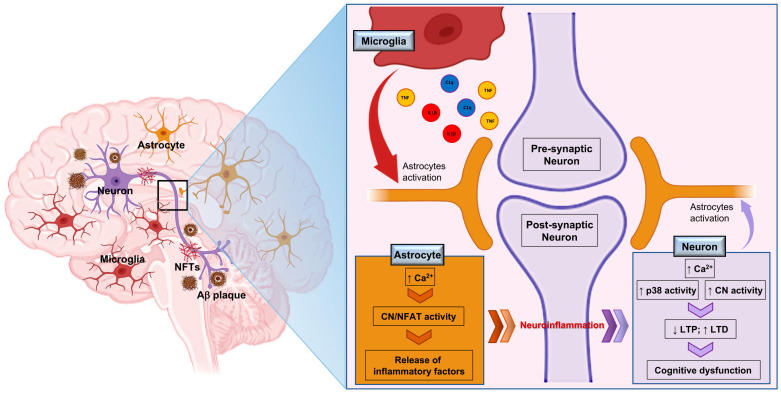
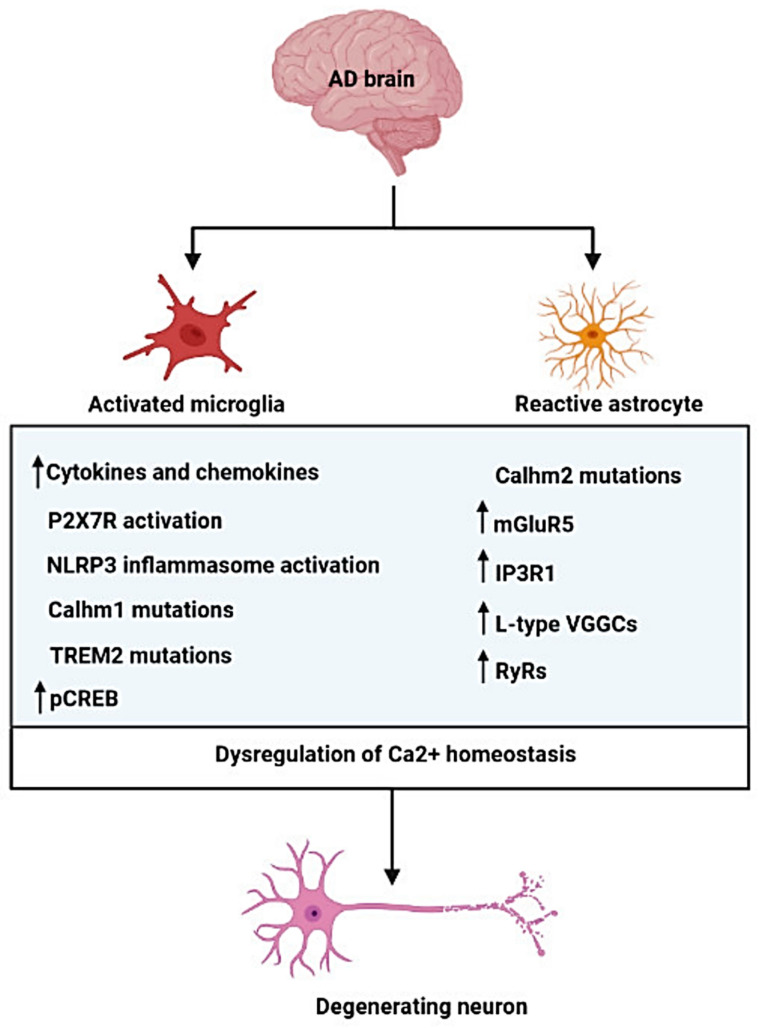
Verification
Claims the paper makes
The claims and statistics of this paper haven’t been checked yet.
Run the check — free, no account needed. It reads the open-access text and checks the sources it cites.
Claims other papers make about this one
Each is checked against this paper’s own text: does it say what the citing paper says it does?
The source backs part of the claim, not all of it — or backs it for a different population, condition or comparison.
In the citing paper
“Activation of microglia and astrocytes is a common feature of AD and other tauopathies (Di Benedetto, Burgaletto et al. 2022, Chen and Yu 2023, Deng, Wu et al. 2024)”
From SORLA up-regulation suppresses pathological effects in aged tauopathy mouse brain (2026) · cites this paper as Di Benedetto, Burgaletto et al. 2022
Experimental — accuracy not yet measuredThe cited source says what the claim attributes to it.
In the citing paper
“In AD and CNS infections, pro- and anti-inflammatory signaling is primarily initiated by CNS resident immune cells, the astrocytes, and microglia (Di Benedetto et al., 2022; Russo and McGavern, 2015).”
From Arbovirus infection increases the risk for the development of neurodegenerative disease pathology in the murine model (2024) · cites this paper as Di Benedetto et al., 2022
Self-check
Percentages, sums and reported differences re-computed from the paper’s own numbers.
The self-check needs the paper’s full text.
Citations
Cites
Calcium's Role in Mechanotransduction during Muscle Development
Damm, T. B., & Egli, M. (2014) · Cellular Physiology and Biochemistry · doi:10.1159/000356667 · Cited by 14,552
Polazzi, E., Mengoni, I., Caprini, M., Peña‐Altamira, E., Kurtys, E., & Monti, B. (2012) · Neurosignals · doi:10.1159/000337115 · Cited by 9,023
Neurotoxic reactive astrocytes are induced by activated microglia
Liddelow, S. A., Guttenplan, K. A., Clarke, L. E., Bennett, F. C., Bohlen, C. J., Schirmer, L., Bennett, M. L., Münch, A. E., Chung, W.-S., Peterson, T. C., et al. (2017) · Nature · doi:10.1038/nature21029 · Cited by 7,971
Neuroinflammation in Alzheimer's disease
Heneka, M. T., Carson, M. J., Khoury, J. E., Landreth, G. E., Brosseron, F., Feinstein, D. L., Jacobs, A. H., Wyss-Coray, T., Vitorica, J., Ransohoff, R. M., et al. (2015) · The Lancet Neurology · doi:10.1016/s1474-4422(15)70016-5 · Cited by 6,226
Scheltens, P., De Strooper, B., Kivipelto, M., Holstege, H., Chételat, G., Teunissen, C. E., Cummings, J., & van der Flier, W. M. (2021) · The Lancet · doi:10.1016/s0140-6736(20)32205-4 · Cited by 5,465
Clapham, D. E. (2007) · Cell · doi:10.1016/j.cell.2007.11.028 · Cited by 4,175
Microglia Sculpt Postnatal Neural Circuits in an Activity and Complement-Dependent Manner
Schafer, D. P., Lehrman, E. K., Kautzman, A. G., Koyama, R., Mardinly, A. R., Yamasaki, R., Ransohoff, R. M., Greenberg, M. E., Barres, B. A., & Stevens, B. (2012) · Neuron · doi:10.1016/j.neuron.2012.03.026 · Cited by 4,089
Microglia: Active sensor and versatile effector cells in the normal and pathologic brain
Hanisch, U.-K., & Kettenmann, H. (2007) · Nature Neuroscience · doi:10.1038/nn1997 · Cited by 3,676
Mechanisms underlying inflammation in neurodegeneration
Glass, C. K., Saijo, K., Winner, B., Marchetto, M. C., & Gage, F. H. (2010) · Cell · doi:10.1016/j.cell.2010.02.016 · Cited by 3,580
Neuroinflammation and microglial activation in Alzheimer disease: where do we go from here?
Leng, F., & Edison, P. (2021) · Nature Reviews Neurology · doi:10.1038/s41582-020-00435-y · Cited by 3,179
Cited by
Sorted by citations
Microglia and Alzheimer’s Disease
Merighi, S., Nigro, M., Travagli, A., & Gessi, S. (2022) · International Journal of Molecular Sciences · doi:10.3390/ijms232112990 · Cited by 236
Quick, J. D., Silva, C., Wong, J. H., Lim, K. L., Reynolds, R., Barron, A. M., Zeng, J., & Lo, C. H. (2023) · Journal of Neuroinflammation · doi:10.1186/s12974-023-02866-y · Cited by 203
The duality of amyloid-β: its role in normal and Alzheimer’s disease states
Azargoonjahromi, A. (2024) · Molecular Brain · doi:10.1186/s13041-024-01118-1 · Cited by 214
Rodríguez-Giraldo, M., González-Reyes, R. E., Ramírez-Guerrero, S., Bonilla-Trilleras, C. E., Guardo-Maya, S., & Nava-Mesa, M. O. (2022) · International Journal of Molecular Sciences · doi:10.3390/ijms232113630 · Cited by 122
Alzheimer's Disease Puzzle: Delving into Pathogenesis Hypotheses
(2024) · aging and disease · doi:10.14336/ad.2023.0608 · Cited by 183
Metadata
- Authors
- Di Benedetto, G., Burgaletto, C., Bellanca, C. M., Munafò, A., Bernardini, R., & Cantarella, G.
- Affiliations
- Department of Biomedical and Biotechnological Sciences, Section of Pharmacology, University of Catania, 95123 Catania, Italy
- University of Catania (IT)
- Corresponding author
- Bernardini, Renato
- ORCID
- Venue
- Cells
- Publisher
- MDPI AG
- Published
- 2022-09-01
- Volume
- 11
- Issue
- 17
- Pages
- 2728
- ISSN
- 2073-4409 (ISSN-L)
- PMC
- PMC9454513
- OpenAlex
- W4294151542
- Cited by
- 189
- References
- 187
- Citations by year
- 2026: 53 · 2025: 63 · 2024: 46 · 2023: 19 · 2022: 8
- FWCI
- 3.48
- Type
- journal article
- Language
- en
- Open access
- gold
- doi.org
- Licence
- Locations
- Cells (publishedVersion, cc-by)
- PubMed Central (publishedVersion, cc-by)
- PubMed (publishedVersion)
- DOAJ (DOAJ: Directory of Open Access Journals) (submittedVersion, cc-by-sa)
- Funders
- the Italian Ministry of Research (2017YH3SXK)
- Topics
- Life Sciences › Neuroscience › Neurology › Neuroinflammation and Neurodegeneration Mechanisms
- Life Sciences › Neuroscience › Cellular and Molecular Neuroscience › Alzheimer's disease research and treatments
- Life Sciences › Neuroscience › Cellular and Molecular Neuroscience › Neuroscience and Neuropharmacology Research
- Keywords
- Alzheimer's disease, microglia, astrocytes, neuroinflammation, calcium homeostasis, calcium signaling, glial interactions, amyloid plaques, neurofibrillary tangles, neurodegeneration, glial inflammation
- MeSH terms
- Neuroinflammatory Diseases, Alzheimer Disease, Astrocytes, Homeostasis, Humans, Microglia, Plaque, Amyloid
About these checks
Registry, retraction, Cites and statistics results are computed, not judged, with one exception: a printed reference that no index lists is read once by a model before it counts as a citation error. Claims are extracted by a model and kept only when their quote appears verbatim in the text; each cited source is then checked, with a model’s help, for whether it says what the claim relies on. Those verdicts can be wrong — read the claim’s quote and the cited source before relying on one.
Statistics and arithmetic are recomputed, not judged.
Confidence bands are shown only for fields calibrated on our annotated test set. None is calibrated yet, so no band is shown.
What counts as a claim ›How we measure confidence ›How we check this ›
Are you an author, or do you see a problem with this page? Request a review
