

The DOI matches its Crossref record; 246 of the 248 references it cites were found in a registry or an index.
Neuron-Astrocyte Interactions in Parkinson’s Disease
Open accessAbstract
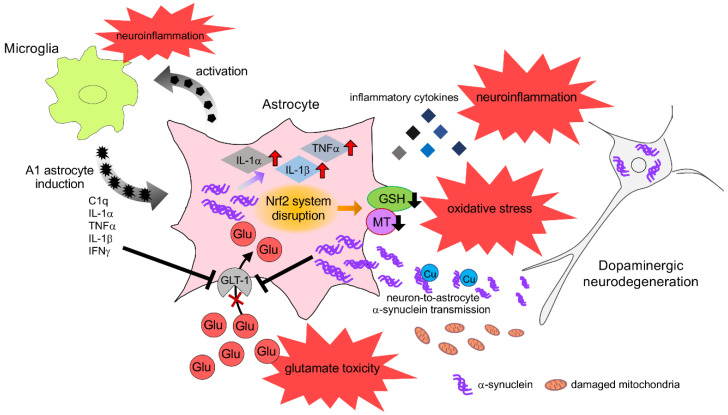
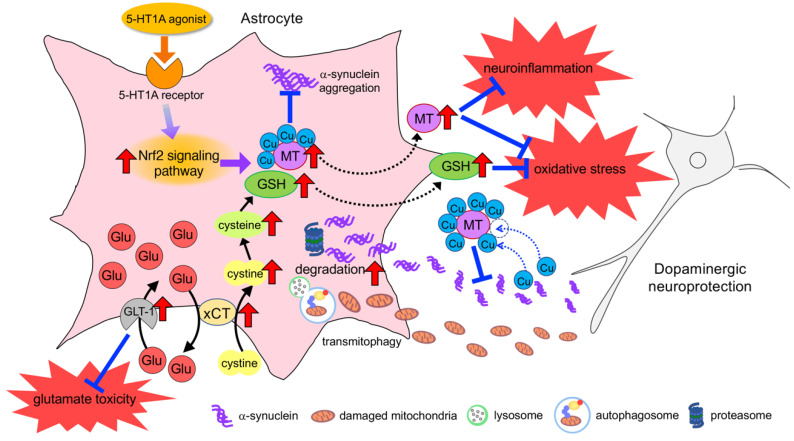
Parkinson’s disease (PD) is the second most common neurodegenerative disease. PD patients exhibit motor symptoms such as akinesia/bradykinesia, tremor, rigidity, and postural instability due to a loss of nigrostriatal dopaminergic neurons. Although the pathogenesis in sporadic PD remains unknown, there is a consensus on the involvement of non-neuronal cells in the progression of PD pathology. Astrocytes are the most numerous glial cells in the central nervous system. Normally, astrocytes protect neurons by releasing neurotrophic factors, producing antioxidants, and disposing of neuronal waste products. However, in pathological situations, astrocytes are known to produce inflammatory cytokines. In addition, various studies have reported that astrocyte dysfunction also leads to neurodegeneration in PD. In this article, we summarize the interaction of astrocytes and dopaminergic neurons, review the pathogenic role of astrocytes in PD, and discuss therapeutic strategies for the prevention of dopaminergic neurodegeneration. This review highlights neuron-astrocyte interaction as a target for the development of disease-modifying drugs for PD in the future.
Overview
The claims and statistics of this paper haven’t been checked yet.
Run the check — free, no account needed. It reads the open-access text and checks the sources it cites.
Integrity signals
Registry
Cites
Statistics
Figures
Verification
Claims the paper makes
The claims and statistics of this paper haven’t been checked yet.
Run the check — free, no account needed. It reads the open-access text and checks the sources it cites.
Claims other papers make about this one
Each is checked against this paper’s own text: does it say what the citing paper says it does?
In the citing paper
“The release of pro-inflammatory factors and neurotoxins by activated glial cells leads to neuroinflammation, neuronal damage, and neurodegeneration [73].”
From Neuroprotective Effects of Sodium Butyrate by Restoring Gut Microbiota and Inhibiting TLR4 Signaling in Mice with MPTP-Induced Parkinson’s Disease (2023) · cites this paper as [73]
Self-check
Percentages, sums and reported differences re-computed from the paper’s own numbers.
The self-check needs the paper’s full text.
Citations
Cites
Neurotoxic reactive astrocytes are induced by activated microglia
Liddelow, S. A., Guttenplan, K. A., Clarke, L. E., Bennett, F. C., Bohlen, C. J., Schirmer, L., Bennett, M. L., Münch, A. E., Chung, W.-S., Peterson, T. C., et al. (2017) · Nature · doi:10.1038/nature21029 · Cited by 7,971
Astrocyte-endothelial interactions at the blood-brain barrier
Abbott, N. J., Rönnbäck, L., & Hansson, E. (2006) · Nature Reviews Neuroscience · doi:10.1038/nrn1824 · Cited by 5,595
Itoh, K., Wakabayashi, N., Katoh, Y., Ishii, T., Igarashi, K., Engel, J. D., & Yamamoto, M. (1999) · Genes & Development · doi:10.1101/gad.13.1.76 · Cited by 3,634
Hereditary Early-Onset Parkinson's Disease Caused by Mutations in PINK1
Valente, E. M., Abou-Sleiman, P. M., Caputo, V., Muqit, M. M. K., Harvey, K., Gispert, S., Ali, Z., Del Turco, D., Bentivoglio, A. R., Healy, D. G., et al. (2004) · Science · doi:10.1126/science.1096284 · Cited by 3,481
GDNF: a Glial Cell Line-Derived Neurotrophic Factor for Midbrain Dopaminergic Neurons
Lin, L.-F. H., Doherty, D. H., Lile, J. D., Bektesh, S. L., & Collins, F. (1993) · Science · doi:10.1126/science.8493557 · Cited by 3,206
McGeer, P. L., Itagaki, S., Boyes, B. E., & McGeer, E. G. (1988) · Neurology · doi:10.1212/wnl.38.8.1285 · Cited by 2,990
The ubiquitin kinase PINK1 recruits autophagy receptors to induce mitophagy
Lazarou, M., Sliter, D. A., Kane, L. A., Sarraf, S. A., Wang, C., Burman, J. L., Sideris, D. P., Fogel, A. I., & Youle, R. J. (2015) · Nature · doi:10.1038/nature14893 · Cited by 2,774
Multicenter Analysis of Glucocerebrosidase Mutations in Parkinson's Disease
Sidransky, E., Nalls, M. A., Aasly, J. O., Aharon-Peretz, J., Annesi, G., Barbosa, E. R., Bar-Shira, A., Berg, D., Bras, J., Brice, A., et al. (2009) · New England Journal of Medicine · doi:10.1056/nejmoa0901281 · Cited by 2,135
Non-motor features of Parkinson disease
Schapira, A. H. V., Chaudhuri, K. R., & Jenner, P. (2017) · Nature Reviews Neuroscience · doi:10.1038/nrn.2017.62 · Cited by 2,053
Dinkova-Kostova, A. T., Holtzclaw, W. D., Cole, R. N., Itoh, K., Wakabayashi, N., Katoh, Y., Yamamoto, M., & Talalay, P. (2002) · Proceedings of the National Academy of Sciences · doi:10.1073/pnas.172398899 · Cited by 1,947
Cited by
Sorted by citations
Astrocyte contribution to dysfunction, risk and progression in neurodegenerative disorders
Brandebura, A. N., Paumier, A., Onur, T. S., & Allen, N. J. (2023) · Nature Reviews Neuroscience · doi:10.1038/s41583-022-00641-1 · Cited by 427
Microglia Mediated Neuroinflammation in Parkinson’s Disease
Işık, S., Yeman-Kıyak, B., Akbayır, R., Şeyhali-Abutayeh, R., & Arpaci, T. (2023) · Cells · doi:10.3390/cells12071012 · Cited by 419
Neuroinflammation, memory, and depression: new approaches to hippocampal neurogenesis
Wu, A., & Zhang, J. (2023) · Journal of Neuroinflammation · doi:10.1186/s12974-023-02964-x · Cited by 354
Neuroinflammation in neurological disorders: pharmacotherapeutic targets from bench to bedside
Mishra, A., Bandopadhyay, R., Singh, P. K., Mishra, P. S., Sharma, N., & Khurana, N. (2021) · Metabolic Brain Disease · doi:10.1007/s11011-021-00806-4 · Cited by 134
Immune Response in Neurological Pathology: Emerging Role of Central and Peripheral Immune Crosstalk
Passaro, A. P., Lebos, A. L., Yao, Y., & Stice, S. L. (2021) · Frontiers in Immunology · doi:10.3389/fimmu.2021.676621 · Cited by 124
Metadata
- Authors
- Miyazaki, I., & Asanuma, M.
- Affiliations
- Okayama University (JP)
- Corresponding author
- Miyazaki, Ikuko
- Venue
- Cells
- Publisher
- MDPI AG
- Published
- 2020-12-07
- Volume
- 9
- Issue
- 12
- Pages
- 2623
- ISSN
- 2073-4409 (ISSN-L)
- PMC
- PMC7762285
- OpenAlex
- W3111143057
- Cited by
- 186
- References
- 248
- Citations by year
- 2026: 37 · 2025: 36 · 2024: 34 · 2023: 35 · 2022: 31 · 2021: 13
- FWCI
- 2.23
- Type
- journal article
- Language
- en
- Open access
- gold
- doi.org
- Licence
- Locations
- Cells (publishedVersion, cc-by)
- PubMed Central (publishedVersion, cc-by)
- PubMed (publishedVersion)
- Institutional Repositories DataBase (IRDB) (submittedVersion, cc-by)
- Okayama University Scientific Achievement Repository (Okayama University) (submittedVersion)
- DOAJ (DOAJ: Directory of Open Access Journals) (submittedVersion, cc-by-sa)
- Funders
- Japan Society for the Promotion of Science (JP25461279, JP16K09673, JP19K07993)
- Okayama Medical Foundation (2014)
- All Japan Coffee Association (2016, 2018)
- Japanese Society of Eucommia (2018)
- Topics
- Health Sciences › Medicine › Clinical Neurology › Parkinson's Disease Mechanisms and Treatments
- Life Sciences › Neuroscience › Neurology › Neuroinflammation and Neurodegeneration Mechanisms
- Life Sciences › Biochemistry, Genetics and Molecular Biology › Molecular Biology › Nuclear Receptors and Signaling
- Keywords
- Parkinson's disease, astrocyte-neuron interaction, astrocytes, dopaminergic neurons, neurodegeneration, neuroinflammation, inflammatory cytokines, glial cells, disease-modifying therapy, neuroprotection
- MeSH terms
- Neuroprotection, Animals, Antioxidants, Astrocytes, Dopamine, Humans, Inflammation, Mitochondria, Nerve Degeneration, Neuroglia, Neurons, Parkinson Disease, Signal Transduction, Oxidative Stress, Disease Progression, alpha-Synuclein, Dopaminergic Neurons
About these checks
Registry, retraction, Cites and statistics results are computed, not judged, with one exception: a printed reference that no index lists is read once by a model before it counts as a citation error. Claims are extracted by a model and kept only when their quote appears verbatim in the text; each cited source is then checked, with a model’s help, for whether it says what the claim relies on. Those verdicts can be wrong — read the claim’s quote and the cited source before relying on one.
Statistics and arithmetic are recomputed, not judged.
Confidence bands are shown only for fields calibrated on our annotated test set. None is calibrated yet, so no band is shown.
What counts as a claim ›How we measure confidence ›How we check this ›
Are you an author, or do you see a problem with this page? Request a review
