

Dynamic Mechanical Behavior and Energy Dissipation of Hybrid Fiber-Reinforced Recycled Aggregate Concrete Under Dry–Wet Cycling and Sulfate Erosion
Open accessThe DOI matches its Crossref record; 28 of the 28 references it cites were found in a registry or an index; none of the 38 sources its claims cite is checked for support yet.
Abstract
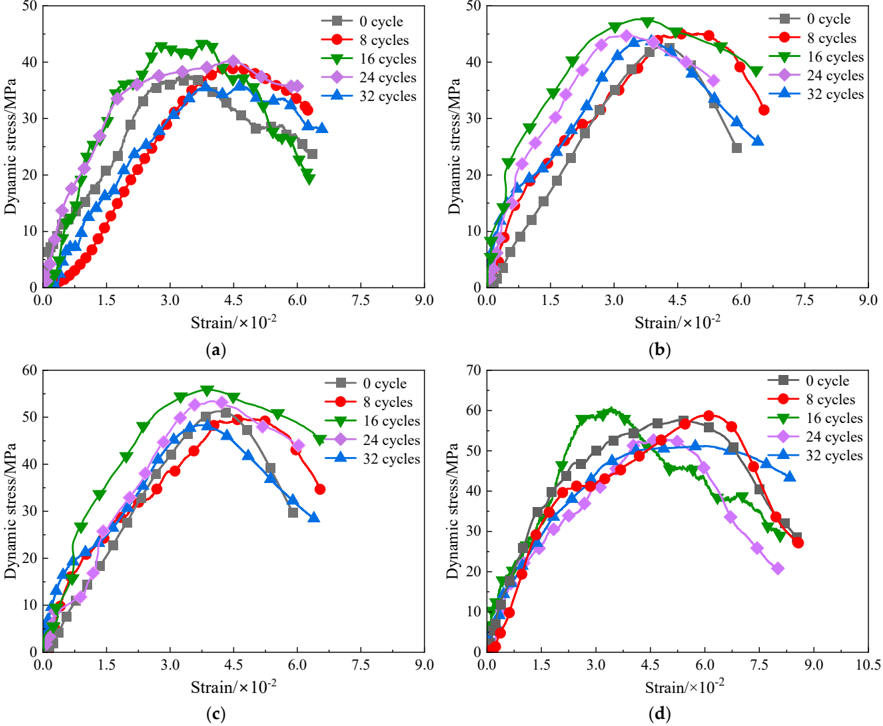
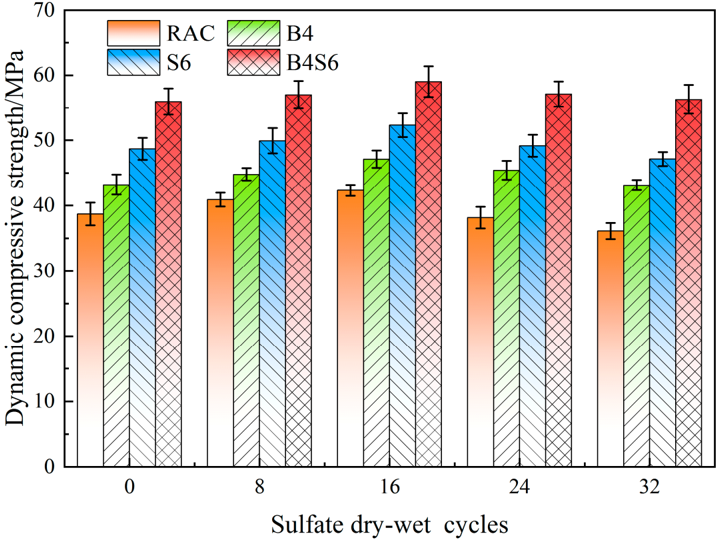
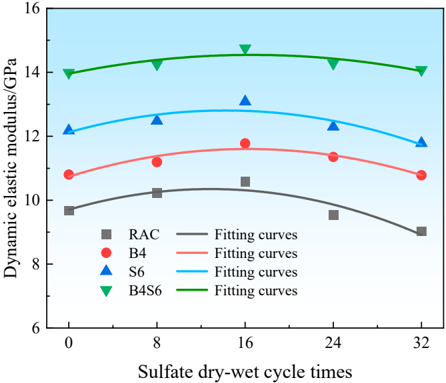
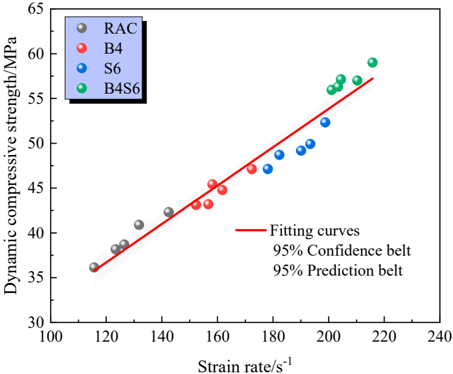
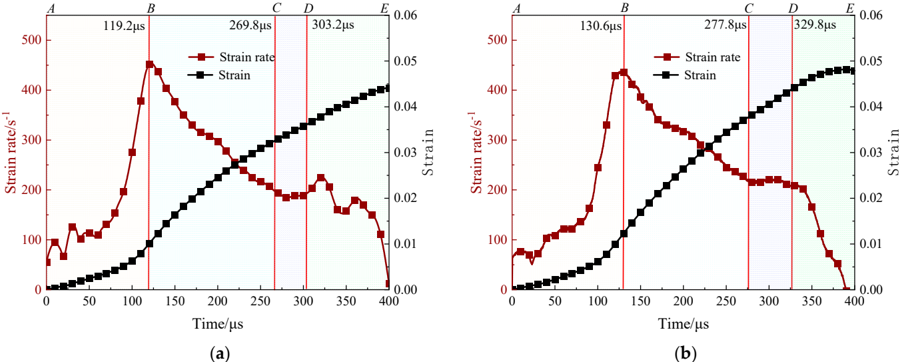
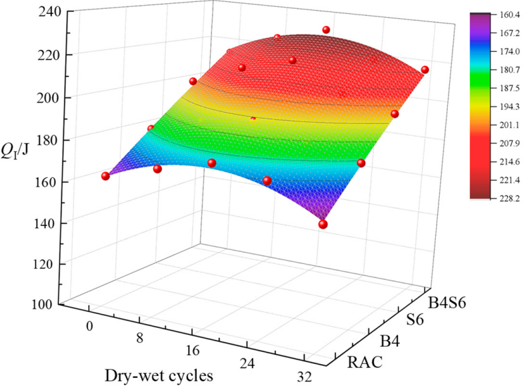
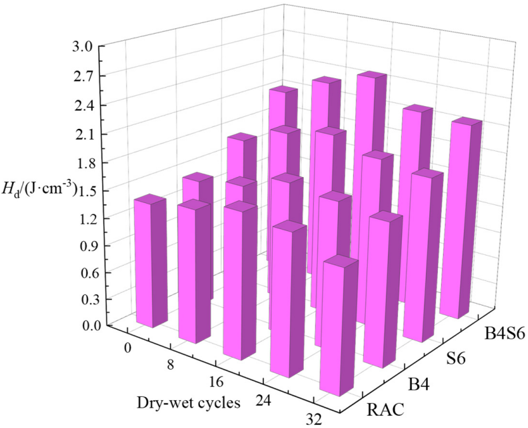
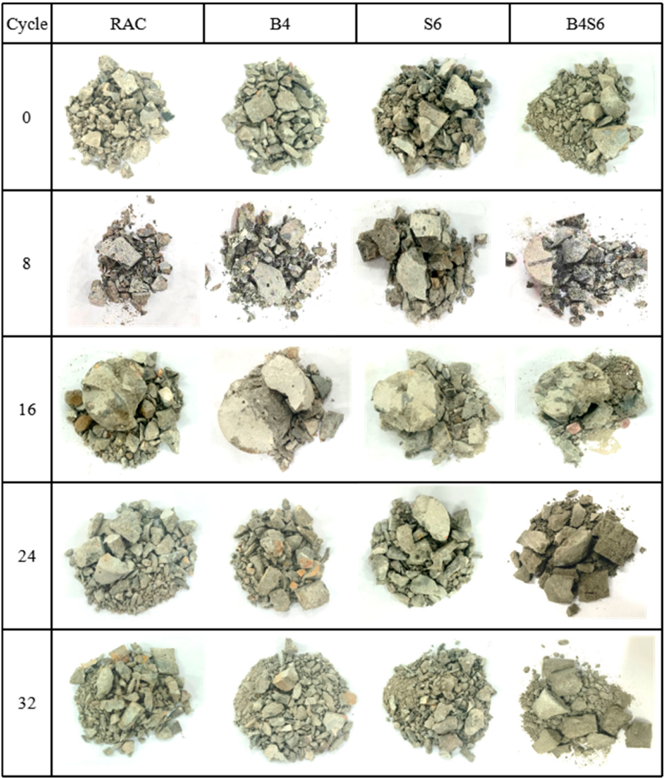
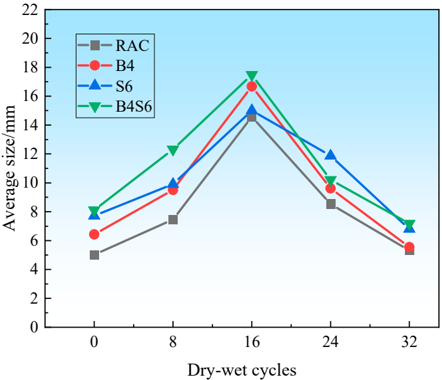
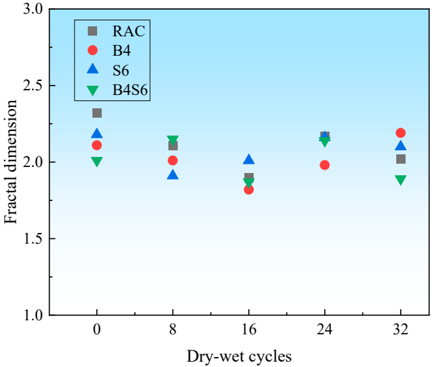
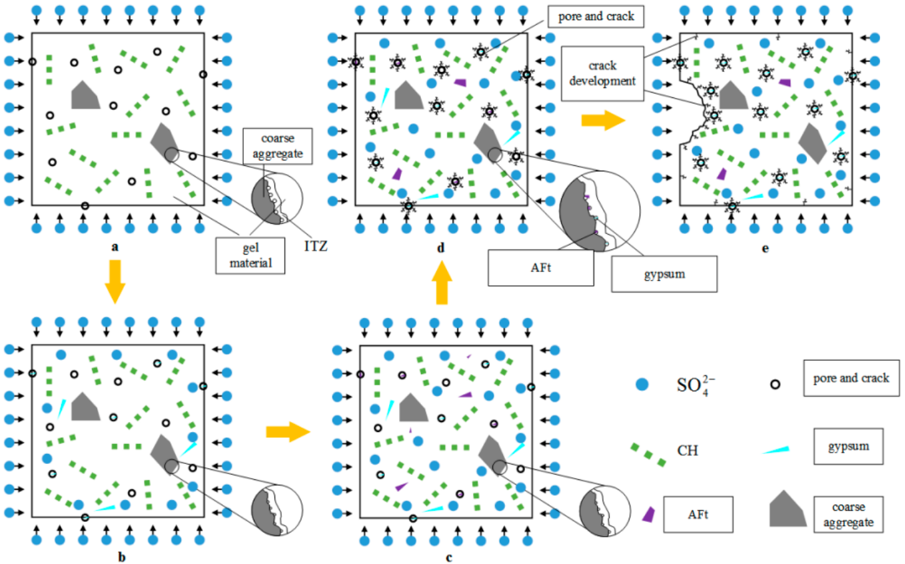
To investigate the impact resistance of hybrid fiber-reinforced recycled aggregate concrete (RAC) under dry–wet cycles and sulfate attack, hybrid fiber-reinforced recycled aggregate concrete (RAC) was prepared. Dynamic impact compression experiments were conducted using an SHPB test device with a 50 mm diameter. The microstructure of recycled aggregate concrete (RAC) within dry–wet cycles and sulfate attack was examined using SEM. The results indicate that the dynamic compressive strength first rises and then declines with the rise in dry–wet cycles, and increases with the increase in the average strain rate. When the number of dry–wet cycles reaches 16, the dynamic compressive strength reaches its peak, with the B4S6 group achieving a maximum dynamic compressive strength of 59.02 MPa. The dynamic elastic modulus follows a good quadratic parabolic function distribution with respect to the number of dry–wet cycles. Both the incident energy and dissipated energy density initially rise and then reduce with increasing dry–wet cycles. The energy values of RAC with different fiber types follow the order: B4S6 > S6 > B4 > RAC. Under impact loading, the strain rate–strain time history curve of recycled aggregate concrete (RAC) exhibits the change of “increase–decrease–stable–decrease”. With increasing dry–wet cycles, the degree of fragmentation of recycled aggregate concrete (RAC) first increases and then decreases, the fractal dimension first decreases and then increases, and the average particle size first increases and then decreases. SEM results and microscopic reaction mechanisms reveal that in the early stage of dry–wet cycles, sulfate ions generate ettringite and gypsum within the recycled aggregate concrete (RAC), which fill internal cracks and pores, making the concrete denser and enhancing its mechanical properties. Towards the end of the dry–wet cycle, the amount of expansive ettringite and gypsum inside the recycled aggregate concrete (RAC) increases, leading to a sharp increase in pore wall stress, which induces new microcracks in the specimens, manifesting as a decline in mechanical properties at the macroscopic level.
Overview
CoChat Summary
TL;DR
This study subjected hybrid steel–basalt fiber-reinforced recycled aggregate concrete (RAC) to coupled sulfate attack and dry–wet cycling, then tested its dynamic impact behavior with a split Hopkinson pressure bar. Dynamic compressive strength, elastic modulus, and energy dissipation all peaked at 16 dry–wet cycles and declined thereafter, with the hybrid B4S6 mix consistently outperforming single-fiber and plain RAC.
Key findings
- Dynamic compressive strength rose then fell with dry–wet cycles, peaking at 16 cycles; the B4S6 group reached a maximum of 59.02 MPa. After 32 cycles, B4S6 retained a strength 4.5% greater than at 0 cycles, whereas plain RAC was 2.0% lower than at 0 cycles.
- Dynamic elastic modulus followed an upward-convex quadratic parabola against cycle number, with fitted R² values all above 0.900 for RAC, B4, S6, and B4S6. Strength increased approximately linearly with average strain rate (fit σd = 10.995 + 0.214ε̇, R² = 0.951), and B4S6 showed the highest rate sensitivity.
- Incident energy and dissipated energy density both rose then declined with cycles, peaking at 16 cycles. For B4S6, incident energy was 213.44, 224.18, 231.22, 218.32, and 216.32 J at 0, 8, 16, 24, and 32 cycles; dissipated energy density was 2.11, 2.32, 2.48, 2.21, and 2.18 J·cm⁻³. Energy ranking across mixes was B4S6 > S6 > B4 > RAC.
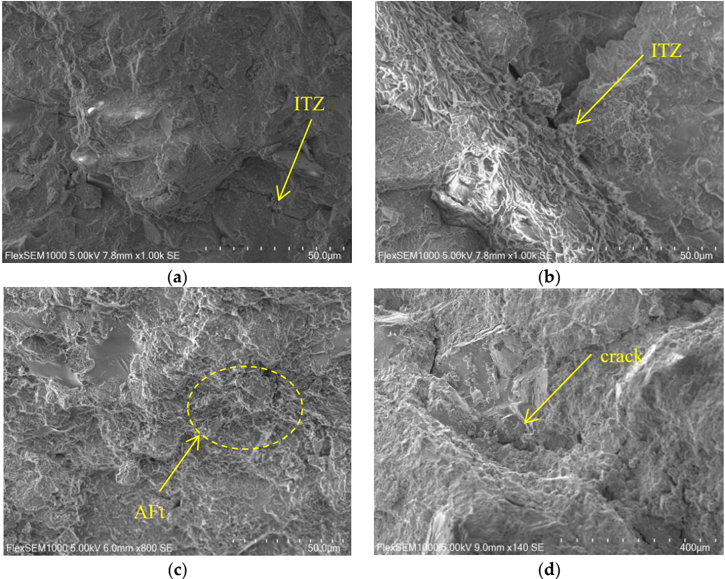
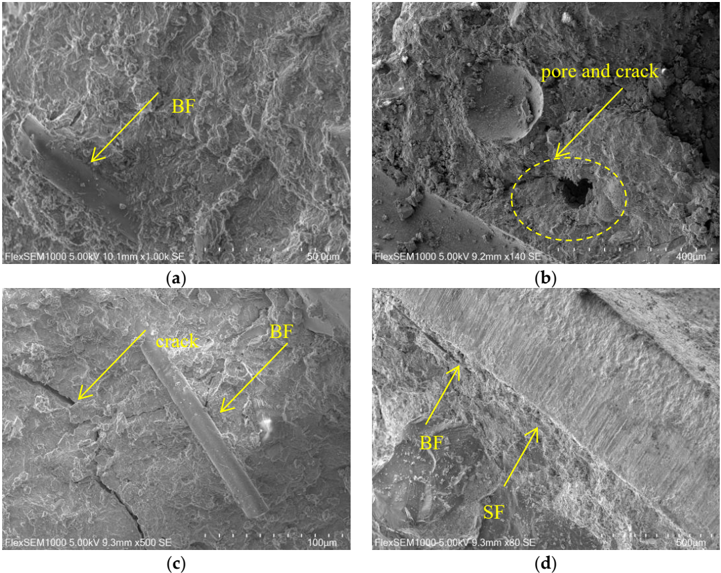
- Fragment fractal dimension decreased then increased (V-shaped) with cycles, while average fragment size increased then decreased. After 32 cycles, SEM image analysis gave an average crack width of 8.7 µm for B4S6 versus 23.4 µm for RAC (a ~62.8% reduction), and crack area density of 1.8% versus 5.6%.
Methods
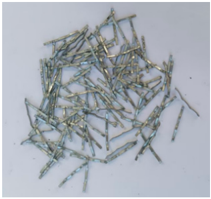
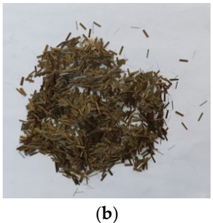
- Four mixes were prepared with recycled coarse aggregate throughout: RAC (control), B4 (0.4% basalt fiber), S6 (0.6% steel fiber), and B4S6 (0.4% basalt + 0.6% steel). Disk specimens of Ø50 mm × 25 mm were cored from cubes cured 28 days.
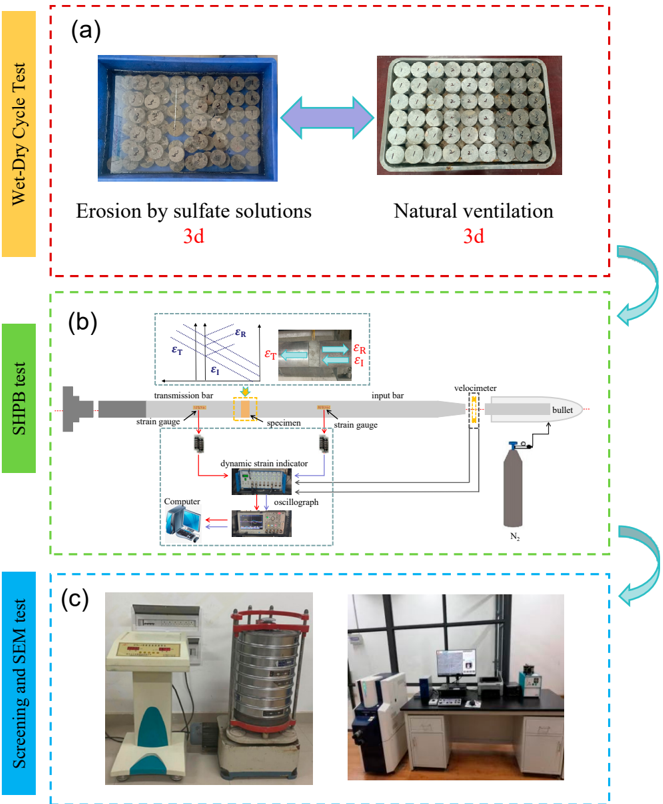
- Sulfate dry–wet cycling used a 10% Na₂SO₄ solution with a "3 days immersion + 3 days natural air drying" protocol, at 0, 8, 16, 24, and 32 cycles; three parallel specimens per group gave 60 disk specimens total.
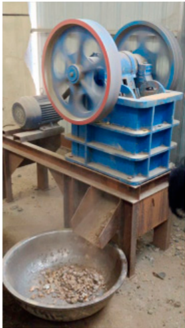
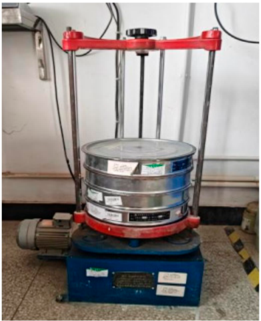
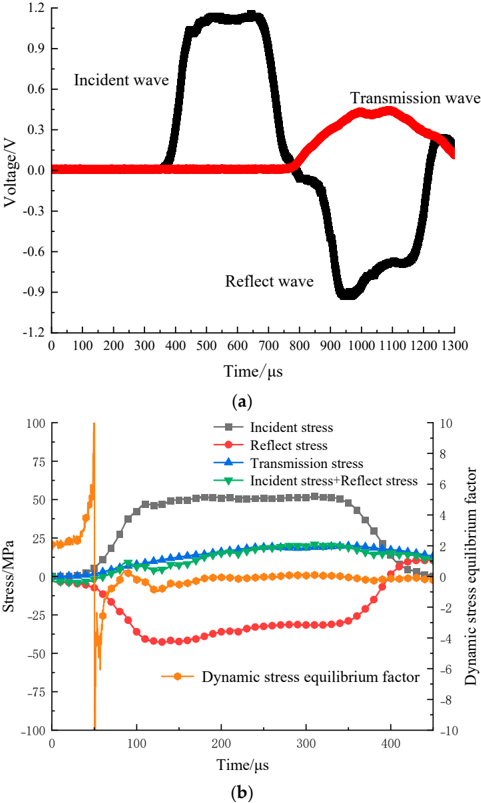
- Dynamic impact compression used a 50 mm diameter SHPB at fixed 0.3 MPa impact pressure (striker velocity 6.5 ± 0.2 m/s) with a copper pulse shaper; stress equilibrium was verified (equilibrium factor below 5%). Post-impact fragments were sieved into nine size fractions for average particle size and fractal dimension analysis, and microstructure was examined by SEM (FlexSEM1000) on RAC and B4S6 specimens.
Limitations
- The paper explicitly states that it provides no direct microanalytical evidence (e.g., XRD or SEM-EDS quantification) confirming the presence or abundance of ettringite and gypsum at each specific cycle; the reaction mechanism is offered as "a reasonable mechanistic hypothesis consistent with the macroscopic trend, rather than a definitive conclusion."
- The paper itself cautions that strain rate strongly influences dynamic response and that fiber effects after sulfate attack "may be either enhanced or diminished to varying degrees under different strain rate levels," so the fiber comparisons are not fully disentangled from rate effects.
- Evident from the text: SEM analysis was performed only on the RAC and B4S6 groups, so microstructural comparisons for B4 and S6 are not supported; the dynamic mechanical property table (Table 3) is only partially reproduced in the text, limiting verification of the full dataset.
Model-written summary. Check it against the paper before relying on it.
Integrity signals
Registry
Cites
Statistics
Figures
Verification
Claims the paper makes
0 Valid · 3 Not valid · 22 Not checked · 141 Own results and interpretations
A result the paper states — it cites no source for it, so there is none to check. The quote shows it is in the paper.
In the paper
“The variation trend of the fitted curves indicates that from 0 to 16 dry-wet cycles in the sulfate erosion solution, the dynamic elastic modulus gradually increases with the number of cycles.”
§ Dynamic Mechanical Behavior and Energy Dissipation of Hybrid Fiber-Reinforced Recycled Aggregate Concrete Under Dry-Wet Cycling and Sulfate Erosion > 3.3. Dynamic Elastic Modulus
hedgedstates a cause- Asserted: passes — The authors put it forward as true.
- Checkable: passes — It can be checked against evidence.
- Load-bearing: passes — The paper’s conclusions depend on it.
- Based: passes — The paper gives a reason why it holds.
A result the paper states — it cites no source for it, so there is none to check. The quote shows it is in the paper.
In the paper
“With increasing dry-wet cycles, the degree of fragmentation of recycled aggregate concrete (RAC) first increases and then decreases”
§ Dynamic Mechanical Behavior and Energy Dissipation of Hybrid Fiber-Reinforced Recycled Aggregate Concrete Under Dry-Wet Cycling and Sulfate Erosion > Abstract
plainstates a cause- Asserted: passes — The authors put it forward as true.
- Checkable: passes — It can be checked against evidence.
- Load-bearing: passes — The paper’s conclusions depend on it.
- Based: passes — The paper gives a reason why it holds.
A result the paper states — it cites no source for it, so there is none to check. The quote shows it is in the paper.
In the paper
“The results indicate that the dynamic compressive strength first rises and then declines with the rise in dry-wet cycles”
- Also stated in: § 3.2. Dynamic Compressive Strength · plain
“After sulfate solution dry-wet cycles, the dynamic compressive strength presents a non-monotonic trend, increasing initially and then declining”
§ Dynamic Mechanical Behavior and Energy Dissipation of Hybrid Fiber-Reinforced Recycled Aggregate Concrete Under Dry-Wet Cycling and Sulfate Erosion > Abstract
plainstates a cause- Asserted: passes — The authors put it forward as true.
- Checkable: passes — It can be checked against evidence.
- Load-bearing: passes — The paper’s conclusions depend on it.
- Based: passes — The paper gives a reason why it holds.
- Also stated in: § 3.2. Dynamic Compressive Strength · plain
A result the paper reports from its own data — it cites no other source for it, so there is none to check. The quote shows it is in the paper.
In the paper
“When the steel fiber content exceeded 0.6%, the compactness of the specimens decreased significantly.”
§ Dynamic Mechanical Behavior and Energy Dissipation of Hybrid Fiber-Reinforced Recycled Aggregate Concrete Under Dry-Wet Cycling and Sulfate Erosion > 2.1.5. Mix Proportion Design
plainstates a cause- Asserted: passes — The authors put it forward as true.
- Checkable: passes — It can be checked against evidence.
- Load-bearing: passes — The paper’s conclusions depend on it.
- Based: passes — The paper gives a reason why it holds.
A result the paper reports from its own data — it cites no other source for it, so there is none to check. The quote shows it is in the paper.
In the paper
“In contrast, for the RAC group, the dynamic compressive strength at 32 dry-wet cycles is 2.0% lower than that at 0 drywet cycles.”
§ Dynamic Mechanical Behavior and Energy Dissipation of Hybrid Fiber-Reinforced Recycled Aggregate Concrete Under Dry-Wet Cycling and Sulfate Erosion > 3.2. Dynamic Compressive Strength
plainstates a cause- Asserted: passes — The authors put it forward as true.
- Checkable: passes — It can be checked against evidence.
- Load-bearing: passes — The paper’s conclusions depend on it.
- Based: passes — The paper gives a reason why it holds.
69 more claims
Create a free account to see all 166 claims and to verify the 38 references still open.
- It may state two separate claims as one. 71
- The quote only partly states this claim. 5
- Probably not a substantial claim. 28
Self-check
Percentages, sums and reported differences re-computed from the paper’s own numbers.
Each contradiction between two passages listed here was confirmed by an independent check.
Rated minor: it would not touch a result — a value no result rests on, a p-value that stays on the same side of the significance level, or a conflict that is clerical, resolved elsewhere in the paper, or outside its own findings.
In the paper
§ Dynamic Mechanical Behavior and Energy Dissipation of Hybrid Fiber-Reinforced Recycled Aggregate Concrete Under Dry-Wet Cycling and Sulfate Erosion > 3.1. Dynamic Stress-Strain Curves
“After fibers are incorporated, it can be clearly observed that the slope of the elastic stage decreases significantly, suggesting that the specimen reaches the moment of loading.”
§ Dynamic Mechanical Behavior and Energy Dissipation of Hybrid Fiber-Reinforced Recycled Aggregate Concrete Under Dry-Wet Cycling and Sulfate Erosion > 3.3. Dynamic Elastic Modulus
“the dynamic elastic modulus of the RAC group without fibers is smaller under dynamic loading, while the B4S6 group has the largest dynamic elastic modulus, and the dynamic elastic modulus of the S6 group is greater than that of the B4 group”
Rated minor: it would not touch a result — a value no result rests on, a p-value that stays on the same side of the significance level, or a conflict that is clerical, resolved elsewhere in the paper, or outside its own findings.
In the paper
§ Dynamic Mechanical Behavior and Energy Dissipation of Hybrid Fiber-Reinforced Recycled Aggregate Concrete Under Dry-Wet Cycling and Sulfate Erosion > 3.5. Strain Rate-Strain Time-History Curves
“The strain rate-strain time-history curves of the recycled concrete specimens show a similar evolutionary trend and can be classified into the following four stages: increase (AB), initial decrease (BC), fluctuation stabilization (CD), and secondary decrease (DE).”
§ Dynamic Mechanical Behavior and Energy Dissipation of Hybrid Fiber-Reinforced Recycled Aggregate Concrete Under Dry-Wet Cycling and Sulfate Erosion > 3.5. Strain Rate-Strain Time-History Curves
“(1) Increase stage (OA segment): This stage is the linear elastic deformation stage.”
Citations
Cites
Mechanical properties of high-strength steel fiber-reinforced concrete
Song, P. S., & Hwang, S. (2004) · Construction and Building Materials · doi:10.1016/j.conbuildmat.2004.04.027 · Cited by 1,004
Comparative environmental assessment of natural and recycled aggregate concrete
Marinković, S., Radonjanin, V., Malešev, M., & Ignjatović, I. (2010) · Waste Management · doi:10.1016/j.wasman.2010.04.012 · Cited by 818
Effect of aspect ratio and volume fraction of steel fiber on the mechanical properties of SFRC
Yazıcı, Ş., İnan, G., & Tabak, V. (2007) · Construction and Building Materials · doi:10.1016/j.conbuildmat.2006.05.025 · Cited by 599
Abbas, S., Soliman, A. M., & Nehdi, M. L. (2015) · Construction and Building Materials · doi:10.1016/j.conbuildmat.2014.11.017 · Cited by 493
Mechanical properties of steel fiber-reinforced, high-strength, lightweight concrete
Gao, J., Sun, W., & Morino, K. (1997) · Cement and Concrete Composites · doi:10.1016/s0958-9465(97)00023-1 · Cited by 352
Study on mechanical properties of alkali-resistant basalt fiber reinforced concrete
Li, M., Gong, F., & Wu, Z. (2020) · Construction and Building Materials · doi:10.1016/j.conbuildmat.2020.118424 · Cited by 112
Pore crystallization and expansion of cement pastes in sulfate solutions with and without chlorides
Ran, B., Omikrine-Metalssi, O., Fen-Chong, T., Dangla, P., & Li, K. (2023) · Cement and Concrete Research · doi:10.1016/j.cemconres.2023.107099 · Cited by 82
Rifa, A., Subhani, S. M., Bahurudeen, A., & Santhosh, K. G. (2023) · Journal of Building Engineering · doi:10.1016/j.jobe.2023.107695 · Cited by 75
Effectiveness of hybrid steel-basalt fiber reinforced concrete under compression
Khan, M., Cao, M., Xie, C., & Ali, M. (2022) · Case Studies in Construction Materials · doi:10.1016/j.cscm.2022.e00941 · Cited by 51
Mamirov, M., Hu, J., & Cavalline, T. (2022) · Journal of Cleaner Production · doi:10.1016/j.jclepro.2022.130754 · Cited by 50
Research works printed but not linked: 6
- Huang, Y.; Yang, W.; Liu, L. Durability evaluation and life prediction of basalt fiber recycled concrete under salt-dry-wet cycle coupling erosion. Sci. Technol. Eng. 2025, 25, 763-772.
- GB/T 18046-2017; Granulated Blast Furnace Slag Powder for Use in Cement, Mortar and Concrete. National Standard of the People's Republic of China: Beijing, China, 2017. https://doi.org/10.3390/coatings16070755 22. GB 175-2023; · doi:10.3390/coatings1607075522.gb175-2023
- Wang, Z.; Bai, E.; Zhou, J.; Huang, H.; Ren, B. Dynamic mechanical properties of basalt fiber reinforced geopolymer concrete. Vib. Impact 2024, 43, 134-144.
- Wang, L.; Yuan, Q.; Xie, G.; Gu, S.; Jiao, Z.; Liu, H.; Chen, L. Length•diameter ratio effect of energy dissipation andfractals of coal samples under impact loading. J. China Coal Soc. 2022, 47, 1534-1546.
- Ji, J.J.; Li, H.T.; Wu, F.M.; Yao, Q. Fractal characteristics of rock fragmentation under impact load. J. Vib. Shock 2020, 39, 176- 183+214.
- Wang, C.; Tian, Q.; Zhang, M.; Qi, S.; Yao, T.; Ruan, M. A review of the effects of dry-wet cycles on the properties of concrete. Mater. Guide 2023, 37, 208-217.
Metadata
- Authors
- Zhou, R., Jin, Y., Ou, Y., & Wang, Y.
- Affiliations
- Bengbu University (CN)
- School of Civil and Hydraulic Engineering, Bengbu University, Bengbu 232081, China
- Corresponding author
- Zhou, Renzhan
- Venue
- Coatings
- Publisher
- MDPI AG
- Published
- 2026-06-25
- Volume
- 16
- Issue
- 7
- Pages
- 755
- ISSN
- 2079-6412 (ISSN-L)
- OpenAlex
- W7166131009
- Cited by
- 0
- References
- 28
- FWCI
- 0.00
- Type
- journal article
- Language
- en
- Open access
- gold
- doi.org
- Licence
- Locations
- Coatings (publishedVersion, cc-by)
- Funders
- the Anhui Province university natural science research key project (2024AH051179)
- Bengbu University scientific research project (2024YYX61QD)
- Topics
- Physical Sciences › Engineering › Building and Construction › Recycled Aggregate Concrete Performance
- Physical Sciences › Engineering › Civil and Structural Engineering › Innovative concrete reinforcement materials
- Physical Sciences › Engineering › Mechanics of Materials › High-Velocity Impact and Material Behavior
- Keywords
- wetting-drying cycles, sulfate attack, dynamic compressive strength, energy dissipation, strain rate sensitivity, elastic modulus, impact loading, ettringite, gypsum, microcracking, fractal dimension, pore structure, recycled aggregate concrete
About these checks
Registry, retraction, Cites and statistics results are computed, not judged, with one exception: a printed reference that no index lists is read once by a model before it counts as a citation error. Claims are extracted by a model and kept only when their quote appears verbatim in the text; each cited source is then checked, with a model’s help, for whether it says what the claim relies on. Those verdicts can be wrong — read the claim’s quote and the cited source before relying on one.
A language model drew the claims from the paper on 2026-11-27, under version 3 of the claim definition (model deepseek-v4.1-flash, prompt extract-v3).
A second model labelled each claim on 2026-11-27 (model jev-1.13-20260917, definition revision gold-guideline-v0.2).
Statistics and arithmetic are recomputed, not judged.
Confidence bands are shown only for fields calibrated on our annotated test set. None is calibrated yet, so no band is shown.
What counts as a claim ›How we measure confidence ›How we check this ›
Are you an author, or do you see a problem with this page? Request a review
How to cite
Cite CoChat for the checks on this page, and the paper for its own findings.
- This page
- CoChat. (2026). Citation check: Dynamic Mechanical Behavior and Energy Dissipation of Hybrid Fiber-Reinforced Recycled Aggregate Concrete Under Dry–Wet Cycling and Sulfate Erosion. https://app.cochat.ai/papers/10.3390/coatings16070755
- The paper
- Zhou, R., Jin, Y., Ou, Y., & Wang, Y. (2026). Dynamic Mechanical Behavior and Energy Dissipation of Hybrid Fiber-Reinforced Recycled Aggregate Concrete Under Dry–Wet Cycling and Sulfate Erosion. Coatings. https://doi.org/10.3390/coatings16070755
Data sources
Bibliographic data: Semantic Scholar, OpenAlex, Crossref.
Contains information from the Semantic Scholar Academic Graph Datasets, made available under the ODC Attribution License (ODC-BY 1.0).
Semantic Scholar’s data is described in: Kinney, R., et al. (2023). The Semantic Scholar Open Data Platform. arXiv:2301.10140.
