

Increasing the Reuse Potential of Recycled Aggregates from Concrete and Masonry CDW: Treatment, Performance, and Sustainability for Structural Applications
Open accessThe DOI matches its Crossref record; 51 of the 51 references it cites were found in a registry or an index; none of the 119 sources its claims cite is checked for support yet.
Abstract
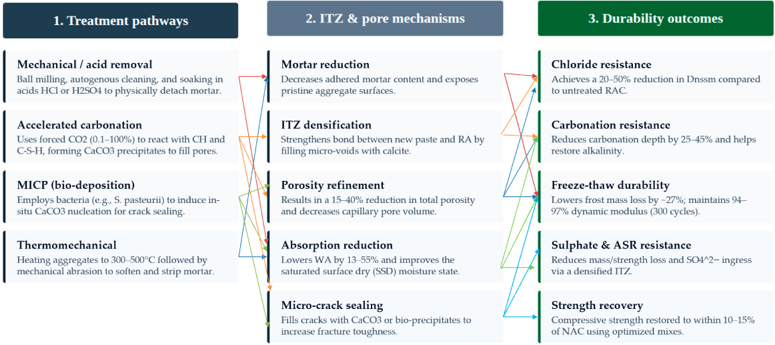
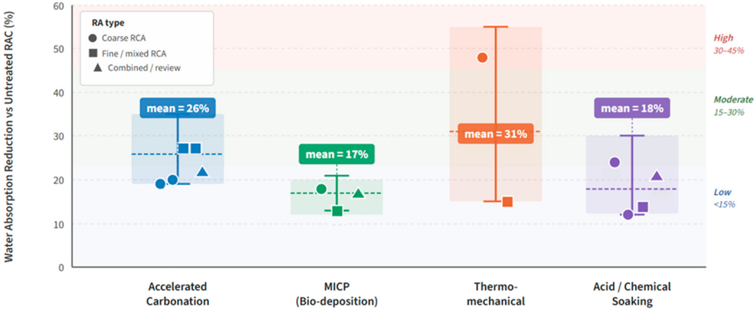
Recycled aggregates (RAs) from construction and demolition waste (CDW) provide substantial circular-economy benefits, yet their elevated porosity, adhered mortar, and heterogeneity typically impair the mechanical performance and durability of recycled aggregate concrete (RAC). This PRISMA 2020-compliant systematic review synthesises 2180 records (2015–2026) to evaluate advanced strategies for enhancing RA quality prior to structural use. This paper critically compares removal-based treatments (mechanical, thermal, acid cleaning) with strengthening and densification approaches, including accelerated carbonation, pozzolanic and nano-silica coatings, polymer impregnation, microbial-induced calcium carbonate precipitation (MICP), and modified mixing methods such as triple-stage mixing (TSMA). Evidence shows that while all RA types (including recycled fine aggregate (RFA), recycled coarse aggregate (RCA), and their combination (RFCA)) can slightly reduce compressive strength and 30% replacement serves as a critical threshold, beyond this, strength loss accelerates, particularly in RCA and RFCA mixes. However, accelerated carbonation and TSMA consistently refine the interfacial transition zone, reduce water absorption by 17–30%, and recover 85–94% of natural aggregate concrete strength. Bio-deposition reduces water absorption by 13–21%, while acid/silica fume treatments improve late-age strength but carry environmental trade-offs. This review formulates a practice-oriented implementation framework for structural-grade RAC. Sustainability analyses indicate that carbonated RA can achieve net-positive CO2 abatement when under low-carbon energy supply. A mechanistic schematic is presented to synthesise treatment-to-pore-structure/durability pathways across the four principal treatment routes, and a quantitative synthesis plot compares water absorption reductions across all treatment types using 13 data points drawn from included studies. A structured treatment comparison evaluates the energy intensity, industrial scalability, CO2 footprint, and technology readiness level for each strategy. The remaining challenges include a lack of hybrid treatment studies, limited real-scale durability data, and insufficient mechanistic models linking treatment to pore structure evolution. This review recommends harmonised durability-based criteria and updates to standards (e.g., BS 8500, EN 12620) to support the scalable deployment of treated RA.
Overview
CoChat Summary
TL;DR
This PRISMA 2020 systematic review synthesises 2180 records (2015–2026) on treatments to upgrade recycled aggregates from concrete/masonry CDW for structural recycled aggregate concrete. It finds strengthening routes—especially accelerated carbonation and modified mixing—outperform removal-based treatments, with carbonation reducing water absorption by 17–30% and recovering 85–94% of natural-aggregate concrete strength.
Key findings
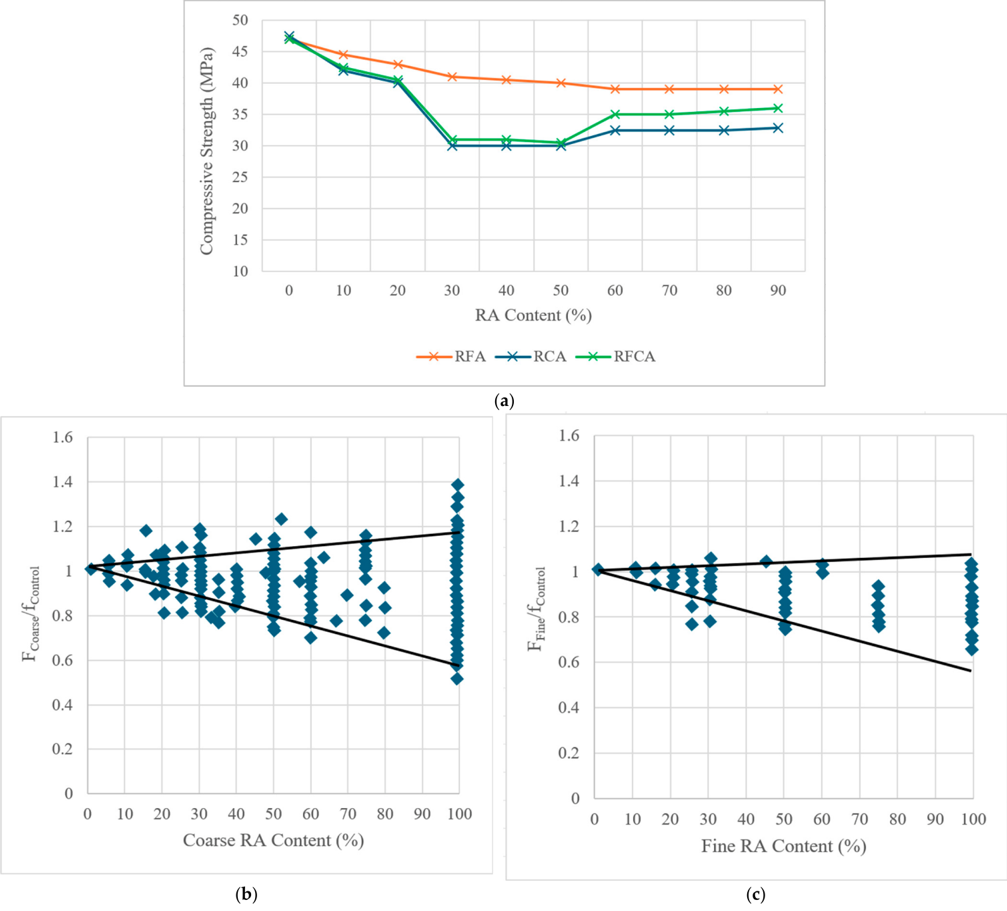
- Thirty percent recycled content is identified as a critical threshold; above it, compressive strength loss accelerates, especially in RCA and RFCA mixes, with RCA/RFCA showing a 10 MPa reduction between ~20 and 30% replacement, while RFA shows a more gradual ~14 MPa reduction across 0–90% replacement.
- Accelerated carbonation reduces water absorption by 17–30% and recovers 85–94% of NAC compressive strength at ≤50% coarse RCA replacement; MICP reduces water absorption by 13–21%; carbonated RFA improves frost resistance by ~27.6% versus noncarbonated mixes.
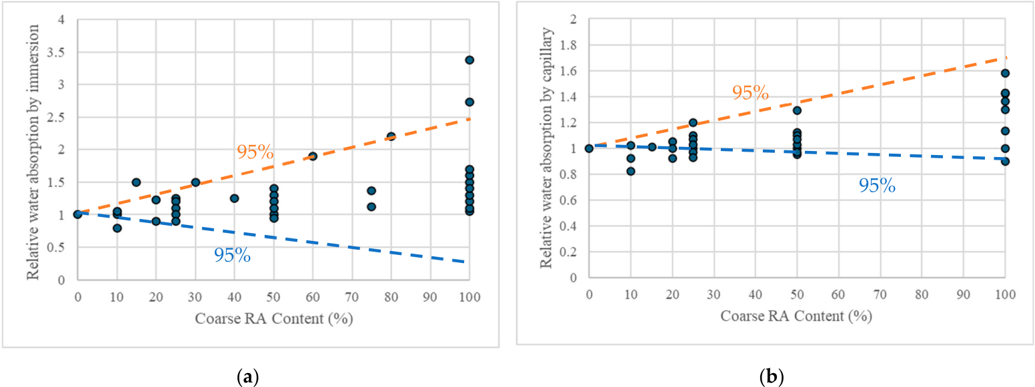
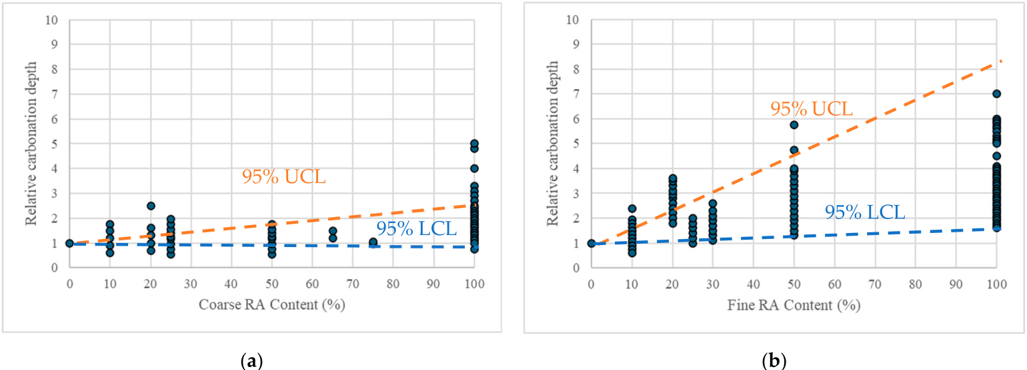
- Durability penalties scale with RA content: 100% coarse RA concrete shows ~2.47× higher water absorption by immersion and ~1.7× higher sorptivity than NAC, while carbonation depth reaches up to ~2.5× NAC for 100% coarse RA and 8.7× NAC for fine RA.
- Carbonated RA can achieve net-positive CO₂ abatement of 18–24 kg CO₂e per tonne of treated RCA under low-carbon energy, and the review proposes indicative acceptance thresholds including resistivity ≥100 Ω·m, chloride migration coefficient ≤10×10⁻¹² m²/s at 90 days, carbonation coefficient ≤3.0 mm/year¹/², and treated aggregate water absorption ≤5% with specific gravity ≥2.4 g/cm³.
Methods
- PRISMA 2020-compliant systematic review using Scopus and ScienceDirect, covering 2015–2026, with primary and secondary search strings; 2295 records before de-duplication, 2180 after de-duplication, 87 full texts assessed, 46 studies included in qualitative synthesis, and 7 core studies in the comparative matrix.
- Two reviewers independently screened full texts and extracted data, resolving disagreements by consensus; extracted parameters included RA source/type, treatment, replacement ratios, mechanical and durability metrics, and environmental/LCA data.
- Synthesis was qualitative and comparative because heterogeneity in RA sources, treatments, and test protocols precluded meta-analysis; risk-of-bias criteria were adapted for materials studies, prioritising RA provenance, characterisation, multi-indicator durability, and treatment scalability.
Limitations
- Stated: meta-analysis was not feasible due to substantial heterogeneity in RA sources, testing protocols, and treatment conditions; the evidence base is dominated by short-term laboratory studies (curing age ≤1 year; specimen scale), with scarce long-term (>3 year) field or pilot-scale data; literature coverage up to 2026 may miss rapidly evolving topics such as hybrid bio-carbonation and digital RA characterisation; LCA conclusions are sensitive to regional electricity grid carbon intensity and transport distance assumptions.
- Evident from the text: the review was not prospectively registered and no protocol was prepared or published in advance, which the authors acknowledge; the provided risk-of-bias table is also partially incomplete for at least one core study, limiting full transparency of the weighting used in the comparative synthesis.
Model-written summary. Check it against the paper before relying on it.
Integrity signals
Registry
Cites
Statistics
Figures
Verification
Claims the paper makes
0 Valid · 6 Not valid · 82 Not checked · 84 Own results and interpretations
A result the paper states — it cites no source for it, so there is none to check. The quote shows it is in the paper.
In the paper
“However, this difference is minimised as the strength class increases.”
§ Increasing the Reuse Potential of Recycled Aggregates from Concrete and Masonry CDW: Treatment, Performance, and Sustainability for Structural Applications > 1.1. The Significance of Using Recycled Aggregate for Structural Applications
plainstates an association- Asserted: passes — The authors put it forward as true.
- Checkable: passes — It can be checked against evidence.
- Load-bearing: passes — The paper’s conclusions depend on it.
- Based: passes — The paper gives a reason why it holds.
A result the paper states — it cites no source for it, so there is none to check. The quote shows it is in the paper.
In the paper
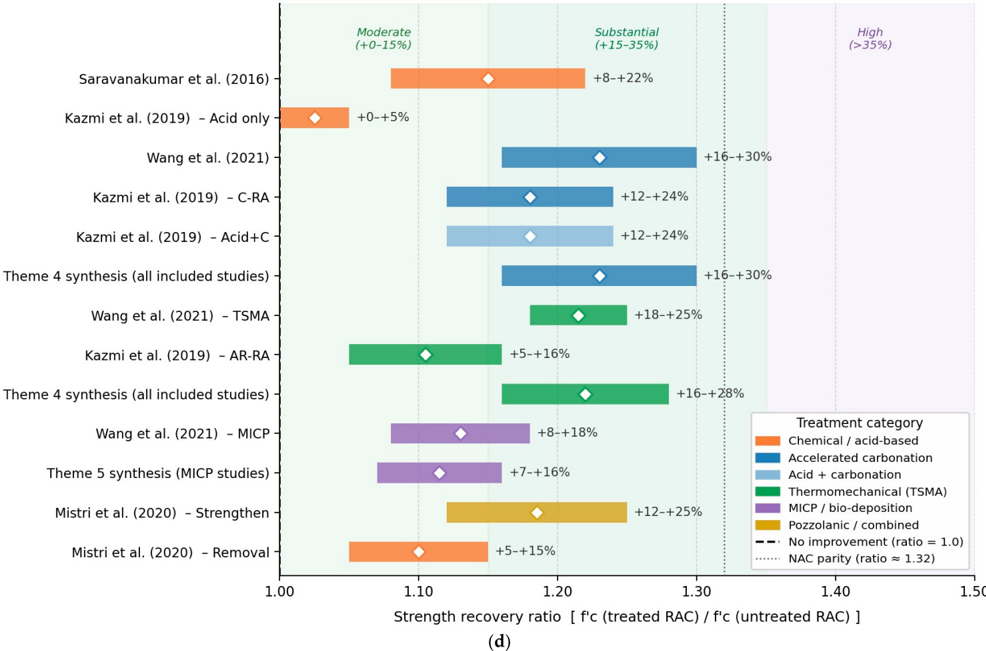
“Figure 5d shows that strength ratio recovery significantly increases if MICP/bio-deposition, accelerated carbonation, or thermomechanical treatments are added to RAC.”
§ Increasing the Reuse Potential of Recycled Aggregates from Concrete and Masonry CDW: Treatment, Performance, and Sustainability for Structural Applications > 1.1. The Significance of Using Recycled Aggregate for Structural Applications
plainstates a cause- Asserted: passes — The authors put it forward as true.
- Checkable: passes — It can be checked against evidence.
- Load-bearing: passes — The paper’s conclusions depend on it.
- Based: passes — The paper gives a reason why it holds.
A result the paper reports from its own data — it cites no other source for it, so there is none to check. The quote shows it is in the paper.
In the paper
“The concrete with RFA shows a more gradual reduction (~14 MPa) across the full replacement range (0-90%).”
§ Increasing the Reuse Potential of Recycled Aggregates from Concrete and Masonry CDW: Treatment, Performance, and Sustainability for Structural Applications > 1.1. The Significance of Using Recycled Aggregate for Structural Applications
plainstates a cause- Asserted: passes — The authors put it forward as true.
- Checkable: passes — It can be checked against evidence.
- Load-bearing: unclear — It is unclear whether the paper’s conclusions depend on it.
- Based: passes — The paper gives a reason why it holds.
A result the paper states — it cites no source for it, so there is none to check. The quote shows it is in the paper.
In the paper
“mechanistic linkages between specific treatment pathways, pore-structure evolution, and long-term service life have not been systematically synthesised.”
§ Increasing the Reuse Potential of Recycled Aggregates from Concrete and Masonry CDW: Treatment, Performance, and Sustainability for Structural Applications > 1. Introduction
plain- Asserted: passes — The authors put it forward as true.
- Checkable: passes — It can be checked against evidence.
- Load-bearing: passes — The paper’s conclusions depend on it.
- Based: passes — The paper gives a reason why it holds.
A result the paper states — it cites no source for it, so there is none to check. The quote shows it is in the paper.
In the paper
“RAC with high RA content can achieve carbonation resistance comparable to natural aggregate concrete when lower water/cement ratios are used.”
§ Increasing the Reuse Potential of Recycled Aggregates from Concrete and Masonry CDW: Treatment, Performance, and Sustainability for Structural Applications > 1.1. The Significance of Using Recycled Aggregate for Structural Applications
plainstates a possible cause- Asserted: passes — The authors put it forward as true.
- Checkable: passes — It can be checked against evidence.
- Load-bearing: passes — The paper’s conclusions depend on it.
- Based: passes — The paper gives a reason why it holds.
56 more claims
Create a free account to see all 172 claims and to verify the 110 references still open.
- Probably not a substantial claim. 19
- It may state two separate claims as one. 102
Self-check
Percentages, sums and reported differences re-computed from the paper’s own numbers.
Each contradiction between two passages listed here was confirmed by an independent check.
Rated minor: it would not touch a result — a value no result rests on, a p-value that stays on the same side of the significance level, or a conflict that is clerical, resolved elsewhere in the paper, or outside its own findings.
In the paper
§ Increasing the Reuse Potential of Recycled Aggregates from Concrete and Masonry CDW: Treatment, Performance, and Sustainability for Structural Applications > 6. Conclusions
“Accelerated carbonation reduces water absorption by 17-30%, lowers chloride migration coefficients, and recovers 85-94% of NAC compressive strength at ≤50% coarse RCA replacement [26,39,45].”
§ Increasing the Reuse Potential of Recycled Aggregates from Concrete and Masonry CDW: Treatment, Performance, and Sustainability for Structural Applications > • • • •
“Accelerated carbonation | Strengthening | Low/moderate (CO 2 supply) | High (RILEM TC pilots) 309-MCP; 0.5-5 t/h | 17-35%”
Rated minor: it would not touch a result — a value no result rests on, a p-value that stays on the same side of the significance level, or a conflict that is clerical, resolved elsewhere in the paper, or outside its own findings.
In the paper
§ Increasing the Reuse Potential of Recycled Aggregates from Concrete and Masonry CDW: Treatment, Performance, and Sustainability for Structural Applications > • • • •
“| Thermomechanical (TmRA/TSMA) | Strengthening | Very high (300-500 • C heat + abrasion) | Medium (lab-scale demonstrated) | 40-55% | 88-94% | High (large input) thermal energy | TRL 4-5 |”
§ Increasing the Reuse Potential of Recycled Aggregates from Concrete and Masonry CDW: Treatment, Performance, and Sustainability for Structural Applications > • • • •
“| TSMA/Triple mixing method | Modified mixing | Low | Medium (mixer adaptation only) | 10-20% | 92-97% | Low (no needed) pretreatment | TRL 6-7 |”
Citations
Cites
Silva, R. V., de Brito, J., & Dhir, R. K. (2014) · Construction and Building Materials · doi:10.1016/j.conbuildmat.2014.04.117 · Cited by 1,229
Performance enhancement of recycled concrete aggregate – A review
Shi, C., Li, Y., Zhang, J., Li, W., Chong, L., & Xie, Z. (2016) · Journal of Cleaner Production · doi:10.1016/j.jclepro.2015.08.057 · Cited by 1,157
An overview of study on recycled aggregate concrete in China (1996–2011)
Xiao, J., Li, W., Fan, Y., & Huang, X. (2012) · Construction and Building Materials · doi:10.1016/j.conbuildmat.2011.12.074 · Cited by 1,101
A Comprehensive Review on Recycled Aggregate and Recycled Aggregate Concrete
Wang, B., Yan, L., Fu, Q., & Kasal, B. (2021) · Resources, Conservation and Recycling · doi:10.1016/j.resconrec.2021.105565 · Cited by 999
Durability of recycled aggregate concrete – A review
Guo, H., Shi, C., Guan, X., Zhu, J., Ding, Y., Ling, T.-C., Zhang, H., & Wang, Y. (2018) · Cement and Concrete Composites · doi:10.1016/j.cemconcomp.2018.03.008 · Cited by 829
Comparative environmental assessment of natural and recycled aggregate concrete
Marinković, S., Radonjanin, V., Malešev, M., & Ignjatović, I. (2010) · Waste Management · doi:10.1016/j.wasman.2010.04.012 · Cited by 818
Duan, Z. H., & Poon, C. S. (2014) · Materials & Design · doi:10.1016/j.matdes.2014.01.044 · Cited by 588
A review on current situation and challenges of construction and demolition waste management
Menegaki, M., & Damigos, D. (2018) · Current Opinion in Green and Sustainable Chemistry · doi:10.1016/j.cogsc.2018.02.010 · Cited by 512 · cited 2×
“It provides a clear idea about CDW resources and materials that are included in CDW. Table 1 shows CDW-related data from countries across the world [3] and, comparing CDW with the turnover of the construction sector, considerable high variation can be identified.”
Carbonation behaviour of recycled aggregate concrete
Silva, R. V., Neves, R., de Brito, J., & Dhir, R. K. (2015) · Cement and Concrete Composites · doi:10.1016/j.cemconcomp.2015.04.017 · Cited by 385
The influence of the use of recycled aggregates on the compressive strength of concrete: a review
Silva, R. V., de Brito, J., & Dhir, R. K. (2015) · European Journal of Environmental and Civil Engineering · doi:10.1080/19648189.2014.974831 · Cited by 366
Bravo, M., de Brito, J., Pontes, J., & Evangelista, L. (2015) · Construction and Building Materials · doi:10.1016/j.conbuildmat.2014.12.103 · Cited by 336
Kazmi, S. M. S., Munir, M. J., Wu, Y.-F., Patnaikuni, I., Zhou, Y., & Xing, F. (2019) · Cement and Concrete Composites · doi:10.1016/j.cemconcomp.2019.103398 · Cited by 253
Mistri, A., Bhattacharyya, S. K., Dhami, N., Mukherjee, A., & Barai, S. V. (2020) · Construction and Building Materials · doi:10.1016/j.conbuildmat.2019.117894 · Cited by 245
Properties of treated recycled aggregates and its influence on concrete strength characteristics
Saravanakumar, P., Abhiram, K., & Manoj, B. (2016) · Construction and Building Materials · doi:10.1016/j.conbuildmat.2016.02.064 · Cited by 244
Kim, Y., Hanif, A., Kazmi, S. M. S., Munir, M. J., & Park, C. (2018) · Journal of Cleaner Production · doi:10.1016/j.jclepro.2018.04.192 · Cited by 226
Global Waste Management Outlook 2024 - Beyond an age of waste: Turning rubbish into a resource
United Nations Environment Programme, & International Solid Waste Association (2024) · United Nations Environment Programme eBooks · doi:10.59117/20.500.11822/44939 · Cited by 222
Current Applications of Recycled Aggregates from Construction and Demolition: A Review
Reis, G. S. D., Quattrone, M., Ambrós, W. M., Grigore Cazacliu, B., & Hoffmann Sampaio, C. (2021) · Materials · doi:10.3390/ma14071700 · Cited by 164
Silva, R. V., de Brito, J., & Dhir, R. K. (2016) · Construction and Building Materials · doi:10.1016/j.conbuildmat.2015.12.171 · Cited by 159
Influence of bonded mortar on recycled aggregate concrete properties: A review
Muhammad, F., Harun, M., Ahmed, A., Kabir, N., Khalid, H. R., & Hanif, A. (2024) · Construction and Building Materials · doi:10.1016/j.conbuildmat.2024.136564 · Cited by 124
Compressive strength of concrete with recycled aggregate; a machine learning-based evaluation
Dabiri, H., Kioumarsi, M., Kheyroddin, A., Kandiri, A., & Sartipi, F. (2022) · Cleaner Materials · doi:10.1016/j.clema.2022.100044 · Cited by 105
Alibeigibeni, A., Stochino, F., Zucca, M., & Gayarre, F. L. (2025) · Buildings · doi:10.3390/buildings15081361 · Cited by 97
Carbon Emission Evaluation of Recycled Fine Aggregate Concrete Based on Life Cycle Assessment
Lei, B., Yu, L., Chen, Z., Yang, W., Deng, C., & Tang, Z. (2022) · Sustainability · doi:10.3390/su142114448 · Cited by 71
Impact of treatment methods on recycled concrete aggregate performance: a comprehensive review
Peiris, D., Gunasekara, C., Law, D. W., Patrisia, Y., Tam, V. W. Y., & Setunge, S. (2025) · Environmental Science and Pollution Research · doi:10.1007/s11356-025-36497-y · Cited by 55
Durability aspects of ancient mortars of the archeological site of Olynthos
Papayianni, I., & Stefanidou, M. (2007) · Journal of Cultural Heritage · doi:10.1016/j.culher.2007.03.001 · Cited by 52
Recycling Construction and Demolition Waste in the Sector of Construction
Patil, Y. R., Dakwale, V. A., & Ralegaonkar, R. V. (2024) · Advances in Civil Engineering · doi:10.1155/2024/6234010 · Cited by 49
Jean, B., Liu, H., Zhu, X., Wang, X., Yan, X., & Ma, T. (2024) · Materials · doi:10.3390/ma17081715 · Cited by 44
Petrović, E. K., & Thomas, C. A. (2024) · Sustainability · doi:10.3390/su16041561 · Cited by 43
Chang, J., Yang, D., Lu, C., Shu, Z., Deng, S., Tan, L., Wen, S., Huang, K., & Duan, P. (2024) · Environmental Science and Pollution Research · doi:10.1007/s11356-024-33824-7 · Cited by 40
Appraisal of Processing Techniques for Recycled Aggregates in Concrete
Professor of Civil Engineering, G. H., Reddy, V. S., Rao, M. V. S., Shrihari, S., & Professor of Civil Engineering, V. H. (2019) · International Journal of Engineering and Advanced Technology · doi:10.35940/ijeat.f8407.088619 · Cited by 39
Jamil, S., Idrees, M., Akbar, A., & Ahmed, W. (2025) · Buildings · doi:10.3390/buildings15020201 · Cited by 35
Mechanical Behavior of Masonry Mortars Made with Recycled Mortar Aggregate
Mora-Ortiz, R. S., Munguía-Balvanera, E., Díaz, S. A., Magaña-Hernández, F., Del Angel-Meraz, E., & Bolaina-Juárez, Á. (2020) · Materials · doi:10.3390/ma13102373 · Cited by 31
Ang, P., Goh, W., Bu, J., & Cheng, S. (2024) · Journal of Cleaner Production · doi:10.1016/j.jclepro.2024.143553 · Cited by 30
Zaccardi, Y. V., Ellwood, L., Perumal, P., Torrenti, J., Zhao, Z., Bernard, E., Hanein, T., Ling, T., Wang, W., Zhang, Z., et al. (2024) · Materials and Structures · doi:10.1617/s11527-024-02489-6 · Cited by 23
Bio-deposition approaches for sustainable execution of recycled aggregates in concretes
Ahmad, M. A., Liu, B., Li, Q., Adeel, M., Zhang, J., Zhou, Y., & Deng, X. (2023) · Frontiers in Materials · doi:10.3389/fmats.2023.1131673 · Cited by 22
Durability performance of concrete incorporating carbonated recycled coarse aggregates: a review
Zhang, Z., Angst, U., Troian, V., Guo, B., & Zeng, Q. (2025) · npj Materials Sustainability · doi:10.1038/s44296-025-00071-x · Cited by 22
Zhang, J., Wang, C., & Wang, Z. (2024) · Buildings · doi:10.3390/buildings14092851 · Cited by 21
Saiz Martínez, P., Ferrández, D., Melane-Lavado, A., & Zaragoza-Benzal, A. (2023) · International Journal of Environmental Research and Public Health · doi:10.3390/ijerph20043709 · Cited by 18
Wang, J., Pang, S., Zhan, X., Wei, W., Li, X., Wang, L., Huang, X., & Zhang, L. (2025) · Buildings · doi:10.3390/buildings15050825 · Cited by 16
Pramanik, S., & Mazumder, D. (2025) · Journal of Material Cycles and Waste Management · doi:10.1007/s10163-025-02394-2 · Cited by 12
Life cycle assessment of sandstone aggregate quarry activities—a case study in Istanbul, Türkiye
Vural, N., Yılmaz, M., Onat, B., & Tuğrul, A. (2025) · The International Journal of Life Cycle Assessment · doi:10.1007/s11367-025-02442-x · Cited by 11
Chen, L., & Yang, A. (2025) · Resources, Conservation and Recycling · doi:10.1016/j.resconrec.2024.107940 · Cited by 10
Recycling Plaster Waste as a Substitute for Aggregates in Obtaining Plastering Mortars
Catalin, S., Daniela, M. L., Monica, P. L., & Raluca, S. L. (2023) · Buildings · doi:10.3390/buildings13020491 · Cited by 9
da Silva Neto, G. A., de Oliveira, J. P. V., Salles, P. V., de Vasconcelos Barros, R. T., Paulino, M. T., & dos Santos, W. J. (2021) · The Open Construction & Building Technology Journal · doi:10.2174/1874836802014010382 · Cited by 8
Durability assessment of recycled aggregate concrete admixed with superplasticizer
Patowary, F., & Siddique, M. A. A. (2025) · Innovative Infrastructure Solutions · doi:10.1007/s41062-025-02076-w · Cited by 6
Vieira, C. S., Pereira, P. M., & Lopes, M. D. L. (2019) · Portuguese National Funding Agency for Science, Research and Technology (RCAAP Project by FCT) · Cited by 6
Mozumder, R. S., Hoque, M. M., Taki, M. Z. H., Bhowmik, M. C., Sheikh, P., & Saha, N. (2025) · Discover Civil Engineering · doi:10.1007/s44290-025-00371-0 · Cited by 5
Optimizing concrete properties with carbonated recycled concrete aggregate: a sustainable approach
Jamil, S., Idrees, M., Akbar, A., & Barbhuiya, S. (2025) · Archives of Civil and Mechanical Engineering · doi:10.1007/s43452-025-01319-y · Cited by 5
Bhartesh, & Singh, G. J. (2024) · Materials and Structures · doi:10.1617/s11527-024-02431-w · Cited by 5
A Comparative Study on Mortar Removal Methods and their Influence on Recycled Aggregate Properties
Kim, J., & Jang, H. (2022) · Periodica Polytechnica Civil Engineering · doi:10.3311/ppci.19065 · Cited by 4
Maaze, M. R., Garg, N., Das, S. K., & Shrivastava, S. (2025) · Discover Materials · doi:10.1007/s43939-025-00318-3 · Cited by 4
Effects of Mineral Admixtures on the Chloride Permeability of Hydraulic Concrete
Zhang, D. Q., Li, X. Y., Ma, X. W., & Wang, Z. (2010) · Advanced Materials Research · doi:10.4028/www.scientific.net/amr.168-170.2082 · Cited by 1
Research works printed but not linked: 2
- Lee, C. A Life Cycle Approach to Environmental Sustainability in Aggregate Production Systems What Matters and for Whom? 2024. Available online: https://www.researchgate.net/publication/380547081_A_Life_Cycle_Approach_to_Environmental_ Sustainability_in_Aggregate_Production_Systems_What_matters_and_for_whom (accessed on 11 January 2026).
- Reinhardt, L.; Vogel, C. Performance evaluation of recycled aggregate concrete for sustainable construction in urban infrastructures. Int. J. Civ. Eng. Archit. Eng. 2025, 6, 36-42.
Cited by
Liu, L., Xi, L., Li, M., & Song, G. (2026) · Materials · doi:10.3390/ma19184006
Shetty, P. P., & Rao, A. U. (2026) · Scientific Reports · doi:10.1038/s41598-026-73032-6
Gabryś, K., & Lasocka, P. (2026) · Sustainability · doi:10.3390/su182211813
Metadata
- Authors
- Rajapaksha, N. D., Ameri Vamkani, M., Gkantou, M., Giuntini, F., & Bras, A.
- Affiliations
- Liverpool John Moores University (GB)
- Built Environment and Sustainable Technologies (BEST) Research Institute, Liverpool John Moores University, Byrom Street, Liverpool L3 3AF, UK
- Venue
- Construction Materials
- Publisher
- MDPI AG
- Published
- 2026-05-15
- Volume
- 6
- Issue
- 3
- Pages
- 29
- ISSN
- 2673-7108 (ISSN-L)
- OpenAlex
- W7161234649
- Cited by
- 3
- References
- 51
- Citations by year
- 2026: 3
- FWCI
- 5.21
- Type
- journal article
- Language
- en
- Open access
- gold
- doi.org
- Licence
- Locations
- Construction Materials (publishedVersion, cc-by)
- Liverpool John Moores University (submittedVersion, cc-by)
- DOAJ (DOAJ: Directory of Open Access Journals) (submittedVersion)
- Topics
- Physical Sciences › Engineering › Building and Construction › Recycled Aggregate Concrete Performance
- Physical Sciences › Engineering › Civil and Structural Engineering › Concrete and Cement Materials Research
- Physical Sciences › Engineering › Building and Construction › Materials Engineering and Processing
- Keywords
- recycled aggregate, recycled aggregate concrete, construction and demolition waste, recycled fine aggregate, recycled coarse aggregate, aggregate treatment, acid cleaning, silica fume, accelerated carbonation, microbially induced calcite precipitation, nano-silica coating, polymer impregnation, interfacial transition zone, water absorption, compressive strength, durability, carbon footprint, circular economy, structural concrete, pore structure
About these checks
Registry, retraction, Cites and statistics results are computed, not judged, with one exception: a printed reference that no index lists is read once by a model before it counts as a citation error. Claims are extracted by a model and kept only when their quote appears verbatim in the text; each cited source is then checked, with a model’s help, for whether it says what the claim relies on. Those verdicts can be wrong — read the claim’s quote and the cited source before relying on one.
A language model drew the claims from the paper on 2026-11-27, under version 3 of the claim definition (model deepseek-v4.1-flash, prompt extract-v3).
A second model labelled each claim on 2026-11-27 (model jev-1.13-20260917, definition revision gold-guideline-v0.2).
Statistics and arithmetic are recomputed, not judged.
Confidence bands are shown only for fields calibrated on our annotated test set. None is calibrated yet, so no band is shown.
What counts as a claim ›How we measure confidence ›How we check this ›
Are you an author, or do you see a problem with this page? Request a review
Data sources
Bibliographic data: Semantic Scholar, OpenAlex, Crossref.
Contains information from the Semantic Scholar Academic Graph Datasets, made available under the ODC Attribution License (ODC-BY 1.0).
Semantic Scholar’s data is described in: Kinney, R., et al. (2023). The Semantic Scholar Open Data Platform. arXiv:2301.10140.
