

The DOI matches its Crossref record; 1 of the 1 references it cites were found in a registry or an index.
The Role of Small Lowland Patches of Exotic Forests as Refuges of Rare Endemic Azorean Arthropods
Abstract
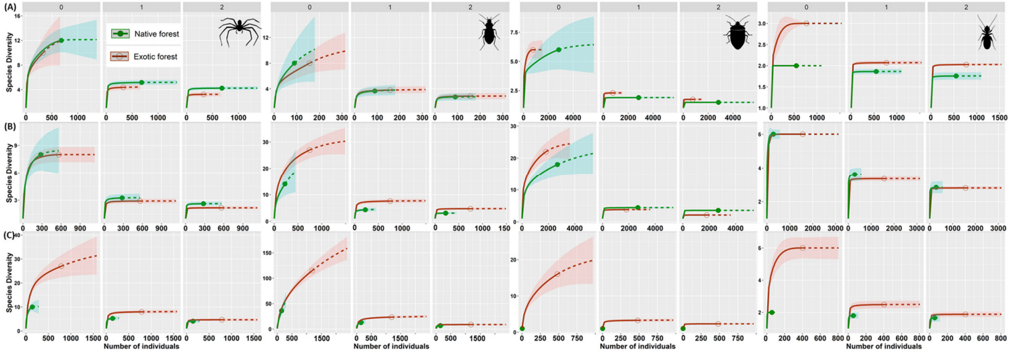
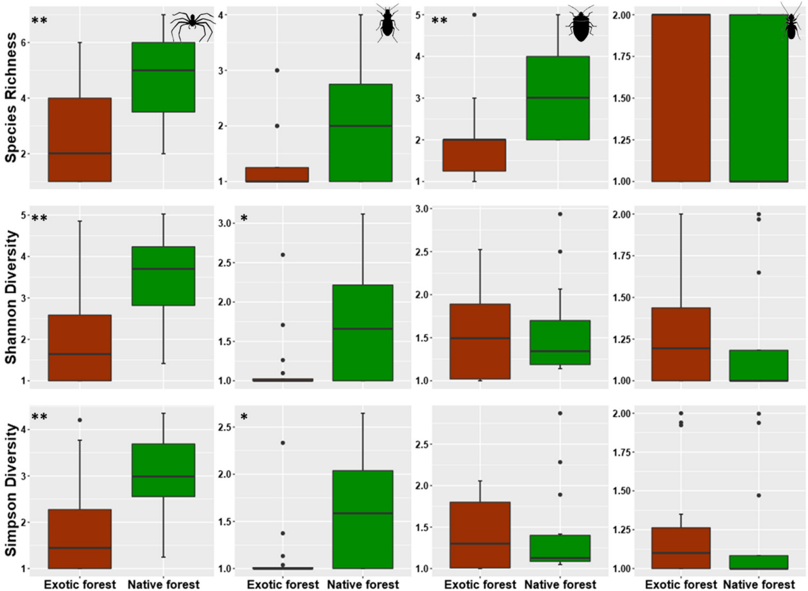
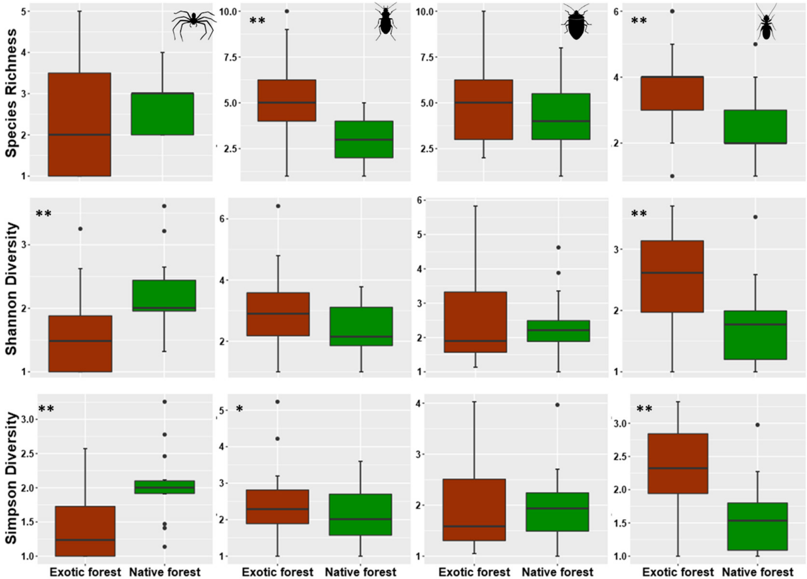
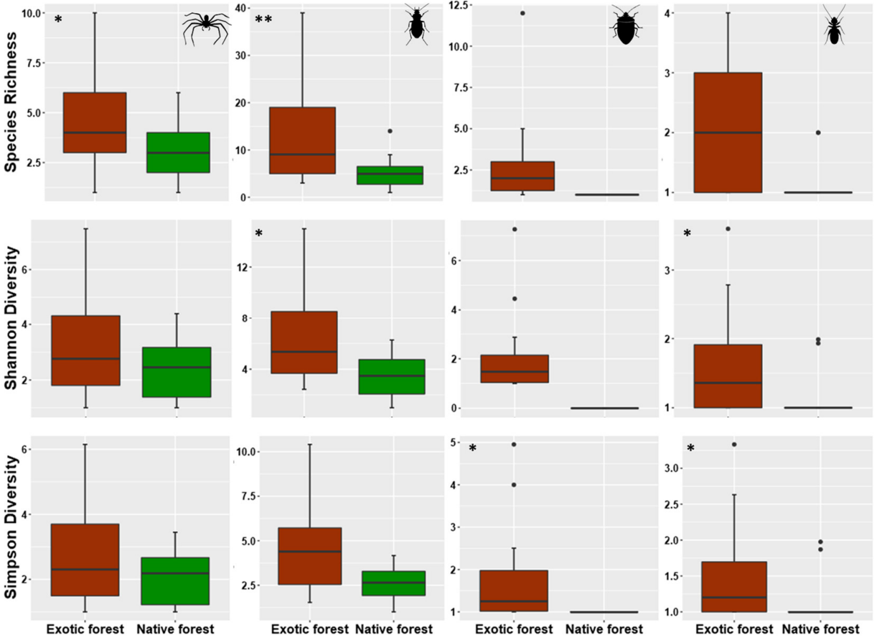
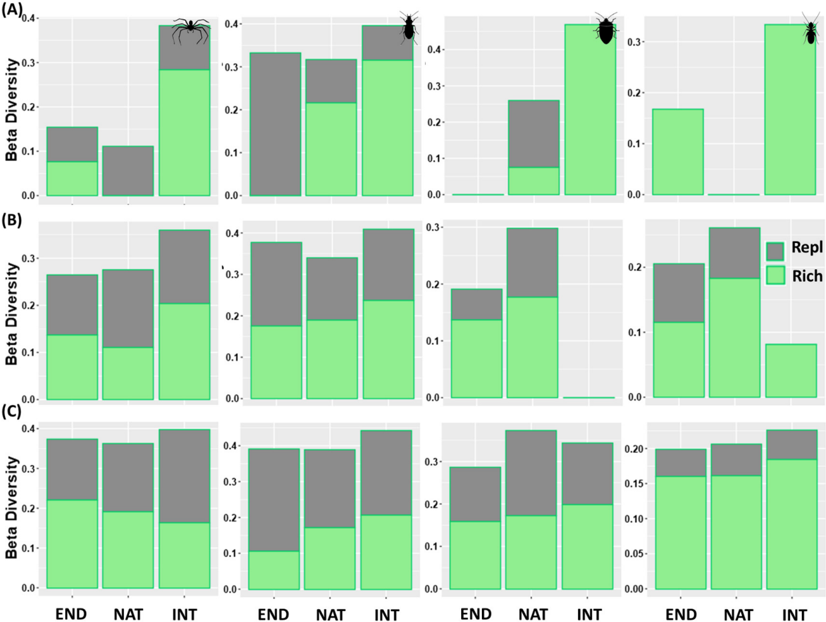
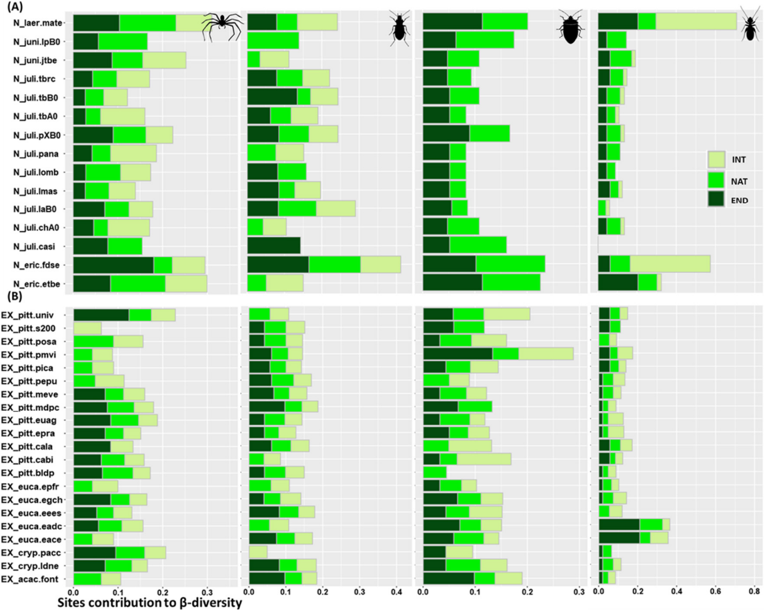
Islands have been disproportionately affected by the current biodiversity crisis. In island biotas, one of the most recurrent anthropic alterations is species introduction. Invasion of exotic species may represent a major threat for island biotas, because invasive species may change species composition and simplify community dynamics. We investigated diversity patterns of native and introduced species in native and exotic forests of Terceira Island (Azores, Portugal) by using diversity profiles based on Hill numbers. Use of diversity profiles allows for a complete characterization of the community diversity because they combine information on species richness, rarity, and dominance. We found that native forest remnants are crucial for the maintenance of endemic Azorean arthropod diversity. However, we also found that some lowland patches of exotic forests can sustain populations of rare endemic species. Our findings reinforce the importance of the few and small remnants of native forests, which are a pillar to the conservation of Azorean endemic arthropods. However, areas occupied by exotic forests, whether they are large and contiguous or small and isolated, close to native forests, or embedded in a matrix of agriculture activities, can also play a role in the conservation of native species, including endemics.
Overview
The claims and statistics of this paper haven’t been checked yet.
Run the check — free, no account needed. It reads the open-access text and checks the sources it cites.
Integrity signals
Registry
Cites
Statistics
Figures
Verification
Claims the paper makes
The claims and statistics of this paper haven’t been checked yet.
Run the check — free, no account needed. It reads the open-access text and checks the sources it cites.
Claims other papers make about this one
Each is checked against this paper’s own text: does it say what the citing paper says it does?
In the citing paper
“Similarly, small lowland patches of exotic forests, such as Cryptomeria japonica (L.f.) D.Don plantations and Pittosporum undulatum Vent. forest patches, can temporarily serve as refuges for rare endemic arthropods (Tsafack et al. 2021, Lhoumeau et al. 2025).”
From Monitoring agroforest plots under the scope of the COMCHA project. 1. Baseline data for the vascular plants and arthropods of "Vale da Fonte Plot" in Pico Island (Azores Archipelago) (2026) · cites this paper as Tsafack et al. 2021
In the citing paper
“These mosaics form transitional zones where native and anthropogenic elements interact, potentially supporting refuges or dispersal corridors for endemic species across fragmented landscapes (Cardoso et al. 2009, Marcelino et al. 2021, Tsafack et al. 2021).”
From Monitoring agroforest plots under the scope of the COMCHA project. 1. Baseline data for the vascular plants and arthropods of "Vale da Fonte Plot" in Pico Island (Azores Archipelago) (2026) · cites this paper as Tsafack et al. 2021
In the citing paper
“Although these human-made habitats cannot substitute the ecological value of native montane cloud forests, they can contribute to short-term persistence and functional connectivity between fragmented native patches (Cardoso et al. 2009, Tsafack et al. 2021, Borges et al. 2022a).”
From Monitoring agroforest plots under the scope of the COMCHA project. 1. Baseline data for the vascular plants and arthropods of "Vale da Fonte Plot" in Pico Island (Azores Archipelago) (2026) · cites this paper as Tsafack et al. 2021
Self-check
Percentages, sums and reported differences re-computed from the paper’s own numbers.
The self-check needs the paper’s full text.
Citations
Cites
More than 75 percent decline over 27 years in total flying insect biomass in protected areas
Hallmann, C. A., Sorg, M., Jongejans, E., Siepel, H., Hofland, N., Schwan, H., Stenmans, W., Müller, A., Sumser, H., Hörren, T., et al. (2017) · PLOS ONE · doi:10.1371/journal.pone.0185809 · Cited by 3,499
Research works printed but not linked: 63
- Cardoso, 2020, Scientists’ warning to humanity on insect extinctions, Biol. Conserv., 242, 108426, 10.1016/j.biocon.2020.108426 · DOI
- Harvey, 2020, International scientists formulate a roadmap for insect conservation and recovery, Nat. Ecol. Evol., 4, 174, 10.1038/s41559-019-1079-8 · DOI
- Samways, 2020, Solutions for humanity on how to conserve insects, Biol. Conserv., 242, 108427, 10.1016/j.biocon.2020.108427 · DOI
- Wyckhuys, 2019, Worldwide decline of the entomofauna: A review of its drivers, Biol. Conserv., 232, 8, 10.1016/j.biocon.2019.01.020 · DOI · Paper page
- Habel, 2019, Long-term large-scale decline in relative abundances of butterfly and burnet moth species across south-western Germany, Sci. Rep., 9, 14921, 10.1038/s41598-019-51424-1 · DOI
- Homburg, 2019, Where have all the beetles gone? Long-term study reveals carabid species decline in a nature reserve in Northern Germany, Insect Conserv. Divers., 12, 268, 10.1111/icad.12348 · DOI
- Seibold, 2019, Arthropod decline in grasslands and forests is associated with landscape-level drivers, Nature, 574, 671, 10.1038/s41586-019-1684-3 · DOI
- Terzopoulou, 2015, Drivers of extinction: The case of Azorean beetles, Biol. Lett., 11, 20150273, 10.1098/rsbl.2015.0273 · DOI
- Triantis, 2010, Extinction debt on oceanic islands, Ecography, 33, 285, 10.1111/j.1600-0587.2010.06203.x · DOI
- Copsey, J.A., Black, S.A., Groombridge, J.J., and Jones, C.G. (2018). Species Conservation: Lessons from Islands, Cambridge University Press. Ecology, Biodiversity and Conservation. · DOI
- Jupiter, 2014, Conservation of Biodiversity in the Pacific Islands of Oceania: Challenges and Opportunities, Pac. Conserv. Biol., 20, 206, 10.1071/PC140206 · DOI
- Privet, 2020, Non-native spiders change assemblages of Hawaiian forest fragment kipuka over space and time, NeoBiota, 55, 1, 10.3897/neobiota.55.48498 · DOI
- Raven, 2021, Agricultural intensification and climate change are rapidly decreasing insect biodiversity, Proc. Natl. Acad. Sci. USA, 118, e2002548117, 10.1073/pnas.2002548117 · DOI
- Causton, 2006, Alien Insects: Threats and Implications for Conservation of Galápagos Islands, Ann. Entomol. Soc. Am., 99, 121, 10.1603/0013-8746(2006)099[0121:AITAIF]2.0.CO;2 · DOI
- Cronk, 1997, Islands: Stability, diversity, conservation, Biodivers. Conserv., 6, 477, 10.1023/A:1018372910025 · DOI
- Sax, 2002, Species Invasions Exceed Extinctions on Islands Worldwide: A Comparative Study of Plants and Birds, Am. Nat., 160, 766, 10.1086/343877 · DOI
- Silva, 2006, A Quantitative Approach to the Study of Non-indigenous Plants: An Example from the Azores Archipelago, Biodivers. Conserv., 15, 1661, 10.1007/s10531-004-5015-z · DOI
- Borges, 2010, The Azorean Biodiversity Portal: An internet database for regional biodiversity outreach, Null, 8, 423
- Borges, 2020, Increase of insular exotic arthropod diversity is a fundamental dimension of the current biodiversity crisis, Insect Conserv. Divers., 13, 508, 10.1111/icad.12431 · DOI
- Borges, 2005, Ranking protected areas in the Azores using standardised sampling of soil epigean arthropods, Biodivers. Conserv., 14, 2029, 10.1007/s10531-004-4283-y · DOI
- Gaspar, 2011, Selection of priority areas for arthropod conservation in the Azores archipelago, J. Insect Conserv., 15, 671, 10.1007/s10841-010-9365-4 · DOI
- Fattorini, 2017, Endemism in historical biogeography and conservation biology: Concepts and implications, Biogeogr. J. Integr. Biogeogr., 32, 47, 10.21426/B632136433 · DOI
- Ferreira, 2016, Effects of climate change on the distribution of indigenous species in oceanic islands (Azores), Clim. Chang., 138, 603, 10.1007/s10584-016-1754-6 · DOI
- Elias, 2016, Natural zonal vegetation of the Azores Islands: Characterization and potential distribution, Phytocoenologia, 46, 107, 10.1127/phyto/2016/0132 · DOI
- Cardoso, 2009, A spatial scale assessment of habitat effects on arthropod communities of an oceanic island, Acta Oecologica, 35, 590, 10.1016/j.actao.2009.05.005 · DOI · Paper page
- Florencio, 2016, The role of plant fidelity and land-use changes on island exotic and indigenous canopy spiders at local and regional scales, Biol. Invasions, 18, 2309, 10.1007/s10530-016-1162-x · DOI
- Florencio, M., Lobo, J.M., Cardoso, P., Almeida-Neto, M., and Borges, P.A.V. (2015). The Colonisation of Exotic Species Does Not Have to Trigger Faunal Homogenisation: Lessons from the Assembly Patterns of Arthropods on Oceanic Islands. PLoS ONE, 10. · DOI
- Florencio, 2013, Arthropod assemblage homogenization in oceanic islands: The role of indigenous and exotic species under landscape disturbance, Divers. Distrib., 19, 1450, 10.1111/ddi.12121 · DOI
- Meijer, 2011, The effects of land-use change on arthropod richness and abundance on Santa Maria Island (Azores): Unmanaged plantations favour endemic beetles, J. Insect Conserv., 15, 505, 10.1007/s10841-010-9330-2 · DOI · Paper page
- Hill, 1973, Diversity and Evenness: A Unifying Notation and Its Consequences, Ecology, 54, 427, 10.2307/1934352 · DOI
- Chao, 2014, Unifying Species Diversity, Phylogenetic Diversity, Functional Diversity, and Related Similarity and Differentiation Measures Through Hill Numbers, Annu. Rev. Ecol. Evol. Syst., 45, 297, 10.1146/annurev-ecolsys-120213-091540 · DOI
- Matthews, 2019, Differential temporal beta-diversity patterns of native and non-native arthropod species in a fragmented native forest landscape, Ecography, 42, 45, 10.1111/ecog.03812 · DOI
- Artega, 2020, Arthropod diversity in two Historic Gardens in the Azores, Portugal, Biodivers. Data J., 8, e54749, 10.3897/BDJ.8.e54749 · DOI
- Borges, 2018, Biota from the coastal wetlands of Praia da Vitória (Terceira, Azores, Portugal): Part 1—Arthropods, Biodivers. Data J., 6, e27194, 10.3897/BDJ.6.e27194 · DOI
- Borges, 2017, Cryptic diversity in the Azorean beetle genus Tarphius Erichson, 1845 (Coleoptera: Zopheridae): An integrative taxonomic approach with description of four new species, Zootaxa, 4236, 401, 10.11646/zootaxa.4236.3.1 · DOI
- Borges, 2017, Conservation status of the forest beetles (Insecta, Coleoptera) from Azores, Portugal, Biodivers. Data J., 5, e14557, 10.3897/BDJ.5.e14557 · DOI
- Marcelino, 2021, Standardised arthropod (Arthropoda) inventory across natural and anthropogenic impacted habitats in the Azores archipelago, Biodivers. Data J., 9, e62157, 10.3897/BDJ.9.e62157 · DOI · Paper page
- Rego, C., Boieiro, M., Rigal, F., Ribeiro, S.P., Cardoso, P., and Borges, P.A.V. (2019). Taxonomic and functional diversity of insect herbivore assemblages associated with the canopy-dominant trees of the Azorean native forest. PLoS ONE, 14. · DOI
- Otto, 2011, A reconstruction of Palaeo-Macaronesia, with particular reference to the long-term biogeography of the Atlantic island laurel forests, J. Biogeogr., 38, 226, 10.1111/j.1365-2699.2010.02427.x · DOI
- Gaspar, 2008, Diversity and distribution of arthropods in native forests of the Azores archipelago, Arquipel. Life Mar. Sci., 25, 1
- Fattorini, S., Cardoso, P., Rigal, F., and Borges, P.A.V. (2012). Use of Arthropod Rarity for Area Prioritisation: Insights from the Azorean Islands. PLoS ONE, 7. · DOI
- Hsieh, 2016, iNEXT: An R package for rarefaction and extrapolation of species diversity (Hill numbers), Methods Ecol. Evol., 7, 1451, 10.1111/2041-210X.12613 · DOI
- Carvalho, 2013, Measuring fractions of beta diversity and their relationships to nestedness: A theoretical and empirical comparison of novel approaches, Oikos, 122, 825, 10.1111/j.1600-0706.2012.20980.x · DOI
- Legendre, 2013, Beta diversity as the variance of community data: Dissimilarity coefficients and partitioning, Ecol. Lett., 16, 951, 10.1111/ele.12141 · DOI
- Legendre, 2014, Interpreting the replacement and richness difference components of beta diversity, Glob. Ecol. Biogeogr., 23, 1324, 10.1111/geb.12207 · DOI · Paper page
- Searcy, 2006, The distribution and habitat preferences of introduced species in the mount Holyoke range, Hampshire co., Massachusetts, Rhodora, 108, 43, 10.3119/04-16.1 · DOI
- Gaston, 2006, Abundance, spatial variance and occupancy: Arthropod species distribution in the Azores, J. Anim. Ecol., 75, 646, 10.1111/j.1365-2656.2006.01085.x · DOI
- Rigal, 2013, Integration of non-indigenous species within the interspecific abundance–occupancy relationship, Acta Oecologica, 48, 69, 10.1016/j.actao.2013.02.003 · DOI
- Ribeiro, 2005, Canopy insect herbivores in the Azorean Laurisilva forests: Key host plant species in a highly generalist insect community, Ecography, 28, 315, 10.1111/j.0906-7590.2005.04104.x · DOI
- Quartau, 2003, A new species of the genus Aphrodes Curtis from the Azores (Hemiptera, Cicadellidae), Bocagiana, 213, 1
- Borges, 2008, Spider biodiversity patterns and their conservation in the Azorean archipelago, with descriptions of new species, Null, 6, 249
- Broadhead, 1985, The Diversity of Psocoptera in Two Tropical Forests in Panama, J. Anim. Ecol., 54, 739, 10.2307/4375 · DOI
- Jaenike, 1990, Host Specialization in Phytophagous Insects, Annu. Rev. Ecol. Syst., 21, 243, 10.1146/annurev.es.21.110190.001331 · DOI
- Manica, 2009, Stochastic and deterministic processes jointly structure tropical arthropod communities, Ecol. Lett., 12, 277, 10.1111/j.1461-0248.2009.01284.x · DOI
- Lessard, 2012, Strong influence of regional species pools on continent-wide structuring of local communities, Proc. R. Soc. B Biol. Sci., 279, 266, 10.1098/rspb.2011.0552 · DOI
- Segre, 2014, Competitive exclusion, beta diversity, and deterministic vs. stochastic drivers of community assembly, Ecol. Lett., 17, 1400, 10.1111/ele.12343 · DOI
- Gillespie, 2002, Arthropods on Islands: Colonization, Speciation, and Conservation, Annu. Rev. Entomol., 47, 595, 10.1146/annurev.ento.47.091201.145244 · DOI
- Kremen, 1993, Terrestrial Arthropod Assemblages: Their Use in Conservation Planning, Conserv. Biol., 7, 796, 10.1046/j.1523-1739.1993.740796.x · DOI
- McNeill, 1993, Single Large or Several Small Marine Reserves? An Experimental Approach with Seagrass Fauna, J. Biogeogr., 20, 429, 10.2307/2845591 · DOI
- 2010, How to resolve the SLOSS debate: Lessons from species-diversity models, J. Theor. Biol., 264, 604, 10.1016/j.jtbi.2010.02.009 · DOI
- Capano, 2019, The emergence of private land conservation in scientific literature: A review, Biol. Conserv., 237, 191, 10.1016/j.biocon.2019.07.010 · DOI
- Kamal, 2015, Challenges and opportunities in biodiversity conservation on private land: An institutional perspective from Central Europe and North America, Biodivers. Conserv., 24, 1271, 10.1007/s10531-014-0857-5 · DOI
- Shumba, 2020, Effectiveness of private land conservation areas in maintaining natural land cover and biodiversity intactness, Glob. Ecol. Conserv., 22, e00935
Cited by
Lago, A., Petrone, A., Soares, A., Boieiro, M., Lopes, D., Freitas, T., Lhoumeau, S., Wallon, S., & Borges, P. (2026) · Biodiversity Data Journal · doi:10.3897/bdj.14.e174244 · Cited by 1
Self-citation
Metadata
- Authors
- Tsafack, N., Fattorini, S., Boieiro, M., Rigal, F., Ros-Prieto, A., Ferreira, M. T., & Borges, P. A. V.
- Affiliations
- cE3c—Centre for Ecology, Evolution and Environmental Changes/Azorean Biodiversity Group, Faculty of Agriculture and Environment, Department of Environmental Sciences and Engineering, Universidade dos Açores, 9700-042 Angra do Heroismo, Azores, Portugal
- Department of Life, Health and Environmental Sciences, University of L’Aquila, Via Vetoio, 67100 L’Aquila, Italy
- Institut des Sciences Analytiques et de Physico-Chimie pour l’Environnement et les Matériaux, CNRS-Université de Pau et des Pays de l’Adour, E2S, UMR 5254, BP, CEDEX, 64000 Pau, France
- Project LIFE BEETLES (LIFE 18 NAT/PT/000864), Regional Secretariat of Environment and Climate Change, Rua do Galo n118, 9700-040 Angra do Heroismo, Azores, Portugal
- Venue
- Diversity
- Publisher
- MDPI AG
- Published
- 2021-09-16
- Volume
- 13
- Issue
- 9
- Pages
- 443
- ISSN
- 1424-2818
- Cited by
- 27
- References
- 1
- Language
- en
- Funders
- Secretaria Regional do Ambiente e Alterações Climáticas (LIFE-BETTLES (LIFE18 NAT_PT_000864), LIFE IP AZORES NATURA (LIFE17 IPE/PT/000010))
- Fundação para a Ciência e a Tecnologia (FCT-NETBIOME–ISLANDBIODIV grant 0003/2011, UID/BIA/00329/2013-2020-24)
- FEDER (AZORESBIOPORTAL–PORBIOTA (ACORES-01-0145-FEDER-000072))
About these checks
Registry, retraction, Cites and statistics results are computed, not judged, with one exception: a printed reference that no index lists is read once by a model before it counts as a citation error. Claims are extracted by a model and kept only when their quote appears verbatim in the text; each cited source is then checked, with a model’s help, for whether it says what the claim relies on. Those verdicts can be wrong — read the claim’s quote and the cited source before relying on one.
Statistics and arithmetic are recomputed, not judged.
Confidence bands are shown only for fields calibrated on our annotated test set. None is calibrated yet, so no band is shown.
What counts as a claim ›How we measure confidence ›How we check this ›
Are you an author, or do you see a problem with this page? Request a review
How to cite
Cite CoChat for the checks on this page, and the paper for its own findings.
- This page
- CoChat. (2026). Citation check: The Role of Small Lowland Patches of Exotic Forests as Refuges of Rare Endemic Azorean Arthropods. https://app.cochat.ai/papers/10.3390/d13090443
- The paper
- Tsafack, N., Fattorini, S., Boieiro, M., Rigal, F., Ros-Prieto, A., Ferreira, M. T., & Borges, P. A. V. (2021). The Role of Small Lowland Patches of Exotic Forests as Refuges of Rare Endemic Azorean Arthropods. Diversity. https://doi.org/10.3390/d13090443
Data sources
Bibliographic data: Semantic Scholar, OpenAlex, Crossref.
Contains information from the Semantic Scholar Academic Graph Datasets, made available under the ODC Attribution License (ODC-BY 1.0).
Semantic Scholar’s data is described in: Kinney, R., et al. (2023). The Semantic Scholar Open Data Platform. arXiv:2301.10140.
