

Interpretable Machine Learning for Personalized Medical Recommendations: A LIME-Based Approach
Open accessThe DOI matches its Crossref record; 45 of the 47 references it cites were found in a registry or an index.
Abstract
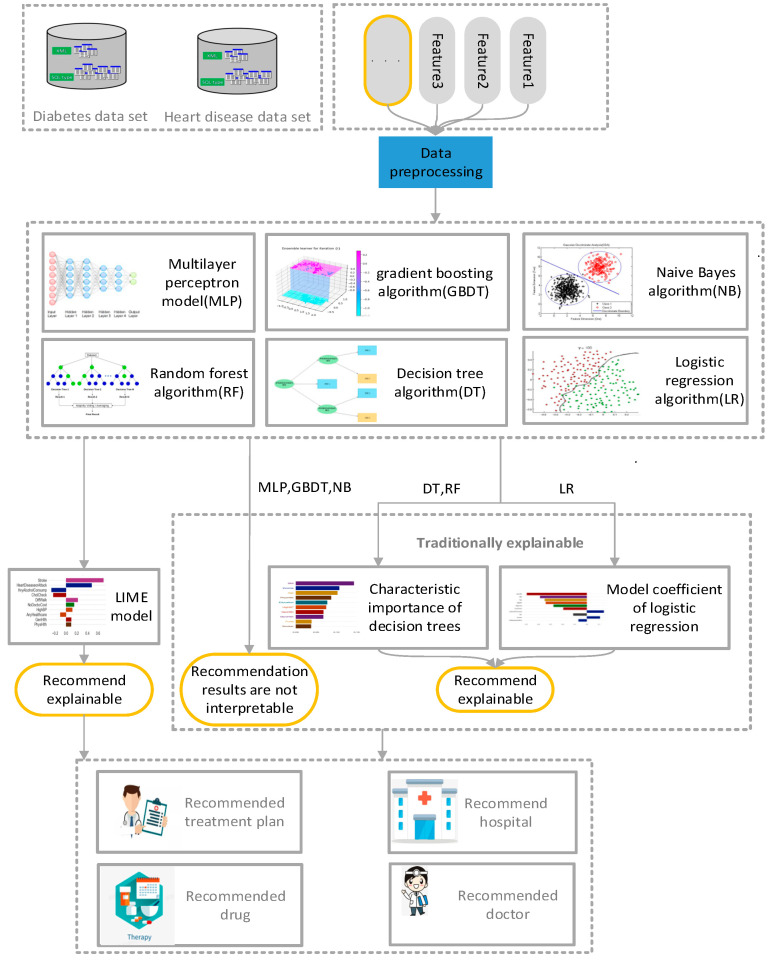
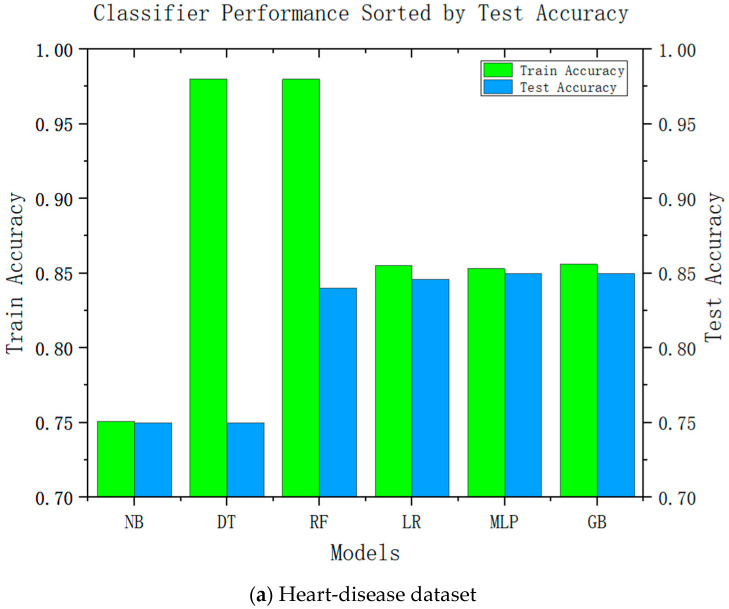
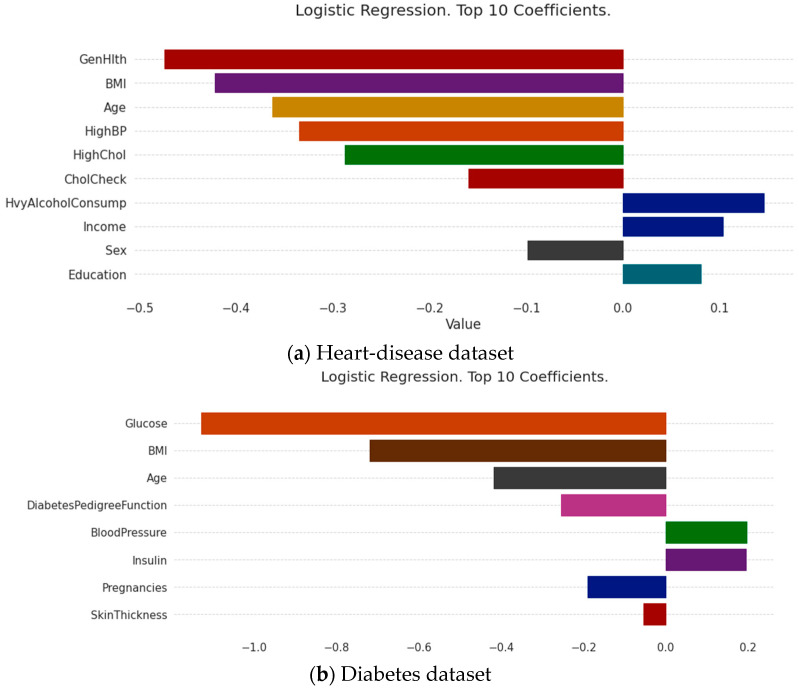
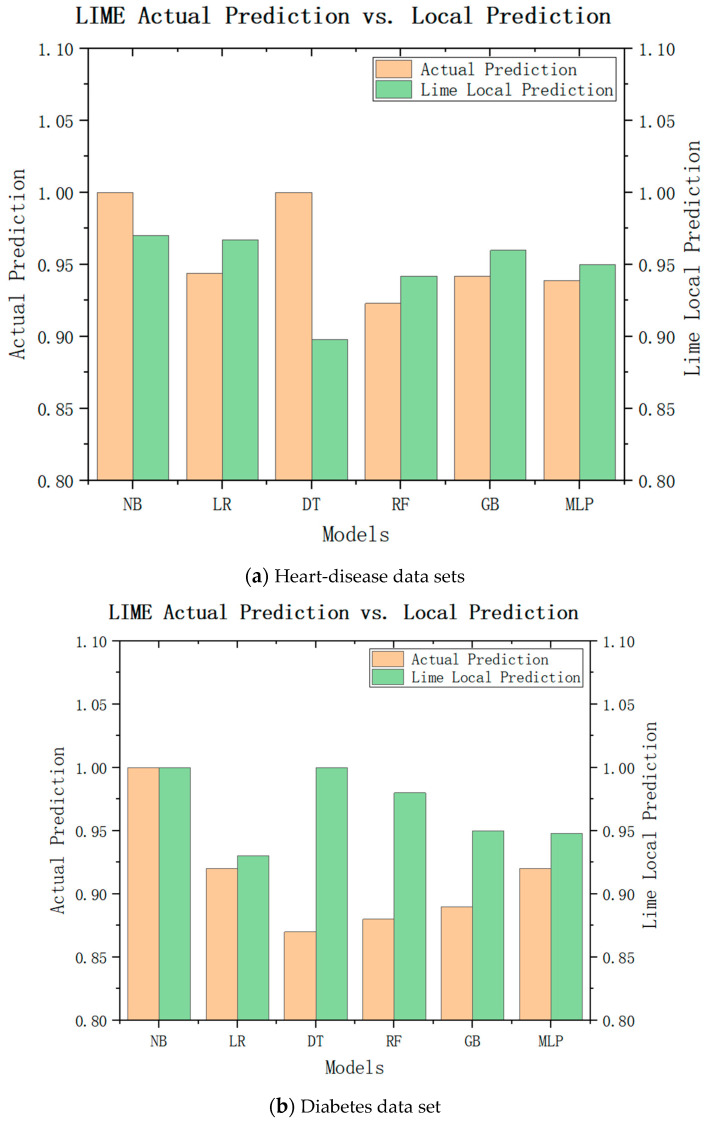
Chronic diseases are increasingly major threats to older persons, seriously affecting their physical health and well-being. Hospitals have accumulated a wealth of health-related data, including patients’ test reports, treatment histories, and diagnostic records, to better understand patients’ health, safety, and disease progression. Extracting relevant information from this data enables physicians to provide personalized patient-treatment recommendations. While collaborative filtering techniques and classical algorithms such as naive Bayes, logistic regression, and decision trees have had notable success in health-recommendation systems, most current systems primarily inform users of their likely preferences without providing explanations. This paper proposes an approach of deep learning with a local interpretable model–agnostic explanations (LIME)-based interpretable recommendation system to solve this problem. Specifically, we apply the proposed approach to two chronic diseases common in older adults: heart disease and diabetes. After data preprocessing, we use six deep-learning algorithms to form interpretations. In the heart-disease data set, the actual model recommendation of multi-layer perceptron and gradient-boosting algorithm differs from the local model’s recommendation of LIME, which can be used as its approximate prediction. From the feature importance of these two algorithms, it can be seen that the CholCheck, GenHith, and HighBP features are the most important for predicting heart disease. In the diabetes data set, the actual model predictions of the multi-layer perceptron and logistic-regression algorithm were little different from the local model’s prediction of LIME, which can be used as its approximate recommendation. Moreover, from the feature importance of the two algorithms, it can be seen that the three features of glucose, BMI, and age were the most important for predicting heart disease. Next, LIME is used to determine the importance of each feature that affected the results of the calculated model. Subsequently, we present the contribution coefficients of these features to the final recommendation. By analyzing the impact of different patient characteristics on the recommendations, our proposed system elucidates the underlying reasons behind these recommendations and enhances patient trust. This approach has important implications for medical recommendation systems and encourages informed decision-making in healthcare.
Overview
The claims and statistics of this paper haven’t been checked yet.
Free: it reads the open-access text and checks the first 5 claims that cite a source we can check. Create a free account to check every claim.
Integrity signals
Registry
Cites
Statistics
Figures



Verification
Claims the paper makes
The claims and statistics of this paper haven’t been checked yet.
Free: it reads the open-access text and checks the first 5 claims that cite a source we can check. Create a free account to check every claim.
Claims other papers make about this one
Each is checked against this paper’s own text: does it say what the citing paper says it does?
The source backs part of the claim, not all of it — or backs it for a different population, condition or comparison.
In the citing paper
“Concurrently, it can also anticipate the goods and services that consumers are likely to favor or be interested in as well as the potential for future shopping [56].”
From The Impact of AI-Personalized Recommendations on Clicking Intentions: Evidence from Chinese E-Commerce (2025) · cites this paper as [56]
Experimental — accuracy not yet measuredThe check wasn’t confident either way, so it gives no verdict — never disputed.
In the citing paper
“Compared with traditional personalized recommendation, AI-personalized recommendations are not limited to what has happened in the past but are used for accurate speculation and prediction of future shopping trends [56].”
From The Impact of AI-Personalized Recommendations on Clicking Intentions: Evidence from Chinese E-Commerce (2025) · cites this paper as [56]
Experimental — accuracy not yet measured
Self-check
Percentages, sums and reported differences re-computed from the paper’s own numbers.
The self-check needs the paper’s full text.
Citations
Cites
Prediction of coronary heart disease using risk factor categories
Wilson, P. W. F., D’Agostino, R. B., Levy, D., Belanger, A. M., Silbershatz, H., & Kannel, W. B. (1998) · Circulation · doi:10.1161/01.cir.97.18.1837 · Cited by 9,581 · cited 1×
“The authors of [18] presented a simple algorithm that uses classification algorithms to help physicians predict a patient’s multivariate heart-disease risk.”
MethodA comparison of event models for naive bayes text classification
McCallum, A., & Nigam, K. (1998) · Cited by 3,289
Data mining applications in healthcare
Ogwueleka, F. (2010) · International Journal of Natural and Applied Sciences · doi:10.4314/ijonas.v5i1.49926 · Cited by 553
Personalized Recommendation System Based on Collaborative Filtering for IoT Scenarios
Cui, Z., Xu, X., Xue, F., Cai, X., Cao, Y., Zhang, W., & Chen, J. (2020) · IEEE Transactions on Services Computing · doi:10.1109/tsc.2020.2964552 · Cited by 543
On the Tractability of SHAP Explanations
Van den Broeck, G., Lykov, A., Schleich, M., & Suciu, D. (2022) · Journal of Artificial Intelligence Research · doi:10.1613/jair.1.13283 · Cited by 469
Bhatti, U. A., Tang, H., Wu, G., Marjan, S., & Hussain, A. (2023) · International Journal of Intelligent Systems · doi:10.1155/2023/8342104 · Cited by 462
Self-citationThe BellKor Solution to the Netflix Grand Prize
Koren, Y. (2009) · Cited by 342
Data mining applications in healthcare.
Koh, H. C., & Tan, G. J. S. (2005) · PubMed · Cited by 256
Chen, L., Reeve, J., Zhang, L., Huang, S., Wang, X., & Chen, J. (2018) · PeerJ · doi:10.7717/peerj.4600 · Cited by 223
Self-citationMFFCG – Multi feature fusion for hyperspectral image classification using graph attention network
Bhatti, U. A., Huang, M., Neira-Molina, H., Marjan, S., Baryalai, M., Tang, H., Wu, G., & Bazai, S. U. (2023) · Expert Systems with Applications · doi:10.1016/j.eswa.2023.120496 · Cited by 191
Self-citation
Research works printed but not linked: 1
- Ming Y. Shuxu G. Jun W. Generating decision trees method based on improved ID3 algorithm China Commun. 2011 8 151 156
Cited by
Hassan, S. U., Abdulkadir, S. J., Zahid, M. S. M., & Al-Selwi, S. M. (2025) · Computers in Biology and Medicine · doi:10.1016/j.compbiomed.2024.109569 · Cited by 108
Nizamani, A. H., Chen, Z., Nizamani, A. A., & Bhatti, U. A. (2023) · Journal of King Saud University - Computer and Information Sciences · doi:10.1016/j.jksuci.2023.101793 · Cited by 126
Self-citationYin, J., Qiu, X., & Wang, Y. (2025) · Journal of Theoretical and Applied Electronic Commerce Research · doi:10.3390/jtaer20010021 · Cited by 103
“The statistical characteristics of the samples can be found in Table A4.”
Huang, M., Zhang, X. S., Bhatti, U. A., Wu, Y., Zhang, Y., & Ghadi, Y. Y. (2024) · Biomedical Signal Processing and Control · doi:10.1016/j.bspc.2023.105913 · Cited by 74
Self-citationAI with agency: a vision for adaptive, efficient, and ethical healthcare
Fuentes, V. G. H., Karim, H. B. A., Tan, M. J. T., & AlDahoul, N. (2025) · Frontiers in Digital Health · doi:10.3389/fdgth.2025.1600216 · Cited by 77
Metadata
- Authors
- Wu, Y., Zhang, L., Bhatti, U. A., & Huang, M.
- Affiliations
- Hainan University (CN)
- Corresponding author
- Bhatti, Uzair Aslam
- Huang, Mengxing
- Venue
- Diagnostics
- Publisher
- MDPI AG
- Published
- 2023-08-15
- Volume
- 13
- Issue
- 16
- Pages
- 2681
- ISSN
- 2075-4418 (ISSN-L)
- PMC
- PMC10453635
- OpenAlex
- W4385840386
- Cited by
- 74
- References
- 47
- Citations by year
- 2026: 21 · 2025: 28 · 2024: 22 · 2023: 3
- FWCI
- 6.97
- Type
- journal article
- Language
- en
- Open access
- gold
- doi.org
- Licence
- Locations
- Diagnostics (publishedVersion, cc-by)
- PubMed Central (publishedVersion, cc-by)
- PubMed (publishedVersion)
- DOAJ (DOAJ: Directory of Open Access Journals) (submittedVersion, cc-by-sa)
- Funders
- National Key R&D Program of China (2021ZD0111000, 82260362, XTCX2022XXC05, XTCX2022XXC08)
- National Natural Science Foundation of China (2021ZD0111000, 82260362, XTCX2022XXC05, XTCX2022XXC08)
- Collaborative Innovation Center Research project of Hainan University (2021ZD0111000, 82260362, XTCX2022XXC05, XTCX2022XXC08)
- Topics
- Physical Sciences › Computer Science › Artificial Intelligence › Explainable Artificial Intelligence (XAI)
- Health Sciences › Health Professions › Health Information Management › Artificial Intelligence in Healthcare
- Physical Sciences › Computer Science › Artificial Intelligence › Machine Learning in Healthcare
- Keywords
- model interpretability, lime, health recommendation system, chronic disease, heart disease, diabetes mellitus, older adults, explainable AI, feature importance, patient trust, deep learning
About these checks
Registry, retraction, Cites and statistics results are computed, not judged, with one exception: a printed reference that no index lists is read once by a model before it counts as a citation error. Claims are extracted by a model and kept only when their quote appears verbatim in the text; each cited source is then checked, with a model’s help, for whether it says what the claim relies on. Those verdicts can be wrong — read the claim’s quote and the cited source before relying on one.
Statistics and arithmetic are recomputed, not judged.
Confidence bands are shown only for fields calibrated on our annotated test set. None is calibrated yet, so no band is shown.
What counts as a claim ›How we measure confidence ›How we check this ›
Are you an author, or do you see a problem with this page? Request a review
How to cite
Cite CoChat for the checks on this page, and the paper for its own findings.
- This page
- CoChat. (2026). Citation check: Interpretable Machine Learning for Personalized Medical Recommendations: A LIME-Based Approach. https://app.cochat.ai/papers/10.3390/diagnostics13162681
- The paper
- Wu, Y., Zhang, L., Bhatti, U. A., & Huang, M. (2023). Interpretable Machine Learning for Personalized Medical Recommendations: A LIME-Based Approach. Diagnostics. https://doi.org/10.3390/diagnostics13162681
Data sources
Bibliographic data: Semantic Scholar, OpenAlex, Crossref.
Contains information from the Semantic Scholar Academic Graph Datasets, made available under the ODC Attribution License (ODC-BY 1.0).
Semantic Scholar’s data is described in: Kinney, R., et al. (2023). The Semantic Scholar Open Data Platform. arXiv:2301.10140.
