

A Lightweight Image Encryption Algorithm Based on Chaotic Map and Random Substitution
Open accessThe DOI matches its Crossref record; 35 of the 35 references it cites were found in a registry or an index.
Abstract
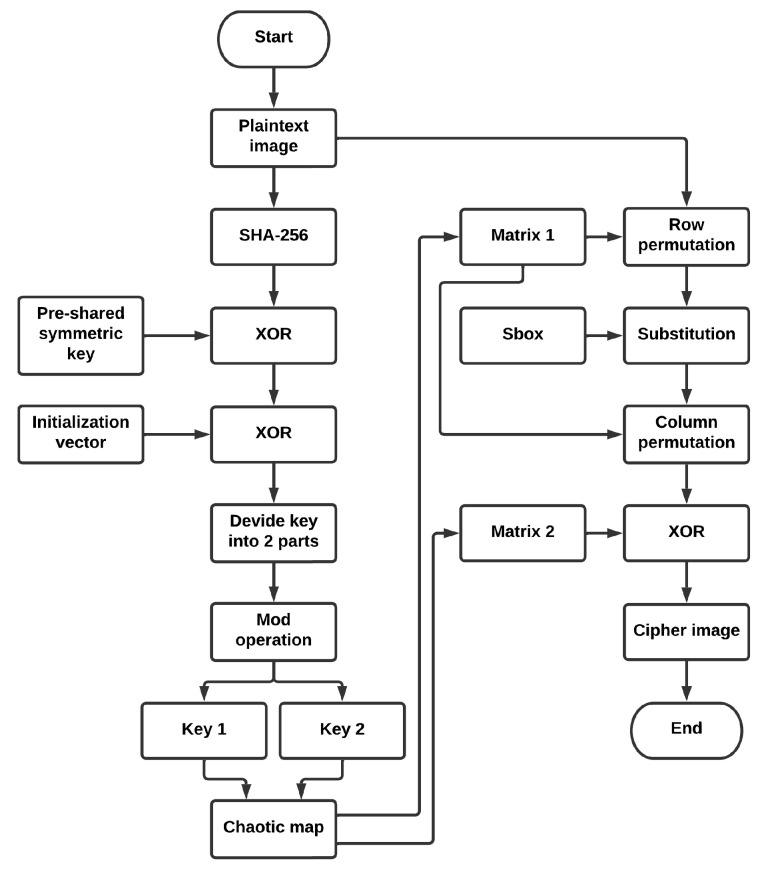
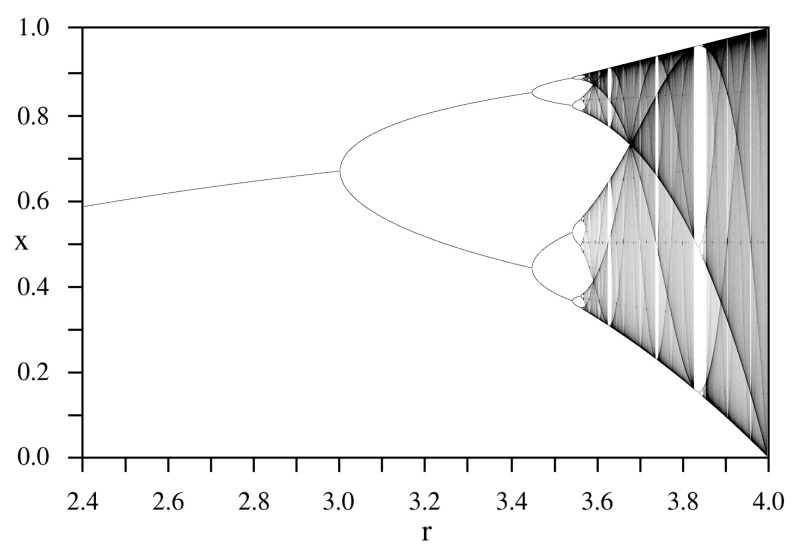
Chaotic-maps-based image encryption methods have been a topic of research interest for a decade. However, most of the proposed methods suffer from slow encryption time or compromise on the security of the encryption to achieve faster encryption. This paper proposes a lightweight, secure, and efficient image encryption algorithm based on logistic map, permutations, and AES S-box. In the proposed algorithm, SHA-2 based on the plaintext image, a pre-shared key, and an initialization vector (IV) are used to generate the initial parameters for the logistic map. The logistic map chaotically generates random numbers, which are then used for the permutations and substitutions. The security, quality, and efficiency of the proposed algorithm are tested and analyzed using a number of metrics, such as correlation coefficient, chi-square, entropy, mean square error, mean absolute error, peak signal-to-noise ratio, maximum deviation, irregular deviation, deviation from uniform histogram, number of pixel change rate, unified average changing intensity, resistance to noise and data loss attacks, homogeneity, contrast, energy, and key space and key sensitivity analysis. Experimental results reveal that the proposed algorithm is up to 15.33× faster compared to other contemporary encryption methods.
Overview
The claims and statistics of this paper haven’t been checked yet.
Free: it reads the open-access text and checks the first 5 claims that cite a source we can check. Create a free account to check every claim.
Integrity signals
Registry
Cites
Statistics
Figures

Verification
Claims the paper makes
The claims and statistics of this paper haven’t been checked yet.
Free: it reads the open-access text and checks the first 5 claims that cite a source we can check. Create a free account to check every claim.
Claims other papers make about this one
Each is checked against this paper’s own text: does it say what the citing paper says it does?
The cited source says what the claim attributes to it.
In the citing paper
“In chaos-based algorithms, the pseudorandom chaotic sequences that are generated by the chaotic system are used to permute and diffuse a plaintext image [8].”
From Image Encryption Algorithms: A Survey of Design and Evaluation Metrics (2024) · cites this paper as [8]
Self-check
Percentages, sums and reported differences re-computed from the paper’s own numbers.
The self-check needs the paper’s full text.
Citations
Cites
1 retracted
Khan, M., & Shah, T. (2014) · Neural Computing and Applications · doi:10.1007/s00521-014-1663-4 · Cited by 72 · cited 1×
“The GLCM calculates the frequency of a pixel with gray-level value i occurring horizontally adjacent to a pixel with the gray-level value j [33].”
MethodRetractedA Mathematical Theory of Communication
Shannon, C. E. (1948) · Bell System Technical Journal · doi:10.1002/j.1538-7305.1948.tb01338.x · Cited by 88,486
SOME BASIC CRYPTOGRAPHIC REQUIREMENTS FOR CHAOS-BASED CRYPTOSYSTEMS
ALVAREZ, G., & LI, S. (2006) · International Journal of Bifurcation and Chaos · doi:10.1142/s0218127406015970 · Cited by 2,119 · cited 1×
“To provide sufficient security against brute force attacks, key space for an encryption algorithm should be larger than 2 100 [39].”
BackgroundA symmetric image encryption scheme based on 3D chaotic cat maps
Chen, G., Mao, Y., & Chui, C. K. (2004) · Chaos, Solitons & Fractals · doi:10.1016/j.chaos.2003.12.022 · Cited by 2,092
(2011) · Cited by 904
2D Sine Logistic modulation map for image encryption
Hua, Z., Zhou, Y., Pun, C.-M., & Chen, C. L. P. (2015) · Information Sciences · doi:10.1016/j.ins.2014.11.018 · Cited by 777 · cited 3×
“Most of the prior works on image encryption [5–8] do not consider encryption speed in their design.”
BackgroundMethodInfluentialLocal Shannon entropy measure with statistical tests for image randomness
Wu, Y., Zhou, Y., Saveriades, G., Agaian, S., Noonan, J. P., & Natarajan, P. (2013) · Information Sciences · doi:10.1016/j.ins.2012.07.049 · Cited by 722
Advanced Encryption Standard (AES)
National Institute of Standards and Technology (US) (2001) · doi:10.6028/nist.fips.197 · Cited by 642
A novel image encryption scheme based on substitution-permutation network and chaos
Belazi, A., Abd El-Latif, A. A., & Belghith, S. (2016) · Signal Processing · doi:10.1016/j.sigpro.2016.03.021 · Cited by 486 · cited 1×
“However, the performance of Belazi et al. [28] is better than the proposed algorithm for the image Peppers and on average.”
Research works printed but not linked: 2
- Mali, 2015, A study on statistical analysis and security evaluation parameters in image encryption, Entropy, 34, 36
- Ahmad, 2010, Efficiency analysis and security evaluation of image encryption schemes, Computing, 23, 25
Cited by
Items 101–108 of 108
PixelChain: A Blockchain Inspired Reversible Cryptographic Framework for Secure Image EncryptionPreprint
Nujumudeen, F. (2026) · Research Square · doi:10.21203/rs.3.rs-11132326/v1
Sari, C. A., Marjuni, A., Setiarso, I., Rachmawanto, E. H., Damayanti, E., Isinkaye, F. O., Yaacob, N. M., & Sarker, M. K. (2026) · Bulletin of Electrical Engineering and Informatics · doi:10.11591/eei.v15i5.11330
A Novel RGB color plane chaotic scrambling-based image encryption algorithm
İNCE, K., İnce, C., & Hanbay, D. (2024) · International Journal of Advanced Natural Sciences and Engineering Researches
Saini, A., & Sehrawat, R. (2026) · Optical Memory and Neural Networks · doi:10.3103/s1060992x26700098
“…in Table 5, the correlation coefficients for the encrypted images drop to near zero, with values such as −0.00248 (horizontal for Baboon) and 0.00089 (horizontal for Peppers), demonstrating a significant improvement compared to existing methods reported in references [17], [24], [31] and [55].”
InfluentialErdoğan, K. D., & Doğan, N. (2026) · Sensors · doi:10.3390/s26196285
A Comprehensive Review of Hybrid Image Encryption Techniques for Secure Digital Image Communication
Agrawal, M. (2026) · Dandao Xuebao/Journal of Ballistics
A Chaotic Pure Tent Map-Based AES Key Expansion for Enhanced Symmetric Key Cryptography
Talirongan, H., Gambe, M. S., & Talirongan, F. J. B. (2026) · doi:10.1109/icsl-dsga70378.2026.11736654
“…ln(1.95) ≈ 0.668 (about 96.3% of the theoretical maximum chaos efficiency) by performing empirical tests instead of heuristic parameter choices, while mixing time verification indicates that the chosen transient length of 200 iterations is greater than 24 times the computed requirement [21], [23].”
InfluentialTatad, L., Martinez, J. J. F., & Tenerife, J. T. (2026) · International Conference on Computer Engineering and Application (ICCEA) · doi:10.1109/iccea69962.2026.11743714
“�∑ � 𝑥𝑥 100 An ideal image has entropy 8; values near 8 means the encrypted image pixel distribution is nearly uniform.”
Metadata
- Authors
- Alghamdi, Y., Munir, A., & Ahmad, J.
- Affiliations
- Kansas State University (US)
- Edinburgh Napier University (GB)
- Corresponding author
- Munir, Arslan
- Venue
- Entropy
- Publisher
- MDPI AG
- Published
- 2022-09-23
- Volume
- 24
- Issue
- 10
- Pages
- 1344
- ISSN
- 1099-4300 (ISSN-L)
- PMC
- PMC9600900
- OpenAlex
- W4297235651
- Cited by
- 97
- References
- 35
- Citations by year
- 2026: 21 · 2025: 33 · 2024: 22 · 2023: 21
- FWCI
- 6.21
- Type
- journal article
- Language
- en
- Open access
- gold
- doi.org
- Licence
- Locations
- Entropy (publishedVersion, cc-by)
- PubMed Central (publishedVersion, cc-by)
- PubMed (publishedVersion)
- DOAJ (DOAJ: Directory of Open Access Journals) (submittedVersion, cc-by-sa)
- Edinburgh Napier Research Repository (Edinburgh Napier University) (submittedVersion, cc-by)
- Topics
- Physical Sciences › Computer Science › Computer Vision and Pattern Recognition › Chaos-based Image/Signal Encryption
- Physical Sciences › Computer Science › Artificial Intelligence › Computer Science and Engineering
- Physical Sciences › Computer Science › Computer Vision and Pattern Recognition › Advanced Steganography and Watermarking Techniques
- Keywords
- image encryption, logistic map, chaotic maps, random replacement, permutations, AES S-box, SHA-2, lightweight encryption, encryption speed, key sensitivity analysis, key space analysis
About these checks
Registry, retraction, Cites and statistics results are computed, not judged, with one exception: a printed reference that no index lists is read once by a model before it counts as a citation error. Claims are extracted by a model and kept only when their quote appears verbatim in the text; each cited source is then checked, with a model’s help, for whether it says what the claim relies on. Those verdicts can be wrong — read the claim’s quote and the cited source before relying on one.
Statistics and arithmetic are recomputed, not judged.
Confidence bands are shown only for fields calibrated on our annotated test set. None is calibrated yet, so no band is shown.
What counts as a claim ›How we measure confidence ›How we check this ›
Are you an author, or do you see a problem with this page? Request a review
Data sources
Bibliographic data: Semantic Scholar, OpenAlex, Crossref.
Contains information from the Semantic Scholar Academic Graph Datasets, made available under the ODC Attribution License (ODC-BY 1.0).
Semantic Scholar’s data is described in: Kinney, R., et al. (2023). The Semantic Scholar Open Data Platform. arXiv:2301.10140.
