

Systematic Review of Mindfulness-Based Interventions in Child-Adolescent Population: A Developmental Perspective
Open accessThe DOI matches its Crossref record; 86 of the 95 references it cites were found in a registry or an index; 16 of the 45 sources its claims cite were checked for support.
Abstract
Human development implies deep changes in cognitive, attentional, emotional, and behavioral skills. Therefore, Mindfulness-Based Interventions (MBIs) should be adapted in terms of dose, frequency, kind of exercises, assessment methods, and expected effects regarding the abilities and limitations of each developmental period. The present review seeks to describe and compare MBIs characteristics, assessment methods, and effects in youth between 3 and 18 years old considering four developmental periods. A systematic review was carried out including experimental primary studies published during the last five years. Results show that the frequency of the sessions and program duration varies widely. Differences were observed in instructors’ training and in assessment strategies. Discrepancies were observed regarding the effects of MBIs both within and between periods in cognitive, socio-emotional, symptoms, and mindfulness variables. Consistency was observed in prosocial behaviors for preschoolers, and in emotional and behavioral problems and hyperactivity in ages between preschool and early adolescence. Nevertheless, it was impossible to compare most results and determine consistency or discrepancy due to the lack of studies. Regarding mindfulness, it is defined and assessed in different ways in each period. Orientations are suggested to move from a compartmentalized view of isolated MBIs, towards an integrative perspective that allows tracing developmental trajectories for mindfulness and other key cognitive and socioemotional skills for children and adolescents.
Overview
CoChat Summary
TL;DR
This systematic review describes and compares mindfulness-based interventions (MBIs) for children and adolescents aged 3–18 across four developmental periods, finding wide variability in intervention design, assessment, and effects. It concludes that most results cannot be compared or judged consistent because of heterogeneity and gaps in the primary literature.
Key findings
- The review included 27 experimental primary studies; MBIs varied widely, with program duration from 4 to 24 weeks and session frequency from 1 to 5 sessions per week.
- Session duration differed by period: preschool sessions were 20–40 min, while early and middle adolescence sessions were 40–90 min; all interventions were face-to-face except one online asynchronous program for adolescents.
- Consistent effects were observed for prosocial behavior in preschoolers, and for emotional/behavioral problems and hyperactivity from preschool through early adolescence; general mindfulness and FFMQ facets were consistent between middle childhood and middle adolescence.
- Discrepancies were observed for cognitive, socioemotional, symptom, and mindfulness variables within and between periods, and most variables were assessed in only one study, preventing comparison.
Methods
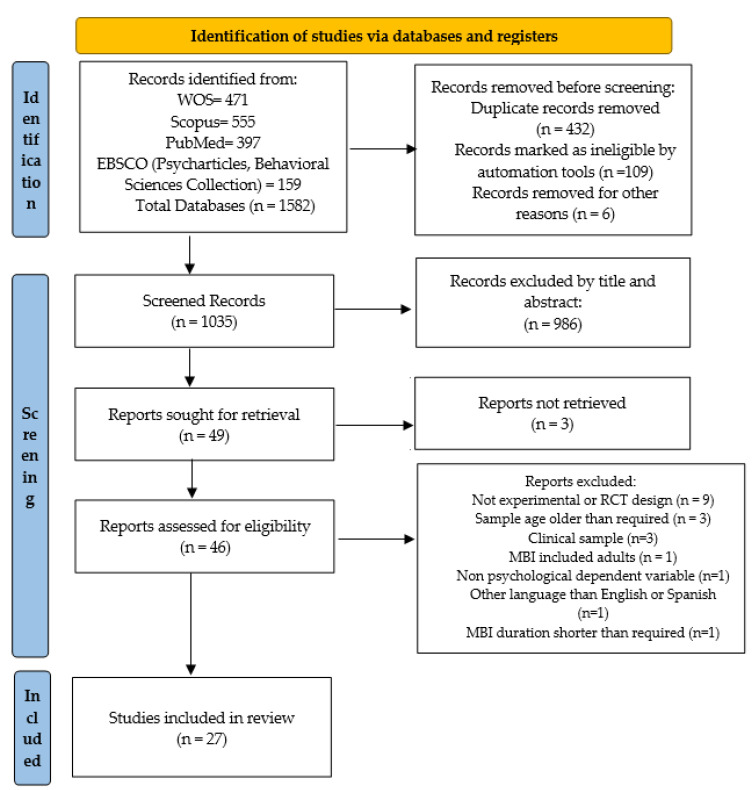
- Systematic review following PRISMA, searching WoS, Scopus, PubMed, and EBSCO for English/Spanish experimental or RCT primary studies published from 2017 to May 2021; 1582 records were retrieved and 27 articles were eligible.
- Inclusion required classic mindfulness exercises, ages 3–18, nonclinical population, school context, experimental/RCT design, and at least one psychological outcome.
- Studies were classified by mean sample age into four periods: preschool (3–6), middle childhood (7–10.9), early adolescence (11–13.9), and middle adolescence (14–18); dependent variables were grouped into cognitive, socioemotional, symptoms, mindfulness, and visual-motor/physiological categories.
Limitations
- The paper states that the search included only English and Spanish peer-reviewed articles, so the review is not exhaustive; it could not deeply compare mindfulness practice guidelines because authors often did not report them; and it could not compare whether self-report test language was adapted across developmental periods.
- The paper also states it considered only experimental primary studies published in peer-reviewed journals.
- Evident from the text: most variables were assessed in only one study, so consistency or discrepancy could not be determined, and heterogeneity in intervention definitions, assessment strategies, and mindfulness operationalization made cross-period comparison largely impossible.
Model-written summary. Check it against the paper before relying on it.
Integrity signals
Registry
Cites
Statistics
Figures
Verification
Claims the paper makes
12 Valid · 3 Not valid · 12 Not checked · 68 Own results and interpretations
Every source the paper cites for this claim was checked and supports it.
In the paper
“On the other hand, a primary study [68] that assessed executive functions used performance tasks (more direct measures) showing significant changes pre-post intervention.”
§ Systematic Review of Mindfulness-Based Interventions in Child-Adolescent Population: A Developmental Perspective > 4. Discussion
What the sources say
- Supportedcites [68] Zelazo P.D. Forston J.L. Masten A.S. Carlson S.M. Mindfulness Plus Reflection Training: Effects on Executive Function in Early Childhood Front. Psychol. 2018 9 208 10.3389/fpsyg.2018.00208 29535661 PMC5834482 source
The Methods > Measures section describes direct behavioral executive-function tasks administered at pre-test and post-test. The Results > Individual EF task analysis reports significant effects of time on those tasks, consistent with the claimed pre–post changes. This does not mean the intervention outperformed the controls at the immediate post-test. (LLM, conf=0.86)
plainstates a cause- Asserted: passes — The authors put it forward as true.
- Checkable: passes — It can be checked against evidence.
- Load-bearing: passes — The paper’s conclusions depend on it.
- Based: passes — The paper gives a reason why it holds.
- Supported
Every source the paper cites for this claim was checked and supports it.
In the paper
“Just one of them was done online, asynchronously, with an adolescent population [79].”
§ Systematic Review of Mindfulness-Based Interventions in Child-Adolescent Population: A Developmental Perspective > 3. Results
What the sources say
- Supportedcites [79] Lahtinen O. Salmivalli C. An Effectiveness Study of a Digital Mindfulness-Based Program for Upper Secondary Education Students Mindfulness 2020 11 2494 2505 10.1007/s12671-020-01462-y source
The Method section describes Tita as a digital mindfulness-based program for Finnish upper secondary students, most of whom were aged 16–19. The Discussion explicitly calls Tita asynchronous and says its content and delivery were not tied to a time or place. The citation identifies the study matching the citing sentence’s description; “just one of them” refers to the citing authors’ set of studies. (LLM, conf=0.93)
plain- Asserted: passes — The authors put it forward as true.
- Checkable: passes — It can be checked against evidence.
- Load-bearing: unclear — It is unclear whether the paper’s conclusions depend on it.
- Based: passes — The paper gives a reason why it holds.
- Supported
Every source the paper cites for this claim was checked and supports it.
In the paper
“(3) Consider effects of MBI on specific symptoms [1]”
§ Systematic Review of Mindfulness-Based Interventions in Child-Adolescent Population: A Developmental Perspective > 1. Introduction
What the sources say
- Supportedcites [1] Caldwell D.M. Davies S.R. Hetrick S.E. Palmer J.C. Caro P. López-López J.A. DSc D.G. Kidger J. Thomas J. French C. School-based interventions to prevent anxiety and depression in children and young people: A systematic review and network meta-analysis Lancet Psychiatry 2019 6 1011 1020 10.1016/S2215-0366(19)30403-1 31734106 PMC7029281 source
The Results section reports that the review included relaxation or mindfulness-based interventions and assessed their effects on specific symptoms. It reports a reduction in anxiety symptoms for mindfulness and relaxation interventions in universal secondary-school settings; the review is not limited to MBIs. (LLM, conf=0.88)
plain- Asserted: passes — The authors put it forward as true.
- Checkable: passes — It can be checked against evidence.
- Load-bearing: passes — The paper’s conclusions depend on it.
- Based: passes — The paper gives a reason why it holds.
- Supported
Every source the paper cites for this claim was checked and supports it.
In the paper
“(4) Include only qualitative studies [36]”
§ Systematic Review of Mindfulness-Based Interventions in Child-Adolescent Population: A Developmental Perspective > 1. Introduction
What the sources say
- Supportedcites [36] Sapthiang S. Van Gordon W. Shonin E. Health school-based mindfulness interventions for improving mental health: A systematic review and thematic synthesis of qualitative studies J. Child Fam. Stud. 2019 28 2650 2658 10.1007/s10826-019-01482-w source
The Selection Criteria and Data Extraction section requires included studies to use qualitative data collection and analysis. Table 1 likewise excludes quantitative studies unless they have an embedded qualitative arm. The citation supports identifying this review as one focused on qualitative evidence, not a claim about all prior reviews. (LLM, conf=0.90)
plain- Asserted: passes — The authors put it forward as true.
- Checkable: passes — It can be checked against evidence.
- Load-bearing: unclear — It is unclear whether the paper’s conclusions depend on it.
- Based: passes — The paper gives a reason why it holds.
- Supported
The sources with a verdict support this claim; the rest weren’t checked yet, have no full text we could read, or their verdicts aren’t rated yet.
In the paper
“(7) Include primary studies conducted past 5 years [14,54,55].”
§ Systematic Review of Mindfulness-Based Interventions in Child-Adolescent Population: A Developmental Perspective > 1. Introduction
What the sources say
- Not checked — no full text of the sourcecites [14] Burke C.A. Mindfulness-based approaches with children and adolescents: A preliminary review of current research in an emergent field J. Child Fam. Stud. 2010 19 133 144 10.1007/s10826-009-9282-x source
- Supportedcites [54] McKeering P. Hwang Y.-S. A systematic review of mindfulness-based school interventions with early adolescents Mindfulness 2019 10 593 610 10.1007/s12671-018-0998-9 source
The Search Strategy section reports that nine of the 13 studies included in this 2019 review were published since 2014, supporting the claim that it included recent primary studies. It also notes that the earliest study was published in 2004, so the review was not limited to the past five years. (LLM, conf=0.88)
- Not checked — no full text of the sourcecites [55] Felver J.C. Celis-de Hoyos C.E. Tezanos K. Singh N.N. A systematic review of mindfulness-based interventions for youth in school settings Mindfulness 2016 7 34 45 10.1007/s12671-015-0389-4 source
plain- Asserted: passes — The authors put it forward as true.
- Checkable: passes — It can be checked against evidence.
- Load-bearing: unclear — It is unclear whether the paper’s conclusions depend on it.
- Based: passes — The paper gives a reason why it holds.
47 more claims · 2 with their cited sources checked
Create a free account to see all 95 claims and every source verdict.
- It may state two separate claims as one. 23
- Probably not a substantial claim. 23
Self-check
Percentages, sums and reported differences re-computed from the paper’s own numbers.
Each contradiction between two passages listed here was confirmed by an independent check.
Rated major: it would touch a result — a value a result rests on, reported and recomputed p-values on opposite sides of the significance level, two passages that conflict with no sign which is right, or a cited work retracted before this paper was published.
In the paper
§ Systematic Review of Mindfulness-Based Interventions in Child-Adolescent Population: A Developmental Perspective > 4. Discussion
“there were significant changes in certain executive functions in stages 1 and 3, but not in stage 4.”
§ Systematic Review of Mindfulness-Based Interventions in Child-Adolescent Population: A Developmental Perspective > 3. Results
“| 4 | Executive Functions | Working Memory *+ | Discrepancy between periods: 67 (1) *, 59 (4) *//81 (3) + |”
Rated minor: it would not touch a result — a value no result rests on, a p-value that stays on the same side of the significance level, or a conflict that is clerical, resolved elsewhere in the paper, or outside its own findings.
In the paper
§ Systematic Review of Mindfulness-Based Interventions in Child-Adolescent Population: A Developmental Perspective > 3. Results
“| 2 | Attentional Skills | Selective Attention * | One study cannot compare: 64 (2) * |”
§ Systematic Review of Mindfulness-Based Interventions in Child-Adolescent Population: A Developmental Perspective > 3. Results
“| 3 | [63,64,69,71,72,75,80,81,82] |”
Rated minor: it would not touch a result — a value no result rests on, a p-value that stays on the same side of the significance level, or a conflict that is clerical, resolved elsewhere in the paper, or outside its own findings.
In the paper
§ Systematic Review of Mindfulness-Based Interventions in Child-Adolescent Population: A Developmental Perspective > 3. Results
“| 4 | Trait Mindfulness (MAAS-C) *+ | Consistency between periods: 60 (2) *, 57 (4) * |”
§ Systematic Review of Mindfulness-Based Interventions in Child-Adolescent Population: A Developmental Perspective > 3. Results
“| 2 | Trait Mindfulness (MAAS-C) *+ | Discrepancy between periods: 58 (2) *, 77 (4) *//71 (3) + |”
Rated minor: it would not touch a result — a value no result rests on, a p-value that stays on the same side of the significance level, or a conflict that is clerical, resolved elsewhere in the paper, or outside its own findings.
In the paper
§ Systematic Review of Mindfulness-Based Interventions in Child-Adolescent Population: A Developmental Perspective > 3. Results
“| 1 | Orientation to experience * | Cannot compare, only one study: 61 (1) * |”
§ Systematic Review of Mindfulness-Based Interventions in Child-Adolescent Population: A Developmental Perspective > 3. Results
“| 2 | [58,60,61,65,76] |”
Rated minor: it would not touch a result — a value no result rests on, a p-value that stays on the same side of the significance level, or a conflict that is clerical, resolved elsewhere in the paper, or outside its own findings.
In the paper
§ Systematic Review of Mindfulness-Based Interventions in Child-Adolescent Population: A Developmental Perspective > 3. Results
“| 4 | Others | Academic Achievement * | One study, cannot compare: 68 (4) |”
§ Systematic Review of Mindfulness-Based Interventions in Child-Adolescent Population: A Developmental Perspective > 3. Results
“| 1 | [62,66,67,68,70,73,78] |”
1 more finding
Create a free account to see every finding of this check.
Citations
Cites
The PRISMA 2020 statement: An updated guideline for reporting systematic reviews
Page, M. J., McKenzie, J. E., Bossuyt, P. M., Boutron, I., Hoffmann, T. C., Mulrow, C. D., Shamseer, L., Tetzlaff, J. M., Akl, E. A., Brennan, S. E., et al. (2021) · BMJ · doi:10.1136/bmj.n71 · Cited by 108,283
Mindfulness: A proposed operational definition.
Bishop, S. R., Lau, M., Shapiro, S., Carlson, L., Anderson, N. D., Carmody, J., Segal, Z. V., Abbey, S., Speca, M., Velting, D., et al. (2004) · Clinical Psychology: Science and Practice · doi:10.1093/clipsy.bph077 · Cited by 7,234 · cited 1×
“It has been defined as a two-component construct: (a) self-regulation of attention, which is maintained in the immediate experience, and (b) orientation to one’s own present experience characterized by curiosity, openness, and acceptance [13].”
BackgroundThe effect of mindfulness based therapy on anxiety and depression: A meta analytic review
Hofmann, S. G., Sawyer, A. T., Witt, A. A., & Oh, D. (2010) · Journal of Consulting and Clinical Psychology · doi:10.1037/a0018555 · Cited by 3,846
Roberts, B. W., & DelVecchio, W. F. (2000) · Psychological Bulletin · doi:10.1037/0033-2909.126.1.3 · Cited by 3,241 · cited 2×
“Differences arise in the cutting age of each group [49,50].”
BackgroundMethodPrevention of relapse/recurrence in major depression by mindfulness-based cognitive therapy.
Teasdale, J. D., Segal, Z. V., Williams, J. M. G., Ridgeway, V. A., Soulsby, J. M., & Lau, M. A. (2000) · Journal of Consulting and Clinical Psychology · doi:10.1037/0022-006x.68.4.615 · Cited by 3,236
Baer, R. A., Smith, G. T., Lykins, E., Button, D., Krietemeyer, J., Sauer, S., Walsh, E., Duggan, D., & Williams, J. M. G. (2008) · Assessment · doi:10.1177/1073191107313003 · Cited by 2,930 · cited 1×
“For example, in stage 1 mindfulness was considered as an orientation to experience, a skill evaluated by an observer [62] while in stage 2 [60] mindfulness was defined based on the classic facets of the 5FMQ, considering General Mindfulness, Observing, Describing, Acting with awareness, Non-judging, Non-reacting [96].”
Method(2007) · PubMed Central · Cited by 2,521
Child and adolescent mental health worldwide: evidence for action
Kieling, C., Baker-Henningham, H., Belfer, M., Conti, G., Ertem, I., Omigbodun, O., Rohde, L. A., Srinath, S., Ulkuer, N., & Rahman, A. (2011) · The Lancet · doi:10.1016/s0140-6736(11)60827-1 · Cited by 2,449
Scaling of theory-of-mind tasks.
Wellman, H. M., & Liu, D. (2004) · Child Development · doi:10.1111/j.1467-8624.2004.00691.x · Cited by 1,980
Gu, J., Strauss, C., Bond, R., & Cavanagh, K. (2015) · Clinical Psychology Review · doi:10.1016/j.cpr.2015.01.006 · Cited by 1,712
Research works printed but not linked: 5
- Kabat-Zinn J. Mindfulness-based stress reduction (MBSR) Constr. Hum. Sci. 2003 8 73
- Raveepatarakul J. Suttiwan P. Iamsupasit S. Mikulas W.L. A mindfulness enhancement program for Thai 8-to 11-year old children: Effects on mindfulness and depression J. Health Res. 2014 28 335 341
- Kim Y.W. Lee S.H. Choi T.K. Suh S.Y. Kim B. Kim C.M. Cho S.J. Kim M.J. Yook K. Ryu M. Effectiveness of mindfulness based cognitive therapy on female elementary students with generalized anxiety disorder Int. J. Psychol. Behav. Res. 2014 3 159 165
- Lerner R.M. Easterbrooks M.A. Mistry J. Developmental Science Across the Life Span: An Introduction John Wiley & Sons, Inc. Hoboken, NJ, USA 2013
- Thorndike R.M. Thorndike-Christ T.M. Measurement and Evaluation in Psychology and Education Pearson London, UK 2010
Cited by
Monsillion, J., Zebdi, R., & Romo, L. (2023) · Children · doi:10.3390/children10050861 · Cited by 76
“However, this raises instructor training discrepancies and proficiency issues, as there are no set standards or requirements for school MBI trainings for teachers [104,105].”
BackgroundPickerell, L., Pennington, K., Cartledge, C., Miller, K. A., & Curtis, F. (2023) · Mindfulness · doi:10.1007/s12671-023-02131-6 · Cited by 83
Cai, C., Mei, Z., Wang, Z., & Luo, S. (2025) · Frontiers in Psychiatry · doi:10.3389/fpsyt.2025.1594658 · Cited by 86
At-Home use of App-Based Mindfulness for Children: A Randomized Active-Controlled Trial
Treves, I. N., Olson, H. A., Ozernov‐Palchik, O., Li, C. E., Wang, K. L., Arechiga, X. M., Goldberg, S. B., & Gabrieli, J. D. E. (2023) · Mindfulness · doi:10.1007/s12671-023-02231-3 · Cited by 23
“…35 for LowPracticeMindful, and 18 mindfulness individuals were missing data for days practiced (Caldwell et al., 2019; Carsley et al., 2018; Porter et al., 2022), improved attention (Bauer et al., 2020), and behavioral regulation (Kaunhoven & Dorjee, 2017; Schonert-Reichl et al., 2015).”
BackgroundOyanadel, C., Núñez, Y., González-Loyola, M., Jofré, I., & Castro, W. P. (2022) · Children · doi:10.3390/children10010024 · Cited by 18
Self-citationPorter, B., Oyanadel, C., Betancourt, I., Worrell, F. C., & Castro, W. P. (2024) · Pediatric Reports · doi:10.3390/pediatric16020022 · Cited by 18
“…MBIs, improving the specificity of the interventions and the quality of the research designs [23,32], as well as increasing the variety of modes to deliver interventions (e.g., face-to-face programs vs. programs carried out 100% online synchronously) [33], are challenges that need to be addressed.”
BackgroundResultInfluentialSelf-citationDong, B., Wang, M., Que, X., Sun, M., & Chen, A. (2025) · Journal of Environmental Psychology · doi:10.1016/j.jenvp.2025.102668 · Cited by 12
Integrating a Strategic Framework to Improve Health Education in Schools in South Tyrol, Italy
Wiedermann, C. J., Rina, P., Barbieri, V., Piccoliori, G., & Engl, A. (2024) · Epidemiologia · doi:10.3390/epidemiologia5030027 · Cited by 15
“In addition, the indirect effects of school-based programs, such as improved teacher health literacy and increased parent–teacher collaboration, contribute to a supportive educational atmosphere, which is essential for students’ overall well-being [27,28].”
BackgroundJoss, D. (2025) · Mindfulness · doi:10.1007/s12671-025-02585-w · Cited by 7
“…& Solangaarachchi, 2021; Lee et al., 2021), mindfulness-based interventions are starting to be developed for parents (Shorey & Ng, 2021), schools (McK-eering & Hwang, 2019), and children of different ages facing various developmental challenges (Greenberg & Harris, 2012; Porter et al., 2022).”
Lin, L.-J., Lin, Y., Yu, S.-P., Liu, T.-H., & Chen, Y. (2025) · Frontiers in Psychology · doi:10.3389/fpsyg.2025.1539962 · Cited by 8
García-Lorenzo, R., Carbonero, M. Á., Valdivieso-León, L., & Izar-de-la-Fuente, I. (2025) · Mindfulness · doi:10.1007/s12671-025-02518-7 · Cited by 10
“Mindfulness intervention programmes had shown significant effects on symptom reduction, improvement of executive functions and a positive impact on emotional skills, both in children and in adolescents (Porter et al., 2022).”
Kuru, N., Ungar, M. T., & Akman, B. (2024) · Journal of Child and Family Studies · doi:10.1007/s10826-024-02924-w · Cited by 7
Devassy, S. M., Scaria, L., Metzger, J. W., Thampi, K., Jose, J., & Joseph, B. (2023) · Scientific Reports · doi:10.1038/s41598-023-45035-0 · Cited by 10
Wepener, I., & Moen, M. C. (2025) · Pastoral Care in Education · doi:10.1080/02643944.2025.2502040 · Cited by 8
“However, while the evidence is promising, it is essential to note that findings are not universally conclusive; some studies indicate variability in MBI outcomes based on factors such as programme duration, facilitator training, and participant engagement (Porter et al., 2022).”
Folger, A. C., Nekkanti, A. K., Williamson, G., Guidinger, C., & Kelly, N. R. (2023) · Frontiers in Psychology · doi:10.3389/fpsyg.2023.1277614 · Cited by 8
D’Souza, F., & Smyth, L. (2025) · Mindfulness · doi:10.1007/s12671-025-02627-3 · Cited by 17
“…typically include focused meditation practices, along with strategies to enhance awareness of internal thoughts, emotions and physical sensations although these awareness practices tend to vary considerably between trials (Carsley et al., 2018; Palacios et al., 2023; Porter et al., 2022).”
Gutiérrez-Hernández, M. E., Fanjul, L. F., Díaz, A., Oyanadel, C., & Castro, W. P. (2023) · European Journal of Investigation in Health Psychology and Education · doi:10.3390/ejihpe13040058 · Cited by 7
“This program connects well-established mindfulnessbased protocols to deal with emotional disorders [19,20] with SC components, as was previously proposed [1].”
BackgroundSelf-citationMalboeuf‐Hurtubise, C., Taylor, G., Léger‐Goodes, T., Touré, E. H., Fitzpatrick, C., & Smith, J. (2025) · Research Square · doi:10.21203/rs.3.rs-6448641/v1 · Cited by 3
Moghimi, E., Belfry, K., Farr, S., Stafford, S., Bogdan, A., Brush, M., Canning, C., & Kim, S. (2025) · BMC Health Services Research · doi:10.1186/s12913-024-12101-w · Cited by 10
Exploring the landscape of mindfulness practice in early childhood education in Ireland
Flanagan, L., McGourty, J., & O’Connor, C. (2025) · European Early Childhood Education Research Journal · doi:10.1080/1350293x.2025.2453867 · Cited by 5
“However, some systematic reviews (Dunning et al. 2022; Porter et al. 2022 and Sun et al. 2021) of mindfulness programmes with children aged 4–18 years indicate methodological concerns regarding measurement, variability in the duration and frequency of the mindfulness sessions and instructor…”
Gülden, Ç., & Yalçın, İ. (2024) · Journal of Adolescent Research · doi:10.1177/07435584241297141 · Cited by 5
“Furthermore, a variety of populations are subjected to MBIs, including those of varying ages, clinical conditions, cultural backgrounds, and socioeconomic statuses (Porter et al., 2022).”
InfluentialCavioni, V., Conte, E., Cefai, C., & Ornaghi, V. (2025) · Children · doi:10.3390/children12080985 · Cited by 4
“Second, the inclusion of brief, regular mindfulness practices at the beginning of each session helped enhance children’s attentional control and emotional awareness—core components of emotional self-regulation [51,76].”
Social–emotional learning program: a community-based case-controlled study
Knier, K., Harrison, T. M., Grady, M., BROCK, A. P., Sood, G., Fuehrer, D. L., Sood, A., & Pierret, C. (2024) · Academia Mental Health and Well-Being · doi:10.20935/mhealthwellb7308 · Cited by 2
“…control, social awareness, empathy and perspective taking, kindness, gratitude, peer and group relationships, and classroom climate), symptoms (internalizing issues, e.g., depression and anxiety, and externalizing issues, e.g., aggression, conduct, and hyperactivity), and mindfulness [12, 28].”
Mindfulness and Its Role in Youth Mental Health in Schools
Albertova, S. M. (2024) · Advances in mental health and addiction · doi:10.1007/978-3-031-54295-4_2 · Cited by 2
Trait mindfulness buffers depersonalization symptoms among young adults exposed to childhood abuse
Mili, F. A., & Lindsay, E. K. (2026) · Frontiers in Psychology · doi:10.3389/fpsyg.2026.1838217 · Cited by 1
“…even though mindfulness interventions have been shown to boost trait mindfulness in adult (Kiken et al., 2015) and child/adolescent samples (Porter et al., 2022), the naturalistic development of trait mindfulness in childhood may be cultivated through mechanisms tied to temperament,…”
Effectiveness of Mindfulness-Based Interventions in Education: A Review
Camacho, C. R. (2025) · IGI Global eBooks · doi:10.4018/979-8-3373-0705-3.ch018 · Cited by 2
Ecker, A., Fritsch, C., Schleicher, D., Jacob, R., Kandsperger, S., Brunner, R. M., & Jarvers, I. (2025) · Frontiers in Psychiatry · doi:10.3389/fpsyt.2024.1503379 · Cited by 4
Magalhães, S., Carvalheiras, C., Ribeiro, C., Francisco, C., Mourisco, C., Leal, T., & Limpo, T. (2024) · Education Sciences · doi:10.3390/educsci14111155 · Cited by 2
“Recent reviews suggest that SBMPs are particularly effective for elementary school children, with studies showing greater improvements in mental health symptoms for younger children than adolescents [4,37].”
Terapi Mindfulness terhadap Kesehatan Mental Remaja
Firdaus, A. M., Sawitri, D. R., & Dwidiyanti, M. (2023) · Journal of Telenursing (JOTING) · doi:10.31539/joting.v5i1.5498 · Cited by 4
“Tidak hanya mengatasi gangguan suasana hati, mindfulness juga meningkatkan respon terhadap stressor atau peristiwa yang traumatis sehingga juga mampu mencegah terjadinya gangguan mood (Porter et al., 2022).”
BackgroundMindfulness Practices in Children and Adolescents
Brown, B., Kurian, S. R., & Zamora, G. (2026) · Psychiatric Clinics of North America · doi:10.1016/j.psc.2026.07.003
Armutçu, B., Tunca, A., & Özkaya, Ü. G. (2026) · Journal of Child & Adolescent Trauma · doi:10.1007/s40653-026-00967-3
Yépez-Verduga, J. V., & Villacís-Macías, C. D. (2026) · Frontiers in Psychology · doi:10.3389/fpsyg.2026.1844428
Atiya-Malki, A., & Tarrasch, R. (2026) · Mindfulness · doi:10.1007/s12671-026-02937-0
Liu, X., Chen, J. K., Zhu, M., & Chen, X. (2026) · Family Relations · doi:10.1111/fare.70281
Voltmer, K., & Klein, A. M. (2026) · Frontiers in Psychology · doi:10.3389/fpsyg.2026.1849238
“In recent years mindfulness-based interventions (MBIs) became increasingly popular in the educational context (Porter et al., 2022).”
Lv, S., Russell, B. S., Francis-Edoziuno, C. C., & Mas, M. (2026) · Mindfulness · doi:10.1007/s12671-026-02935-2
Accompagner le développement des fonctions exécutives à la petite enfance : document de soutien
Melançon, A., & Bergeron-Gaudin, M.-È. (2026) · doi:10.64490/rilx1689
Oswal, N. P., Jagtap, P., & Dasarwar, P. (2026) · Frontiers in Public Health · doi:10.3389/fpubh.2026.1772248
“There are many studies wherein the effect of mindfulness practices for non-clinical populations among children and adolescents has been assessed (12).”
InfluentialChong, Z. Y., Chen, D., & Xu, W. (2026) · Mindfulness · doi:10.1007/s12671-026-02819-5
“This finding extends prior developmental accounts by indicating that mindful awareness may be more context-dependent and less age-driven than cognitive self-regulatory processes (Niem-inen & Sajaniemi, 2016; Porter et al., 2022; Vekety et al., 2022).”
Xie, J., Li, L., Liu, X., Yue, W., & Guo, J. (2026) · Psychological Medicine · doi:10.1017/s0033291726104735
“These results support the clinical utility of MBCT for reducing NSSI, consistent with prior mindfulness research (Dumontheil et al., 2023; Porter et al., 2022).”
Mindfulness and Psychological Growth
Wajanatinapart, P. (2025) · Springer eBooks · doi:10.1007/978-981-95-3133-2_12
ERİNLİK DÖNEMİNDEKİ ÇOCUKLARIN FARKINDALIK VE ÖZNEL İYİ OLUŞ DURUMLARININ İNCELENMESİ
Solak, Z., & Özçelik, A. D. Ö. (2024) · Mehmet Akif Ersoy üniversitesi eğitim fakültesi dergisi. · doi:10.21764/maeuefd.1409346
Porter, B., Oyanadel, C., Betancourt, I., et al. (2024) · Preprints.org · doi:10.20944/preprints202401.2078.v1
Self-citationDhamodharan, M. (2024) · Advances in psychology, mental health, and behavioral studies (APMHBS) book series · doi:10.4018/979-8-3693-2651-0.ch013
Metadata
- Authors
- Porter, B., Oyanadel, C., Sáez-Delgado, F., Andaur, A., & Peñate, W.
- Affiliations
- University of Concepción (CL)
- Departamento de Psicología, Facultad de Ciencias Sociales, Universidad de Concepción, 4030000 Concepción, Chile
- Universidad Católica de la Santísima Concepción (CL)
- Pontificia Universidad Católica de Chile (CL)
- Departamento de Psicología Clínica, Psicobiología y Metodología, Facultad de Psicología, Campus de Guajara, Universidad de La Laguna, 38200 Santa Cruz de Tenerife, Spain
- Corresponding author
- Porter, Bárbara
- Venue
- European Journal of Investigation in Health, Psychology and Education
- Publisher
- MDPI AG
- Published
- 2022-08-22
- Volume
- 12
- Issue
- 8
- Pages
- 1220-1243
- ISSN
- 2174-8144 (ISSN-L)
- 2254-9625
- PMC
- PMC9407079
- OpenAlex
- W4292693454
- Semantic Scholar
- 311d765f732237645d68bb22731b12b0d260e1da
- Cited by
- 45
- References
- 95
- Citations by year
- 2026: 13 · 2025: 14 · 2024: 9 · 2023: 8 · 2022: 1
- FWCI
- 1.33
- Type
- journal article
- Language
- en
- Open access
- gold
- doi.org
- Licence
- Locations
- European Journal of Investigation in Health Psychology and Education (publishedVersion, cc-by)
- PubMed Central (publishedVersion, cc-by)
- PubMed (publishedVersion)
- Dialnet (Universidad de la Rioja) (submittedVersion)
- DOAJ (DOAJ: Directory of Open Access Journals) (submittedVersion)
- Funders
- National Agency for Research and Development (ANID)/International Cooperation Program/Project of the Chilean Ministry of Science, Technology, Knowledge, and Innovation (MEC80180087, n° 21180390)
- ANID (MEC80180087, n° 21180390)
- Topics
- Social Sciences › Psychology › Clinical Psychology › Mindfulness and Compassion Interventions
- Social Sciences › Education › Early Childhood Education and Development
- Social Sciences › Psychology › Clinical Psychology › Child and Adolescent Psychosocial and Emotional Development
- Keywords
- mindfulness-based interventions, child and adolescent development, developmental stages, preschool children, early adolescence, prosocial behavior, emotional and behavioral problems, hyperactivity, socioemotional skills, cognitive skills, mindfulness assessment, instructor training
About these checks
Registry, retraction, Cites and statistics results are computed, not judged, with one exception: a printed reference that no index lists is read once by a model before it counts as a citation error. Claims are extracted by a model and kept only when their quote appears verbatim in the text; each cited source is then checked, with a model’s help, for whether it says what the claim relies on. Those verdicts can be wrong — read the claim’s quote and the cited source before relying on one.
The claim verdicts this report counts are experimental: their accuracy is not yet measured.
A language model drew the claims from the paper on 2026-10-03, under version 3 of the claim definition (model deepseek-v4.1-flash, prompt extract-v3).
A second model labelled each claim on 2026-10-03 (model jev-1.13-20260917, definition revision gold-guideline-v0.2).
Cited sources are checked with a language model’s help (gpt-6-sol).
Statistics and arithmetic are recomputed, not judged.
Confidence bands are shown only for fields calibrated on our annotated test set. None is calibrated yet, so no band is shown.
What counts as a claim ›How we measure confidence ›How we check this ›
Are you an author, or do you see a problem with this page? Request a review
Data sources
Bibliographic data: Semantic Scholar, OpenAlex, Crossref.
Contains information from the Semantic Scholar Academic Graph Datasets, made available under the ODC Attribution License (ODC-BY 1.0).
Semantic Scholar’s data is described in: Kinney, R., et al. (2023). The Semantic Scholar Open Data Platform. arXiv:2301.10140.
