

Content Analysis Using Specific Natural Language Processing Methods for Big Data
Open accessThe DOI matches its Crossref record; 71 of the 74 references it cites were found in a registry or an index.
Abstract
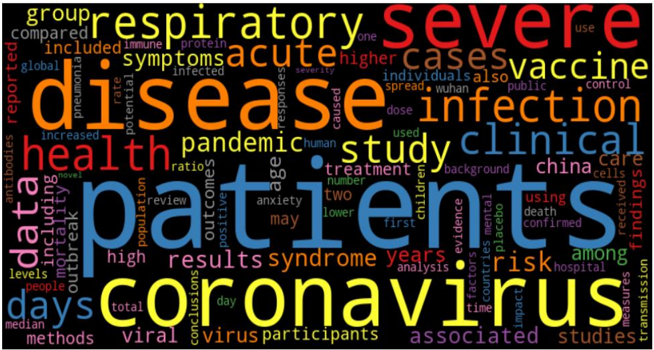
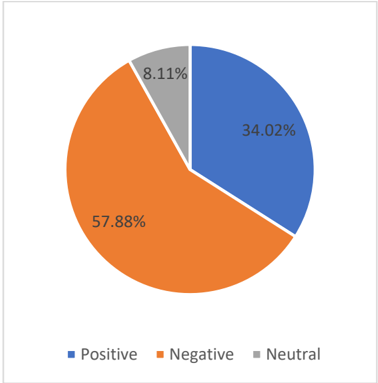
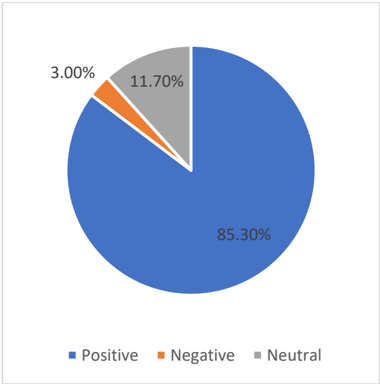
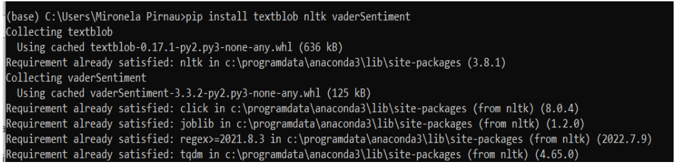
Researchers from different fields have studied the effects of the COVID-19 pandemic and published their results in peer-reviewed journals indexed in international databases such as Web of Science (WoS), Scopus, PubMed. Focusing on efficient methods for navigating the extensive literature on COVID-19 pandemic research, our study conducts a content analysis of the top 1000 cited papers in WoS that delve into the subject by using elements of natural language processing (NLP). Knowing that in WoS, a scientific paper is described by the group Paper = {Abstract, Keyword, Title}; we obtained via NLP methods the word dictionaries with their frequencies of use and the word cloud for the 100 most used words, and we investigated if there is a degree of similarity between the titles of the papers and their abstracts, respectively. Using the Python packages NLTK, TextBlob, VADER, we computed sentiment scores for paper titles and abstracts, analyzed the results, and then, using Azure Machine Learning-Sentiment analysis, extended the range of comparison of sentiment scores. Our proposed analysis method can be applied to any research topic or theme from papers, articles, or projects in various fields of specialization to create a minimal dictionary of terms based on frequency of use, with visual representation by word cloud. Complementing the content analysis in our research with sentiment and similarity analysis highlights the different or similar treatment of the topics addressed in the research, as well as the opinions and feelings conveyed by the authors in relation to the researched issue.
Overview
The claims and statistics of this paper haven’t been checked yet.
Free: it reads the open-access text and checks the first 5 claims that cite a source we can check. Create a free account to check every claim.
Integrity signals
Registry
Cites
Statistics
Figures
Verification
Claims the paper makes
The claims and statistics of this paper haven’t been checked yet.
Free: it reads the open-access text and checks the first 5 claims that cite a source we can check. Create a free account to check every claim.
Self-check
Percentages, sums and reported differences re-computed from the paper’s own numbers.
The self-check needs the paper’s full text.
Citations
Cites
WHO Declares COVID-19 a Pandemic.
Cucinotta, D., & Vanelli, M. (2020) · Acta bio-medica dell'Ateneo parmense/Acta biomedica · doi:10.23750/abm.v91i1.9397 · Cited by 7,457
Representational similarity analysis-connecting the branches of systems neuroscience
Kriegeskorte, N. (2008) · Frontiers in Systems Neuroscience · doi:10.3389/neuro.06.004.2008 · Cited by 3,355
Text as Data: The Promise and Pitfalls of Automatic Content Analysis Methods for Political Texts
Grimmer, J., & Stewart, B. M. (2013) · Political Analysis · doi:10.1093/pan/mps028 · Cited by 3,297
Sentiment analysis algorithms and applications: A survey
Medhat, W., Hassan, A., & Korashy, H. (2014) · Ain Shams Engineering Journal · doi:10.1016/j.asej.2014.04.011 · Cited by 3,248
Natural language processing: an introduction
Nadkarni, P. M., Ohno-Machado, L., & Chapman, W. W. (2011) · Journal of the American Medical Informatics Association · doi:10.1136/amiajnl-2011-000464 · Cited by 1,975
Natural language processing: state of the art, current trends and challenges
Khurana, D., Koli, A., Khatter, K., & Singh, S. (2023) · Multimedia Tools and Applications · doi:10.1007/s11042-022-13428-4 · Cited by 1,823
A survey on sentiment analysis methods, applications, and challenges
Wankhade, M., Rao, A. C. S., & Kulkarni, C. (2022) · Artificial Intelligence Review · doi:10.1007/s10462-022-10144-1 · Cited by 1,528
Kolbe, R. H., & Burnett, M. S. (1991) · Journal of Consumer Research · doi:10.1086/209256 · Cited by 1,520
Extracting Policy Positions from Political Texts Using Words as Data
LAVER, M., BENOIT, K., & GARRY, J. (2003) · American Political Science Review · doi:10.1017/s0003055403000698 · Cited by 1,377
Verma, S., & Gustafsson, A. (2020) · Journal of Business Research · doi:10.1016/j.jbusres.2020.06.057 · Cited by 1,092
Research works printed but not linked: 3
- Nair, C.S.; Shivdas, A.; Yasmin, M. Research trends of open access publications in library and information science during COVID-19 pandemic: A bibliometric analysis. J. Posit. Sch. Psychol. 2022, 6, 1517-1524.
- Fry, A.; Gieseck-Ashworth, J.; Seiler, C. Loving statistics & excel fuzzy lookup in the time of COVID-19. Ser. Libr. 2022, 82, 145-149. [CrossRef]
- Teodorescu, H.N.; Bolea, S.C. Comparative Lexical Analysis of Three Romanian Works-The Etymological Metalepsis Role and Etymological Indices. Sci. Technol. (Romjist) 2022, 25, 275-289.
Cited by
Kanchon, M. K. H., Sadman, M., Nabila, K. F., Tarannum, R., & Khan, R. (2024) · International Journal of Cognitive Computing in Engineering · doi:10.1016/j.ijcce.2024.06.002 · Cited by 104
Oncioiu, I., & Bularca, A. R. (2025) · Societies · doi:10.3390/soc15060144 · Cited by 64
“AI models that collect and process data, especially those based on machine learning and deep learning, often work better when they have access to large datasets [8–10].”
Self-citationAlmashaleh, O., Wicaksono, H., & Valilai, O. F. (2025) · Journal of Open Innovation Technology Market and Complexity · doi:10.1016/j.joitmc.2025.100544 · Cited by 35
A Case Study of Social Media Analytics for Effective Digital Marketing in Textile Circularity
Almashaleh, O., Wicaksono, H., & Valilai, O. F. (2024) · IEEE International Conference on Technology Management, Operations and Decisions (ICTMOD) · doi:10.1109/ictmod63116.2024.10878228 · Cited by 13
Analysis of Digital Content of Indonesian Society in the Public Service Sector
Binsar, F., Bayu, M., Abbas, I., Budiman, A., & Abidah (2025) · Lecture notes in networks and systems · doi:10.1007/978-981-97-9324-2_8 · Cited by 6
Silayo, D. M., Bongole, A. J., & Kulwijila, M. (2025) · Cogent Food & Agriculture · doi:10.1080/23311932.2025.2546079 · Cited by 5
“The primary aim of this review was not to assess emotional tone or linguistic features which are best handled through nlP (Pirnau et al., 2024), but rather to synthesize meaningful conceptual insights and thematic patterns to inform technology implementers, policymakers, and researchers.”
A Hybrid Numerical–Semantic Clustering Algorithm Based on Scalarized Optimization
Ifrim, A. M., & Oncioiu, I. (2025) · Algorithms · doi:10.3390/a18100607 · Cited by 5
Self-citationHamid, M. S., Eviyanti, A., Hindarto, H., & Ariyanti, N. (2025) · SMATIKA JURNAL · doi:10.32664/smatika.v15i01.1522 · Cited by 2
Analysis of Indonesian Opinion on the Arrival of COVID-19 Vaccine Using Machine Learning
Alfat, L., Uddin, N., Nasucha, M., Mohamad, M., & Masrom, S. (2024) · International Conference on Information Technology, Computer, and Electrical Engineering · doi:10.1109/icitacee62763.2024.10761958
“The TextBlob library is used for sentiment classification by analyzing every word in the text corpus using NLP. Textblob assigns a sentence as positive, negative, or neutral sentiment based on the average polarity and subjectivity score [13].”
Nimrud, A. H., Al-Rubay, S. H. A., Ali, Z. A. A. W., Hasan, M., Hamza, A. A., Read, S. A., & Madi, A. (2025) · International Conference on Cyber Resilience (ICCR) · doi:10.1109/iccr67387.2025.11292580 · Cited by 1
Sumantiawan, D. I., Abdillah, M. Z., & Kholilurrahman, M. (2026) · Jurnal Teknik Informatika (Jutif) · doi:10.52436/1.jutif.2026.7.2.5184
Señal, C. D., Parungao, A. A., Estrada, E. B., Mina, J. C., & Dioses, I. A. M. (2026) · International Conference on Integrated Intelligence and Cognitive Engineering (ICIICE) · doi:10.1109/iciice69672.2026.11565410
“Such approaches are particularly relevant in architectural design contexts, where user experience is shaped by both physical and digital interactions [5].”
Pîrjan, A., & Petroșanu, D.-M. (2025) · doi:10.5281/zenodo.21682014 · Cited by 13
THE IMPACT OF AGENTIC CODING ON THE MODERN SOFTWARE DEVELOPMENT LIFECYCLE
Pîrjan, A., & Petroșanu, D.-M. (2026) · doi:10.5281/zenodo.21682074
Theodorakopoulos, L., Theodoropoulou, A., & Giotopoulos, K. (2026) · Springer proceedings in business and economics · doi:10.1007/978-3-032-17534-2_4
Pathinayake, N., Makavita, C. D., & Dinalankara, D. M. R. (2026) · Moratuwa Engineering Research Conference (MERCon) · doi:10.1109/mercon71835.2026.11691552
“To check whether prominent terms in LLM-generated ideas and novice-generated ideas are similar, the study used the most frequent words of the titles of generated ideas [26], [27] and visualized using top word list in. Fig.”
Metadata
- Authors
- Pirnau, M., Botezatu, M. A., Priescu, I., Hosszu, A., Tabusca, A., Coculescu, C., & Oncioiu, I.
- Affiliations
- Department of Informatics, Faculty of Informatics, Titu Maiorescu University, 040051 Bucharest, Romania
- Romanian-American University (RO)
- Titu Maiorescu University (RO)
- University of Bucharest (RO)
- Department of Informatics, Statistics and Mathematics, School of Computer Science for Business Management, Romanian American University, 012101 Bucharest, Romania
- Corresponding author
- Oncioiu, Ionica
- Venue
- Electronics
- Publisher
- MDPI AG
- Published
- 2024-01-31
- Volume
- 13
- Issue
- 3
- Pages
- 584
- ISSN
- 2079-9292 (ISSN-L)
- OpenAlex
- W4391384310
- Cited by
- 11
- References
- 74
- Citations by year
- 2026: 2 · 2025: 6 · 2024: 3
- FWCI
- 9.58
- Type
- journal article
- Language
- en
- Open access
- gold
- doi.org
- Licence
- Locations
- Electronics (publishedVersion, cc-by)
- Topics
- Social Sciences › General Social Sciences › Computational and Text Analysis Methods
- Physical Sciences › Computer Science › Artificial Intelligence › Sentiment Analysis and Opinion Mining
- Social Sciences › Library and Information Sciences › scientometrics and bibliometrics research
- Keywords
- COVID-19 pandemic research, Web of Science, highly cited papers, word frequency analysis, word clouds, sentiment analysis
About these checks
Registry, retraction, Cites and statistics results are computed, not judged, with one exception: a printed reference that no index lists is read once by a model before it counts as a citation error. Claims are extracted by a model and kept only when their quote appears verbatim in the text; each cited source is then checked, with a model’s help, for whether it says what the claim relies on. Those verdicts can be wrong — read the claim’s quote and the cited source before relying on one.
Statistics and arithmetic are recomputed, not judged.
Confidence bands are shown only for fields calibrated on our annotated test set. None is calibrated yet, so no band is shown.
What counts as a claim ›How we measure confidence ›How we check this ›
Are you an author, or do you see a problem with this page? Request a review
Data sources
Bibliographic data: Semantic Scholar, OpenAlex, Crossref.
Contains information from the Semantic Scholar Academic Graph Datasets, made available under the ODC Attribution License (ODC-BY 1.0).
Semantic Scholar’s data is described in: Kinney, R., et al. (2023). The Semantic Scholar Open Data Platform. arXiv:2301.10140.
