

Lithium Ion Battery Models and Parameter Identification Techniques
Open accessThe DOI matches its Crossref record; 153 of the 154 references it cites were found in a registry or an index.
Abstract
Nowadays, battery storage systems are very important in both stationary and mobile applications. In particular, lithium ion batteries are a good and promising solution because of their high power and energy densities. The modeling of these devices is very crucial to correctly predict their state of charge (SoC) and state of health (SoH). The literature shows that numerous battery models and parameters estimation techniques have been developed and proposed. Moreover, surveys on their electric, thermal, and aging modeling are also reported. This paper presents a more complete overview of the different proposed battery models and estimation techniques. In particular, a method for classifying the proposed models based on their approaches is proposed. For this classification, the models are divided in three categories: mathematical models, physical models, and circuit models.
Overview
The claims and statistics of this paper haven’t been checked yet.
Free: it reads the open-access text and checks the first 5 claims that cite a source we can check. Create a free account to check every claim.
Integrity signals
Registry
Cites
Statistics
Figures
Verification
Claims the paper makes
The claims and statistics of this paper haven’t been checked yet.
Free: it reads the open-access text and checks the first 5 claims that cite a source we can check. Create a free account to check every claim.
Claims other papers make about this one
Each is checked against this paper’s own text: does it say what the citing paper says it does?
In the citing paper
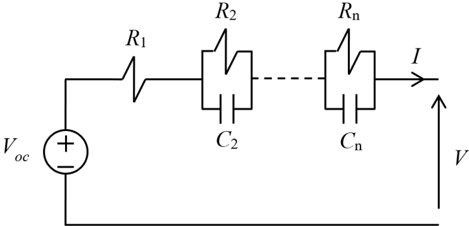
“The accuracy and reliability of the model prediction can be im proved by adding more RC series modules while the increased number of state parame ters make the identification process difficult.Thus, the accuracy and robustness of models are enhanced, but applicability in real-time is reduced [70].”
From A Review of Lithium-Ion Battery State of Health Estimation and Prediction Methods (2021) · cites this paper as [70]
Self-check
Percentages, sums and reported differences re-computed from the paper’s own numbers.
The self-check needs the paper’s full text.
Citations
Cites
Impedance Spectroscopy: Theory, Experiment, and Applications
(2005) · Wiley eBooks · doi:10.1002/0471716243 · Cited by 5,322
Modeling of Galvanostatic Charge and Discharge of the Lithium/Polymer/Insertion Cell
Doyle, M., Fuller, T. F., & Newman, J. (1993) · Journal of The Electrochemical Society · doi:10.1149/1.2221597 · Cited by 4,328 · cited 1×
“[47,52], in order to estimate both the current and voltage limits for a lithium ion cell under pulse operations.”
BackgroundA General Energy Balance for Battery Systems
Bernardi, D., Pawlikowski, E., & Newman, J. (1985) · Journal of The Electrochemical Society · doi:10.1149/1.2113792 · Cited by 2,548 · cited 3×
“[18], developed a one-dimensional model that could predict the temperature of a lithium ion cell.”
BackgroundAccurate electrical battery model capable of predicting runtime and I-V performance
Chen, M., & Rincon-Mora, G. A. (2006) · IEEE Transactions on Energy Conversion · doi:10.1109/tec.2006.874229 · Cited by 2,427
Simulation and Optimization of the Dual Lithium Ion Insertion Cell
Fuller, T. F., Doyle, M., & Newman, J. (1994) · Journal of The Electrochemical Society · doi:10.1149/1.2054684 · Cited by 2,057 · cited 1×
“[47,52], in order to estimate both the current and voltage limits for a lithium ion cell under pulse operations.”
BackgroundKinetics of rapid electrode reactions
Randles, J. E. B. (1947) · Discussions of the Faraday Society · doi:10.1039/df9470100011 · Cited by 1,884 · cited 1×
“Nevertheless, one of the most important so-called impedance models is based on the well-known Randless equivalent circuit model [108].”
MethodCycle-life model for graphite-LiFePO4 cells
Wang, J., Liu, P., Hicks-Garner, J., Sherman, E., Soukiazian, S., Verbrugge, M., Tataria, H., Musser, J., & Finamore, P. (2011) · Journal of Power Sources · doi:10.1016/j.jpowsour.2010.11.134 · Cited by 1,760
A review on lithium-ion battery ageing mechanisms and estimations for automotive applications
Barré, A., Deguilhem, B., Grolleau, S., Gérard, M., Suard, F., & Riu, D. (2013) · Journal of Power Sources · doi:10.1016/j.jpowsour.2013.05.040 · Cited by 1,758 · cited 1×
“Several surveys on these battery storage systems have been conducted for the different modeled aspects such as electric [1–4], thermal [5,6], and aging [7] factors.”
BackgroundNg, K. S., Moo, C.-S., Chen, Y.-P., & Hsieh, Y.-C. (2009) · Applied Energy · doi:10.1016/j.apenergy.2008.11.021 · Cited by 1,636 · cited 1×
“In [40,41], the authors proposed aging models based on the common method called “Coulomb counting.”
MethodComparison of Modeling Predictions with Experimental Data from Plastic Lithium Ion Cells
Doyle, M., Newman, J., Gozdz, A. S., Schmutz, C. N., & Tarascon, J. (1996) · Journal of The Electrochemical Society · doi:10.1149/1.1836921 · Cited by 1,569
Research works printed but not linked: 6
- Linden, D.; Reddy, T.B. Handbook of Batteries; McGraw-Hill: New York, NY, USA, 1995.
- Newman, J.; Thomas-Aleya, K. Electrochemical Systems, 3rd ed.; John Wiley & Sons: Hoboken, NJ, USA, 2004.
- Chan, H.L. (2000). A new battery model for used with battery energy storage system and electric vehicle power system. IEEE Power Eng. Soc., 470–475.
- Handschuh, T. (2007). Analysis of the Operation and Ageing Behaviour of Lead-Acid Batteries for Typical Stress Conditions of Hybrid Electric Propulsion Systems. [Ph.D. Thesis, University of Ulm].
- Moura, S.J., Chaturvedi, N.A., and Krstic, M. (2012, January 27–29). PDE Estimation Techniques for Advanced Battery Management Systems—Part II: SOH Estimation. Proceedings of the American Control Conference (ACC), Montreal, QC, Canada. · DOI · Paper page
- Erol, S. (2015.). Electrochemical Impedance Spectroscopy Analysis and Modeling of Lithium Cobalt Oxide/Carbon Batteries. [Ph.D. Thesis, University of Florida]. Available online: http://www.che.ufl.edu/orazem/pdf-files/Erol-PhD-2015.pdf.
Cited by
Shrivastava, P., Soon, T. K., Idris, M. Y. I. B., & Mekhilef, S. (2019) · Renewable and Sustainable Energy Reviews · doi:10.1016/j.rser.2019.06.040 · Cited by 704
Khan, F. M. N. U., Rasul, M. G., Sayem, A. S. M., & Mandal, N. K. (2023) · Journal of Energy Storage · doi:10.1016/j.est.2023.108033 · Cited by 507
Maximizing energy density of lithium-ion batteries for electric vehicles: A critical review
Khan, F. M. N. U., Rasul, M. G., Sayem, A. S. M., & Mandal, N. (2023) · Energy Reports · doi:10.1016/j.egyr.2023.08.069 · Cited by 300
A Review of Lithium-Ion Battery State of Health Estimation and Prediction Methods
Yao, L., Xu, S., Tang, A., Zhou, F., Hou, J., Xiao, Y., & Fu, Z. (2021) · World Electric Vehicle Journal · doi:10.3390/wevj12030113 · Cited by 237
“Thus, the accuracy and robustness of models are enhanced, but applicability in real-time is reduced [70].”
BackgroundBarcellona, S., Colnago, S., Dotelli, G., Latorrata, S., & Piegari, L. (2022) · Journal of Energy Storage · doi:10.1016/j.est.2022.104658 · Cited by 174
Self-citation
Metadata
- Authors
- Barcellona, S., & Piegari, L.
- Affiliations
- Politecnico di Milano (IT)
- Corresponding author
- Piegari, Luigi
- Venue
- Energies
- Publisher
- MDPI AG
- Published
- 2017-12-01
- Volume
- 10
- Issue
- 12
- Pages
- 2007
- ISSN
- 1996-1073 (ISSN-L)
- OpenAlex
- W2773340786
- Cited by
- 149
- References
- 154
- Citations by year
- 2026: 9 · 2025: 19 · 2024: 24 · 2023: 32 · 2022: 19 · 2021: 21 · 2020: 19 · 2019: 5 · 2018: 1
- FWCI
- 4.34
- Type
- journal article
- Language
- en
- Open access
- gold
- doi.org
- Licence
- Locations
- Energies (publishedVersion, cc-by)
- Virtual Community of Pathological Anatomy (University of Castilla La Mancha) (submittedVersion, other-oa)
- RePEc: Research Papers in Economics (submittedVersion)
- DOAJ (DOAJ: Directory of Open Access Journals) (submittedVersion, cc-by-sa)
- Topics
- Physical Sciences › Engineering › Automotive Engineering › Battery Modeling and Management
- Physical Sciences › Engineering › Electrical and Electronic Engineering › Advancements in Battery Materials
- Physical Sciences › Engineering › Control and Systems Engineering › Control Systems and Identification
- Keywords
- lithium-ion batteries, battery modeling, parameter estimation, state of charge estimation, state of health estimation, battery degradation, thermal modeling, battery storage systems, circuit model, mathematical model, physical model
About these checks
Registry, retraction, Cites and statistics results are computed, not judged, with one exception: a printed reference that no index lists is read once by a model before it counts as a citation error. Claims are extracted by a model and kept only when their quote appears verbatim in the text; each cited source is then checked, with a model’s help, for whether it says what the claim relies on. Those verdicts can be wrong — read the claim’s quote and the cited source before relying on one.
Statistics and arithmetic are recomputed, not judged.
Confidence bands are shown only for fields calibrated on our annotated test set. None is calibrated yet, so no band is shown.
What counts as a claim ›How we measure confidence ›How we check this ›
Are you an author, or do you see a problem with this page? Request a review
How to cite
Cite CoChat for the checks on this page, and the paper for its own findings.
- This page
- CoChat. (2026). Citation check: Lithium Ion Battery Models and Parameter Identification Techniques. https://app.cochat.ai/papers/10.3390/en10122007
- The paper
- Barcellona, S., & Piegari, L. (2017). Lithium Ion Battery Models and Parameter Identification Techniques. Energies. https://doi.org/10.3390/en10122007
Data sources
Bibliographic data: Semantic Scholar, OpenAlex, Crossref.
Contains information from the Semantic Scholar Academic Graph Datasets, made available under the ODC Attribution License (ODC-BY 1.0).
Semantic Scholar’s data is described in: Kinney, R., et al. (2023). The Semantic Scholar Open Data Platform. arXiv:2301.10140.
