

Improving Anaerobic Digestion of Sewage Sludge by Hydrogen Addition: Analysis of Microbial Populations and Process Performance
Open accessThe DOI matches its Crossref record; 46 of the 46 references it cites were found in a registry or an index.
Abstract
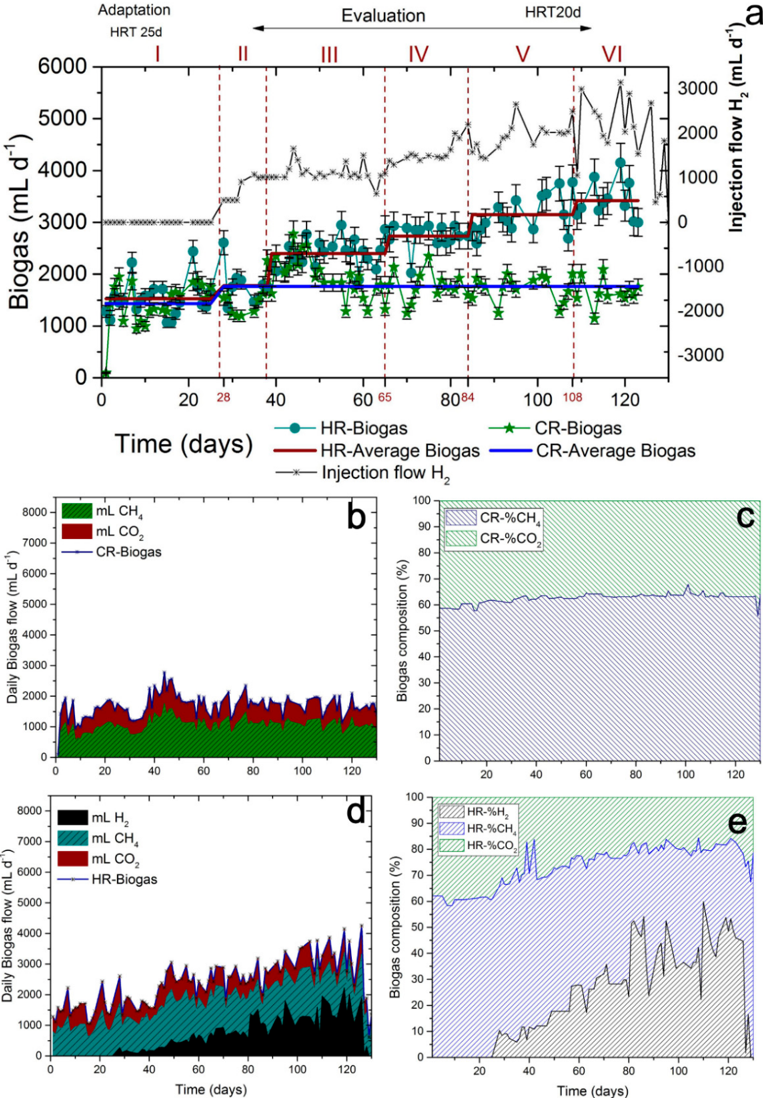
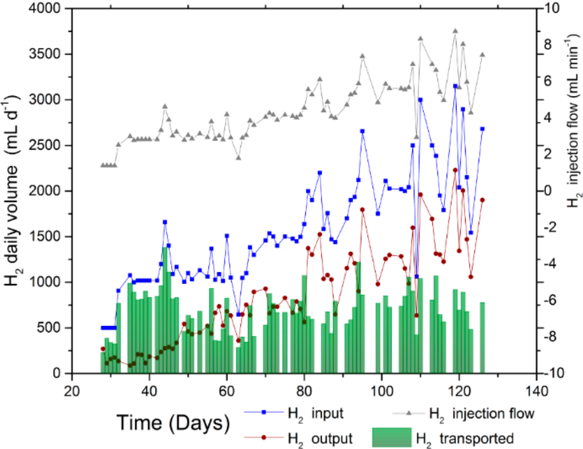
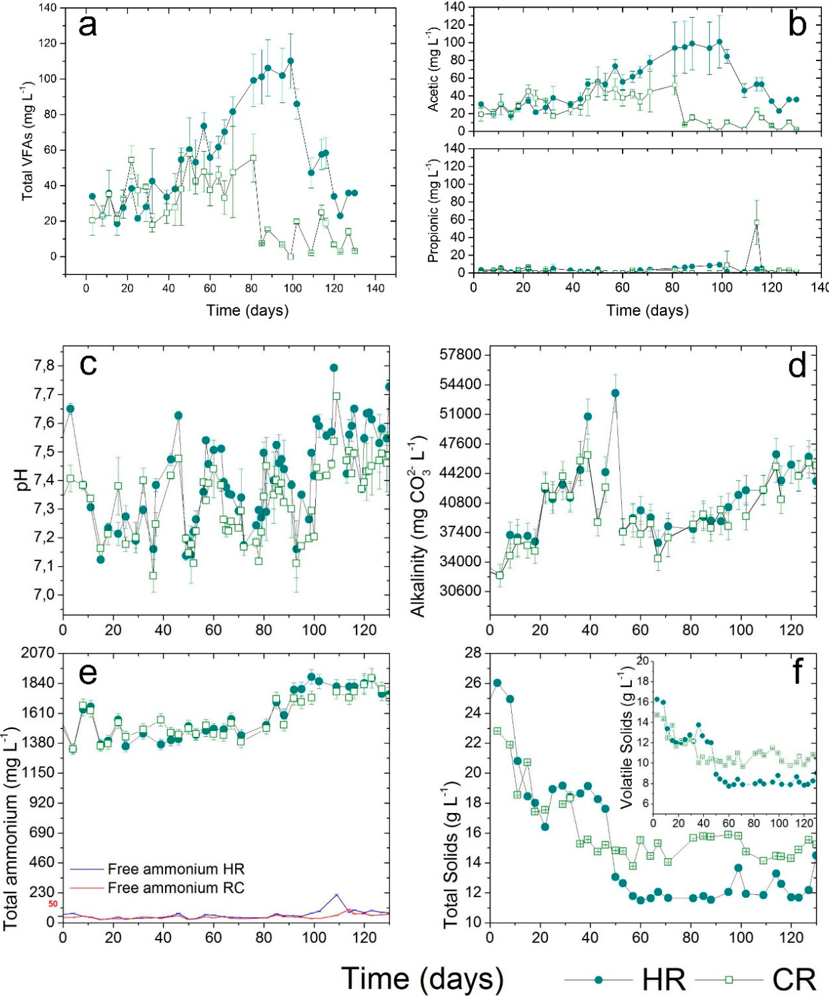
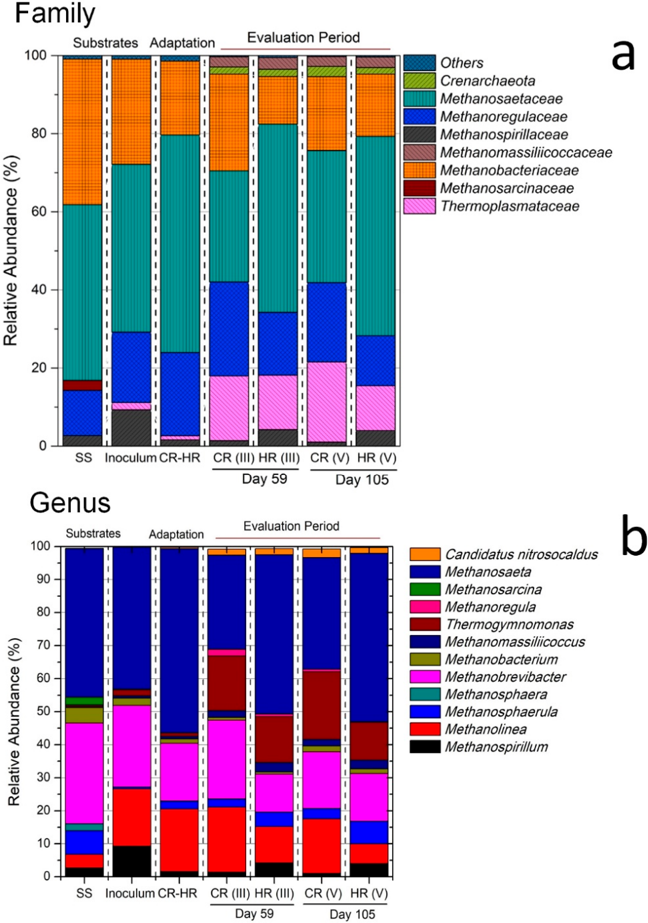
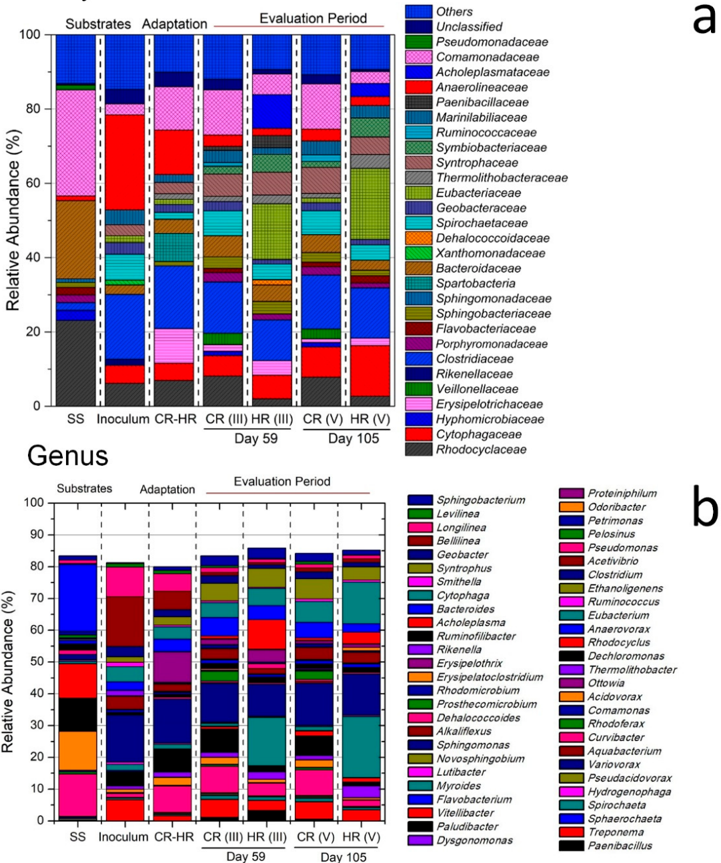
The effect of hydrogen pulse addition on digestion performance of sewage sludge was evaluated as a means for studying the increase in efficiency of methane production. Microbial communities were also evaluated to get an insight of the changes caused by the operational modifications of the digester. An energy evaluation of this alternative was performed considering the theoretical process of coupling bioelectrochemical systems (BES) for the treatment of wastewater along with hydrogen production and the subsequent anaerobic digestion. The addition of hydrogen to sewage sludge digestion resulted in an increase of 12% in biogas production over the control (1353 mL CH4 d−1 at an injection flow rate of 1938 mL H2 d−1). The liquid phase of the sludge reactor and the H2 supplemented one did not show significant differences, thus indicating that the application of hydrogen as the co-substrate was not detrimental. High-throughput sequencing analysis showed slight changes in archaeal relative abundance after hydrogen addition, whereas eubacterial community structure and composition revealed noteworthy shifts. The mass and energy balance indicated that the amount of hydrogen obtained from a hypothetical BES can be assimilated in the sludge digester, improving biogas production, but this configuration was not capable of covering all energy needs under the proposed scenario.
Overview
The claims and statistics of this paper haven’t been checked yet.
Free: it reads the open-access text and checks the first 5 claims that cite a source we can check. Create a free account to check every claim.
Integrity signals
Registry
Cites
Statistics
Figures
Verification
Claims the paper makes
The claims and statistics of this paper haven’t been checked yet.
Free: it reads the open-access text and checks the first 5 claims that cite a source we can check. Create a free account to check every claim.
Self-check
Percentages, sums and reported differences re-computed from the paper’s own numbers.
The self-check needs the paper’s full text.
Citations
Cites
WALKLEY, A., & BLACK, I. A. (1934) · Soil Science · doi:10.1097/00010694-193401000-00003 · Cited by 22,272 · cited 1×
“Organic matter was analysed in accordance with the Walkley–Black method [26].”
MethodMethanogenic archaea: ecologically relevant differences in energy conservation
Thauer, R. K., Kaster, A.-K., Seedorf, H., Buckel, W., & Hedderich, R. (2008) · Nature Reviews Microbiology · doi:10.1038/nrmicro1931 · Cited by 2,184 · cited 1×
“The common substrates of hydrogenotrophic methanogens are H2, CO2 and formate, whereas acetate is the main substrate for acetoclastic methanogens producing methane via acidogenesis and acetogenesis although a few other compounds like methanol, ethanol and pyruvate can also be utilised [12,13].”
BackgroundDomestic Wastewater Treatment as a Net Energy Producer–Can This be Achieved?
McCarty, P. L., Bae, J., & Kim, J. (2011) · Environmental Science & Technology · doi:10.1021/es2014264 · Cited by 1,792 · cited 1×
“The replacement of the activated-sludge process by a bioelectrochemical system (BES) has been proposed by several authors as a means for reducing the high energy demand of wastewater treatment systems [21,22].”
BackgroundDemirel, B., & Scherer, P. (2008) · Reviews in Environmental Science and Bio/Technology · doi:10.1007/s11157-008-9131-1 · Cited by 1,200 · cited 1×
“The development of AD is strongly related to the structure of the microbial communities present in the reactor in addition to the operating conditions applied [11].”
BackgroundTakai, K., & Horikoshi, K. (2000) · Applied and Environmental Microbiology · doi:10.1128/aem.66.11.5066-5072.2000 · Cited by 883 · cited 1×
“Each sample was amplified with the primer set 27F mod (5′-AGRGTTTGATCMTGGCTCAG-3′) with 519R modBio (5′-GTNTTACNGCGGCKGCTG-3′) [28] and Arch 349F (5′-GYGCASCAGKCGMGAAW-3′) with Arch 806R (5′-GGACTACVSGGGTATCTAAT-3′) [29] for the eubacterial and archaeal population, respectively.”
MethodEvaluation of energy efficiency of various biogas production and utilization pathways
Pöschl, M., Ward, S., & Owende, P. (2010) · Applied Energy · doi:10.1016/j.apenergy.2010.05.011 · Cited by 783 · cited 1×
“0 g L−1 %VS 73 % Digester volume 4000 m3 Electric efficiency CHP unit [41] 33 % Energy production from biogas valorisation by CHP 342 kW”
MethodWastewater treatment in microbial fuel cells – an overview
Gude, V. G. (2016) · Journal of Cleaner Production · doi:10.1016/j.jclepro.2016.02.022 · Cited by 593 · cited 2×
“The most widely used technology for the treatment of municipal wastewaters is based on an activated-sludge process in spite of its high energy cost (up to ~75% of the total energy costs of a plant) [1].”
BackgroundPant, D., Singh, A., Van Bogaert, G., Irving Olsen, S., Singh Nigam, P., Diels, L., & Vanbroekhoven, K. (2012) · RSC Adv. · doi:10.1039/c1ra00839k · Cited by 588 · cited 1×
“On the other hand, in microbial electrolysis cells (MECs), organic matter of the liquid stream is transformed by microorganisms with application of small voltage resulting in production of hydrogen at the cathode [24].”
BackgroundKarakashev, D., Batstone, D. J., Trably, E., & Angelidaki, I. (2006) · Applied and Environmental Microbiology · doi:10.1128/aem.00489-06 · Cited by 417 · cited 1×
“Accordingly, the proliferation of homoacetogenic bacteria in this reactor (HR) could be favouring the proliferation of the acetoclastic Methanosaeta, which follow the acetoclastic route [32].”
BackgroundLuo, G., & Angelidaki, I. (2012) · Biotechnology and Bioengineering · doi:10.1002/bit.24557 · Cited by 337 · cited 2×
“Studies by Luo and Angelidaki [18] of gas upgrading (in a thermophilic anaerobic reactor treating sludge) revealed greater content of CH4 (~90”
Background
Research works printed but not linked: 1
- Angelidaki, I.; Ellegaard, L. Codigestion of manure and organic wastes in centralized biogas plants. Appl. Microbiol. Biotechnol. 2003, 109, 95-105.
Cited by
Noori, M. T., Vu, M. T., Ali, R. B., & Min, B. (2020) · Chemical Engineering Journal · doi:10.1016/j.cej.2019.123689 · Cited by 161
González, R., Carrillo‐Peña, D., & Gómez, X. (2022) · Applied Sciences · doi:10.3390/app12178884 · Cited by 171
“The great capacity for transforming hydrogen gas into methane as described by Mart í nez et al. [68] and Zhu et al. [190] has been widely reported, who indicated that the activity of homoace-togenic microbes was enhanced when continuously feeding hydrogen into the reactor, increasing the levels of…”
BackgroundSelf-citationBiogas Production from Organic Wastes: Integrating Concepts of Circular Economy
Ellacuriaga, M., García-Cascallana, J., & Gómez, X. (2021) · Fuels · doi:10.3390/fuels2020009 · Cited by 126
“[33] reported improvements in biogas production with the addition of H2 gas into a digester treating sewage sludge.”
BackgroundSelf-citationElsayed, A., Kakar, F. L., Abdelrahman, A. M., Ahmed, N., AlSayed, A., Zaghloul, M. S., Müller, C., Bell, K. Y., Santoro, D., Norton, J., et al. (2024) · Energy Conversion and Management · doi:10.1016/j.enconman.2024.118979 · Cited by 118
Sevillano, C. A., Pesantes, A. A., Peña Carpio, E., Martínez, E. J., & Gómez, X. (2021) · Entropy · doi:10.3390/e23020145 · Cited by 91
Self-citationRambling facets of manure-based biogas production in Europe: A briefing
Achinas, S., & Euverink, G. J. W. (2019) · Renewable and Sustainable Energy Reviews · doi:10.1016/j.rser.2019.109566 · Cited by 81
“In general, researchers state that metagenomics studies will pave the way for high-yielding bioreactors in the future [41,42].”
BackgroundLiu, Y., Li, Y., Gan, R., Jia, H., Yong, X., Yong, Y., Wu, X., Wei, P., & Zhou, J. (2020) · Chemical Engineering Journal · doi:10.1016/j.cej.2020.124510 · Cited by 66
Achinas, S., & Euverink, G. J. W. (2019) · Waste Management & Research The Journal for a Sustainable Circular Economy · doi:10.1177/0734242x19873383 · Cited by 57
Hydrogenotrophs-Based Biological Biogas Upgrading Technologies
Tatsiana, A., Lee, I., Joo, S., & Kim, H. (2022) · Frontiers in Bioengineering and Biotechnology · doi:10.3389/fbioe.2022.833482 · Cited by 57
González-Arias, J., Gil, M. V., Fernández, R. Á., Martínez, E. J., Fernández, C., Papaharalabos, G., & Gómez, X. (2020) · Environmental Science and Pollution Research · doi:10.1007/s11356-020-09461-1 · Cited by 46
Self-citationRenewable hydrogen anaerobic fermentation technology: Problems and potentials
Fagbohungbe, M. O., Komolafe, A. O., & Okere, U. V. (2019) · Renewable and Sustainable Energy Reviews · doi:10.1016/j.rser.2019.109340 · Cited by 43
Biomethane recovery from source-diverted household blackwater: Impacts from feed sulfate
Gao, M., Guo, B., Zhang, L., Zhang, Y., Yu, N., & Liu, Y. (2020) · Process Safety and Environmental Protection · doi:10.1016/j.psep.2020.01.010 · Cited by 37
Liu, Y., Qian, Y., Yong, X., Jia, H., Wei, P., & Zhou, J. (2021) · Bioresource Technology · doi:10.1016/j.biortech.2021.125109 · Cited by 37
Arenas, C. B., González, R., González-Arias, J., Cara-Jiménez, J., Papaharalabos, G., Gómez, X., & Martínez, E. J. (2021) · Journal of Environmental Management · doi:10.1016/j.jenvman.2021.112365 · Cited by 33
Self-citationConversion of Sewage Sludge to combined heat and power: Modeling and optimization
Fraia, S. D., Massarotti, N., Uddin, M. R., & Vanoli, L. (2021) · Smart Energy · doi:10.1016/j.segy.2021.100061 · Cited by 34
Domestic and industrial wastewater generation and its energy recovery potential in Bangladesh
Islam, A. K. (2023) · Cleaner Energy Systems · doi:10.1016/j.cles.2023.100092 · Cited by 35
Fraia, S. D., & Uddin, M. R. (2022) · Sustainability · doi:10.3390/su14084669 · Cited by 28
Arenas, C. B., Chiappero, M., Gómez, X., Fiore, S., & Torres, E. J. M. (2020) · Energies · doi:10.3390/en13225971 · Cited by 28
Self-citationGonzález-Arias, J., la Rubia, M. A. D., Sánchez, M. E., Gómez, X., Cara-Jiménez, J., & Martínez, E. J. (2022) · Environmental Research · doi:10.1016/j.envres.2022.114773 · Cited by 26
Self-citationHydrogen from sewage sludge: Production methods, influencing factors, challenges, and prospects
Khan, U., Bilal, M., Adil, H. M., Nnabodo, D., Khan, A., Khan, N., & Ihsanullah, I. (2024) · The Science of The Total Environment · doi:10.1016/j.scitotenv.2024.170696 · Cited by 26
Liu, T., Schnürer, A., Björkmalm, J., Willquist, K., & Kreuger, E. (2020) · Microorganisms · doi:10.3390/microorganisms8091394 · Cited by 26
González, R., Cabeza, I., Casallas-Ojeda, M., & Gómez, X. (2023) · Environments · doi:10.3390/environments10050082 · Cited by 25
“[127] were in consonance, in this case studying the addition of hydrogen to a digester treating sewage sludge under mesophilic conditions, obtaining a 13% in‐ crease in biogas production, without evidencing changes in biogas composition.”
BackgroundSelf-citationNgoumelah, D. D., Heggeset, T. M. B., Haugen, T., Sulheim, S., Wentzel, A., Harnisch, F., & Kretzschmar, J. (2024) · npj Biofilms and Microbiomes · doi:10.1038/s41522-024-00490-z · Cited by 26
Ali, R. B., Noori, M. T., Lee, S., Park, H., & Min, B. (2022) · Sustainable Energy Technologies and Assessments · doi:10.1016/j.seta.2022.102276 · Cited by 21
Mahmoodi‐Eshkaftaki, M., Rafiee, M. R., & Mahmoudi, M. (2023) · BioEnergy Research · doi:10.1007/s12155-023-10601-x · Cited by 18
“Several studies have reported bio-H 2 production to be correlated with the removal of TS, TVS, COD, and BOD [15, 28].”
Sewage Sludge Gasification Process Optimization for Combined Heat and Power Generation
Carotenuto, A., Fraia, S. D., Massarotti, N., Sobek, S., Uddin, M. R., Vanoli, L., & Werle, S. (2023) · Energies · doi:10.3390/en16124742 · Cited by 17
Deago, E., Ramírez, M., Kleveer Abilio Espino, C., Nieto, D., Barragán, M., García, M., & Guevara-Cedeño, J. (2023) · Water · doi:10.3390/w15142653 · Cited by 21
A Review of Basic Bioinformatic Techniques for Microbial Community Analysis in an Anaerobic Digester
Upadhyay, A., Kovalev, А. A., Zhuravleva, E. A., Kovalev, D. A., Litti, Y., Masakapalli, S. K., Pareek, N., & Vivekanand, V. (2023) · Fermentation · doi:10.3390/fermentation9010062 · Cited by 16
Petropoulos, E. A., Shamurad, B., Tabraiz, S., Yu, Y., Davenport, R. J., Curtis, T. P., & Dolfing, J. (2020) · Environmental Science Water Research & Technology · doi:10.1039/d0ew00753f · Cited by 13
Benefits of Age–Improved Resistance of Mature Electroactive Biofilm Anodes in Anaerobic Digestion
Ngoumelah, D. D., Harnisch, F., & Kretzschmar, J. (2021) · Environmental Science & Technology · doi:10.1021/acs.est.0c07320 · Cited by 13
Beneficial effects of intermittent feedstock management on biogas and methane production
Maurus, K., Ahmed, S., & Kazda, M. (2020) · Bioresource Technology · doi:10.1016/j.biortech.2020.123004 · Cited by 12
Ellacuriaga, M., González, R., & Gómez, X. (2024) · Energy Nexus · doi:10.1016/j.nexus.2024.100285 · Cited by 12
Self-citationBao, Y., Koutavarapu, R., & Lee, T.-G. (2023) · Systems · doi:10.3390/systems11070375 · Cited by 10
Ngoumelah, D. D., Kuchenbuch, A., Harnisch, F., & Kretzschmar, J. (2023) · Environmental Science & Technology · doi:10.1021/acs.est.2c07574 · Cited by 10
Muñoz-Páez, K. M., Ramos-Arechiga, K. Y., & Buitrón, G. (2024) · Fuel · doi:10.1016/j.fuel.2024.133330 · Cited by 11
Feghhipour, S. E., Hatamipour, M. S., Amiri, H., & Nosrati, M. (2024) · Process Safety and Environmental Protection · doi:10.1016/j.psep.2024.07.095 · Cited by 6
Nguyen, P. Y., Ferreira, A. L. M., Santiago, P.-R., Zee, F. V. D., Lacroix, S., Tian, J.-H., & Lens, P. N. L. (2025) · Renewable Energy · doi:10.1016/j.renene.2025.123113 · Cited by 5
Integrating Gasification into Conventional Wastewater Treatment Plants: Plant Performance Simulation
González, R., González-Rojo, S., & Gómez, X. (2025) · Eng—Advances in Engineering · doi:10.3390/eng6050100 · Cited by 5
“A 50% selectivity was assumed based on results reported by Martínez et al. [62] where hydrogen addition to the reactor led to acetate formation and subsequent methane production: For this process, a hydrogen conversion of 95% was assumed, which was the mean value reported by Asimakopoulos et al.…”
Self-citationPanda, S., & Jain, M. S. (2024) · Biomass Conversion and Biorefinery · doi:10.1007/s13399-024-05457-w · Cited by 5
“Researchers like [35] tried purging hydrogen to promote hydrogenotrophic methano-genesis to enhance the rate of biomethanation, although no significant enrichment in the overall gas composition was obtained.”
Simulation of Conventional WWTPs Acting as Mediators in H2/CO2 Conversion into Methane
González, R., & Gómez, X. (2025) · Environments · doi:10.3390/environments12070245 · Cited by 3
Self-citationMaruyama, D. O., Akizuki, S., Fujiwara, M., Habtu, N. G., Sato, S., Toda, T., & Nakasaki, K. (2025) · BioEnergy Research · doi:10.1007/s12155-025-10883-3 · Cited by 3
“Clostridiaceae (#18), known for its various metabolic pathways including cellulose degradation, acetate production from glucose [47, 48], and homoacetogenesis [49], likely contributed to several metabolic steps of AD in this study.”
Bioconversion and Biorefineries: Recent Advances and Applications
Álvarez, J. F. G., González-Arias, J., Arenas, C. B., & Gómez, X. (2020) · Biofuel and biorefinery technologies · doi:10.1007/978-3-030-53933-7_10 · Cited by 4
Self-citationDąbrowska, S., & Masłoń, A. A. (2020) · Zeszyty Naukowe Politechniki Rzeszowskiej. Budownictwo i Inżynieria Środowiska · doi:10.7862/rb.2020.1 · Cited by 3
La transformación de los residuos, una clave para la producción de energía
Torres, E. J. M. (2024) · Ambiociencias · doi:10.18002/ambioc.i21.8186 · Cited by 2
Bioelectrochemical System for Wastewater Treatment for Energy via Suitable Microbial Systems
Srivastava, R. K. (2020) · Springer eBooks · doi:10.1007/978-981-15-6868-8_8 · Cited by 2
An Assessment of Wastewater Inventory and its Energy Potential: Bangladesh PerspectivePreprint
Islam, A. K. M. K. (2020) · Research Square · doi:10.21203/rs.3.rs-64059/v1 · Cited by 2
Biogas production by anaerobic treatment of biowaste: a theoretical and experimental approach
Achinas, S. (2024) · University of Groningen research database (University of Groningen / Centre for Information Technology) · doi:10.33612/diss.1052378036 · Cited by 2
Arenas, C. B. (2020) · Buleria (Universidad de León) · doi:10.18002/10612/12513
Self-citationFeasibility of coupling hydrogen and methane production during sewage sludge digestion
Gómez, X., Ellacuriaga, M., & Pesantes, A. D. P. A. (2022) · Global NEST International Conference on Environmental Science & Technology · doi:10.30955/gnc2021.00742
Self-citationHafuka, A., Oshiki, M., Fujino, S., Takahashi, K., Okabe, S., Ito, R., Mizuno, S., Oshita, K., & Kimura, K. (2025) · ACS ES&T Water · doi:10.1021/acsestwater.5c00904
Чубур, В. С. (2023) · Electronic Sumy State University Institutional Repository (Sumy State University) · Cited by 1
Ira, R., Sharma, V., Kumar, S., Sharma, L., Halder, A., & Prakash, T. (2026) · Water Environment Research · doi:10.1002/wer.70425
“…the potential of utilizing different WW to produce biogas using AD (Ahn et al. 2020; Alvarado et al. 2022; Calabrò et al. 2024; Khawer et al. 2022; Martínez et al. 2019), although the characteristics of being nutrient-enriched make sewage sludge a valuable raw material for energy production…”
Assessing methane generation potential for energy substitution in Qatar’s natural-gas-based economy
Ghanimeh, S. A., Rezqalla, B. A., & Hashmi, M. Z. U. R. (2026) · Energy Nexus · doi:10.1016/j.nexus.2026.100848
Metadata
- Authors
- Martínez, E. J., Sotres, A., Arenas, C. B., Blanco, D., Martínez, O., & Gómez, X.
- Affiliations
- Chemical and Environmental Bioprocess Engineering Group, Natural Resources Institute (IRENA), University of Leon, Av. de Portugal 41, 24009 Leon, Spain
- Universidad de León (ES)
- Corresponding author
- Gómez, Xiomar
- ORCID
- Venue
- Energies
- Publisher
- MDPI AG
- Published
- 2019-03-30
- Volume
- 12
- Issue
- 7
- Pages
- 1228
- ISSN
- 1996-1073 (ISSN-L)
- OpenAlex
- W2932756549
- Cited by
- 53
- References
- 45
- Citations by year
- 2026: 2 · 2025: 5 · 2024: 9 · 2023: 8 · 2022: 7 · 2021: 6 · 2020: 12 · 2019: 4
- FWCI
- 4.86
- Type
- journal article
- Language
- en
- Open access
- gold
- doi.org
- Licence
- Locations
- Energies (publishedVersion, cc-by)
- RePEc: Research Papers in Economics (submittedVersion)
- DOAJ (DOAJ: Directory of Open Access Journals) (submittedVersion, cc-by-sa)
- Funders
- Ministerio de Economía, Industria y Competitividad, Gobierno de España (CTQ2015-68925-R, UNLE15-EE-3070)
- Consejería de Educación, Junta de Castilla y León (LE060U16)
- Topics
- Physical Sciences › Energy › Renewable Energy, Sustainability and the Environment › Anaerobic Digestion and Biogas Production
- Physical Sciences › Environmental Science › Environmental Engineering › Microbial Fuel Cells and Bioremediation
- Physical Sciences › Environmental Science › Pollution › Wastewater Treatment and Nitrogen Removal
- Keywords
- anaerobic digestion, sewage sludge, hydrogen supplementation, methane production, biogas yield, microbial community composition, archaea, bacteria, bioelectrochemical systems, hydrogen production, energy balance, sludge treatment
About these checks
Registry, retraction, Cites and statistics results are computed, not judged, with one exception: a printed reference that no index lists is read once by a model before it counts as a citation error. Claims are extracted by a model and kept only when their quote appears verbatim in the text; each cited source is then checked, with a model’s help, for whether it says what the claim relies on. Those verdicts can be wrong — read the claim’s quote and the cited source before relying on one.
Statistics and arithmetic are recomputed, not judged.
Confidence bands are shown only for fields calibrated on our annotated test set. None is calibrated yet, so no band is shown.
What counts as a claim ›How we measure confidence ›How we check this ›
Are you an author, or do you see a problem with this page? Request a review
Data sources
Bibliographic data: Semantic Scholar, OpenAlex, Crossref.
Contains information from the Semantic Scholar Academic Graph Datasets, made available under the ODC Attribution License (ODC-BY 1.0).
Semantic Scholar’s data is described in: Kinney, R., et al. (2023). The Semantic Scholar Open Data Platform. arXiv:2301.10140.
