

Using Artificial Intelligence to Predict Wind Speed for Energy Application in Saudi Arabia
Open accessThe DOI matches its Crossref record; 53 of the 54 references it cites were found in a registry or an index.
Abstract
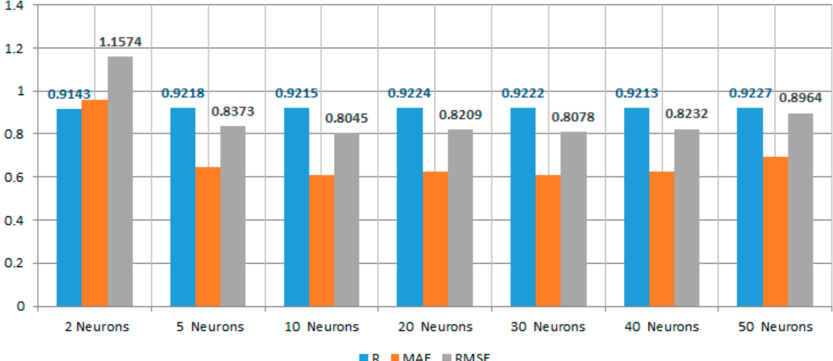
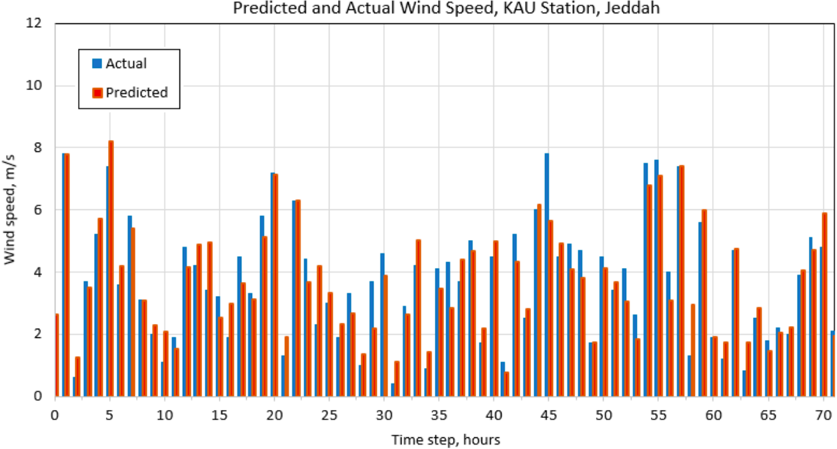
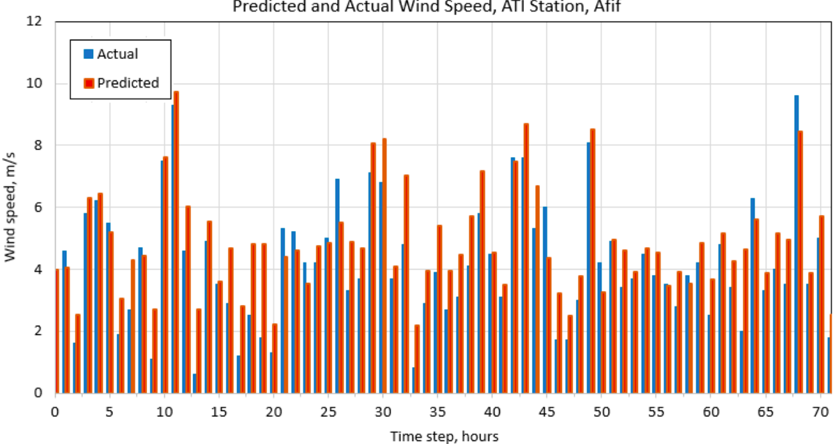
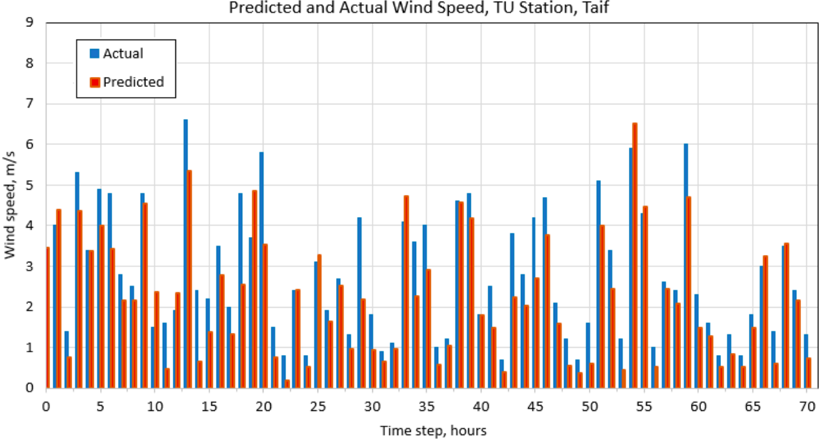
Predicting wind speed for wind energy conversion systems (WECS) is an essential monitor, control, plan, and dispatch generated power and meets customer needs. The Kingdom of Saudi Arabia recently set ambitious targets in its national transformation program and Vision 2030 to move away from oil dependence and redirect oil and gas exploration efforts to other higher-value uses, chiefly meeting 10% of its energy demand through renewable energy sources. In this paper, we propose the use of the artificial neural networks (ANNs) method as a means of predicting daily wind speed in a number of locations in the Kingdom of Saudi Arabia based on multiple local meteorological measurement data provided by K.A.CARE. The suggested model is a feed-forward neural network model with the administered learning technique using a back-propagation algorithm. Results indicate that the best structure is obtained with thirty neurons in the hidden layers matching a minimum root mean square error (RMSE) and the highest correlation coefficient (R). A comparison between predicted and actual data from meteorological stations showed good agreement. A comparison between five machine learning algorithms, namely ANN, support vector machines (SVM), random tree, random forest, and RepTree revealed that random tree has low correlation and relatively high root mean square error. The significance of the present study relies on its ability to predict wind speeds, a necessary prerequisite to executing sustainable integration of wind power into Saudi Arabia’s electrical grid, assisting operators in efficiently managing generated power, and helping achieve the energy efficiency and production targets of Vision 2030.
Overview
The claims and statistics of this paper haven’t been checked yet.
Free: it reads the open-access text and checks the first 5 claims that cite a source we can check. Create a free account to check every claim.
Integrity signals
Registry
Cites
Statistics
Figures



Verification
Claims the paper makes
The claims and statistics of this paper haven’t been checked yet.
Free: it reads the open-access text and checks the first 5 claims that cite a source we can check. Create a free account to check every claim.
Claims other papers make about this one
Each is checked against this paper’s own text: does it say what the citing paper says it does?
The check wasn’t confident either way, so it gives no verdict — never disputed.
In the citing paper
“Accordingly, the current trends divulge that by 2030, road traffic injuries are predicted to be the seventh leading cause of death across all age groups in Saudi Arabia if no adequate preventive measures are effectuated [2].”
From A Real-Time Computer Vision Based Approach to Detection and Classification of Traffic Incidents (2023) · cites this paper as [2]
Experimental — accuracy not yet measured
Self-check
Percentages, sums and reported differences re-computed from the paper’s own numbers.
The self-check needs the paper’s full text.
Citations
Cites
Review on Methods to Fix Number of Hidden Neurons in Neural Networks
Sheela, K. G., & Deepa, S. N. (2013) · Mathematical Problems in Engineering · doi:10.1155/2013/425740 · Cited by 941
A review on the young history of the wind power short-term prediction
Costa, A., Crespo, A., Navarro, J., Lizcano, G., Madsen, H., & Feitosa, E. (2008) · Renewable and Sustainable Energy Reviews · doi:10.1016/j.rser.2007.01.015 · Cited by 638 · cited 1×
“[52] suggested further study on complex terrain and research on adaptive parameter estimation.”
BackgroundRepeated wavelet transform based ARIMA model for very short-term wind speed forecasting
Aasim, Singh, S. N., & Mohapatra, A. (2019) · Renewable Energy · doi:10.1016/j.renene.2019.01.031 · Cited by 617
State of the Art of Machine Learning Models in Energy Systems, a Systematic Review
Mosavi, A., Salimi, M., Faizollahzadeh Ardabili, S., Rabczuk, T., Shamshirband, S., & Varkonyi-Koczy, A. R. (2019) · Energies · doi:10.3390/en12071301 · Cited by 578
A survey of artificial neural network in wind energy systems
Marugán, A. P., Márquez, F. P. G., Perez, J. M. P., & Ruiz-Hernández, D. (2018) · Applied Energy · doi:10.1016/j.apenergy.2018.07.084 · Cited by 479 · cited 1×
“[51] demonstrated that artificial neural networks could be an alternative to conventional methods in many cases.”
MethodErnst, B., Oakleaf, B., Ahlstrom, M., Lange, M., Moehrlen, C., Lange, B., Focken, U., & Rohrig, K. (2007) · IEEE Power and Energy Magazine · doi:10.1109/mpe.2007.906306 · Cited by 441
Machine Learning: An Algorithmic Perspective
Marsland, S. (2014) · Chapman & Hall/CRC eBooks · doi:10.1201/b17476 · Cited by 353
Review of the use of Numerical Weather Prediction (NWP) Models for wind energy assessment
Al-Yahyai, S., Charabi, Y., & Gastli, A. (2010) · Renewable and Sustainable Energy Reviews · doi:10.1016/j.rser.2010.07.001 · Cited by 347
A Literature Review of Wind Forecasting Methods
Chang, W.-Y. (2014) · Journal of Power and Energy Engineering · doi:10.4236/jpee.2014.24023 · Cited by 302 · cited 1×
“The main objective is to take advantage of each method and increase the accuracy of the wind speed forecast [17,40].”
MethodKhosravi, A., Koury, R. N. N., Machado, L., & Pabon, J. J. G. (2018) · Sustainable Energy Technologies and Assessments · doi:10.1016/j.seta.2018.01.001 · Cited by 279 · cited 1×
“Among the most popular models used in forecasting wind speed based on artificial intelligence we found ANN models [18,42], support vector machines (SVM) [43,44], fuzzy logic [45], and the adaptive neuro-fuzzy inference framework (ANFIS) approach [46,47].”
Method
Research works printed but not linked: 4
- MEIM, Ministry of Energy, Industry and Mineral Resources (MEIM). Embarking on Round Two of Saudi Arabia's National Renewable Energy Program. Available online: https://www.powersaudiarabia.com.sa/ web/attach/news/Press-Release-080719-REPDO-Round2RFQ-EN.pdf (accessed on 10 October 2019).
- Kariniotakis, G. Renewable Energy Forecasting: From Models to Applications; Woodhead Publishing: Cambridge, UK, 2017.
- Giebel, G.; Kariniotakis, G. Best Practice in the Use of Short-Term Forecasting. A Users Guide. Project Report for the POW'WOW Project. 2008, p. 6. Available online: https://www.researchgate.net/publication/47398578_ Best_Practice_in_short-term_Forecasting_A_users_Guide (accessed on 29 September 2019).
- Manwell, J.F.; McGowan, J.G.; Rogers, A.L. Wind Energy Explained: Theory, Design and Application; John Wiley & Sons, Ltd.: Chichester, UK, 2011.
Cited by
A Real-Time Computer Vision Based Approach to Detection and Classification of Traffic Incidents
Basheer Ahmed, M. I., Zaghdoud, R., Ahmed, M. S., Sendi, R., Alsharif, S., Alabdulkarim, J., Albin Saad, B. A., Alsabt, R., Rahman, A., & Krishnasamy, G. (2023) · Big Data and Cognitive Computing · doi:10.3390/bdcc7010022 · Cited by 122
Smart grid infrastructure and renewable energy deployment: A conceptual review of Saudi Arabia
Khan, K. A., Quamar, M. M., Al-Qahtani, F. H., Asif, M., Alqahtani, M. F., & Khalid, M. (2023) · Energy Strategy Reviews · doi:10.1016/j.esr.2023.101247 · Cited by 128
A Review on ANN Based Model for Solar Radiation and Wind Speed Prediction with Real-Time Data
Malik, P., Gehlot, A., Singh, R., Gupta, L. R., & Thakur, A. K. (2022) · Archives of Computational Methods in Engineering · doi:10.1007/s11831-021-09687-3 · Cited by 81
A review on short‐term load forecasting models for micro‐grid application
Kondaiah, V. Y., Saravanan, B., Padmanaban, S., & Khan, B. (2022) · The Journal of Engineering · doi:10.1049/tje2.12151 · Cited by 76
Noman, A. A., Tasneem, Z., Sahed, M. F., Muyeen, S. M., Das, S. K., & Alam, F. (2022) · Renewable and Sustainable Energy Reviews · doi:10.1016/j.rser.2022.112531 · Cited by 67
Better wind forecasting using Evolutionary Neural Architecture search driven Green Deep Learning
Pujari, K. N., Miriyala, S. S., Mittal, P., & Mitra, K. (2022) · Expert Systems with Applications · doi:10.1016/j.eswa.2022.119063 · Cited by 57
Sagar, A., Padmanaban, S., Bertoluzzo, M., Kumar, A., Joshi, B. P., & Singh, A. K. (2023) · International Conference on Power Energy, Environment and Intelligent Control (PEEIC) · doi:10.1109/peeic59336.2023.10450276 · Cited by 48
“…for the ANN model was implemented in MATLAB/Simulink, and data gathered from the Simulink dataset are used for several analysisThe effectiveness of the novel approach has been evaluated in comparison to previously used methods such as NN [19], FF + NN [20], PSO + NN [21], and AQ + NN [15].”
MethodKumar, K., Prabhakar, P., Verma, A., Saroha, S., & Singh, K. (2024) · Multimedia Tools and Applications · doi:10.1007/s11042-024-18916-3 · Cited by 55
“In 2019, Brahimi [43] have designed an AI that was being used to anticipate the velocity of the wind for energy-associated objectives.”
One-Day-Ahead Solar Irradiation and Windspeed Forecasting with Advanced Deep Learning Techniques
Blazakis, K. V., Katsigiannis, Y. A., & Stavrakakis, G. S. (2022) · Energies · doi:10.3390/en15124361 · Cited by 42
“…hyperparameters of the forecasting models, evaluation of the results of windspeed and solar irradiation forecasting was based on well-known relationships to calculate the deviation (error) between predicted and real (measured) values, i.e., the well-known forecasting error statistical metrics [1].”
BackgroundMohana, M., Saidi, A. S., Alelyani, S., Alshayeb, M. J., Basha, S. P. S., & Anqi, A. E. M. (2021) · Energies · doi:10.3390/en14206759 · Cited by 38
Sacie, M., Santos, M., López, R., & Pandit, R. (2022) · Journal of Marine Science and Engineering · doi:10.3390/jmse10070938 · Cited by 37
“In [23], the authors propose an ANN model to predict daily wind speed with meteorological measurements ATMP, WDIR, GHI, relative humidity and PRES as input features selected among the 13 attributes available in the dataset.”
MethodMiliket, T. A., Ageze, M. B., & Tigabu, M. T. (2022) · International Journal of Green Energy · doi:10.1080/15435075.2021.2005605 · Cited by 34
“ANN was proposed by (Brahimi 2019) as a powerful tool to predict the wind speed associated with input layers and hidden layers.”
MethodGao, Y., Wang, B., Chen, F., Zhang, W., Zhou, D., Wu, F., & Chen, D. (2023) · Energy Reports · doi:10.1016/j.egyr.2023.05.034 · Cited by 33
Shah, D., Patel, K., & Shah, M. (2021) · International Journal of Energy and Water Resources · doi:10.1007/s42108-021-00113-9 · Cited by 37
“There are more works to be executed to build the precision of wind speed forecast (Brahimi 2019).”
BackgroundMachine learning and its applications
Arora, V., Ng, E. Y. K., & Singh, A. (2022) · Elsevier eBooks · doi:10.1016/b978-0-323-90789-7.00002-6 · Cited by 27
Laghridat, H., Essadki, A., & Nasser, T. (2022) · Protection and Control of Modern Power Systems · doi:10.1186/s41601-022-00227-0 · Cited by 18
Noman, A. A., Tasneem, Z., Abhi, S. H., Badal, F. R., Rafsanzane, M., Islam, M. R., & Alam, F. (2022) · Heliyon · doi:10.1016/j.heliyon.2023.e15672 · Cited by 22
“Additionally, recent studies have noted the involvement of AI in the dominant wind power generation sector; for example, AI has been shown to be effective at estimating wind speed [64].”
BackgroundTalaat, F. M., Kabeel, A. E., & Shaban, W. M. (2025) · Sustainable Energy Technologies and Assessments · doi:10.1016/j.seta.2025.104348 · Cited by 35
Aminuddin, A., Hesty, N. W., Supriatna, N. K., Akhmad, K., Kuncoro, A. H., Nurliyanti, V., Rahardja, M. B., Sudarto, S., Mulyadi, W., & Utama, P. A. (2024) · Evergreen · doi:10.5109/7172293 · Cited by 16
Modeling of Water Generation from Air Using Anhydrous Salts
Sibie, S. K., El-Amin, M. F., & Sun, S. (2021) · Energies · doi:10.3390/en14133822 · Cited by 16
Comparative study of Wind Speed Forecasting using Machine Learning
Nookesh, V. M., Kumar, V. B., Saketh, B. S., Syama, S., & Ramprabhakar, J. (2021) · International Conference on Smart Electronics and Communication (ICOSEC) · doi:10.1109/icosec51865.2021.9591767 · Cited by 15
“This can be observed from the yield as ANN substantiated itself an adaptable technique as far as accuracy and computer time usage, when contrasted with climatic models [13].”
MethodBaquero, L., Torío, H., & Leask, P. (2022) · Energies · doi:10.3390/en15155518 · Cited by 19
Shi, J., Liu, Y., Liu, Y., Li, Y., Roux, G., Shi, L., & Fan, X. (2022) · Energies · doi:10.3390/en15030896 · Cited by 15
Mansir, I. B., Okonkwo, P. C., & Farouk, N. (2024) · Energy & Environment · doi:10.1177/0958305x241248373 · Cited by 14
Wind Farm Power Prediction Considering Layout and Wake Effect: Case Study of Saudi Arabia
Barashid, K., Munshi, A., & Alhindi, A. (2023) · Energies · doi:10.3390/en16020938 · Cited by 12
Wind Power Forecasting Using Machine Learning Algorithms
Diop, S., Traoré, P. S., & Ndiaye, M. (2021) · International Renewable and Sustainable Energy Conference (IRSEC) · doi:10.1109/irsec53969.2021.9741109 · Cited by 11
“These differences can be explained on the one hand by the very random seasonal variation of the study area and on the other hand by the over-learning The performance criteria are compared by the models [13, 17-18] to see the impact of the parameters.”
MethodGunawan, A., Thamrin, S., Kuntjoro, Y. D., & Idris, A. M. (2022) · Trends in Renewable Energy · doi:10.17737/tre.2022.8.2.00143 · Cited by 9
A Multi-Hour Ahead Wind Power Forecasting System Based on a WRF-TOPSIS-ANFIS Model
Xing, Y., Lien, F., Melek, W., & Yee, E. (2022) · Energies · doi:10.3390/en15155472 · Cited by 11
Alkhayat, G., Hasan, S. H., & Mehmood, R. (2023) · Sustainability · doi:10.3390/su152416759 · Cited by 14
One-Day-Ahead Wind Speed Forecasting Based on Advanced Deep and Hybrid Quantum Machine Learning
Blazakis, K. V., Katsigiannis, Y. A., Schetakis, N. A., & Stavrakakis, G. S. (2024) · Frontiers of artificial intelligence, ethics and multidisciplinary applications. · doi:10.1007/978-981-99-9836-4_13 · Cited by 7
Kommineni, H. P., Gade, P. K., Venkata, S. S. M. G. N., & Manikyala, A. (2024) · Global Disclosure of Economics and Business · doi:10.18034/gdeb.v13i1.779 · Cited by 7
“By integrating these measures into BI systems, energy suppliers may track their ecological effects in real time, evaluate their sustainability, and make data-driven choices to improve operational efficiency and environmental responsibility (Brahimi, 2019).”
Wind Energy in Saudi Arabia Opportunities and Challenges
Alkinani, S. S., Alghazi, O. S., Asfour, R., & Brahimi, T. (2022) · International Conference on Industrial Engineering and Operations Management (IEOM) · doi:10.46254/af03.20220565 · Cited by 6
Self-citationSibtain, M., Li, X., Saleem, S., Qurat‐ul‐Ain, Shi, Q., Li, F., & Apaydın, H. (2024) · Stochastic Environmental Research and Risk Assessment · doi:10.1007/s00477-024-02866-1 · Cited by 5
“Brahimi (2019) predicted wind speed using different artificial intelligence (AI) models comprising RF, ANN, random tree, SVM, and RepTree.”
An Improved Metaheuristic Method-Based Neural Network for Predicting Wind Turbine Power
Ahilan, T., Selvaraj, Y., & Prasad, D. V. S. S. S. V. (2022) · Cybernetics & Systems · doi:10.1080/01969722.2022.2145663 · Cited by 5
Predicting the Wind Turbine Power Generation based on Weather Conditions
Preethi, S., Prithika, H., Pramila, M., & Birundha, S. (2021) · International Conference on Electronics, Communication and Aerospace Technology (ICECA) · doi:10.1109/iceca52323.2021.9676051 · Cited by 4
Predicting Topographic Effect Multipliers in Complex Terrain With Shallow Neural Networks
Santiago-Hernández, J. X., Santiago, A. R., Catarelli, R. A., Phillips, B. M., Aponte-Bermúdez, L. D., & Masters, F. J. (2022) · Frontiers in Built Environment · doi:10.3389/fbuil.2022.762054 · Cited by 4
“…design and operation of wind tunnels (e.g., Križan et al., 2015), prediction of design wind speeds for civil infrastructure (e.g., Huang and Xu, 2013), and forecasting for wind energy resources (e.g., Burlando and Meissner, 2017; Chen et al., 2018; Liu et al., 2018; Yu et al., 2018; Brahimi, 2019).”
BackgroundDong, D., Wang, S., Guo, Q., Li, X., Zou, W., & You, Z. (2023) · Journal of Marine Science and Engineering · doi:10.3390/jmse11122350 · Cited by 4
Clare, M., & Piggott, M. (2022) · CRC Press eBooks · doi:10.1201/9781003360773-61 · Cited by 4
Hybrid Model of VMD and LSTM for Next-Hour Wind Speed Forecasting in a Hot Desert ClimatePreprint
Alkhayat, G., Hasan, S. H., & Mehmood, R. (2023) · Preprints.org · doi:10.20944/preprints202309.1966.v1 · Cited by 4
Marjani, S. E., Er-Rbib, S., & Benabbou, L. (2023) · International Conference on Industrial Engineering and Operations Management (IEOM) · doi:10.46254/an12.20220097 · Cited by 3
Integral Backstepping Control for Stability Enhancement of Doubly Fed Induction Generator
Anwar, G., Gherbi, A., Chebabhi, A., & Ghada, M. (2024) · International Conference on Electrical Engineering and Automatic Control (ICEEAC) · doi:10.1109/iceeac61226.2024.10576355 · Cited by 3
“…is one of the most promising and fastest growing RESs because it is cost competitive, easy of controllability, has a significant part in grid integration and electricity production [1], and has high energy efficiency and improved power quality according to Wind-Europe’s Central Scenario (WECS) [2].”
BackgroundAn Artificial Intelligence Approach to Forecast Wind Speeds in Algeria
Bouhelal, A., & Smaïli, A. (2021) · Springer proceedings in energy · doi:10.1007/978-981-16-0378-5_18 · Cited by 3
Entropy and Exergy in Renewable Energy
Wang, L.-S., Cao, W., & Hu, S.-B. (2021) · IntechOpen eBooks · doi:10.5772/intechopen.92472 · Cited by 3
Haider, H., Hassan, K., Shafiquzzaman, M., Alresheedi, M. T., Mallick, J., & Ghumman, A. R. (2025) · Scientific Reports · doi:10.1038/s41598-025-18698-0 · Cited by 2
Rashid, L. B., Rehman, S., Zayed, M. E., Ibrahim, R., Drammeh, F., Shalaby, S. M., & Mujtaba, I. M. (2026) · Energies · doi:10.3390/en19174159 · Cited by 2
Structural and Environmental Safety Studies of the Holy Mosque Area Using CFD
Farouk, M. (2023) · Buildings · doi:10.3390/buildings13071809 · Cited by 2
Wave Energy in the Red Sea Region Perspectives and Analysis
Alkhayyat, M., Brahimi, T., Langodan, S., & Hoteit, I. (2020) · IEEE International Energy Conference (ENERGYCON) · doi:10.1109/energycon48941.2020.9236479 · Cited by 2
Self-citationA Study on Intelligent Tourism App Based on Artificial Intelligence
Xue, J. (2021) · Journal of Physics Conference Series · doi:10.1088/1742-6596/1881/2/022076 · Cited by 2
“…establishment of Jiangxi Province Intelligent Tourism Information Network, through Taobao to achieve online sales of tourism products, the development of smart phone-based tourism information service software applications to promote the development of intelligent tourism in Jiangxi Province [4].”
BackgroundDeep Learning-Based Solar and Wind Energy Forecasting for Grid-Independent Systems
Gaikwad, N. H., Jangilwar, P. K., Dora, B. K., Mitra, A., & Das, S. (2025) · IEEE International Conference on Sustainable Energy and Future Electric Transportation (SEFET) · doi:10.1109/sefet65155.2025.11255404 · Cited by 1
A Review on Artificial Intelligence Based Wind Energy Forecasting Techniques
Ali, S., Mirjat, N. H., Raza, M. A., Arshad, N., & Uqaili, M. A. (2026) · Geological Journal · doi:10.1002/gj.70267 · Cited by 1
Turbine recommender: The selection of wind turbine type using one of a machine learning technique
al., A. E. (2022) · International Journal of ADVANCED AND APPLIED SCIENCES · doi:10.21833/ijaas.2022.02.013 · Cited by 1
“Brahimi (2019) utilized the artificial neural networks (ANNs) method as a means of predicting daily wind speed for wind energy conversion systems (WECS) in a number of locations in Saudi Arabia with the ultimate goal of monitoring, controlling, planning, and dispatching generated power while…”
BackgroundMethodBrune, S., & Keller, J. D. (2022) · Wind energy science · doi:10.5194/wes-7-1905-2022 · Cited by 1
“The vertical structure is described by a height-based terrain-following coordinate with grid spacing of a few decameters in the lower atmosphere (Bollmeyer et al., 2015).”
BackgroundMethodA Complete Design of Smart Wind Farm Enriched with Novel Anemometer
Revathi, K., Tamilselvi, T., Theresa, W. G., & Dhivya, M. (2023) · International Journal on Recent and Innovation Trends in Computing and Communication · doi:10.17762/ijritcc.v11i6s.6950 · Cited by 1
Jog, P. A., & Kumawat, R. K. (2023) · International Journal of High Speed Electronics and Systems · doi:10.1142/s0129156424500022 · Cited by 1
Data-driven prediction of mean wind turbulence from topographic data
da Costa, B. M., Snæbjörnsson, J. T., Øiseth, O. A., Wang, J., & Jakobsen, J. B. (2021) · IOP Conference Series Materials Science and Engineering · doi:10.1088/1757-899x/1201/1/012005 · Cited by 1
Deep Learning-Based Short-Term Wind Power Forecasting for Adama-Ii Wind TurbinesPreprint
Teshome, A. D., Kahsay, M. B., & Molinas, M. (2025) · SSRN Electronic Journal · doi:10.2139/ssrn.5358510 · Cited by 1
Brahimi, T., & Paraschivoiu, I. (2021) · IntechOpen eBooks · doi:10.5772/intechopen.96343 · Cited by 3
Self-citationA Two-Parameter Model for Water-Lubricated Pipeline Transportation of Unconventional Crudes
Rushd, S., Ahmed, E., Mahmud, S., & Hossain, S. S. (2021) · Energies · doi:10.3390/en14185665
Ozoegwu, C. G. (2021) · Research Square · doi:10.21203/rs.3.rs-794022/v1
“The several ways to predict wind speed include (1) using geographic location and seasonality parameters as predictors, see Fadare [8] who used latitude, longitude and month number as the predictors of wind speed, (2) using meteorological parameters as predictors, see [9, 10] in which air temperature, relative humidity…”
MethodRoy, R., Varghese, A. J., & Awasthi, S. R. (2021) · IEEE International Power and Renewable Energy Conference (IPRECON) · doi:10.1109/iprecon52453.2021.9641039
(2022) · Wind energy science · doi:10.5194/wes-2022-20-rc1
(2022) · Wind energy science · doi:10.5194/wes-2022-20-rc2
Brune, S. (2022) · Wind energy science · doi:10.5194/wes-2022-20-ac1
Fitting and Time Series Neural Networks Modelling to Forecast Weather and Wind Speed
AlGhamdi, S. A., & Abouelatta, O. B. (2022) · International Middle East Power Systems Conference (MEPCON) · doi:10.1109/mepcon55441.2022.10021727
“NN method was also used, with local weather data in the Kingdom of Saudi Arabia, to predict wind speeds at different locations [19].”
MethodPrediction of wind speed and solar radiation using LM and BR neural network algorithm
Malik, P., Malik, P., Gehlot, A., & Singh, R. (2023) · AIP conference proceedings · doi:10.1063/5.0152368
Using Artificial Intelligence Models to Predict the Wind Power to be Fed into the Grid
Diop, S., Traoré, P. S., Ndiaye, M., & Zerbo, I. (2024) · Journal of Engineering Research and Sciences · doi:10.55708/js0306001
“The performance criteria, evaluated by the models [17],[25][26], are used to examine the impact of the parameters and are applied to the test data to generalise the artificial intelligence models.”
MethodTransfer Learning for Wind Speed Forecasting in the Desert
Alkhayat, G. (2025) · Learning and Technology Conference (L&T) · doi:10.1109/lt64002.2025.10941461
Almeida, F., Castelli, M., & Côrte-Real, N. (2025) · Environments · doi:10.3390/environments12040131
“1 R-Squared (R 2 ): R 2 , also known as the coefficient of determination, measures the proportion of the variance in the dependent variable (y) that is explained by the independent variable(s) ( y ) [49].”
The Silicon Oasis: IP-Enabled Generative AI Innovations for Saudi Arabia’s Environmental Vision
Hussein, S. A., & Chikhaoui, E. (2025) · Studies in computational intelligence · doi:10.1007/978-3-031-90573-5_9
Predicting Wind Speed Using Machine Learning Models
Pinninti, S., Veeramsetty, V., & Kumar, D. M. V. (2025) · International Conference on Engineering Innovations and Technologies (ICoEIT) · doi:10.1109/icoeit63558.2025.11211575
“ANN approaches are utilized to predict daily wind speed at different locations of Saudi Arabia[8].”
Artificial intelligence for the energy sector/industry
Sharshir, S. W., Joseph, A., & Elsayad, M. M. (2025) · Elsevier eBooks · doi:10.1016/b978-0-443-34019-2.00003-1 · Cited by 1
The Role of Wind Turbines as a Source of Sustainable Energy in the Kingdom of Saudi Arabia
Altamimi, T. F. (2025) · Global Conference on Sustainable Energy and Net-Zero Emissions (SENZE) · doi:10.1109/senze66459.2025.11428505
“These developments may lead to an increase in the operational efficiency of WT power plants and, consequently, to maximize the electricity generated [52].”
Optimized Deep Learning Architecture for Short-Term Wind Speed Estimation
Pinninti, S., Veeramsetty, V., Kumar, D. M., & Salkuti, S. R. (2026) · Lecture notes in electrical engineering · doi:10.1007/978-981-95-8773-5_7
Adedeji, B. P., Oni, O. S., & Adedeji, A. S. (2026) · Next Energy · doi:10.1016/j.nxener.2026.101121
Metadata
- Authors
- Brahimi, T.
- Affiliations
- Effat University (SA)
- Corresponding author
- Brahimi, Tayeb
- ORCID
- Brahimi, Tayeb
- Venue
- Energies
- Publisher
- MDPI AG
- Published
- 2019-12-09
- Volume
- 12
- Issue
- 24
- Pages
- 4669
- ISSN
- 1996-1073 (ISSN-L)
- OpenAlex
- W2993384776
- Cited by
- 74
- References
- 54
- Citations by year
- 2026: 4 · 2025: 10 · 2024: 8 · 2023: 14 · 2022: 23 · 2021: 14 · 2020: 1
- FWCI
- 3.42
- Type
- journal article
- Language
- en
- Open access
- gold
- doi.org
- Licence
- Locations
- Energies (publishedVersion, cc-by)
- RePEc: Research Papers in Economics (submittedVersion)
- Funders
- Effat University
- Topics
- Physical Sciences › Engineering › Electrical and Electronic Engineering › Energy Load and Power Forecasting
- Physical Sciences › Energy › Renewable Energy, Sustainability and the Environment › Solar Radiation and Photovoltaics
- Physical Sciences › Energy › Renewable Energy, Sustainability and the Environment › Wind Energy Research and Development
- Keywords
- wind speed forecasting, artificial neural networks, feedforward neural networks, backpropagation, wind energy conversion system, renewable energy integration, Saudi Arabia, Saudi Vision 2030, meteorological observations, random forest, support vector machine, REPTree, random trees
About these checks
Registry, retraction, Cites and statistics results are computed, not judged, with one exception: a printed reference that no index lists is read once by a model before it counts as a citation error. Claims are extracted by a model and kept only when their quote appears verbatim in the text; each cited source is then checked, with a model’s help, for whether it says what the claim relies on. Those verdicts can be wrong — read the claim’s quote and the cited source before relying on one.
Statistics and arithmetic are recomputed, not judged.
Confidence bands are shown only for fields calibrated on our annotated test set. None is calibrated yet, so no band is shown.
What counts as a claim ›How we measure confidence ›How we check this ›
Are you an author, or do you see a problem with this page? Request a review
Data sources
Bibliographic data: Semantic Scholar, OpenAlex, Crossref.
Contains information from the Semantic Scholar Academic Graph Datasets, made available under the ODC Attribution License (ODC-BY 1.0).
Semantic Scholar’s data is described in: Kinney, R., et al. (2023). The Semantic Scholar Open Data Platform. arXiv:2301.10140.
