

Using Artificial Intelligence to Predict Wind Speed for Energy Application in Saudi Arabia
Open accessThe DOI matches its Crossref record; 53 of the 54 references it cites were found in a registry or an index.
Abstract
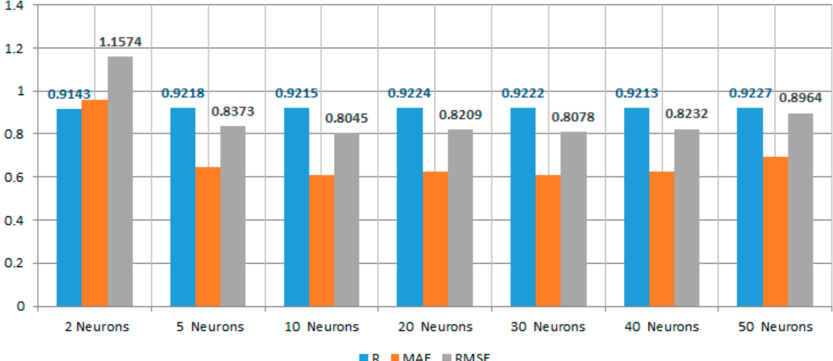
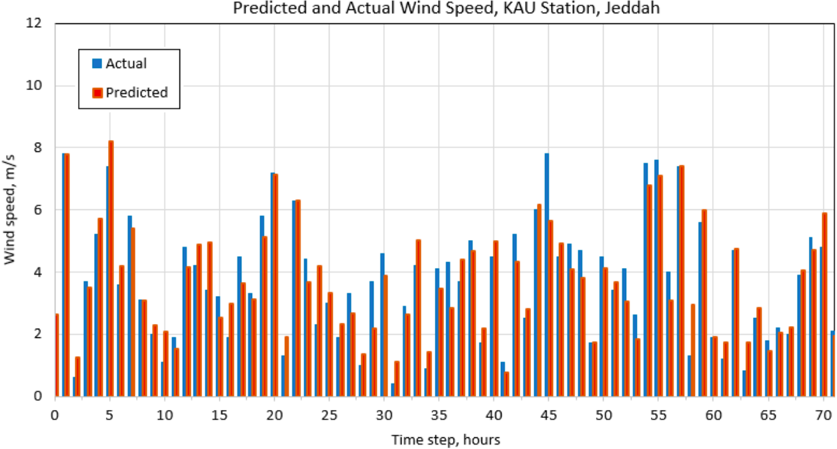
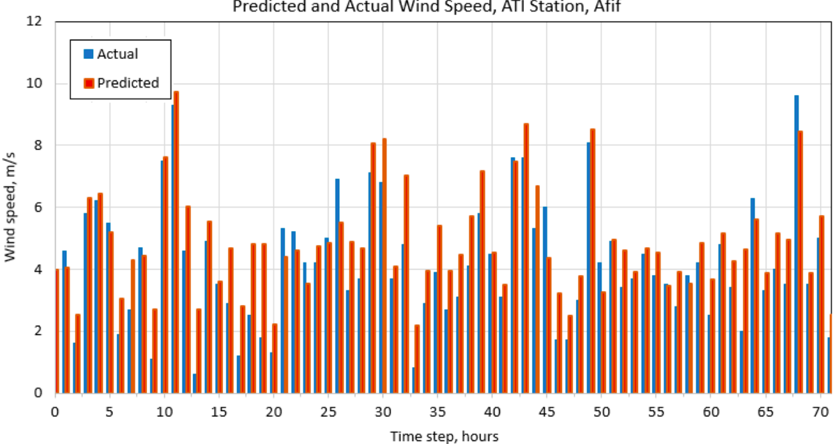
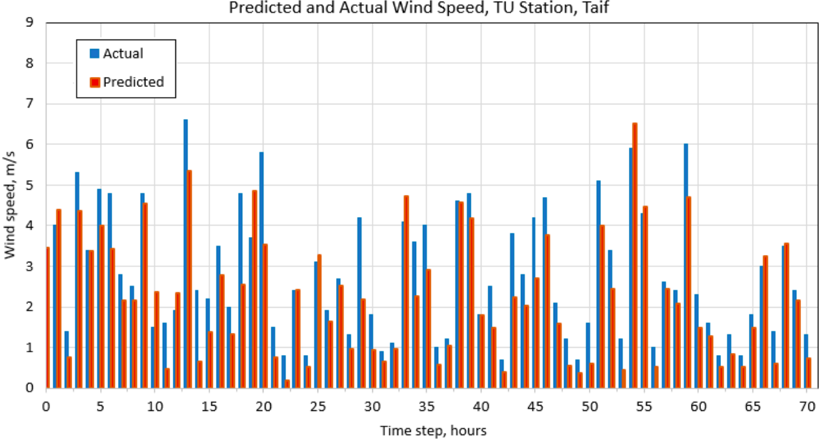
Predicting wind speed for wind energy conversion systems (WECS) is an essential monitor, control, plan, and dispatch generated power and meets customer needs. The Kingdom of Saudi Arabia recently set ambitious targets in its national transformation program and Vision 2030 to move away from oil dependence and redirect oil and gas exploration efforts to other higher-value uses, chiefly meeting 10% of its energy demand through renewable energy sources. In this paper, we propose the use of the artificial neural networks (ANNs) method as a means of predicting daily wind speed in a number of locations in the Kingdom of Saudi Arabia based on multiple local meteorological measurement data provided by K.A.CARE. The suggested model is a feed-forward neural network model with the administered learning technique using a back-propagation algorithm. Results indicate that the best structure is obtained with thirty neurons in the hidden layers matching a minimum root mean square error (RMSE) and the highest correlation coefficient (R). A comparison between predicted and actual data from meteorological stations showed good agreement. A comparison between five machine learning algorithms, namely ANN, support vector machines (SVM), random tree, random forest, and RepTree revealed that random tree has low correlation and relatively high root mean square error. The significance of the present study relies on its ability to predict wind speeds, a necessary prerequisite to executing sustainable integration of wind power into Saudi Arabia’s electrical grid, assisting operators in efficiently managing generated power, and helping achieve the energy efficiency and production targets of Vision 2030.
Overview
The claims and statistics of this paper haven’t been checked yet.
Free: it reads the open-access text and checks the first 5 claims that cite a source we can check. Create a free account to check every claim.
Integrity signals
Registry
Cites
Statistics
Figures



Verification
Claims the paper makes
The claims and statistics of this paper haven’t been checked yet.
Free: it reads the open-access text and checks the first 5 claims that cite a source we can check. Create a free account to check every claim.
Claims other papers make about this one
Each is checked against this paper’s own text: does it say what the citing paper says it does?
The check wasn’t confident either way, so it gives no verdict — never disputed.
In the citing paper
“Accordingly, the current trends divulge that by 2030, road traffic injuries are predicted to be the seventh leading cause of death across all age groups in Saudi Arabia if no adequate preventive measures are effectuated [2].”
From A Real-Time Computer Vision Based Approach to Detection and Classification of Traffic Incidents (2023) · cites this paper as [2]
Experimental — accuracy not yet measured
Self-check
Percentages, sums and reported differences re-computed from the paper’s own numbers.
The self-check needs the paper’s full text.
Citations
Cites
Review on Methods to Fix Number of Hidden Neurons in Neural Networks
Sheela, K. G., & Deepa, S. N. (2013) · Mathematical Problems in Engineering · doi:10.1155/2013/425740 · Cited by 941
A review on the young history of the wind power short-term prediction
Costa, A., Crespo, A., Navarro, J., Lizcano, G., Madsen, H., & Feitosa, E. (2008) · Renewable and Sustainable Energy Reviews · doi:10.1016/j.rser.2007.01.015 · Cited by 638 · cited 1×
“[52] suggested further study on complex terrain and research on adaptive parameter estimation.”
BackgroundRepeated wavelet transform based ARIMA model for very short-term wind speed forecasting
Aasim, Singh, S. N., & Mohapatra, A. (2019) · Renewable Energy · doi:10.1016/j.renene.2019.01.031 · Cited by 617
State of the Art of Machine Learning Models in Energy Systems, a Systematic Review
Mosavi, A., Salimi, M., Faizollahzadeh Ardabili, S., Rabczuk, T., Shamshirband, S., & Varkonyi-Koczy, A. R. (2019) · Energies · doi:10.3390/en12071301 · Cited by 578
A survey of artificial neural network in wind energy systems
Marugán, A. P., Márquez, F. P. G., Perez, J. M. P., & Ruiz-Hernández, D. (2018) · Applied Energy · doi:10.1016/j.apenergy.2018.07.084 · Cited by 479 · cited 1×
“[51] demonstrated that artificial neural networks could be an alternative to conventional methods in many cases.”
MethodErnst, B., Oakleaf, B., Ahlstrom, M., Lange, M., Moehrlen, C., Lange, B., Focken, U., & Rohrig, K. (2007) · IEEE Power and Energy Magazine · doi:10.1109/mpe.2007.906306 · Cited by 441
Machine Learning: An Algorithmic Perspective
Marsland, S. (2014) · Chapman & Hall/CRC eBooks · doi:10.1201/b17476 · Cited by 353
Review of the use of Numerical Weather Prediction (NWP) Models for wind energy assessment
Al-Yahyai, S., Charabi, Y., & Gastli, A. (2010) · Renewable and Sustainable Energy Reviews · doi:10.1016/j.rser.2010.07.001 · Cited by 347
A Literature Review of Wind Forecasting Methods
Chang, W.-Y. (2014) · Journal of Power and Energy Engineering · doi:10.4236/jpee.2014.24023 · Cited by 302 · cited 1×
“The main objective is to take advantage of each method and increase the accuracy of the wind speed forecast [17,40].”
MethodKhosravi, A., Koury, R. N. N., Machado, L., & Pabon, J. J. G. (2018) · Sustainable Energy Technologies and Assessments · doi:10.1016/j.seta.2018.01.001 · Cited by 279 · cited 1×
“Among the most popular models used in forecasting wind speed based on artificial intelligence we found ANN models [18,42], support vector machines (SVM) [43,44], fuzzy logic [45], and the adaptive neuro-fuzzy inference framework (ANFIS) approach [46,47].”
MethodWitten, I. H., Frank, E., Hall, M. A., & Pal, C. J. (2017) · Data Mining · doi:10.1016/b978-0-12-804291-5.00010-6 · Cited by 254
Ferrero Bermejo, J., Gómez Fernández, J. F., Olivencia Polo, F., & Crespo Márquez, A. (2019) · Applied Sciences · doi:10.3390/app9091844 · Cited by 222
Applied Data Mining for Business and Industry
Giudici, P., & Figini, S. (2009) · Wiley eBooks · doi:10.1002/9780470745830 · Cited by 181
Ackermann, T., Abbad, J., Dudurych, I., Erlich, I., Holttinen, H., Kristoffersen, J., & Sorensen, P. (2007) · IEEE Power and Energy Magazine · doi:10.1109/mpae.2007.4317490 · Cited by 169
Different Models for Forecasting Wind Power Generation: Case Study
de Alencar, D. B., Affonso, C. M., Júnior, O., Rodríguez, J. L. M., Leite, J. C., & Filho, J. R. (2017) · Energies · doi:10.3390/en10121976 · Cited by 154 · cited 3×
“[19] on ultra-short, short, medium, and long-term wind speed prediction models based on ANN, ARIMA, and hybrid models, the authors concluded that despite the existence of a full range of methods none of the forecasts cover the entire forecasting possibilities between ultra-short-term and several years ahead.”
BackgroundMethodWind energy resource assessment for five locations in Saudi Arabia
Al-Abbadi, N. M. (2004) · Renewable Energy · doi:10.1016/j.renene.2004.11.013 · Cited by 152
Exploiting Deep Learning for Wind Power Forecasting Based on Big Data Analytics
Mujeeb, S., Alghamdi, T. A., Ullah, S., Fatima, A., Javaid, N., & Saba, T. (2019) · Applied Sciences · doi:10.3390/app9204417 · Cited by 118 · cited 1×
“[54] proposed a demand management scheme and a wind power forecasting method using big data-driven wind power forecasting.”
MethodShort-term wind power forecasts by a synthetical similar time series data mining method
Sun, G., Jiang, C., Cheng, P., Liu, Y., Wang, X., Fu, Y., & Yang, H. (2017) · Renewable Energy · doi:10.1016/j.renene.2017.08.071 · Cited by 116 · cited 2×
“[34] listed the persistence method or “Naïve Predictor”, which assumes a correlation between the wind speed at a time “t + x” and the current wind speed at the time “t”, where both speeds are assumed to be the same.”
BackgroundMethodRecent trends in wind speed across Saudi Arabia, 1978–2013: a break in the stilling
Azorín-Molina, C., Rehman, S., Guijarro, J. A., McVicar, T. R., Minola, L., Chen, D., & Vicente-Serrano, S. M. (2018) · International Journal of Climatology · doi:10.1002/joc.5423 · Cited by 93
Short-term wind speed forecasting using ARIMA model
Grigonytė, E., & Butkevičiūtė, E. (2016) · Energetika · doi:10.6001/energetika.v62i1-2.3313 · Cited by 92
Statistical approach for improved wind speed forecasting for wind power production
Pearre, N. S., & Swan, L. G. (2018) · Sustainable Energy Technologies and Assessments · doi:10.1016/j.seta.2018.04.010 · Cited by 91 · cited 1×
“Wind speed prediction using statistical methods is based on historical data and patterns [19,39].”
MethodReducing High Energy Demand Associated with Air-Conditioning Needs in Saudi Arabia
Alshahrani, J., & Boait, P. J. (2018) · Energies · doi:10.3390/en12010087 · Cited by 77 · cited 1×
“According to the Electricity and Cogeneration Regulatory Authority, the residential sector consumes 50% of the generated power [7,8].”
BackgroundWind power meteorology. Part I: climate and turbulence
Petersen, E. L., Mortensen, N. G., Landberg, L., Højstrup, J., & Frank, H. P. (1998) · Wind Energy · doi:10.1002/(sici)1099-1824(199804)1:1+<5::aid-we1>3.0.co;2-i · Cited by 72
Short-term forecast of wind speed through mathematical models
Ferreira, M., dos Santos, A. T. S., & Lúcio, P. S. (2019) · Energy Reports · doi:10.1016/j.egyr.2019.05.007 · Cited by 62
Daily Average Wind Energy Forecasting Using Artificial Neural Networks
Dumitru, C.-D., & Gligor, A. (2017) · Procedia Engineering · doi:10.1016/j.proeng.2017.02.474 · Cited by 52 · cited 1×
“Among the most popular models used in forecasting wind speed based on artificial intelligence we found ANN models [18,42], support vector machines (SVM) [43,44], fuzzy logic [45], and the adaptive neuro-fuzzy inference framework (ANFIS) approach [46,47].”
MethodThe prediction of the wind speed at different heights by machine learning methods
Türkan, Y. S., Aydoğmuş, H. Y., & Erdal, H. (2016) · An International Journal of Optimization and Control Theories & Applications (IJOCTA) · doi:10.11121/ijocta.01.2016.00315 · Cited by 49
Short-term electric load forecasting in Tunisia using artificial neural networks
Houimli, R., Zmami, M., & Ben‐Salha, O. (2019) · Energy Systems · doi:10.1007/s12667-019-00324-4 · Cited by 46
Heppelmann, T., Steiner, A., & Vogt, S. (2017) · Meteorologische Zeitschrift · doi:10.1127/metz/2017/0820 · Cited by 42 · cited 1×
“Multiple physical models have been developed to help in producing a more reliable forecast, such as the numeric weather prediction (NWP) model [35], which solves complex mathematical equations describing the physical process of the wind over a given geographical area.”
BackgroundWind Energy Forecasting with Neural Networks: A Literature Review
Manero, J., Béjar, J., & Ulises Cortés, A. (2018) · Computación y Sistemas · doi:10.13053/cys-22-4-3081 · Cited by 42
Geothermal energy resources of Jizan, SW Saudi Arabia
Chandrasekharam, D., Lashin, A., Al‐Arifi, N., Bassam, A. A., Ranjith, P. G., Varun, C., & Singh, H. K. (2015) · Journal of African Earth Sciences · doi:10.1016/j.jafrearsci.2015.05.016 · Cited by 40
Comparative Analysis of Wind Speed Forecasting Using LSTM and SVM
Gangwar, S., Bali, V., & Kumar, A. (2018) · ICST Transactions on Scalable Information Systems · doi:10.4108/eai.13-7-2018.159407 · Cited by 34
APPLICATION OF DECISION TREE METHODS FOR WIND SPEED ESTIMATION
Akıncı, T. Ç., & Nogay, H. S. (2019) · European Journal of Technic · doi:10.36222/ejt.558914 · Cited by 29 · cited 2×
“Details of each of these techniques ca be found in [64,67]; how ve , we highlight the main characteristics f method.”
BackgroundMethodShort term wind speed estimation in Saudi Arabia
Mohandes, M. A., & Rehman, S. (2014) · Journal of Wind Engineering and Industrial Aerodynamics · doi:10.1016/j.jweia.2014.02.007 · Cited by 28
Very short-term wind forecasting for Tasmanian power generation
Potter, C., & Negnevitsky, M. (2006) · IEEE Power Engineering Society General Meeting · doi:10.1109/pes.2006.1709044 · Cited by 27 · cited 1×
“Applying physical modeling requires excessive computer time and shows better results only when weather conditions are stable [38].”
BackgroundZoumakis, N. M. (2009) · Redalyc (Universidad Autónoma del Estado de México) · Cited by 26
Çolak, İ., Sağıroğlu, Ş., Yeşilbudak, M., Kabalcı, E., & Bülbül, H. İ. (2015) · International Conference on Renewable Energy Research and Applications (ICRERA) · doi:10.1109/icrera.2015.7418697 · Cited by 23 · cited 1×
“Very short-term Few seconds to 30 min Forecasting wind speed and power for electricity market clearing, regulatory actions, and operational aspects [22,23]”
BackgroundEvaluation of Two ANN Approaches for the Wind Power Forecast in a Mountainous Site
Mana, M., Burlando, M., & Meißner, C. (2017) · International Journal of Renewable Energy Research · doi:10.20508/ijrer.v7i4.6186.g7203 · Cited by 23 · cited 1×
“[48] found that both methods gave similar results, however, ANN forecasts were better at medium wind speed ranges while the hybrid model forecasts were better at low and high wind speed ranges.”
ResultEvaluation of neural network-based methodologies for wind speed forecasting
Samet, H., Reisi, M., & Marzbani, F. (2019) · Computers & Electrical Engineering · doi:10.1016/j.compeleceng.2019.07.024 · Cited by 18 · cited 1×
“On the other hand, wind forecasting methods are classified into four categories: physical methods, statistical methods, hybrid methods, and artificial intelligence methods [17,19,33].”
MethodA Review on Different Methods of Wind Power Forecasting
Agarwal, P., Shukla, P., & Sahay, K. B. (2018) · International Electrical Engineering Congress (iEECON) · doi:10.1109/ieecon.2018.8712262 · Cited by 17 · cited 1×
“As artificial intelligence methods developed rapidly, many researchers turned to machine learning techniques to predict wind speed, as reported by [17,30,43].”
BackgroundDarrieus Rotor Aerodynamics in Turbulent Wind
Brahimi, T., & Paraschivoiu, I. (1995) · Journal of Solar Energy Engineering · doi:10.1115/1.2870839 · Cited by 16 · cited 1×
“In contrast to conventional power plants, the electricity generated from wind turbines depends mostly on meteorological conditions, in particular, the magnitude of the wind speed, the atmospheric turbulence, and the control of the wind turbine characteristics [15,16].”
BackgroundSelf-citationSpace-time short- to medium-term wind speed forecasting
Ambach, D., & Croonenbroeck, C. (2015) · Statistical Methods & Applications · doi:10.1007/s10260-015-0343-6 · Cited by 16 · cited 1×
“Medium-term 6 h to 1 day Operational security, safety, and electricity market [26,27]”
BackgroundPanapakidis, I. P., Michailides, C., & Angelides, D. C. (2019) · Electronics · doi:10.3390/electronics8040420 · Cited by 13 · cited 1×
“Long-term 1 day to 1 week or above Unit commitment decisions, maintenance scheduling, and operational management [28,29]”
BackgroundFeasibility study of wind energy utilization in Saudi Arabia
Amin, M. I., & El-Samanoudy, M. (1985) · Journal of Wind Engineering and Industrial Aerodynamics · doi:10.1016/0167-6105(85)90094-7 · Cited by 12 · cited 2×
“According to Amin and El-Samanoudy [59], the coastal region of the Arabian Gulf can experience speeds up to 6 m/s, while the red sea coastal region can reach a wind speed between 4.5 and 5 m/s at 100 m height.”
BackgroundInfluentialFuzzy logic principles for wind speed estimation in wind energy conversion systems
Naba, A. (2014) · doi:10.1109/iciteed.2014.7007939 · Cited by 10 · cited 1×
“Among the most popular models used in forecasting wind speed based on artificial intelligence we found ANN models [18,42], support vector machines (SVM) [43,44], fuzzy logic [45], and the adaptive neuro-fuzzy inference framework (ANFIS) approach [46,47].”
MethodPerformance Evaluation of Different ANN Models for Medium Term Wind Speed Forecasting
Dhivya, S., Ulagammai, M., & Devi, R. P. K. (2011) · Wind Engineering · doi:10.1260/0309-524x.35.4.443 · Cited by 8 · cited 1×
“Medium-term 6 h to 1 day Operational security, safety, and electricity market [26,27]”
BackgroundLMI-BASED STATE-FEEDBACK CONTROL DESIGN FOR A WIND GENERATING POWER PLANT
Bensenouci, A. (2009) · Cited by 6
One Hour-Ahead Wind Speed Forecasting of Sotavento Galicia SA Wind Farm by Using ANN
Sahay, K. B., & Shukla, P. (2018) · International Electrical Engineering Congress (iEECON) · doi:10.1109/ieecon.2018.8712247 · Cited by 6
Short-Term Wind Speed Forecasting of Lelystad Wind Farm by Using ANN Algorithms
Sahay, K. B., & Srivastava, S. (2018) · International Electrical Engineering Congress (iEECON) · doi:10.1109/ieecon.2018.8712227 · Cited by 6 · cited 1×
“Short-term 30 min to 6 h Dispatching the generated power of the WECS to meet customer need within a short time [24,25]”
BackgroundForecasting of Power in Wind Energy Based on Back Propagation Algorithm in Neural Networks
Pillai, S. R. (2019) · doi:10.1109/aicai.2019.8701326 · Cited by 5 · cited 1×
“Among the most popular models used in forecasting wind speed based on artificial intelligence we found ANN models [18,42], support vector machines (SVM) [43,44], fuzzy logic [45], and the adaptive neuro-fuzzy inference framework (ANFIS) approach [46,47].”
MethodLong Term Forecasting of Wind Speed for Wind Energy Application
Aghbalou, N., Charki, A., Elazzouzi, S. R., & Reklaoui, K. (2018) · International Renewable and Sustainable Energy Conference (IRSEC) · doi:10.1109/irsec.2018.8702892 · Cited by 3 · cited 1×
“Long-term 1 day to 1 week or above Unit commitment decisions, maintenance scheduling, and operational management [28,29]”
BackgroundWind Speed Prediction by Adaptive Neuro-Fuzzy Inference System and FCM Clustering
Ko, Y. H. (2016) · International Journal of Hybrid Information Technology · doi:10.14257/ijhit.2016.9.10.10 · Cited by 2 · cited 1×
“Among the most popular models used in forecasting wind speed based on artificial intelligence we found ANN models [18,42], support vector machines (SVM) [43,44], fuzzy logic [45], and the adaptive neuro-fuzzy inference framework (ANFIS) approach [46,47].”
MethodForecast on Short-Term Wind Speed and Wind Farm Power Generation
Cheng, Y. (2016) · doi:10.2991/nceece-15.2016.15 · Cited by 1
Wind Speed Forecast Based on Support Vector Machine
Yang, X., & Tang, F. (2016) · International Conference on Civil, Architectural and Hydraulic Engineering (ICCAHE) · doi:10.2991/iccahe-16.2016.9 · Cited by 1 · cited 9×
“The support vector machine (SVM) is a supervised machine learning algorithm that classifies linear and nonlinear data.”
MethodInfluential
Research works printed but not linked: 4
- MEIM, Ministry of Energy, Industry and Mineral Resources (MEIM). Embarking on Round Two of Saudi Arabia's National Renewable Energy Program. Available online: https://www.powersaudiarabia.com.sa/ web/attach/news/Press-Release-080719-REPDO-Round2RFQ-EN.pdf (accessed on 10 October 2019).
- Kariniotakis, G. Renewable Energy Forecasting: From Models to Applications; Woodhead Publishing: Cambridge, UK, 2017.
- Giebel, G.; Kariniotakis, G. Best Practice in the Use of Short-Term Forecasting. A Users Guide. Project Report for the POW'WOW Project. 2008, p. 6. Available online: https://www.researchgate.net/publication/47398578_ Best_Practice_in_short-term_Forecasting_A_users_Guide (accessed on 29 September 2019).
- Manwell, J.F.; McGowan, J.G.; Rogers, A.L. Wind Energy Explained: Theory, Design and Application; John Wiley & Sons, Ltd.: Chichester, UK, 2011.
Cited by
A Real-Time Computer Vision Based Approach to Detection and Classification of Traffic Incidents
Basheer Ahmed, M. I., Zaghdoud, R., Ahmed, M. S., Sendi, R., Alsharif, S., Alabdulkarim, J., Albin Saad, B. A., Alsabt, R., Rahman, A., & Krishnasamy, G. (2023) · Big Data and Cognitive Computing · doi:10.3390/bdcc7010022 · Cited by 122
Smart grid infrastructure and renewable energy deployment: A conceptual review of Saudi Arabia
Khan, K. A., Quamar, M. M., Al-Qahtani, F. H., Asif, M., Alqahtani, M. F., & Khalid, M. (2023) · Energy Strategy Reviews · doi:10.1016/j.esr.2023.101247 · Cited by 128
A Review on ANN Based Model for Solar Radiation and Wind Speed Prediction with Real-Time Data
Malik, P., Gehlot, A., Singh, R., Gupta, L. R., & Thakur, A. K. (2022) · Archives of Computational Methods in Engineering · doi:10.1007/s11831-021-09687-3 · Cited by 81
A review on short‐term load forecasting models for micro‐grid application
Kondaiah, V. Y., Saravanan, B., Padmanaban, S., & Khan, B. (2022) · The Journal of Engineering · doi:10.1049/tje2.12151 · Cited by 76
Noman, A. A., Tasneem, Z., Sahed, M. F., Muyeen, S. M., Das, S. K., & Alam, F. (2022) · Renewable and Sustainable Energy Reviews · doi:10.1016/j.rser.2022.112531 · Cited by 67
Metadata
- Authors
- Brahimi, T.
- Affiliations
- Effat University (SA)
- Corresponding author
- Brahimi, Tayeb
- ORCID
- Brahimi, Tayeb
- Venue
- Energies
- Publisher
- MDPI AG
- Published
- 2019-12-09
- Volume
- 12
- Issue
- 24
- Pages
- 4669
- ISSN
- 1996-1073 (ISSN-L)
- OpenAlex
- W2993384776
- Cited by
- 74
- References
- 54
- Citations by year
- 2026: 4 · 2025: 10 · 2024: 8 · 2023: 14 · 2022: 23 · 2021: 14 · 2020: 1
- FWCI
- 3.42
- Type
- journal article
- Language
- en
- Open access
- gold
- doi.org
- Licence
- Locations
- Energies (publishedVersion, cc-by)
- RePEc: Research Papers in Economics (submittedVersion)
- Funders
- Effat University
- Topics
- Physical Sciences › Engineering › Electrical and Electronic Engineering › Energy Load and Power Forecasting
- Physical Sciences › Energy › Renewable Energy, Sustainability and the Environment › Solar Radiation and Photovoltaics
- Physical Sciences › Energy › Renewable Energy, Sustainability and the Environment › Wind Energy Research and Development
- Keywords
- wind speed forecasting, artificial neural networks, feedforward neural networks, backpropagation, wind energy conversion system, renewable energy integration, Saudi Arabia, Saudi Vision 2030, meteorological observations, random forest, support vector machine, REPTree, random trees
About these checks
Registry, retraction, Cites and statistics results are computed, not judged, with one exception: a printed reference that no index lists is read once by a model before it counts as a citation error. Claims are extracted by a model and kept only when their quote appears verbatim in the text; each cited source is then checked, with a model’s help, for whether it says what the claim relies on. Those verdicts can be wrong — read the claim’s quote and the cited source before relying on one.
Statistics and arithmetic are recomputed, not judged.
Confidence bands are shown only for fields calibrated on our annotated test set. None is calibrated yet, so no band is shown.
What counts as a claim ›How we measure confidence ›How we check this ›
Are you an author, or do you see a problem with this page? Request a review
Data sources
Bibliographic data: Semantic Scholar, OpenAlex, Crossref.
Contains information from the Semantic Scholar Academic Graph Datasets, made available under the ODC Attribution License (ODC-BY 1.0).
Semantic Scholar’s data is described in: Kinney, R., et al. (2023). The Semantic Scholar Open Data Platform. arXiv:2301.10140.
