

The DOI matches its Crossref record; 40 of the 40 references it cites were found in a registry or an index; none of the 13 sources its claims cite is checked for support yet.
iABACUS: A Wi-Fi-Based Automatic Bus Passenger Counting System
Open accessAbstract
Since the early stages of the Internet-of-Things (IoT), one of the application scenarios that have been affected the most by this new paradigm is mobility. Smart Cities have greatly benefited from the awareness of some people’s habits to develop efficient mobility services. In particular, knowing how people use public transportation services and move throughout urban infrastructure is crucial in several areas, among which the most prominent are tourism and transportation. Indeed, especially for Public Transportation Companies (PTCs), long- and short-term planning of the transit network requires having a thorough knowledge of the flows of passengers in and out vehicles. Thanks to the ubiquitous presence of Internet connections, this knowledge can be easily enabled by sensors deployed on board of public transport vehicles. In this paper, a Wi-Fi-based Automatic Bus pAssenger CoUnting System, named iABACUS, is presented. The objective of iABACUS is to observe and analyze urban mobility by tracking passengers throughout their journey on public transportation vehicles, without the need for them to take any action. Test results proves that iABACUS efficiently detects the number of devices with an active Wi-Fi interface, with an accuracy of 100% in the static case and almost 94% in the dynamic case. In the latter case, there is a random error that only appears when two bus stops are very close to each other.
Overview
CoChat Summary
TL;DR
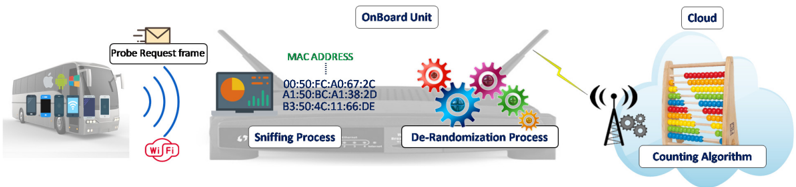
iABACUS is a Wi-Fi-based automatic bus passenger counting system that sniffs Probe Request frames and de-randomizes MAC addresses to count and track passenger devices without passenger action. It reports 100% accuracy in a static test and almost 94% in a dynamic car-simulated bus test, with random errors mainly when two bus stops are very close.
Key findings
- In the static de-randomization test with 21 devices with active Wi-Fi in a university room over 15 minutes, iABACUS returned the exact number of devices (21), while a traditional Wi-Fi APCS that ignores MAC randomization would have counted 37; the abstract reports 100% accuracy in the static case.
- In the dynamic car-simulated bus experiments in Cagliari, with 13 stops and 8 Wi-Fi devices (3 implementing MAC randomization), the abstract reports almost 94% accuracy; errors were random and appeared when two bus stops were very close.
- Across three dynamic tests, the first test missed devices A and H, misassigned devices D and C, and counted an unplanned external device X; the second test had only a device C alighting/boarding error; the third test solved the device C problem and counted no external devices even with the required frame count set to 1, but device D was again misassigned because stops 2 and 3 were very close and their guard times overlapped.
- The paper states MAC randomization is a serious problem: even the presence of only three devices can lead to a count six times higher in a 15-minute interval, while the de-randomization algorithm successfully recognized all randomized MAC addresses in the 21-device test.
Methods
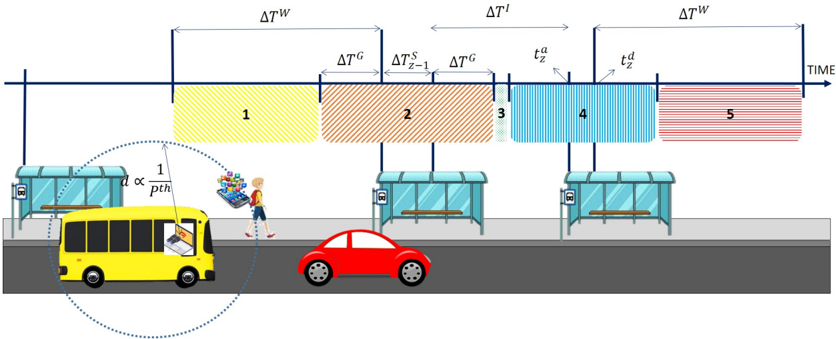
- iABACUS uses an on-board Wi-Fi sniffer to collect Probe Request frames, stores them in a MySQL database via a Lua script, and queries them with a PHP application; the de-randomization algorithm uses tagged parameters, timestamps, and frame sequence numbers, while the counting algorithm applies temporal windows, frame-count thresholds, received-power thresholds, permanence checks, guard times, and sectors around bus stops.
- Static evaluation: a Wireshark sniffer in Monitor Mode captured broadcast Probe Request frames in a university room for 15 minutes, with 21 devices with active Wi-Fi, 2.4 GHz reception, and a received-power threshold of −55 dBm.
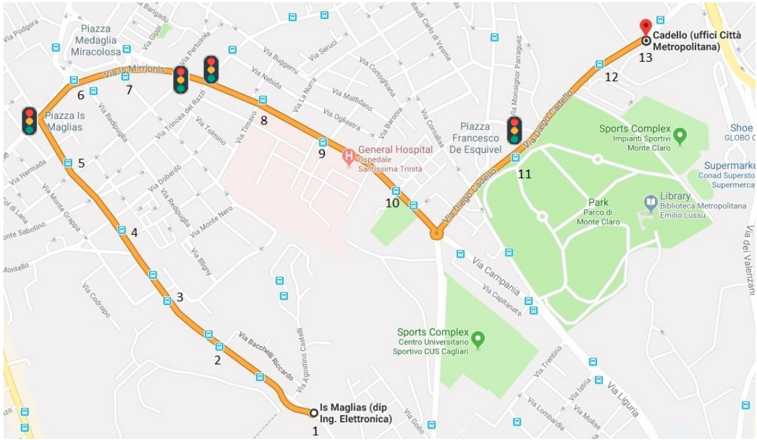
- Dynamic evaluation: a car simulated a bus path in Cagliari, Italy, with 13 stops, about 2.4 km, and about 15 minutes travel time; 8 Wi-Fi devices were used, 3 with MAC randomization, and boarding/alighting was simulated by switching Wi-Fi interfaces on and off; the sniffer was implemented on a Raspberry Pi 2 with Raspbian Stretch, a USB Wi-Fi dongle, and a GPS module sending position every 5 s; three tests tuned parameters such as temporal window, required frame count, power threshold, permanence time, and guard time.
Limitations
- The paper states future work is needed on real-use conditions such as Wi-Fi signal attenuation due to bus size or passenger bodies, interference, and non-line-of-sight; on how many sniffers are required and their optimal position; on the random error related to proximity of two bus stops; and on the systematic error due to non-connected users, including comparison with local bus transport data and city-specific adjusting factors.
- The paper states that scaling factors are needed because the number of devices may not equal the number of passengers, and that calibrating these factors is out of scope; Wi-Fi may underestimate passenger volumes if Wi-Fi is turned off, while multiple devices per passenger may overestimate counts.
- Evident from the text: the dynamic experiments used a car to simulate a bus, involved only 8 devices with 3 randomized, and were run in moderate traffic before or during lunch; errors were tied to low or irregular Probe Request frequency and energy-saving mode, and close bus stops could cause guard-time overlap and unavoidable misassignment.
Model-written summary. Check it against the paper before relying on it.
Integrity signals
Registry
Cites
Statistics
Figures



Verification
Claims the paper makes
0 Valid · 3 Not valid · 11 Not checked · 60 Own results and interpretations
A result the paper reports from its own data — it cites no other source for it, so there is none to check. The quote shows it is in the paper.
In the paper
“device D boards at stop 4 instead of stop 2”
§ iABACUS: A Wi-Fi-Based Automatic Bus Passenger Counting System > 4.2. Passenger Counting Experiments
plainSingle case- Asserted: passes — The authors put it forward as true.
- Checkable: passes — It can be checked against evidence.
- Load-bearing: unclear — It is unclear whether the paper’s conclusions depend on it.
- Based: passes — The paper gives a reason why it holds.
A result the paper reports from its own data — it cites no other source for it, so there is none to check. The quote shows it is in the paper.
In the paper
“Test results proves that iABACUS efficiently detects the number of devices with an active Wi-Fi interface, with an accuracy of 100% in the static case and almost 94% in the dynamic case.”
§ iABACUS: A Wi-Fi-Based Automatic Bus Passenger Counting System > Abstract
boosted- Asserted: passes — The authors put it forward as true.
- Checkable: passes — It can be checked against evidence.
- Load-bearing: passes — The paper’s conclusions depend on it.
- Based: passes — The paper gives a reason why it holds.
A result the paper reports from its own data — it cites no other source for it, so there is none to check. The quote shows it is in the paper.
In the paper
“iABACUS ensures that a much more accurate result is obtained, compared to common Wi-Fi-based APCS that does not take into account the randomization of MAC addresses.”
§ iABACUS: A Wi-Fi-Based Automatic Bus Passenger Counting System > 4.1. Accuracy Evaluation for the De-Randomization Algorithm
plainstates a causeSingle case- Asserted: passes — The authors put it forward as true.
- Checkable: passes — It can be checked against evidence.
- Load-bearing: passes — The paper’s conclusions depend on it.
- Based: passes — The paper gives a reason why it holds.
A result the paper reports from its own data — it cites no other source for it, so there is none to check. The quote shows it is in the paper.
In the paper
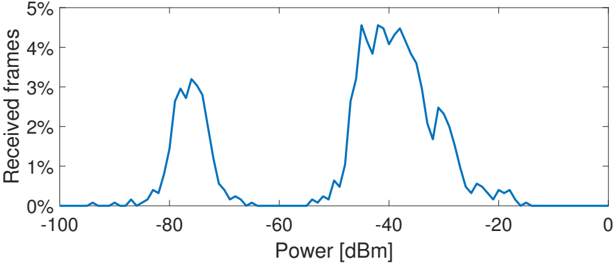
“As expected, the highest average power was measured for the devices that were closer to the sniffer.”
§ iABACUS: A Wi-Fi-Based Automatic Bus Passenger Counting System > 4.1. Accuracy Evaluation for the De-Randomization Algorithm
plainstates an association- Asserted: passes — The authors put it forward as true.
- Checkable: passes — It can be checked against evidence.
- Load-bearing: passes — The paper’s conclusions depend on it.
- Based: passes — The paper gives a reason why it holds.
A result the paper reports from its own data — it cites no other source for it, so there is none to check. The quote shows it is in the paper.
In the paper
“The results of the first test show that devices A and H are missing”
§ iABACUS: A Wi-Fi-Based Automatic Bus Passenger Counting System > 4.2. Passenger Counting Experiments
plain- Asserted: passes — The authors put it forward as true.
- Checkable: passes — It can be checked against evidence.
- Load-bearing: unclear — It is unclear whether the paper’s conclusions depend on it.
- Based: passes — The paper gives a reason why it holds.
38 more claims
Create a free account to see all 74 claims and to verify the 1 reference still open.
- It may state two separate claims as one. 20
- Probably not a substantial claim. 16
Claims other papers make about this one
Each is checked against this paper’s own text: does it say what the citing paper says it does?
The source backs part of the claim, not all of it — or backs it for a different population, condition or comparison.
In the citing paper
“To the best of our knowledge, most validation of these Wi-Fi-based counting systems has been done either in controlled environments or only over short periods (Nitti et al. 2020; Oransirikul et al. 2014).”
From A low-cost automatic people-counting system at bus stops using Wi-Fi probe requests and deep learning (2025) · cites this paper as Nitti et al. 2020
Experimental — accuracy not yet measuredThe source backs part of the claim, not all of it — or backs it for a different population, condition or comparison.
In the citing paper
“CCTV Cameras (with ML) [11,26,32] 92-99%”
From A Review of Passenger Counting in Public Transport Concepts with Solution Proposal Based on Image Processing and Machine Learning (2024) · cites this paper as [26]
Experimental — accuracy not yet measuredThe source backs part of the claim, not all of it — or backs it for a different population, condition or comparison.
In the citing paper
“Research [26] has shown that detecting the opening and closing of doors can significantly improve the precision of passenger counting, as it allows the system to focus on periods of high passenger movement.”
From A Review of Passenger Counting in Public Transport Concepts with Solution Proposal Based on Image Processing and Machine Learning (2024) · cites this paper as [26]
Experimental — accuracy not yet measuredThe cited source says what the claim attributes to it.
In the citing paper
“Traditional APC systems [4], [37], [149] count the number of passengers inside vehicles on the basis of various onboard sensors, mainly IR or pressure-sensitive ones.”
From Sensing Technologies for Crowd Management, Adaptation, and Information Dissemination in Public Transportation Systems: A Review (2023) · cites this paper as [149]
The cited source says what the claim attributes to it.
In the citing paper
“It counts the number of active Wi-Fi interfaces of mobile devices carried by passengers.It is based on a de-randomization mechanism, which overcomes the issue of not being able to attribute two or more random MAC addresses to the same device, and since the original MAC address is kept unknown, the identity of passengers cannot be inferred, and their privacy is preserved.”
From A Review of Passenger Counting in Public Transport Concepts with Solution Proposal Based on Image Processing and Machine Learning (2024) · cites this paper as [26]
Self-check
Percentages, sums and reported differences re-computed from the paper’s own numbers.
Each contradiction between two passages listed here was confirmed by an independent check.
Rated minor: it would not touch a result — a value no result rests on, a p-value that stays on the same side of the significance level, or a conflict that is clerical, resolved elsewhere in the paper, or outside its own findings.
In the paper
§ iABACUS: A Wi-Fi-Based Automatic Bus Passenger Counting System > 4.2. Passenger Counting Experiments
“We also decide to set a more conservative threshold for the received power, to avoid counting devices from outside the car.”
§ iABACUS: A Wi-Fi-Based Automatic Bus Passenger Counting System > 5. Conclusions and Future Works
“| P th (dBm) | -55 | -65 | -65 |”
Rated minor: it would not touch a result — a value no result rests on, a p-value that stays on the same side of the significance level, or a conflict that is clerical, resolved elsewhere in the paper, or outside its own findings.
In the paper
§ iABACUS: A Wi-Fi-Based Automatic Bus Passenger Counting System > 2.2. Emerging Automatic Passenger Counting Systems
“According to this technology, [30] presented a method to estimate at aggregate level passenger demand for public transportation services.”
§ iABACUS: A Wi-Fi-Based Automatic Bus Passenger Counting System > References
“30. Gao, R.; Zhao, M.; Ye, T.; Ye, F.; Wang, Y.; Luo, G. Smartphone-based real time vehicle tracking in indoor parking structures.”
Citations
Cites
Understanding individual human mobility patterns
González, M. C., Hidalgo, C. A., & Barabási, A.-L. (2008) · Nature · doi:10.1038/nature06958 · Cited by 6,059
(2019) · Cited by 633
Understanding individual human mobility patterns
González, M. C., Hidalgo, C. A., & Barabási, A.-L. (2009) · Nature · doi:10.1038/nature07850 · Cited by 484
A GPS/GIS method for travel mode detection in New York City
Gong, H., Chen, C., Bialostozky, E., & Lawson, C. T. (2012) · Computers, Environment and Urban Systems · doi:10.1016/j.compenvurbsys.2011.05.003 · Cited by 292 · cited 1×
“Urban mobility and flow of people throughout urban infrastructures have a great impact on several areas, such as tourism and transportation [1,2].”
BackgroundDissemination and Harvesting of Urban Data Using Vehicular Sensing Platforms
Lee, U., Magistretti, E., Gerla, M., Bellavista, P., & Corradi, A. (2009) · IEEE Transactions on Vehicular Technology · doi:10.1109/tvt.2008.928899 · Cited by 238
PortoLivingLab: An IoT-Based Sensing Platform for Smart Cities
Santos, P. M., Queiros, C., Sargento, S., Aguiar, A., Barros, J., Rodrigues, J. G. P., Cruz, S. B., Lourenco, T., d'Orey, P. M., Luis, Y., et al. (2018) · IEEE Internet of Things Journal · doi:10.1109/jiot.2018.2791522 · Cited by 177
Accurate WiFi based localization for smartphones using peer assistance
Liu, H., Yang, J., Sidhom, S., Wang, Y., Chen, Y., & Ye, F. (2014) · IEEE Transactions on Mobile Computing · doi:10.1109/tmc.2013.140 · Cited by 151
A real-time passenger flow estimation and prediction method for urban bus transit systems
Zhang, J., Shen, D., Tu, L., Zhang, F., Xu, C., Wang, Y., Tian, C., Li, X., Huang, B., & Li, Z. (2017) · IEEE Transactions on Intelligent Transportation Systems · doi:10.1109/tits.2017.2686877 · Cited by 130 · cited 1×
“…the number of passengers represents one of the most relevant components of the transit service, since it provides a key measure of the effectiveness of Public Transportation Companies (PTCs) and is pivotal for the efficient planning of the transit network, both in the long and short term [3,4].”
BackgroundUSES OF ARCHIVED AVL-APC DATA TO IMPROVE TRANSIT PERFORMANCE AND MANAGEMENT: REVIEW AND POTENTIAL
Furth, P. G., Hemily, B., Muller, T., & Strathman, J. G. (2003) · Cited by 102
Bi-directional passing people counting system based on IR-UWB radar sensors
Choi, J. W., Quan, X., & Cho, S. H. (2018) · IEEE Internet of Things Journal · doi:10.1109/jiot.2017.2714181 · Cited by 102
Research works printed but not linked: 4
- Barabino, 2013, The quality of public transport service: The 13816 standard and a methodological approach to an Italian case, Ing. Ferrov., 68, 475
- Pinna, 2010, Automatic passenger counting and vehicle load monitoring, Ing. Ferrov., 65, 101
- Kyritsis, D. (2017). The Identification of Road Modality and Occupancy Patterns by Wi-Fi Monitoring Sensors as a Way to Support the “Smart Cities” Concept: Application at the City Centre of Dordrecht. [Master’s Thesis, TU Delft].
- IEEE Computer Society LAN/MAN Standards Committee (2007). IEEE Standard for Information Technology-Telecommunications and Information Exchange between Systems-Local and Metropolitan Area Networks-Specific Requirements Part 11: Wireless LAN Medium Access Control (MAC) and Physical Layer (PHY) Specifications, IEEE. IEEE Std 802.11.
Cited by
Exploring Human Mobility for Multi-Pattern Passenger Prediction: A Graph Learning Framework
Kong, X., Wang, K., Hou, M., Xia, F., Karmakar, G., & Li, J. (2022) · IEEE Transactions on Intelligent Transportation Systems · doi:10.1109/tits.2022.3148116 · Cited by 75
“[35] presented a Wi-Fi-based Automatic Bus pAssenger CoUnting System (iABACUS), which did not depends on passengers card records and can track passengers to analyze urban mobility.”
MethodDarsena, D., Gelli, G., Iudice, I., & Verde, F. (2023) · IEEE Sensors Journal · doi:10.1109/jsen.2022.3223297 · Cited by 71
“Traditional APC systems [4, 37, 149] count the number of passengers inside vehicles on the basis of various onboard sensors, mainly IR or pressure-sensitive ones.”
BackgroundMethodA review of bus arrival time prediction using artificial intelligence
Singh, N., & Kumar, K. (2022) · Wiley Interdisciplinary Reviews Data Mining and Knowledge Discovery · doi:10.1002/widm.1457 · Cited by 48
“Emerging APCs require a specific app installed on passengers mobiles and hence face MAC address issue which is shown to deal with using a de-randomization mechanism recently (Nitti et al., 2020).”
BackgroundUras, M., Ferrara, E., Cossu, R., Liotta, A., & Atzori, L. (2022) · Computer Networks · doi:10.1016/j.comnet.2022.109393 · Cited by 32
Origin–Destination Flow Estimation from Link Count Data Only
Dey, S., Winter, S., & Tomko, M. (2020) · Sensors · doi:10.3390/s20185226 · Cited by 30
“Accordingly, as a future work, our model can be extended for tracking passengers throughout their journeys on public transportation vehicles using automatic passenger counting systems [45,46].”
Method
Metadata
- Authors
- Nitti, M., Pinna, F., Pintor, L., Pilloni, V., & Barabino, B.
- Affiliations
- University of Cagliari (IT)
- Department of Electrical and Electronic Engineering (DIEE), University of Cagliari, 09123 Cagliari, Italy
- University of Brescia (IT)
- Corresponding author
- Nitti, Michele
- Pilloni, Virginia
- Barabino, Benedetto
- Venue
- Energies
- Publisher
- MDPI AG
- Published
- 2020-03-19
- Volume
- 13
- Issue
- 6
- Pages
- 1446
- ISSN
- 1996-1073 (ISSN-L)
- OpenAlex
- W3012110674
- Cited by
- 72
- References
- 40
- Citations by year
- 2026: 3 · 2025: 17 · 2024: 20 · 2023: 12 · 2022: 10 · 2021: 7 · 2020: 3
- FWCI
- 7.14
- Type
- journal article
- Language
- en
- Open access
- gold
- doi.org
- Licence
- Locations
- Energies (publishedVersion, cc-by)
- RePEc: Research Papers in Economics (submittedVersion)
- DOAJ (DOAJ: Directory of Open Access Journals) (submittedVersion, cc-by-sa)
- Institutional Research Information System (Università degli Studi di Brescia) (submittedVersion, cc-by)
- UNICA IRIS Institutional Research Information System (University of Cagliari) (submittedVersion, other-oa)
- Funders
- Ministero dell’Istruzione, dell’Università e della Ricerca (SCN_00281, PON04a2_00381)
- Ministero dello Sviluppo Economico (PON 2014/2020 POS. 395)
- Topics
- Social Sciences › Transportation › Human Mobility and Location-Based Analysis
- Physical Sciences › Engineering › Electrical and Electronic Engineering › Indoor and Outdoor Localization Technologies
- Social Sciences › Transportation › Transportation Planning and Optimization
- Keywords
- automatic passenger counting, WiFi sensing, Internet of Things, public transport, urban mobility, smart cities, in-vehicle sensors, device detection, transit network planning
About these checks
Registry, retraction, Cites and statistics results are computed, not judged, with one exception: a printed reference that no index lists is read once by a model before it counts as a citation error. Claims are extracted by a model and kept only when their quote appears verbatim in the text; each cited source is then checked, with a model’s help, for whether it says what the claim relies on. Those verdicts can be wrong — read the claim’s quote and the cited source before relying on one.
A language model drew the claims from the paper on 2026-10-10, under version 3 of the claim definition (model deepseek-v4.1-flash, prompt extract-v3).
A second model labelled each claim on 2026-10-10 (model jev-1.13-20260917, definition revision gold-guideline-v0.2).
Statistics and arithmetic are recomputed, not judged.
Confidence bands are shown only for fields calibrated on our annotated test set. None is calibrated yet, so no band is shown.
What counts as a claim ›How we measure confidence ›How we check this ›
Are you an author, or do you see a problem with this page? Request a review
How to cite
Cite CoChat for the checks on this page, and the paper for its own findings.
- This page
- CoChat. (2026). Citation check: iABACUS: A Wi-Fi-Based Automatic Bus Passenger Counting System. https://app.cochat.ai/papers/10.3390/en13061446
- The paper
- Nitti, M., Pinna, F., Pintor, L., Pilloni, V., & Barabino, B. (2020). iABACUS: A Wi-Fi-Based Automatic Bus Passenger Counting System. Energies. https://doi.org/10.3390/en13061446
Data sources
Bibliographic data: Semantic Scholar, OpenAlex, Crossref.
Contains information from the Semantic Scholar Academic Graph Datasets, made available under the ODC Attribution License (ODC-BY 1.0).
Semantic Scholar’s data is described in: Kinney, R., et al. (2023). The Semantic Scholar Open Data Platform. arXiv:2301.10140.
