

The DOI matches its Crossref record.
A Low-Voltage DC Backbone with Aggregated RES and BESS: Benefits Compared to a Traditional Low-Voltage AC System
Abstract
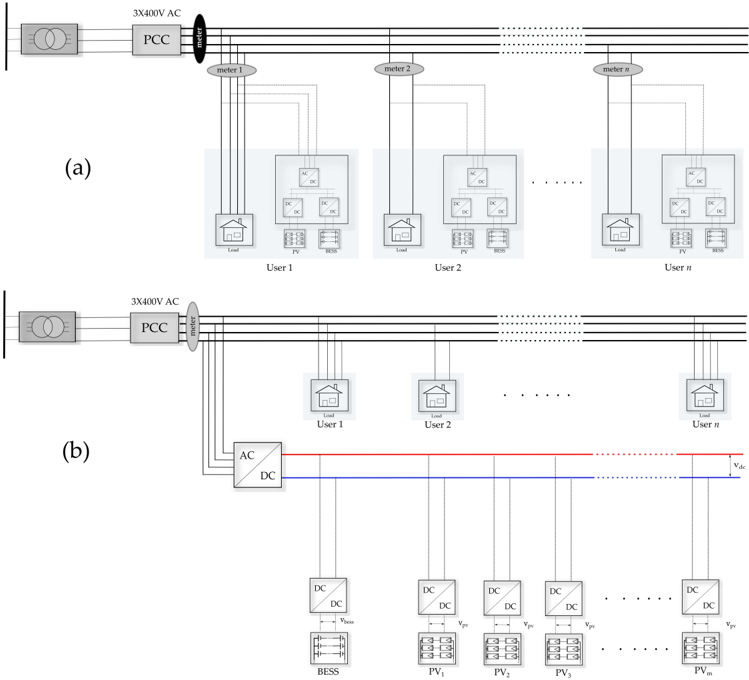
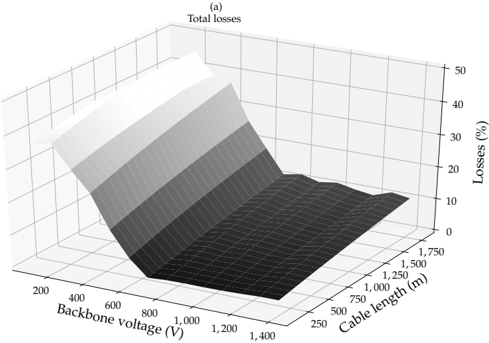
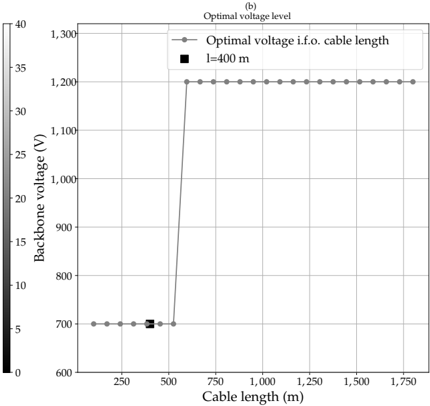
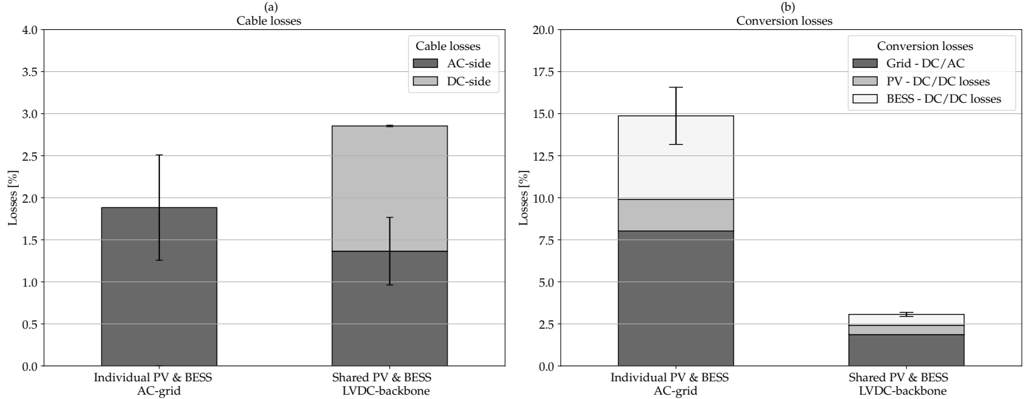
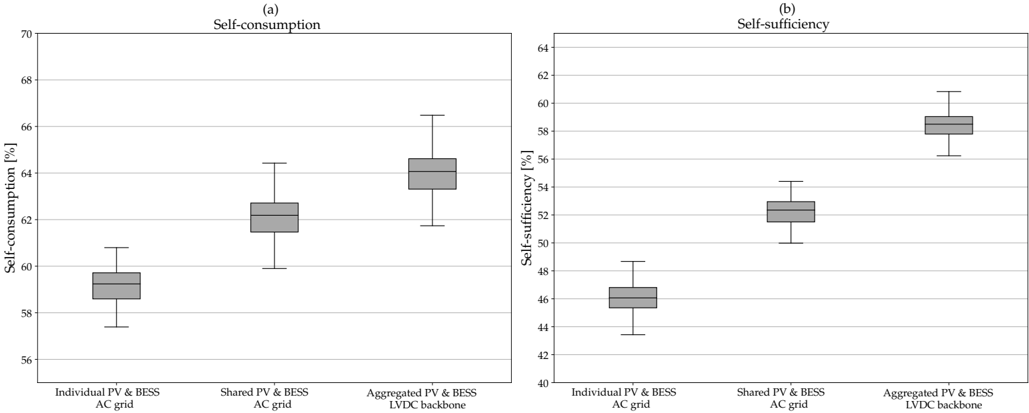
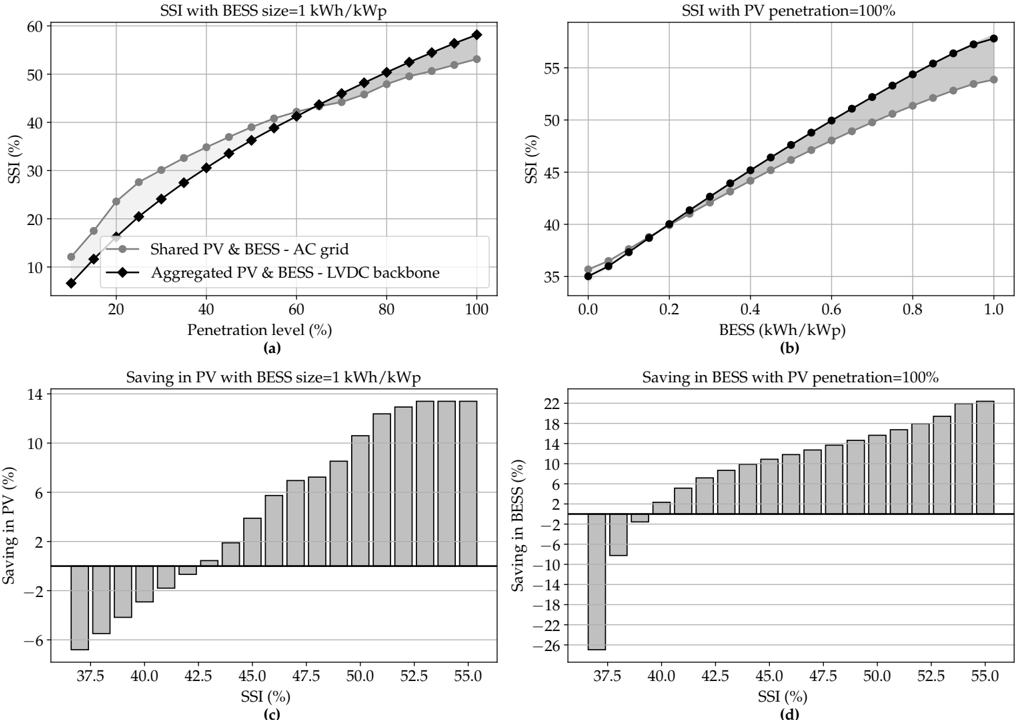
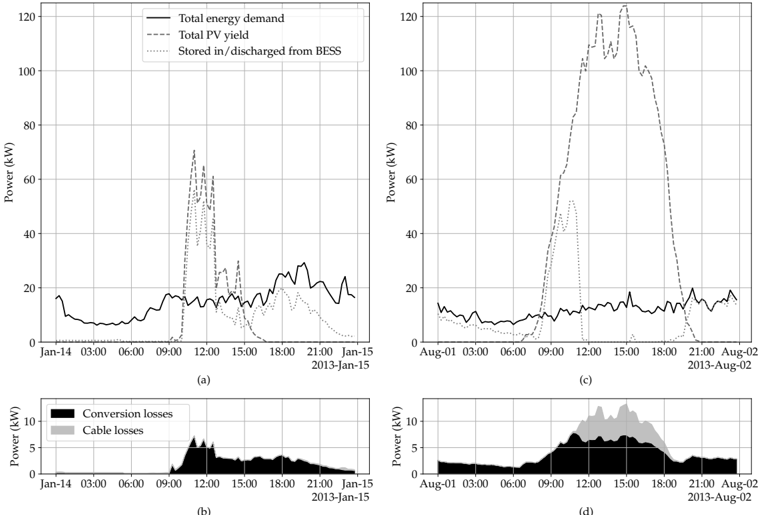
The increasing penetration of PV into the distribution grid leads to congestion, causing detrimental power quality issues. Moreover, the multiple small photovoltaic (PV) systems and battery energy storage systems (BESSs) result in increasing conversion losses. A low-voltage DC (LVDC) backbone to interconnect these assets would decrease the conversion losses and is a promising solution for a more optimal integration of PV systems. The multiple small PV systems can be replaced by shared assets with large common PV installations and a large BESS. Sharing renewable energy and aggregation are activities that are stimulated by the European Commission and lead to a substantial benefit in terms of self-consumption index (SCI) and self-sufficiency index (SSI). In this study, the benefit of an LVDC backbone is investigated compared to using a low-voltage AC (LVAC) system. It is found that the cable losses increase by 0.9 percent points and the conversion losses decrease by 12 percent points compared to the traditional low-voltage AC (LVAC) system. The SCI increases by 2 percent points and the SSI increases by 6 percent points compared to using an LVAC system with shared meter. It is shown that an LVDC backbone is only beneficial with a PV penetration level of 65% and that the BESS can be reduced by 22% for the same SSI.
Overview
The claims and statistics of this paper haven’t been checked yet.
Run the check — free, no account needed. It reads the open-access text and checks the sources it cites.
Integrity signals
Registry
Cites
Statistics
Figures
Verification
Claims the paper makes
The claims and statistics of this paper haven’t been checked yet.
Run the check — free, no account needed. It reads the open-access text and checks the sources it cites.
Claims other papers make about this one
Each is checked against this paper’s own text: does it say what the citing paper says it does?
In the citing paper
“These studies propose using a DC backbone as an alternative to alternative current (AC) backbones in smart grids by connecting various DC-based renewable energy generation systems, storage systems [39], and loads such as EV chargers [40,41].”
From Smart, circular and renewable: The role of cooperative governance in accelerating a sustainable energy transition (2025) · cites this paper as [39]
Self-check
Percentages, sums and reported differences re-computed from the paper’s own numbers.
The self-check needs the paper’s full text.
Citations
Cites
No references could be resolved yet.
Research works printed but not linked: 40
- Patil, A., Girgaonkar, R., and Musunuri, S.K. (2014, January 17–18). Impacts of increasing photovoltaic penetration on distribution grid—Voltage rise case study. Proceedings of the 2014 International Conference on Advances in Green Energy (ICAGE), Thiruvananthapuram, India. · DOI
- Bayer, 2018, The German experience with integrating photovoltaic systems into the low-voltage grids, Renew. Energy, 119, 129, 10.1016/j.renene.2017.11.045 · DOI
- Klyapovskiy, 2019, Incorporating flexibility options into distribution grid reinforcement planning: A techno-economic framework approach, Appl. Energy, 254, 113662, 10.1016/j.apenergy.2019.113662 · DOI
- Allard, 2020, Considering distribution grids and local flexibilities in the prospective development of the European power system by 2050, Appl. Energy, 270, 114958, 10.1016/j.apenergy.2020.114958 · DOI
- Haesen, 2010, The Impact of Charging Plug-In Hybrid Electric Vehicles on a Residential Distribution Grid, IEEE Trans. Power Syst., 25, 371, 10.1109/TPWRS.2009.2036481 · DOI · Paper page
- Agustoni, A., Borioli, E., Simioli, G., Tironi, E., and Ubezio, G. (2005, January 6–9). LV DC distribution network with distributed energy resources: Analysis of possible structures. Proceedings of the 18th International Conference and Exhibition on Electricity Distribution (CIRED 2015), Turin, Italy. · DOI
- Yang, 2011, An Industry-Based Survey of Reliability in Power Electronic Converters, IEEE Trans. Ind. Appl., 18, 480
- Kakigano, H., Miura, Y., and Ise, T. (2010, January 21–24). Loss evaluation of DC distribution for residential houses compared with AC system. Proceedings of the 2010 International Power Electronics Conference (ECCE ASIA), Sapporo, Japan. · DOI
- Kakigano, H., Miura, Y., Ise, T., Van Roy, J., and Driesen, J. (2005, January 11–14). Basic Sensitivity Analysis of Conversion Losses in a DC Microgrid. Proceedings of the International Conference on Renewable Energy Research and Applications (ICRERA 2012), Nagasaki, Japan. · DOI
- Emhemed, 2014, An Advanced Protection Scheme for Enabling an LVDC Last Mile Distribution Network, IEEE Trans. Smart Grid, 5, 2602, 10.1109/TSG.2014.2335111 · DOI
- Chen, 2016, Voltage-Level Selection of Future Two-Level LVdc Distribution Grids: A Compromise Between Grid Compatibiliy, Safety, and Efficiency, IEEE Electrif. Mag., 4, 20, 10.1109/MELE.2016.2543979 · DOI
- Freitas, 2018, Minimizing storage needs for large scale photovoltaics in the urban environment, Sol. Energy, 159, 375, 10.1016/j.solener.2017.11.011 · DOI
- Luthander, 2016, Self-consumption enhancement of residential photovoltaics with battery storage and electric vehicles in communities, Energy, 112, 221, 10.1016/j.energy.2016.06.039 · DOI
- Barbour, 2018, Community energy storage: A smart choice for the smart grid?, Appl. Energy, 212, 489, 10.1016/j.apenergy.2017.12.056 · DOI
- Roberts, M.B., Bruce, A., and MacGill, I. (December, January 30). PV for appartment buildings: Which side of the meter?. Proceedings of the Solar Research Conference, Melbourne, Australia.
- Claeys, R., Delerue, T., and Desmet, J. (October, January 29). Assessing the influence of the aggregation level of residential consumers through load duration curves. Proceedings of the IEEE ISGT-Europe, Bucharest, Romania.
- Poulin, 2008, Load duration curve: A tool for technico-economic analysis of energy solutions, Energy Build., 40, 29, 10.1016/j.enbuild.2007.01.020 · DOI
- Sevlian, R.A., and Rajagopal, R. (2014, January 27–31). A model for the effect of aggregation on short term load forecasting. Proceedings of the 2014 IEEE PES General Meeting, Washington, DC, USA. · DOI
- Schlund, J., Pflugradt, N., Steber, D., Muntwyler, U., and German, R. (2018, January 21–25). Benefits of Virtual Community Energy Storages compared to Individual Batteries based on Behaviour Based Synthetic Load Profiles. Proceedings of the IEEE ISGT-Europe, Sarajevo, Bosnia and Herzegovina. · DOI
- Gonzalez, C., Geuns, J., Weckx, S., Wijnhoven, T., Vingerhoets, P., De Rybel, T., and Driesen, J. (2012, January 14–17). LV Distribution Network Feeders in Belgium and Power Quality Issues due to Increasing PV Penetration Levels. Proceedings of the IEEE ISGT-Europe, Berlin, Germany. · DOI
- Lowitzsch, 2019, Renewable energy communities under the 2019 European Clean Energy Package—Governance model for the energy clusters of the future?, Renew. Sustain. Energy Rev., 122, 1
- Maksimovic, 2001, Modeling and simulation of power electronic converters, Proc. IEEE, 89, 898, 10.1109/5.931486 · DOI
- Rashid, M.H. (2018). 11—Inverters. Power Electronics Handbook, Elsevier.
- Rashid, M.H. (2018). 10—DC-DC Converters. Power Electronics Handbook, Elsevier. · DOI
- Xiong, 2009, New Physical Insights on Power MOSFET Switching Losses, IEEE Trans. Power Electron., 24, 525, 10.1109/TPEL.2008.2006567 · DOI
- Rafiq, M., and Hasan, M.F.U. (2011). Design and Analysis of 60 kW DC-DC Converter for Hybrid Electric Vehicle Applications. [Master’s Thesis, Chalmers University of Technology].
- Venkatachalam, K., Sullivan, C.R., Abdallah, T., and Tacca, H. (2002, January 3–4). Accurate prediction of ferrite core loss with nonsinusoidal waveforms using only Steinmetz parameters. Proceedings of the 2002 IEEE Workshop on Computers in Power Electronics, Mayaguez, PR, USA.
- Davies, J.A., and Hay, J.E. (1978, January 17–19). Calculation of the solar radiation incident on an inclined surface. Proceedings of the 1st Canadian Solar Radiation Data Workshop, Toronto, ON, Canada.
- Holm, 2018, pvlib python: A python package for modeling solar energy systems, Open Source Softw., 3, 884, 10.21105/joss.00884 · DOI
- Jacobson, 2018, World estimates of PV optimal tilt angles and ratios of sunlight incident upon tilted and tracked PV panels relative to horizontal panels, Sol. Energy, 169, 55, 10.1016/j.solener.2018.04.030 · DOI
- Erdinc, O., Vural, B., and Uzunoglu, M. (2009, January 9–11). A dynamic lithium-ion battery model considering the effects of temperature and capacity fading. Proceedings of the International Conference on Clean Electrical Power, Capri, Italy. · DOI
- Chicco, G., Schlabbach, J., and Spertino, F. (2005, January 27–30). Characterisation and assessment of the harmonic emission of grid-connected photovoltaic systems. Proceedings of the IEEE Russia Power Tech, St. Petersburg, Russia. · DOI
- Brenna, M., Chiumea, R., and Gandolfi, C. (2011, January 14–16). Harmonic analysis: Comparison between different modulation strategies for three phase inverter connecting Distributed Generation. Proceedings of the International Conference on Clean Electrical Power, Ischia, Italy. · DOI
- Schwanz, 2017, Stochastic Assessment of Voltage Unbalance Due to Single-Phase-Connected Solar Power, IEEE Trans. Power Deliv., 32, 852, 10.1109/TPWRD.2016.2579680 · DOI
- Ulinuha, A., Masoum, M.A.S., and Islam, S.M. (2007, January 4–7). Unbalance power flow calculation for a radial distribution system using forward-backward propagation algorithm. Proceedings of the Australasian Universities Power Engineering Conference, Sydney, Australia. · DOI
- Kersting, W.H. (2002). Distribution System Modeling and Analysis, CRC Press LLC. · DOI · Paper page
- Locment, 2015, Modeling and Simulation of DC Microgrids for Electric Vehicle Charging Stations, Energies, 8, 4335, 10.3390/en8054335 · DOI
- Aluisio, B., Bruno, S., De Bellies, L., Dicorato, M., Forte, G., and Trovato, M. (2019). DC-Microgrid Operation Planning for an Electric Vehicle Supply Infrastructure. Appl. Sci., 9. · DOI
- Zhuang, 2014, Experimental Study on the Emergency Ampacity of XLPE Cable and Its Application, Appl. Mech. Mater., 599, 931, 10.4028/www.scientific.net/AMM.599-601.931 · DOI
- Azaioud, H., Desmet, J., and Vandevelde, L. (2020). Benefit Evaluation of PV Orientation for Individual Residential Consumers. Energies, 13. · DOI
Cited by
Sorted by citations
Van Opstal, W., Bocken, N., & Brusselaers, J. (2025) · Energy Research & Social Science · doi:10.1016/j.erss.2025.104049 · Cited by 20
Metadata
- Authors
- Azaioud, H., Claeys, R., Knockaert, J., Vandevelde, L., & Desmet, J.
- Affiliations
- EELab/Lemcko, Department of Electromechanical, Systems and Metal Engineering, Ghent University, 8500 Kortrijk, Belgium
- EELab, Department of Electromechanical, Systems and Metal Engineering, Ghent University, 9052 Ghent, Belgium
- Venue
- Energies
- Publisher
- MDPI AG
- Published
- 2021-03-04
- Volume
- 14
- Issue
- 5
- Pages
- 1420
- ISSN
- 1996-1073
- Cited by
- 17
- References
- 0
- Language
- en
About these checks
Registry, retraction, Cites and statistics results are computed, not judged, with one exception: a printed reference that no index lists is read once by a model before it counts as a citation error. Claims are extracted by a model and kept only when their quote appears verbatim in the text; each cited source is then checked, with a model’s help, for whether it says what the claim relies on. Those verdicts can be wrong — read the claim’s quote and the cited source before relying on one.
Statistics and arithmetic are recomputed, not judged.
Confidence bands are shown only for fields calibrated on our annotated test set. None is calibrated yet, so no band is shown.
What counts as a claim ›How we measure confidence ›How we check this ›
Are you an author, or do you see a problem with this page? Request a review
