

A Survey of Security Strategies in Federated Learning: Defending Models, Data, and Privacy
Open accessThe DOI matches its Crossref record; 175 of the 177 references it cites were found in a registry or an index, and 2 are not checked yet.
Abstract
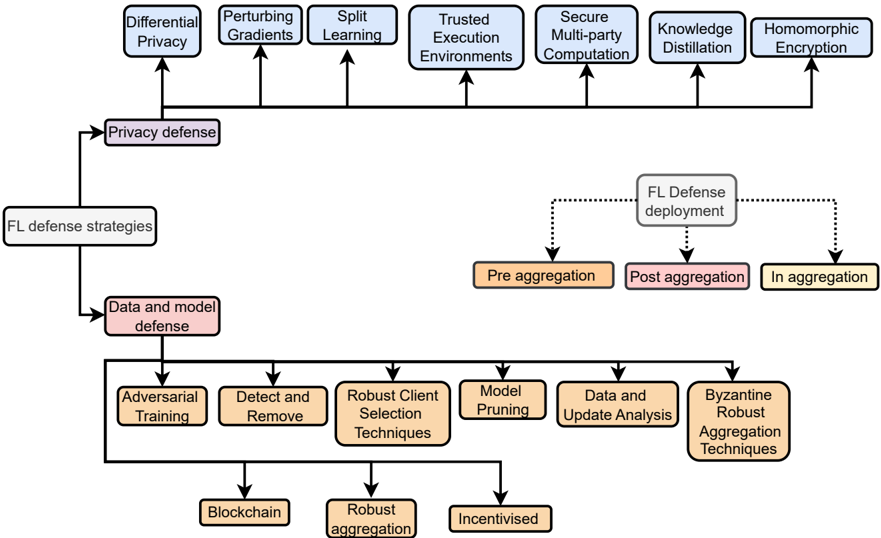
Federated Learning (FL) has emerged as a transformative paradigm in machine learning, enabling decentralized model training across multiple devices while preserving data privacy. However, the decentralized nature of FL introduces significant security challenges, making it vulnerable to various attacks targeting models, data, and privacy. This survey provides a comprehensive overview of the defense strategies against these attacks, categorizing them into data and model defenses and privacy attacks. We explore pre-aggregation, in-aggregation, and post-aggregation defenses, highlighting their methodologies and effectiveness. Additionally, the survey delves into advanced techniques such as homomorphic encryption and differential privacy to safeguard sensitive information. The integration of blockchain technology for enhancing security in FL environments is also discussed, along with incentive mechanisms to promote active participation among clients. Through this detailed examination, the survey aims to inform and guide future research in developing robust defense frameworks for FL systems.
Overview
The claims and statistics of this paper haven’t been checked yet.
Free: it reads the open-access text and checks the first 5 claims that cite a source we can check. Create a free account to check every claim.
Integrity signals
Registry
Cites
Statistics
Figures
Verification
Claims the paper makes
The claims and statistics of this paper haven’t been checked yet.
Free: it reads the open-access text and checks the first 5 claims that cite a source we can check. Create a free account to check every claim.
Self-check
Percentages, sums and reported differences re-computed from the paper’s own numbers.
The self-check needs the paper’s full text.
Citations
Cites
Dwork, C. (2006) · Lecture Notes in Computer Science · doi:10.1007/11787006_1 · Cited by 5,291
A Simple Unified Framework for Detecting Out-of-Distribution Samples and Adversarial Attacks
Lee, K., Lee, K., Lee, H., & Shin, J. (2018) · arXiv · doi:10.48550/arxiv.1807.03888 · Cited by 2,450
Federated Learning With Differential Privacy: Algorithms and Performance Analysis
Wei, K., Li, J., Ding, M., Ma, C., Yang, H. H., Farokhi, F., Jin, S., Quek, T. Q. S., & Vincent Poor, H. (2020) · IEEE Transactions on Information Forensics and Security · doi:10.1109/tifs.2020.2988575 · Cited by 2,400
Big data in healthcare: management, analysis and future prospects
Dash, S., Shakyawar, S. K., Sharma, M., & Kaushik, S. (2019) · Journal of Big Data · doi:10.1186/s40537-019-0217-0 · Cited by 1,747
Reed, R. (1993) · IEEE Transactions on Neural Networks · doi:10.1109/72.248452 · Cited by 1,708
A survey on security and privacy of federated learning
Mothukuri, V., Parizi, R. M., Pouriyeh, S., Huang, Y., Dehghantanha, A., & Srivastava, G. (2021) · Future Generation Computer Systems · doi:10.1016/j.future.2020.10.007 · Cited by 1,480
(2017) · neural information processing systems · Cited by 1,413
Data-Free Knowledge Distillation for Heterogeneous Federated Learning
Zhu, Z., Hong, J., & Zhou, J. (2021) · PubMed · doi:10.48550/arxiv.2105.10056 · Cited by 1,257
Byzantine-Robust Distributed Learning: Towards Optimal Statistical Rates
Yin, D., Chen, Y., Ramchandran, K., & Bartlett, P. (2018) · arXiv · doi:10.48550/arxiv.1803.01498 · Cited by 1,130
Federated Learning Based on Dynamic RegularizationPreprint
Acar, D. A. E., Zhao, Y., Navarro, R. M., Mattina, M., Whatmough, P. N., & Saligrama, V. (2021) · arXiv (Cornell University) · doi:10.48550/arxiv.2111.04263 · Cited by 1,095
Research works printed but not linked: 10
- 1. Badi, S. IoT and Big Data Analytics: Revolutionizing Business and Society with Advanced Insights. Int. J. Appl. Math. Comput. Sci. 2024, 3, 42-56.
- 73. Shen, S.; Tople, S.; Saxena, P. Auror: Defending against poisoning attacks in collaborative deep learning systems. In Proceedings of the 32nd Annual Conference on Computer Security Applications, Los Angeles, CA, USA, 5-9 December 2016; pp. 508-519.
- Muñoz-González, L., Co, K.T., and Lupu, E.C. (2019). Byzantine-robust federated machine learning through adaptive model averaging. arXiv.
- Balakrishnan, R., Li, T., Zhou, T., Himayat, N., Smith, V., and Bilmes, J. (2022, January 25–29). Diverse client selection for federated learning via submodular maximization. Proceedings of the International Conference on Learning Representations, Virtual.
- Yan, G., Lyu, S., Hou, H., Zheng, Z., and Song, L. (2024). Towards Quantum-Safe Federated Learning via Homomorphic Encryption: Learning with Gradients. arXiv.
- Liu, Y., Zou, T., Kang, Y., Liu, W., He, Y., Yi, Z., and Yang, Q. (2021). Batch label inference and replacement attacks in black-boxed vertical federated learning. arXiv.
- Sengupta, A., Dixit, S., Akhtar, M.S., and Chakraborty, T. (2023, January 25–29). A Good Learner can Teach Better: Teacher-Student Collaborative Knowledge Distillation. Proceedings of the The Twelfth International Conference on Learning Representations, Virtual Event.
- Lan, W., Cheung, Y.m., Xu, Q., Liu, B., Hu, Z., Li, M., and Chen, Z. (2024). Improve Knowledge Distillation via Label Revision and Data Selection. arXiv.
- Mugunthan, V., Polychroniadou, A., Byrd, D., and Balch, T.H. (2019, January 13). Smpai: Secure multi-party computation for federated learning. Proceedings of the NeurIPS 2019 Workshop on Robust AI in Financial Services, Vancouver, BC, Canada.
- Wang, S., Zhu, T., Liu, B., Ming, D., Guo, X., Ye, D., and Zhou, W. (2024). Unique Security and Privacy Threats of Large Language Model: A Comprehensive Survey. arXiv.
Cited by
Abbas, S. R., Abbas, Z., Zahir, A., & Lee, S. W. (2024) · Healthcare · doi:10.3390/healthcare12242587 · Cited by 228
Federated Learning for IoT: A Survey of Techniques, Challenges, and Applications
Dritsas, E., & Τρίγκα, Μ. (2025) · Journal of Sensor and Actuator Networks · doi:10.3390/jsan14010009 · Cited by 238
“The noise magnitude is captured by a parameter called privacy budget; a smaller budget offers stronger privacy but reduces model accuracy [26,77].”
Li, J., Zhao, Y., Fan, Y., Chen, J., Gong, J., & Li, W. J. (2025) · Nano Energy · doi:10.1016/j.nanoen.2025.110821 · Cited by 95
Jaffal, N. O., Alkhanafseh, M., & Mohaisen, D. (2025) · AI · doi:10.3390/ai6090216 · Cited by 69
Iqbal, S., Zhong, X., Khan, M. A., Wu, Z., AlHammadi, D. A., Liu, W., & Choudhry, I. A. (2025) · Information Processing & Management · doi:10.1016/j.ipm.2025.104157 · Cited by 24
Metadata
- Authors
- Manzoor, H. U., Shabbir, A., Chen, A., Flynn, D., & Zoha, A.
- Affiliations
- University of Glasgow (GB)
- Ghulam Ishaq Khan Institute of Engineering Sciences and Technology (PK)
- Corresponding author
- Zoha, Ahmed
- Venue
- Future Internet
- Publisher
- MDPI AG
- Published
- 2024-10-15
- Volume
- 16
- Issue
- 10
- Pages
- 374
- ISSN
- 1999-5903 (ISSN-L)
- OpenAlex
- W4403429393
- Cited by
- 58
- References
- 158
- Citations by year
- 2026: 31 · 2025: 22 · 2024: 5
- FWCI
- 8.59
- Type
- journal article
- Language
- en
- Open access
- gold
- doi.org
- Licence
- Locations
- Future Internet (publishedVersion, cc-by)
- ENLIGHTEN (Jurnal Bimbingan dan Konseling Islam) (acceptedVersion, cc-by-sa)
- RePEc: Research Papers in Economics (submittedVersion)
- DOAJ (DOAJ: Directory of Open Access Journals) (submittedVersion)
- Funders
- Engineering and Physical Sciences Research Council (EP/Y002288/1)
- Topics
- Physical Sciences › Computer Science › Artificial Intelligence › Privacy-Preserving Technologies in Data
- Physical Sciences › Computer Science › Artificial Intelligence › Adversarial Robustness in Machine Learning
- Physical Sciences › Computer Science › Computer Networks and Communications › Cryptography and Data Security
- Keywords
- federated learning security, data poisoning, model poisoning, privacy attacks, homomorphic encryption, differential privacy, blockchain, incentive mechanisms, data privacy
About these checks
Registry, retraction, Cites and statistics results are computed, not judged, with one exception: a printed reference that no index lists is read once by a model before it counts as a citation error. Claims are extracted by a model and kept only when their quote appears verbatim in the text; each cited source is then checked, with a model’s help, for whether it says what the claim relies on. Those verdicts can be wrong — read the claim’s quote and the cited source before relying on one.
Statistics and arithmetic are recomputed, not judged.
Confidence bands are shown only for fields calibrated on our annotated test set. None is calibrated yet, so no band is shown.
What counts as a claim ›How we measure confidence ›How we check this ›
Are you an author, or do you see a problem with this page? Request a review
Data sources
Bibliographic data: Semantic Scholar, OpenAlex, Crossref.
Contains information from the Semantic Scholar Academic Graph Datasets, made available under the ODC Attribution License (ODC-BY 1.0).
Semantic Scholar’s data is described in: Kinney, R., et al. (2023). The Semantic Scholar Open Data Platform. arXiv:2301.10140.
