

Sustainability Recommendations and Practices in School Feeding: A Systematic Review
Open accessThe DOI matches its Crossref record; 146 of the 146 references it cites were found in a registry or an index.
Abstract
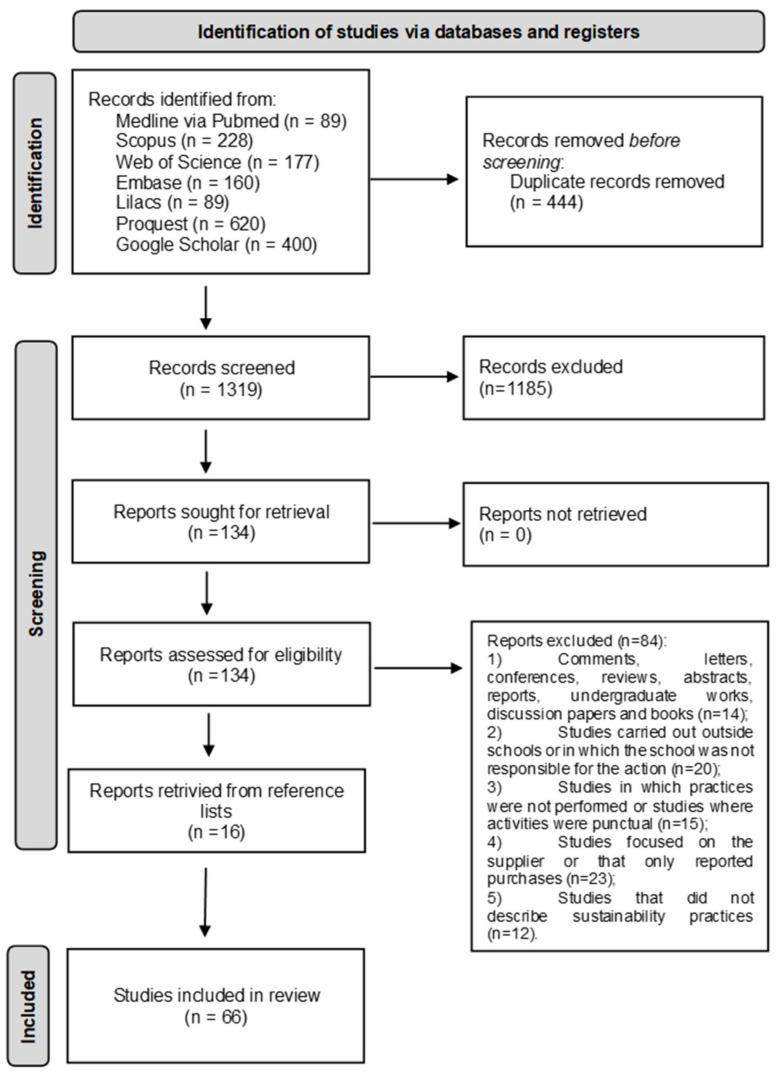
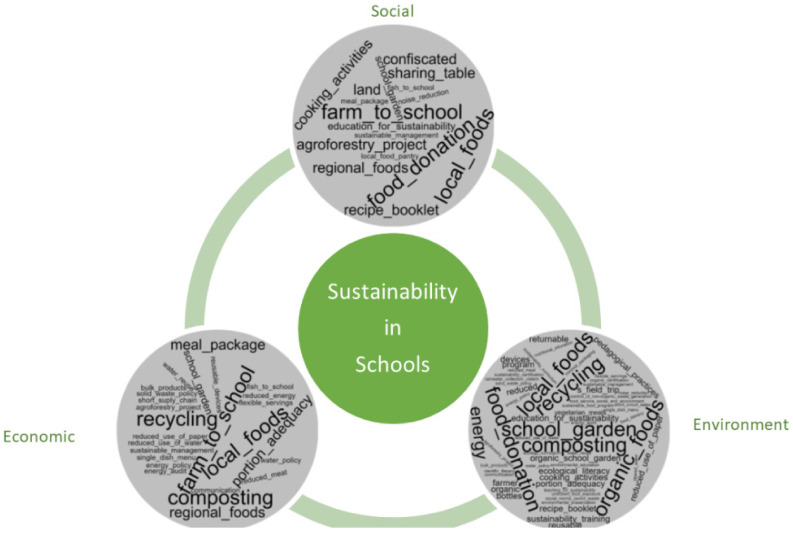
Considering the importance of schools for sustainable food offers and the formation of conscientious citizens on sustainability, this systematic review aimed to verify the recommendations on sustainability in school feeding policies and the sustainability practices adopted in schools. The research question that guided this study is “what are the recommendations on sustainability in school feeding policies and the sustainability practices adopted in schools?”. This systematic review was prepared according to PRISMA, and its checklist was registered in PROSPERO. Specific search strategies for Scopus, Web of Science, Pubmed, Lilacs, Google Scholar, and ProQuest Dissertations & Theses Global were developed. The included studies’ methodological quality was evaluated using the Meta-Analysis Statistical Assessment and Review Instrument (MASTARI). A total of 134 studies were selected for a full reading. Of these, 50 met the eligibility criteria and were included in the systematic review. Several sustainability practices were described. The most cited are school gardens and education activities for sustainability. However, actions carried out in food services were also mentioned, from the planning of menus and the purchase of raw materials (mainly local and organic foods, vegetarian/vegan menus) to the distribution of meals (reduction of organic and inorganic waste: composting, recycling, donating food, and portion sizes). Recommendations for purchasing sustainable food (organic, local, and seasonal), nutrition education focused on sustainability, and reducing food waste were frequent; this reinforces the need to stimulate managers’ view, in their most varied spheres, for the priority that should be given to this theme, so that education for sustainability is universally part of the curricula. The importance of education in enabling individuals to promote sustainable development is reaffirmed in Sustainable Development Goal 4 (SDG 4). The development of assessment instruments can help monitor the evolution of sustainable strategies at schools and the main barriers and potentialities related to their implementation.
Overview
The claims and statistics of this paper haven’t been checked yet.
Free: it reads the open-access text and checks the first 5 claims that cite a source we can check. Create a free account to check every claim.
Integrity signals
Registry
Cites
Statistics
Figures
Verification
Claims the paper makes
The claims and statistics of this paper haven’t been checked yet.
Free: it reads the open-access text and checks the first 5 claims that cite a source we can check. Create a free account to check every claim.
Self-check
Percentages, sums and reported differences re-computed from the paper’s own numbers.
The self-check needs the paper’s full text.
Citations
Cites
Transforming Our World: The 2030 Agenda for Sustainable Development
(2018) · A New Era in Global Health · doi:10.1891/9780826190123.ap02 · Cited by 19,351
Food in the Anthropocene: the EAT–Lancet Commission on healthy diets from sustainable food systems
Willett, W., Rockström, J., Loken, B., Springmann, M., Lang, T., Vermeulen, S., Garnett, T., Tilman, D., DeClerck, F., Wood, A., et al. (2019) · The Lancet · doi:10.1016/s0140-6736(18)31788-4 · Cited by 10,880
The PRISMA 2020 statement: An updated guideline for reporting systematic reviews
Page, M. J., McKenzie, J. E., Bossuyt, P. M., Boutron, I., Hoffmann, T. C., Mulrow, C. D., Shamseer, L., Tetzlaff, J. M., Akl, E. A., Brennan, S. E., et al. (2021) · PLoS Medicine · doi:10.1371/journal.pmed.1003583 · Cited by 5,148
The Global Syndemic of Obesity, Undernutrition, and Climate Change: The Lancet Commission report
Swinburn, B. A., Kraak, V. I., Allender, S., Atkins, V. J., Baker, P. I., Bogard, J. R., Brinsden, H., Calvillo, A., De Schutter, O., Devarajan, R., et al. (2019) · The Lancet · doi:10.1016/s0140-6736(18)32822-8 · Cited by 3,081
A Global Assessment of the Water Footprint of Farm Animal Products
Mekonnen, M. M., & Hoekstra, A. Y. (2012) · Ecosystems · doi:10.1007/s10021-011-9517-8 · Cited by 1,393
Education for Sustainable Development.
Halfacree, A., & Ellison, J. N. (2001) · Education in science · Cited by 636
Jomaa, L. H., McDonnell, E., & Probart, C. (2011) · Nutrition Reviews · doi:10.1111/j.1753-4887.2010.00369.x · Cited by 290
Wamsler, C. (2020) · International Journal of Sustainability in Higher Education · doi:10.1108/ijshe-04-2019-0152 · Cited by 289
Oostindjer, M., Aschemann-Witzel, J., Wang, Q., Skuland, S. E., Egelandsdal, B., Amdam, G. V., Schjøll, A., Pachucki, M. C., Rozin, P., Stein, J., et al. (2017) · Critical Reviews in Food Science and Nutrition · doi:10.1080/10408398.2016.1197180 · Cited by 240
Lombardini, C., & Lankoski, L. (2013) · Journal of Consumer Policy · doi:10.1007/s10603-013-9221-5 · Cited by 175
Research works printed but not linked: 26
- WCED (1987). Report of the World Commission on Environment and Development: Our Common Future, Oxford University Press.
- United Nations (1992, January 3–14). Report of the United Nations Conference on Environment and Development. Proceedings of the UN Conference on Environment and Development, Rio de Janeiro, Brazil.
- Mann, N.L. (1991). A Decision Model for Solid Waste Management in School Food Service. [Ph.D. Thesis, Texas Woman’s University].
- Wadsworth, K.G. (2002). A Process and Outcome Evaluation of EarthFriends: A Curriculum Designed to Teach Elementary School-Aged Children to Make Environmentally Sustainable Food Choices. [Ph.D. Thesis, Columbia University].
- Vogt, R.A. (2006). Improving School Nutrition with Sustainable Food Systems. [Ph.D. Thesis, University of California].
- Baca, J. (2011). Investigating Waste Management Programs in School Foodservice Operations. [Master’s Thesis, Texas Woman’s University].
- O’Brien, B. (2013). Religion, Ethics, Nature in Secondary School Education: Exploring Religion’s Role in Sustainability Trends. [Ph.D. Thesis, University of Florida].
- Coe, M.A. (2015). Influential Environments: School Gardens Impacting Arizona Children’s Environmental Perspectives. [Master’s Thesis, The University of Arizona].
- Huston, W.G. (2018). Implementing Education for Sustainability in Rural Elementary Schools: A Collective Case Study of How Leadership Impacts the Implementation of Education for Sustainability in Rural Elementary Schools in Northern New England. [Ph.D. Thesis, New England College].
- UNESCO (2021). Learn for Our Planet: A Global Review of How Environmental Issues Are Integrated in Education, United Nations Educational, Scientific and Cultural Organization.
- Amarante, E.A.L. (2016). Caracterização da Comercialização de Alimentos Através do Programa Nacional de Alimentação Escolar-PNAE-no Município de Marechal Cândido Rondon-PR Como Estratégia para Promover a Sustentabilidade nos Empreendimentos da Agricultura Familiar. [Undergraduate Thesis, Universisdade Estadual do Oeste do Paraná]. Final paper.
- Coleman, 2012, Changing nutrition policies and environments in low-income schools using implementation models: The healthy options for nutrition environments in schools (ONES) intervention, Obesity, Volume 19, 124
- Damapong, 2013, Lesson learned: Improvement of food quality in school and child development center for sustainable child nutrition, Proceedings of the 20th International Congress of Nutrition, Volume 63, 1073
- Eich, 2015, Percepções: Agricultura familiar e políticas públicas para alimentação escolar no município de São Paulo das Missões-RS, Direitos Sociais Políticas Públicas, 3, 22
- Gregolin, 2017, Política pública e sustentabilidade: Possibilidade de interface no Programa Nacional de Alimentação Escolar-PNAE, Emancipação, 17, 199
- Hendler, 2021, de Sociobiodiversidade na escola, promoção da saúde, da sustentabilidade e da cultura: Um movimento em construção no município de Mostardas/RS, Agric. Fam. Pesqui. Formação Desenvolv., 15, 115
- Kipfer, H.J. (2018). Gaining Consensus on Implementation, Sustainability, and Benefits of School Garden Programming in Washington, D.C. [Ph.D. Thesis, West Virginia University].
- Koch, P.A. (2000). A comparison of two nutrition education curricula: Cookshops and food & environment lessons. [Ph.D. Thesis, Columbia University].
- McCarty, C.A. (2013). Alaskan Adolescent Nutrition Project. [Master’s Thesis, University of Alaska Anchorage].
- 2012, Produtos sustentáveis na alimentação escolar: O PNAE no Paraná, Cad. IPARDES Estud. Pesqui., 2, 87
- Muansrichai, 2015, Learning and practicing in accordance with the sufficiency economy philosophy of third grade primary students in the local northeast socio-culural context of Thailand, Int. J. Appl. Bus. Econ. Res., 13, 4605
- Padilha, 2018, The contribution of PNAE to sustainable rural development in the municipality of Pitanga—PR, Braz. J. Dev., 4, 4351
- Polo Galante, A., Mireles, M., Kiamba, J., Mamadoultaibou, A., Sablah, M., Boitshepo, G., and Sanou, D. (2017, January 15–20). Innovative home grown school feeding linked to family farming: FAO school food and nutrition approach in sub-Saharan Africa. Proceedings of the 21st International Congress of Nutrition, Buenos Aires, Argentina.
- Scott, R.A. (2011). The Nested Systems of Sustainability Education: Charting a Pathway to Ecological Learning. [Master’s Thesis, Prescott College].
- Sziwelski, 2015, Programa Nacional de Alimentação Escolar (PNAE) [National School Feeding Program] implications in the income and organization of family farmers, Rev. Bras. Políticas Públicas, 5, 220
- Wickramasinghe, 2016, Estimating the changes in nutritional quality and environmental impact of primary school meals if all meals met the new school food plan standards in England, Proceedings of the World Congress of Cardiology & Cardiovascular Health, Volume 11, e128
Cited by
Wild berries and related wild small fruits as traditional healthy foods
Aguilera, J. M., & Toledo, T. (2022) · Critical Reviews in Food Science and Nutrition · doi:10.1080/10408398.2022.2156475 · Cited by 64
Toward Sustainable Diets—Interventions and Perceptions Among Adolescents: A Scoping Review
Lanham, A. R., & van der Pols, J. C. (2024) · Nutrition Reviews · doi:10.1093/nutrit/nuae052 · Cited by 37
Long-term sustainability of African school feeding programs, a review
Mainje, M., Matumba, L., Harvey, J., Phiri, H., Gama, A. P., Phiri, A., Phangaphanga, I., Chizimba, R., Wamey, B. S., Gallagher, P., et al. (2024) · Frontiers in Sustainable Food Systems · doi:10.3389/fsufs.2024.1424354 · Cited by 34
Sundin, N., Malefors, C., Strotmann, C., Orth, D., Kaltenbrunner, K., Obersteiner, G., Scherhaufer, S., Sjölund, A., Osowski, C. P., Strid, I. V., et al. (2024) · Journal of Cleaner Production · doi:10.1016/j.jclepro.2024.144196 · Cited by 24
Browne, S., Mullen, A., Mulholland, B., Lo, C., & Ruttledge, A. (2023) · Journal of Human Nutrition and Dietetics · doi:10.1111/jhn.13220 · Cited by 20
Metadata
- Authors
- dos Santos, E. B., da Costa Maynard, D., Zandonadi, R. P., Raposo, A., & Botelho, R. B. A.
- Affiliations
- Universidade Federal de Mato Grosso (BR)
- Department of Nutrition, University of Brasília, Brasília 70910-900, Brazil
- Universidade de Brasília (BR)
- Universidade Lusófona de Humanidades e Tecnologias (PT)
- Corresponding author
- Raposo, António
- Botelho, Raquel Braz Assunção
- ORCID
- Venue
- Foods
- Publisher
- MDPI AG
- Published
- 2022-01-10
- Volume
- 11
- Issue
- 2
- Pages
- 176
- ISSN
- 2304-8158 (ISSN-L)
- PMC
- PMC8775006
- OpenAlex
- W4205588384
- Cited by
- 47
- References
- 146
- Citations by year
- 2026: 15 · 2025: 15 · 2024: 10 · 2023: 2 · 2022: 5
- FWCI
- 1.91
- Type
- journal article
- Language
- en
- Open access
- gold
- doi.org
- Licence
- Locations
- Foods (publishedVersion, cc-by)
- PubMed Central (publishedVersion, cc-by)
- PubMed (publishedVersion)
- DOAJ (DOAJ: Directory of Open Access Journals) (submittedVersion, cc-by-sa)
- Topics
- Social Sciences › Education › Sustainability in Higher Education
- Physical Sciences › Environmental Science › Management, Monitoring, Policy and Law › Environmental Education in Latin America
- Physical Sciences › Environmental Science › Ecology › Agriculture Sustainability and Environmental Impact
- Keywords
- school meals, sustainability, school nutrition policy, school gardens, sustainability education, food waste reduction, sustainable food purchasing, meal planning, food service waste, nutrition education, Sustainable Development Goal 4
About these checks
Registry, retraction, Cites and statistics results are computed, not judged, with one exception: a printed reference that no index lists is read once by a model before it counts as a citation error. Claims are extracted by a model and kept only when their quote appears verbatim in the text; each cited source is then checked, with a model’s help, for whether it says what the claim relies on. Those verdicts can be wrong — read the claim’s quote and the cited source before relying on one.
Statistics and arithmetic are recomputed, not judged.
Confidence bands are shown only for fields calibrated on our annotated test set. None is calibrated yet, so no band is shown.
What counts as a claim ›How we measure confidence ›How we check this ›
Are you an author, or do you see a problem with this page? Request a review
Data sources
Bibliographic data: Semantic Scholar, OpenAlex, Crossref.
Contains information from the Semantic Scholar Academic Graph Datasets, made available under the ODC Attribution License (ODC-BY 1.0).
Semantic Scholar’s data is described in: Kinney, R., et al. (2023). The Semantic Scholar Open Data Platform. arXiv:2301.10140.
