

Metabolomics Combined with Sensory Analysis Reveals the Impact of Different Extraction Methods on Coffee Beverages from Coffea arabica and Coffea canephora var. Robusta
Open accessThe DOI matches its Crossref record; 38 of the 38 references it cites were found in a registry or an index.
Abstract
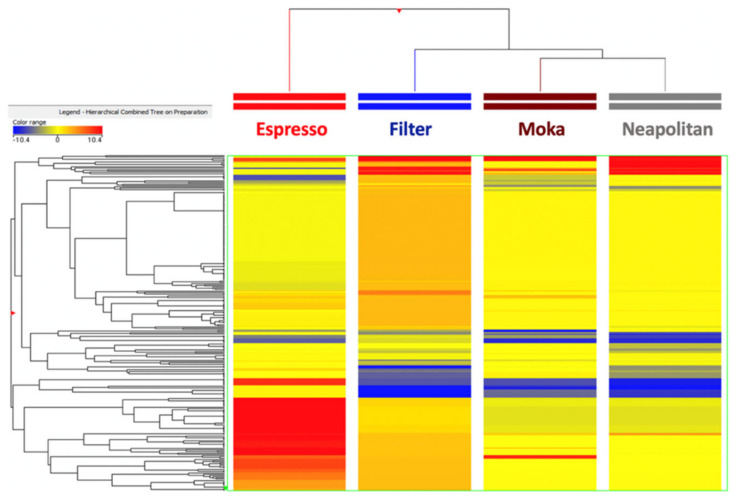
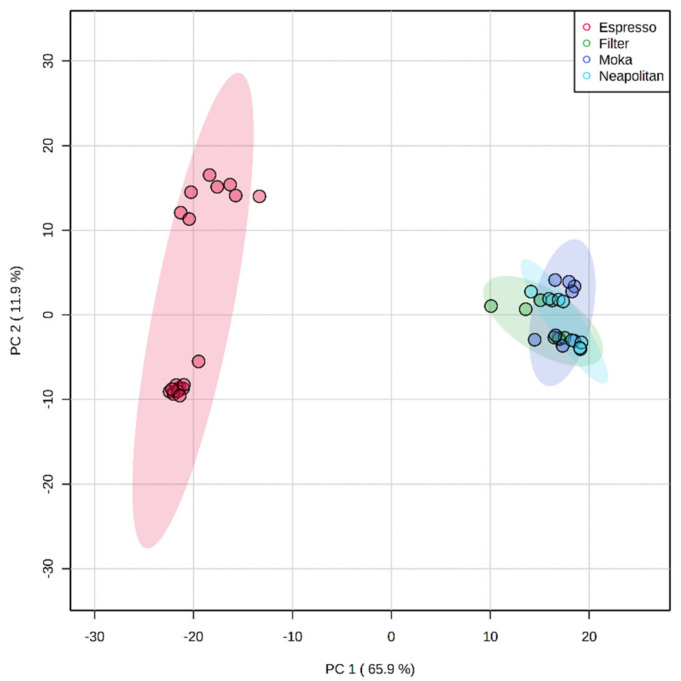
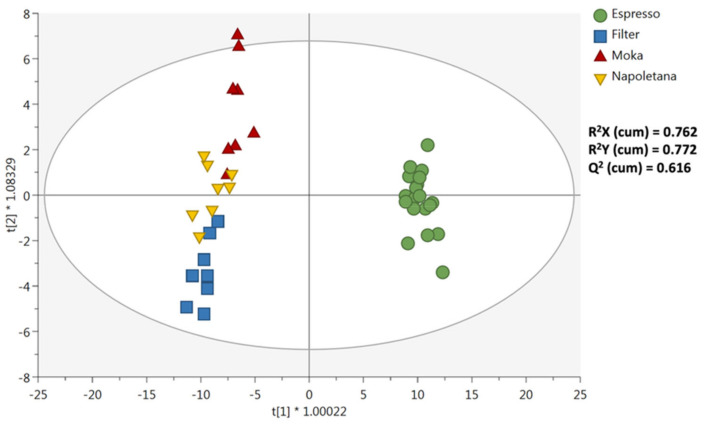
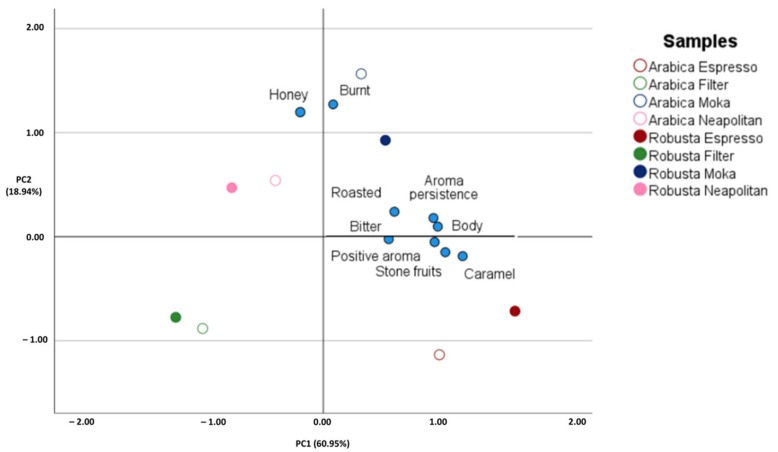
An untargeted metabolomics approach combined with sensory analysis was used to depict the impact of different traditional Italian extraction methods (i.e., Espresso, Neapolitan, Moka) along with Filter, on Coffea arabica and Coffea canephora var. robusta beverages. To this aim, polyphenols, Maillard reaction products, and coffee metabolites were screened by high resolution mass spectrometry and elaborated through both unsupervised and supervised multivariate statistical approaches. Multivariate statistics showed a distinctive chemical profile for Espresso preparation, while Moka and Neapolitan were very similar. The orthogonal projection to latent structures and discriminant analysis allowed the identification of 86 compounds showing a high VIP discrimination score (i.e., > 0.8). The 2,5-dimethyl-3-(methyldithio)-furan was a marker for the Filter preparation, while 1,2-disinapoylgentiobiose characterized both Filter and Neapolitan extractions. Caffeine (known to be a bitter compound) accumulated highly in Filter vs. Espresso, although at the sensory profile, bitterness was more perceived in Espresso. Vegetal aroma carried by pyrazines, pyridines, and phenolic acids were markers of Espresso, with Robusta showing higher values than Arabica. Notwithstanding, our findings showed that the extraction process played a hierarchically higher role in driving the chemical composition of the beverages when compared to coffee species.
Overview
The claims and statistics of this paper haven’t been checked yet.
Free: it reads the open-access text and checks the first 5 claims that cite a source we can check. Create a free account to check every claim.
Integrity signals
Registry
Cites
Statistics
Figures
Verification
Claims the paper makes
The claims and statistics of this paper haven’t been checked yet.
Free: it reads the open-access text and checks the first 5 claims that cite a source we can check. Create a free account to check every claim.
Claims other papers make about this one
Each is checked against this paper’s own text: does it say what the citing paper says it does?
The source backs part of the claim, not all of it — or backs it for a different population, condition or comparison.
In the citing paper
“While most coffee sensory studies of brewed coffee focused on pressurized espresso brew or flow-based drip brew2,4,6–10, there are comparatively less sensory studies on full immersion brewing methods other than a few recent ones focused on cold brew10–14.”
From Sensory analysis of the flavor profile of full immersion hot, room temperature, and cold brewed coffee over time (2024) · cites this paper as [9]
Experimental — accuracy not yet measured
Self-check
Percentages, sums and reported differences re-computed from the paper’s own numbers.
The self-check needs the paper’s full text.
Citations
Cites
Tsugawa, H., Kind, T., Nakabayashi, R., Yukihira, D., Tanaka, W., Cajka, T., Saito, K., Fiehn, O., & Arita, M. (2016) · Analytical Chemistry · doi:10.1021/acs.analchem.6b00770 · Cited by 685 · cited 3×
“The latter were elaborated upon using the software MS-DIAL (version 4.70) for a further identification and/or confirmation step [26] and compared against the publicly available MS/MS experimental spectra available in the same software (e.g., Mass Bank of North America) and MS-Finder in-silico fragmentation from compou…”
BackgroundMethodInfluentialThe role of reporting standards for metabolite annotation and identification in metabolomic studies
Salek, R. M., Steinbeck, C., Viant, M. R., Goodacre, R., & Dunn, W. B. (2013) · GigaScience · doi:10.1186/2047-217x-2-13 · Cited by 507 · cited 2×
“Based on our process, each compound was identified according to a Level 2 of confidence (putative annotation based on high mass accuracy, exploiting the isotopic profile of each mass feature) as reported by COSMOS Metabolomics Standards Initiative [25].”
MethodComparison of nine common coffee extraction methods: Instrumental and sensory analysis
Gloess, A. N., Schönbächler, B., Klopprogge, B., D`Ambrosio, L., Chatelain, K., Bongartz, A., Strittmatter, A., Rast, M., & Yeretzian, C. (2013) · European Food Research and Technology · doi:10.1007/s00217-013-1917-x · Cited by 311 · cited 1×
“Also, the transformations occurring during roasting and extraction steps can lead to exclusive metabolites, such as aromatic compounds and bioactive molecules, providing a cup profile to the beverage that testifies all those characteristics [10,11].”
BackgroundCaporaso, N., Whitworth, M. B., Cui, C., & Fisk, I. D. (2018) · Food Research International · doi:10.1016/j.foodres.2018.03.077 · Cited by 298 · cited 1×
“Finally, cyclopentanedione derivatives (such as 3,5-dimethyl-1,2-cyclopentanedione), also known as benzyl-related compounds, belong to the class of organic compounds known as cyclic ketones, usually described as sweet, maple, sugar, caramel, and coffee tasting compounds, and then considered potential biomarkers for th…”
BackgroundCordoba, N., Fernandez-Alduenda, M., Moreno, F. L., & Ruiz, Y. (2020) · Trends in Food Science & Technology · doi:10.1016/j.tifs.2019.12.004 · Cited by 271 · cited 1×
“rediscovery of home extraction systems stressed the need for accurate studies on technical aspects [16] to exalt and differentiate the final cup from Moka Neapolitan pots [17].”
BackgroundFormation of Furan and Methylfuran by Maillard-Type Reactions in Model Systems and Food
Limacher, A., Kerler, J., Davidek, T., Schmalzried, F., & Blank, I. (2008) · Journal of Agricultural and Food Chemistry · doi:10.1021/jf800268t · Cited by 227 · cited 1×
“As reported by [37], methyl-furan forms are generated from the condensation of carbohydrate moieties arising from the Maillard reaction, while the origins of 3-methyl-, 2,5-dimethyl-, and 2,3-dimethyl-furan derivatives have yet to be fully established [38].”
BackgroundScalabrin, S., Toniutti, L., Gaspero, G. D., Scaglione, D., Magris, G., Vidotto, M., Pinosio, S., Cattonaro, F., Magni, F., Jurman, I., et al. (2020) · Scientific Reports · doi:10.1038/s41598-020-61216-7 · Cited by 175 · cited 1×
“These species are deeply different genetically (polyploid for the former, diploid for the latter) [2], require different pedoclimatic conditions [3], have different biochemical ripening processes, and undergo different post-harvesting processes [4–7].”
BackgroundCharacterization of Espresso Coffee Aroma by Static Headspace GC−MS and Sensory Flavor Profile
Maeztu, L., Sanz, C., Andueza, S., Paz De Peña, M., Bello, J., & Cid, C. (2001) · Journal of Agricultural and Food Chemistry · doi:10.1021/jf0107959 · Cited by 163
Gloess, A. N., Vietri, A., Wieland, F., Smrke, S., Schönbächler, B., López, J. A. S., Petrozzi, S., Bongers, S., Koziorowski, T., & Yeretzian, C. (2014) · International Journal of Mass Spectrometry · doi:10.1016/j.ijms.2014.02.010 · Cited by 156 · cited 1×
“Also, the transformations occurring during roasting and extraction steps can lead to exclusive metabolites, such as aromatic compounds and bioactive molecules, providing a cup profile to the beverage that testifies all those characteristics [10,11].”
BackgroundNeapolitan coffee brew chemical analysis in comparison to espresso, moka and American brews
Caporaso, N., Genovese, A., Canela, M. D., Civitella, A., & Sacchi, R. (2014) · Food Research International · doi:10.1016/j.foodres.2014.01.020 · Cited by 140
Cited by
Thermal Contaminants in Coffee Induced by Roasting: A Review
da Costa, D. S., Albuquerque, T. G., Costa, H. S., & Bragotto, A. P. A. (2023) · International Journal of Environmental Research and Public Health · doi:10.3390/ijerph20085586 · Cited by 71
Li, Z., Zhou, B., Zheng, T., Zhao, C., Shen, X., Wang, X., Qiu, M., & Fan, J. (2023) · Foods · doi:10.3390/foods12071432 · Cited by 38
Ni, J., Bi, Y., Vidyarthi, S. K., Xiao, H., Han, L., Wang, J., & Fang, X.-M. (2023) · LWT · doi:10.1016/j.lwt.2023.114480 · Cited by 31
Metabolomics as a tool for geographic origin assessment of roasted and green coffee beans
de León‐Solís, C., Casasola, V., & Monterroso, T. (2023) · Heliyon · doi:10.1016/j.heliyon.2023.e21402 · Cited by 28
Shen, X., Zi, C., Yang, Y., Wang, Q., Zhang, Z., Shao, J., Zhao, P., Liu, K., Li, X., & Fan, J. (2023) · Fermentation · doi:10.3390/fermentation9080717 · Cited by 24
Metadata
- Authors
- Vezzulli, F., Rocchetti, G., Lambri, M., & Lucini, L.
- Affiliations
- Università Cattolica del Sacro Cuore (IT)
- Corresponding author
- Rocchetti, Gabriele
- Venue
- Foods
- Publisher
- MDPI AG
- Published
- 2022-03-11
- Volume
- 11
- Issue
- 6
- Pages
- 807
- ISSN
- 2304-8158 (ISSN-L)
- PMC
- PMC8953325
- OpenAlex
- W4220772971
- Cited by
- 27
- References
- 38
- Citations by year
- 2026: 6 · 2025: 7 · 2024: 2 · 2023: 11 · 2022: 1
- FWCI
- 3.14
- Type
- journal article
- Language
- en
- Open access
- gold
- doi.org
- Licence
- Locations
- Foods (publishedVersion, cc-by)
- PubMed Central (publishedVersion, cc-by)
- PubMed (publishedVersion)
- DOAJ (DOAJ: Directory of Open Access Journals) (submittedVersion)
- PubliCatt (Università Cattolica del Sacro Cuore) (submittedVersion, other-oa)
- PubliCatt (Università Cattolica del Sacro Cuore) (submittedVersion, cc-by)
- Topics
- Health Sciences › Medicine › Pharmacology (medical) › Coffee research and impacts
- Life Sciences › Agricultural and Biological Sciences › Food Science › Fermentation and Sensory Analysis
- Life Sciences › Agricultural and Biological Sciences › Food Science › Food Chemistry and Fat Analysis
- Keywords
- coffee beverages, espresso, Moka, Neapolitan, filter coffee, Coffea arabica, Coffea canephora var. robusta, coffee metabolites, polyphenols, Maillard reaction products, caffeine, bitterness, pyrazine, phenolic acids, sensory profile
About these checks
Registry, retraction, Cites and statistics results are computed, not judged, with one exception: a printed reference that no index lists is read once by a model before it counts as a citation error. Claims are extracted by a model and kept only when their quote appears verbatim in the text; each cited source is then checked, with a model’s help, for whether it says what the claim relies on. Those verdicts can be wrong — read the claim’s quote and the cited source before relying on one.
Statistics and arithmetic are recomputed, not judged.
Confidence bands are shown only for fields calibrated on our annotated test set. None is calibrated yet, so no band is shown.
What counts as a claim ›How we measure confidence ›How we check this ›
Are you an author, or do you see a problem with this page? Request a review
How to cite
Cite CoChat for the checks on this page, and the paper for its own findings.
- This page
- CoChat. (2026). Citation check: Metabolomics Combined with Sensory Analysis Reveals the Impact of Different Extraction Methods on Coffee Beverages from Coffea arabica and Coffea canephora var. Robusta. https://app.cochat.ai/papers/10.3390/foods11060807
- The paper
- Vezzulli, F., Rocchetti, G., Lambri, M., & Lucini, L. (2022). Metabolomics Combined with Sensory Analysis Reveals the Impact of Different Extraction Methods on Coffee Beverages from Coffea arabica and Coffea canephora var. Robusta. Foods. https://doi.org/10.3390/foods11060807
Data sources
Bibliographic data: Semantic Scholar, OpenAlex, Crossref.
Contains information from the Semantic Scholar Academic Graph Datasets, made available under the ODC Attribution License (ODC-BY 1.0).
Semantic Scholar’s data is described in: Kinney, R., et al. (2023). The Semantic Scholar Open Data Platform. arXiv:2301.10140.
