

IoT-Enabled Quality-Triggered Markdown Pricing for Perishable Food: Equity and Waste Implications
Open accessThe DOI matches its Crossref record; 57 of the 57 references it cites were found in a registry or an index; 7 of the 42 sources its claims cite were checked for support.
Abstract
Inequitable access to affordable, nutritious food is partly sustained because markdowns on perishable products are often delayed until quality deterioration becomes visible, through which affordability gains are limited and waste is increased. In this study, the extent to which Internet of Things (IoT) real-time quality monitoring enables quality-triggered markdowns that reduce waste while improving food equity is examined. An analytical pricing and markdown model for perishables with quality-sensitive demand is developed, and optimal decisions under IoT-enabled quality observability and under a baseline setting without IoT are compared. Convexity is established for the retailer’s problem, and closed-form solutions are derived for the optimal regular price, markdown timing, and markdown depth. Under continuous quality visibility, earlier markdown initiation within the selling horizon is shown to be optimal while product quality remains acceptable, and a deeper markdown than in the non-IoT setting is shown to be optimal. Through numerical experiments, increased sell-through before products become unsalable is demonstrated, waste reduction is quantified, and an expanded time window is shown in which price-sensitive consumers can purchase acceptable-quality food at a lower price. Overall, improved food equity is supported by proactive, quality-aligned pricing policies without retailer profitability being sacrificed.
Overview
CoChat Summary
TL;DR
The paper develops an analytical pricing and markdown model for perishable food retail and compares a baseline without IoT to an IoT-enabled regime with continuous quality observability. It finds that IoT leads to earlier and deeper markdowns, higher sell-through, reduced waste, and expanded affordability for price-sensitive consumers without sacrificing retailer profitability under many conditions.
Key findings
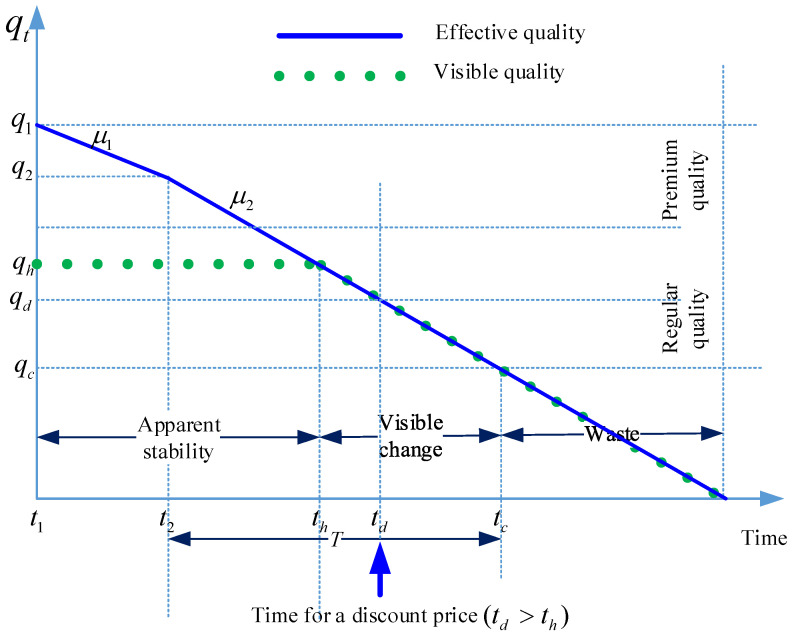
- IoT-enabled quality observability makes earlier markdowns at higher quality and deeper discounts optimal: the optimal discount trigger is \( \bar{q}_d^*=(q_2+q_c)/2 \), and the incremental markdown over the non-IoT case is \( \Delta\theta = \beta(q_2-q_h)/(4\alpha) \).
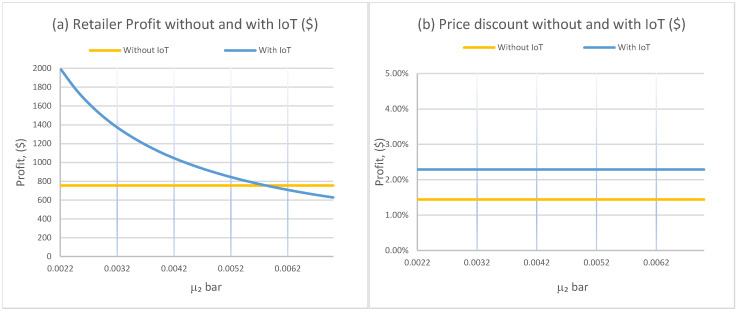
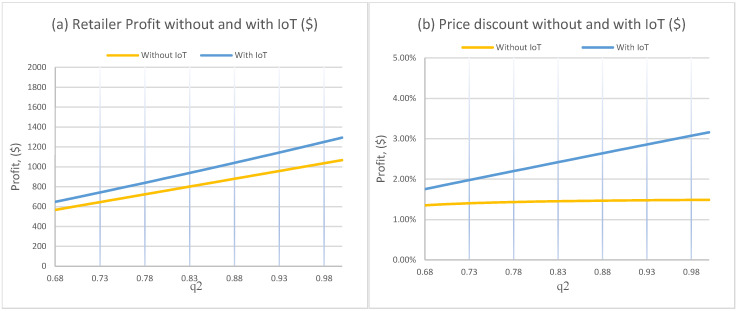
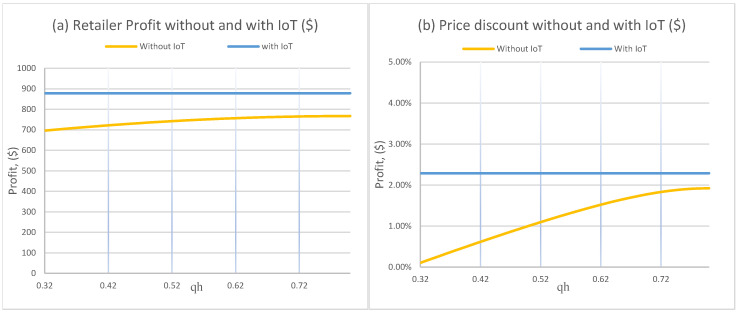
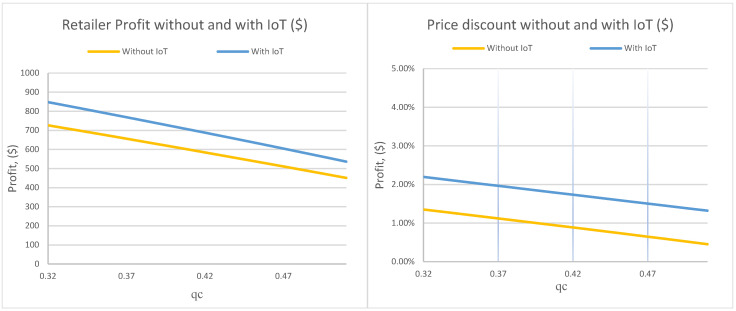
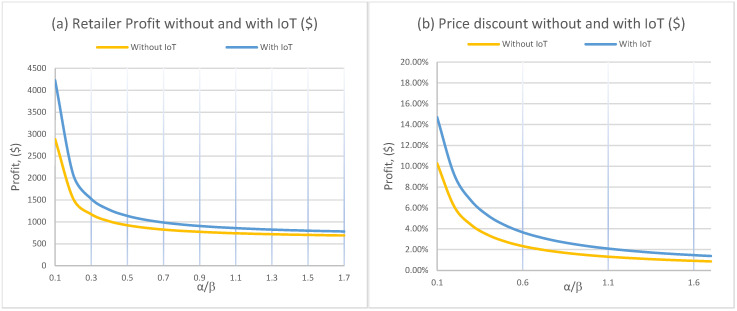
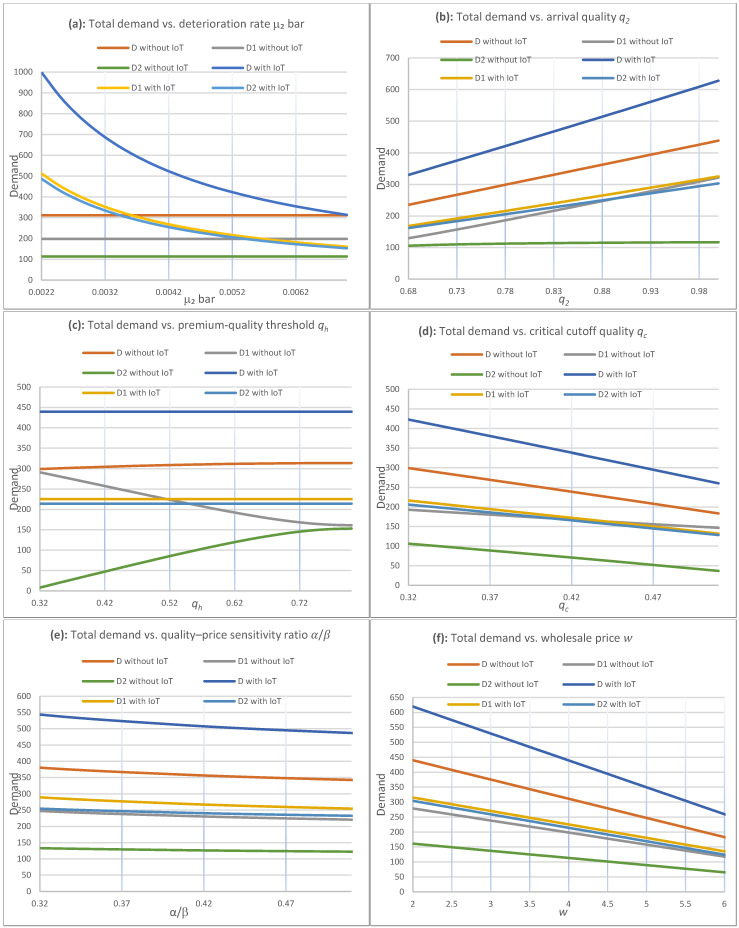
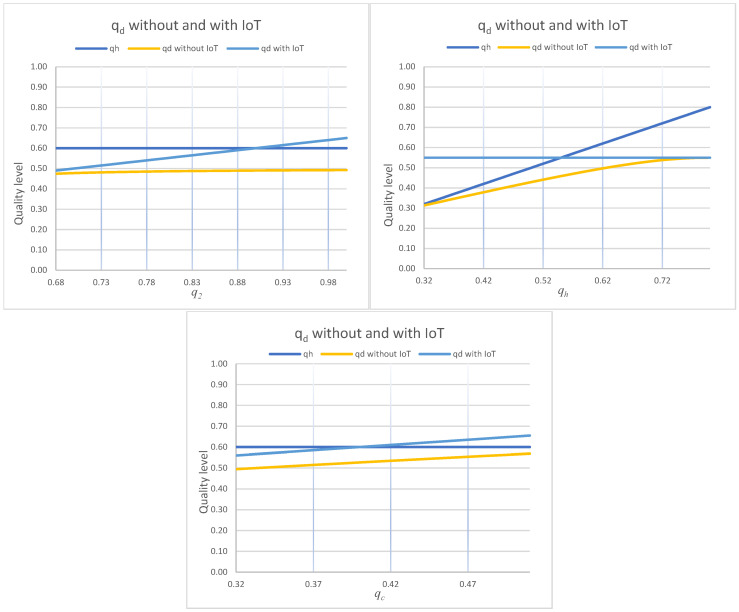
- In the numerical baseline, the optimal discount rate is approximately 2.3% with IoT versus 1.4% without IoT; total demand is higher with IoT across all sensitivity panels, driven primarily by the discounted-demand channel.
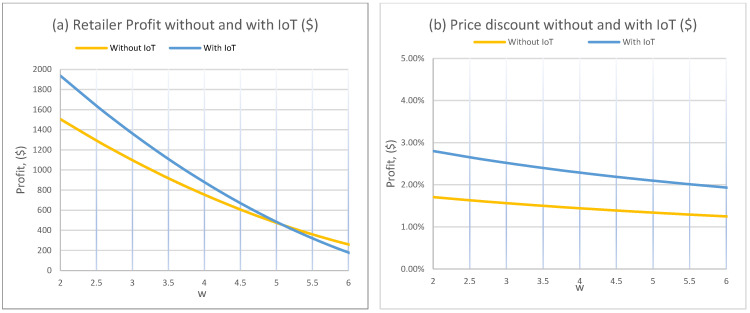
- IoT yields higher retailer profit when it sufficiently improves effective deterioration: in the experiment, IoT outperforms the non-IoT benchmark when \( \bar{\mu}_2 \lesssim 0.0057 \) per hour. When wholesale price becomes sufficiently high (around \( w \gtrsim \$5 \)), the profit advantage from IoT disappears.
- Equity improves operationally: earlier and deeper markdowns expand the time window in which price-sensitive consumers can buy acceptable-quality food, and higher sell-through before products cross the unsalable quality threshold reduces waste.
Methods
- The paper builds two analytical models that share the same deterioration and demand primitives but differ only in quality observability: a baseline without IoT, where consumers perceive quality coarsely and markdowns are delayed, and an IoT-enabled model, where perceived quality aligns with effective quality continuously.
- The retailer’s profit maximization problem is formulated under quality-sensitive demand; convexity is established, and closed-form solutions are derived for optimal regular price, markdown timing, and markdown depth.
- A numerical study uses parameters inspired by Chen et al.: \( \mu_2=0.007 \) per hour, \( \bar{\mu}_2=0.005 \) per hour, \( q_2=0.80 \), \( q_h=0.60 \), \( q_c=0.30 \), \( D_0=15 \) units per hour, \( \alpha=1.8 \), \( \beta=1.8 \), and \( c=\$4 \), with one-factor-at-a-time sensitivity analysis.
Limitations
- Stated: the analysis assumes a deterministic, linear quality deterioration trajectory and a single markdown event to preserve analytical tractability; it abstracts from demand uncertainty, learning, repeated price updates, and multiple sequential discounts.
- Stated: the numerical analysis uses one-factor-at-a-time sensitivity rather than global robustness assessments under simultaneous parameter uncertainty; the model focuses on retailer pricing decisions and does not integrate explicit IoT cost structures into the optimization.
- Evident from the text: the model uses aggregate demand and does not incorporate strategic consumer behavior, competition, or multi-echelon supply-chain interactions, though the literature review notes these as relevant extensions.
Model-written summary. Check it against the paper before relying on it.
Integrity signals
Registry
Cites
Statistics
Figures
Verification
Claims the paper makes
6 Valid · 2 Not valid · 18 Not checked · 142 Own results and interpretations
The cited sources support only part of this claim — read each source’s verdict below.
In the paper
“Large-scale experimental implementations based on chain-of-things architectures have shown that end-to-end quality visibility is technically feasible under real operating conditions, providing retailers with reliable and granular quality signals throughout the product life cycle [8].”
§ IoT-Enabled Quality-Triggered Markdown Pricing for Perishable Food: Equity and Waste Implications > 1. Introduction
What the sources say
- Partly supportedcites [8] Sathiya V. Nagalakshmi K. Raju K. Lavanya R. Tracking perishable foods in the supply chain using chain of things technology Sci. Rep. 2024 14 21621 10.1038/s41598-024-72617-3 39285258 PMC11405703 sourceExperimental — accuracy not yet measured
The Introduction’s implementation section describes a CoT system used in a seafood-company case study, and its proposed framework aims at end-to-end visibility and food-quality assessment. But the Results and discussion evaluate transaction performance using program-generated transactions; at 1,000 transactions, breadth falls to 10% and depth to 15%. The paper also says sensor effectiveness was not validated, so it does not establish reliable, granular quality signals throughout the product life cycle at large scale under real operating conditions. (LLM, conf=0.87)
boosted- Asserted: passes — The authors put it forward as true.
- Checkable: passes — It can be checked against evidence.
- Load-bearing: passes — The paper’s conclusions depend on it.
- Based: passes — The paper gives a reason why it holds.
- Partly supported
The cited sources support only part of this claim — read each source’s verdict below.
In the paper
“Sensor-based systems now enable continuous, real-time monitoring of key quality indicators such as temperature, humidity, and gas concentration across storage, transportation, and retail stages [5,6].”
§ IoT-Enabled Quality-Triggered Markdown Pricing for Perishable Food: Equity and Waste Implications > 1. Introduction
What the sources say
- Partly supportedcites [5] Afreen H. Bajwa I.S. An IoT-based real-time intelligent monitoring and notification system of cold storage IEEE Access 2021 9 38236 38253 10.1109/ACCESS.2021.3056672 sourceExperimental — accuracy not yet measured
The Introduction and Data Acquisition section describe real-time IoT monitoring of temperature, humidity, and gas concentration in cold storage. The State of the Art also discusses monitoring during shipment, but our copy does not establish monitoring of all three indicators across storage, transportation, and retail; retail monitoring is not shown. Page numbers are unavailable in our copy. (LLM, conf=0.88)
- Not checked — no full text of the sourcecites [6] Ben-Daya M. Hassini E. Bahroun Z. Banimfreg B.H. The role of Internet of Things in food supply chain quality management: A review Qual. Manag. J. 2021 28 17 40 10.1080/10686967.2020.1838978 source
plainstates a cause- Asserted: passes — The authors put it forward as true.
- Checkable: passes — It can be checked against evidence.
- Load-bearing: passes — The paper’s conclusions depend on it.
- Based: passes — The paper gives a reason why it holds.
- Partly supported
The cited sources support only part of this claim — read each source’s verdict below.
In the paper
“First, IoT and cold-chain monitoring studies provide strong evidence that sensor-based systems improve visibility, traceability, and quality preservation across fresh food supply chains [9,17,41].”
§ IoT-Enabled Quality-Triggered Markdown Pricing for Perishable Food: Equity and Waste Implications > 2. Related Literature > 2.8. Synthesis and Gap Addressed by This Paper
What the sources say
- Partly supportedcites [9] Wang K. Du N. Real-time monitoring and energy consumption management strategy of cold chain logistics based on the Internet of Things Energy Inform. 2025 8 34 10.1186/s42162-025-00493-w sourceExperimental — accuracy not yet measured
The Introduction says IoT sensors improve transparency and allow goods’ location and environmental status to be tracked. The Collaborative optimization of equipment clusters section reports improved temperature and humidity control that better safeguards goods quality, especially in food and medicine cold-chain transport. These passages support the visibility, traceability, and quality elements, but the evidence is specific to cold-chain logistics rather than fresh food supply chains as a whole. (LLM, conf=0.84)
- Partly supportedcites [17] da Costa T.P. Gillespie J. Cama-Moncunill X. Ward S. Condell J. Ramanathan R. Murphy F. A systematic review of real-time monitoring technologies and its potential application to reduce food loss and waste: Key elements of food supply chains and IoT technologies Sustainability 2022 15 614 10.3390/su15010614 sourceExperimental — accuracy not yet measured
Section 3.3.2 reports that IoT sensor data made traceability information available in real time and that a proposed system helped reduce spoilage; it also links reliable location data to supply-chain visibility. The Conclusions describe IoT as helpful for preventing food loss, but note that studies concentrated on storage and transportation. The claim’s assertion of strong evidence across fresh food supply chains is broader than the review establishes. (LLM, conf=0.82)
- Not checked — no full text of the sourcecites [41] Katz M.L. Firm-specific differentiation and competition among multiproduct firms J. Bus. 1984 57 S149 S166 10.1086/296244 source
boostedstates a cause- Asserted: passes — The authors put it forward as true.
- Checkable: passes — It can be checked against evidence.
- Load-bearing: passes — The paper’s conclusions depend on it.
- Based: passes — The paper gives a reason why it holds.
- Partly supported
A result the paper states — it cites no source for it, so there is none to check. The quote shows it is in the paper.
In the paper
“a deeper markdown than in the non-IoT setting is shown to be optimal”
§ IoT-Enabled Quality-Triggered Markdown Pricing for Perishable Food: Equity and Waste Implications > Abstract
plainstates a cause- Asserted: passes — The authors put it forward as true.
- Checkable: passes — It can be checked against evidence.
- Load-bearing: passes — The paper’s conclusions depend on it.
- Based: passes — The paper gives a reason why it holds.
A result the paper reports from its own data — it cites no other source for it, so there is none to check. The quote shows it is in the paper.
In the paper
“Through numerical experiments, increased sell-through before products become unsalable is demonstrated”
§ IoT-Enabled Quality-Triggered Markdown Pricing for Perishable Food: Equity and Waste Implications > Abstract
boostedstates a cause- Asserted: passes — The authors put it forward as true.
- Checkable: passes — It can be checked against evidence.
- Load-bearing: passes — The paper’s conclusions depend on it.
- Based: passes — The paper gives a reason why it holds.
97 more claims
Create a free account to see all 168 claims and to verify the 8 references still open.
- It may state two separate claims as one. 54
- Probably not a substantial claim. 17
- The quote only partly states this claim. 1
Self-check
Percentages, sums and reported differences re-computed from the paper’s own numbers.
Each contradiction between two passages listed here was confirmed by an independent check.
Rated major: it would touch a result — a value a result rests on, reported and recomputed p-values on opposite sides of the significance level, two passages that conflict with no sign which is right, or a cited work retracted before this paper was published.
In the paper
§ IoT-Enabled Quality-Triggered Markdown Pricing for Perishable Food: Equity and Waste Implications > 4. Numerical Study
“This controlled two-regime design isolates the incremental value of observability for markdown timing and depth, avoiding confounding effects from changing demand primitives or deterioration assumptions.”
§ IoT-Enabled Quality-Triggered Markdown Pricing for Perishable Food: Equity and Waste Implications > 4. Numerical Study > 4.1. Parameter Setting and Baseline Rationale
“We set the baseline deterioration rate without IoT to μ2=0.007 per hour, which reflects typical spoilage dynamics when quality is managed using coarse historical averages. Under IoT, quality monitoring and control improve handling decisions, reduce exposure to adverse conditions, and enable earlier interventions. This is represented by a lower effective deterioration rate μ¯2=0.005 per hour [12].”
Rated major: it would touch a result — a value a result rests on, reported and recomputed p-values on opposite sides of the significance level, two passages that conflict with no sign which is right, or a cited work retracted before this paper was published.
In the paper
§ IoT-Enabled Quality-Triggered Markdown Pricing for Perishable Food: Equity and Waste Implications > 3. Model and Analysis > 3.4. Model with IoT
“Equation (17) implies that the discount increases when the shipped quality is higher or when consumers impose stricter quality acceptance thresholds, as both conditions expand the quality range over which proactive discounting is effective.”
§ IoT-Enabled Quality-Triggered Markdown Pricing for Perishable Food: Equity and Waste Implications > 3. Model and Analysis > 3.4. Model with IoT
“(17) θ¯*=βq2−qc4α”
Rated minor: it would not touch a result — a value no result rests on, a p-value that stays on the same side of the significance level, or a conflict that is clerical, resolved elsewhere in the paper, or outside its own findings.
In the paper
§ IoT-Enabled Quality-Triggered Markdown Pricing for Perishable Food: Equity and Waste Implications > 3. Model and Analysis > 3.2. Assumptions
“At time t2, the quality of the product is assumed to be at its premium level, i.e., q2> qh.”
§ IoT-Enabled Quality-Triggered Markdown Pricing for Perishable Food: Equity and Waste Implications > 3. Model and Analysis > 3.2. Assumptions
“Given the quality deterioration process, it is reasonable to assume that qc<qh, q2<qh and qc<qd.”
Citations
Cites
Mussa, M., & Rosen, S. (1978) · Journal of Economic Theory · doi:10.1016/0022-0531(78)90085-6 · Cited by 3,306 · cited 2×
“Early work on quality-based price discrimination formalized consumer utility as increasing in product quality, implying that price discounts must compensate consumers for reductions in quality [40].”
Internet of things and supply chain management: A literature review
Ben-Daya, M., Hassini, E., & Bahroun, Z. (2019) · International Journal of Production Research · doi:10.1080/00207543.2017.1402140 · Cited by 1,501
Self-citationTsiros, M., & Heilman, C. M. (2005) · Journal of Marketing · doi:10.1509/jmkg.69.2.114.60762 · Cited by 405 · cited 3×
“…markdowns can coexist with improved sell-through and reduced waste, linking empirical evidence on freshness-sensitive demand and markdown effectiveness [42,47,55] to a concrete, analytically grounded decision mechanism that aligns operational efficiency with affordability in perishable food retail.”
A vehicle routing algorithm for the distribution of fresh vegetables and similar perishable food
Osvald, A., & Stirn, L. Z. (2008) · Journal of Food Engineering · doi:10.1016/j.jfoodeng.2007.07.008 · Cited by 366
A dynamic product quality evaluation based pricing model for perishable food supply chains
Wang, X., & Li, D. (2012) · Omega · doi:10.1016/j.omega.2012.02.001 · Cited by 329 · cited 1×
“Most analytical pricing and inventory models for perishable goods continue to assume exogenous or average quality deterioration processes, abstracting away from the informational value of real-time quality data [10,11].”
A consumer behavioural approach to food waste
Aktas, E., Sahin, H., Topaloglu, Z., Oledinma, A., Huda, A. K. S., Irani, Z., Sharif, A. M., van’t Wout, T., & Kamrava, M. (2018) · Journal of Enterprise Information Management · doi:10.1108/jeim-03-2018-0051 · Cited by 285
da Costa, T. P., Gillespie, J., Cama-Moncunill, X., Ward, S., Condell, J., Ramanathan, R., & Murphy, F. (2022) · Sustainability · doi:10.3390/su15010614 · Cited by 166 · cited 3×
“First, IoT and cold-chain monitoring studies provide strong evidence that sensor-based systems improve visibility, traceability, and quality preservation across fresh food supply chains [9,17,41].”
Patterns of retail price variation
Hosken, D., & Reiffen, D. (2004) · The RAND Journal of Economics · doi:10.2307/1593733 · Cited by 150 · cited 1×
“Markdown timing for perishables often appears irregular empirically compared to non-perishables [48,49].”
Food cold chain logistics and management: A review of current development and emerging trends
Mustafa, M. F. M. S., Navaranjan, N., & Demirović, A. (2024) · Journal of Agriculture and Food Research · doi:10.1016/j.jafr.2024.101343 · Cited by 139
The Humanitarian Pickup and Distribution Problem
Eisenhändler, O., & Tzur, M. (2018) · Operations Research · doi:10.1287/opre.2018.1751 · Cited by 130 · cited 1×
“This line of work expanded to incorporate capacity constraints, uncertainty, and multi-period planning in food distribution systems [23,24], as well as optimization of gleaning and food-rescue operations to maximize recovered food volumes and improve last-mile delivery performance [25–27].”
Data-driven optimal dynamic pricing strategy for reducing perishable food waste at retailers
Kayikci, Y., Demir, S., Mangla, S. K., Subramanian, N., & Koc, B. (2022) · Journal of Cleaner Production · doi:10.1016/j.jclepro.2022.131068 · Cited by 125 · cited 1×
“Third, perishables inventory and pricing models have made important strides in optimizing markdown timing and depth under quality decay, strategic consumer behavior, and dynamic demand [12,43,56,59].”
The role of Internet of Things in food supply chain quality management: A review
Ben-Daya, M., Hassini, E., Bahroun, Z., & Banimfreg, B. H. (2021) · Quality Management Journal · doi:10.1080/10686967.2020.1838978 · Cited by 120
Self-citationModeling for the equitable and effective distribution of donated food under capacity constraints
Orgut, I. S., Ivy, J., Uzsoy, R., & Wilson, J. R. (2016) · IIE Transactions · doi:10.1080/0740817x.2015.1063792 · Cited by 117 · cited 1×
“This line of work expanded to incorporate capacity constraints, uncertainty, and multi-period planning in food distribution systems [23,24], as well as optimization of gleaning and food-rescue operations to maximize recovered food volumes and improve last-mile delivery performance [25–27].”
An IoT-based real-time intelligent monitoring and notification system of cold storage
Afreen, H., & Bajwa, I. S. (2021) · IEEE Access · doi:10.1109/access.2021.3056672 · Cited by 109 · cited 1×
“Sensor-based systems now enable continuous, real-time monitoring of key quality indicators such as temperature, humidity, and gas concentration across storage, transportation, and retail stages [5,6].”
Firm-specific differentiation and competition among multiproduct firms
Katz, M. L. (1984) · The Journal of Business · doi:10.1086/296244 · Cited by 109 · cited 2×
“First, IoT and cold-chain monitoring studies provide strong evidence that sensor-based systems improve visibility, traceability, and quality preservation across fresh food supply chains [9,17,41].”
State-of-the-art literature review on inventory models for perishable products
Chaudhary, V., Kulshrestha, R., & Routroy, S. (2018) · Journal of Advances in Management Research · doi:10.1108/jamr-09-2017-0091 · Cited by 107 · cited 2×
“Most analytical pricing and inventory models for perishable goods continue to assume exogenous or average quality deterioration processes, abstracting away from the informational value of real-time quality data [10,11].”
Chen, S.-C., Min, J., Teng, J.-T., & Li, F. (2016) · Journal of the Operational Research Society · doi:10.1057/jors.2015.100 · Cited by 96 · cited 1×
“Advanced pricing models that include product age, stock, and strategic consumer behavior show that optimal prices, replenishment, and freshness-keeping effort interact in nontrivial ways [51–53].”
Optimal pricing strategy for the perishable food supply chain
Chen, X., Wu, S., Wang, X., & Li, D. (2019) · International Journal of Production Research · doi:10.1080/00207543.2018.1557352 · Cited by 82 · cited 9×
“These insights align with prior work on freshness-aware markdown policies and quality-sensitive demand, as discussed at the end of this section [12,42,56].”
InfluentialLee, D., Sönmez, E., Gomez, M. I., & Fan, X. (2017) · Food Policy · doi:10.1016/j.foodpol.2016.12.004 · Cited by 82 · cited 1×
“This line of work expanded to incorporate capacity constraints, uncertainty, and multi-period planning in food distribution systems [23,24], as well as optimization of gleaning and food-rescue operations to maximize recovered food volumes and improve last-mile delivery performance [25–27].”
Agi, M. A. N., & Soni, H. N. (2019) · Journal of the Operational Research Society · doi:10.1080/01605682.2018.1525473 · Cited by 76
Maheshwari, P., Kamble, S., Pundir, A., Belhadi, A., Ndubisi, N. O., & Tiwari, S. (2025) · Annals of Operations Research · doi:10.1007/s10479-021-04277-9 · Cited by 72 · cited 1×
“Complementary studies highlight persistent adoption barriers and cost–benefit trade-offs, particularly for micro, small, and medium enterprises, underscoring the importance of analytically grounded justification for IoT investments [37].”
Yan, R. (2017) · Industrial Management & Data Systems · doi:10.1108/imds-07-2016-0297 · Cited by 70 · cited 2×
“Early analytical studies demonstrated how IoT and RFID technologies can increase revenue and improve logistics and inventory decisions, while also highlighting that the economic benefits of adoption may be scale-dependent due to technology investment costs, particularly for smaller firms [31].”
Vrat, P., Gupta, R., Bhatnagar, A., Pathak, D. K., & Fulzele, V. (2018) · OPSEARCH · doi:10.1007/s12597-018-0338-9 · Cited by 70 · cited 1×
“Classical reviews summarize inventory modeling for perishable products and cold supply chains, emphasizing deterioration dynamics, preservation efforts, and coordination challenges [10,30].”
RFID Technology for Food Industry 4.0: A Review of Solutions and Applications
Mostaccio, A., Bianco, G. M., Marrocco, G., & Occhiuzzi, C. (2023) · IEEE Journal of Radio Frequency Identification · doi:10.1109/jrfid.2023.3278722 · Cited by 68 · cited 1×
“Radio-Frequency Identification (RFID) has remained a foundational traceability technology, and recent syntheses confirm its central role in logistics, sensing, and emerging “green” tag designs aligned with Industry 4.0 paradigms [21].”
InfluentialTechnology adoption and the multiple dimensions of food security: the case of maize in Tanzania
Magrini, E., & Vigani, M. (2016) · Food Security · doi:10.1007/s12571-016-0593-7 · Cited by 59 · cited 1×
“Subsequent empirical evidence reinforced this perspective by demonstrating that agricultural and supply-chain technologies contribute to key pillars of food security, especially food availability and economic access, through reductions in post-harvest losses and improved market responsiveness [19].”
Cheng, J., Feng, X., & Bai, X. (2021) · Computers & Industrial Engineering · doi:10.1016/j.cie.2021.107183 · Cited by 47 · cited 1×
“This line of work expanded to incorporate capacity constraints, uncertainty, and multi-period planning in food distribution systems [23,24], as well as optimization of gleaning and food-rescue operations to maximize recovered food volumes and improve last-mile delivery performance [25–27].”
Cross perishable effect on optimal inventory preservation control
Yang, Y., Chi, H., Tang, O., Zhou, W., & Fan, T. (2019) · European Journal of Operational Research · doi:10.1016/j.ejor.2019.01.069 · Cited by 47 · cited 1×
“The cross-perishability concept shows that co-storage can either accelerate or slow deterioration dynamics, and that IoT-like real-time data substantially improves the effectiveness of integrated control strategies in multi-product environments [39].”
Bigliardi, B., & Filippelli, S. (2022) · European Journal of Innovation Management · doi:10.1108/ejim-05-2021-0258 · Cited by 46
IoT Services for Monitoring Food Supply Chains
Protopappas, L., Bechtsis, D., & Tsotsolas, N. (2025) · Applied Sciences · doi:10.3390/app15137602 · Cited by 46
The sustainability challenges of fresh food supply chains: An integrative framework
de Castro Moura Duarte, A. L., Picanço Rodrigues, V., & Bonome Message Costa, L. (2024) · Environment, Development and Sustainability · doi:10.1007/s10668-024-04850-9 · Cited by 44 · cited 2×
“Recent integrative analyses emphasize that sustainability challenges in fresh food supply chains stem not only from logistical and operational constraints but also from misaligned decision-making mechanisms that fail to balance waste reduction, economic viability, and equitable access [4].”
Scheduling and routing models for food rescue and delivery operations
Nair, D. J., Grzybowska, H., Fu, Y., & Dixit, V. V. (2018) · Socio-Economic Planning Sciences · doi:10.1016/j.seps.2017.06.003 · Cited by 43
Optimal pricing and donation policy for fresh goods
Özbilge, A., Hassini, E., & Parlar, M. (2024) · European Journal of Operational Research · doi:10.1016/j.ejor.2023.06.020 · Cited by 41 · cited 3×
“Fourth, research on quality-sensitive demand confirms that consumer response is driven by perceived freshness rather than objective deterioration alone [46,47].”
Self-citationPricing Behavior of Multiproduct Retailers
Hosken, D., & Reiffen, D. (2007) · The B.E. Journal of Theoretical Economics · doi:10.2202/1935-1704.1354 · Cited by 36
RFID investment strategy for fresh food supply chains
Fu, N., Cheng, T. C. E., & Tian, Z. (2019) · Journal of the Operational Research Society · doi:10.1080/01605682.2018.1494526 · Cited by 30 · cited 1×
“Subsequent research examined RFID and IoT adoption decisions using game-theoretic and newsvendor-style formulations, including models that allow for delegation and cost-sharing arrangements across supply-chain partners [32].”
Wang, K., & Du, N. (2025) · Energy Informatics · doi:10.1186/s42162-025-00493-w · Cited by 30
Tracking perishable foods in the supply chain using chain of things technology
Sathiya, V., Nagalakshmi, K., Raju, K., & Lavanya, R. (2024) · Scientific Reports · doi:10.1038/s41598-024-72617-3 · Cited by 26 · cited 2×
“Large-scale experimental implementations based on chain-of-things architectures have shown that end-to-end quality visibility is technically feasible under real operating conditions, providing retailers with reliable and granular quality signals throughout the product life cycle [8].”
Mohammadi, T., Sajadi, S. M., Najafi, S. E., & Taghizadeh, M. R. (2024) · Mathematics · doi:10.3390/math12050679 · Cited by 22 · cited 1×
“…inventory models and intelligent network design formulations further integrate technology selection and multi-product perishability decisions, reinforcing the operational value of real-time information across https://doi.org/10.3390/foods15040742 multiple echelons of the supply chain [35,36].”
InfluentialOptimal pricing in the presence of IoT investment and quality-dependent demand
Ben‐Daya, M., Hassini, E., Bahroun, Z., & Saeed, H. (2022) · Annals of Operations Research · doi:10.1007/s10479-022-04595-6 · Cited by 19 · cited 2×
“…food supply chains as one of the most promising application domains for IoT in supply chain management, while calling for operations models that explicitly incorporate quality evolution and decision-making mechanisms rather than treating IoT as descriptive or contextual infrastructure [6,16,33].”
Self-citationBackroom effect on perishable inventory management with IoT information
Li, L., Tang, O., Zhou, W., & Fan, T. (2023) · International Journal of Production Research · doi:10.1080/00207543.2021.1960447 · Cited by 18 · cited 2×
“For example, Li et al. [54] examine how IoT-enabled information affects perishable inventory decisions when a backroom is used to manage freshness and availability, highlighting how improved observability can change operational policies beyond simple age-based decay assumptions.”
Hasiloglu-Ciftciler, M., & Kaya, O. (2025) · Computers & Operations Research · doi:10.1016/j.cor.2025.107103 · Cited by 17 · cited 1×
“Complementing these contributions, Hasiloglu-Ciftciler and Kaya [58] develop a bi-objective dynamic programming model that jointly optimizes pricing and ordering while explicitly quantifying the trade-off between retailer profit and food waste, including settings with simultaneous sales of old and…”
Kharel, S., Sharifiasl, S., & Pan, Q. (2025) · Transportation Research Record: Journal of the Transportation Research Board · doi:10.1177/03611981241254382 · Cited by 16 · cited 4×
“Empirical studies show that pricing plays a central role in determining food accessibility, particularly for low-income populations, and that ignoring price dynamics can lead to systematically inequitable outcomes even in food-abundant environments [13].”
InfluentialKasturi, P. (2009) · International Journal of Ethics and Systems · doi:10.1108/08288660910964210 · Cited by 14 · cited 1×
“Early research established that technology adoption can strengthen food security by enabling improved operational policies, particularly in inventory control, coordination, and waste prevention [18].”
On the convexity of piecewise-defined functions
Bauschke, H. H., Lucet, Y., & Phan, H. M. (2015) · ESAIM Control Optimisation and Calculus of Variations · doi:10.1051/cocv/2015023 · Cited by 12
Li-hong, P., Li, X., & Shan, M. (2025) · Journal of theoretical and applied electronic commerce research · doi:10.3390/jtaer20020137 · Cited by 11 · cited 1×
“Pan et al. [38] develop a multi-period, multi-objective supply-chain network model for perishable products that explicitly incorporates IoT deployment costs alongside inventory, location, and routing decisions, demonstrating how real-time monitoring enhances both economic and service-level…”
Innovative Methods for Delivering Fresh Food to Underserved Populations
Choi, Y., Schonfeld, P. M., Lee, Y.-J., et al. (2020) · Journal of Transportation Engineering Part A Systems · doi:10.1061/jtepbs.0000464 · Cited by 11 · cited 1×
“Related studies examined cost-efficient last-mile delivery strategies aimed at extending nutritious food access to underserved communities [28].”
Optimal markdown policies for perishable products with fixed shelf life
Moshtagh, M. S., Zhou, Y., & Verma, M. (2025) · International Journal of Production Research · doi:10.1080/00207543.2025.2461133 · Cited by 10 · cited 5×
“These insights align with prior work on freshness-aware markdown policies and quality-sensitive demand, as discussed at the end of this section [12,42,56].”
InfluentialA systematic review of data-driven approaches to food waste and loss management
Shadid, N., Ahmed, V., & Bahroun, Z. (2025) · Cleaner Waste Systems · doi:10.1016/j.clwas.2025.100448 · Cited by 10
Self-citationRodvong, T., & Anal, A. K. (2025) · Journal of Science and Technology Policy Management · doi:10.1108/jstpm-01-2024-0008 · Cited by 9 · cited 1×
“…and policy-oriented work demonstrates that IoT-enabled traceability improves visibility of product condition, logistics performance, and compliance with quality standards, thereby supporting waste reduction and alignment with broader sustainability and development goals in fresh food systems [20].”
Time-sensitive markdown strategies for perishable products based on dynamic quality evaluation
Wang, J.-T., Zhang, S., Wu, C.-H., Yu, J.-J., Chen, C.-B., & Tsai, S.-B. (2021) · Kybernetes · doi:10.1108/k-10-2019-0703 · Cited by 9 · cited 4×
“Building on these insights, operations and marketing models have represented demand as jointly sensitive to price and quality using functional forms such as exponentially decaying quality weights and competitive interaction structures [43,44].”
InfluentialAre food price promotions predictable? The hazard function of supermarket discounts
Lan, H., Lloyd, T. A., Morgan, W., & Dobson, P. (2021) · Journal of Agricultural Economics · doi:10.1111/1477-9552.12448 · Cited by 8 · cited 1×
“Related work links discounting patterns to retail formats and category-specific hazard functions [50].”
Lee, S., & Park, J. (2025) · Sustainability · doi:10.3390/su17177680 · Cited by 7
Perceived freshness and the intention to repurchase fresh food products online
Ferreira, D., Barbosa, B., & Sousa, A. (2026) · EuroMed Journal of Business · doi:10.1108/emjb-11-2024-0289 · Cited by 7 · cited 4×
“…markdowns can coexist with improved sell-through and reduced waste, linking empirical evidence on freshness-sensitive demand and markdown effectiveness [42,47,55] to a concrete, analytically grounded decision mechanism that aligns operational efficiency with affordability in perishable food retail.”
InfluentialStocking and quality decisions for deteriorating perishable products under competition
Chintapalli, P., & Hazra, J. (2015) · Journal of the Operational Research Society · doi:10.1057/jors.2015.80 · Cited by 7 · cited 1×
“Building on these insights, operations and marketing models have represented demand as jointly sensitive to price and quality using functional forms such as exponentially decaying quality weights and competitive interaction structures [43,44].”
Tariq, H., & Ali, M. H. (2025) · British Food Journal · doi:10.1108/bfj-01-2025-0096 · Cited by 7
Masters, W. A. (2025) · Food Policy · doi:10.1016/j.foodpol.2025.102913 · Cited by 4 · cited 3×
“…tracking the cost of meeting nutritional requirements provides a more actionable measure of food security than availability metrics alone, allowing policymakers and supply-chain actors to distinguish whether access failures arise from high prices, income constraints, or market inefficiencies [14].”
Yi, G., Chen, X., & Tan, C. (2018) · Journal of Industrial and Management Optimization · doi:10.3934/jimo.2018112 · Cited by 4 · cited 1×
“Advanced pricing models that include product age, stock, and strategic consumer behavior show that optimal prices, replenishment, and freshness-keeping effort interact in nontrivial ways [51–53].”
Vargas, C., Backholer, K., Bennett, R., Maganti, R., Lewis, M., Marshall, J., Sacks, G., Alston, L., Gupta, A., Needham, C., et al. (2025) · Proceedings of the Nutrition Society · doi:10.1017/s0029665125101225 · Cited by 3 · cited 2×
“These studies demonstrate that systematic monitoring of food prices is essential for identifying inequities and designing interventions that improve access for financially vulnerable populations, particularly in urban and low-income settings [29].”
Research works printed but not linked: 3
- Huang J. Liu H. Application of Internet of Things (IoT) in inventory management for perishable produce INFORMS International Conference on Service Science Springer International Publishing Cham, Switzerland 2020 163 177
- Bafandegan Emroozi A. Modares A. Roozkhosh P. Agarwal R. Strategic evaluation and optimization of Internet of Things adoption in vendor-managed inventory system: A case study in dairy industry Process Integr. Optim. Sustain. 2024 8 1163 1191 10.1007/s41660-024-00421-7 · DOI
- Sousa M. Martins S. Santos M.J. Amorim P. Steiner W. Consumers’ willingness to pay for each additional day of shelf life: Evidence across key perishable food categories Sustain. Anal. Model. 2025 5 100040 10.1016/j.samod.2025.100040 · DOI · Paper page
Cited by
Frough, E. M., Hassan, H., & Nathan, R. J. (2026) · Computers in Human Behavior Reports · doi:10.1016/j.chbr.2026.101274
Metadata
- Authors
- Hassini, E., Ben-Daya, M., & Bahroun, Z.
- Affiliations
- McMaster University (CA)
- Department of Industrial Engineering, American University of Sharjah, Sharjah P.O. Box 26666, United Arab Emirates
- American University of Sharjah (AE)
- Venue
- Foods
- Publisher
- MDPI AG
- Published
- 2026-02-17
- Volume
- 15
- Issue
- 4
- Pages
- 742
- ISSN
- 2304-8158 (ISSN-L)
- PMC
- PMC12939744
- OpenAlex
- W7130364556
- Semantic Scholar
- 8c7e6c16cfe84ecc323b682e32b0e4a68aa8aa0f
- Cited by
- 1
- References
- 57
- Citations by year
- 2026: 1
- FWCI
- 10.12
- Type
- journal article
- Language
- en
- Open access
- gold
- doi.org
- Licence
- Locations
- Foods (publishedVersion, cc-by)
- PubMed (publishedVersion)
- PubMed Central (publishedVersion, cc-by)
- DOAJ (DOAJ: Directory of Open Access Journals) (submittedVersion)
- Funders
- American University of Sharjah
- Topics
- Social Sciences › Decision Sciences › Management Science and Operations Research › Supply Chain and Inventory Management
- Social Sciences › Business, Management and Accounting › Marketing › Consumer Market Behavior and Pricing
- Life Sciences › Agricultural and Biological Sciences › Food Science › Food Waste Reduction and Sustainability
- Keywords
- perishable food, markdown pricing, Internet of Things, food quality monitoring, food waste reduction, food equity
About these checks
Registry, retraction, Cites and statistics results are computed, not judged, with one exception: a printed reference that no index lists is read once by a model before it counts as a citation error. Claims are extracted by a model and kept only when their quote appears verbatim in the text; each cited source is then checked, with a model’s help, for whether it says what the claim relies on. Those verdicts can be wrong — read the claim’s quote and the cited source before relying on one.
The claim verdicts this report counts are experimental: their accuracy is not yet measured.
A language model drew the claims from the paper on 2026-09-30, under version 3 of the claim definition (model deepseek-v4.1-flash, prompt extract-v3).
A second model labelled each claim on 2026-09-30 (model jev-1.13-20260917, definition revision gold-guideline-v0.2).
Cited sources are checked with a language model’s help (gpt-6-sol).
Statistics and arithmetic are recomputed, not judged.
Confidence bands are shown only for fields calibrated on our annotated test set. None is calibrated yet, so no band is shown.
What counts as a claim ›How we measure confidence ›How we check this ›
Are you an author, or do you see a problem with this page? Request a review
Data sources
Bibliographic data: Semantic Scholar, OpenAlex, Crossref.
Contains information from the Semantic Scholar Academic Graph Datasets, made available under the ODC Attribution License (ODC-BY 1.0).
Semantic Scholar’s data is described in: Kinney, R., et al. (2023). The Semantic Scholar Open Data Platform. arXiv:2301.10140.
