

Chemical and Nutritional Characterization of Seed Oil from Cucurbita maxima L. (var. Berrettina) Pumpkin
Open accessThe DOI matches its Crossref record; 52 of the 52 references it cites were found in a registry or an index.
Abstract
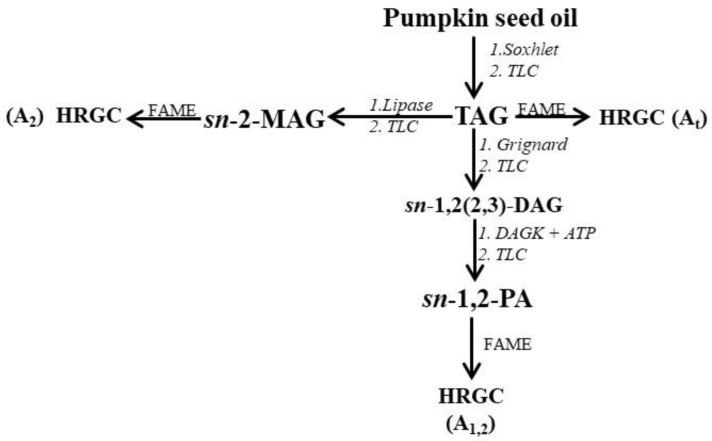
Pumpkin (Cucurbita spp.) has received considerable attention in recent years because of the nutritional and health-protective value of seed oil. The nutritional composition of pumpkin native to central Italy, locally known as “Berrettina” (Cucurbita maxima L.), was evaluated. In particular, the lipid fraction of seed oil was characterized, and the triacylglycerol (TAG) was thoroughly studied by using a stereospecific procedure to obtain the intrapositional fatty acid composition of the three sn-positions of the glycerol backbone of TAG. Moreover, alkaline hydrolysis was carried out to study the main components of the unsaponifiable fraction, i.e., sterols and alcohols. It was observed that monounsaturated fatty acids and polyunsaturated fatty acids were the most abundant (41.7% and 37.2%, respectively) in Berrettina pumpkin seed oil, with high content of oleic and linoleic acid (41.4% and 37.0%, respectively). The main sterols of Berrettina pumpkin seed oil were Δ7,22,25-stigmastatrienol, Δ7,25-stigmastadienol, and spinasterol; with regard to the alcoholic fraction, triterpenic compounds were more abundant than aliphatic compounds (63.2% vs. 36.8%). The obtained data are useful to evaluate pumpkin seed oil from a nutritional point of view. The oil obtained from the seed could be used as a preservative and as a functional ingredient in different areas, e.g., cosmetics, foods, and nutraceuticals.
Overview
The claims and statistics of this paper haven’t been checked yet.
Free: it reads the open-access text and checks the first 5 claims that cite a source we can check. Create a free account to check every claim.
Integrity signals
Registry
Cites
Statistics
Figures
Verification
Claims the paper makes
The claims and statistics of this paper haven’t been checked yet.
Free: it reads the open-access text and checks the first 5 claims that cite a source we can check. Create a free account to check every claim.
Claims other papers make about this one
Each is checked against this paper’s own text: does it say what the citing paper says it does?
The cited source says what the claim attributes to it.
In the citing paper
“Montesano et al. [53] found that the most prevalent fractions were polyunsaturated fatty acids and monounsaturated fatty acids (37.2% and 41.7%, respectively).”
From Pumpkin and Pumpkin By-Products: A Comprehensive Overview of Phytochemicals, Extraction, Health Benefits, and Food Applications (2024) · cites this paper as [53]
The cited source says what the claim attributes to it.
In the citing paper
“The fatty acids that were most abundant were oleic and linoleic acids.”
From Pumpkin and Pumpkin By-Products: A Comprehensive Overview of Phytochemicals, Extraction, Health Benefits, and Food Applications (2024) · cites this paper as [53]
Self-check
Percentages, sums and reported differences re-computed from the paper’s own numbers.
The self-check needs the paper’s full text.
Citations
Cites
1 retracted
Bardaa, S., Ben Halima, N., Aloui, F., Ben Mansour, R., Jabeur, H., Bouaziz, M., & Sahnoun, Z. (2016) · Lipids in Health and Disease · doi:10.1186/s12944-016-0237-0 · Cited by 206
Retracted(1971) · Soil Science Society of America Journal · doi:10.2136/sssaj1971.03615995003500050003x · Cited by 6,358
Coronary heart disease: seven dietary factors
Ulbricht, T. L. V., & Southgate, D. A. T. (1991) · The Lancet · doi:10.1016/0140-6736(91)91846-m · Cited by 3,623 · cited 2×
“that some FA can help to prevent or promote coronary thrombosis and atherosclerosis based on their effects on LDL concentration and serum cholesterol [41].”
BackgroundRAO, A., & RAO, L. (2007) · Pharmacological Research · doi:10.1016/j.phrs.2007.01.012 · Cited by 2,011
USDA National Nutrient Database for Standard Reference, Release 22
(2018) · Cited by 1,285
Orsavova, J., Misurcova, L., Ambrozova, J., Vicha, R., & Mlcek, J. (2015) · International Journal of Molecular Sciences · doi:10.3390/ijms160612871 · Cited by 1,034 · cited 3×
“SFA with carbon chains shorter than 14 carbon atoms, called short- and medium-chain FA, was not found in pumpkin seed oil, as confirmed in other papers [14,20,37,38].”
BackgroundResultBioactivity and protective effects of natural carotenoids
Stahl, W., & Sies, H. (2005) · Biochimica et Biophysica Acta (BBA) - Molecular Basis of Disease · doi:10.1016/j.bbadis.2004.12.006 · Cited by 898
Essential fatty acids as functional components of foods- a review
Kaur, N., Chugh, V., & Gupta, A. K. (2014) · Journal of Food Science and Technology · doi:10.1007/s13197-012-0677-0 · Cited by 490 · cited 2×
“In addition, several studies [39] have positively correlated EFA intake with reduction of”
BackgroundOil and Tocopherol Content and Composition of Pumpkin Seed Oil in 12 Cultivars
Stevenson, D. G., Eller, F. J., Wang, L., Jane, J.-L., Wang, T., & Inglett, G. E. (2007) · Journal of Agricultural and Food Chemistry · doi:10.1021/jf0706979 · Cited by 428 · cited 4×
“SFA with carbon chains shorter than 14 carbon atoms, called short- and medium-chain FA, was not found in pumpkin seed oil, as confirmed in other papers [14,20,37,38].”
BackgroundResultInfluentialPlant sterols: factors affecting their efficacy and safety as functional food ingredients.
Berger, A., Jones, P. J. H., & AbuMweis, S. S. (2004) · Lipids in Health and Disease · doi:10.1186/1476-511x-3-5 · Cited by 402
Research works printed but not linked: 1
- Blessing A.C. Ifeanyi U.M. Chijioke O.B. Nutritional evaluation of some Nigerian pumpkins (Cucurbita spp.) Fruit Veg. Cereal Sci. Biotechnol. 2012 5 64 71
Cited by
Items 101–152 of 152
Eissa, E. H., Salama, W. M., Elbahnaswy, S., Al‐Kareem, O. M. A., El-Gawad, E. A. A., Osailan, R., Mansour, Y. A., Eldin, Z. E., (6934622), S. A., El‐Aziz, Y. M. A., et al. (2026) · Developmental & Comparative Immunology · doi:10.1016/j.dci.2026.105582 · Cited by 3
Thamer, S. J., Ibrahim, M. K., & Alnema, K. S. (2021) · Karbala International Journal of Modern Science · doi:10.33640/2405-609x.3161 · Cited by 4
Abo‐State, H., El-Monairy, M. M., Hamouda, Y., & Hassan, H. M. A. (2022) · Advances in Animal and Veterinary Sciences · doi:10.17582/journal.aavs/2022/10.4.882.887 · Cited by 3
Chemical and Biochemical Features of Spinasterol and Schottenol
Khallouki, F., Ksila, M., Ghzaiel, I., Essadek, S., Tahri-Joutey, M., Maaloul, S., Zennouhi, W., Benbacer, L., Bourhia, M., Hajji, L., et al. (2023) · Advances in experimental medicine and biology · doi:10.1007/978-3-031-43883-7_3 · Cited by 3
Alzahrani, Q. E., Gillis, R. B., Harding, S. E., Pinto, L. H., Gulati, M., Kapoor, B., Rani, P., Singh, S. K., & Adams, G. G. (2022) · Journal of Reports in Pharmaceutical Sciences · doi:10.4103/jrptps.jrptps_144_21 · Cited by 4
Aziz, A., Noreen, S., Khalid, W., Ejaz, A., Rasool, I. F. U., Maham, Munir, A., Farwa, Javed, M., Erċışlı, S., et al. (2025) · ACS Omega · doi:10.1021/acsomega.5c00201 · Cited by 3
Noura, H., & Khémiri, I. (2025) · LUTS Lower Urinary Tract Symptoms · doi:10.1111/luts.70024 · Cited by 3
“Notably, β - sitosterol, the principal phytosterol in CPSO [40, 43], may help lower cholesterol by restricting its absorption and stimulating the immune system.”
ANTIOXIDANT PROPERTIES OF TOTAL LUTEIN CONTENT IN DIFFERENT PARTS OF PUMPKIN (Cucurbita maxima)
WEN, W. Y., & Ahmad, F. T. (2020) · Universiti Malaysia Terengganu Journal of Undergraduate Research · doi:10.46754/umtjur.v2i3.158 · Cited by 2
“Peels, flesh and seeds of the pumpkin were separated from each other and cut to reduce the size (Montesano et al., 2018).”
BackgroundSaputra, H., Azrifirwan, A., & Firdani, F. (2024) · GreenTech · doi:10.25077/greentech.v1i1.10 · Cited by 2
Divergence analysis of Cucurbita pepo L. population for seed oil production
Tomić, D., Radovanović, M., Marjanović, M., Đurović, V., Stevović, V., Pavlović, N., Lazarević, Đ., ZORNIĆ, V. G., & Madić, M. (2024) · Notulae Botanicae Horti Agrobotanici Cluj-Napoca · doi:10.15835/nbha52413907 · Cited by 2
Bashir, K., Jan, K., Habib, M., & Jan, S. (2025) · Springer eBooks · doi:10.1007/978-3-031-83803-3_4 · Cited by 4
EDIBLE SEEDS MEDICINAL VALUE, THERAPEUTIC APPLICATIONS AND FUNCTIONAL PROPERTIES-A REVIEW
R., C., & Sivagami, B. (2021) · International Journal of Pharmacy and Pharmaceutical Sciences · doi:10.22159/ijpps.2021v13i7.41436 · Cited by 7
Breeding of Sweet Gourd (Cucurbita moschata Duch. ex Poir.)
Islam, A. K. M. A., Sarkar, S., Ruma, K. N., Khatun, M., Era, F. M., & Raihan, M. S. (2021) · Springer eBooks · doi:10.1007/978-3-030-66961-4_8 · Cited by 2
Oyedeji, A. O., Azeez, L. A., & Odeyemi, B. (2021) · Natural Resources for Human Health · doi:10.53365/nrfhh/143048 · Cited by 2
Başdoğan, H., Akman, P. K., Yıldırım, R. M., Sağdıç, O., Geçgel, Ü., Tekin‐Cakmak, Z. H., & Karasu, S. (2022) · Food Science and Technology · doi:10.1590/fst.20621 · Cited by 2
Mejía‐Morales, C., Rodríguez-Macias, R., Salcedo-Pérez, E., Zamora-Natera, F., Molina‐Torres, J., & Zañudo‐Hernández, J. (2022) · Revista Chapingo serie ciencias forestales y del ambiente (en línea)/Revista Chapingo serie ciencias forestales y del ambiente · doi:10.5154/r.rchscfa.2021.10.060 · Cited by 1
“…calabazas silvestres (Figuras 2 y 3, carril 11) también ha sido identificado en Cucurbita maxima L. (Akintayo, Akintayo, Akinsola, & Ziegler, 2009), pero en otras especies domesticadas no se ha reportado la presencia (Montesano, Blasi, Simonetti, Santini, & Cossignani, 2018; Neđeral et al., 2012).”
BackgroundRisal, A. F., Syam, A., Indriasari, R., Hadju, V., Zulkifli, A., & Zainal, Z. (2023) · Biomedical & Pharmacology Journal · doi:10.13005/bpj/2633 · Cited by 1
Ryazhanka with pumpkin puree and flax seeds
Kuzmin, O., Kiiko, V., Khareba, О. V., Gavrylenko, O., Ianchyk, M., & Melnyk, N. (2023) · Ukrainian Food Journal · doi:10.24263/2304-974x-2023-12-1-7 · Cited by 5
Kaur, M., Sharma, S., & Dhatt, A. S. (2024) · Wiley eBooks · doi:10.1002/9781119803980.ch18 · Cited by 2
Probiotics and oilseed cakes as feed additives in piglets nutrition
Dumitru, M., Râmbu, D. T., & Ciurescu, G. (2025) · Archiva zootechnica · doi:10.2478/azibna-2025-0001 · Cited by 1
Noura, H., Bitri, L., & Khémiri, I. (2025) · Euro-Mediterranean Journal for Environmental Integration · doi:10.1007/s41207-025-00858-3 · Cited by 1
“We used the petroleum ether as an organic solvent to isolate the maximum of the seeds’ lipid fraction by a Soxhlet extractor (Montesano et al. 2018).”
Akter, M., & Borna, A. A. (2026) · Journal of Food Processing and Preservation · doi:10.1155/jfpp/6410657 · Cited by 1
Gao, Y., Duan, X., Chen, Z., Zhou, L., He, D., & Lei, F. (2026) · Foods · doi:10.3390/foods15091602 · Cited by 1
“In combination with the high linoleic acid content of PSO, sterols may offer additional benefits in managing lipid-related conditions such as atherosclerosis [38].”
Phytochemicals characterization of nutraceutical enriched fruits and nuts spread
Rohini, C., Geetha, P. S., Vijayalakshmi, R., & Mini, M. L. (2021) · Journal of Applied and Natural Science · doi:10.31018/jans.v13isi.2810 · Cited by 1
“It is an underutilized crop and considered as an agro waste (Montesano et al. 2018).”
BackgroundFormulation of Healthy Cucurbita maxima seed incorporated Milkshake
Jerlin, H., Keerthika, B., & Gracia, J. (2022) · International Journal of Scientific Research in Science and Technology · doi:10.32628/ijsrst229150 · Cited by 1
Seed to Wellness: The Therapeutic Potential of Pumpkin Seeds
Tambe, S. (2024) · International Journal for Research in Applied Science and Engineering Technology · doi:10.22214/ijraset.2024.59531 · Cited by 1
Oyedeji, A. O., Odeyemi, B., Adewuyi, S. O., & Azeez, L. A. (2021) · Walailak Journal of Science and Technology (WJST) · doi:10.48048/wjst.2021.7025 · Cited by 1
Cucurbita pepo and Cucurbitacin in the Management of Anti-proliferation by JAK/STAT Pathway
Mukherjee, S., & Pal, D. (2021) · Indian Journal of Pharmaceutical Education and Research · doi:10.5530/ijper.55.1.3 · Cited by 1
Jahromi, S. M., & jahromi, S. N. (2020) · Iranian Red Crescent Medical Journal · doi:10.32592/ircmj.2020.22.9.139
“It is also noteworthy that estrogen is a potent stimulus of follicular growth in rodents (53, 54).”
BackgroundBoskou, D. G., & Clodoveo, M. L. (2021) · MDPI eBooks · doi:10.3390/books978-3-03943-856-3 · Cited by 1
FRĂTUȚU, F.-C., Nanu, Ș., Diaconu, A., Sfîrloagă, L.-M., & ȘERBAN, D. M. (2023) · Annals of the University of Craiova - Agriculture Montanology Cadastre Series · doi:10.52846/aamc.v52i1.1325
al., H. M. K. E. (2023) · Egyptian Journal of Aquatic Biology and Fisheries · doi:10.21608/ejabf.2023.318113
Haščík, P., & Čech, M. (2023) · Slovak University of Agriculture in Nitra, Slovakia eBooks · doi:10.15414/2023.9788055226705
Cittadini, A. (2023) · Academica-e (Universidad Pública de Navarra) · doi:10.48035/tesis/2454/47174
Exploring the Diverse Biological Properties of Cannabidiol: A Focus on Plant Growth Stimulation
Gruľová, D., Baranová, B., Francolino, R., Elshafie, H. S., Kiššová, Z., Glovaťáková, A., Martino, L. D., Amato, G., Martino, M., Caputo, L., et al. (2024) · Chemistry & Biodiversity · doi:10.1002/cbdv.202400274
Simultaneous determination of cucurbitacins B, D, and E in Cucurbita seed oils by HPLC-DAD
Goya‐Jorge, E., Rodríguez, M. E. J., & Hernández, Y. S. (2024) · Natural Product Research · doi:10.1080/14786419.2024.2394097
“Characterisation of other components of Cucurbita seed oils has been reported (Lerma-García et al. 2015; Montesano et al. 2018; Shelenga et al. 2020), but not the cucurbitacin content.”
Functional foods for hair loss and alopecia
Zahedinia, S., Bayar, E., Karimidastjerd, A., & Khan, Z. S. (2025) · Elsevier eBooks · doi:10.1016/b978-0-443-28862-3.00019-4
Calampa, J. A. B. C., Valle, C. A. F., Rios, Ó. G. P., Silva, G. Y. C., & Gutiérrez, Ó. G. H. (2025) · Nutrición clínica y dietética hospitalaria/Nutrición clínica, dietética hospitalaria · doi:10.12873/452caballero
Aslam, M., Shafqat, F., Atif, M., Amin, F., Elkelish, A., Abu-Elsaoud, A. M., Alzahrani, M. M., & Arif, M. (2026) · Applied Biochemistry and Biotechnology · doi:10.1007/s12010-025-05546-0
Deepak, D. S., Chirag, P. C., Sushil, K., Hetal, P. P., Parmar, D., Ankit, C., & Trivima, S. (2026) · Plant Science Today · doi:10.14719/pst.9076
Etim, E. E., Ezeanyika, L. U. S., & Ganyam, M. M. (2026) · doi:10.54117/ijmds.v4i1.47
Alam, M. F., Hazazi, A. M. A., Al-Kasim, M. A., Jali, A. M., Hanbashi, A., Alshahrani, S., Alshamrani, A. A., Mawkili, W., Oraiby, M. E., Ibrahim, S., et al. (2026) · Journal of Pharmacology and Pharmacotherapeutics · doi:10.1177/0976500x261417397
Al-Shammari, N. A. H., Shtewi, H., Sultan, F., & Sayed-Lafi, R. M. (2026) · Open Veterinary Journal · doi:10.5455/ovj.2026.v16.i2.26
“As a result, pumpkin is increasingly gaining attention due to its therapeutic uses, nutritional value, and health-protective properties (Montesano et al. , 2018).”
STUDY OF THE FATTY ACIDS OF PUMPKIN, WATERMELON AND BLACK CUMIN OILS IN THE ASTRAKHAN REGION
Vasilyev, V. A., & Реснянская, А. С. (2026) · Вестник Красноярского государственного аграрного университета · doi:10.36718/1819-4036-2026-3-228-239
Nurrahman, N., Suyanto, A., Astuti, R., DEWI, Y. K., & AMALIA, N. (2026) · Asian Journal of Agriculture · doi:10.13057/asianjagric/g100132
Sicana odorifera seeds as a new source of punicic acid determined by NMR analyses
Mereles, L. G., Burgos-Edwards, A., Leyton, F., Carvajal, M. B., Coronel, E., & Schmeda‐Hirschmann, G. (2026) · Food Chemistry Advances · doi:10.1016/j.focha.2026.101325
Bella, V., Šramková, K. F., Vergun, O. M., Grygorieva, O., Brindza, J., Nowicki, M., Ivanišová, E., & Kowalczewski, P. Ł. (2026) · REVIEWS ON ADVANCED MATERIALS SCIENCE · doi:10.1515/rams-2025-0221
“The seeds of pumpkin ( Cucurbita spp.) have traditionally been regarded as agro-industrial by-products [41, 42].”
Mwezi, R. J., Kipanyula, M. J., Vianney, J., & Stephano, F. (2026) · Frontiers in Toxicology · doi:10.3389/ftox.2026.1930770
“Frontiers in Toxicology frontiersin.org 15 Although both plants contain bioactive and antioxidant phytochemicals (Montesano et al., 2018; Peng et al., 2021; Toomer, 2018), the present design does not permit conclusions regarding pharmacological additivity or synergy.”
Cucurbita Maxima Pumpkin Seed Oil: Chemical Properties and Profile Characterization
Motri, S., Gharsallah, K., Rezig, L., Rabeb, L., Nefzi, S., Mnif, W., Alqahtany, F. Z., & Giuffrè, A. M. (2026) · Current Research in Nutrition and Food Science Journal · doi:10.12944/crnfsj.14.2.28
Cucurbita seed oil extraction, evaluation of physico chemical properties & health benefits
B.Swapna, S.Vasantha, & T.Chandana (2022) · International Journal of Pharmacology and Clinical Research (IJPCR)
Nеtrеbа, N., Gurev, A., Dragancea, V., Cojocari, D., Bălan, G., Macari, A., Bоеstеаn, О., Diаnu, I., Sаndu, I., Cușmenco, T., et al. (2026) · Applied Sciences · doi:10.3390/app162110540
Исследование состава жирных кислот масел тыквы, арбуза и черного тмина Астраханской области
Анатольевич, В. В., & Станиславовна, Р. А. (2026) · Вестник Красноярского государственного аграрного университета
Metadata
- Authors
- Montesano, D., Blasi, F., Simonetti, M., Santini, A., & Cossignani, L.
- Affiliations
- University of Perugia (IT)
- University of Naples Federico II (IT)
- Corresponding author
- Santini, Antonello
- Venue
- Foods
- Publisher
- MDPI AG
- Published
- 2018-03-01
- Volume
- 7
- Issue
- 3
- Pages
- 30
- ISSN
- 2304-8158 (ISSN-L)
- PMC
- PMC5867545
- OpenAlex
- W2792074374
- Semantic Scholar
- c810f23b909a5fdca6bc35acde2e083a9df5c111
- Cited by
- 139
- References
- 52
- Citations by year
- 2026: 12 · 2025: 13 · 2024: 17 · 2023: 15 · 2022: 26 · 2021: 24 · 2020: 17 · 2019: 13 · 2018: 2
- FWCI
- 5.74
- Type
- journal article
- Language
- en
- Open access
- gold
- doi.org
- Licence
- Locations
- Foods (publishedVersion, cc-by)
- Europe PMC (PubMed Central) (publishedVersion, cc-by)
- PubMed Central (publishedVersion, cc-by)
- PubMed (publishedVersion)
- DOAJ (DOAJ: Directory of Open Access Journals) (submittedVersion, cc-by-sa)
- Topics
- Physical Sciences › Chemistry › Organic Chemistry › Edible Oils Quality and Analysis
- Life Sciences › Agricultural and Biological Sciences › Food Science › Food Nutrient Composition and Product Development
- Life Sciences › Agricultural and Biological Sciences › Food Science › Food Chemistry and Fat Analysis
- Keywords
- Cucurbita maxima, pumpkin seed oil, triacylglycerol composition, unsaponifiable matter, sterols, triterpenic alcohols, oleic acid, linoleic acid, monounsaturated fatty acids, polyunsaturated fatty acids, nutritional composition, functional food ingredients
About these checks
Registry, retraction, Cites and statistics results are computed, not judged, with one exception: a printed reference that no index lists is read once by a model before it counts as a citation error. Claims are extracted by a model and kept only when their quote appears verbatim in the text; each cited source is then checked, with a model’s help, for whether it says what the claim relies on. Those verdicts can be wrong — read the claim’s quote and the cited source before relying on one.
Statistics and arithmetic are recomputed, not judged.
Confidence bands are shown only for fields calibrated on our annotated test set. None is calibrated yet, so no band is shown.
What counts as a claim ›How we measure confidence ›How we check this ›
Are you an author, or do you see a problem with this page? Request a review
Data sources
Bibliographic data: Semantic Scholar, OpenAlex, Crossref.
Contains information from the Semantic Scholar Academic Graph Datasets, made available under the ODC Attribution License (ODC-BY 1.0).
Semantic Scholar’s data is described in: Kinney, R., et al. (2023). The Semantic Scholar Open Data Platform. arXiv:2301.10140.
