

Microbial Community Analysis of Sauerkraut Fermentation Reveals a Stable and Rapidly Established Community
Open accessThe DOI matches its Crossref record; 24 of the 25 references it cites were found in a registry or an index.
Abstract
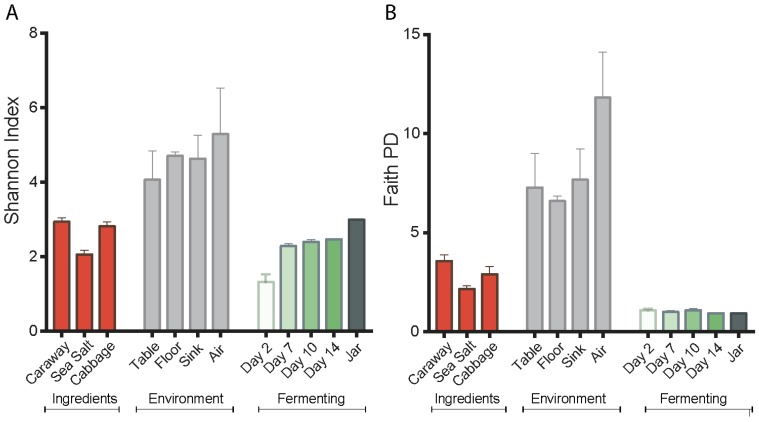
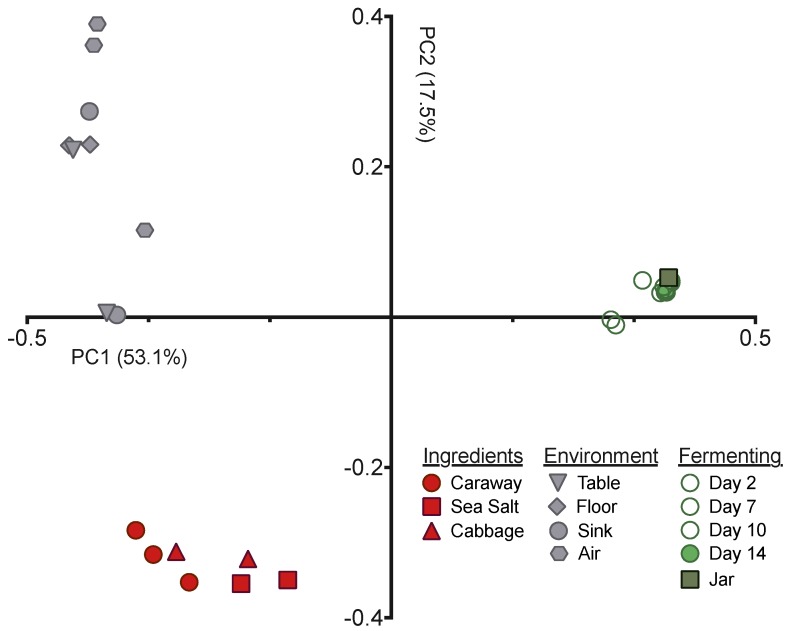
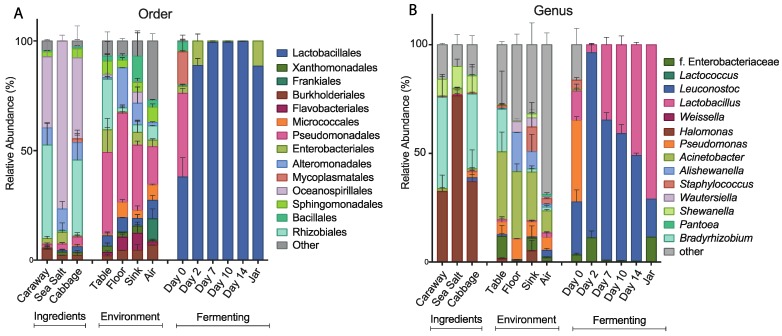
Despite recent interest in microbial communities of fermented foods, there has been little inquiry into the bacterial community dynamics of sauerkraut, one of the world’s oldest and most prevalent fermented foods. In this study, we utilize 16S rRNA amplicon sequencing to profile the microbial community of naturally fermented sauerkraut throughout the fermentation process while also analyzing the bacterial communities of the starting ingredients and the production environment. Our results indicate that the sauerkraut microbiome is rapidly established after fermentation begins and that the community is stable through fermentation and packaging for commercial sale. Our high-throughput analysis is in agreement with previous studies that utilized traditional microbiological assessments but expands the identified taxonomy. Additionally, we find that the microbial communities of the starting ingredients and the production facility environment exhibit low relative abundance of the lactic acid bacteria that dominate fermented sauerkraut.
Overview
The claims and statistics of this paper haven’t been checked yet.
Free: it reads the open-access text and checks the first 5 claims that cite a source we can check. Create a free account to check every claim.
Integrity signals
Registry
Cites
Statistics
Figures
Verification
Claims the paper makes
The claims and statistics of this paper haven’t been checked yet.
Free: it reads the open-access text and checks the first 5 claims that cite a source we can check. Create a free account to check every claim.
Claims other papers make about this one
Each is checked against this paper’s own text: does it say what the citing paper says it does?
The cited source says what the claim attributes to it.
In the citing paper
“Sauerkraut has also been shown to predominantly contain Leuconostoc and Lactobacillus spp. [18,19,90,91].”
From Fermented foods: definitions and characteristics, impact on the gut microbiota and effects on gastrointestinal health and disease (2019) · cites this paper as [90]
Self-check
Percentages, sums and reported differences re-computed from the paper’s own numbers.
The self-check needs the paper’s full text.
Citations
Cites
QIIME allows analysis of high-throughput community sequencing data
Caporaso, J. G., Kuczynski, J., Stombaugh, J., Bittinger, K., Bushman, F. D., Costello, E. K., Fierer, N., Peña, A. G., Goodrich, J. K., Gordon, J. I., et al. (2010) · Nature Methods · doi:10.1038/nmeth.f.303 · Cited by 34,887
Ultra-high-throughput microbial community analysis on the Illumina HiSeq and MiSeq platforms
Caporaso, J. G., Lauber, C. L., Walters, W. A., Berg-Lyons, D., Huntley, J., Fierer, N., Owens, S. M., Betley, J., Fraser, L., Bauer, M., et al. (2012) · The ISME Journal · doi:10.1038/ismej.2012.8 · Cited by 8,839
A communal catalogue reveals Earth's multiscale microbial diversity
Thompson, L. R., Sanders, J. G., McDonald, D., Amir, A., Ladau, J., Locey, K. J., Prill, R. J., Tripathi, A., Gibbons, S. M., Ackermann, G., et al. (2017) · Nature · doi:10.1038/nature24621 · Cited by 2,684
Walters, W., Hyde, E. R., Berg-Lyons, D., Ackermann, G., Humphrey, G., Parada, A., Gilbert, J. A., Jansson, J. K., Caporaso, J. G., Fuhrman, J. A., et al. (2016) · mSystems · doi:10.1128/msystems.00009-15 · Cited by 2,191
Trends in the Use of Complementary Health Approaches Among Adults in the United States: New Data
Jackson, C. (2015) · Holistic Nursing Practice · doi:10.1097/hnp.0000000000000088 · Cited by 1,166
(2015) · PubMed · Cited by 926
Lactic acid bacteria as probiotics.
Ljungh, Å., & Wadström, T. (2006) · PubMed · Cited by 551
Application of bacteriocins in vegetable food biopreservation
Settanni, L., & Corsetti, A. (2008) · International Journal of Food Microbiology · doi:10.1016/j.ijfoodmicro.2007.09.001 · Cited by 441
Cheigh, H., Park, K., & Lee, C. Y. (1994) · Critical Reviews in Food Science and Nutrition · doi:10.1080/10408399409527656 · Cited by 413
Kim, M., & Chun, J. (2005) · International Journal of Food Microbiology · doi:10.1016/j.ijfoodmicro.2004.11.030 · Cited by 251
Research works printed but not linked: 1
- Pederson C.S. Albury M.N. Bulletin: Number 824: The Sauerkraut Fermentation Agricultural Experiment Station New York, NY, USA 1969
Cited by
Items 101–171 of 171
Techaoei, S., Jarmkom, K., Dumrongphuttidecha, T., & Khobjai, W. (2023) · Journal of Pharmacy & Pharmacognosy Research · doi:10.56499/jppres23.1713_11.6.1044 · Cited by 5
Tarantini, A., Mancini, L., Vacca, M., Celano, G., Romano, G., D’Amico, L., Cardinali, A., Bleve, G., & Angelis, M. D. (2025) · LWT · doi:10.1016/j.lwt.2025.117961 · Cited by 4
Chih, Y., Chiang, S., & Tsai, C. (2025) · Fermentation · doi:10.3390/fermentation11090517 · Cited by 4
“This observation is consistent with findings in sourdough and fermented vegetable studies [46,47].”
Yoshioka, M., Akasaka, N., Masuda, Y., Mori, M., & Watanabe, D. (2025) · Applied and Environmental Microbiology · doi:10.1128/aem.01730-25 · Cited by 3
“…during fermentation; LAB in the genus Leuconostoc are dominant at the early stage of fermentation, and the microbial community is gradually occupied by other LAB in the genus Lactiplantibacillus , which previously belonged to the genus Lactobacillus , in parallel with fermentation progression (8).”
Fukuba, J. A., Sela, D. A., Gibbons, J. G., Moore, M. D., & Kinchla, A. J. (2026) · Applied Food Research · doi:10.1016/j.afres.2026.101985 · Cited by 3
Microbiomic Prospects in Fermented Food and Beverage Technology
Bouki, P., Mitsagga, C., Kambouris, M. E., & Giavasis, I. (2020) · Elsevier eBooks · doi:10.1016/b978-0-12-816664-2.00012-8 · Cited by 8
Akın, M., Eyduran, Ş. P., Negi, N. P., Yılmaz, B., Yıldırım, K., Παπαγεωργίου, Μ., & Rocha, J. M. (2024) · Elsevier eBooks · doi:10.1016/b978-0-443-18622-6.00010-4 · Cited by 3
Das, M., Saha, S., Lahon, J., Gurung, K., Kharnaior, P., & Tamang, J. P. (2025) · Microbiology · doi:10.1134/s0026261724605839 · Cited by 3
“…the globe that are believed to have health benefits and have been analyzed micro-biologically include Korean kimchi (Kim and Park, 2018; Song et al., 2023), European sauerkraut (Zabat et al., 2018; Gaudioso et al., 2022), and Chinese suan-cai and pao cai (Xiao et al., 2020; Ting et al., 2022).”
Bemis, D. H., Camphausen, C. E., Liu, E., Dantus, J. J., Navarro, J. A., Dykstra, K. L., Paltrowitz, L. A., Dzhelmach, M., Joerg, M., Tamelessio, P., et al. (2025) · Foods · doi:10.3390/foods14111948 · Cited by 3
“In fact, the final microbial profile in the cabbage-only media more closely resembled that of sauerkraut [30], a fermentation that solely relies on cabbage-derived nutrients.”
Self-citationBeeck, W. V., Eilers, T., Smets, W., Delanghe, L., Vandenheuvel, D., Tuyaerts, I., Malderen, J. V., Ahannach, S., Michiels, K., Dricot, C. E. M. K., et al. (2025) · Microbiology Spectrum · doi:10.1128/spectrum.00368-25 · Cited by 4
“The general microbial community dynamics of vegetable fermentations such as modern cabbage kimchi are rather well studied (11, 19–21), but the precise origin of the microbiota that colonize the fermentation is not yet fully understood.”
The effect of consumption of natural non-dairy probiotics on human health
Sikora, D., Wojciechowska-Alwin, N., Lipski, A., Bogdański, P., & Skrypnik, D. (2020) · Nutrition Obesity & Metabolic Surgery · doi:10.5114/noms.2020.94668 · Cited by 4
“Constant production conditions ensure the same composition of the microorganisms and their metabolites in the final product [13].”
BackgroundChemical Composition and Sensory Profile of Sauerkraut from Different Cabbage Hybrids
Yanchenko, E. V., Волкова, Г. С., Куксова, Е. В., Вирченко, И. И., Yanchenko, A. V., Serba, E. M., & Ivanova, M. I. (2023) · Food Processing Techniques and Technology · doi:10.21603/2074-9414-2023-1-2420 · Cited by 3
New Insights Into Lactic Acid Bacteria Fermentation of Plant Foods Through Complementary Omics
Cagno, R. D., Filannino, P., Albiac, M. A., & Gobbetti, M. (2020) · Elsevier eBooks · doi:10.1016/b978-0-08-100596-5.23043-6 · Cited by 3
African Fermented Vegetable Products
Mahunu, G. K., & Mariod, A. A. (2022) · Springer eBooks · doi:10.1007/978-3-030-82902-5_18 · Cited by 4
Physico-chemical properties and sensory quality of cassava-cowpea-millet composite flours
Onyango, S. O., Abong', G. O., Okoth, M. W., Kilalo, D., & Mwang’ombe, A. W. (2020) · African Crop Science Journal · doi:10.4314/acsj.v28i1.3s · Cited by 3
Fermented plant-based foods (e.g., tofu, sauerkraut, sourdough)
Das, S., Kathiriya, M. R., Gawai, K. M., & Hati, S. (2022) · Elsevier eBooks · doi:10.1016/b978-0-323-89842-3.00006-3 · Cited by 2
Ashikhmina, T. Y., Тоvstiк, E. V., & Adamovich, T. A. (2024) · chemistry of plant raw material · doi:10.14258/jcprm.20240414599 · Cited by 2
“Данный вид сырья по ско-рости воспроизведения, в сравнении с древесиной, является более доступным источником целлюлозы [67].”
Microbial Fermentation Profiling: Tools and Techniques for Food Analysis
Selva Kumar, T., Saranyadevi, S., Abdullahi, A., & Navina, B. (2025) · Methods and protocols in food science · doi:10.1007/978-1-0716-4787-5_14 · Cited by 4
Economic Importance of Brassica Crops
Rijal, R., Sharm, A. K., & Kumar, A. (2026) · Springer eBooks · doi:10.1007/978-981-95-3861-4_1 · Cited by 7
Fermentation-driven interactions of gut microbes with their environment
Berretta, A., & Schwab, C. (2025) · Essays in Biochemistry · doi:10.1042/ebc20253057 · Cited by 3
“Evidence of probiotic use can be found as early as ancient Rome [84].”
Кондратенко, В. В., Посокина, Н. Е., Kolokolova, A. Y., & Zakharova, A. I. (2021) · Food Processing Techniques and Technology · doi:10.21603/2074-9414-2021-3-584-592 · Cited by 2
Technological and Evolutionary Principles for the Domestication of Fermenting Microorganisms
Claudino, P. H., Bolsan, A. C., Trentin, A. B., Leite, D. C. D. A., & Gabiatti, N. C. (2024) · Springer eBooks · doi:10.1007/978-3-031-72000-0_5 · Cited by 3
The Effect of Calcium in the Fermentation of White Cabbage with Salicornia
Pires-Cabral, P., Pires-Cabral, P., Mira, H., & Quintas, C. (2025) · Fermentation · doi:10.3390/fermentation11020091 · Cited by 2
Miller, E. R., Schwartz, J. O., Cox, G., & Wolfe, B. E. (2020) · Journal of Visualized Experiments · doi:10.3791/61149 · Cited by 4
Microbial community dynamics in traditionally fermented milk
Groenenboom, A. E. (2019) · doi:10.18174/476594 · Cited by 3
Paul, P., Rutkowska, P., & Balaji, S. (2024) · Nutrire · doi:10.1186/s41110-024-00255-w · Cited by 1
“Some of them are in the form of north-eastern Indian fermented vegetables, soybean, bamboo shoots, fish [10], yogurt [11], kefir [12], sauerkraut [13], potato chips [14], kombucha [15], miso [16], kimchi [17], tempeh [18], idli batter [19], and pozha [20].”
Rachmawati, E., Machdaniar, M., Kinasih, L. S., Sargowo, D., Syarifuddin, B. P., Putri, F. C. R., & Ismail, M. (2024) · The Indonesian Biomedical Journal · doi:10.18585/inabj.v16i2.2934 · Cited by 1
Agrawal, R. (2024) · Springer eBooks · doi:10.1007/978-981-97-9582-6_9 · Cited by 1
Sagvekar, A. M., & Gore, M. (2023) · Journal of Applied Biological Sciences · doi:10.71336/jabs.1174 · Cited by 1
“Similar trends are reported during the fermentation of sauerkraut, kimchi (Korean fermented cabbage) and Shalgam (Turkish beverage) in published literature [29, 30, 31].”
Ashikhmina, T. Y., Тоvstiк, E. V., & Adamovich, T. A. (2025) · Russian Journal of Bioorganic Chemistry · doi:10.1134/s1068162025150014 · Cited by 1
Das, R., Rai, P. K., Pandey, S., Das, N., Medhi, M. C., & Tamang, B. (2026) · Fermented Foods · doi:10.1016/j.ferfo.2026.100012 · Cited by 1
程可可, Tang, X., Zhong, H., Chen, X., Li, F., Xie, L., Ge, J., & Ling, H. (2026) · Food Production Processing and Nutrition · doi:10.1186/s43014-026-00374-z · Cited by 1
Addy, H. P., Amedorme, D., Osei‐Poku, P., & Kwarteng, A. (2026) · MicrobiologyOpen · doi:10.1002/mbo3.70272 · Cited by 1
Eilers, T., Rillaer, T. V., Wittouck, S., Tuyaerts, I., Michiels, K., Victor, M., Gehrmann, T., Bron, P. A., Beeck, W. V., & Lebeer, S. (2026) · Microbiology Spectrum · doi:10.1128/spectrum.03578-25 · Cited by 2
“These include sauerkraut (14, 15), kimchi (16, 17), cucumber (18), olives (19), and fermented carrot juice (12, 20).”
InfluentialRecent Advances and Future Trends in Fermented and Functional Foods
Patra, J. K., Shin, H., & Paramithiotis, S. (2022) · MDPI eBooks · doi:10.3390/books978-3-0365-4189-1 · Cited by 2
Semenova, J. A., Посокина, Н. Е., & Терешонок, В. И. (2020) · VEGETABLE CROPS OF RUSSIA · doi:10.18619/2072-9146-2020-6-99-103 · Cited by 1
Sauerkraut and sour turnip consumption habits in Slovenia
Nagode, M., & Bezek, K. (2020) · doi:10.26493/978-961-293-015-8.125-131
Antimicrobial Action of a Bacteria (sakbnc-4) Isolated from Sauerkraut & Its Characterization
Kalam, A. (2019) · Research Journal of Life Sciences Bioinformatics Pharmaceutical and Chemical Sciences · doi:10.26479/2019.0502.82 · Cited by 1
The cutting type of spontaneously fermented vegetables impacts their fermentation ratePreprint
Valence, F., Junker, R., Baty-Julien, C., Rué, O., Mariadassou, M., Madec, M. N., Maillard, M.-B., Bage, A.-S., Chuat, V., Marché, L., et al. (2024) · HAL
Sauerkraut and fermented cabbage juices
Rodrigues, S. Á., Valigura, A. E. D. S., Pena, A. D. C. C., de Lima, K. P., Gallardo, V., Santos, C. R., Pagnoncelli, M. G. B., & Hashimoto, E. H. (2024) · Elsevier eBooks · doi:10.1016/b978-0-443-13966-6.00001-4
Diet to Data: Validation of a Bias-Mitigating Nutritional Screener Using Assembly Theory
Penrose, O. C., Gross, P. J., Singh, H., Rynarzewska, A. I., Ayazo, C., & Jones, L. (2025) · Nutrients · doi:10.3390/nu17152459
“This microbiome is another complex ingredient [54].”
Indigenous Fermented Food Products: Biochemistry, Microbiology, and Biotechnology
Singh, V., Singh, Y., & Kumar, R. (2025) · Disaster Resilience and Green Growth · doi:10.1007/978-981-96-9286-6_2
Máximo-Olguín, A., Pérez‐Flores, J. G., García‐Curiel, L., Pérez-Escalante, E., Contreras‐López, E., Ordaz, J. J., & Cruz-Guerrero, A. E. (2025) · Revista de investigación Agropecuaria Science and Biotechnology · doi:10.25127/riagrop.20254.1132
Review, D. S. S. (2024) · Dialogue Social Science Review (DSSR) · doi:10.5281/zenodo.14268660 · Cited by 1
Bioactivity of Secreted Compounds Made by Fermented Vegetable-Associated Lactobacilli
Wei, L. (2024) · eScholarship (California Digital Library)
Fermentation of Fucus vesiculosus: Sensory evaluation and product innovation
Maher, M. (2024) · UTUPub (University of Turku)
PROBIOTIC: SOURCES, PRODUCTS AND HEALTH BENEFITS – REVIEW
Umbarkar, V. D., Shinde, V. S., Rutika, Y., Bhutada, S. B., Dahikar, S. B., & Kovaleva, E. G. (2025) · Electronic scientific archive of UrFU (Ural Federal University)
(2025) · Electronic scientific archive of UrFU (Ural Federal University)
LÓPEZ, J. R. (2022) · RUJA. Institutional Repository of Scientific Production of the University of Jaén (University of Jaén)
Mayr, C., Dankó, E., Antonielli, L., & Kostić, T. (2026) · International Journal of Food Microbiology · doi:10.1016/j.ijfoodmicro.2026.111742
Gendre, J. C. (2025) · theses.fr (ABES) · doi:10.70675/0a78eaf7z2f9fz4957zb2c7z720f77ad63e0
Vukojevic, A., Milica, P., Simeunovic, V., Pavlović, S. Z., Borković-Mitić, S., Mladenović, A., Milanović, D., & Praćer, S. (2026) · BioFactors · doi:10.1002/biof.70100
Yang, Y., Zhang, H., Shuang, Q., & Xia, Y. N. (2026) · Food Chemistry Molecular Sciences · doi:10.1016/j.fochms.2026.100430 · Cited by 1
“In the sauerkraut fermentation system, the dominant microbial community that drives the fermentation process plays a decisive role in shaping the final product quality and its unique sensory characteristics (Zabat et al., 2018).”
Martelli, F., Nicolotti, C., Monica, E. D., Vecchio, L. D., Levante, A., Cirlini, M., Gatti, M., & Bottari, B. (2026) · Food Bioscience · doi:10.1016/j.fbio.2026.109479
The effect of combined stress factors on resistant Bacillus cereus spores in sauerkraut production
Huong, N. T. N., Sittisart, P., Mahidsanan, T., Pinyo, J., & Gasaluck, P. (2026) · Food Research · doi:10.26656/fr.2017.10(4).023
Global Fermented Meat and Seafood Products: Safety, Processing, and Future Prospects
Muruganandam, K., David Evander Jebson, S., Madhumitha, M., Nagarethinam, B., & Sivanandham, V. (2026) · International Journal of Food Technology and Management · doi:10.63338/ijftm.2026.000029
“Through fermentation, carbon dioxide is produced, which creates an anaerobic environment within the storage container (Zabat et al., 2018).”
Fadlillah, H. N., Palupi, E., listyorini, N., & Felanesa, L. (2026) · Food Reviews International · doi:10.1080/87559129.2026.2704699
Microorganisms, Quality Changes, and Process Optimization in Fermented Vegetable Processing
Huang, N., Yu, S., Li, S., Fang, L., Wu, Z., & Liu, Y. (2026) · Food Reviews International · doi:10.1080/87559129.2026.2707556
Tuțulescu, F., Ionică, M. E., & Stoica, F. (2026) · Foods · doi:10.3390/foods15152746 · Cited by 1
“The preserving effect of lactic acid bacteria on food is also well established, extending the shelf life and increasing the nutritional value of the resulting final product [14].”
From fruit waste to foods via fermentation
Calvete‐Torre, I., Breselge, S., Leech, J., Mathur, H., & Cotter, P. D. (2026) · Current Research in Food Science · doi:10.1016/j.crfs.2026.101549
Li, N., Zhang, A., Hu, J., Yu, M., Zhou, Y., Liang, K., Román‐Camacho, J. J., Shen, Y., Song, J., Wang, M., et al. (2026) · Comprehensive Reviews in Food Science and Food Safety · doi:10.1111/1541-4337.70623
Latief, K., Hidayat, S. H., Iqbal, & Hutabarat, O. S. (2026) · IOP Conference Series Earth and Environmental Science · doi:10.1088/1755-1315/1655/1/012091
Shao, Z., Cai, D., Chen, X., Sogore, T., Mu, T., Ding, T., Li, Z., & Shen, S. (2026) · Trends in Food Science & Technology · doi:10.1016/j.tifs.2026.106127
Effect of Different Lactic Acid Bacteria Strains on Red Beet Kvass VOCs
Sevindik, O., & Kelebek, H. (2025) · FOOD ANALYTICA GROUP
Sauerkraut as a Functional Food: Nutritional Significance and Health-Promoting Potential
Tyagi, D., Bisla, G., & Sindhu, N. (2026) · Defence Life Science Journal
Xinyu, W. A. N. G., Lei, W., Tang, Q., Lin, S., Gao, W., Xiang, L. I., Ding, S., ZHANG, J., & Liu, W. (2026) · Food Bioscience · doi:10.1016/j.fbio.2026.110423
Metadata
- Authors
- Zabat, M. A., Sano, W. H., Wurster, J. I., Cabral, D. J., & Belenky, P.
- Affiliations
- Brown University (US)
- Corresponding author
- Belenky, Peter
- Venue
- Foods
- Publisher
- MDPI AG
- Published
- 2018-05-12
- Volume
- 7
- Issue
- 5
- Pages
- 77
- ISSN
- 2304-8158 (ISSN-L)
- PMC
- PMC5977097
- OpenAlex
- W2799331051
- Semantic Scholar
- 68c6ce50e18e51839ba090b0cac7eb1bccc00424
- Cited by
- 160
- References
- 25
- Citations by year
- 2026: 21 · 2025: 30 · 2024: 21 · 2023: 20 · 2022: 21 · 2021: 15 · 2020: 19 · 2019: 11 · 2018: 2
- FWCI
- 11.02
- Type
- journal article
- Language
- en
- Open access
- gold
- doi.org
- Licence
- Locations
- Foods (publishedVersion, cc-by)
- PubMed Central (publishedVersion, cc-by)
- PubMed (publishedVersion)
- Funders
- National Science Foundation (1644760)
- National Institutes of Health (NIH P20 GM109035)
- Topics
- Life Sciences › Agricultural and Biological Sciences › Food Science › Probiotics and Fermented Foods
- Life Sciences › Agricultural and Biological Sciences › Food Science › Fermentation and Sensory Analysis
- Life Sciences › Biochemistry, Genetics and Molecular Biology › Molecular Biology › Gut microbiota and health
- Keywords
- sauerkraut, fermented foods, microbial community dynamics, lactic acid bacteria, bacterial community stability, 16S rRNA amplicon sequencing, spontaneous fermentation
About these checks
Registry, retraction, Cites and statistics results are computed, not judged, with one exception: a printed reference that no index lists is read once by a model before it counts as a citation error. Claims are extracted by a model and kept only when their quote appears verbatim in the text; each cited source is then checked, with a model’s help, for whether it says what the claim relies on. Those verdicts can be wrong — read the claim’s quote and the cited source before relying on one.
Statistics and arithmetic are recomputed, not judged.
Confidence bands are shown only for fields calibrated on our annotated test set. None is calibrated yet, so no band is shown.
What counts as a claim ›How we measure confidence ›How we check this ›
Are you an author, or do you see a problem with this page? Request a review
Data sources
Bibliographic data: Semantic Scholar, OpenAlex, Crossref.
Contains information from the Semantic Scholar Academic Graph Datasets, made available under the ODC Attribution License (ODC-BY 1.0).
Semantic Scholar’s data is described in: Kinney, R., et al. (2023). The Semantic Scholar Open Data Platform. arXiv:2301.10140.
